1956 Washington Quarter Coin Value: How Much Is It Worth?
A 1956 Washington quarter is a 90% silver coin, so even well-worn pieces carry a baseline value tied to their metal content — guide estimates start around $16.43 in Good condition. Mint State examples typically range from about $20 at MS60 up to roughly $31–$39 at MS65, depending on the mint.
The real upside comes from specific varieties like the Type B reverse or authenticated error coins, which operate on a different pricing level entirely.
Fast Way to Identify Your 1956 Washington Quarter
The quickest way to get a preliminary read on your 1956 quarter is to snap clear photos of both sides and upload them to our identifier. A well-lit front shot captures the date and any obverse doubling, while the reverse reveals the mintmark and lettering spacing.
This gives you a starting point — not a certified opinion, but a solid first step toward figuring out what you have.
1956 Washington Quarter Value
Upload both sides of your 1956 Washington Quarter.
Front Obverse
Upload photo
Back Reverse
Upload photo
Which 1956 Washington Quarter Versions Are Worth Money?
- The 1956 Type B Reverse is the standout variety for this date — a proof-style reverse hub on a Philadelphia circulation strike, identified by a clear gap between E and S in STATES. One graded MS66+ sold for $2,400 at Heritage in January 2018.
- A 1956-D in MS65 condition guides around $39, slightly above the Philadelphia business strike at that grade, making high-grade Denver pieces worth confirming.
- Proof doubled die obverse examples showing extra impressions in IN GOD WE TRUST, the date and LIBERTY are individually valued based on authentication, condition and severity of the doubling.
- Denver doubled die reverse quarters with thickened and separated lettering in QUARTER DOLLAR and other legends are a separate variety requiring professional confirmation.
- A 1956-D repunched mintmark, showing remnants of a second punch position, can add a premium depending on visibility and grade.
Step 1: Identify Your 1956 Washington Quarter Mint Mark and Version
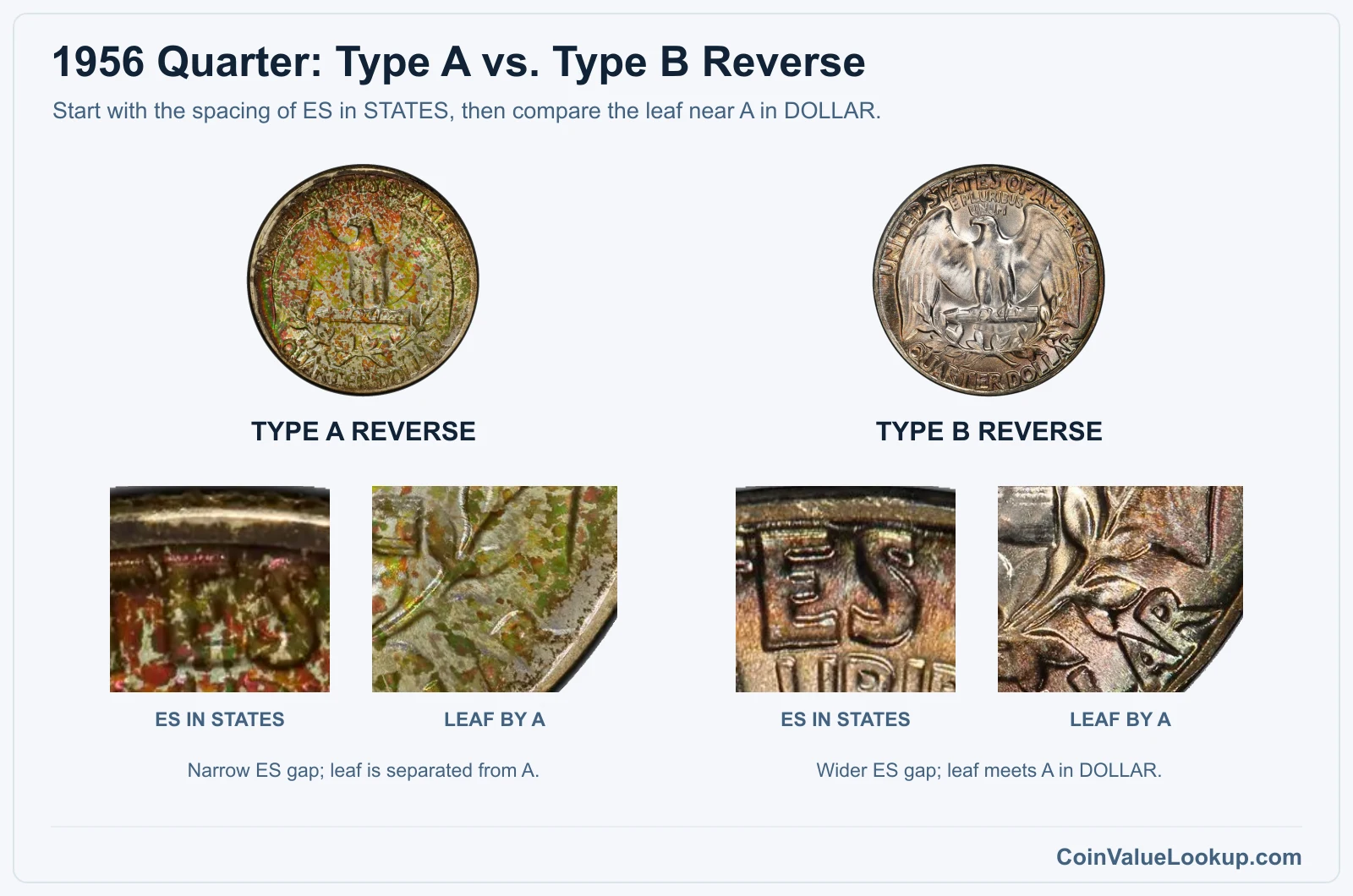
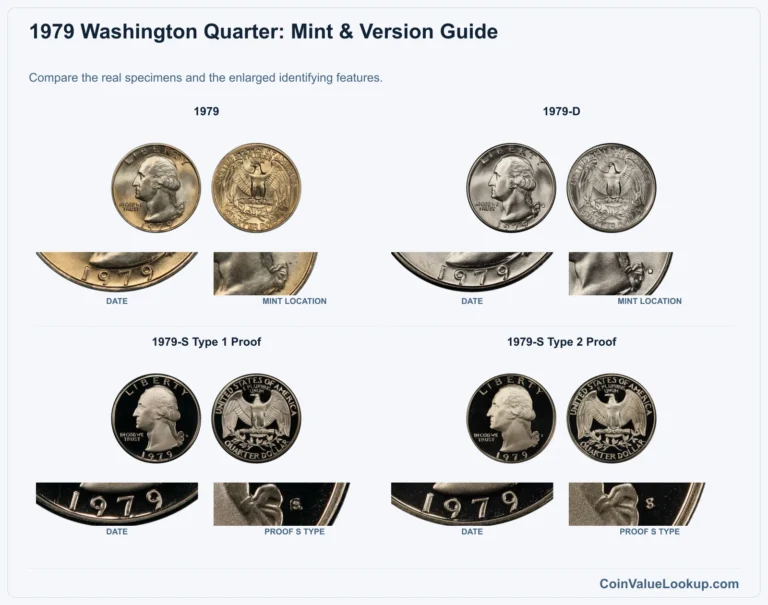
The 1956 Washington quarter was struck at two mints. Philadelphia coins carry no mintmark at all — a blank space below the wreath on the reverse is perfectly normal for this era.
Denver coins show a small "D" in that same spot.
All 1956 quarters share the same composition: 90% silver and 10% copper, weighing about 6.25 grams at roughly 24.3 mm in diameter. That silver content is what keeps even beat-up examples above face value.
Philadelphia also produced proof quarters this year, which have mirrored fields and sharp detail from specially prepared dies. A proof is a method of manufacture, not a higher grade — don't confuse a shiny proof with a high-grade business strike.
Both use the same alloy.
The trickiest identification call on this date is the Type B reverse, found only on Philadelphia business strikes. On the ordinary reverse, the letters E and S in STATES nearly touch.
On the Type B, those letters are clearly separated — a result of a proof-style reverse hub being paired with circulation dies. If your coin has proof-like mirrored fields and that gap, it might just be a regular proof, which is not the same thing.
Confirm business-strike surfaces before getting excited.
Step 2: Check Your 1956 Washington Quarter Grade
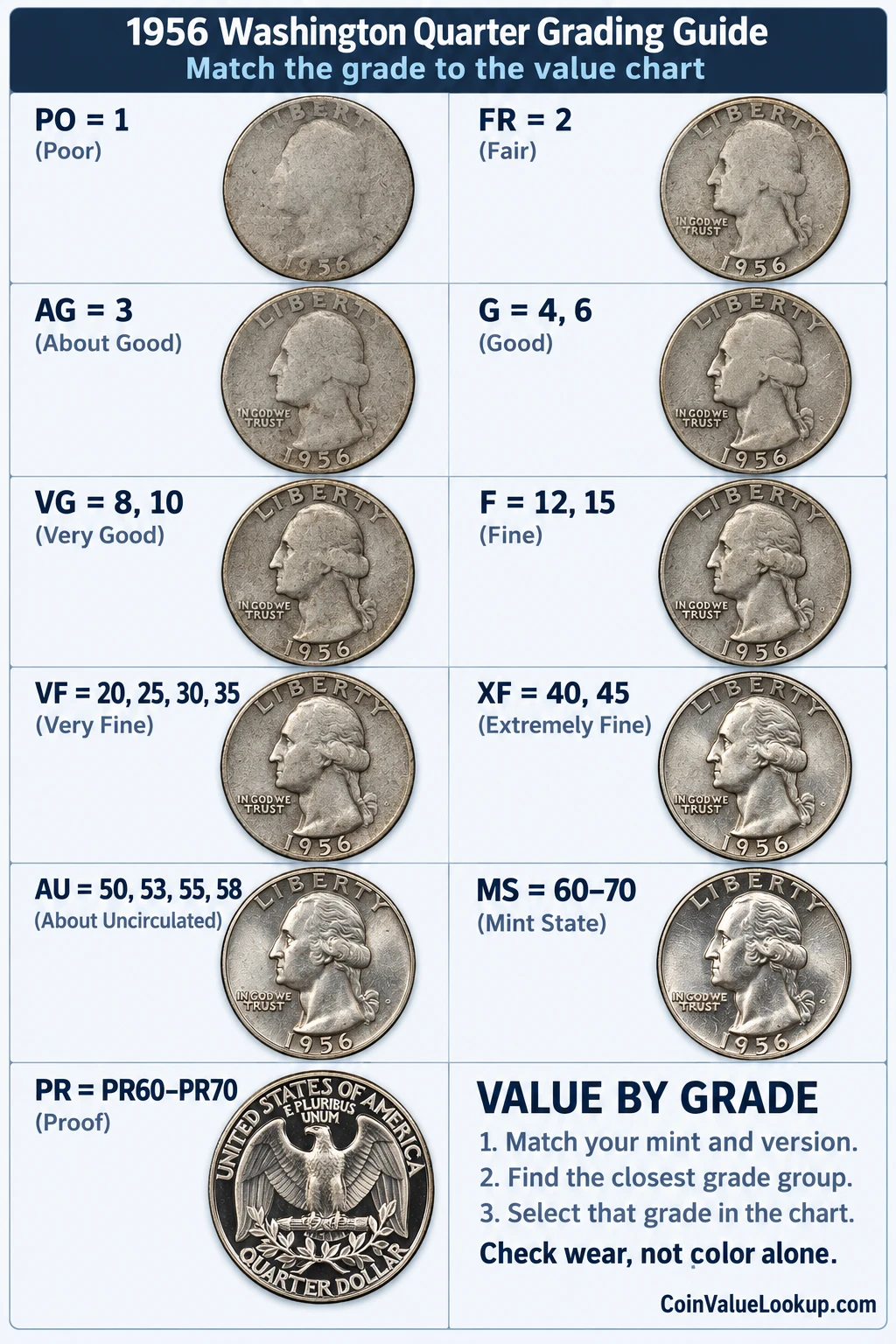
Start on the obverse. Washington's cheek and the hair directly above his ear are the first places to lose detail.
Even light friction will dull the luster there before anywhere else. If those areas are sharp and the luster rolls unbroken across the surface, you are in Mint State territory.
Flip it over. The eagle's breast feathers and wing tips wear next.
Compare those with a known grade example to calibrate your eye.
Weak strikes can fool you. A softly struck coin might look worn, but if the luster is intact across the high points, the die simply did not push the metal fully into the recesses.
That is not the same as circulation wear.
Look for cleaning hairlines under a light held at a low angle. Even gentle cleaning leaves fine parallel scratches that torpedo a coin's grade.
Contact marks, rim dings and dark spots all matter too.
Use the comparison image on this page to match your coin against known wear patterns. The jump from About Uncirculated to true Mint State is subtle — a single rub on the cheek can make the difference.
Step 3: Check 1956 Washington Quarter Value by Mint and Version
1956 Washington Quarter
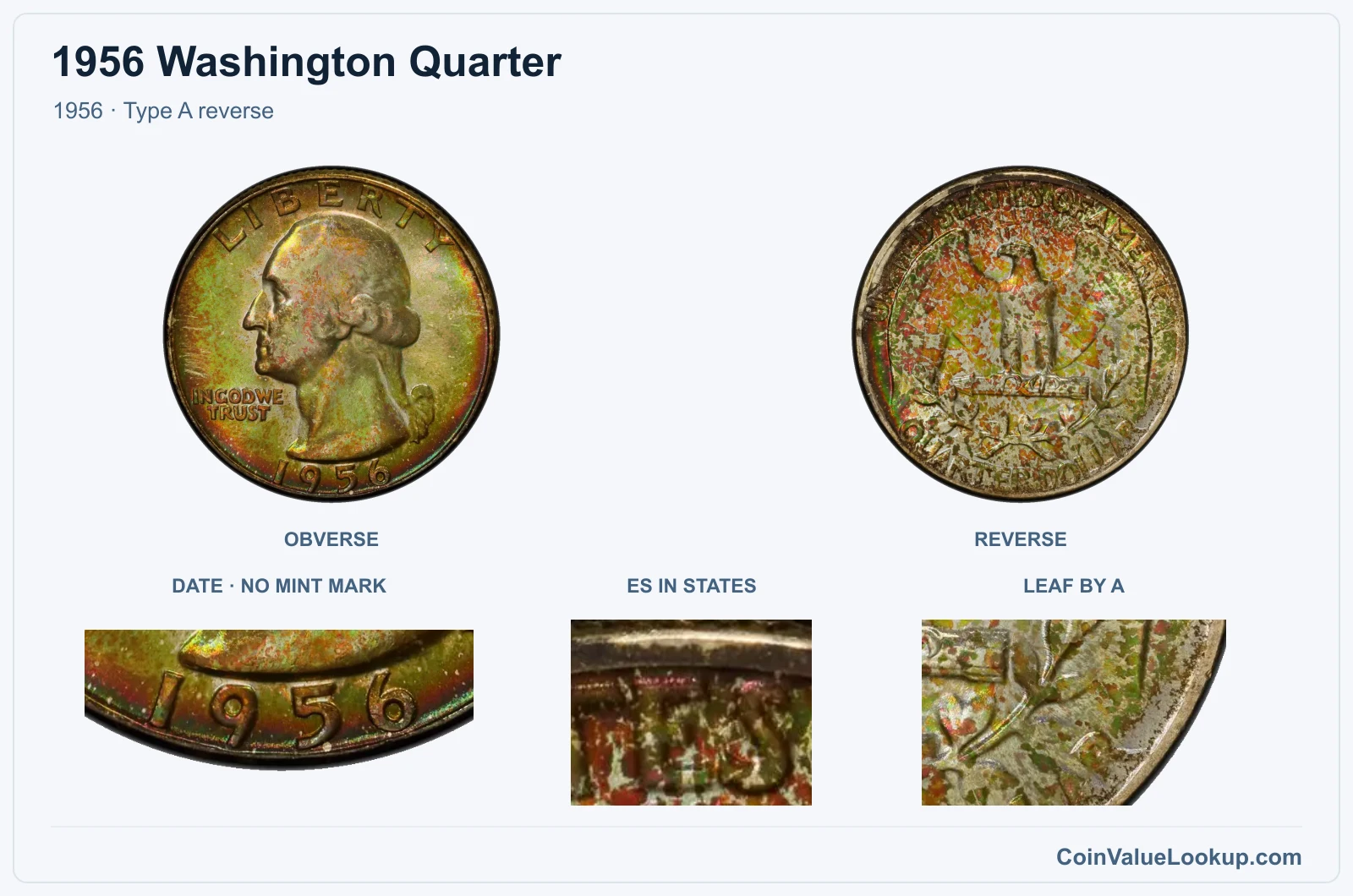
The 1956 Philadelphia quarter is the standard business strike for this year, carrying no mintmark below the reverse wreath. It was produced in large enough numbers that Gem-quality survivors are not particularly scarce.
Guide estimates place a Good-4 example at about $16.43, reflecting the silver floor. An MS60 runs around $20, and MS65 pieces guide near $31 according to USA Coin Book.
These are retail guide figures, not guaranteed buy prices.
This version uses what collectors call the Type A or ordinary circulation reverse — the letters E and S in STATES nearly touch. If yours shows a clear gap there, stop and read the Type B section below.
| Range | Grade | Price | Auction Records | Appraisal |
|---|---|---|---|---|
| PO | PO 1 | — | Coin Identifier | |
| FR | FR 2 | — | Coin Identifier | |
| AG | AG 3 | — | Coin Identifier | |
| G | G 4 | — | Coin Identifier | |
| G 6 | — | Coin Identifier | ||
| VG | VG 8 | — | Coin Identifier | |
| VG 10 | — | Coin Identifier | ||
| F | F 12 | — | Coin Identifier | |
| F 15 | — | Coin Identifier | ||
| VF | VF 20 | — | Coin Identifier | |
| VF 25 | — | Coin Identifier | ||
| VF 30 | — | Coin Identifier | ||
| VF 35 | — | Coin Identifier | ||
| XF | XF 40 | — | Coin Identifier | |
| XF 45 | — | Coin Identifier | ||
| AU | AU 50 | — | Coin Identifier | |
| AU 53 | — | Coin Identifier | ||
| AU 55 | — | Coin Identifier | ||
| AU 58 | — | Coin Identifier | ||
| MS | MS 60 | Coin Identifier | ||
| MS 61 | — | Coin Identifier | ||
| MS 62 | — | Coin Identifier | ||
| MS 63 | Coin Identifier | |||
| MS 64 | Coin Identifier | |||
| MS 65 | Coin Identifier | |||
| MS 66 | Coin Identifier | |||
| MS 67 | Coin Identifier | |||
| MS 68 | Coin Identifier | |||
| MS 69 | — | — | — | |
| MS 70 | — | — | — |
1956 Washington Quarter — Proof
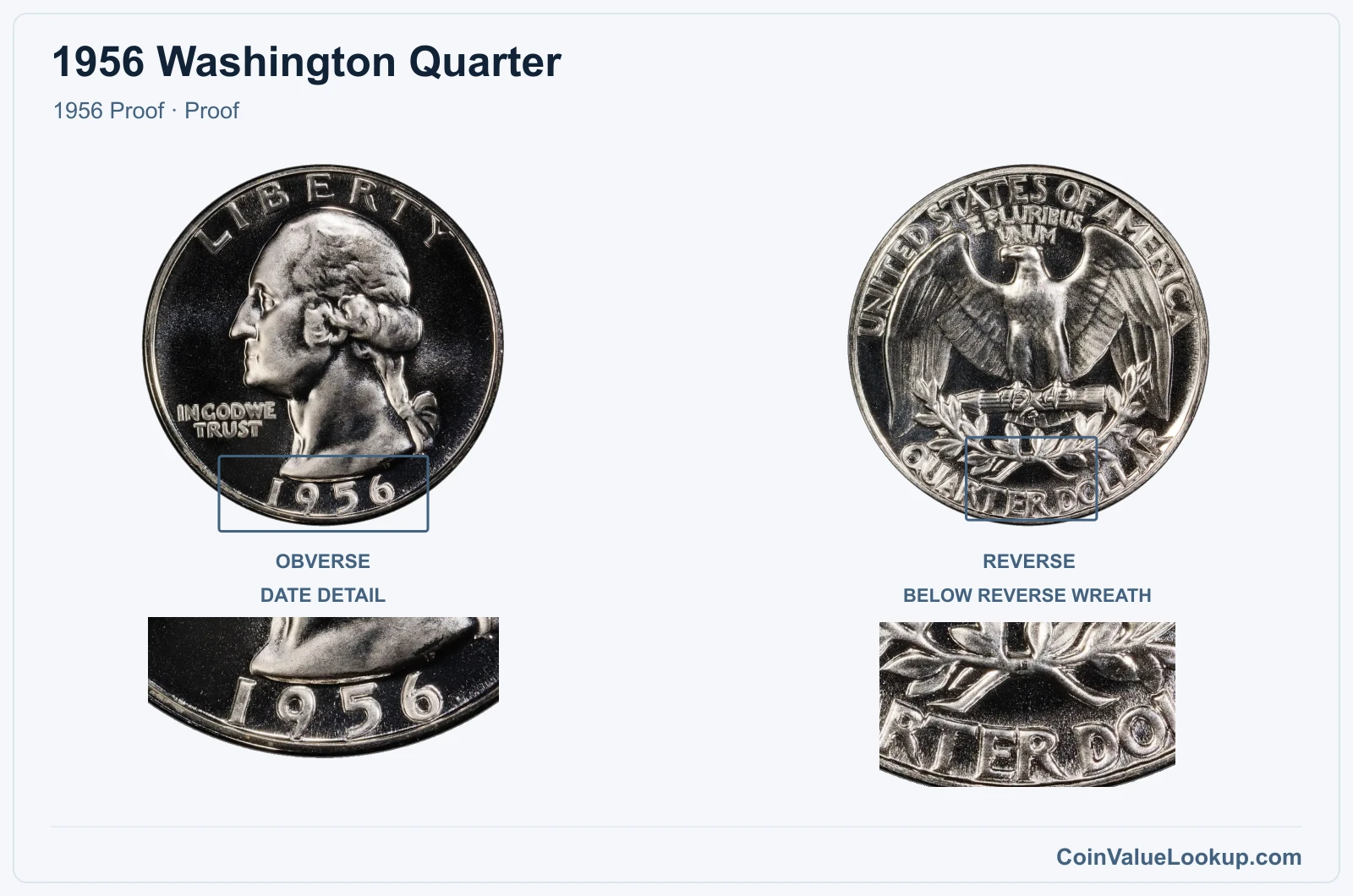
Philadelphia also struck proof quarters in 1956, using the same 90% silver composition but specially prepared dies and planchets. These coins have deeply mirrored fields and crisp, fully formed design elements.
A PR65 example guides around $34 per USA Coin Book. Cameo and Deep Cameo designations — describing the degree of frosty contrast on the devices against those mirror fields — are separate tiers with their own pricing, not covered here.
Coin Value Lookup is a good place to start if you are trying to compare your proof against business-strike values across different Washington quarter dates. A proof finish alone does not mean the coin is more valuable than a high-grade business strike; the specific grade and contrast matter.
| Range | Grade | Price | Auction Records | Appraisal |
|---|---|---|---|---|
| PR | PR 1 | — | Coin Identifier | |
| PR 2 | — | Coin Identifier | ||
| PR 3 | — | Coin Identifier | ||
| PR 4 | — | Coin Identifier | ||
| PR 6 | — | Coin Identifier | ||
| PR 8 | — | Coin Identifier | ||
| PR 10 | — | Coin Identifier | ||
| PR 12 | — | Coin Identifier | ||
| PR 15 | — | Coin Identifier | ||
| PR 20 | — | Coin Identifier | ||
| PR 25 | — | Coin Identifier | ||
| PR 30 | — | Coin Identifier | ||
| PR 35 | — | Coin Identifier | ||
| PR 40 | — | Coin Identifier | ||
| PR 45 | — | Coin Identifier | ||
| PR 50 | — | Coin Identifier | ||
| PR 53 | — | Coin Identifier | ||
| PR 55 | — | Coin Identifier | ||
| PR 58 | — | Coin Identifier | ||
| PR 60 | — | Coin Identifier | ||
| PR 61 | — | Coin Identifier | ||
| PR 62 | — | Coin Identifier | ||
| PR 63 | — | Coin Identifier | ||
| PR 64 | Coin Identifier | |||
| PR 65 | Coin Identifier | |||
| PR 66 | Coin Identifier | |||
| PR 67 | Coin Identifier | |||
| PR 68 | Coin Identifier | |||
| PR 69 | Coin Identifier | |||
| PR 70 | — | — | — |
1956 Washington Quarter — D
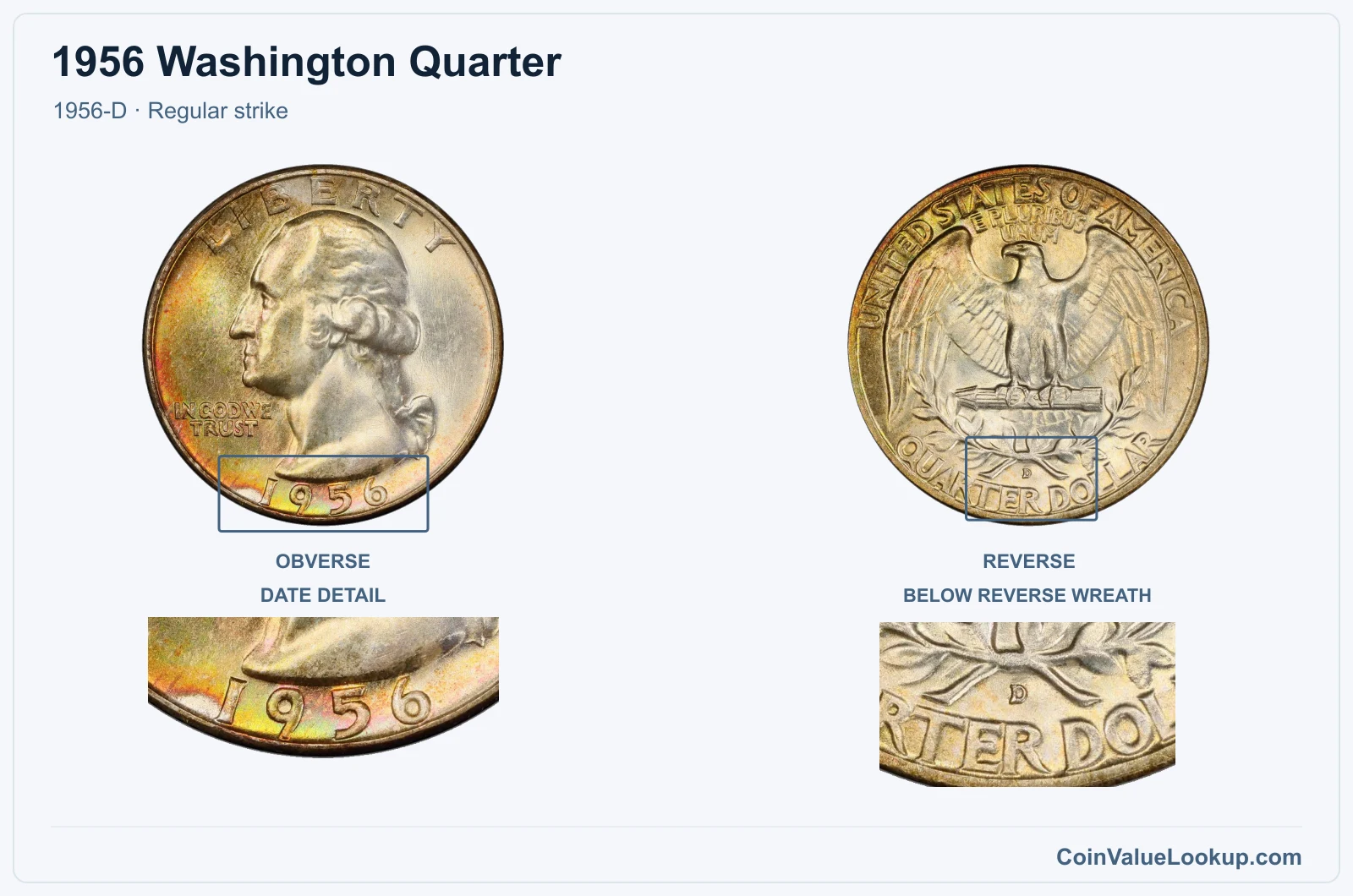
The 1956-D quarter carries a small "D" mintmark below the wreath on the reverse. Denver struck plenty of these, so circulated examples are common.
Guide values from USA Coin Book put a G4 at about $16.43 — essentially the silver value floor. MS60 comes in around $20, and MS65 guides at roughly $39, a few dollars above the Philadelphia business strike at the same grade.
That small premium likely reflects slightly lower survival rates in top condition rather than any dramatic scarcity.
Check the mintmark carefully. Some 1956-D quarters show evidence of repunching, which is a separate collectible variety.
| Range | Grade | Price | Auction Records | Appraisal |
|---|---|---|---|---|
| PO | PO 1 | — | Coin Identifier | |
| FR | FR 2 | — | Coin Identifier | |
| AG | AG 3 | — | Coin Identifier | |
| G | G 4 | — | Coin Identifier | |
| G 6 | — | Coin Identifier | ||
| VG | VG 8 | — | Coin Identifier | |
| VG 10 | — | Coin Identifier | ||
| F | F 12 | — | Coin Identifier | |
| F 15 | — | Coin Identifier | ||
| VF | VF 20 | — | Coin Identifier | |
| VF 25 | — | Coin Identifier | ||
| VF 30 | — | Coin Identifier | ||
| VF 35 | — | Coin Identifier | ||
| XF | XF 40 | — | Coin Identifier | |
| XF 45 | — | Coin Identifier | ||
| AU | AU 50 | — | Coin Identifier | |
| AU 53 | — | Coin Identifier | ||
| AU 55 | — | Coin Identifier | ||
| AU 58 | — | Coin Identifier | ||
| MS | MS 60 | — | Coin Identifier | |
| MS 61 | — | Coin Identifier | ||
| MS 62 | — | Coin Identifier | ||
| MS 63 | — | Coin Identifier | ||
| MS 64 | Coin Identifier | |||
| MS 65 | Coin Identifier | |||
| MS 66 | Coin Identifier | |||
| MS 67 | Coin Identifier | |||
| MS 68 | — | — | — | |
| MS 69 | — | — | — | |
| MS 70 | — | — | — |
1956 Washington Quarter — Type B Reverse Quarter
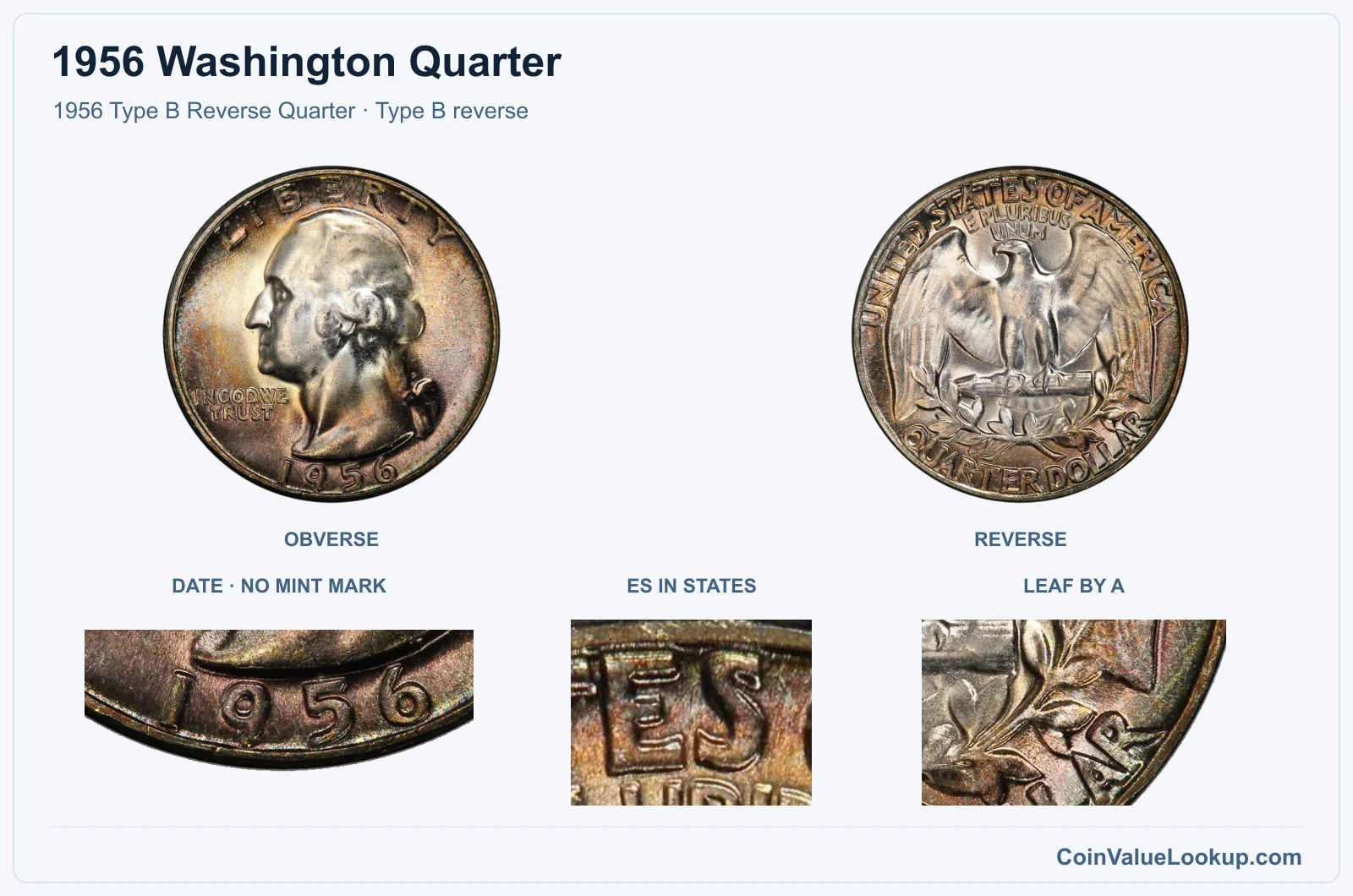
This is the one that gets collectors' attention. The 1956 Type B reverse is a Philadelphia business-strike quarter that received a proof-style reverse die — identifiable by the clear separation between the letters E and S in STATES.
On the normal circulation reverse, those letters nearly touch.
The distinction is a hub difference, not a striking anomaly. Philadelphia circulation quarters from 1956 through 1964 can potentially turn up with this reverse, but 1956 is a recognized attribution year.
A single MS66+ example sold for $2,400 at Heritage Auctions in January 2018. That is one recorded result at a very high grade, not a price you can assume for every Type B you find.
Lower-grade examples would bring less, and the variety itself must be properly attributed.
Confirm business-strike surfaces before claiming this variety. A regular proof quarter uses the same reverse design — that is its normal die — so a proof with separated ES is not a Type B circulation variety.
Range Grade
Price Auction Records Appraisal PO PO 1
—
Coin Identifier FR FR 2
—
Coin Identifier AG AG 3
—
Coin Identifier G G 4
—
Coin Identifier
G 6
—
Coin Identifier VG VG 8
—
Coin Identifier
VG 10
—
Coin Identifier F F 12
—
Coin Identifier
F 15
—
Coin Identifier VF VF 20
—
Coin Identifier
VF 25
—
Coin Identifier
VF 30
—
Coin Identifier
VF 35
—
Coin Identifier XF XF 40
—
Coin Identifier
XF 45
—
Coin Identifier AU AU 50
—
Coin Identifier
AU 53
—
Coin Identifier
AU 55
—
Coin Identifier
AU 58
—
Coin Identifier MS MS 60
—
Coin Identifier
MS 61
—
Coin Identifier
MS 62
—
Coin Identifier
MS 63
Coin Identifier
MS 64
Coin Identifier
MS 65
Coin Identifier
MS 66
Coin Identifier
MS 67
—
Coin Identifier
MS 68
—
—
—
MS 69
—
—
—
MS 70
—
—
—
1956 Washington Quarter Error List
1. 1956 Washington Quarter — Proof Doubled Die Obverse
Some 1956 Philadelphia proof quarters were struck from a doubled obverse die, producing multiple raised impressions in IN GOD WE TRUST, the date digits and portions of LIBERTY. Under magnification, you will see distinct extra outlines sitting alongside the primary lettering — these are die-made, created when the hub impressed the die more than once in slightly different positions.
The key distinction is raised, matching duplication. Machine doubling — a far more common occurrence — leaves flat, shelf-like distortions without true secondary relief.
Doubled reflections from the proof's mirrored surface can also trick the eye, especially in photographs. Post-mint scratches are incuse, not raised.
No standard price range is established here. Value depends on the specific die pairing, severity of the doubling, and the coin's overall condition.
Professional authentication is the practical path to confirming this variety.
2. 1956 Washington Quarter — Denver Doubled Die Reverse
The 1956-D doubled die reverse shows pronounced thickening and, in stronger examples, separated contours in QUARTER DOLLAR, UNITED STATES OF AMERICA, E PLURIBUS UNUM, the lower olive leaves and eagle's wings. This is a Denver business-strike variety — look for the D mintmark to confirm the right mint first.
Do not confuse this with the Philadelphia Type B reverse. The Type B is a different hub design with wider spacing between E and S in STATES; the Denver DDR is accidental doubling from the die-making process, affecting multiple legend elements with visible extra thickness.
Worn lettering can mimic doubling to an untrained eye. Die deterioration spreads metal outward but lacks the crisp secondary contours of a true doubled die.
Machine doubling produces flat shelves, not raised duplication. No standard price range applies; value depends on authentication, the strength of the doubling and the coin's grade.
3. 1956 Washington Quarter — Type B Reverse Variety
The Type B reverse variety occurs on 1956 Philadelphia circulation-strike quarters that received a proof-style reverse hub. The diagnostic is straightforward: enlarge the letters E and S in STATES on the reverse.
On the ordinary circulation reverse, those two letters nearly touch. On the Type B, there is a clear, deliberate gap.
This is a hub design difference, not a striking accident. That makes it consistent and repeatable — every Type B quarter from the same hub will show the same spacing.
A coin graded MS66+ sold for $2,400 at Heritage Auctions in January 2018. That is one historical result at an exceptional grade, not a blanket value for every Type B found.
Watch out for regular proofs — they naturally use this same reverse design, so a proof with separated ES is not the error variety. Worn lettering on a circulated coin can also obscure the gap.
Mechanically doubled legends look different from a hub substitution; the spacing is built into the die, not caused by movement during striking.
4. 1956 Washington Quarter — Repunched Mintmark
The 1956-D repunched mintmark variety shows traces of a second mintmark punch beneath or offset from the primary D below the reverse wreath. During production, mintmarks were hand-punched into working dies, and occasionally the punch landed slightly off on the first attempt before being corrected.
To check, examine the D under at least 5x magnification. Look for a partial second outline, a shadow or a notch that does not match normal die wear.
Compare against a known normal 1956-D mintmark at the same magnification — a clean, single impression with no remnant edges.
Machine doubling can spread the mintmark into a flat shelf shape, but that lacks the distinct second punch outline. Die chips or corrosion near the letter can also add confusing extra metal.
Neither is the same as a repunched mintmark.
No standard price range is provided. Value depends on the visibility of the repunching, the coin's grade and professional attribution.
5. 1956 Washington Quarter — Die Gouge / Named Raised-Line Variety
A 1956 reverse die gouge variety features a raised line or extra-metal feature on the reverse, created when the die itself was damaged before striking. Because the gouge is cut into the die, it appears as raised metal on every coin struck from that die — the opposite of a scratch, which is incuse.
Inspect the reverse carefully for a line that sits above the coin's surface and appears in a consistent position relative to the design elements. Compare it with a normal 1956 reverse at the same magnification; the raised feature should be absent on an unaffected coin.
Do not confuse this with an incuse post-mint scratch, which cuts into the surface rather than rising above it. Die cracks follow stress patterns and typically connect design elements or the rim, while a gouge can appear anywhere.
Unrelated contact marks tend to be random and lack the sharp, consistent profile of a die-made feature.
No standard price range is adopted. The coin's value depends on the prominence of the feature, overall condition and proper attribution.