1991 Washington Quarter Coin Value: How Much Is It Worth?
Most 1991 Washington quarters you find in pocket change are worth face value — 25 cents. That changes when a coin is in original, uncirculated condition.
A guide estimate for a 1991-P or 1991-D in MS65 grade reaches about $15, while the 1991-S clad proof carries a PR65 guide estimate around $4.96. Certain mint errors, like rotated dies or off-center strikes, can push prices higher still.
Fast Way to Identify Your 1991 Washington Quarter
The quickest way to get a preliminary identification of your 1991 quarter is to upload clear photos of both the front and back. Good lighting and a steady hand help capture the mintmark location, surface condition, and any oddities.
This gives a solid starting point before deciding whether professional grading is worthwhile.
1991 Washington Quarter Value
Upload both sides of your 1991 Washington Quarter.
Front Obverse
Upload photo
Back Reverse
Upload photo
Which 1991 Washington Quarter Versions Are Worth Money?
- 1991-P in original MS65 condition carries a guide estimate of about $15 — high-grade Philadelphia examples are harder to find than the mintage might suggest.
- 1991-D in MS65 also has a guide estimate near $15; look for full luster with minimal bag marks.
- 1991-P rotated-die error: one example in NGC AU58 sold for $94 at Heritage Auctions in December 2025.
- 1991-P off-center strike (20% toward 1 o'clock): a certified example appeared in a Heritage lot, confirming collector demand for documented striking errors.
- 1991-S clad proof in PR65 has a guide estimate of roughly $4.96; higher-contrast DCAM examples may differ in value.
Step 1: Identify Your 1991 Washington Quarter Mint Mark and Version
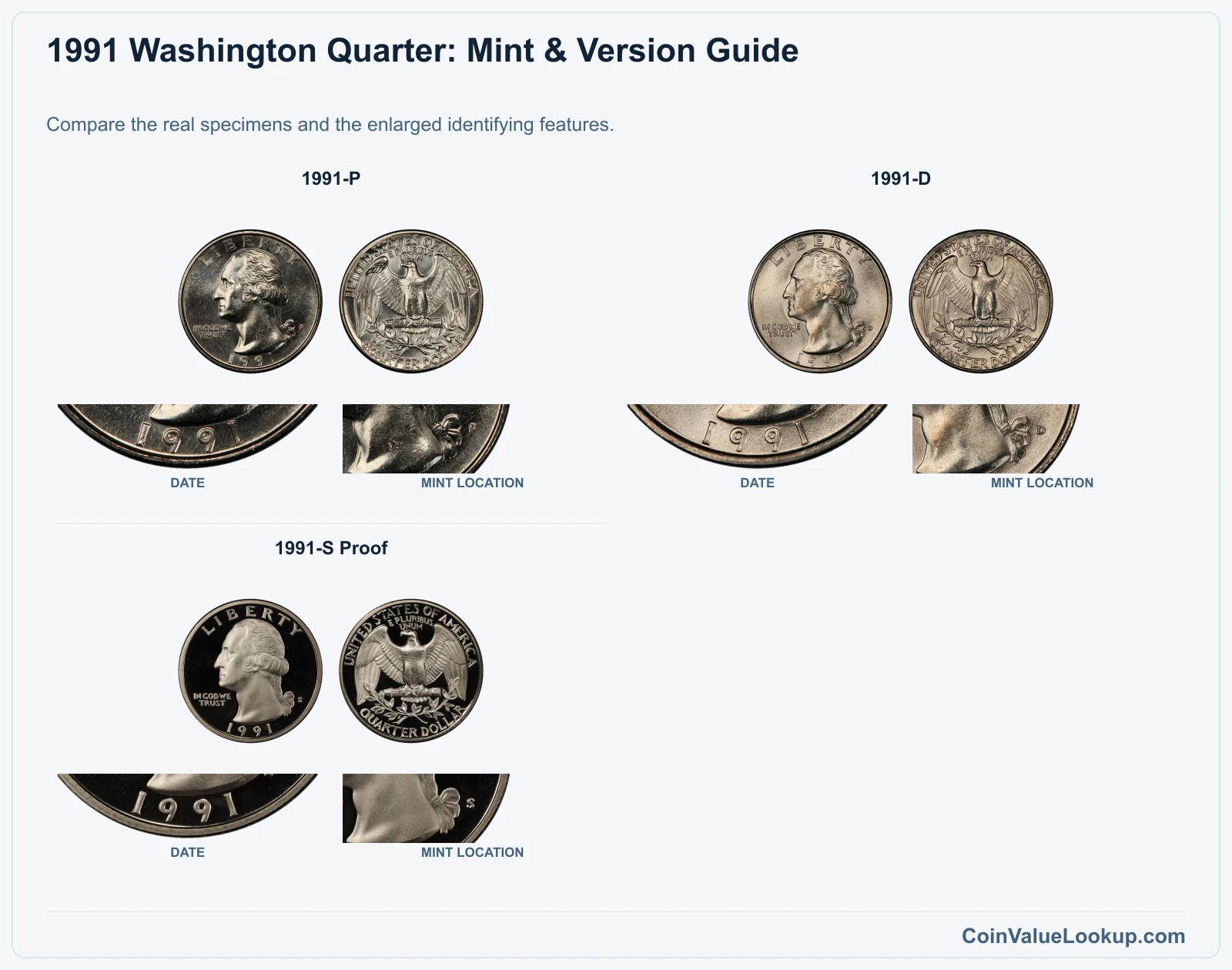
Flip your coin to the obverse and look just to the right of Washington's ponytail, near the date. You will see a small letter: P for Philadelphia, D for Denver, or S for San Francisco.
There is no blank-mintmark variety for 1991 — Philadelphia coins carry a P.
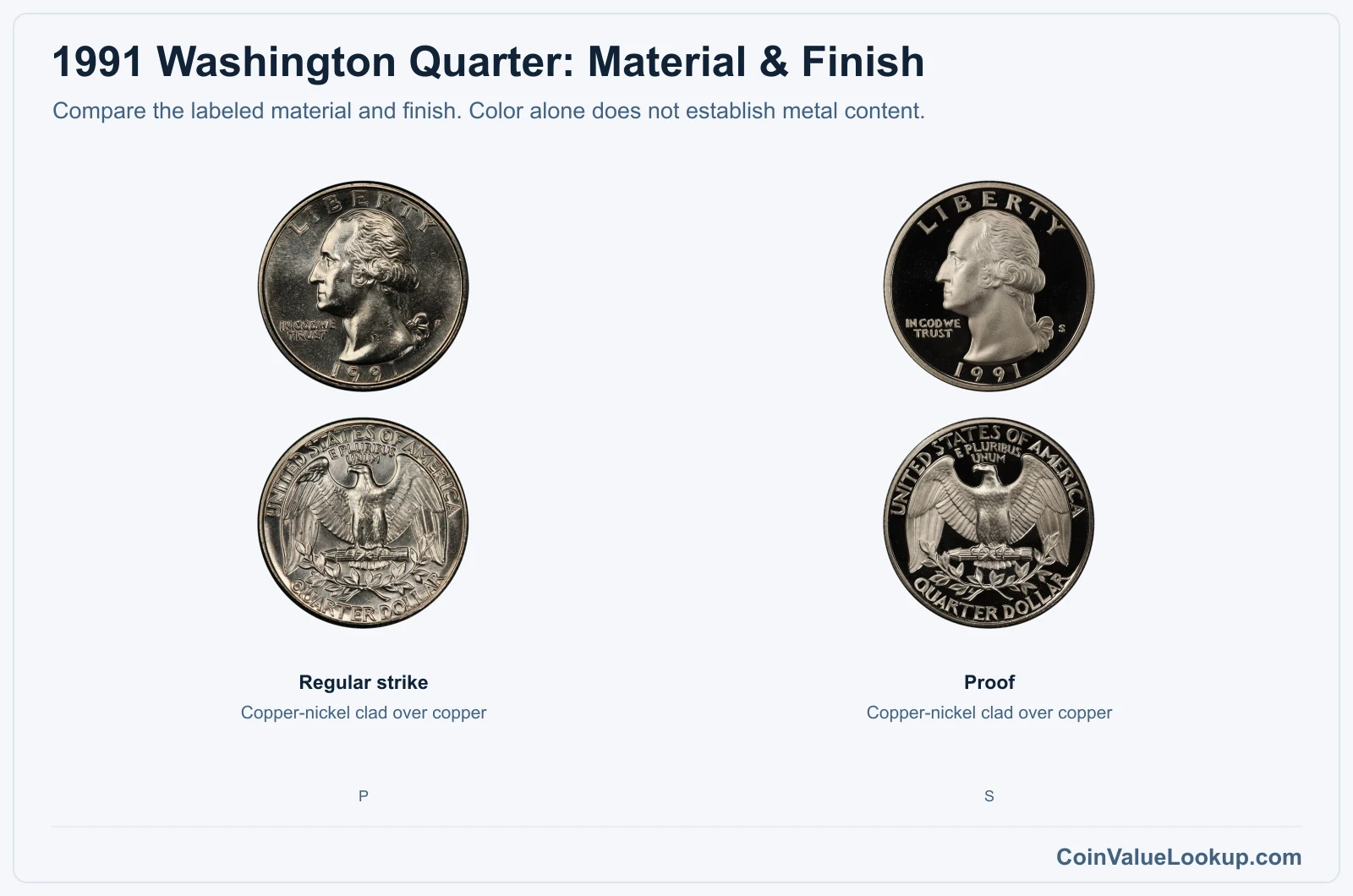
All three versions are copper-nickel clad, weighing about 5.67 grams with a diameter of roughly 24.3 mm. None of the regular 1991 quarters contain silver.
If a magnet sticks to it, you have a different problem entirely.
The S-mint coin is a proof, struck at San Francisco for collectors. It has sharp, squared rims and mirror-like fields that are easy to distinguish from the softer look of a business strike.
DCAM (Deep Cameo) refers to the contrast between frosted devices and mirror fields — it is a finish characteristic, not a silver indicator.
Step 2: Check Your 1991 Washington Quarter Grade
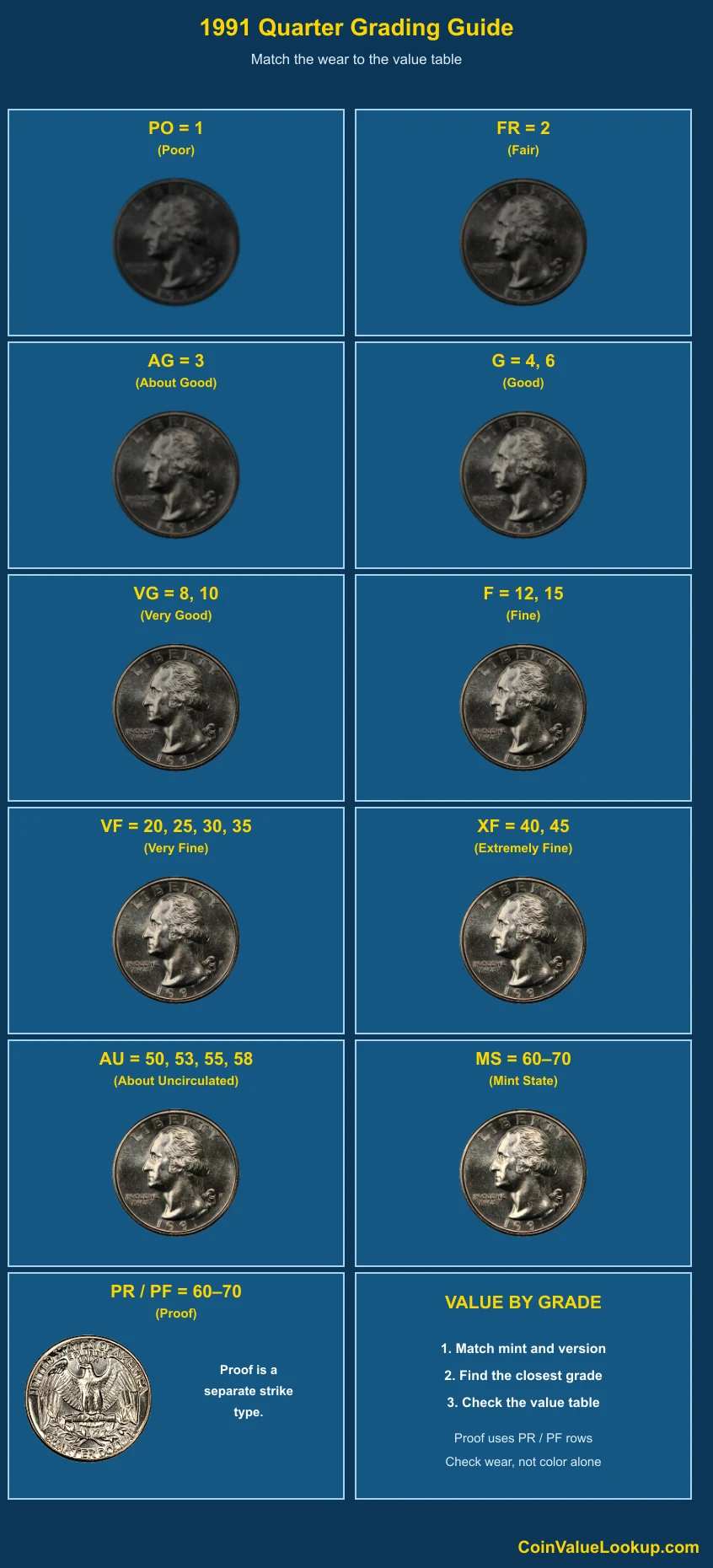
Start by checking the hair detail above Washington's ear and along the cheekbone and jaw. On a well-circulated coin, these high points show obvious flattening.
The eagle's breast feathers on the reverse wear down in a similar pattern.
An uncirculated coin retains full original luster across every surface — not just brightness from cleaning. Hairlines, bag marks, and contact scratches all count against the grade even on a coin that was never spent.
Compare your coin side-by-side with the reference image. A coin that looks "shiny" but has scratches under magnification has been cleaned, which lowers its value.
True mint luster has a cartwheel effect when you tilt the coin under a single light source.
For proofs, look for hairlines from mishandling and haze from improper storage. A PR65 proof may have a few minor marks visible under magnification but should still present strong reflective fields.
Step 3: Check 1991 Washington Quarter Value by Mint and Version
1991 Washington Quarter — P
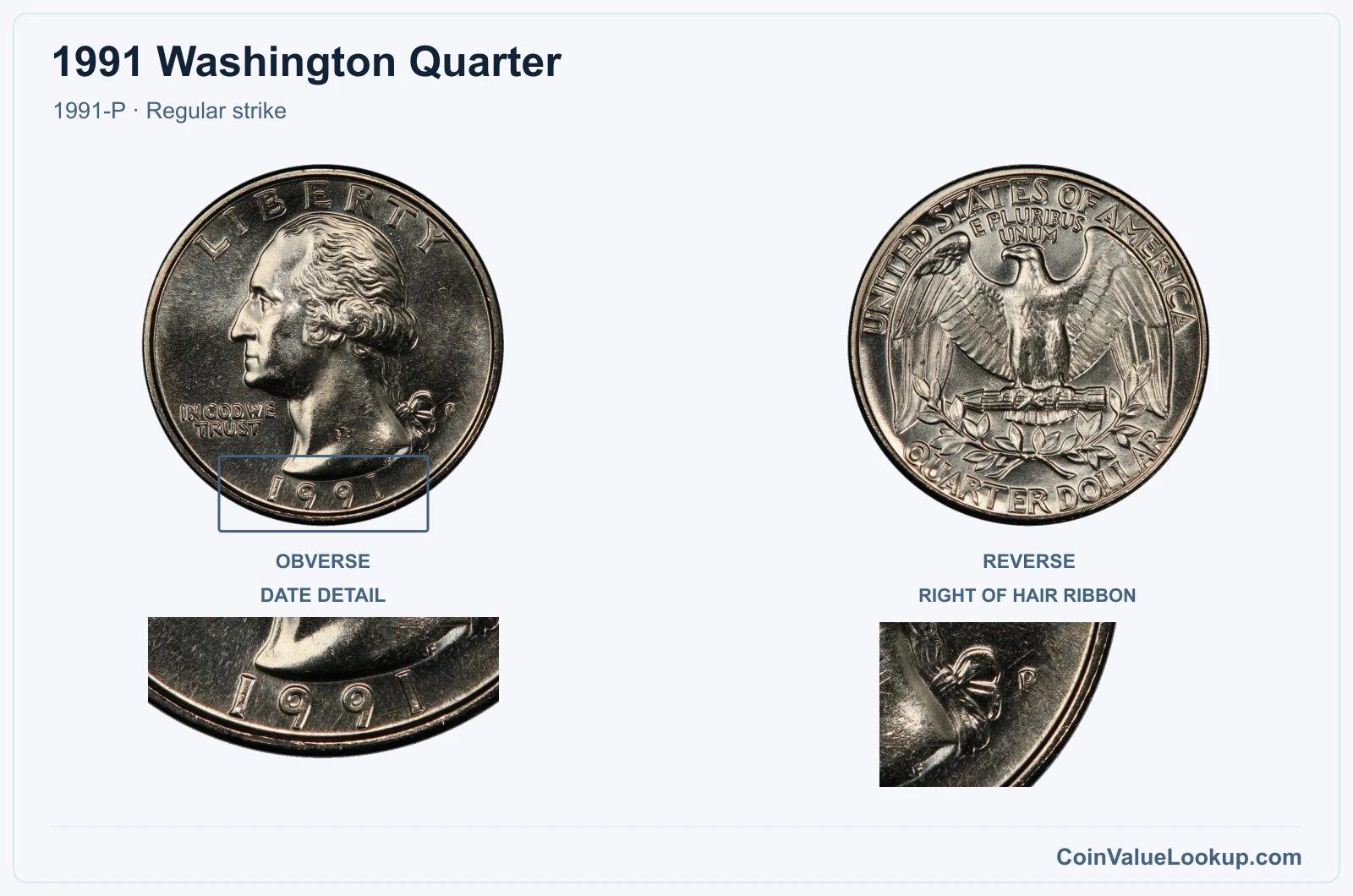
The 1991-P quarter was struck at Philadelphia for general circulation. It is a copper-nickel clad coin, 91.67% copper and 8.33% nickel overall, weighing about 5.67 grams.
In typical circulated condition it is worth 25 cents and nothing more.
Where it gets interesting is in high grade. A USA Coin Book guide estimate places an MS65 example at roughly $15.
Original, untouched Philadelphia quarters from 1991 in that condition are more selective than the huge mintage might suggest — most were spent, dinged, or poorly stored. Look for coins with full cartwheel luster, minimal contact marks, and sharp hair detail above Washington's ear.
| Range | Grade | Price | Auction Records | Appraisal |
|---|---|---|---|---|
| PO | PO 1 | — | Coin Identifier | |
| FR | FR 2 | — | Coin Identifier | |
| AG | AG 3 | — | Coin Identifier | |
| G | G 4 | — | Coin Identifier | |
| G 6 | — | Coin Identifier | ||
| VG | VG 8 | — | Coin Identifier | |
| VG 10 | — | Coin Identifier | ||
| F | F 12 | — | Coin Identifier | |
| F 15 | — | Coin Identifier | ||
| VF | VF 20 | — | Coin Identifier | |
| VF 25 | — | Coin Identifier | ||
| VF 30 | — | Coin Identifier | ||
| VF 35 | — | Coin Identifier | ||
| XF | XF 40 | — | Coin Identifier | |
| XF 45 | — | Coin Identifier | ||
| AU | AU 50 | — | Coin Identifier | |
| AU 53 | — | Coin Identifier | ||
| AU 55 | — | Coin Identifier | ||
| AU 58 | — | Coin Identifier | ||
| MS | MS 60 | — | Coin Identifier | |
| MS 61 | — | Coin Identifier | ||
| MS 62 | — | Coin Identifier | ||
| MS 63 | — | Coin Identifier | ||
| MS 64 | — | Coin Identifier | ||
| MS 65 | Coin Identifier | |||
| MS 66 | Coin Identifier | |||
| MS 67 | Coin Identifier | |||
| MS 68 | — | — | — | |
| MS 69 | — | — | — | |
| MS 70 | — | — | — |
1991 Washington Quarter — D
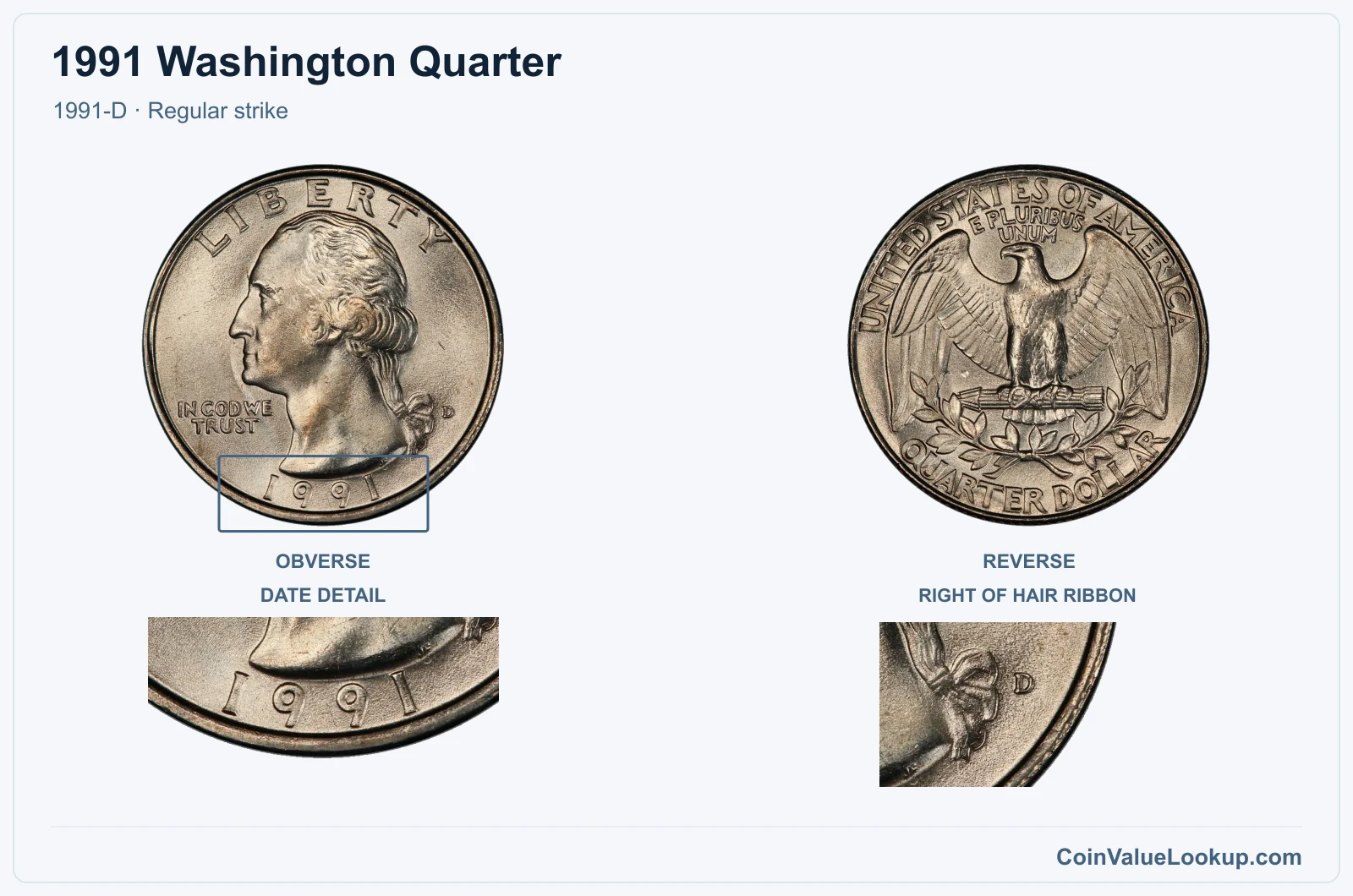
The 1991-D was struck at the Denver Mint, also in copper-nickel clad at the same 5.67-gram standard weight. Like the P, it is common in circulated grades and worth face value if worn.
A guide estimate from USA Coin Book puts an MS65 1991-D at about $15. Finding one in that condition means locating a coin with virtually no post-mint contact marks and full original luster.
Check the eagle's breast feathers on the reverse — if they are sharp and the fields are clean, you may have a keeper.
Coin Value Lookup is a useful starting point when you want to look up guide values for quarters and other denominations across different years and mints.
| Range | Grade | Price | Auction Records | Appraisal |
|---|---|---|---|---|
| PO | PO 1 | — | Coin Identifier | |
| FR | FR 2 | — | Coin Identifier | |
| AG | AG 3 | — | Coin Identifier | |
| G | G 4 | — | Coin Identifier | |
| G 6 | — | Coin Identifier | ||
| VG | VG 8 | — | Coin Identifier | |
| VG 10 | — | Coin Identifier | ||
| F | F 12 | — | Coin Identifier | |
| F 15 | — | Coin Identifier | ||
| VF | VF 20 | — | Coin Identifier | |
| VF 25 | — | Coin Identifier | ||
| VF 30 | — | Coin Identifier | ||
| VF 35 | — | Coin Identifier | ||
| XF | XF 40 | — | Coin Identifier | |
| XF 45 | — | Coin Identifier | ||
| AU | AU 50 | — | Coin Identifier | |
| AU 53 | — | Coin Identifier | ||
| AU 55 | — | Coin Identifier | ||
| AU 58 | — | Coin Identifier | ||
| MS | MS 60 | — | Coin Identifier | |
| MS 61 | — | Coin Identifier | ||
| MS 62 | — | Coin Identifier | ||
| MS 63 | — | Coin Identifier | ||
| MS 64 | Coin Identifier | |||
| MS 65 | — | Coin Identifier | ||
| MS 66 | Coin Identifier | |||
| MS 67 | Coin Identifier | |||
| MS 68 | — | — | — | |
| MS 69 | — | — | — | |
| MS 70 | — | — | — |
1991 Washington Quarter — S Proof
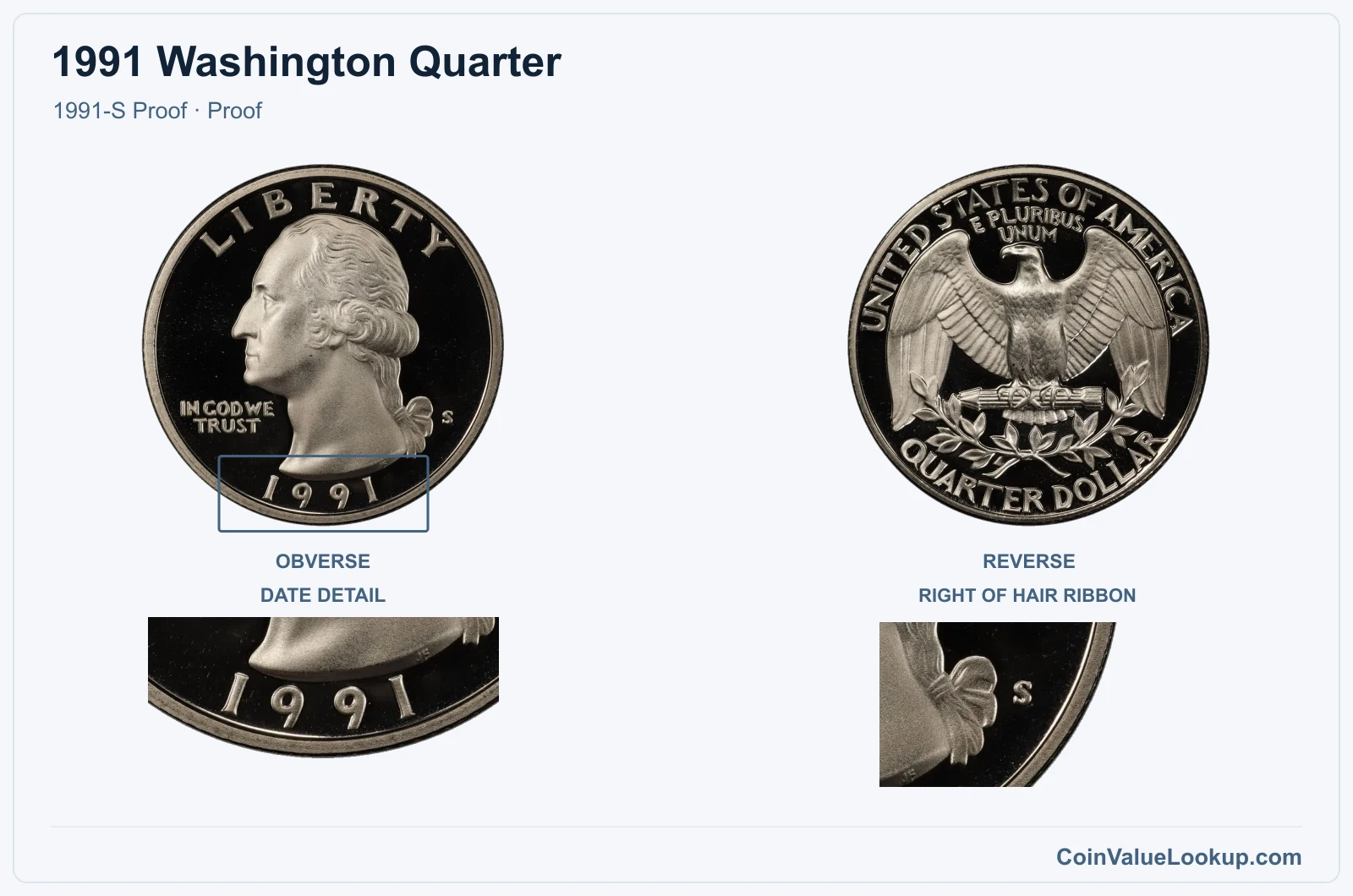
The 1991-S proof quarter was manufactured at San Francisco exclusively for collector sets. It shares the same copper-nickel clad composition as the business strikes but was produced with polished dies and specially prepared planchets, giving it mirror-like fields and sharp design edges.
A USA Coin Book guide estimate for PR65 is about $4.96. That is for a standard clad proof — not a Deep Cameo designation, and not silver.
DCAM examples with strong contrast between frosted devices and reflective fields are a separate category. Handle any proof by its edges; fingerprints on those mirror surfaces are permanent without professional conservation.
| Range | Grade | Price | Auction Records | Appraisal |
|---|---|---|---|---|
| PR | PR 1 | — | Coin Identifier | |
| PR 2 | — | Coin Identifier | ||
| PR 3 | — | Coin Identifier | ||
| PR 4 | — | Coin Identifier | ||
| PR 6 | — | Coin Identifier | ||
| PR 8 | — | Coin Identifier | ||
| PR 10 | — | Coin Identifier | ||
| PR 12 | — | Coin Identifier | ||
| PR 15 | — | Coin Identifier | ||
| PR 20 | — | Coin Identifier | ||
| PR 25 | — | Coin Identifier | ||
| PR 30 | — | Coin Identifier | ||
| PR 35 | — | Coin Identifier | ||
| PR 40 | — | Coin Identifier | ||
| PR 45 | — | Coin Identifier | ||
| PR 50 | — | Coin Identifier | ||
| PR 53 | — | Coin Identifier | ||
| PR 55 | — | Coin Identifier | ||
| PR 58 | — | Coin Identifier | ||
| PR 60 | — | Coin Identifier | ||
| PR 61 | — | Coin Identifier | ||
| PR 62 | — | Coin Identifier | ||
| PR 63 | — | Coin Identifier | ||
| PR 64 | — | Coin Identifier | ||
| PR 65 | — | Coin Identifier | ||
| PR 66 | — | Coin Identifier | ||
| PR 67 | Coin Identifier | |||
| PR 68 | — | Coin Identifier | ||
| PR 69 | Coin Identifier | |||
| PR 70 | Coin Identifier |
1991 Washington Quarter Error List
1. 1991 Washington Quarter — Rotated Dies
A rotated-die error occurs when one die is turned from its normal position relative to the other. On a correctly aligned U.S. coin, if you hold the obverse upright and flip it top-to-bottom along a horizontal axis, the reverse should also appear upright.
A rotated-die coin will show the reverse tilted to some degree.
One documented 1991-P rotated-die quarter graded NGC AU58 sold for $94 at Heritage Auctions in December 2025. The exact degree of rotation on that coin is not specified in the catalog.
Be careful when checking: you must flip the coin along the correct axis every time. Rotating the coin in your hand, or flipping it left-to-right instead, will give a false reading.
A coin loose in a holder can also shift orientation. Consistent, repeatable misalignment confirmed by the same flip method is what you are looking for.
2. 1991 Washington Quarter — Off-Center Strike
An off-center strike happens when the planchet is not properly seated between the dies at the moment of striking. The result is a crescent-shaped blank area on one or both sides, with the struck design shifted away from center.
A documented 1991-P quarter struck approximately 20% off center toward 1 o'clock was certified by ANACS at MS64. It appeared in a Heritage Auctions lot in January 2022 as part of a two-coin group with a 1994-P off-center quarter, so no individual sale price can be separated from the $71 lot total.
To confirm a genuine off-center strike, both sides should show the shift consistently, with original strike surfaces and no signs of post-mint cutting, filing, or hammering. An odd rim shape or strange color alone is not enough.
The date and mintmark should be visible and match the attributed coin.
3. 1991 Washington Quarter — Doubled Die
Doubled-die errors on 1991 quarters have been reported in collector search lists. This type of error shows consistent doubling of design elements — such as separation or notching on lettering, the date, or Washington's profile — caused during the die-making process.
The specific mint and die position are not confirmed in the available information, so do not assume every 1991 quarter with slightly blurry letters qualifies. True hub doubling produces uniform, repeatable separation on affected design elements.
Machine doubling is the most common lookalike: it creates flat, shelf-like distortion rather than the raised, distinct separation of a genuine doubled die. Reflections under certain lighting and post-mint impressions from contact with other coins can also mimic doubling.
Value depends on the visibility of the doubling, the specific die variety, and the coin's overall condition.
4. 1991 Washington Quarter — Misaligned Die
Misaligned-die errors on 1991 quarters have appeared in collector reference lists. This error occurs when one die is shifted laterally so that one side of the coin's design is displaced relative to the planchet or opposite face.
The result is an uneven rim — noticeably wider on one side than the other.
This is different from both a rotated die (which twists the image) and an off-center strike (which shifts the planchet itself). With a misaligned die, the blank is correctly positioned but the die is not.
A tilted photograph, post-mint rim damage from being dropped, or a slightly off-center strike can all look similar at first glance. Check both sides carefully: the displacement should be consistent with a die-position issue, not random damage.
Value depends on the degree of misalignment, visual impact, and the coin's grade.
5. 1991 Washington Quarter — Struck-Through Error
Struck-through errors on 1991 quarters have been documented in collector listings, specifically struck-through-grease examples. This happens when foreign material — in this case grease — sits on the die face during striking, preventing the full design from transferring to the planchet.
The result is a localized area of missing or weakened detail, often appearing as a smooth, slightly depressed patch where design elements should be. Grease fill-ins commonly affect small areas like individual letters or portions of the eagle.
Do not confuse this with normal wear, cleaning damage, or a weakly struck area from worn dies. A struck-through area should have a distinct boundary and appear recessed into the coin's surface rather than worn away from the top.
Ordinary weak strikes tend to affect broader areas more evenly. Value depends on the size and location of the obstruction, the coin's condition, and overall visual appeal.