1906 Indian Head Penny Coin Value: How Much Is It Worth?
The 1906 Indian Head penny is a solid, common-date bronze cent from the Philadelphia Mint. Guide values for regular circulation strikes run from about $2.50 in Good-4 condition to around $81 in Mint State 63, according to USA Coin Book.
Proofs, major die varieties and mint errors require separate evaluation. These are retail guide estimates, not guaranteed purchase offers, and actual prices depend on your coin's exact condition and surfaces.
Fast Way to Identify Your 1906 Indian Head Penny
Want a quick read on your 1906 Indian Head cent? Upload clear photos of both the front and back, and our identifier can offer a preliminary take on what version you have and its approximate condition.
Good lighting and a steady shot help enormously. This is not a substitute for professional authentication or certified grading, but it gives you a useful starting point.
1906 Indian Head Penny Value
Upload both sides of your 1906 Indian Head Penny.
Front Obverse
Upload photo
Back Reverse
Upload photo
Which 1906 Indian Head Penny Versions Are Worth Money?
- A regular 1906 business strike in Mint State 63 carries a guide value around $81, making original uncirculated examples the main target for this date.
- Proof 1906 cents, struck with polished dies and squared rims, list at roughly $313 in Proof-63; confirm proof status through manufacturing traits, not just appearance.
- Coins retaining strong original red or red-brown color command more attention than fully brown examples in equivalent grades.
- Several die errors, including doubled dies, repunched dates and die breaks, have been documented for 1906 and may carry premiums based on severity and authentication.
Step 1: Identify Your 1906 Indian Head Penny Mint Mark and Version
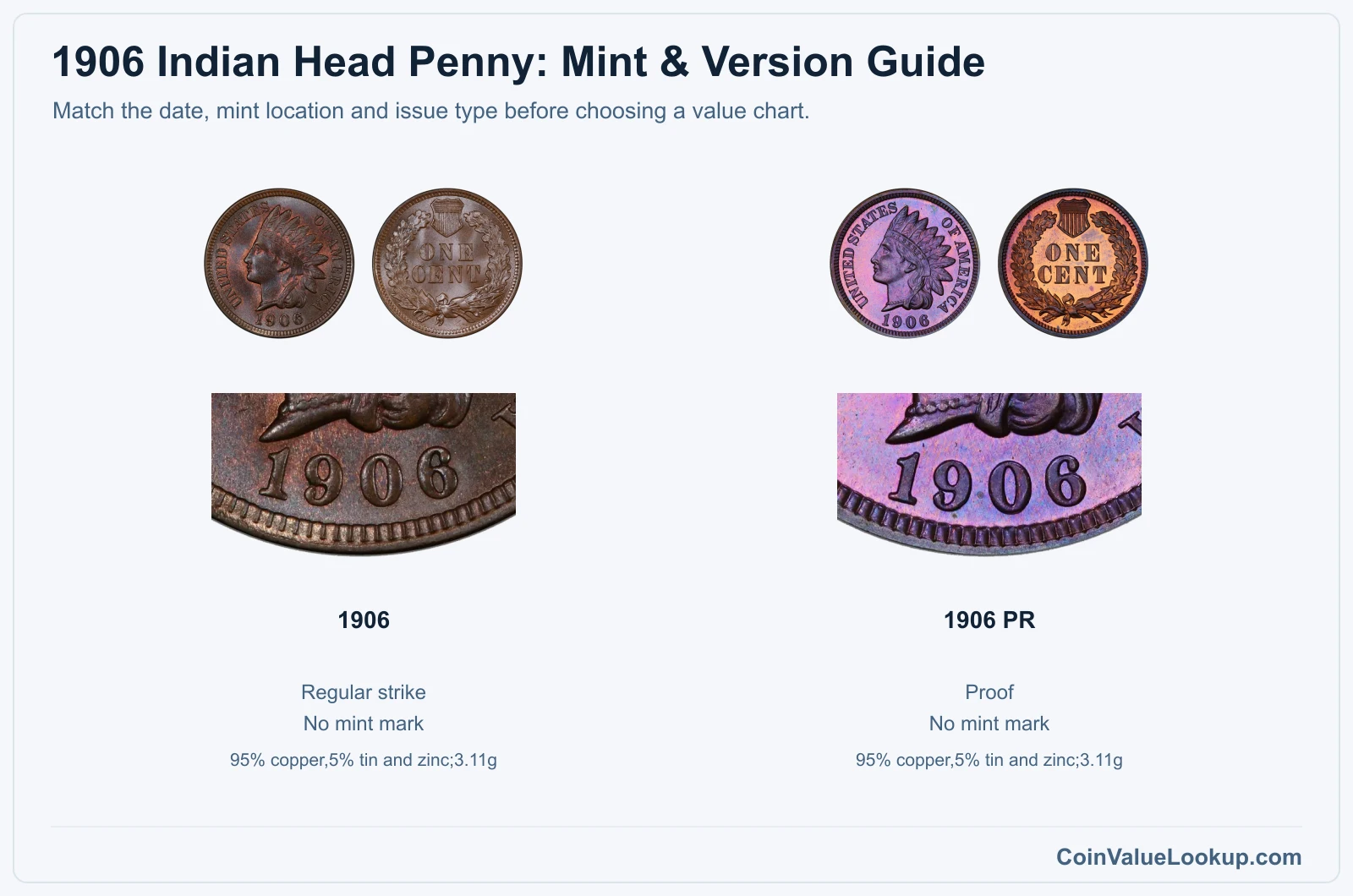
Every regular 1906 Indian Head cent was struck at Philadelphia. There is no mintmark on this coin, and the small "L" sometimes visible on the ribbon behind the portrait is a designer initial, not a mint designation.
Do not confuse it with a mintmark.
The obverse shows the familiar Indian portrait with a feathered headdress and the word LIBERTY inscribed on the headband. The reverse features an oak wreath enclosing the denomination ONE CENT, topped by a federal shield.
If your coin has a wheat-ear reverse or a smooth, un-feathered portrait, you are looking at a different series entirely.
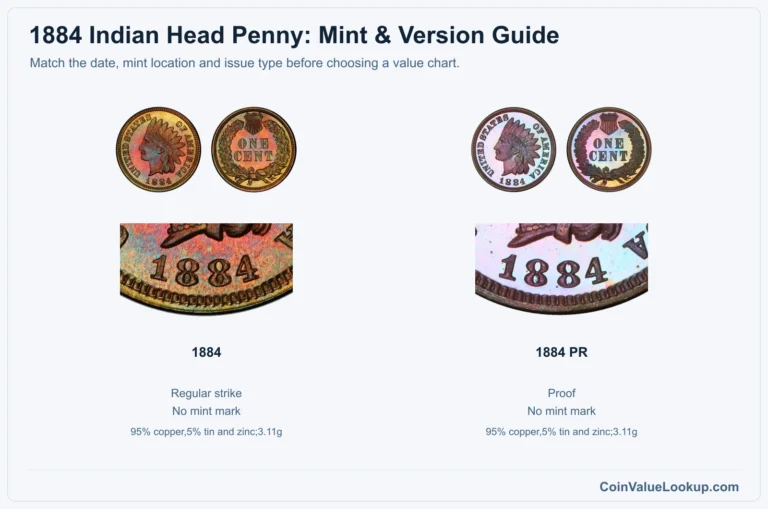
This year comes in two distinct manufacturing types: business strikes made for circulation, and proofs produced in small quantities for collectors. Proof status is determined by manufacturing characteristics such as squared rims, mirrored fields and sharp detail, not simply by how nice a coin looks.
A polished or lightly circulated business strike is not a proof. If you suspect you have a proof, professional authentication is the safest route.
Bronze color designations like BN (brown), RB (red-brown) and RD (red) describe how much original copper color remains. They are not different metals.
All 1906 cents use the same 95% copper, 5% tin-and-zinc alloy at 3.11 grams.
Step 2: Check Your 1906 Indian Head Penny Grade
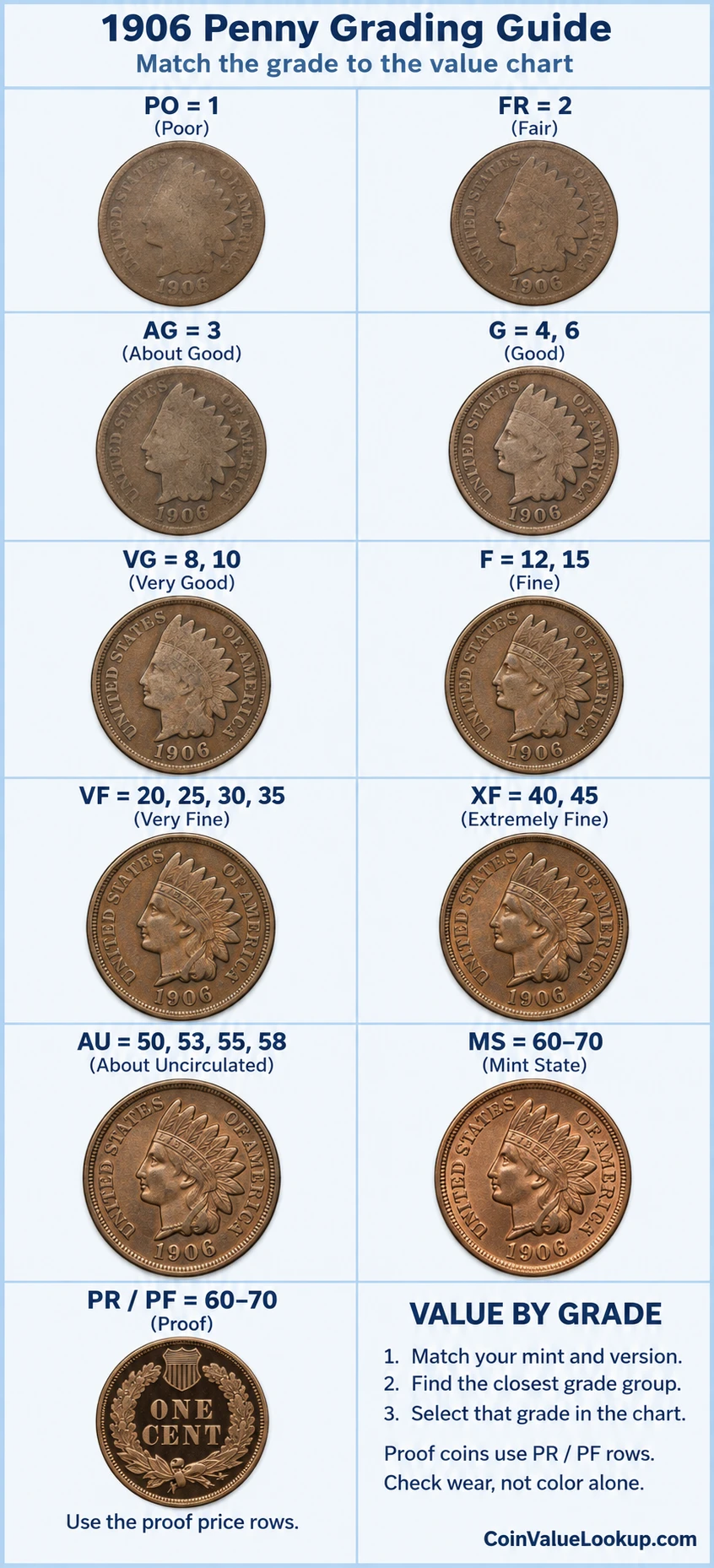
Start with the headband. On a well-worn coin the word LIBERTY will be partially or fully gone; on a lightly circulated example all letters should be visible, though they may be soft.
Check the feather tips above the ear and the hair curls below the headband for flattening.
Flip it over. The wreath leaves and shield show wear first at their highest points.
A coin grading Good-4 will have a smooth portrait outline with LIBERTY largely absent, while a Mint State 63 coin retains full detail, original luster and only minor contact marks.
Don't grade from one area alone. A weak strike at the factory can leave feathers or hair flat even on an uncirculated coin.
Look at the overall surface for luster breaks and friction before deciding.
Use the comparison image to match your coin's wear pattern. Pay attention to remaining luster, surface color and any problems like cleaning, scratches or corrosion.
Cleaned coins and those with environmental damage trade at significant discounts regardless of remaining detail.
Step 3: Check 1906 Indian Head Penny Value by Mint and Version
1906 Indian Head Penny
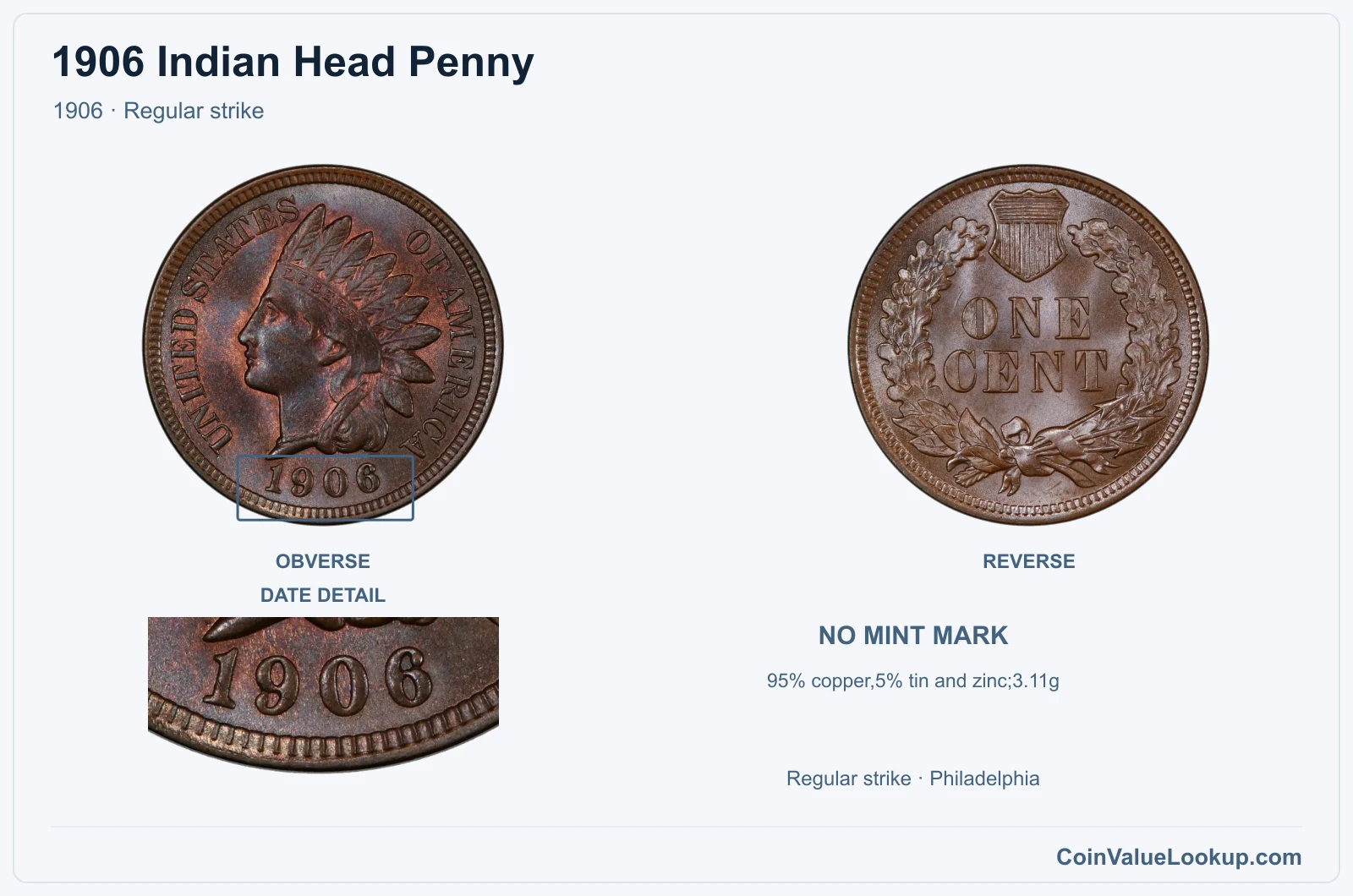
The standard 1906 Indian Head cent is a Philadelphia business strike with no mintmark. It weighs 3.11 grams in 95% copper with 5% tin and zinc.
At Good-4 condition, guide value sits around $2.50. Push that up to Mint State 63 with original surfaces and the same guide lists roughly $81.
Condition is everything here. A well-worn example is a perfectly nice pocket piece but not a financial standout.
Original luster and minimal contact marks separate a $10 coin from an $80 coin in a hurry. Cleaning or artificial toning will knock the price down, so leave the polish cloth in the drawer.
| Range | Grade | Price | Auction Records | Appraisal |
|---|---|---|---|---|
| PO | PO 1 | Coin Identifier | ||
| FR | FR 2 | — | Coin Identifier | |
| AG | AG 3 | — | Coin Identifier | |
| G | G 4 | — | Coin Identifier | |
| G 6 | — | Coin Identifier | ||
| VG | VG 8 | — | Coin Identifier | |
| VG 10 | — | Coin Identifier | ||
| F | F 12 | Coin Identifier | ||
| F 15 | — | Coin Identifier | ||
| VF | VF 20 | Coin Identifier | ||
| VF 25 | Coin Identifier | |||
| VF 30 | Coin Identifier | |||
| VF 35 | Coin Identifier | |||
| XF | XF 40 | — | Coin Identifier | |
| XF 45 | Coin Identifier | |||
| AU | AU 50 | Coin Identifier | ||
| AU 53 | — | Coin Identifier | ||
| AU 55 | Coin Identifier | |||
| AU 58 | Coin Identifier | |||
| MS | MS 60 | — | Coin Identifier | |
| MS 61 | Coin Identifier | |||
| MS 62 | Coin Identifier | |||
| MS 63 | Coin Identifier | |||
| MS 64 | Coin Identifier | |||
| MS 65 | Coin Identifier | |||
| MS 66 | Coin Identifier | |||
| MS 67 | — | — | — | |
| MS 68 | — | — | — | |
| MS 69 | — | — | — | |
| MS 70 | — | — | — |
1906 Indian Head Penny — PR
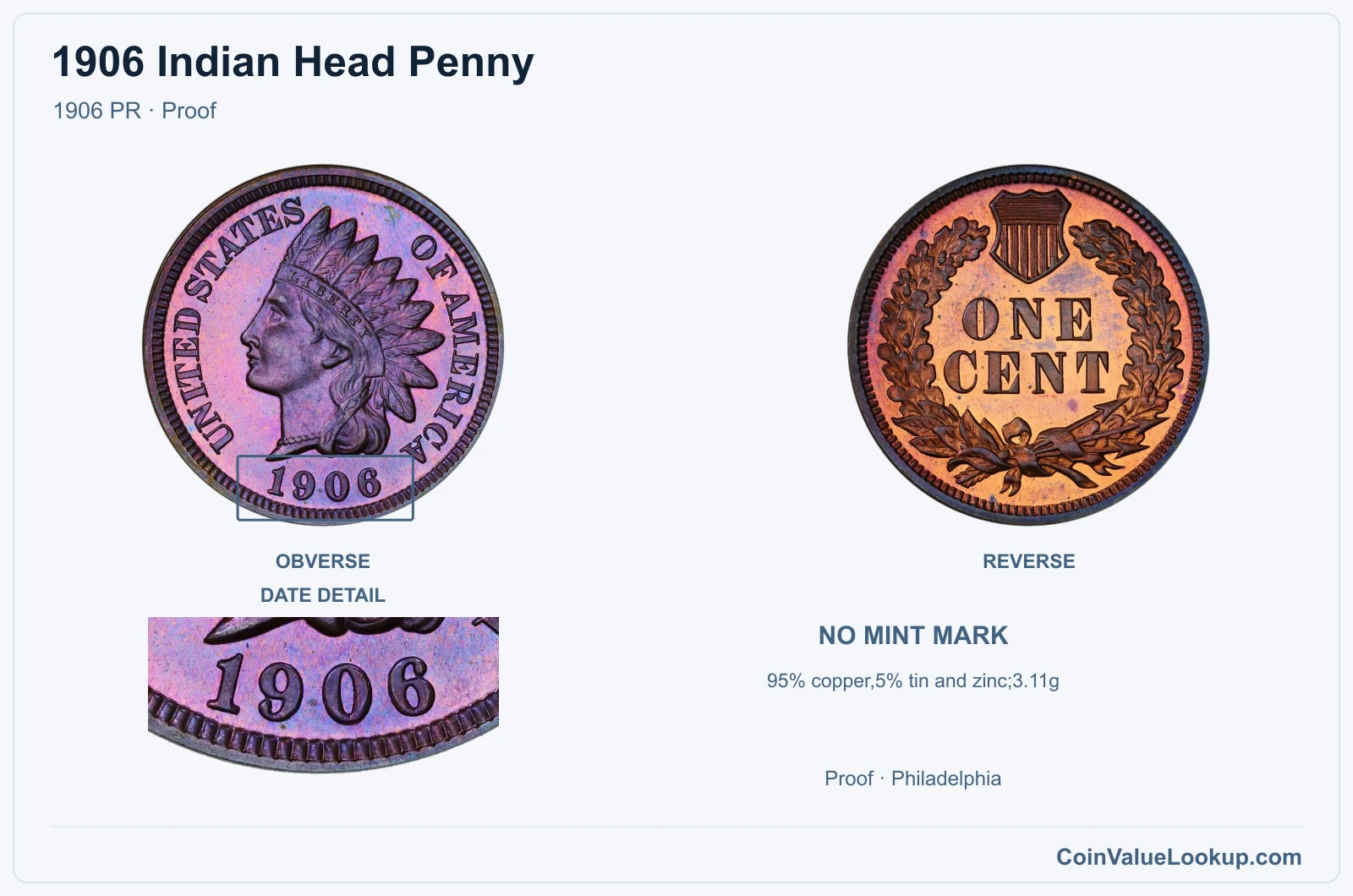
The 1906 proof Indian Head cent was a special collector issue from Philadelphia, struck on polished planchets with specially prepared dies. These have mirrored fields, squared rim edges and exceptionally sharp detail that a business strike simply cannot match.
USA Coin Book lists a Proof-63 example at about $313. That is a retail guide figure, not a guaranteed sale price, but it shows the step up from circulation strikes.
Before claiming proof status, examine the rim geometry and field reflectivity carefully. A shiny business strike that someone polished in 1950 is not a proof, no matter how mirror-like it appears.
Professional certification is the standard way to confirm proof manufacture.
Coin Value Lookup is a good place to start if you want to compare this date across the Indian Head cent series or look up other denominations from the same era.
| Range | Grade | Price | Auction Records | Appraisal |
|---|---|---|---|---|
| PR | PR 1 | — | Coin Identifier | |
| PR 2 | — | Coin Identifier | ||
| PR 3 | — | Coin Identifier | ||
| PR 4 | — | Coin Identifier | ||
| PR 6 | — | Coin Identifier | ||
| PR 8 | — | Coin Identifier | ||
| PR 10 | — | Coin Identifier | ||
| PR 12 | — | Coin Identifier | ||
| PR 15 | — | Coin Identifier | ||
| PR 20 | — | Coin Identifier | ||
| PR 25 | — | Coin Identifier | ||
| PR 30 | — | Coin Identifier | ||
| PR 35 | — | Coin Identifier | ||
| PR 40 | — | Coin Identifier | ||
| PR 45 | — | Coin Identifier | ||
| PR 50 | — | Coin Identifier | ||
| PR 53 | — | Coin Identifier | ||
| PR 55 | — | Coin Identifier | ||
| PR 58 | — | Coin Identifier | ||
| PR 60 | — | Coin Identifier | ||
| PR 61 | — | Coin Identifier | ||
| PR 62 | Coin Identifier | |||
| PR 63 | Coin Identifier | |||
| PR 64 | Coin Identifier | |||
| PR 65 | Coin Identifier | |||
| PR 66 | Coin Identifier | |||
| PR 67 | — | — | — | |
| PR 68 | — | — | — | |
| PR 69 | — | — | — | |
| PR 70 | — | — | — |
1906 Indian Head Penny Error List
1. 1906 Indian Head Penny — Die Break / Cud
A cud forms when a chunk of the die breaks away at the rim, leaving a raised, featureless blob that connects to the edge of the coin. On a 1906 Indian cent, look for an area along the rim where normal design or lettering is replaced by a smooth, raised lump.
The blob will flow into the adjacent struck detail without a sharp boundary.
Do not confuse a cud with a rim dent or corrosion spot. A dent is pushed inward, while a cud is raised above the surface.
Interior die chips that sit away from the rim are a different category. Value depends on size, location and the coin's overall grade, so individual assessment by an authenticated example is the practical approach.
No standard price range is adopted for this date.
2. 1906 Indian Head Penny — Doubled Die Reverse
A doubled die reverse on a 1906 cent shows consistent doubling in the reverse legends or wreath elements. Compare the lettering of ONE CENT and UNITED STATES OF AMERICA against a normal example under the same lighting.
True hub doubling produces a second, slightly offset image with rounded contours on the affected elements.
The key distinction is consistency. Every affected letter or leaf will show the doubling in the same direction and magnitude.
Machine doubling, by contrast, tends to produce a flat, shelf-like displacement and is far less collectible. Random scratches and light reflections can also mimic doubling to the untrained eye.
No specific price range is adopted for this variety; value depends on the strength of doubling, authentication and the coin's condition.
3. 1906 Indian Head Penny — Misplaced Date
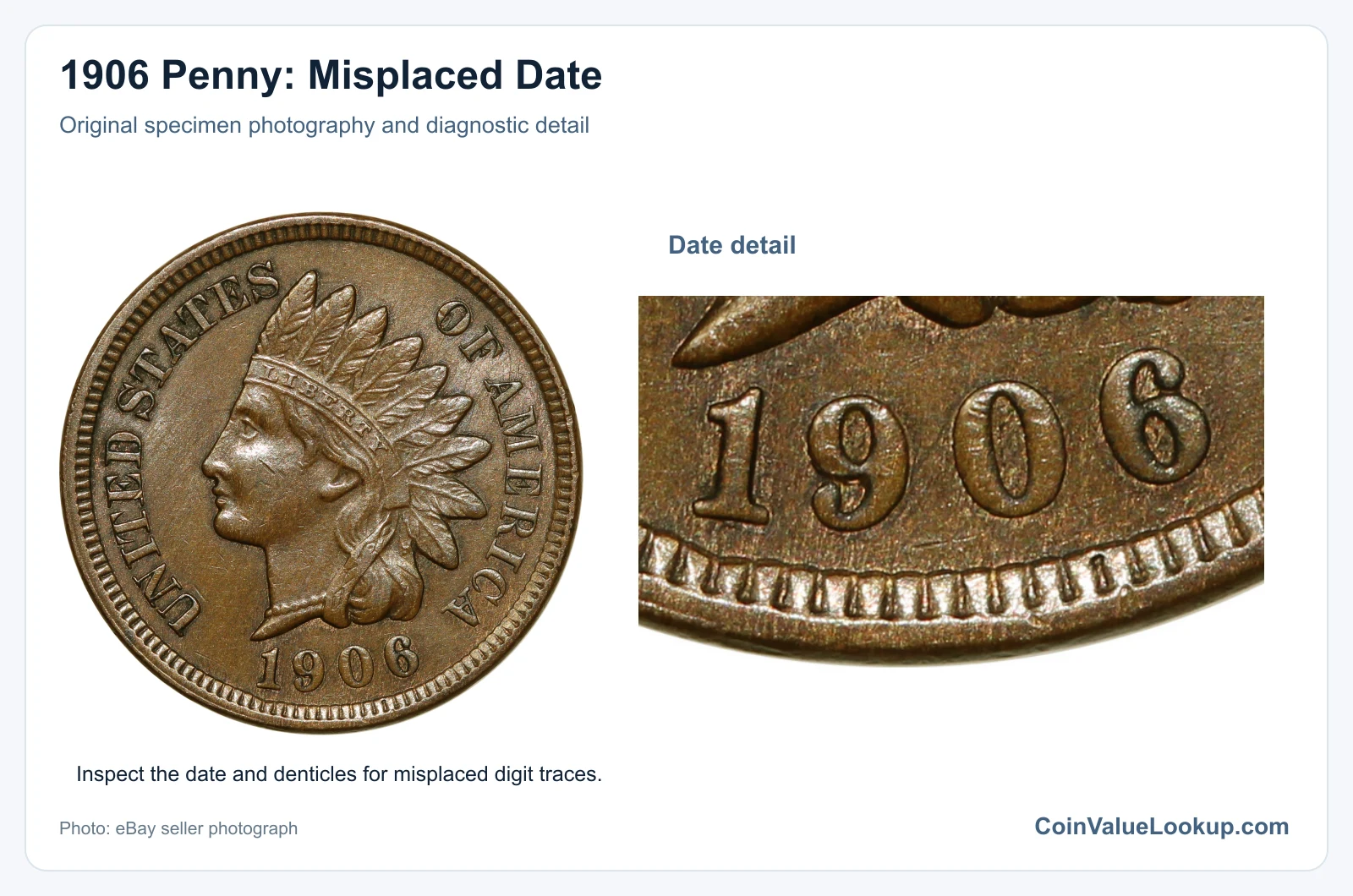
A misplaced date occurs when a partial impression of one or more date digits appears somewhere other than the final date position, often embedded in the denticles below the date or near the portrait. On a 1906 Indian cent, look carefully in the border area for ghost-like remnants of a numeral that do not belong to any design element.
These remnants will match the shape and font of the date digits. Scratches, die chips and random bumps can look similar, but they will not reproduce the contour of a specific numeral.
Comparing your coin to a known example photograph is the most reliable way to confirm the variety. No established price range is adopted; value is assessed individually based on visibility, authentication and overall grade.
4. 1906 Indian Head Penny — Repunched Date
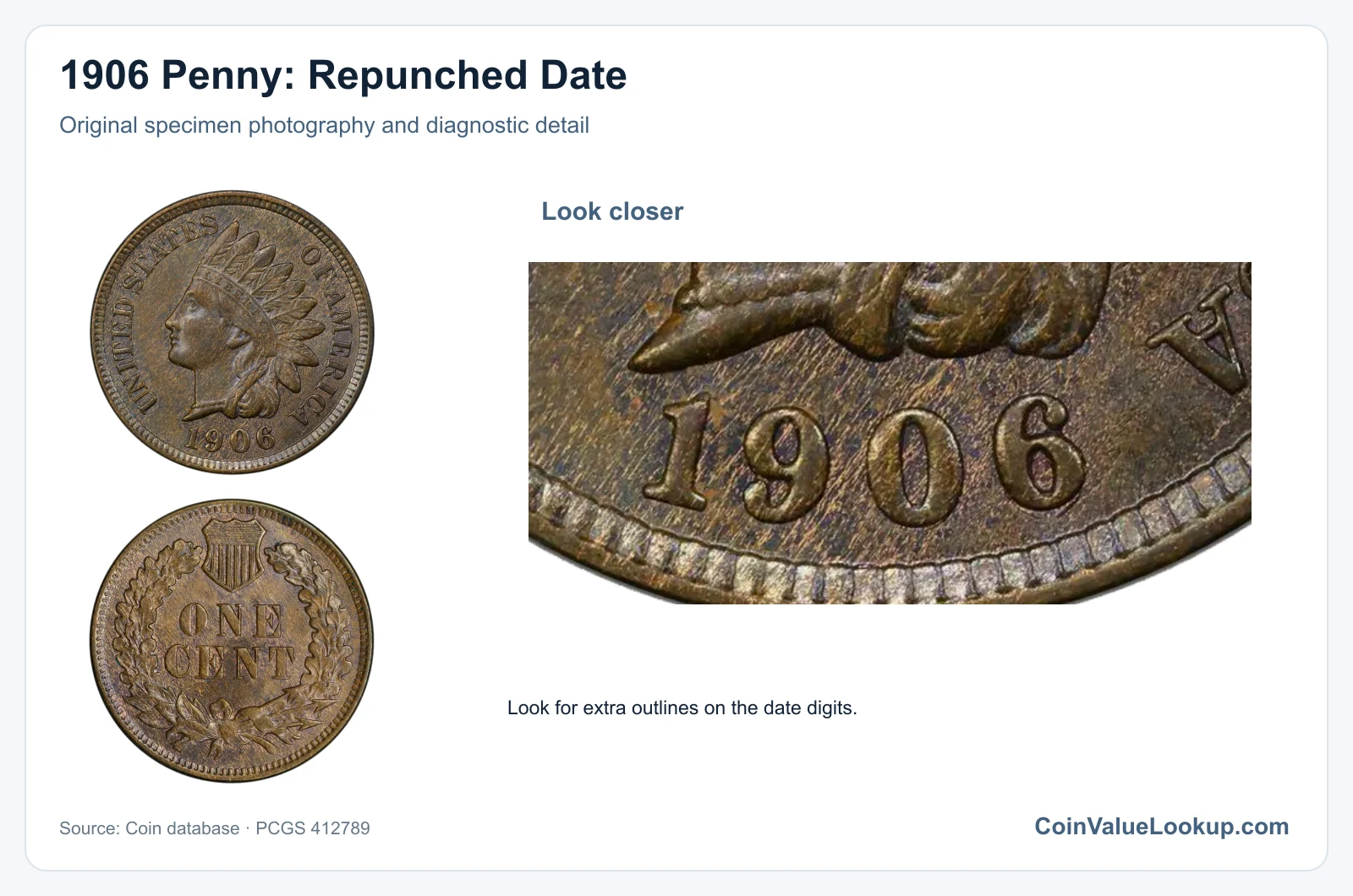
A repunched date shows traces of an earlier punch position beside or beneath the final date numerals. On a 1906 Indian cent, check each digit for secondary outlines or notching that indicate the date punch was impressed more than once at slightly different positions.
This is different from a doubled die, which affects the entire design through a hub error. Repunching is localized to the date area because the date was added to the die separately.
A damaged date from post-strike contact looks irregular and inconsistent, while a genuine repunched date will show clean, repeatable remnants. Value depends on the strength and clarity of the repunching, the coin's grade and authentication.
No specific price range is adopted for this date.
5. 1906 Indian Head Penny — Die Crack
Die cracks appear as thin, raised lines running across the coin's surface. They form when the steel die develops a fracture during use, and the crack fills with metal during striking.
On a 1906 Indian cent, trace the line from start to finish. A genuine die crack is raised and follows a path that can cross fields, lettering or design elements without interruption.
An incuse scratch is the opposite: it cuts into the surface rather than rising above it. Corrosion lines and displaced-metal scrapes can also mimic a crack, but they lack the clean, consistent raised profile.
Minor die cracks are common and add only modest interest, while dramatic cracks spanning the full coin attract more attention. No adopted price range exists; assessment is individual based on severity and grade.
6. 1906 Indian Head Penny — Clashed Dies
Clashed dies result from the obverse and reverse dies striking each other without a planchet between them. The impact transfers a mirror-image impression of the opposite design onto each die, and subsequent coins show faint ghost-like traces of the wrong design in the fields.
On a 1906 Indian cent, look for portions of the wreath or shield faintly visible in the obverse field, or elements of the portrait appearing on the reverse. The transferred image should align with where the opposite die would have made contact.
Scratches, random raised lines and brockage strikes can look similar but will not align with the opposing design. No specific price range is adopted; value depends on clash strength, clarity and the coin's overall condition.
7. 1906 Indian Head Penny — Die Chip
A die chip is a small, raised lump on the coin's surface caused by a tiny piece of the die flaking away. On a 1906 Indian cent, these often appear inside letters or within design elements, filling part of a recessed area with a shapeless blob of metal.
The surrounding struck detail flows smoothly into the chip, which distinguishes it from post-strike damage like gouges or glued debris. A gouge cuts into the surface, while a die chip sits above it.
Die chips are relatively common on well-used dies and most add only minor collector interest, though a chip in a prominent location can attract attention. No price range is adopted for this category; individual assessment based on location, size and grade applies.
8. 1906 Indian Head Penny — Doubled Die Obverse
A doubled die obverse on a 1906 Indian cent shows consistent doubling in the obverse design elements, such as LIBERTY on the headband, the date or the portrait details. Compare the affected area to a normal coin under the same lighting conditions.
Genuine hub doubling produces a secondary image with rounded, separated contours rather than a flat mechanical shelf.
Machine doubling creates a shelf-like flattening in one direction and is far more common but much less valuable. Worn die contours and odd reflections can also fool the eye.
Look for consistent separation or notching across multiple design elements; if only one letter shows it, be skeptical. No adopted price range exists for this date, so value depends on doubling strength, professional authentication and the coin's overall grade.