1904 Morgan Silver Dollar Coin Value: How Much Is It Worth?
The 1904 Morgan Silver Dollar is a collectible piece struck in 90% silver and 10% copper, weighing 26.73 grams. Its value depends on which mint produced it, its condition, whether it carries original surfaces, and if any manufacturing errors are present.
Before assigning a value, you need to confirm the exact version you hold.
Fast Way to Identify Your 1904 Morgan Silver Dollar
The quickest way to start figuring out what your 1904 Morgan Dollar is worth is to upload clear photos of both the front and back of your coin. Our identifier can give you a preliminary read on the mint, design match, and general condition from those images alone.
Snap the photos in even lighting and avoid glare.
1904 Morgan Silver Dollar Value
Upload both sides of your 1904 Morgan Silver Dollar.
Front Obverse
Upload photo
Back Reverse
Upload photo
Which 1904 Morgan Silver Dollar Versions Are Worth Money?
- The 1904 Proof is a low-mintage manufacturing finish struck at Philadelphia; confirm proof surfaces with a trusted grading service before assuming you have one.
- The 1904-S San Francisco issue and the 1904 Philadelphia strike can carry significant premiums in higher grades; authenticated condition is key.
- Prooflike (PL) or deep-mirror prooflike (DMPL) surface designations on eligible business strikes can add value, but a shiny surface alone does not qualify.
- Avoid paying premiums for cleaning, plating, ordinary wear, or unverified error claims; authentication matters.
Step 1: Identify Your 1904 Morgan Silver Dollar Mint Mark and Version
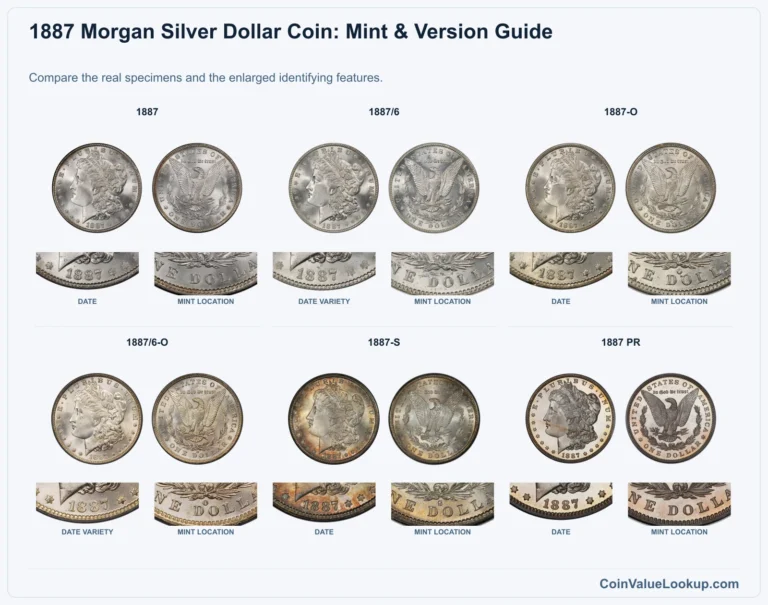
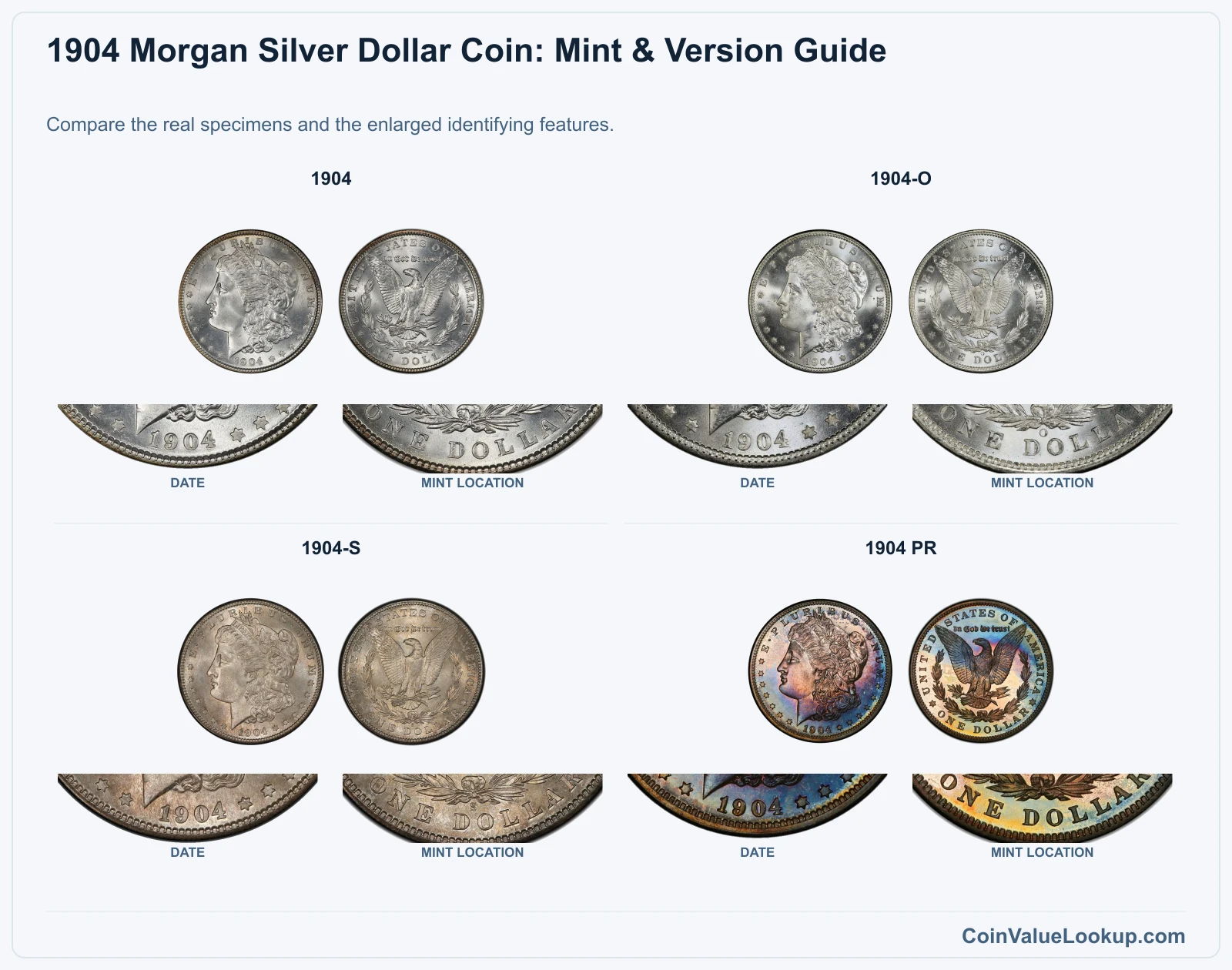
Flip your coin to the reverse side and look directly below the bow that ties the wreath together. That small space is where a mintmark lives.
No letter means Philadelphia. An "O" means New Orleans.
An "S" means San Francisco. There is no "D" or "CC" mintmark for 1904.
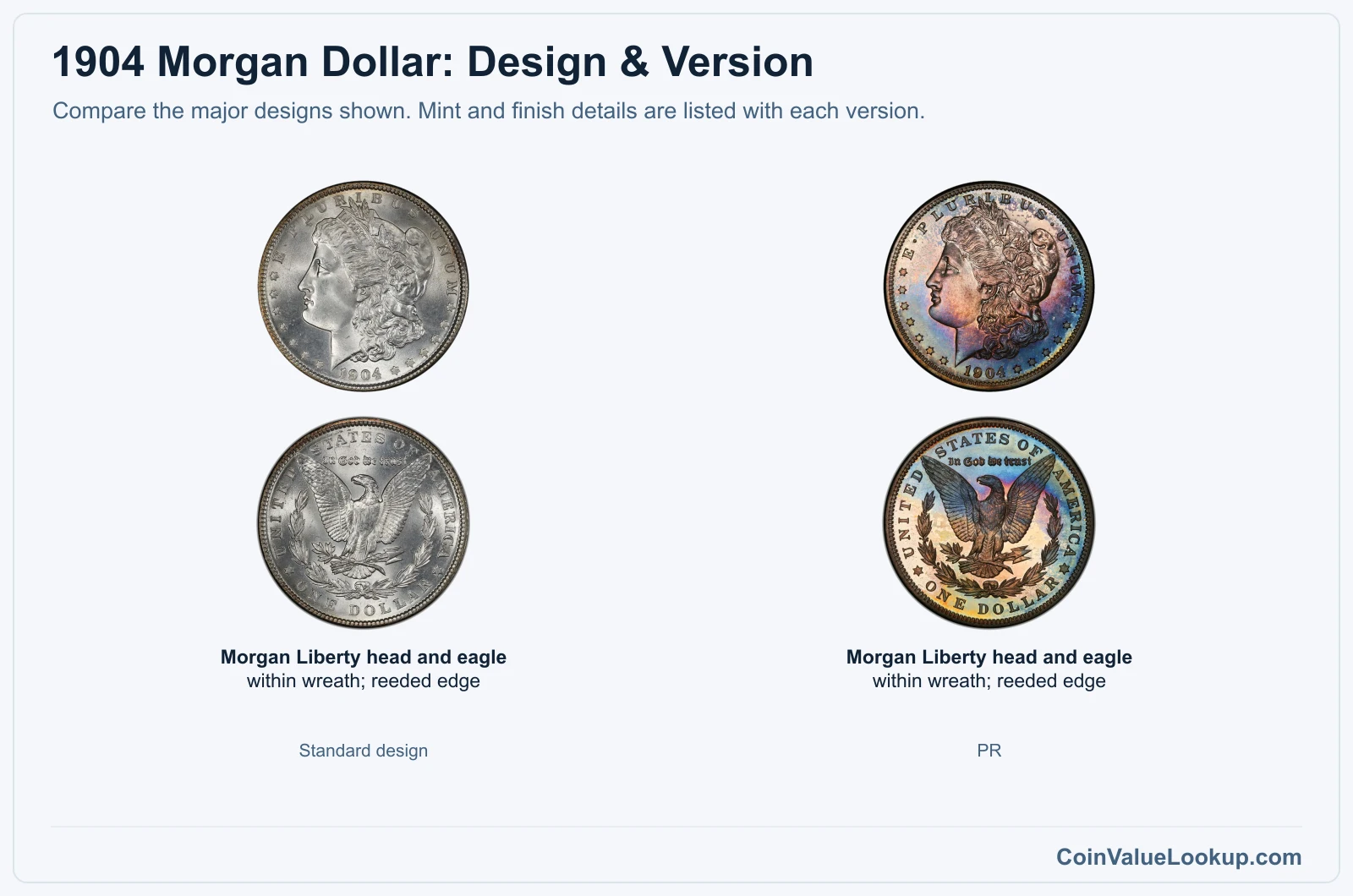
The 1904 Morgan Dollar is made of 90% silver and 10% copper, so it has real precious-metal weight at 26.73 grams. The obverse shows the Morgan Liberty head facing left, wearing a Phrygian cap with wheat ears and a cotton boll.
The reverse features an eagle with outstretched wings clutching arrows and an olive branch, encircled by a wreath.
Four collectible branches exist for this date: the 1904 Philadelphia strike, the 1904-O from New Orleans, the 1904-S from San Francisco, and the 1904 Proof, also struck at Philadelphia. Each version carries its own collector demand, so identifying yours accurately is the essential first step.
A shiny coin is not automatically a proof or a prooflike piece. Proof is a specific manufacturing method, not just a high grade.
Prooflike (PL) and deep-mirror prooflike (DMPL) are surface designations applied to certain business strikes and should not be confused with proof manufacture.
Step 2: Check Your 1904 Morgan Silver Dollar Grade
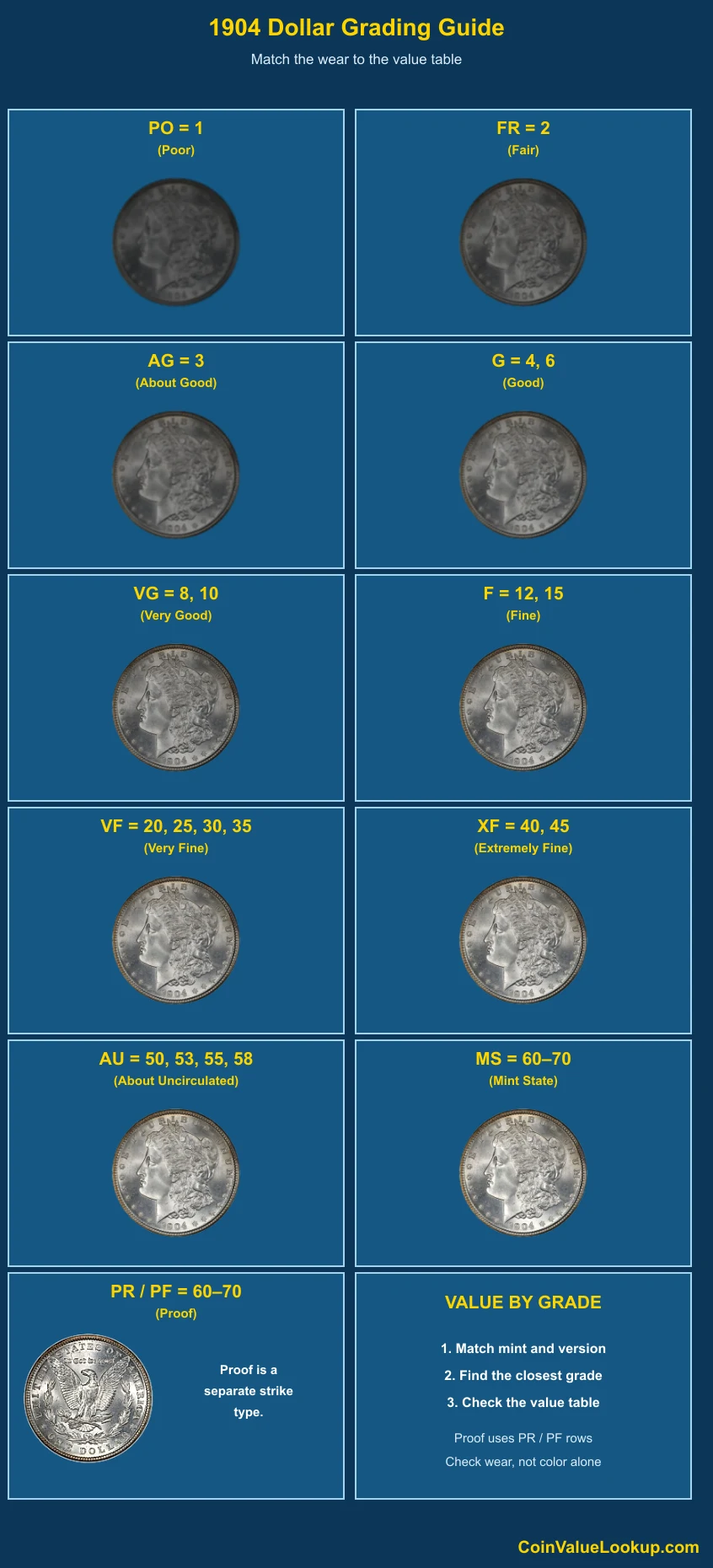
Start by examining the hair above Liberty's ear and across the cheek. In lower circulated grades, that hair detail flattens noticeably, and the cheek shows broad, smooth wear.
A coin grading around Fine will have visible hair strands but obvious flatness in these key spots.
At About Uncirculated, only the highest points show a trace of friction. Look at the cap above Liberty's forehead and the eagle's breast feathers on the reverse for the same subtle smoothing.
Mint State coins retain full original luster with no wear, but bag marks from storage and shipping can be heavy. These contact marks lower the numeric grade without meaning the coin actually circulated.
Check the fields around Liberty's face for scattered nicks.
Use the comparison image to gauge your coin against circulated, AU, and Mint State examples side by side. Proof coins should be evaluated separately from business strikes because their surfaces are manufactured differently.
Cleaning, polishing, or artificial toning will reduce a coin's desirability and grade regardless of how much detail remains.
Step 3: Check 1904 Morgan Silver Dollar Value by Mint and Version
1904 Morgan Silver Dollar
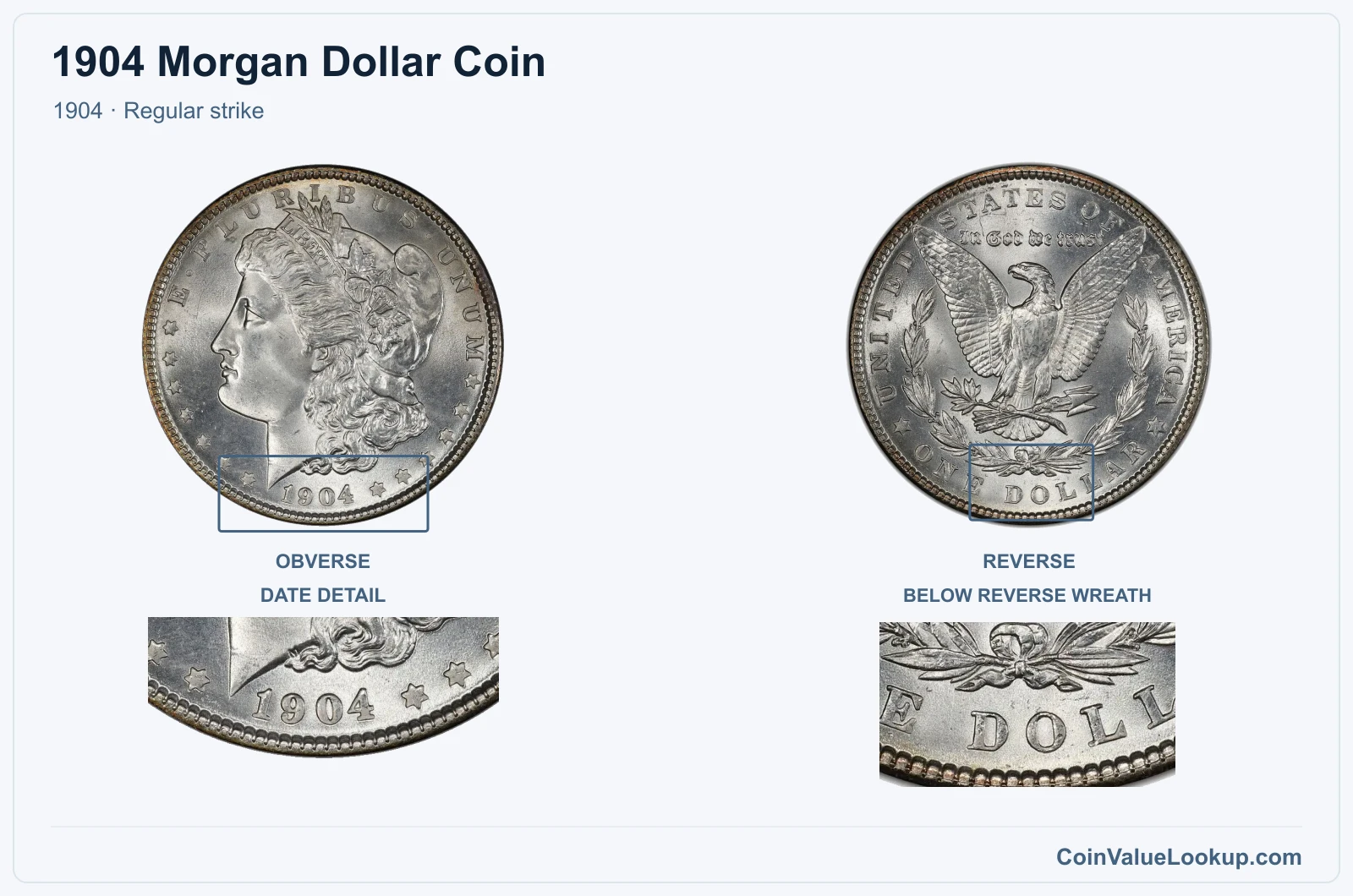
The 1904 Morgan Dollar was struck at Philadelphia and carries no mintmark. It is a business-strike issue in 90% silver.
Value depends entirely on authenticated grade and the originality of its surfaces.
Coins with cleaning or polishing lose comparability to problem-free examples. In circulated grades this date is collected primarily for its silver content and historical appeal, while higher Mint State grades command stronger premiums.
Some Philadelphia strikes qualify for prooflike (PL) or deep-mirror prooflike (DMPL) designations, which reflect the surface character rather than a different manufacturing process. Have your coin professionally assessed before assuming any surface designation.
Range Grade
Price Auction Records Appraisal PO PO 1
—
Coin Identifier FR FR 2
—
Coin Identifier AG AG 3
—
Coin Identifier G G 4
—
Coin Identifier
G 6
—
Coin Identifier VG VG 8
—
Coin Identifier
VG 10
—
Coin Identifier F F 12
Coin Identifier
F 15
—
Coin Identifier VF VF 20
—
Coin Identifier
VF 25
—
Coin Identifier
VF 30
—
Coin Identifier
VF 35
Coin Identifier XF XF 40
Coin Identifier
XF 45
Coin Identifier AU AU 50
Coin Identifier
AU 53
Coin Identifier
AU 55
Coin Identifier
AU 58
Coin Identifier MS MS 60
Coin Identifier
MS 61
Coin Identifier
MS 62
Coin Identifier
MS 63
Coin Identifier
MS 64
Coin Identifier
MS 65
Coin Identifier
MS 66
Coin Identifier
MS 67
—
Coin Identifier
MS 68
—
—
—
MS 69
—
—
—
MS 70
—
—
—
1904 Morgan Silver Dollar — O
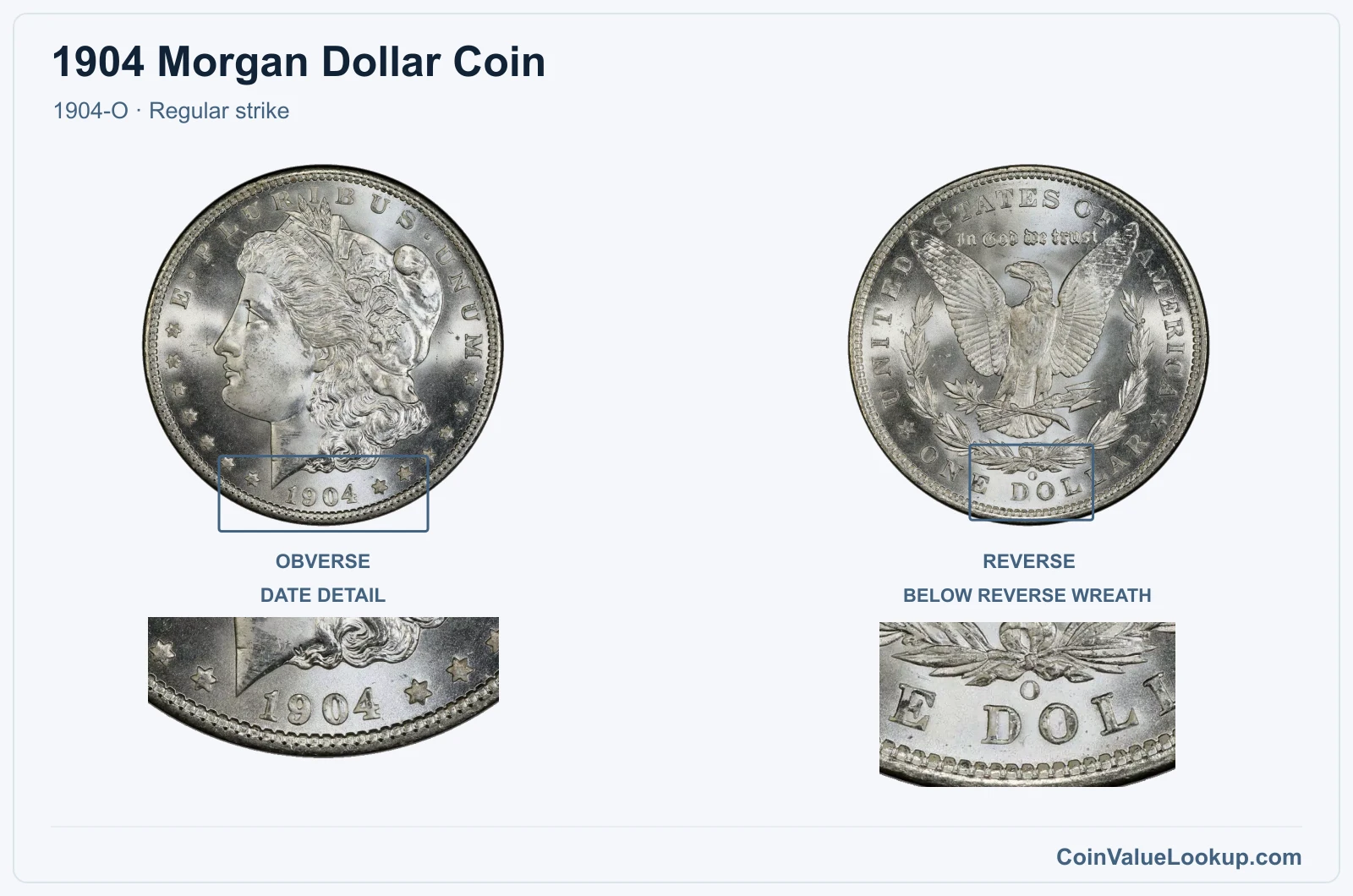
The 1904-O was struck at the New Orleans Mint and shows a small "O" mintmark below the wreath bow on the reverse. It shares the same 90% silver composition and 26.73-gram weight as other Morgan Dollars.
Coin Value Lookup is a useful starting point if you want to look up guides for other dates and mints in the Morgan series.
Original, uncleaned surfaces matter for this issue. PL and DMPL surface designations can apply to eligible business strikes, but a coin that simply looks reflective from wear or cleaning does not qualify.
The value of a 1904-O hinges on its authenticated condition and whether its surfaces are original.
Range Grade
Price Auction Records Appraisal PO PO 1
—
Coin Identifier FR FR 2
—
Coin Identifier AG AG 3
—
Coin Identifier G G 4
—
Coin Identifier
G 6
—
Coin Identifier VG VG 8
—
Coin Identifier
VG 10
—
Coin Identifier F F 12
—
Coin Identifier
F 15
—
Coin Identifier VF VF 20
—
Coin Identifier
VF 25
—
Coin Identifier
VF 30
—
Coin Identifier
VF 35
—
Coin Identifier XF XF 40
—
Coin Identifier
XF 45
—
Coin Identifier AU AU 50
—
Coin Identifier
AU 53
Coin Identifier
AU 55
—
Coin Identifier
AU 58
Coin Identifier MS MS 60
Coin Identifier
MS 61
Coin Identifier
MS 62
Coin Identifier
MS 63
Coin Identifier
MS 64
Coin Identifier
MS 65
Coin Identifier
MS 66
Coin Identifier
MS 67
Coin Identifier
MS 68
—
—
—
MS 69
—
—
—
MS 70
—
—
—
1904 Morgan Silver Dollar — S
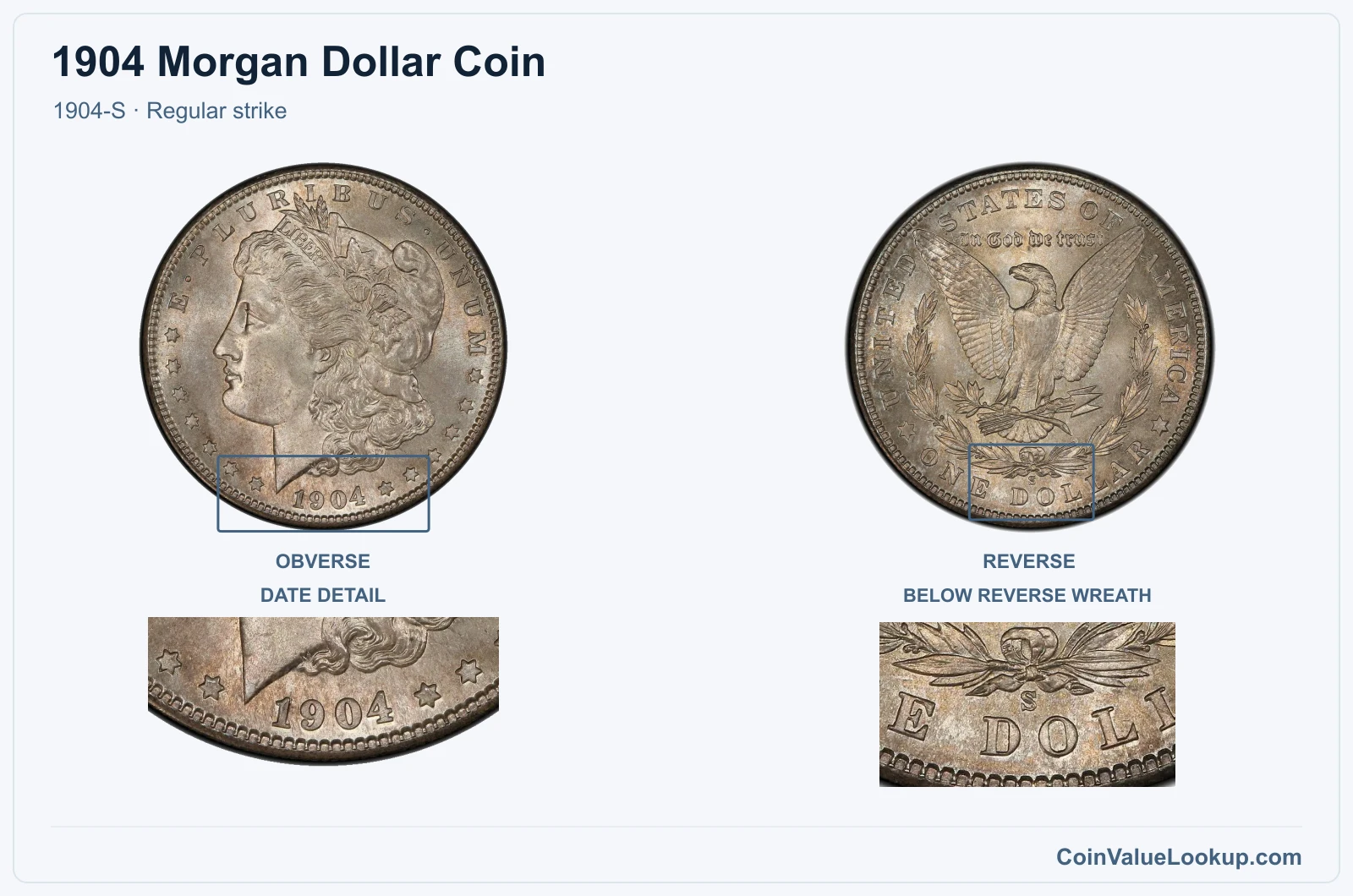
The 1904-S carries an "S" mintmark for the San Francisco Mint. Like all Morgan Dollars, it is struck in 90% silver and 10% copper at 26.73 grams.
San Francisco issues from this era are generally well-regarded for strike quality. Still, value comes down to authenticated grade and surface preservation.
Cleaning or environmental damage will reduce appeal substantially. PL and DMPL designations can appear on qualifying business strikes of this mint, and those surface types may influence pricing.
Have your specific coin evaluated individually rather than relying on generic assumptions about the date.
Range Grade
Price Auction Records Appraisal PO PO 1
—
Coin Identifier FR FR 2
Coin Identifier AG AG 3
—
Coin Identifier G G 4
Coin Identifier
G 6
Coin Identifier VG VG 8
Coin Identifier
VG 10
Coin Identifier F F 12
Coin Identifier
F 15
Coin Identifier VF VF 20
Coin Identifier
VF 25
Coin Identifier
VF 30
Coin Identifier
VF 35
Coin Identifier XF XF 40
Coin Identifier
XF 45
Coin Identifier AU AU 50
Coin Identifier
AU 53
Coin Identifier
AU 55
Coin Identifier
AU 58
Coin Identifier MS MS 60
Coin Identifier
MS 61
Coin Identifier
MS 62
Coin Identifier
MS 63
Coin Identifier
MS 64
Coin Identifier
MS 65
Coin Identifier
MS 66
Coin Identifier
MS 67
Coin Identifier
MS 68
—
—
—
MS 69
—
—
—
MS 70
—
—
—
1904 Morgan Silver Dollar — PR
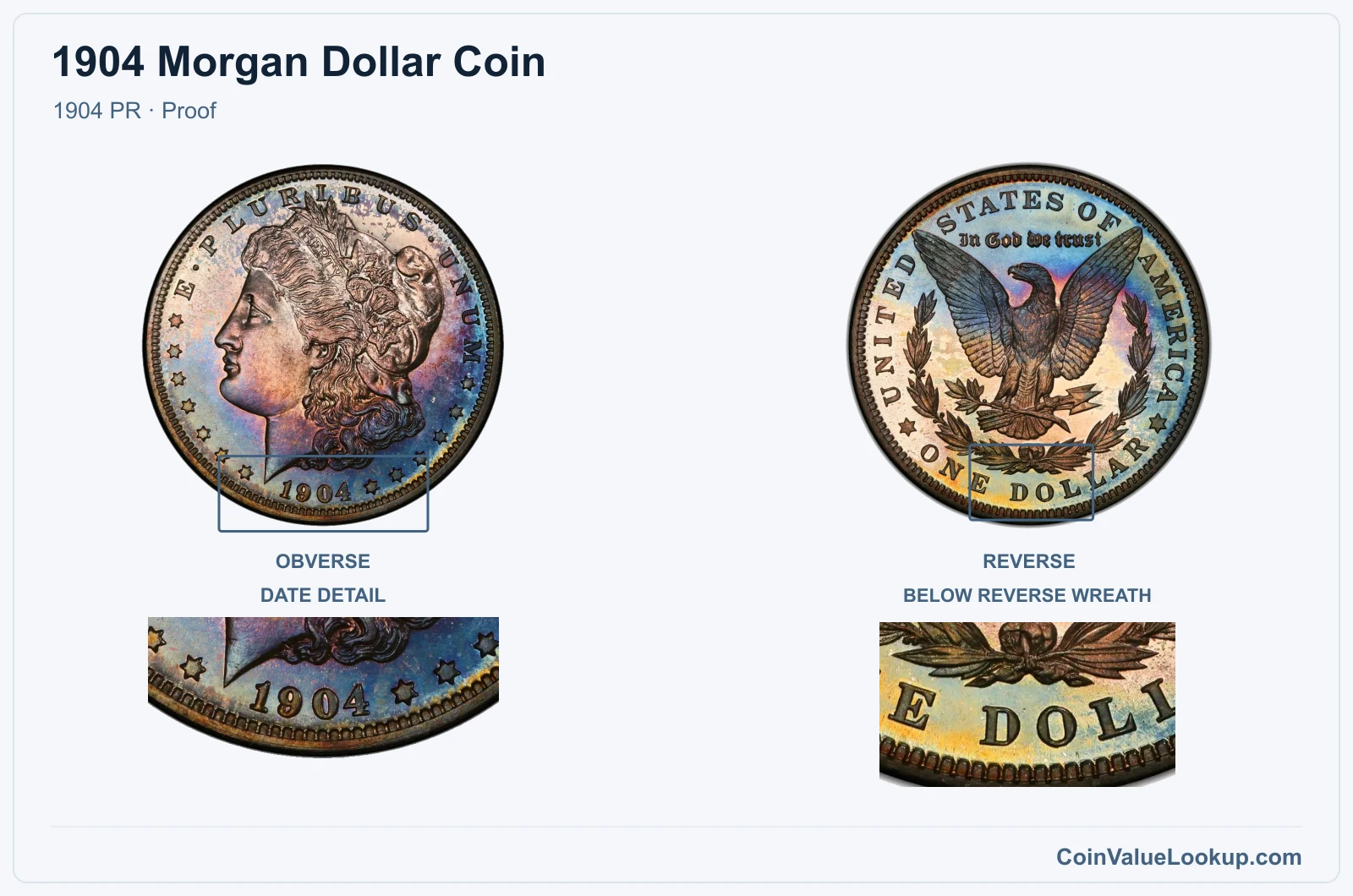
The 1904 Proof Morgan Dollar was manufactured at Philadelphia using specially prepared dies and planchets. It carries no mintmark, just like the regular Philadelphia business strike, so you cannot distinguish it by mintmark alone.
The proof finish produces mirror-like fields and sharp design details that differ from an ordinary business strike, no matter how well preserved.
A proof is a manufacturing method, not a grade above Mint State. Do not assume your coin is a proof simply because it appears shiny or has strong luster.
Professional grading services authenticate proof status based on surface characteristics, die finish, and strike quality. Because proof Morgan Dollars of any date had limited production, a confirmed 1904 Proof carries collector interest well above a standard strike.
Individual value depends on the coin's authenticated proof grade and surface quality.
Range Grade
Price Auction Records Appraisal PR PR 1
—
Coin Identifier
PR 2
—
Coin Identifier
PR 3
—
Coin Identifier
PR 4
—
Coin Identifier
PR 6
—
Coin Identifier
PR 8
—
Coin Identifier
PR 10
—
Coin Identifier
PR 12
—
Coin Identifier
PR 15
—
Coin Identifier
PR 20
—
Coin Identifier
PR 25
—
Coin Identifier
PR 30
—
Coin Identifier
PR 35
—
Coin Identifier
PR 40
—
Coin Identifier
PR 45
Coin Identifier
PR 50
—
Coin Identifier
PR 53
Coin Identifier
PR 55
Coin Identifier
PR 58
Coin Identifier
PR 60
—
Coin Identifier
PR 61
Coin Identifier
PR 62
Coin Identifier
PR 63
Coin Identifier
PR 64
Coin Identifier
PR 65
Coin Identifier
PR 66
Coin Identifier
PR 67
Coin Identifier
PR 68
Coin Identifier
PR 69
—
—
—
PR 70
—
—
—
1904 Morgan Silver Dollar Error List
1. 1904 Morgan Silver Dollar — Rotated Dies
A rotated die error on the 1904 Morgan Dollar means the obverse and reverse designs are misaligned from their normal orientation. To check, hold the obverse upright, then rotate the coin top-to-bottom on its vertical axis.
On a properly struck U.S. coin the reverse eagle should appear upright. If the eagle is tilted, you may have a rotation error.
The degree of rotation matters. A slight tilt of a few degrees is minor, while a dramatic rotation approaching 90 or 180 degrees is far more unusual.
Be careful not to confuse a rotated photograph or simply turning the coin sideways with a genuine die rotation. Condition, the degree of misalignment, and authenticated identity all factor into what such a coin may be worth.
Professional verification is recommended.
2. 1904 Morgan Silver Dollar — Lamination / Split Planchet
A lamination error on the 1904 Morgan Dollar appears as a peeling layer of metal, a retained flap, or a visible separation within the silver alloy of the planchet. These occur when impurities or gas pockets in the metal cause layers to split apart during or after striking.
Look at both faces and the edge carefully. Photograph the edge and the affected area together to document the separation.
The size and location of the lamination influence collector interest.
Do not confuse a lamination with surface scraping, corrosion pitting, or a deliberately cut or altered coin. Genuine laminations show a natural metal separation rather than tool marks or chemical damage.
Value depends on the visibility and severity of the error, overall coin condition, and authenticated identity.
3. 1904 Morgan Silver Dollar — Struck-Through Error
A struck-through error on the 1904 Morgan Dollar happens when foreign material sits between the die and the planchet during striking. The result is a localized depression, an impression of the obstruction, or an area of incomplete design detail.
Grease fills and retained foreign objects are distinct subtypes. A grease-filled die produces a smooth, flat blank area, while a retained object may leave a textured impression.
Both are struck-through errors, but they look quite different.
Ordinary wear, scratches, cleaning marks, or a weakly struck area from worn dies can mimic a struck-through at first glance. The key difference is that a genuine struck-through shows a discrete, localized interruption rather than gradual overall loss of detail.
The error's size, location, and clarity all affect collector interest. Have the coin examined professionally to confirm the error before assigning extra value.