1942 Jefferson Nickel Coin Value: How Much Is It Worth?
The 1942 Jefferson nickel sits at a crossroads in U.S. coinage history, straddling the switch from standard copper-nickel to the wartime silver alloy. Ordinary circulated examples in about VF20 condition range from roughly $0.86 for a Philadelphia no-mintmark coin to around $6.34 for a silver-composition P-mint piece, based on guide estimates.
At MS65, ordinary business strikes run from about $19 to $73 depending on mint and alloy. Proof strikes, Full Steps designations, and authenticated error varieties occupy separate price tiers entirely.
What you actually hold matters a lot, so let's sort it out.
Fast Way to Identify Your 1942 Jefferson Nickel
The quickest way to start figuring out what you have is to photograph both sides of the coin in good light. Upload clear images of the front (Jefferson portrait) and the back (Monticello) so the preliminary identifier can help you narrow down the mint, composition, and general type.
That first step saves time before you dig into mintmark placement, alloy color, or any possible variety.
1942 Jefferson Nickel Value
Upload both sides of your 1942 Jefferson Nickel.
Front Obverse
Upload photo
Back Reverse
Upload photo
Which 1942 Jefferson Nickel Versions Are Worth Money?
- The 1942-D over horizontal D variety shows a sideways D under the normal D at Monticello; guide values reach about $7,335 at MS65, far above the ordinary Denver issue.
- Uncirculated 1942-D coins in MS65 grade list around $73 in guide estimates, the highest of the standard copper-nickel business strikes.
- Silver-alloy 1942-P and 1942-S coins carry intrinsic metal value that fluctuates with the silver market, adding a floor beneath their numismatic worth.
- Philadelphia proof coins exist in both copper-nickel (guide about $112 at PR65) and silver (about $135 at PR65), each a separate collectible finish.
Step 1: Identify Your 1942 Jefferson Nickel Mint Mark and Version
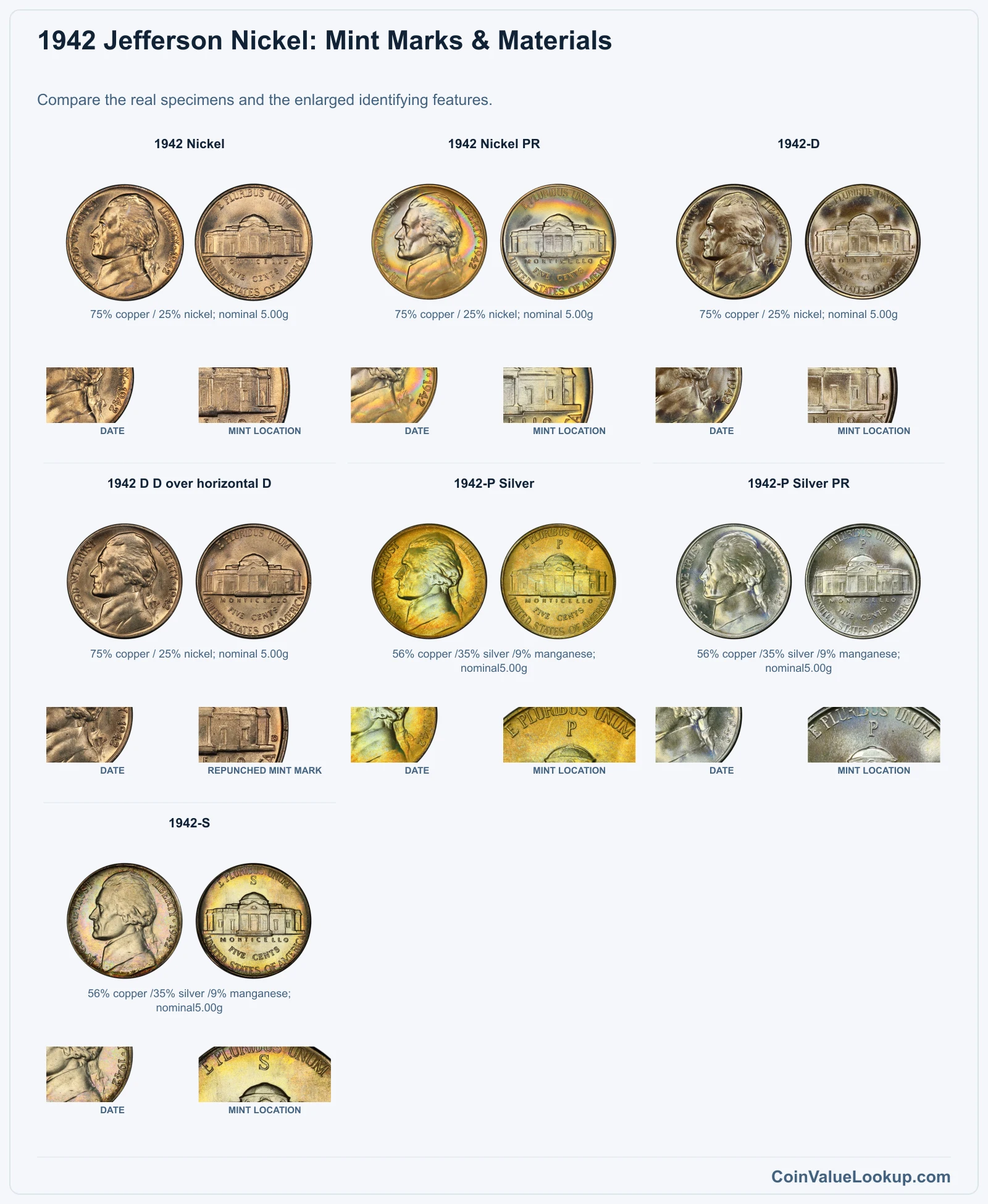
The 1942 nickel comes in two distinct alloys and multiple mint versions, which trips people up. Copper-nickel coins (75% copper, 25% nickel) were struck at Philadelphia with no mintmark and at Denver with a small D to the right of Monticello.
Silver-alloy coins (56% copper, 35% silver, 9% manganese) carry a large mintmark above the Monticello dome: a big P for Philadelphia or a big S for San Francisco.
That mintmark location is your first sorting tool. Small letter to the right of the building means copper-nickel.
Large letter above the dome means wartime silver. Philadelphia also produced proof coins in both alloys, so finish matters too.
The nominal weight for all versions is 5.00 grams and the diameter is 21.2 mm. Color alone cannot confirm composition because toning, environmental damage, and cleaning all change surface appearance.
If you suspect silver, weigh the coin and examine the mintmark position before drawing conclusions.
Also watch for the D over horizontal D variety on Denver copper-nickel strikes. That one has a sideways D remnant beneath the upright D and commands dramatically higher prices.
Use magnification to compare your mintmark with a known normal example rather than guessing from a blurry photo.
Step 2: Check Your 1942 Jefferson Nickel Grade
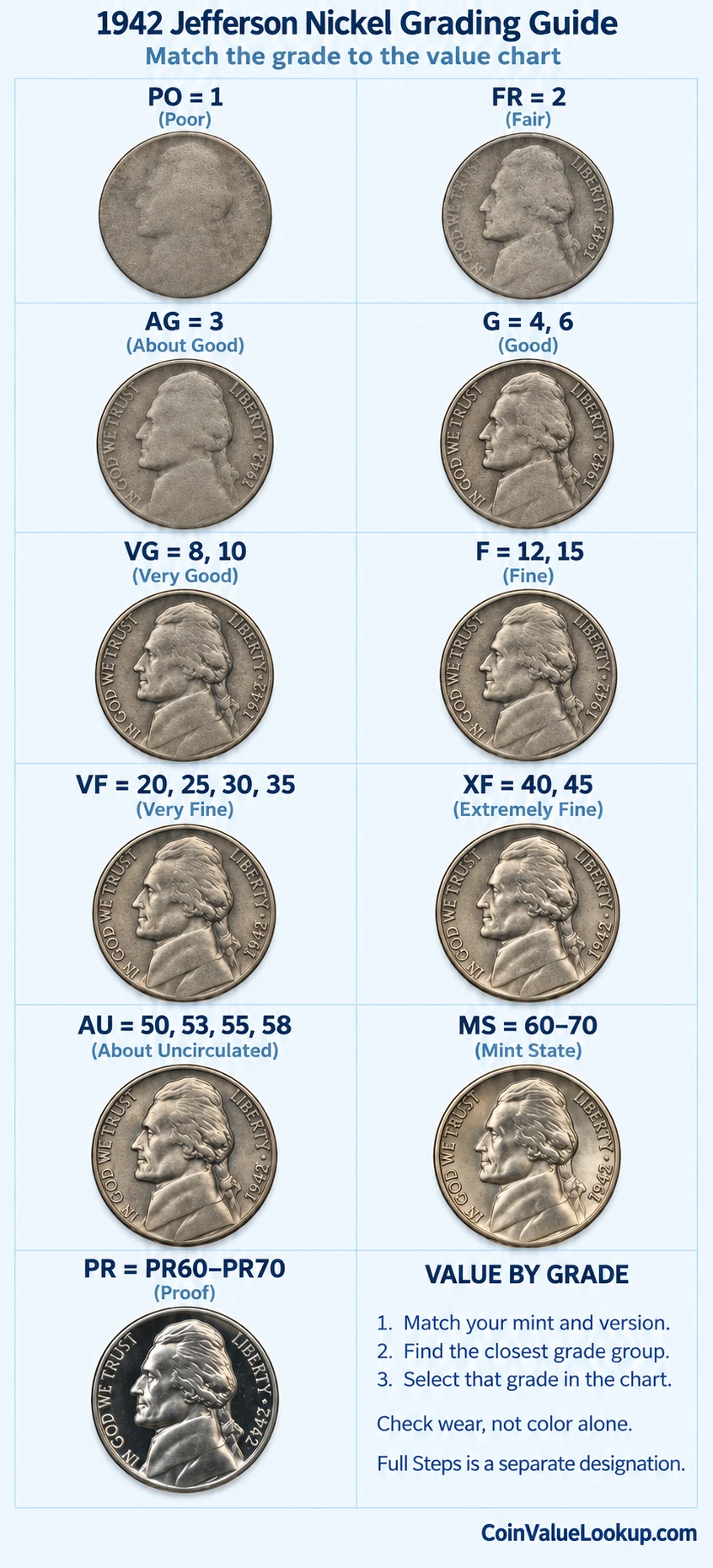
Start with Jefferson's cheekbone and the hair detail just above his ear. On a lightly circulated coin those areas show slight flattening first, while a well-worn piece will have the cheekbone almost flat.
Flip the coin and check the Monticello roof lines and the column details; they wear in tandem with the obverse.
Luster is the dividing line between circulated and Mint State. A coin with full, undisturbed cartwheel luster across both sides and no wear on the high points qualifies for Mint State consideration.
Compare your coin to the reference image to gauge where it falls.
Full Steps is a separate designation applied only to qualifying Mint State coins. It requires clearly separated steps on the Monticello base.
A weakly struck coin can look worn in that area even with no actual wear, so do not use the steps alone as a grading shortcut. If you think your coin qualifies for Full Steps, professional certification is the way to confirm it.
Step 3: Check 1942 Jefferson Nickel Value by Mint and Version
1942 Jefferson Nickel — Nickel
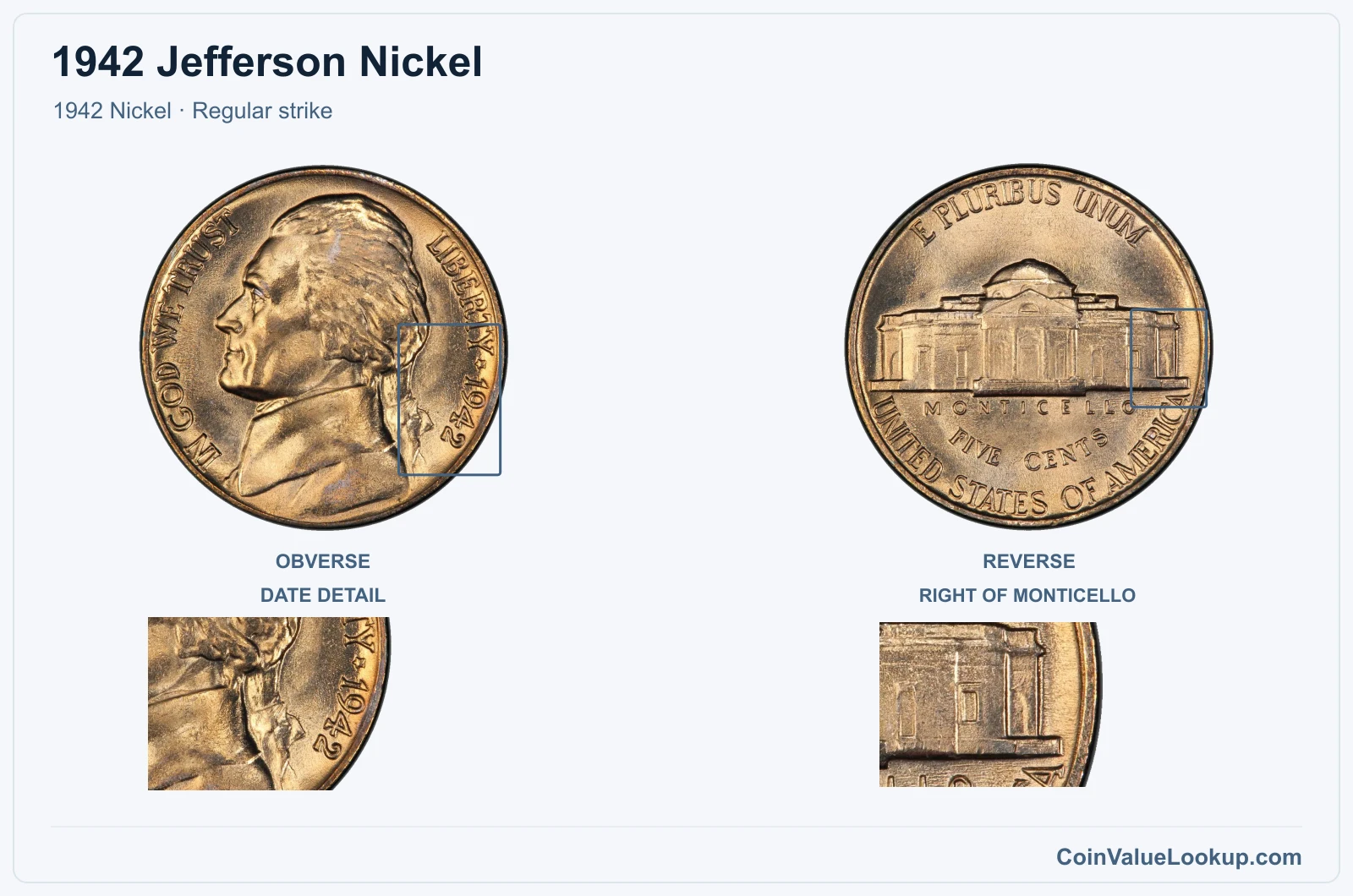
This is the standard Philadelphia business strike in copper-nickel, carrying no mintmark. You will find the reverse clean of any letter to the right of Monticello and nothing above the dome.
In VF20 the guide estimate sits at about $0.86, rising to roughly $4.96 at MS60 and $19 at MS65.
Billions of these circulated for decades, so finding one in pocket change is not unusual. The value jump into double digits only happens with genuinely uncirculated survivors showing full luster.
Full Steps coins command their own premium beyond these figures, but that designation requires professional confirmation.
| Range | Grade | Price | Auction Records | Appraisal |
|---|---|---|---|---|
| PO | PO 1 | — | Coin Identifier | |
| FR | FR 2 | — | Coin Identifier | |
| AG | AG 3 | — | Coin Identifier | |
| G | G 4 | — | Coin Identifier | |
| G 6 | Coin Identifier | |||
| VG | VG 8 | — | Coin Identifier | |
| VG 10 | — | Coin Identifier | ||
| F | F 12 | — | Coin Identifier | |
| F 15 | — | Coin Identifier | ||
| VF | VF 20 | — | Coin Identifier | |
| VF 25 | — | Coin Identifier | ||
| VF 30 | — | Coin Identifier | ||
| VF 35 | — | Coin Identifier | ||
| XF | XF 40 | — | Coin Identifier | |
| XF 45 | — | Coin Identifier | ||
| AU | AU 50 | — | Coin Identifier | |
| AU 53 | — | Coin Identifier | ||
| AU 55 | — | Coin Identifier | ||
| AU 58 | Coin Identifier | |||
| MS | MS 60 | — | Coin Identifier | |
| MS 61 | Coin Identifier | |||
| MS 62 | Coin Identifier | |||
| MS 63 | — | Coin Identifier | ||
| MS 64 | Coin Identifier | |||
| MS 65 | Coin Identifier | |||
| MS 66 | Coin Identifier | |||
| MS 67 | Coin Identifier | |||
| MS 68 | — | — | — | |
| MS 69 | — | — | — | |
| MS 70 | — | — | — |
1942 Jefferson Nickel — Nickel PR
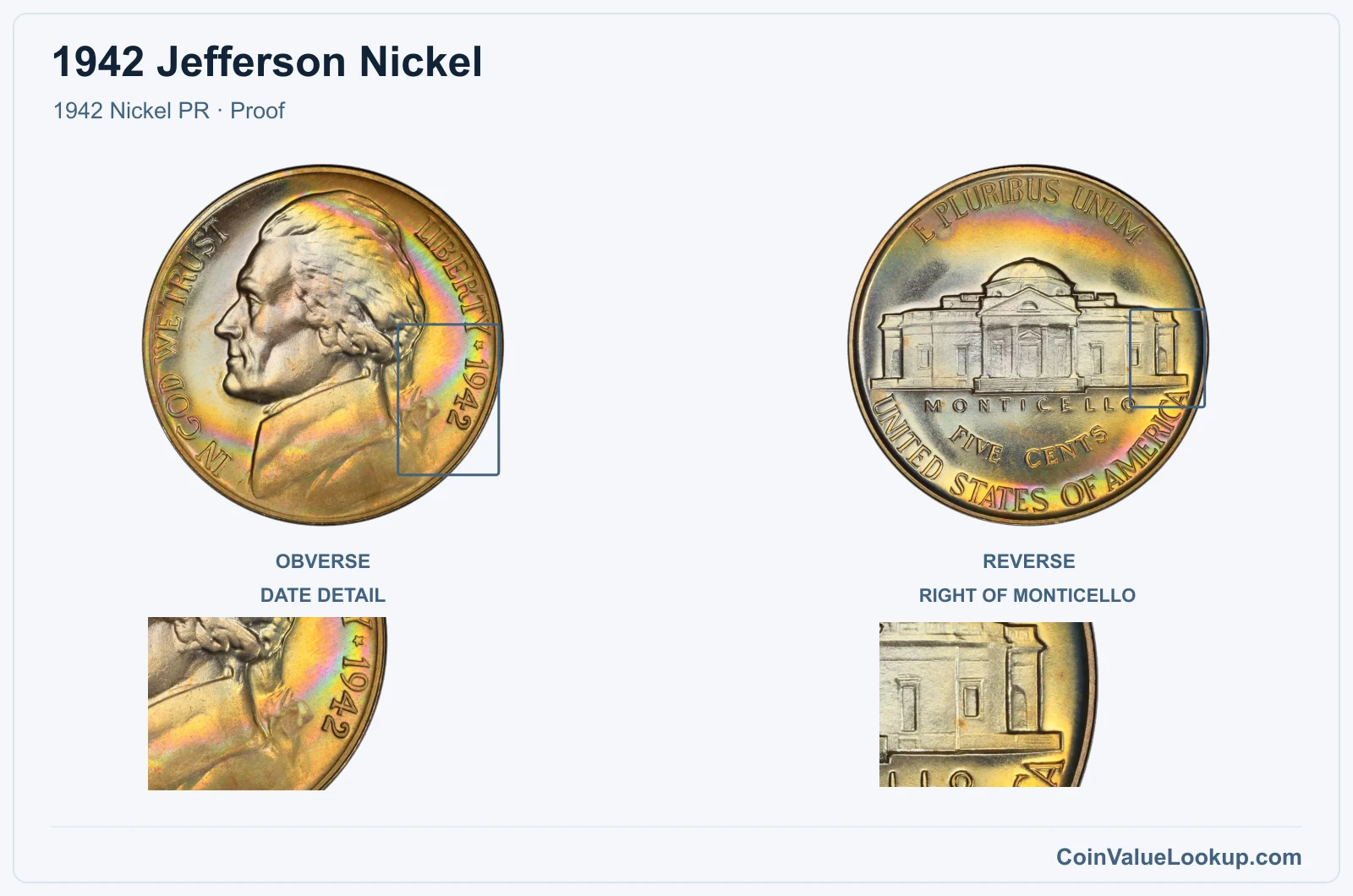
Philadelphia also struck proof nickels in the standard copper-nickel alloy for 1942. These display mirror-like fields and razor-sharp design elements that no amount of polishing a business strike can replicate.
A PR65 example carries a guide estimate of about $112.
Proof is a method of manufacture, not a grade above Mint State. Genuine proofs were sold in collector sets and typically show squared rims and deeply reflective surfaces.
Look for protected fields free of bag marks. If someone offers you a shiny business strike as a proof, walk away.
Coin Value Lookup is a handy starting point if you want to look up guide values for this and other coin series quickly.
| Range | Grade | Price | Auction Records | Appraisal |
|---|---|---|---|---|
| PR | PR 1 | — | Coin Identifier | |
| PR 2 | — | Coin Identifier | ||
| PR 3 | — | Coin Identifier | ||
| PR 4 | — | Coin Identifier | ||
| PR 6 | — | Coin Identifier | ||
| PR 8 | — | Coin Identifier | ||
| PR 10 | — | Coin Identifier | ||
| PR 12 | — | Coin Identifier | ||
| PR 15 | — | Coin Identifier | ||
| PR 20 | — | Coin Identifier | ||
| PR 25 | — | Coin Identifier | ||
| PR 30 | — | Coin Identifier | ||
| PR 35 | — | Coin Identifier | ||
| PR 40 | — | Coin Identifier | ||
| PR 45 | — | Coin Identifier | ||
| PR 50 | — | Coin Identifier | ||
| PR 53 | — | Coin Identifier | ||
| PR 55 | — | Coin Identifier | ||
| PR 58 | — | Coin Identifier | ||
| PR 60 | — | Coin Identifier | ||
| PR 61 | — | Coin Identifier | ||
| PR 62 | Coin Identifier | |||
| PR 63 | Coin Identifier | |||
| PR 64 | Coin Identifier | |||
| PR 65 | Coin Identifier | |||
| PR 66 | Coin Identifier | |||
| PR 67 | Coin Identifier | |||
| PR 68 | Coin Identifier | |||
| PR 69 | — | — | — | |
| PR 70 | — | — | — |
1942 Jefferson Nickel — D
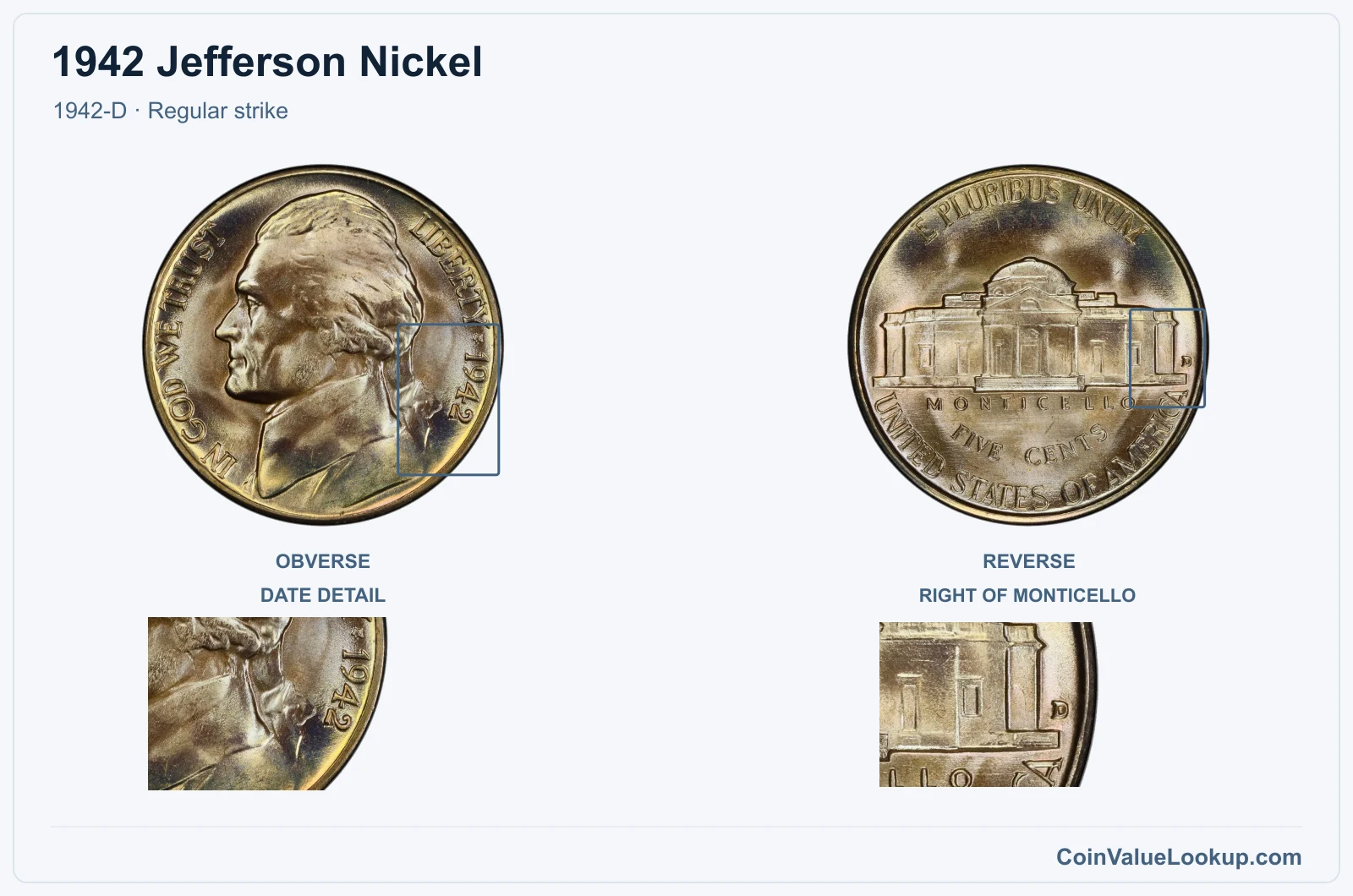
The 1942-D is a Denver copper-nickel strike with a small D mintmark to the right of Monticello. Guide estimates place it at about $3.62 in VF20, $25 at MS60, and roughly $73 at MS65, making it the priciest ordinary copper-nickel business strike of the year.
That MS65 figure reflects the difficulty of finding well-preserved examples with strong strikes. Before you celebrate, confirm the mintmark is a normal upright D with no trace of a sideways letter underneath.
If something extra lurks there, you may have the much more valuable D over horizontal D variety instead.
| Range | Grade | Price | Auction Records | Appraisal |
|---|---|---|---|---|
| PO | PO 1 | — | Coin Identifier | |
| FR | FR 2 | — | Coin Identifier | |
| AG | AG 3 | — | Coin Identifier | |
| G | G 4 | — | Coin Identifier | |
| G 6 | — | Coin Identifier | ||
| VG | VG 8 | — | Coin Identifier | |
| VG 10 | — | Coin Identifier | ||
| F | F 12 | — | Coin Identifier | |
| F 15 | — | Coin Identifier | ||
| VF | VF 20 | — | Coin Identifier | |
| VF 25 | — | Coin Identifier | ||
| VF 30 | — | Coin Identifier | ||
| VF 35 | — | Coin Identifier | ||
| XF | XF 40 | — | Coin Identifier | |
| XF 45 | — | Coin Identifier | ||
| AU | AU 50 | — | Coin Identifier | |
| AU 53 | — | Coin Identifier | ||
| AU 55 | Coin Identifier | |||
| AU 58 | Coin Identifier | |||
| MS | MS 60 | — | Coin Identifier | |
| MS 61 | — | Coin Identifier | ||
| MS 62 | — | Coin Identifier | ||
| MS 63 | Coin Identifier | |||
| MS 64 | Coin Identifier | |||
| MS 65 | Coin Identifier | |||
| MS 66 | Coin Identifier | |||
| MS 67 | Coin Identifier | |||
| MS 68 | — | — | — | |
| MS 69 | — | — | — | |
| MS 70 | — | — | — |
1942 Jefferson Nickel — D D over horizontal D
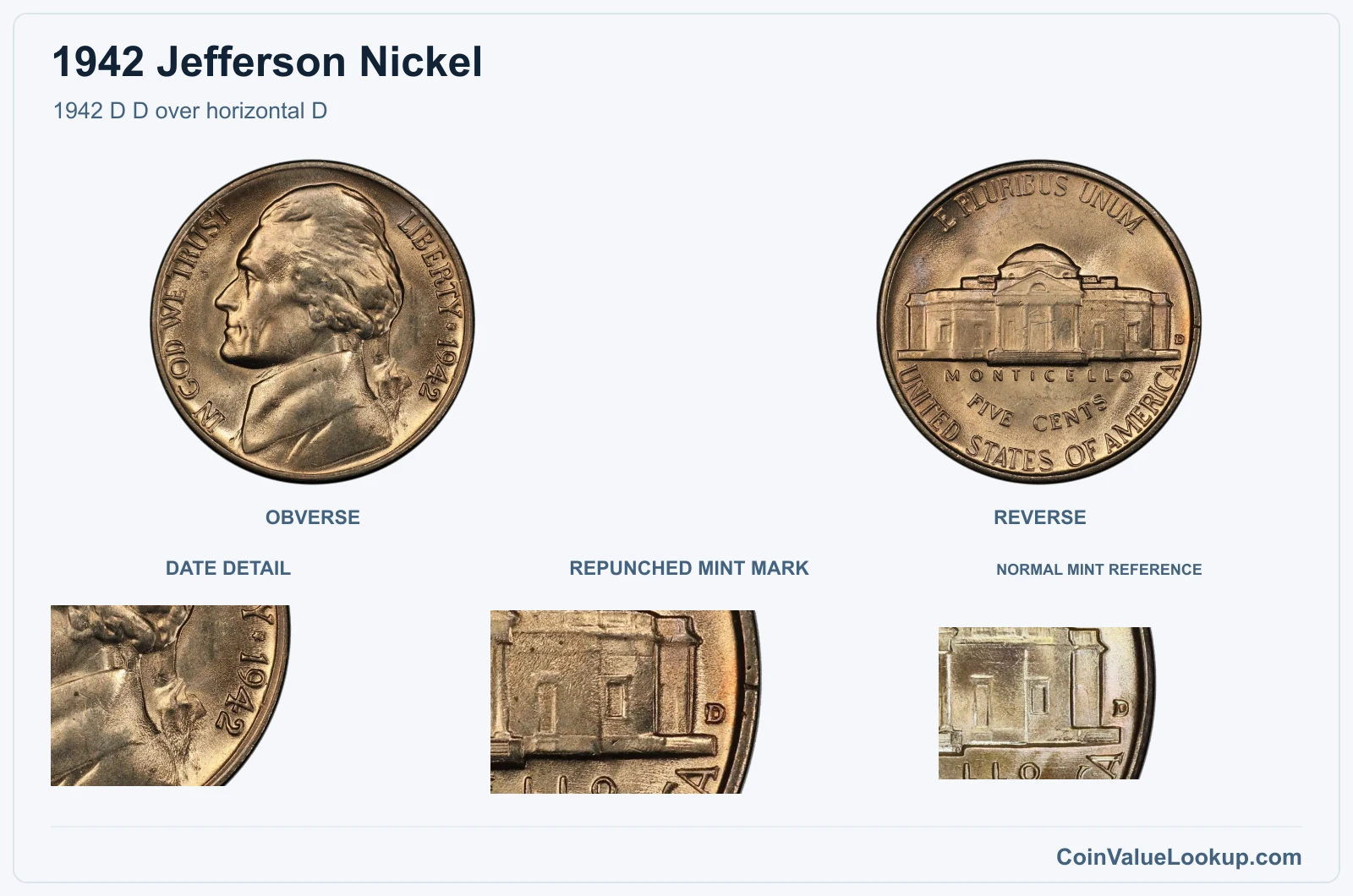
This is the headline variety of the year. The Denver mint punched the small D mintmark over a previously applied horizontal (sideways) D, leaving a clear remnant of the turned letter beneath the upright one.
You need a loupe to see it properly.
Guide estimates jump to about $92 at VF20, around $1,879 at MS60, and approximately $7,335 at MS65. Those figures dwarf the ordinary 1942-D at every grade level.
The variety must be attributed by a grading service to command these premiums in the marketplace.
Do not confuse this with damage around the mintmark area or a large wartime-style letter. The diagnostic is specifically a sideways D remnant under the normal small D.
If you own a 1942-D and have not checked this, grab a magnifier. Grade and any Full Steps designation remain separate factors in the final value.
| Range | Grade | Price | Auction Records | Appraisal |
|---|---|---|---|---|
| PO | PO 1 | — | Coin Identifier | |
| FR | FR 2 | — | Coin Identifier | |
| AG | AG 3 | — | Coin Identifier | |
| G | G 4 | — | Coin Identifier | |
| G 6 | — | Coin Identifier | ||
| VG | VG 8 | — | Coin Identifier | |
| VG 10 | — | Coin Identifier | ||
| F | F 12 | — | Coin Identifier | |
| F 15 | — | Coin Identifier | ||
| VF | VF 20 | Coin Identifier | ||
| VF 25 | Coin Identifier | |||
| VF 30 | Coin Identifier | |||
| VF 35 | — | Coin Identifier | ||
| XF | XF 40 | Coin Identifier | ||
| XF 45 | Coin Identifier | |||
| AU | AU 50 | Coin Identifier | ||
| AU 53 | Coin Identifier | |||
| AU 55 | Coin Identifier | |||
| AU 58 | Coin Identifier | |||
| MS | MS 60 | Coin Identifier | ||
| MS 61 | Coin Identifier | |||
| MS 62 | Coin Identifier | |||
| MS 63 | Coin Identifier | |||
| MS 64 | Coin Identifier | |||
| MS 65 | Coin Identifier | |||
| MS 66 | Coin Identifier | |||
| MS 67 | — | — | — | |
| MS 68 | — | — | — | |
| MS 69 | — | — | — | |
| MS 70 | — | — | — |
1942 Jefferson Nickel — P Silver
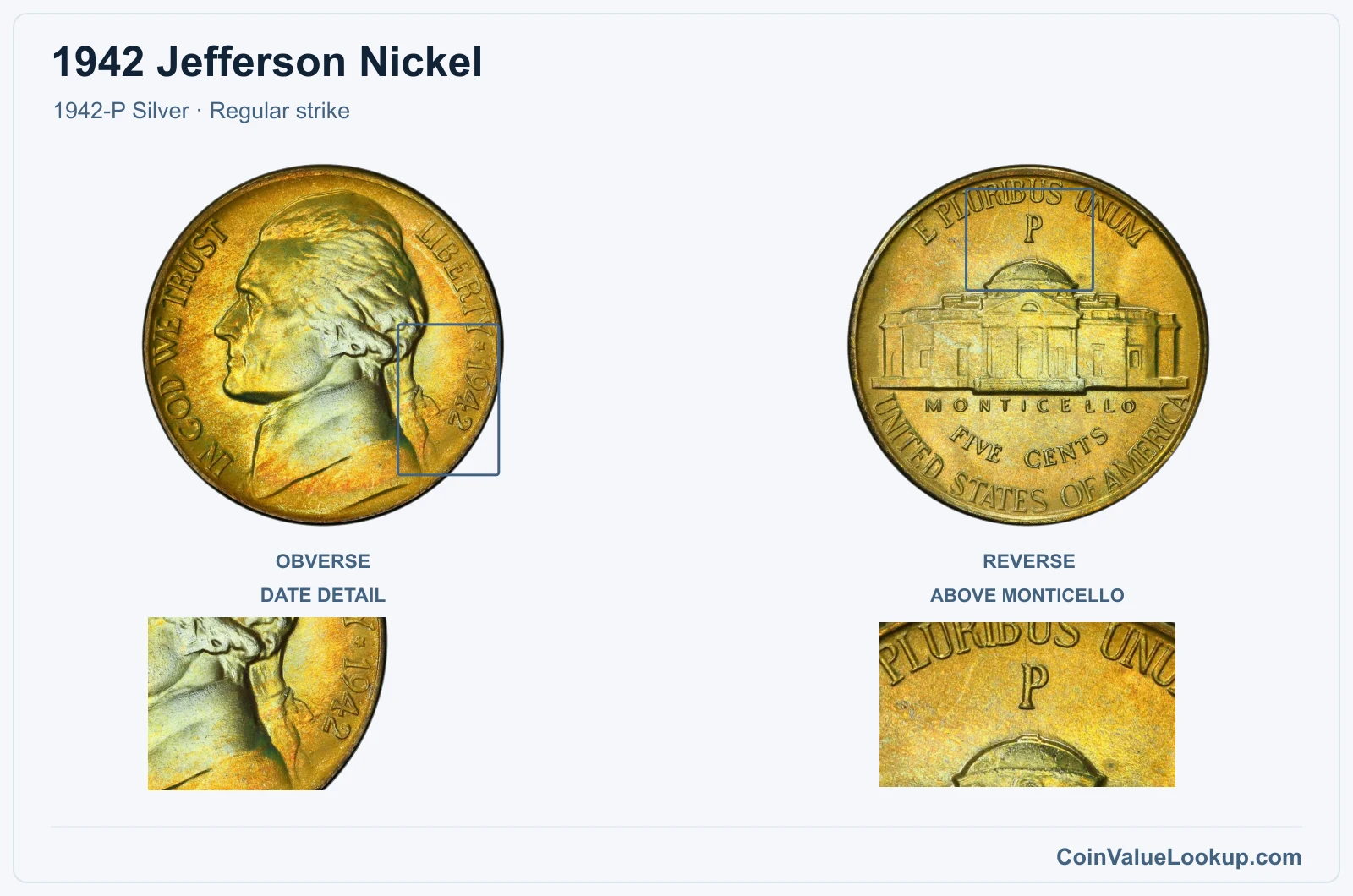
When the wartime silver alloy debuted in 1942, Philadelphia strikes received a large P above Monticello's dome, the first time a P mintmark appeared on a U.S. coin. The alloy is 56% copper, 35% silver, and 9% manganese.
Guide estimates run about $6.34 in VF20, $11.36 at MS60, and $28 at MS65. These coins also carry intrinsic silver value that shifts with the metal market, so the floor price changes over time.
The large P is unmistakable once you know where to look: centered above the dome, much bigger than any mintmark on the copper-nickel issues.
| Range | Grade | Price | Auction Records | Appraisal |
|---|---|---|---|---|
| PO | PO 1 | — | Coin Identifier | |
| FR | FR 2 | — | Coin Identifier | |
| AG | AG 3 | — | Coin Identifier | |
| G | G 4 | — | Coin Identifier | |
| G 6 | — | Coin Identifier | ||
| VG | VG 8 | — | Coin Identifier | |
| VG 10 | — | Coin Identifier | ||
| F | F 12 | — | Coin Identifier | |
| F 15 | — | Coin Identifier | ||
| VF | VF 20 | — | Coin Identifier | |
| VF 25 | — | Coin Identifier | ||
| VF 30 | — | Coin Identifier | ||
| VF 35 | — | Coin Identifier | ||
| XF | XF 40 | — | Coin Identifier | |
| XF 45 | — | Coin Identifier | ||
| AU | AU 50 | — | Coin Identifier | |
| AU 53 | — | Coin Identifier | ||
| AU 55 | — | Coin Identifier | ||
| AU 58 | Coin Identifier | |||
| MS | MS 60 | — | Coin Identifier | |
| MS 61 | — | Coin Identifier | ||
| MS 62 | — | Coin Identifier | ||
| MS 63 | Coin Identifier | |||
| MS 64 | Coin Identifier | |||
| MS 65 | Coin Identifier | |||
| MS 66 | Coin Identifier | |||
| MS 67 | Coin Identifier | |||
| MS 68 | Coin Identifier | |||
| MS 69 | — | — | — | |
| MS 70 | — | — | — |
1942 Jefferson Nickel — P Silver PR
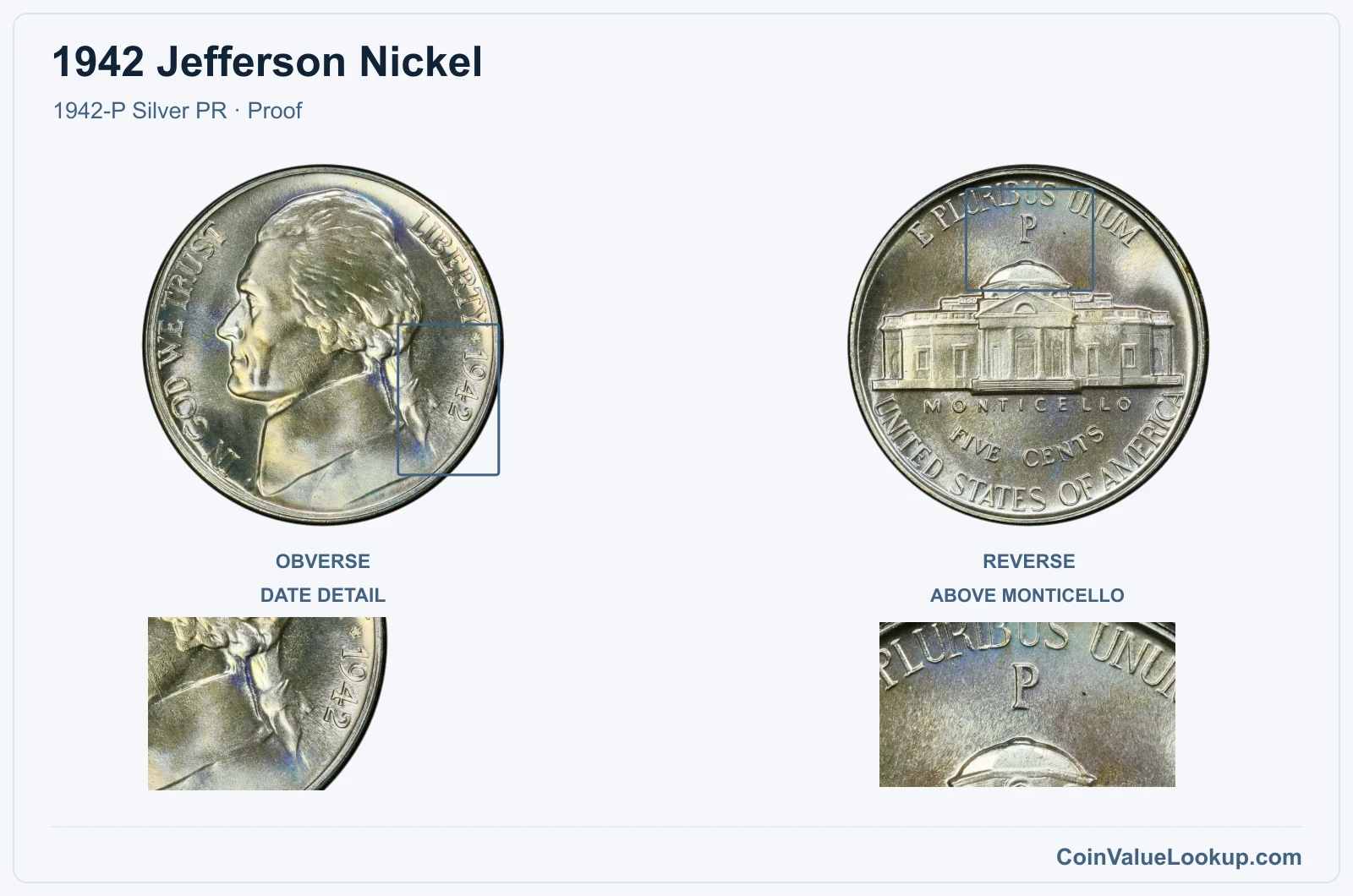
The 1942-P silver proof is the proof counterpart struck on the wartime silver-alloy planchet. It carries the same large P above Monticello and the same 56% copper, 35% silver, 9% manganese composition as the business strike, but with full proof finish: mirrored fields and crisp devices.
At PR65 the guide estimate is about $135. Proof surfaces need to be carefully distinguished from polished or dipped business strikes.
Squared-off rims and deeply reflective, undisturbed fields are hallmarks. This is the only silver-alloy proof in the 1942 wartime nickel group, making it a natural target for type-set collectors.
| Range | Grade | Price | Auction Records | Appraisal |
|---|---|---|---|---|
| PR | PR 1 | — | Coin Identifier | |
| PR 2 | — | Coin Identifier | ||
| PR 3 | — | Coin Identifier | ||
| PR 4 | — | Coin Identifier | ||
| PR 6 | — | Coin Identifier | ||
| PR 8 | — | Coin Identifier | ||
| PR 10 | — | Coin Identifier | ||
| PR 12 | — | Coin Identifier | ||
| PR 15 | — | Coin Identifier | ||
| PR 20 | — | Coin Identifier | ||
| PR 25 | — | Coin Identifier | ||
| PR 30 | — | Coin Identifier | ||
| PR 35 | — | Coin Identifier | ||
| PR 40 | — | Coin Identifier | ||
| PR 45 | — | Coin Identifier | ||
| PR 50 | — | Coin Identifier | ||
| PR 53 | — | Coin Identifier | ||
| PR 55 | — | Coin Identifier | ||
| PR 58 | — | Coin Identifier | ||
| PR 60 | Coin Identifier | |||
| PR 61 | — | Coin Identifier | ||
| PR 62 | Coin Identifier | |||
| PR 63 | Coin Identifier | |||
| PR 64 | Coin Identifier | |||
| PR 65 | Coin Identifier | |||
| PR 66 | Coin Identifier | |||
| PR 67 | Coin Identifier | |||
| PR 68 | Coin Identifier | |||
| PR 69 | — | Coin Identifier | ||
| PR 70 | — | — | — |
1942 Jefferson Nickel — S
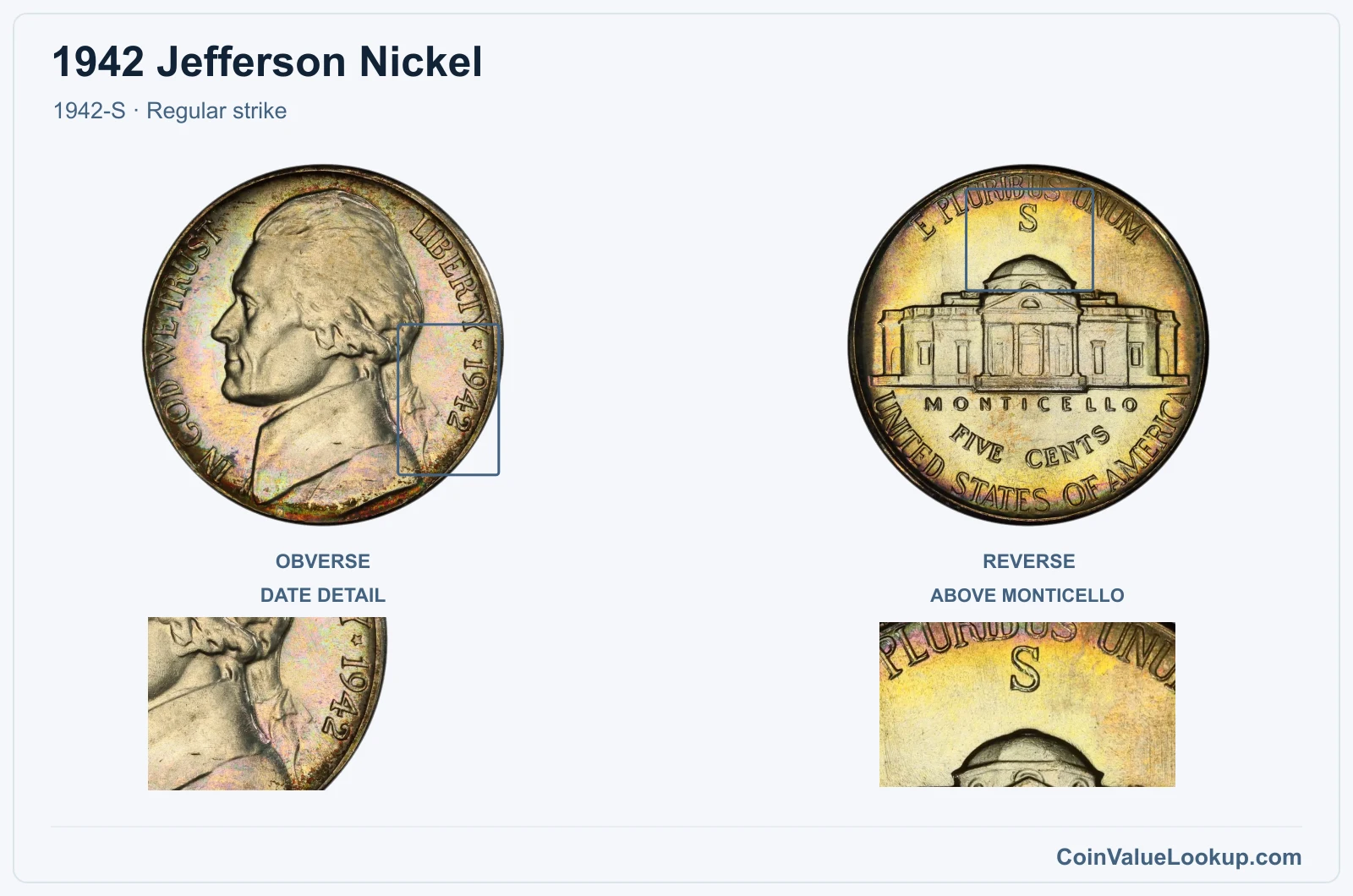
San Francisco's 1942-S is a silver-alloy business strike with a large S above the Monticello dome. Guide estimates come in at about $6.08 in VF20, $13 at MS60, and $33 at MS65.
Like the Philadelphia silver issue, the coin's silver content provides a fluctuating price floor tied to the metal market. The large S is positioned the same way as the large P on the Philadelphia version.
Condition and strike quality matter for collector premiums, but even well-worn examples retain their melt-based value.
| Range | Grade | Price | Auction Records | Appraisal |
|---|---|---|---|---|
| PO | PO 1 | — | Coin Identifier | |
| FR | FR 2 | — | Coin Identifier | |
| AG | AG 3 | — | Coin Identifier | |
| G | G 4 | — | Coin Identifier | |
| G 6 | — | Coin Identifier | ||
| VG | VG 8 | — | Coin Identifier | |
| VG 10 | — | Coin Identifier | ||
| F | F 12 | — | Coin Identifier | |
| F 15 | — | Coin Identifier | ||
| VF | VF 20 | — | Coin Identifier | |
| VF 25 | — | Coin Identifier | ||
| VF 30 | — | Coin Identifier | ||
| VF 35 | — | Coin Identifier | ||
| XF | XF 40 | — | Coin Identifier | |
| XF 45 | — | Coin Identifier | ||
| AU | AU 50 | — | Coin Identifier | |
| AU 53 | — | Coin Identifier | ||
| AU 55 | Coin Identifier | |||
| AU 58 | — | Coin Identifier | ||
| MS | MS 60 | — | Coin Identifier | |
| MS 61 | — | Coin Identifier | ||
| MS 62 | — | Coin Identifier | ||
| MS 63 | Coin Identifier | |||
| MS 64 | Coin Identifier | |||
| MS 65 | Coin Identifier | |||
| MS 66 | Coin Identifier | |||
| MS 67 | Coin Identifier | |||
| MS 68 | Coin Identifier | |||
| MS 69 | — | — | — | |
| MS 70 | — | — | — |
1942 Jefferson Nickel Error List
1. 1942 Jefferson Nickel — D over horizontal D
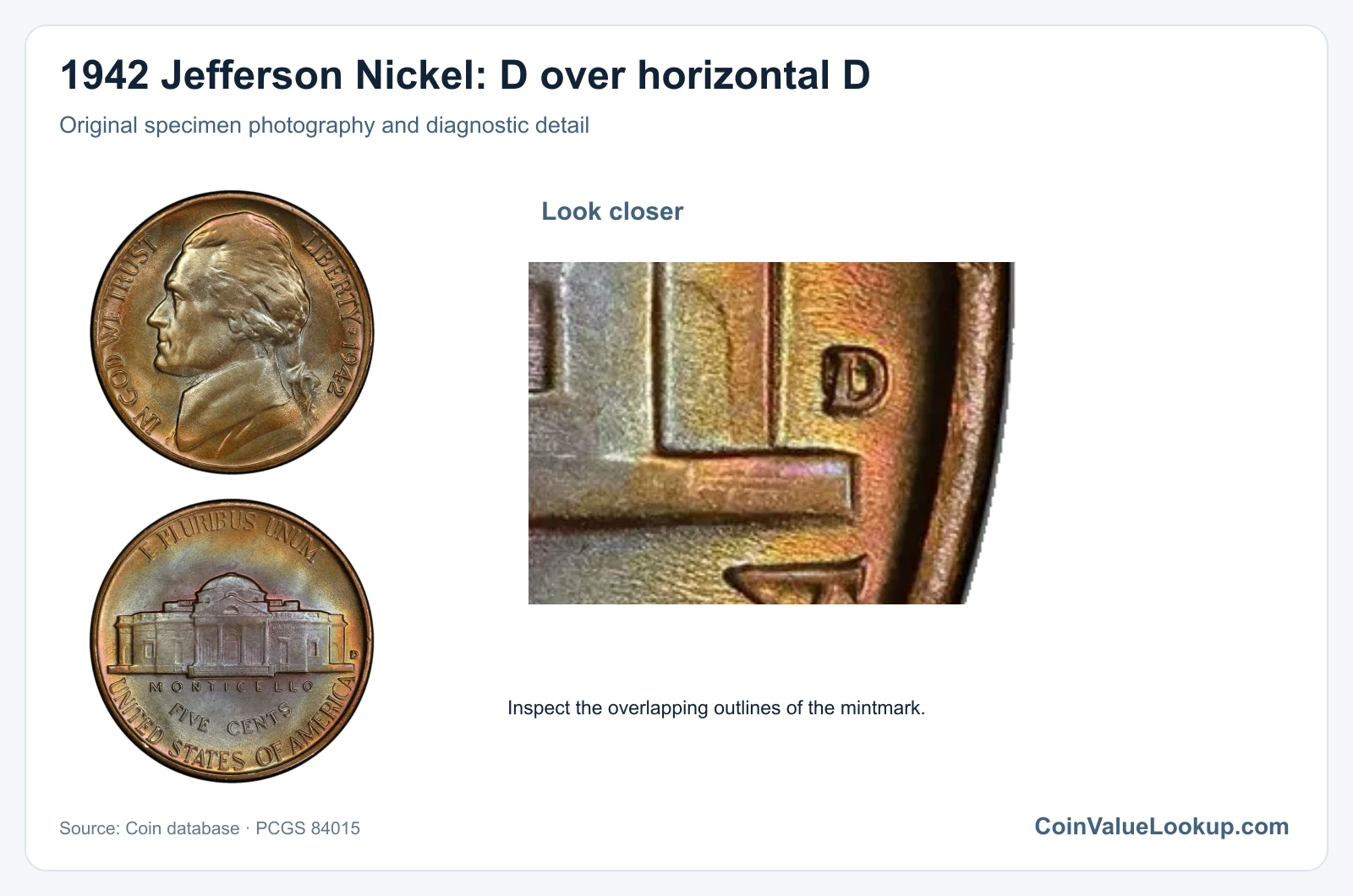
The D over horizontal D is the most widely recognized variety on the 1942 Jefferson nickel. On Denver copper-nickel strikes, a remnant of a sideways D sits beneath the normal upright small D to the right of Monticello.
You need at least a 5x loupe to see the extra letter clearly.
Guide values for the attributed variety run about $92 in VF20, roughly $1,879 at MS60, and approximately $7,335 at MS65. Those prices apply only to coins that have been professionally attributed.
Watch out for lookalikes. Damage around the mintmark area, a mechanically added letter, or simple die deterioration can mimic a repunched mintmark to the untrained eye.
The diagnostic is a consistent, recognizable sideways D impression, not random scratches. This is not the same as the large wartime D above the dome on silver coins.
2. 1942 Jefferson Nickel — Struck on a cent planchet
A 1942 nickel struck on a cent-sized copper-alloy planchet is a dramatic wrong-planchet error. The blank is smaller and lighter than a normal nickel, so the finished coin shows a reduced diameter, cropped or stretched outer lettering, and copper-colored surfaces.
A normal nickel weighs about 5 grams; the reported example weighed 3.04 grams.
A Heritage Auctions sale in July 2021 realized $2,280 for an NGC MS62 RB example. That is one recorded sale, not a broad market range.
Lookalikes include copper-plated nickels, environmentally toned coins, ground-down edges, and novelty-shop souvenirs. Certification confirming the date, alloy, and planchet type is essential before assuming any premium.
If your coin is copper-colored but weighs the standard 5 grams, it is not this error.
3. 1942 Jefferson Nickel — Struck on a silver dime planchet
This error occurred when a silver dime blank was fed into the nickel press. The result is an undersized coin with the Jefferson nickel design cropped at the perimeter because the dime planchet is smaller than the nickel die cavity.
On the reported 1942-S example, the large S mintmark survives above the dome and enough of the date remains for attribution.
A Heritage Auctions sale in January 2023 brought $3,600 for a PCGS MS63 specimen. That price reflects a single transaction.
Do not confuse this with a normal 1942-S silver war nickel, which is full-sized, or with a plated coin. The key giveaway is the physically smaller diameter and the cropped design elements.
Professional certification is the only reliable way to confirm a wrong-planchet strike.
4. 1942 Jefferson Nickel — Type1 dies on silver-alloy planchet
This is a transitional error: a 1942 Philadelphia nickel struck from ordinary Type 1 dies (no large P on the reverse) but on a silver-alloy planchet instead of the expected copper-nickel blank. The reverse looks normal for a pre-war nickel, with no large mintmark above Monticello, yet the metal is silver-composition.
A Heritage Auctions sale in August 2016 brought $9,987.50 for a PCGS Good-6 example weighing 4.7 grams. Even in low grade the rarity commands serious money.
That said, one sale is one sale.
Lookalikes include normal large-P silver coins mistakenly thought to lack a mintmark, and gray-toned copper-nickel pieces. Both alloy testing and professional certification are necessary to establish this error.
Visual inspection alone is not sufficient.
5. 1942 Jefferson Nickel — Double struck, rotated broadstrike
A double-struck 1942 nickel received two impressions from the dies, with the second strike rotated and delivered outside the collar. The result is a visibly enlarged coin showing two overlapping but offset design impressions.
You can see distinct repeated elements of Jefferson's portrait and Monticello rather than the fixed, consistent doubling of a doubled die.
A Heritage Auctions sale in September 2010 brought $862.50 for an NGC MS67 Six Full Steps example. That is one recorded result.
Do not confuse this with a doubled die, which shows fixed separation within design elements from a die-making issue. A double strike produces two clearly separate impressions of the entire design.
An altered coin or a vice job can mimic this, so professional attribution matters.
6. 1942 Jefferson Nickel — Doubled Die Obverse
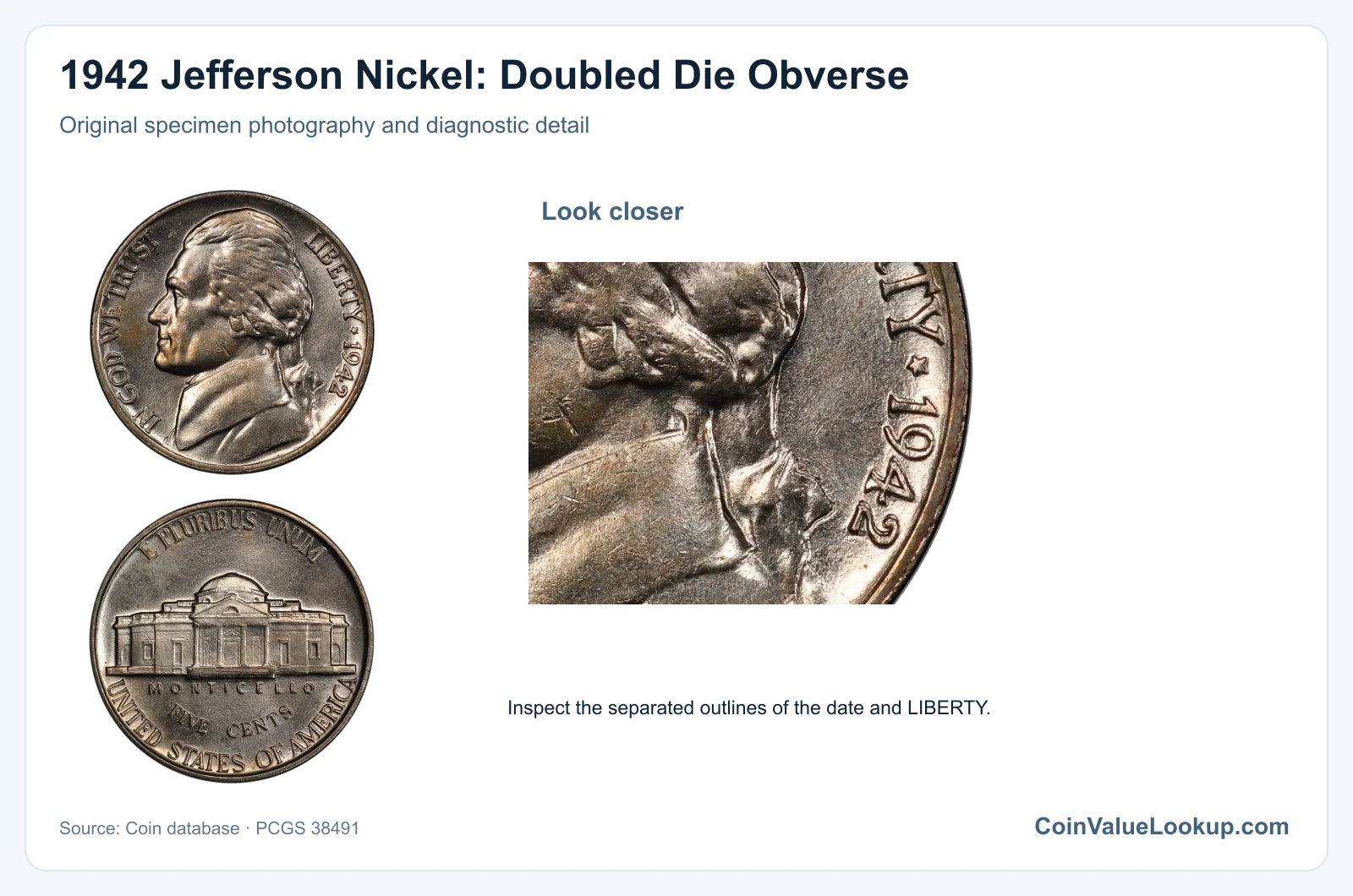
The 1942 Doubled Die Obverse is a die variety where obverse design elements show consistent doubling from the die-manufacturing process. Look at the lettering and date on the obverse under good magnification and compare against a normal 1942 nickel in similar lighting.
Genuine doubled die features show clean, consistent separation or notching on affected elements.
No specific price range is adopted for this variety. Value depends on condition, the visibility of the doubling, and which specific die pairing is involved.
Professional attribution directly affects marketability.
Machine doubling is the most common lookalike: it produces flat, shelf-like displacement rather than the rounded, separated profiles of a true doubled die. Reflections and worn die contours can also fool you.
Side-by-side comparison with a confirmed normal coin under identical light is the best first step before seeking professional evaluation.