1941 Washington Quarter Coin Value: How Much Is It Worth?
A 1941 Washington Quarter is a 90% silver coin that carries real bullion and collector value. Circulated examples from any mint start around $16.43 in well-worn condition, while choice uncirculated pieces graded MS65 can reach roughly $89 depending on the mint.
Philadelphia proof strikes command higher premiums, with a PR65 example estimated near $156. Several authenticated error varieties also exist for this year, and those can push values well beyond ordinary levels.
Fast Way to Identify Your 1941 Washington Quarter
The quickest way to start figuring out what your 1941 quarter is worth is to upload clear photos of both the front and back of the coin. Our identifier can provide a preliminary identification of your coin's mint, version, and general condition from those images alone.
That first step helps you zero in on the right value range before digging deeper.
1941 Washington Quarter Value
Upload both sides of your 1941 Washington Quarter.
Front Obverse
Upload photo
Back Reverse
Upload photo
Which 1941 Washington Quarter Versions Are Worth Money?
- The 1941-D in MS65 condition is estimated around $89, matching the 1941-S at the same grade — both outpace the Philadelphia issue at that level.
- Philadelphia proof strikes graded PR65 carry an estimated value near $156, making them the highest-value regular issue for the year at that tier.
- A 1941-D Doubled Die Obverse authenticated by PCGS sold for $1,320 in MS66 at Heritage Auctions in April 2024.
- A 1941-D Doubled Die Reverse in PCGS MS66 sold for $169 at Heritage Auctions in April 2024, showing that even less dramatic die doubling can carry a premium.
- Die crack and die chip varieties exist for 1941 quarters; value depends on the size, location, and visibility of the raised feature.
Step 1: Identify Your 1941 Washington Quarter Mint Mark and Version
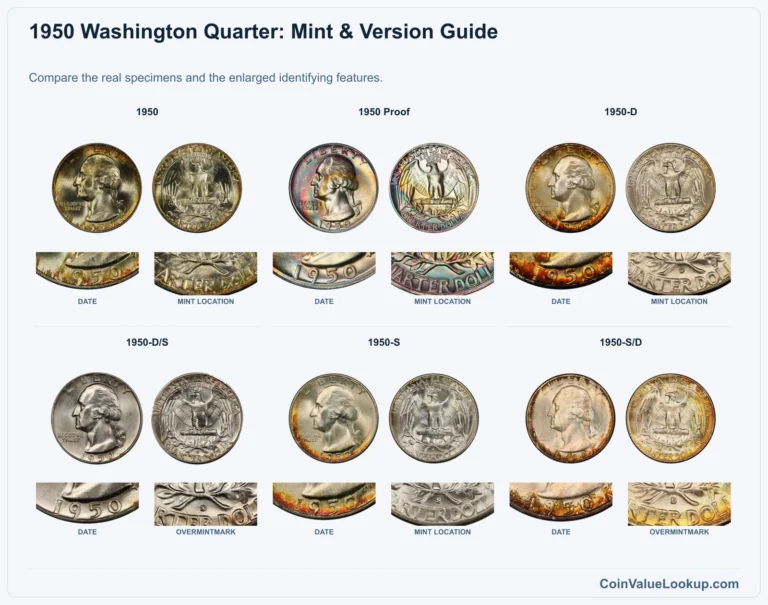
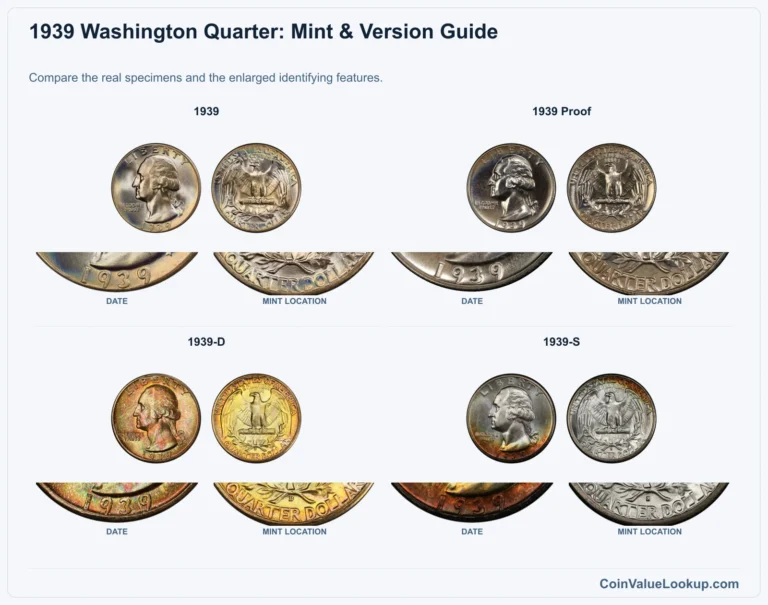
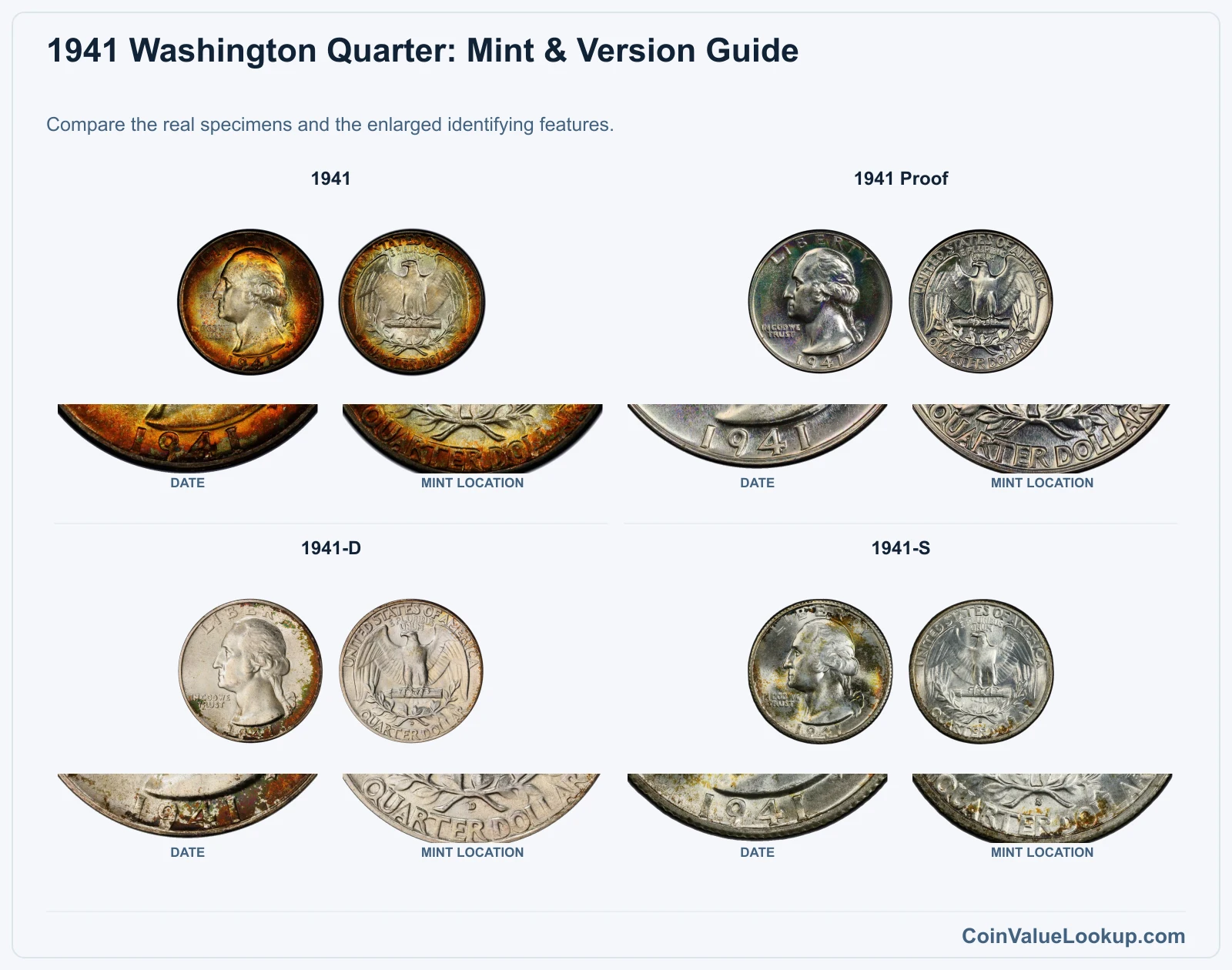
Start with the date on the obverse — you are looking for "1941" below Washington's portrait. Then flip the coin over and check the reverse just below the wreath tie.
A small "D" means Denver, an "S" means San Francisco, and a blank space there means Philadelphia.
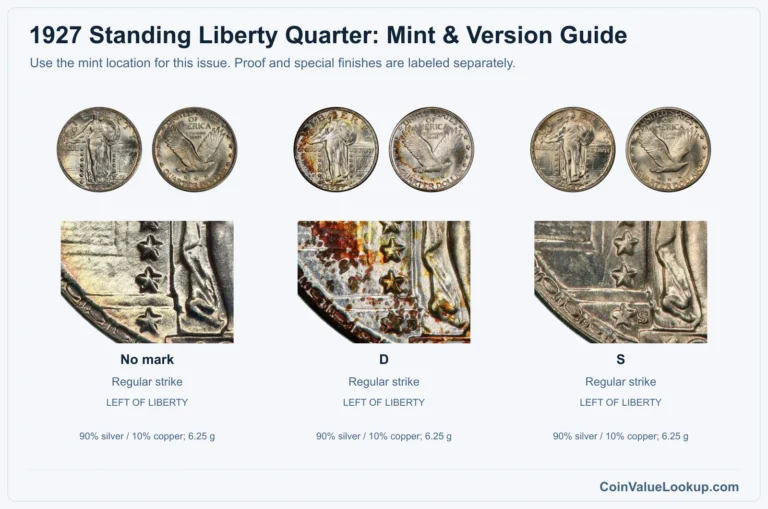
All regular 1941 quarters are struck in 90% silver and 10% copper, weigh about 6.25 grams, and measure roughly 24.3 mm across. The edge should be fully reeded with no copper-colored stripe visible — if you see a sandwich layer, you are looking at a later clad coin, not this issue.
Philadelphia also produced proof strikes this year. Those have deeply mirrored fields and exceptionally sharp design details from special die preparation.
A shiny circulated coin that has been polished is not a proof. Proof status comes from the manufacturing method, not from how pretty a coin looks after decades in a drawer.
Step 2: Check Your 1941 Washington Quarter Grade
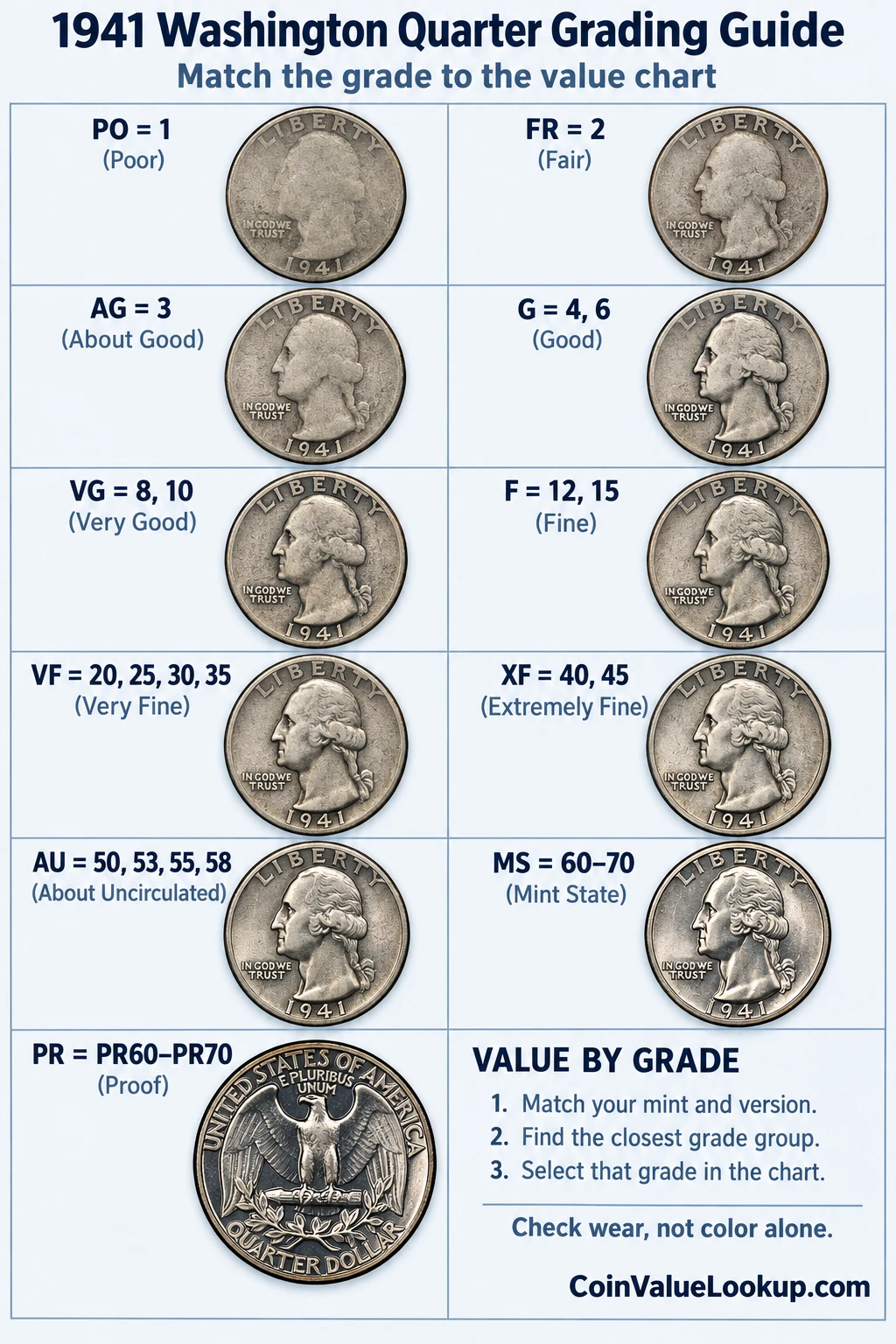
Look at Washington's hair directly above the ear first. On a well-preserved coin, individual strands are visible and the luster rolls smoothly across them.
As the grade drops, this area flattens and loses detail before almost anything else. The cheek and jawline are your next checkpoints — light friction shows there quickly.
On the reverse, inspect the eagle's breast feathers and the tops of the wings. Weak breast detail can mean wear, but it can also mean a soft strike, so compare both sides before deciding.
A softly struck coin often still has cartwheel luster in protected areas.
Hairlines from cleaning, rim dings, and unnatural color are separate issues that hurt a coin's grade and desirability regardless of how much design detail remains. Do not assume a bright, shiny surface means a high grade — original toning and undisturbed luster are what grading services reward.
Use the comparison image nearby to match your coin's wear pattern to approximate condition levels.
Step 3: Check 1941 Washington Quarter Value by Mint and Version
1941 Washington Quarter
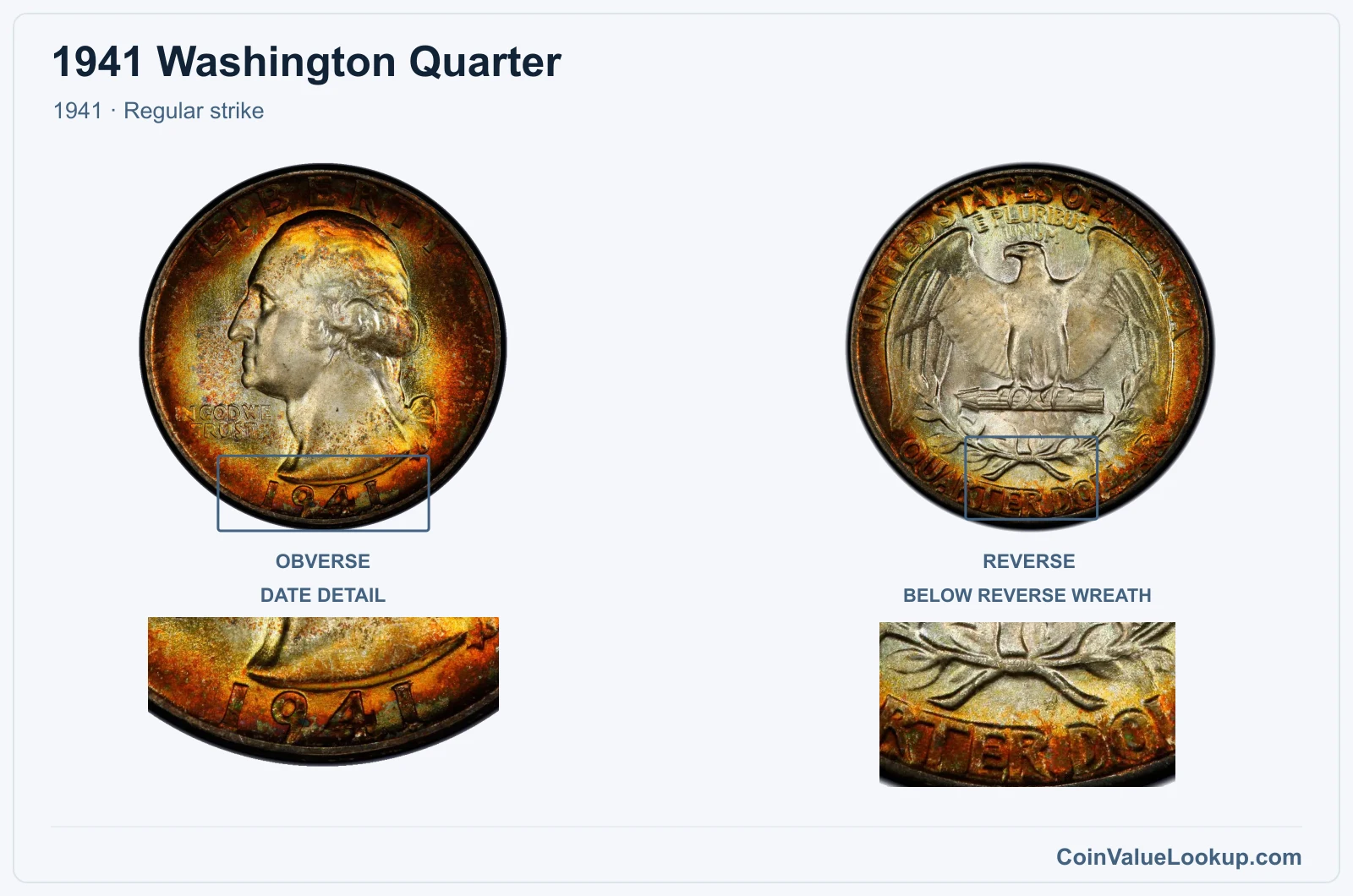
The 1941 Philadelphia quarter has no mintmark — just a smooth area below the wreath on the reverse. Philadelphia struck large quantities, and many survivors exist today in all grades.
A well-worn G4 example is estimated around $16.43, while an MS60 uncirculated piece sits near $21. Push up to a clean MS65 and the guide estimate reaches about $51.
Original surfaces matter here. Uncleaned coins with natural toning or intact cartwheel luster are preferable to pieces that have been scrubbed bright.
Most of the value jump between circulated and uncirculated comes down to how well those original surfaces survived, not just how much design detail remains.
| Range | Grade | Price | Auction Records | Appraisal |
|---|---|---|---|---|
| PO | PO 1 | — | Coin Identifier | |
| FR | FR 2 | — | Coin Identifier | |
| AG | AG 3 | — | Coin Identifier | |
| G | G 4 | — | Coin Identifier | |
| G 6 | — | Coin Identifier | ||
| VG | VG 8 | — | Coin Identifier | |
| VG 10 | — | Coin Identifier | ||
| F | F 12 | — | Coin Identifier | |
| F 15 | — | Coin Identifier | ||
| VF | VF 20 | — | Coin Identifier | |
| VF 25 | — | Coin Identifier | ||
| VF 30 | — | Coin Identifier | ||
| VF 35 | — | Coin Identifier | ||
| XF | XF 40 | — | Coin Identifier | |
| XF 45 | — | Coin Identifier | ||
| AU | AU 50 | — | Coin Identifier | |
| AU 53 | — | Coin Identifier | ||
| AU 55 | — | Coin Identifier | ||
| AU 58 | Coin Identifier | |||
| MS | MS 60 | — | Coin Identifier | |
| MS 61 | — | Coin Identifier | ||
| MS 62 | Coin Identifier | |||
| MS 63 | Coin Identifier | |||
| MS 64 | Coin Identifier | |||
| MS 65 | Coin Identifier | |||
| MS 66 | Coin Identifier | |||
| MS 67 | Coin Identifier | |||
| MS 68 | Coin Identifier | |||
| MS 69 | — | — | — | |
| MS 70 | — | — | — |
1941 Washington Quarter — Proof
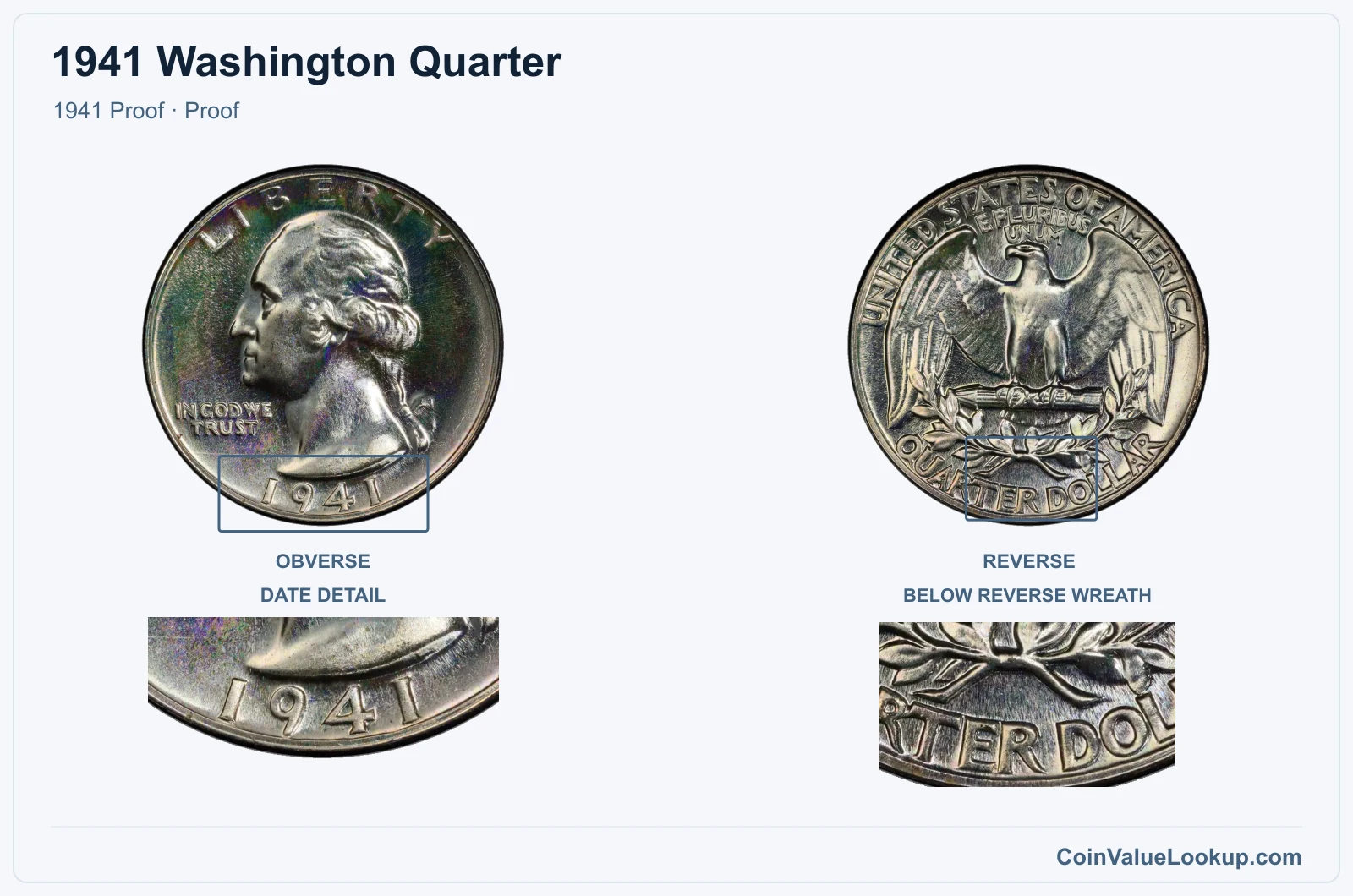
The 1941 Proof was struck only at Philadelphia using polished dies and specially prepared planchets, producing deeply mirrored fields and razor-sharp design elements. These are not simply nice-looking circulation strikes — proof is a manufacturing method.
A coin that has been polished or lightly circulated does not become a proof, and a genuine proof that has been mishandled does not become a business strike.
A PR65 example carries a guide estimate of about $156, well above any business-strike version at comparable preservation. When evaluating a suspected proof, look for perfectly squared rim edges, full mirror reflection in the fields, and no signs of bag contact or circulation wear.
If you are exploring values across multiple years and denominations, Coin Value Lookup offers guides that can help you compare quickly.
Authentication by a recognized grading service is the surest way to confirm proof status, since some well-preserved Philadelphia business strikes can superficially resemble proofs to an untrained eye.
| Range | Grade | Price | Auction Records | Appraisal |
|---|---|---|---|---|
| PR | PR 1 | — | Coin Identifier | |
| PR 2 | — | Coin Identifier | ||
| PR 3 | — | Coin Identifier | ||
| PR 4 | — | Coin Identifier | ||
| PR 6 | — | Coin Identifier | ||
| PR 8 | — | Coin Identifier | ||
| PR 10 | — | Coin Identifier | ||
| PR 12 | — | Coin Identifier | ||
| PR 15 | — | Coin Identifier | ||
| PR 20 | — | Coin Identifier | ||
| PR 25 | — | Coin Identifier | ||
| PR 30 | — | Coin Identifier | ||
| PR 35 | — | Coin Identifier | ||
| PR 40 | — | Coin Identifier | ||
| PR 45 | — | Coin Identifier | ||
| PR 50 | — | Coin Identifier | ||
| PR 53 | — | Coin Identifier | ||
| PR 55 | — | Coin Identifier | ||
| PR 58 | Coin Identifier | |||
| PR 60 | — | Coin Identifier | ||
| PR 61 | — | Coin Identifier | ||
| PR 62 | Coin Identifier | |||
| PR 63 | Coin Identifier | |||
| PR 64 | Coin Identifier | |||
| PR 65 | Coin Identifier | |||
| PR 66 | Coin Identifier | |||
| PR 67 | Coin Identifier | |||
| PR 68 | Coin Identifier | |||
| PR 69 | — | — | — | |
| PR 70 | — | — | — |
1941 Washington Quarter — D
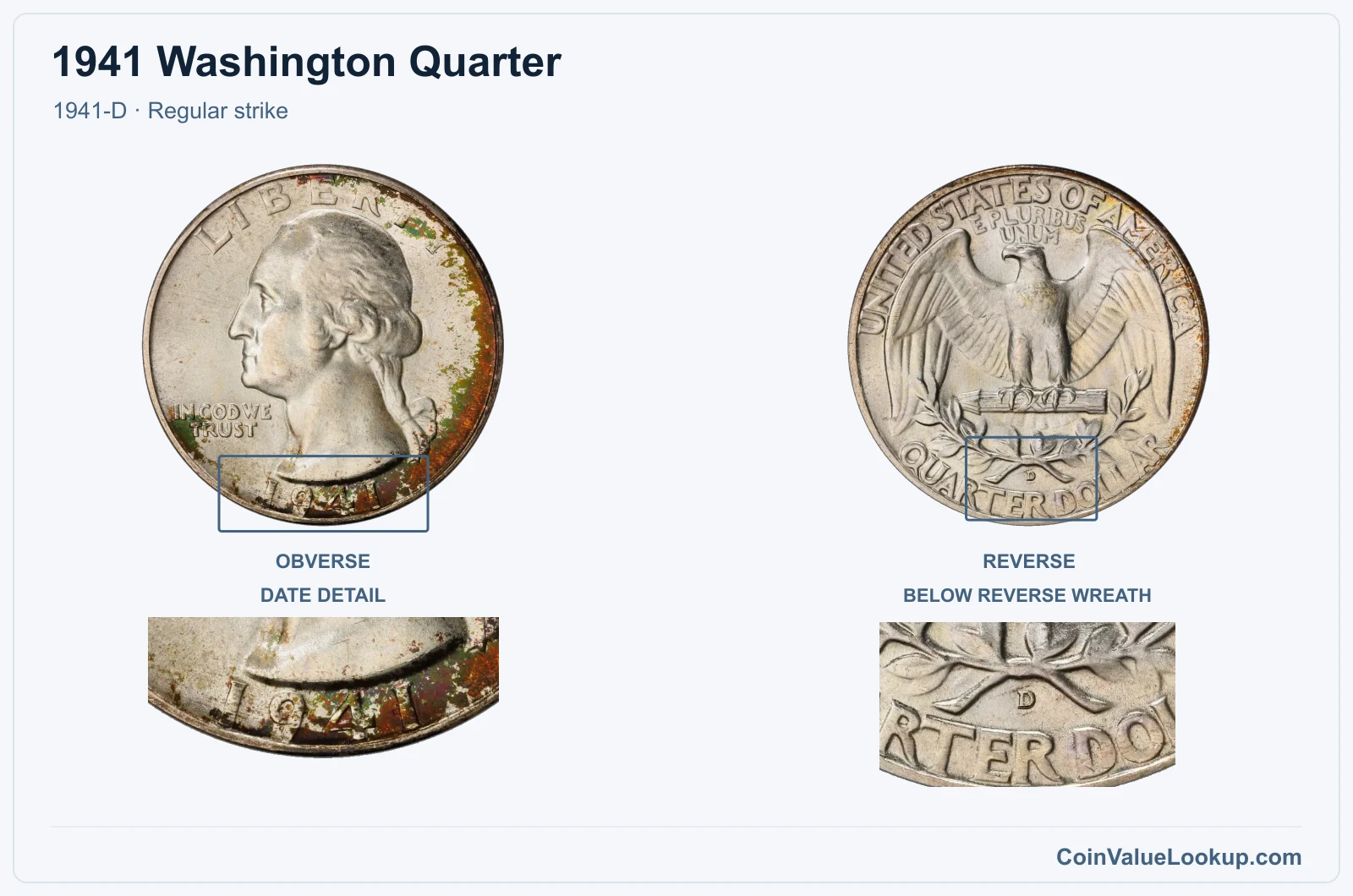
Look for a small "D" mintmark on the reverse beneath the wreath. The 1941-D starts at roughly $16.43 in G4 condition, but the spread between circulated and uncirculated is wider here than for the Philadelphia issue.
An MS60 is estimated near $65, and an MS65 reaches about $89.
That jump from the Philadelphia MS65 estimate of $51 to the Denver MS65 of $89 reflects relative availability at the gem level. Denver coins in fully original, mark-free condition are less common in top grades.
If yours has clean, lustrous surfaces and sharp hair detail, it is worth a closer look.
| Range | Grade | Price | Auction Records | Appraisal |
|---|---|---|---|---|
| PO | PO 1 | — | Coin Identifier | |
| FR | FR 2 | — | Coin Identifier | |
| AG | AG 3 | — | Coin Identifier | |
| G | G 4 | — | Coin Identifier | |
| G 6 | — | Coin Identifier | ||
| VG | VG 8 | — | Coin Identifier | |
| VG 10 | — | Coin Identifier | ||
| F | F 12 | — | Coin Identifier | |
| F 15 | — | Coin Identifier | ||
| VF | VF 20 | — | Coin Identifier | |
| VF 25 | — | Coin Identifier | ||
| VF 30 | — | Coin Identifier | ||
| VF 35 | — | Coin Identifier | ||
| XF | XF 40 | — | Coin Identifier | |
| XF 45 | — | Coin Identifier | ||
| AU | AU 50 | — | Coin Identifier | |
| AU 53 | — | Coin Identifier | ||
| AU 55 | Coin Identifier | |||
| AU 58 | — | Coin Identifier | ||
| MS | MS 60 | — | Coin Identifier | |
| MS 61 | — | Coin Identifier | ||
| MS 62 | Coin Identifier | |||
| MS 63 | Coin Identifier | |||
| MS 64 | Coin Identifier | |||
| MS 65 | Coin Identifier | |||
| MS 66 | Coin Identifier | |||
| MS 67 | Coin Identifier | |||
| MS 68 | Coin Identifier | |||
| MS 69 | — | — | — | |
| MS 70 | — | — | — |
1941 Washington Quarter — S
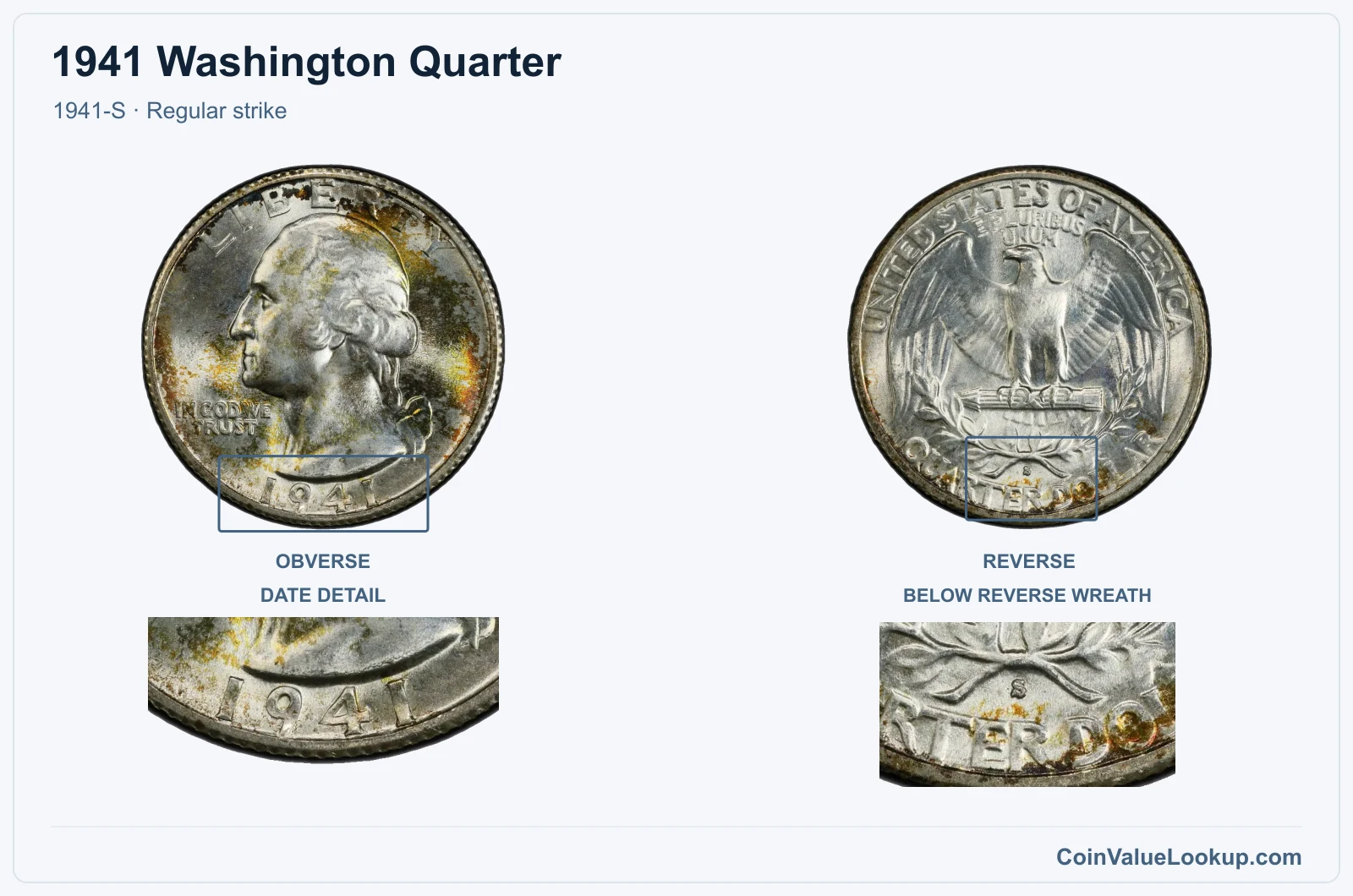
The 1941-S carries a small "S" mintmark in the same spot below the reverse wreath. In G4 condition the guide estimate is around $16.43, matching the other mints at that worn grade.
Things get more interesting at MS60, where the estimate is about $58, and at MS65 it matches the Denver coin at roughly $89.
San Francisco quarters from this era sometimes display softer strikes, so do not confuse a mushy eagle breast with heavy wear. Check luster in the fields — if it is still rolling, the coin may grade higher than the design sharpness alone suggests.
As always with silver Washingtons, original surfaces beat a cleaned coin every time.
| Range | Grade | Price | Auction Records | Appraisal |
|---|---|---|---|---|
| PO | PO 1 | — | Coin Identifier | |
| FR | FR 2 | — | Coin Identifier | |
| AG | AG 3 | — | Coin Identifier | |
| G | G 4 | — | Coin Identifier | |
| G 6 | — | Coin Identifier | ||
| VG | VG 8 | — | Coin Identifier | |
| VG 10 | — | Coin Identifier | ||
| F | F 12 | — | Coin Identifier | |
| F 15 | — | Coin Identifier | ||
| VF | VF 20 | — | Coin Identifier | |
| VF 25 | — | Coin Identifier | ||
| VF 30 | — | Coin Identifier | ||
| VF 35 | — | Coin Identifier | ||
| XF | XF 40 | — | Coin Identifier | |
| XF 45 | — | Coin Identifier | ||
| AU | AU 50 | — | Coin Identifier | |
| AU 53 | — | Coin Identifier | ||
| AU 55 | — | Coin Identifier | ||
| AU 58 | Coin Identifier | |||
| MS | MS 60 | — | Coin Identifier | |
| MS 61 | — | Coin Identifier | ||
| MS 62 | Coin Identifier | |||
| MS 63 | Coin Identifier | |||
| MS 64 | Coin Identifier | |||
| MS 65 | Coin Identifier | |||
| MS 66 | Coin Identifier | |||
| MS 67 | Coin Identifier | |||
| MS 68 | Coin Identifier | |||
| MS 69 | — | — | — | |
| MS 70 | — | — | — |
1941 Washington Quarter Error List
1. 1941 Washington Quarter — Doubled Die Obverse
A Doubled Die Obverse has been authenticated on the 1941-D quarter specifically. True die doubling on the obverse shows a repeated, raised pattern in the lettering or design elements — it is created during the die-making process, so the doubling is consistent and precise across every coin struck by that die.
The key distinction is between genuine die doubling and machine doubling. Machine doubling produces flat, shelf-like distortions that lack the sharp secondary image of a real doubled die.
Scratches, wear, and post-strike damage can also mimic doubling to an untrained eye, but none of those will show the repeatable die-made pattern.
A PCGS-authenticated MS66 example of the 1941-D DDO sold for $1,320 at Heritage Auctions in April 2024. That is a single recorded result in a very high grade, not a guaranteed price for every specimen.
Magnification and comparison against an attributed example are essential before drawing conclusions.
2. 1941 Washington Quarter — Doubled Die Reverse
The 1941-D quarter also has an authenticated Doubled Die Reverse variety. Inspect the reverse lettering and design contours under magnification — genuine doubling will appear as a crisp, raised secondary image that matches the die-made pattern across the affected area.
Do not confuse this with flat, shelf-like machine doubling, which is far more common and far less valuable. Machine doubling is caused by die bounce during striking, producing a mushy, spread appearance rather than a distinct second impression.
Ordinary wear, scratches, and corrosion can also create misleading visual effects on the reverse.
A PCGS MS66 example of this 1941-D DDR sold for $169 at Heritage Auctions in April 2024. That single result gives a reference point, but individual value depends on the coin's actual grade and the strength of the doubling.
Professional attribution is the safest route for confirming this variety.
3. 1941 Washington Quarter — Die Crack / Die Chip
Die cracks and die chips are reported for 1941 quarters. These show up as thin raised lines or small raised blobs on the coin's surface, caused by fractures in the steel die during production.
A die crack typically runs as a raised line connecting design elements or extending from the rim inward, while a die chip appears as a small raised lump where a piece of the die face broke away.
A rim-connected break that removes a significant chunk of the design is sometimes called a cud — that is a more dramatic version of the same phenomenon. Do not confuse any of these with incuse scratches, surface corrosion, or foreign material stuck to the coin.
Die-made features are raised and feel smooth; post-mint damage is usually incuse or rough.
No specific price range is adopted for this category because value depends heavily on the size, location, and visual impact of the individual crack or chip, along with the coin's overall condition.