1910 Wheat Penny Coin Value: How Much Is It Worth?
A 1910 Wheat Penny can range from about $0.61 in Good-4 condition up to around $178 at MS63, depending on which mint struck it. Those guide figures cover ordinary Philadelphia and San Francisco circulation strikes at specific grades — they are not the full market picture.
Proofs, major varieties, and error coins are priced separately, and original surfaces, color, and wear all affect what a buyer will actually pay.
Fast Way to Identify Your 1910 Wheat Penny
Snap a clear photo of the front and back of your 1910 penny and upload both images for a preliminary identification. This can help you figure out the mint, general condition range, and whether any obvious variety or error features are present.
It is not a substitute for professional grading or authentication, but it is a solid first step.
1910 Wheat Penny Value
Upload both sides of your 1910 Wheat Penny.
Front Obverse
Upload photo
Back Reverse
Upload photo
Which 1910 Wheat Penny Versions Are Worth Money?
- The 1910-S carries a significantly higher guide value than the Philadelphia issue at every grade level, starting around $19 in G4 versus $0.61 for a no-mintmark coin.
- A genuine 1910 matte proof from Philadelphia is a separate collectible category with a guide value near $825 at PR63 — look for squared rims and distinctive prepared surfaces.
- Repunched mintmark varieties on the 1910-S can add collector interest; value depends on the specific variety, its severity, and authenticated condition.
- Strong original surfaces without cleaning or corrosion improve a coin's appeal regardless of grade, especially in the lower circulated range where many survivors show damage.
Step 1: Identify Your 1910 Wheat Penny Mint Mark and Version
Flip your coin to the reverse side first. You should see two wheat ears flanking the words ONE CENT — that confirms you have a Wheat-reverse Lincoln cent rather than a later Memorial design.
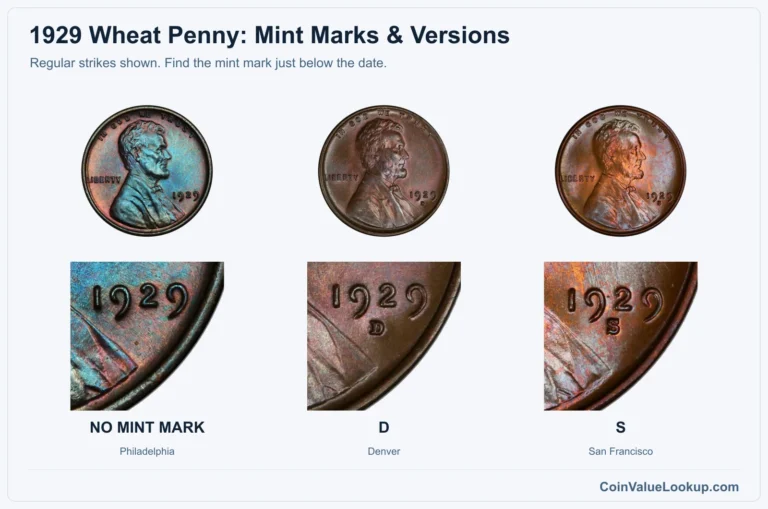
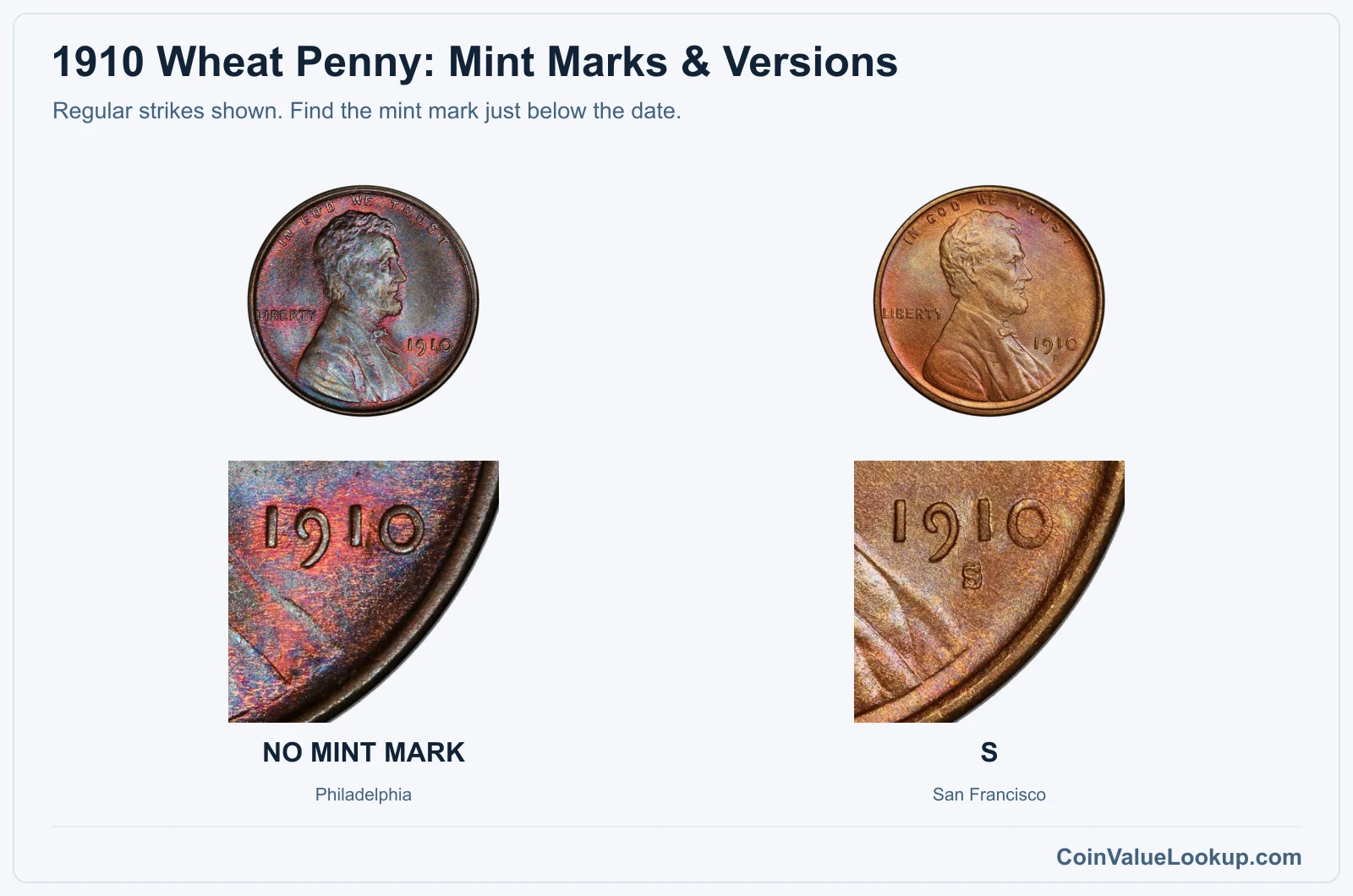
Now check under the date on the obverse. If there is no letter, your coin was struck at Philadelphia.
A small "S" means San Francisco. No Denver-minted 1910 cents exist, so if you see a "D" you are looking at a different year.
The coin should weigh about 3.11 grams and have a plain (smooth) edge. It is a 95% copper alloy with 5% tin and zinc.
If it feels unusually light or has a reeded edge, something else is going on.
Philadelphia also produced a matte proof version in 1910. This is a special manufacturing finish with squared rims and prepared matte surfaces — it is not the same as a well-struck circulation coin that happens to look sharp.
Distinguishing a genuine matte proof from a nice business strike requires careful comparison of the rim profile and surface texture.
Step 2: Check Your 1910 Wheat Penny Grade
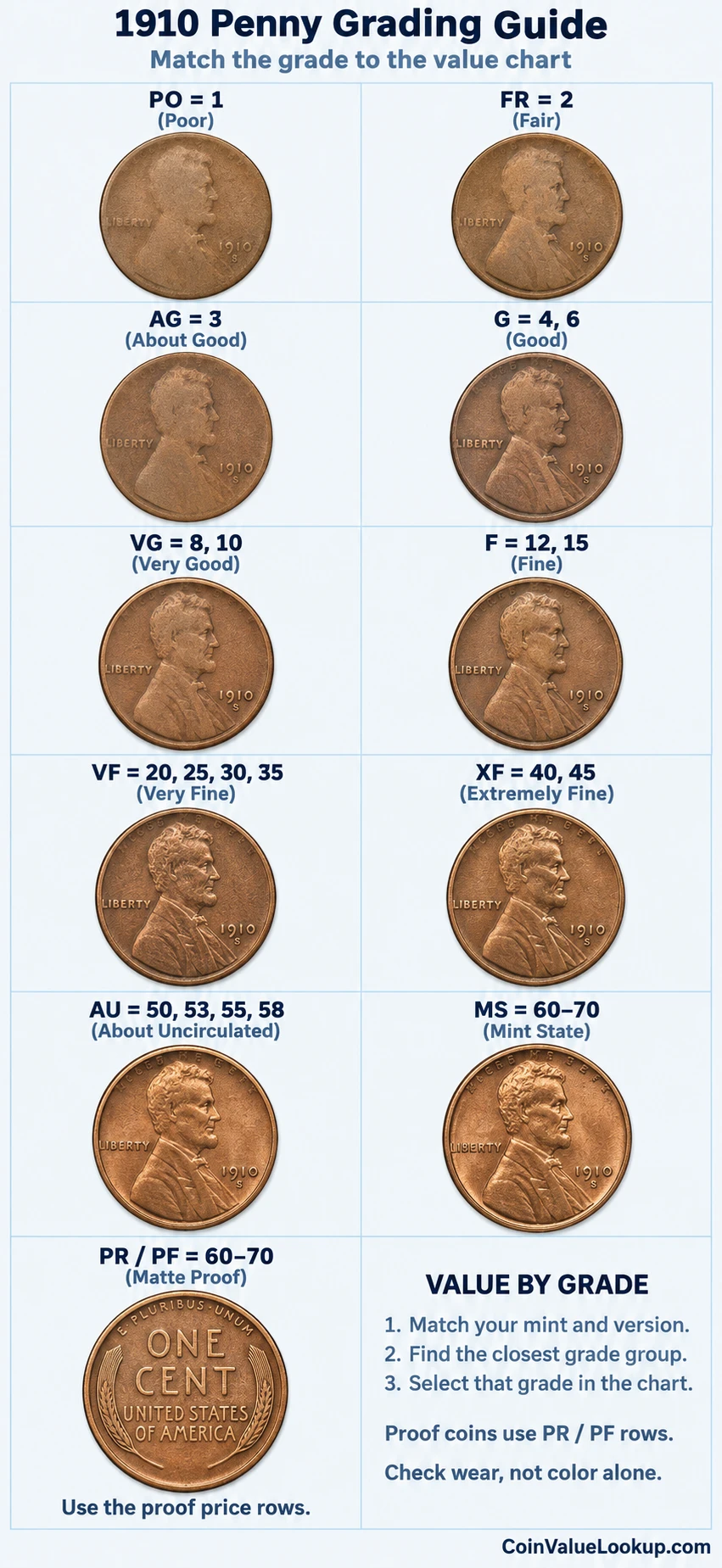
Start with Lincoln's cheekbone and jawline on the obverse. In lower grades these flatten first, blending into the field.
Then look at the hair detail above his ear — fine strands disappear as wear increases.
On the reverse, check the individual grain lines within each wheat ear. A coin grading Good-4 will show the outline of the ears but almost no interior detail.
By MS63 you should see full grain separation and original mint luster across the surfaces.
One trap: a weakly struck coin can look worn even when it is not. If the luster is intact and unbroken across the high points, the soft detail may be a strike issue rather than wear.
Compare your coin to the reference image to see what genuine wear patterns look like versus original softness.
Color matters separately from grade. A brown coin and a red coin can share the same wear grade but carry very different premiums.
Cleaning, spots, and corrosion also reduce desirability regardless of how sharp the detail is. Do not assume a bright copper surface means a higher grade — it may just mean someone cleaned it.
Step 3: Check 1910 Wheat Penny Value by Mint and Version
1910 Wheat Penny
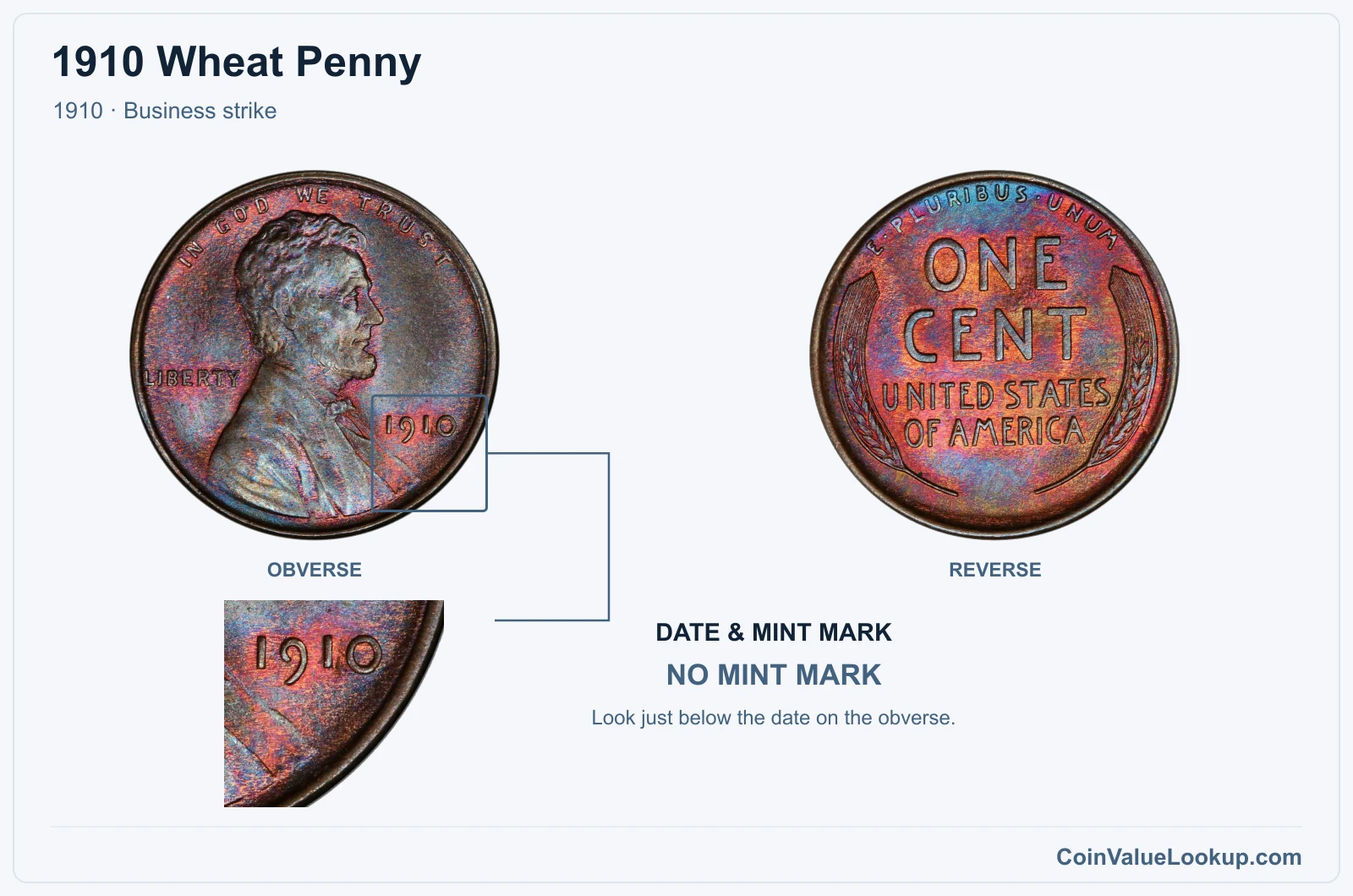
The 1910 Philadelphia cent has no mintmark below the date. With a huge original mintage, these are common in circulated grades.
A guide estimate puts the Good-4 value around $0.61 and MS63 around $38.
Most surviving examples show heavy wear, so the jump between low grades and a nice uncirculated piece is significant. Original brown surfaces without cleaning or corrosion are what you want even in lower grades.
If your coin has full luster and sharp hair detail, you are in solid uncirculated territory and should consider professional grading.
| Range | Grade | Price | Auction Records | Appraisal |
|---|---|---|---|---|
| PO | PO 1 | — | Coin Identifier | |
| FR | FR 2 | — | Coin Identifier | |
| AG | AG 3 | — | Coin Identifier | |
| G | G 4 | — | Coin Identifier | |
| G 6 | — | Coin Identifier | ||
| VG | VG 8 | — | Coin Identifier | |
| VG 10 | — | Coin Identifier | ||
| F | F 12 | — | Coin Identifier | |
| F 15 | — | Coin Identifier | ||
| VF | VF 20 | — | Coin Identifier | |
| VF 25 | — | Coin Identifier | ||
| VF 30 | — | Coin Identifier | ||
| VF 35 | — | Coin Identifier | ||
| XF | XF 40 | — | Coin Identifier | |
| XF 45 | — | Coin Identifier | ||
| AU | AU 50 | — | Coin Identifier | |
| AU 53 | — | Coin Identifier | ||
| AU 55 | Coin Identifier | |||
| AU 58 | Coin Identifier | |||
| MS | MS 60 | Coin Identifier | ||
| MS 61 | Coin Identifier | |||
| MS 62 | Coin Identifier | |||
| MS 63 | Coin Identifier | |||
| MS 64 | Coin Identifier | |||
| MS 65 | Coin Identifier | |||
| MS 66 | Coin Identifier | |||
| MS 67 | — | — | — | |
| MS 68 | — | — | — | |
| MS 69 | — | — | — | |
| MS 70 | — | — | — |
1910 Wheat Penny — S
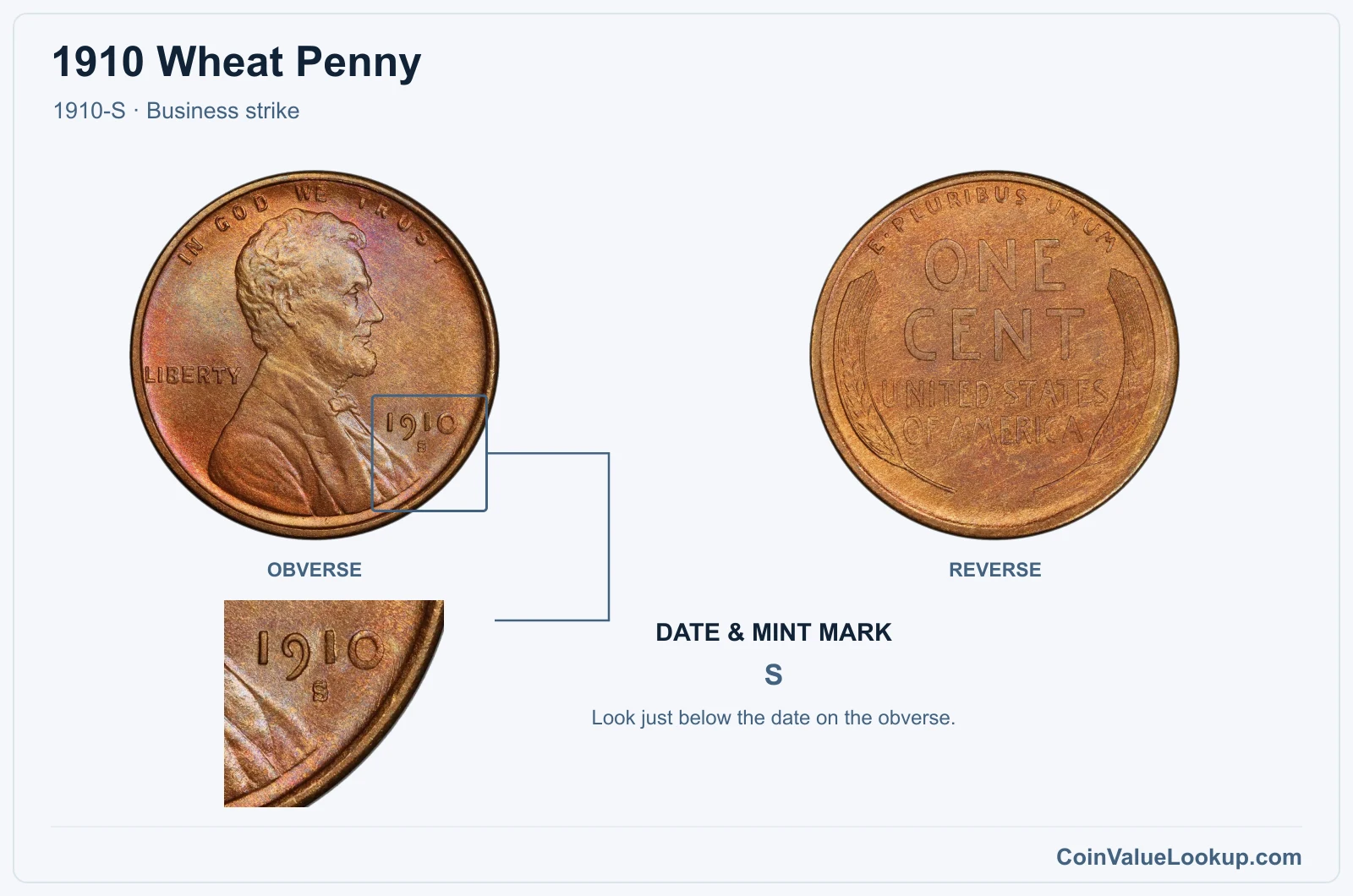
Look for the small "S" mintmark below the date. The 1910-S trades at a premium over its Philadelphia counterpart at every grade, with a guide value of about $19 in Good-4 climbing to roughly $178 at MS63.
San Francisco struck far fewer cents this year, and that lower survival rate in higher grades drives the price gap. A well-preserved 1910-S with original surfaces is a genuinely desirable early Lincoln cent.
Even a heavily worn example has meaningful value, so do not dismiss yours just because the hair detail is flat — check the mintmark carefully under magnification before setting it aside.
Coin Value Lookup is a handy starting point when you want to compare your 1910-S against other early Lincoln cent dates and mints. You can look up guides across the full Wheat cent series without bouncing between a dozen different sites.
| Range | Grade | Price | Auction Records | Appraisal |
|---|---|---|---|---|
| PO | PO 1 | — | Coin Identifier | |
| FR | FR 2 | — | Coin Identifier | |
| AG | AG 3 | — | Coin Identifier | |
| G | G 4 | — | Coin Identifier | |
| G 6 | — | Coin Identifier | ||
| VG | VG 8 | — | Coin Identifier | |
| VG 10 | Coin Identifier | |||
| F | F 12 | — | Coin Identifier | |
| F 15 | — | Coin Identifier | ||
| VF | VF 20 | Coin Identifier | ||
| VF 25 | — | Coin Identifier | ||
| VF 30 | — | Coin Identifier | ||
| VF 35 | Coin Identifier | |||
| XF | XF 40 | Coin Identifier | ||
| XF 45 | Coin Identifier | |||
| AU | AU 50 | Coin Identifier | ||
| AU 53 | Coin Identifier | |||
| AU 55 | Coin Identifier | |||
| AU 58 | Coin Identifier | |||
| MS | MS 60 | — | Coin Identifier | |
| MS 61 | Coin Identifier | |||
| MS 62 | Coin Identifier | |||
| MS 63 | Coin Identifier | |||
| MS 64 | Coin Identifier | |||
| MS 65 | Coin Identifier | |||
| MS 66 | — | — | — | |
| MS 67 | — | — | — | |
| MS 68 | — | — | — | |
| MS 69 | — | — | — | |
| MS 70 | — | — | — |
1910 Wheat Penny — PR
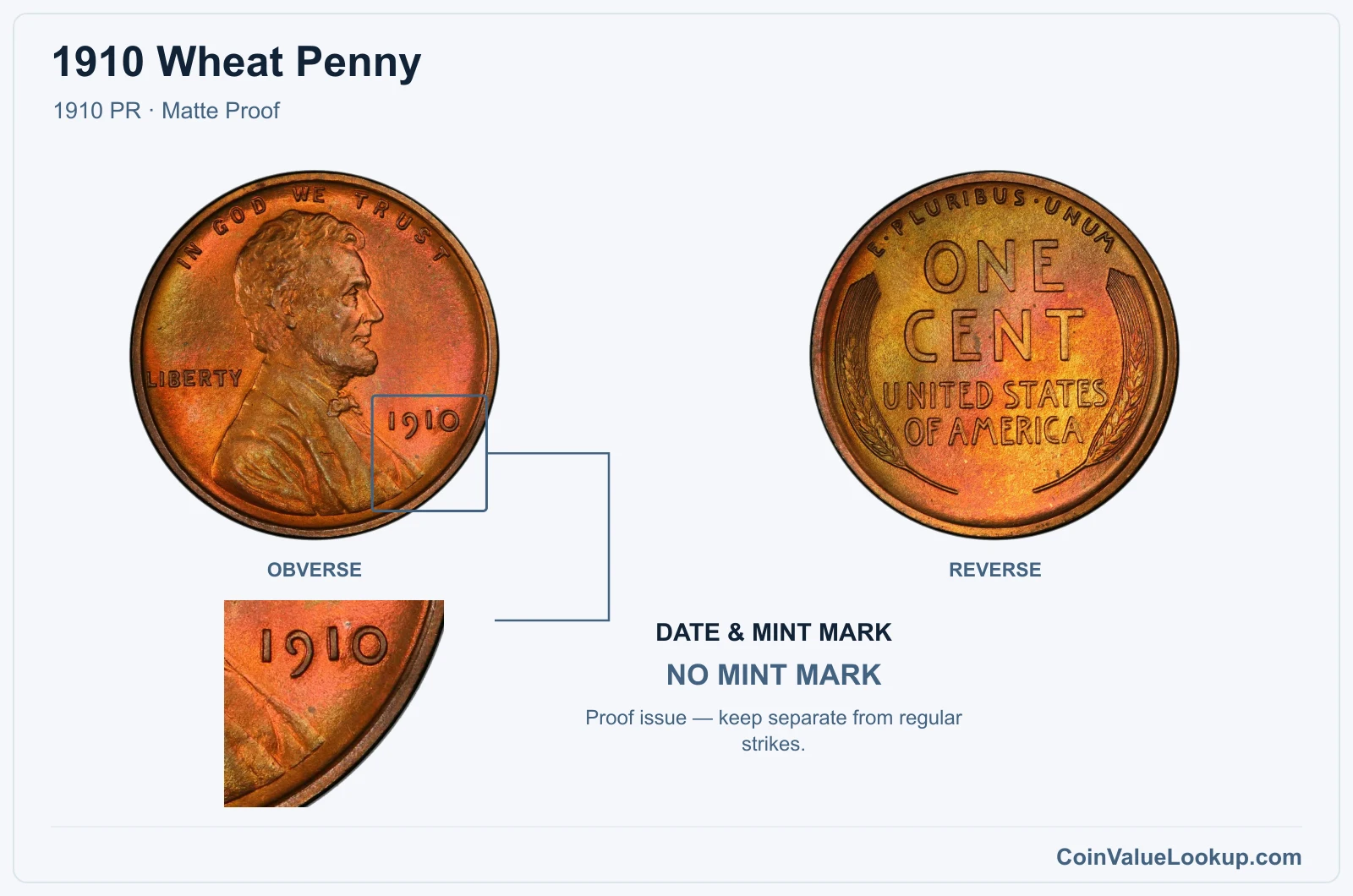
The 1910 matte proof was produced at Philadelphia with specially prepared dies and planchets. These have a distinctive granular matte surface rather than the mirror-like finish you see on modern proofs.
The rims are squared and precise, and the design details are exceptionally sharp.
A guide estimate places the PR63 value around $825. That reflects both the coin's low original production and the difficulty of finding examples with clean, problem-free surfaces — matte proofs are notoriously easy to mistake for well-struck business strikes and vice versa.
Do not assume your coin is a proof just because it looks sharp. The matte texture and squared rim profile are the key diagnostics.
If those features are absent, you almost certainly have a regular circulation strike no matter how nice it appears. Professional authentication is strongly recommended before buying or selling a coin as a matte proof.
| Range | Grade | Price | Auction Records | Appraisal |
|---|---|---|---|---|
| PR | PR 1 | — | Coin Identifier | |
| PR 2 | — | Coin Identifier | ||
| PR 3 | — | Coin Identifier | ||
| PR 4 | — | Coin Identifier | ||
| PR 6 | — | Coin Identifier | ||
| PR 8 | — | Coin Identifier | ||
| PR 10 | — | Coin Identifier | ||
| PR 12 | — | Coin Identifier | ||
| PR 15 | — | Coin Identifier | ||
| PR 20 | — | Coin Identifier | ||
| PR 25 | — | Coin Identifier | ||
| PR 30 | — | Coin Identifier | ||
| PR 35 | — | Coin Identifier | ||
| PR 40 | — | Coin Identifier | ||
| PR 45 | — | Coin Identifier | ||
| PR 50 | — | Coin Identifier | ||
| PR 53 | — | Coin Identifier | ||
| PR 55 | — | Coin Identifier | ||
| PR 58 | — | Coin Identifier | ||
| PR 60 | — | Coin Identifier | ||
| PR 61 | — | Coin Identifier | ||
| PR 62 | Coin Identifier | |||
| PR 63 | Coin Identifier | |||
| PR 64 | Coin Identifier | |||
| PR 65 | Coin Identifier | |||
| PR 66 | Coin Identifier | |||
| PR 67 | Coin Identifier | |||
| PR 68 | — | — | — | |
| PR 69 | — | — | — | |
| PR 70 | — | — | — |
1910 Wheat Penny Error List
1. 1910 Wheat Penny — Repunched Mintmark
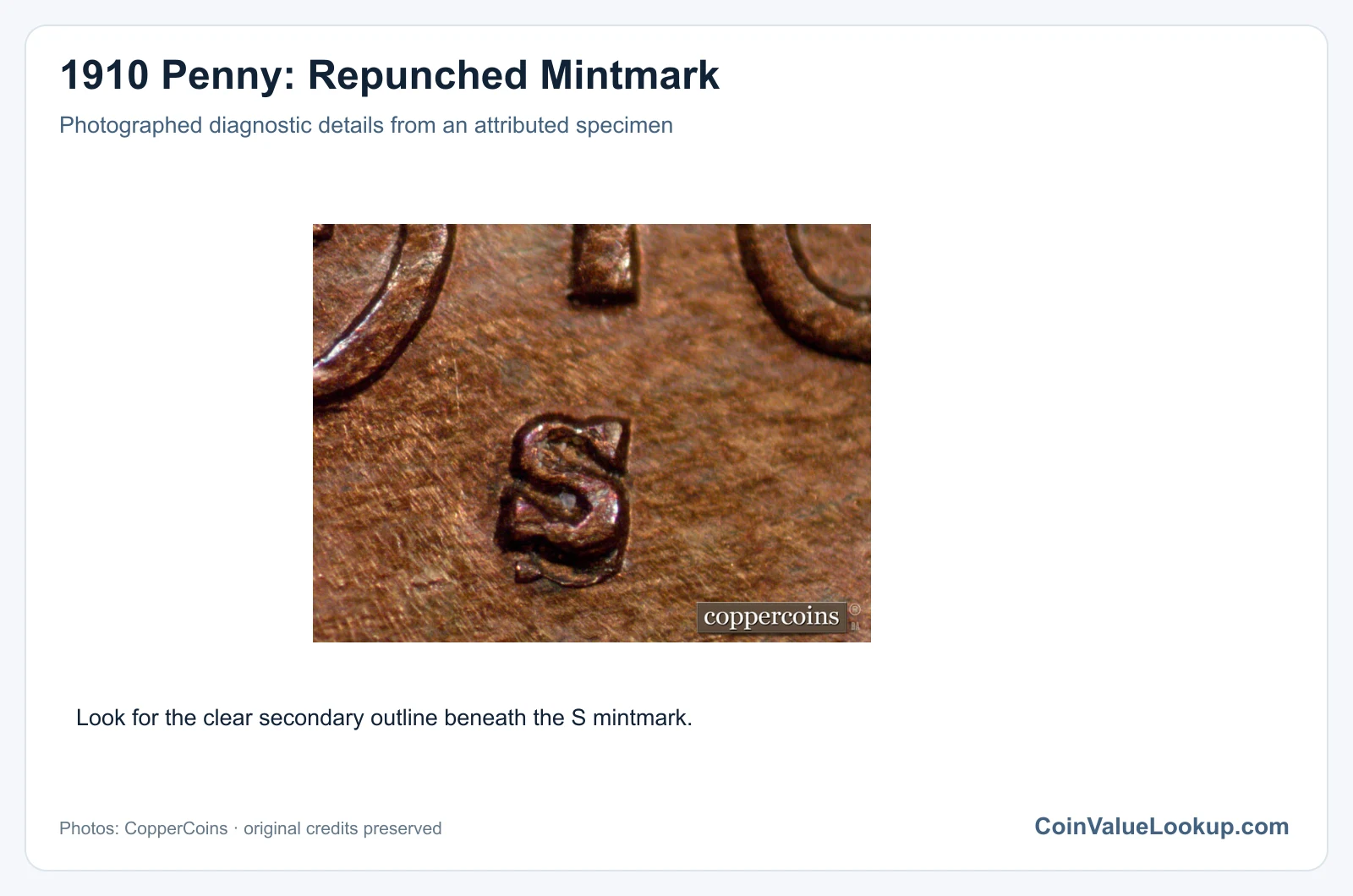
A repunched mintmark on the 1910-S shows remnants of an earlier, slightly mispositioned "S" beneath or beside the final punch. You will need magnification to spot it — look for a secondary outline, a notch, or a shadow that does not match the primary mintmark shape.
This error applies only to the San Francisco issue since Philadelphia coins carry no mintmark to repunch. Compare your coin's mintmark to a known normal 1910-S at the same magnification; the extra impression should be consistent and clearly part of the die, not random damage.
Machine doubling, a small die chip on the mintmark, and corrosion around the letter can all mimic an RPM. The key distinction is that a genuine repunched mintmark shows a complete or partial second impression with its own contour, not a flat shelf or pitted surface.
Pricing depends on the specific variety, its visual severity, and authenticated condition.
2. 1910 Wheat Penny — Off-Center Strike
An off-center strike happens when the planchet is not properly seated between the dies. The result is a displaced design with an unstruck crescent of blank metal on one side.
The more dramatic the shift, the more visually striking the coin.
For a 1910 Wheat cent, the date needs to remain visible for the coin to be identified and valued — an off-center piece with no readable date is worth far less. Moderate shifts in the 5–15% range with a full date tend to attract collector interest.
Do not confuse an off-center strike with a clipped planchet, a one-sided die misalignment, or post-mint damage from being squeezed or flattened. An off-center coin will have a corresponding shift in the design on both sides.
Value depends on the percentage of displacement, date visibility, and overall condition, and should be assessed individually by an authenticated example.
3. 1910 Wheat Penny — Die Crack / Die Chip
Die cracks appear as raised lines on the coin's surface, formed when a crack develops in the steel die during production. Small raised blobs — die chips — occur when a tiny piece of the die breaks away, leaving a filled area that transfers as a raised lump on the struck coin.
On a 1910 Wheat cent, inspect both sides for thin raised lines that cross letters, the portrait, or the wheat ears. These lines follow the die's fracture pattern and are consistent from coin to coin struck by that die.
Do not confuse them with incuse scratches (which are recessed, not raised), corrosion, or foreign material stuck to the surface. A genuine die crack is raised above the field and has a clean metallic profile.
Pricing varies widely based on the crack's size, location, and visual drama, so individual assessment is appropriate.
4. 1910 Wheat Penny — Die Break / Cud
A cud is a specific type of die break where a piece of the die at the rim has broken away entirely. The result is a raised, featureless blob that connects to the rim and replaces part of the normal design.
It is flat on top and clearly metallic — not a dent or deposit.
On a 1910 Wheat cent, check the rim area on both sides for any raised lump that obliterates the underlying design. The boundary between the cud and the surviving design should be relatively sharp.
A rim dent pushes metal inward and is recessed, not raised. Corrosion can create lumpy surfaces but lacks the smooth, flat character of a cud.
An interior die chip that does not reach the rim is technically a die chip, not a cud. Value depends on the cud's size and location, and each example should be individually assessed based on authenticated condition.
5. 1910 Wheat Penny — Struck-Through Error
A struck-through error occurs when foreign material — grease, a thread, a metal fragment — gets trapped between the die and the planchet during striking. The result is a localized depression or incomplete design area where the obstruction blocked the die's impression.
On a 1910 Wheat cent, look for a smooth depression that interrupts the normal design. A grease-filled die leaves a soft, broad area of missing detail, while a retained foreign object may leave a distinct impression or outline in the coin's surface.
Ordinary wear, scratches, cleaning marks, and weak strikes can all look superficially similar. The difference is that a struck-through impression has a specific shape and depth consistent with something physically blocking the die, and the surrounding metal often flows around the obstruction.
Value is determined individually based on the size, clarity, and type of the struck-through impression.
6. 1910 Wheat Penny — Lamination / Split Planchet
Lamination errors show up as peeling, flaking, or splitting within the coin's metal. On a 1910 Wheat cent, the copper alloy may separate into layers, producing a retained flap of metal or a visible crack along the edge where the planchet has begun to split apart.
To identify one, examine the coin's edge and surfaces for any area where the metal appears to be lifting or separating. Photograph the edge and the affected face together — that combination helps confirm the split runs through the planchet rather than being surface damage.
Scraping, corrosion, and deliberately cut or peeled coins can mimic a lamination. Genuine laminations follow the internal structure of the alloy and have a natural, irregular boundary.
Deliberately damaged coins tend to show tool marks or unnaturally clean edges. Each lamination error should be assessed individually based on its size, visibility, and authenticated condition.
7. 1910 Wheat Penny — Doubled Die Obverse
A doubled die obverse on a 1910 Wheat cent shows consistent doubling in the design elements — typically visible as separation or notching in the lettering of LIBERTY, IN GOD WE TRUST, or the date numerals. The doubling comes from a misaligned hub impression during die production, so it appears identical on every coin struck by that die.
Compare your coin's obverse lettering to a known normal 1910 cent under the same lighting and magnification. Genuine doubled die doubling shows distinct, separated outlines or notched serifs rather than a flat, shelf-like displacement.
Machine doubling — caused by die bounce during striking — is far more common and produces a flat, spread appearance without the sharp secondary outline of a true doubled die. Reflections and worn die contours can also fool the eye.
Pricing for a confirmed doubled die obverse depends on the variety's strength and the coin's authenticated condition.