1978 Washington Quarter Coin Value: How Much Is It Worth?
Most 1978 Washington quarters you find in pocket change are worth face value — 25 cents, period. These are common clad coins made in large numbers across three mints.
Where things get more interesting is in the uncirculated and proof tiers: a USA Coin Book guide estimate puts selected MS65 business strikes around $7.29 and PR65 proofs near $6.25. Errors, though, can push values dramatically higher.
A 1978 quarter struck on a cent planchet sold for $1,440 at auction.
Fast Way to Identify Your 1978 Washington Quarter
Snap clear photos of the front and back of your 1978 quarter, then upload them here for a preliminary identification. This helps pin down mintmark, overall condition and whether something unusual is going on.
It is not a substitute for professional authentication or certified grading, but it gives you a solid starting point before deciding your next step.
1978 Washington Quarter Value
Upload both sides of your 1978 Washington Quarter.
Front Obverse
Upload photo
Back Reverse
Upload photo
Which 1978 Washington Quarter Versions Are Worth Money?
- 1978 (Philadelphia) and 1978-D business strikes are worth checking in truly uncirculated condition; a USA Coin Book guide estimate places MS65 examples around $7.29 each.
- The 1978-S proof, struck at San Francisco, carries a guide estimate near $6.25 at PR65 — original surface quality and contrast matter.
- A 1978 quarter struck on a cent planchet (wrong metal, smaller diameter) sold for $1,440 in MS66 Red at Heritage Auctions in September 2025.
- Off-center strikes, broadstrikes, doubled die obverses and other authenticated errors exist for this date and can carry premiums that depend on severity and condition.
Step 1: Identify Your 1978 Washington Quarter Mint Mark and Version
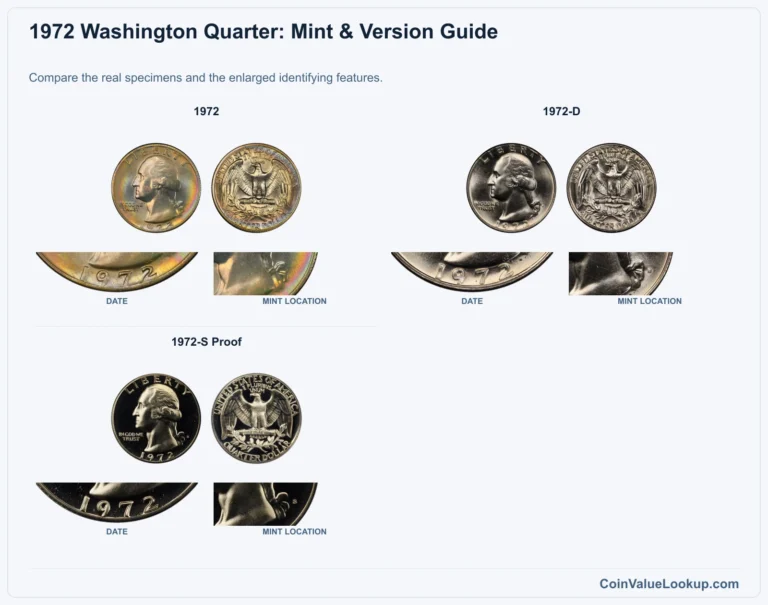
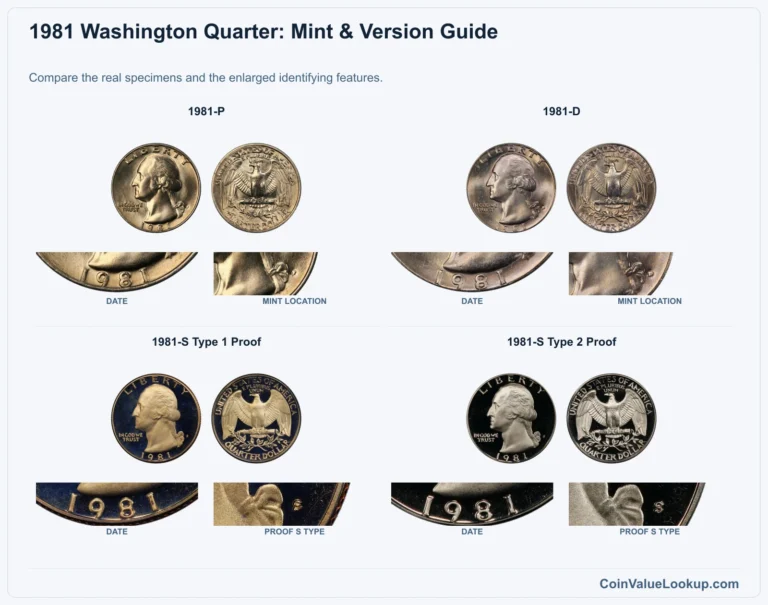
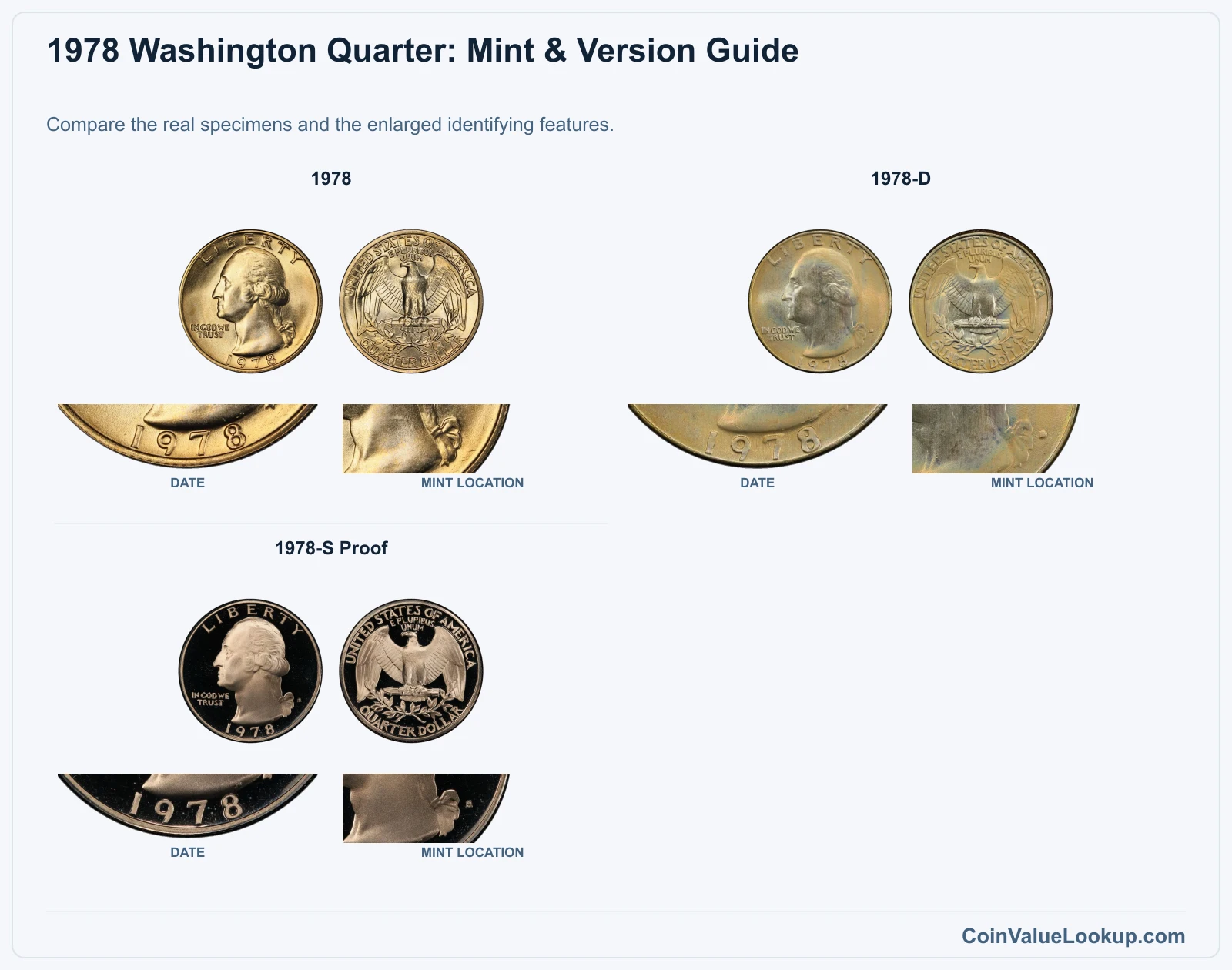
Three versions of the 1978 quarter exist: Philadelphia (no mintmark), Denver (D), and San Francisco (S) proof. The mintmark sits on the obverse, near the date at roughly the 4 o'clock position.
No mintmark means Philadelphia.
All three are copper-nickel clad, weighing about 5.67 grams and measuring 24.3 mm across. The S mintmark does not indicate silver — every regular-issue 1978 quarter is the same clad composition.
If your coin looks copper-colored rather than silvery, that is not normal toning on a clad quarter. It could be a wrong-planchet error, environmental damage, or a missing clad layer.
Check the edge: a normal quarter shows a visible copper stripe sandwiched between silver-toned layers. Weight and diameter measurements help, but do not rely on color alone to authenticate an error.
Step 2: Check Your 1978 Washington Quarter Grade
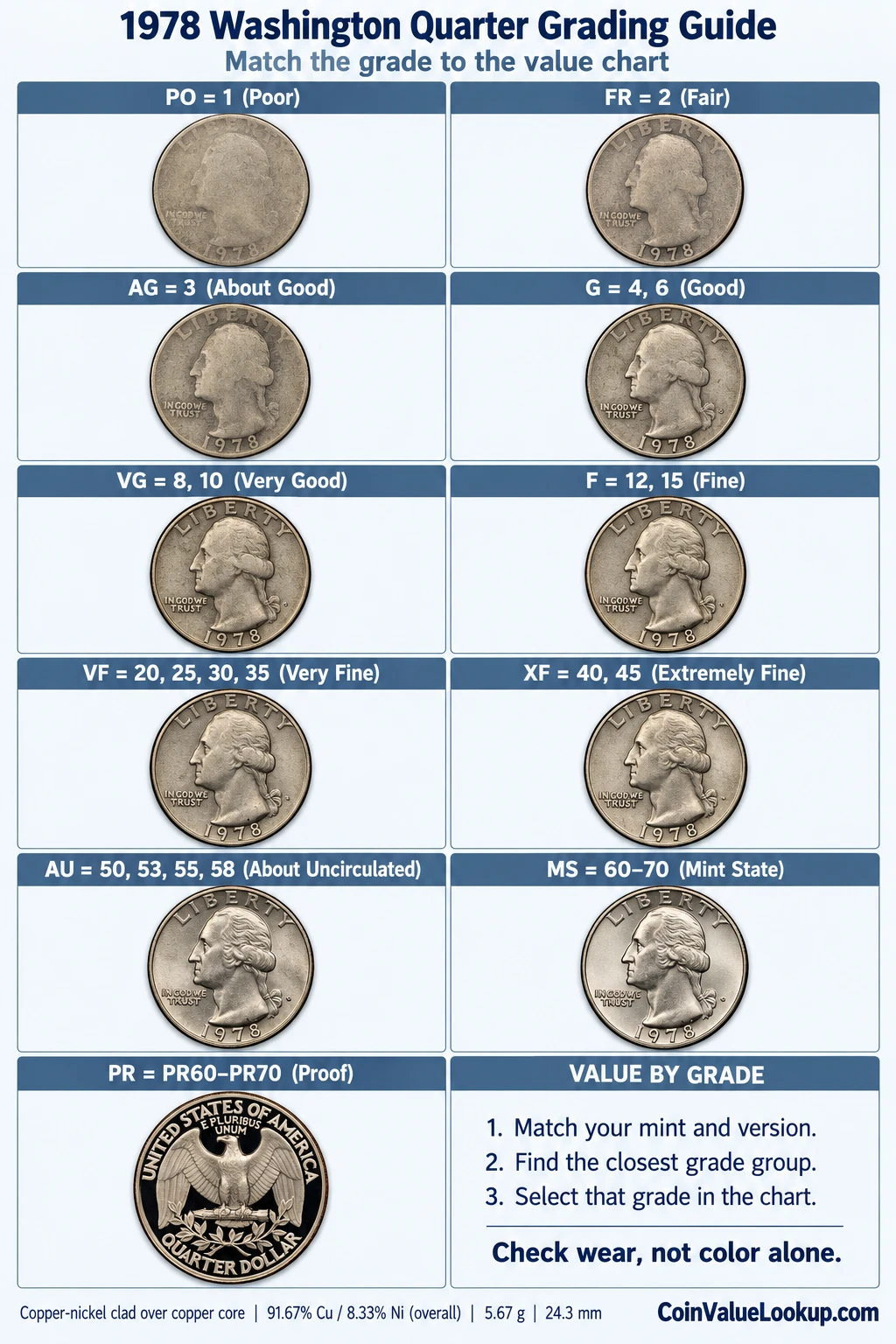
Focus on Washington's hair detail above the ear. On a fresh uncirculated coin, every strand is sharp and distinct.
As a coin wears, this area flattens first, followed by the cheek and jawline.
Flip it over. The eagle's breast feathers lose definition at the same pace.
Compare your coin to the reference image to judge where it falls.
Original mint luster matters a lot in the uncirculated range. A coin can have full detail but still lose grade points from heavy bag marks, nicks or cleaning hairlines.
If you see fine parallel scratches under a light, someone probably cleaned it — and that hurts value.
Proof coins have their own scale. The mirrored fields and sharp rims are a manufacturing finish, not an indicator that the coin grades higher than a Mint State piece.
Cameo or deep cameo designations describe the contrast between frosted devices and reflective fields within the proof category.
Step 3: Check 1978 Washington Quarter Value by Mint and Version
1978 Washington Quarter
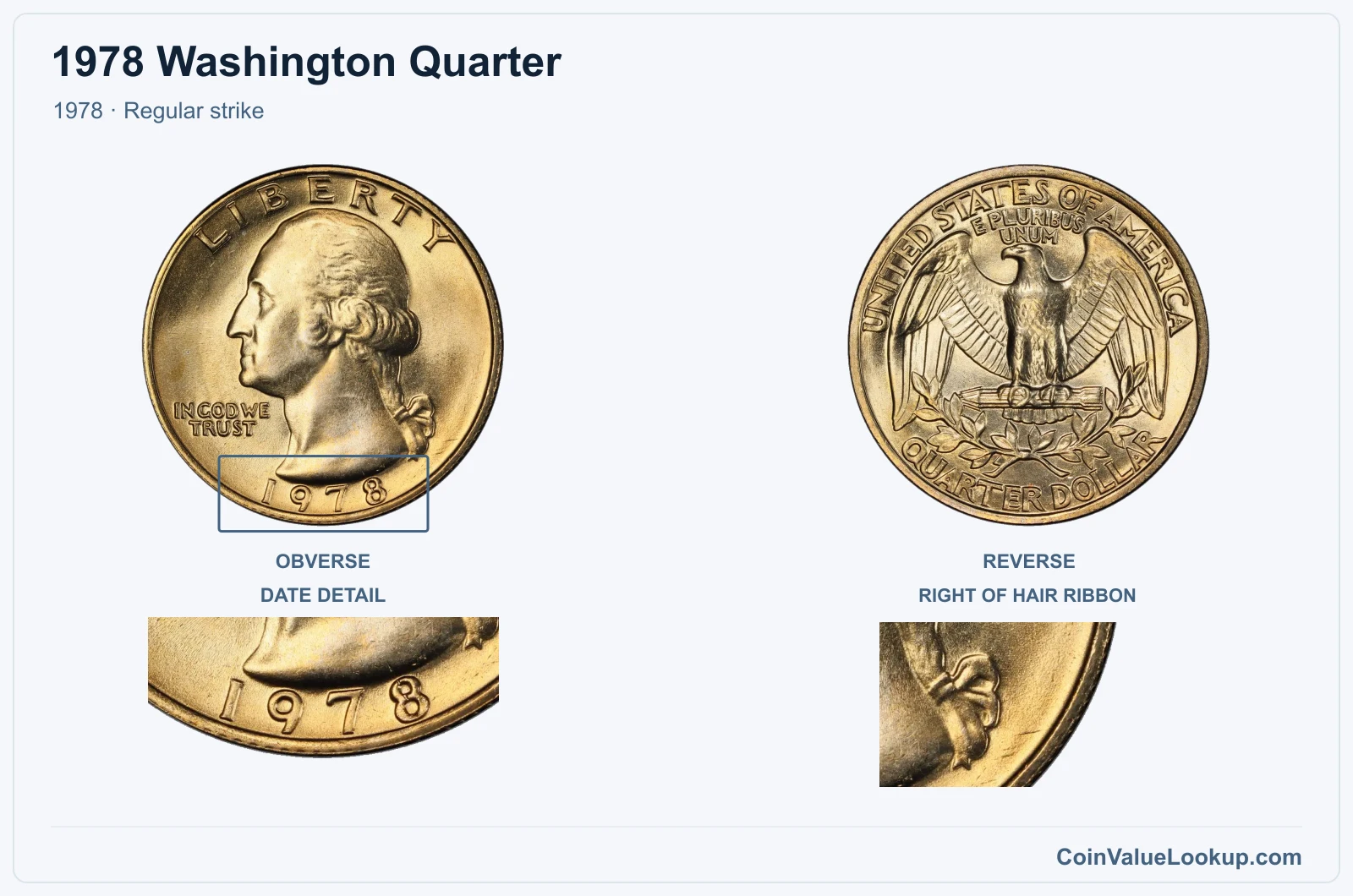
The 1978 Philadelphia quarter has no mintmark on the obverse. It is a copper-nickel clad business strike with the standard Washington obverse and eagle reverse.
Millions were made, so circulated examples are worth 25 cents.
Condition is everything here. A USA Coin Book guide estimate for MS65 is about $7.29, but reaching that grade means clean surfaces, full luster and minimal contact marks.
Most rolls and junk-bin finds grade well below MS65. Look for sharp hair detail above the ear and no friction on the cheek to confirm it has never circulated.
Coin Value Lookup is a handy place to look up quarter values across different years if you are sorting through a jar of change or a small collection.
| Range | Grade | Price | Auction Records | Appraisal |
|---|---|---|---|---|
| PO | PO 1 | — | Coin Identifier | |
| FR | FR 2 | — | Coin Identifier | |
| AG | AG 3 | — | Coin Identifier | |
| G | G 4 | — | Coin Identifier | |
| G 6 | — | Coin Identifier | ||
| VG | VG 8 | — | Coin Identifier | |
| VG 10 | — | Coin Identifier | ||
| F | F 12 | — | Coin Identifier | |
| F 15 | — | Coin Identifier | ||
| VF | VF 20 | — | Coin Identifier | |
| VF 25 | — | Coin Identifier | ||
| VF 30 | — | Coin Identifier | ||
| VF 35 | — | Coin Identifier | ||
| XF | XF 40 | — | Coin Identifier | |
| XF 45 | — | Coin Identifier | ||
| AU | AU 50 | — | Coin Identifier | |
| AU 53 | — | Coin Identifier | ||
| AU 55 | — | Coin Identifier | ||
| AU 58 | — | Coin Identifier | ||
| MS | MS 60 | — | Coin Identifier | |
| MS 61 | — | Coin Identifier | ||
| MS 62 | — | Coin Identifier | ||
| MS 63 | — | Coin Identifier | ||
| MS 64 | Coin Identifier | |||
| MS 65 | Coin Identifier | |||
| MS 66 | Coin Identifier | |||
| MS 67 | Coin Identifier | |||
| MS 68 | — | — | — | |
| MS 69 | — | — | — | |
| MS 70 | — | — | — |
1978 Washington Quarter — D
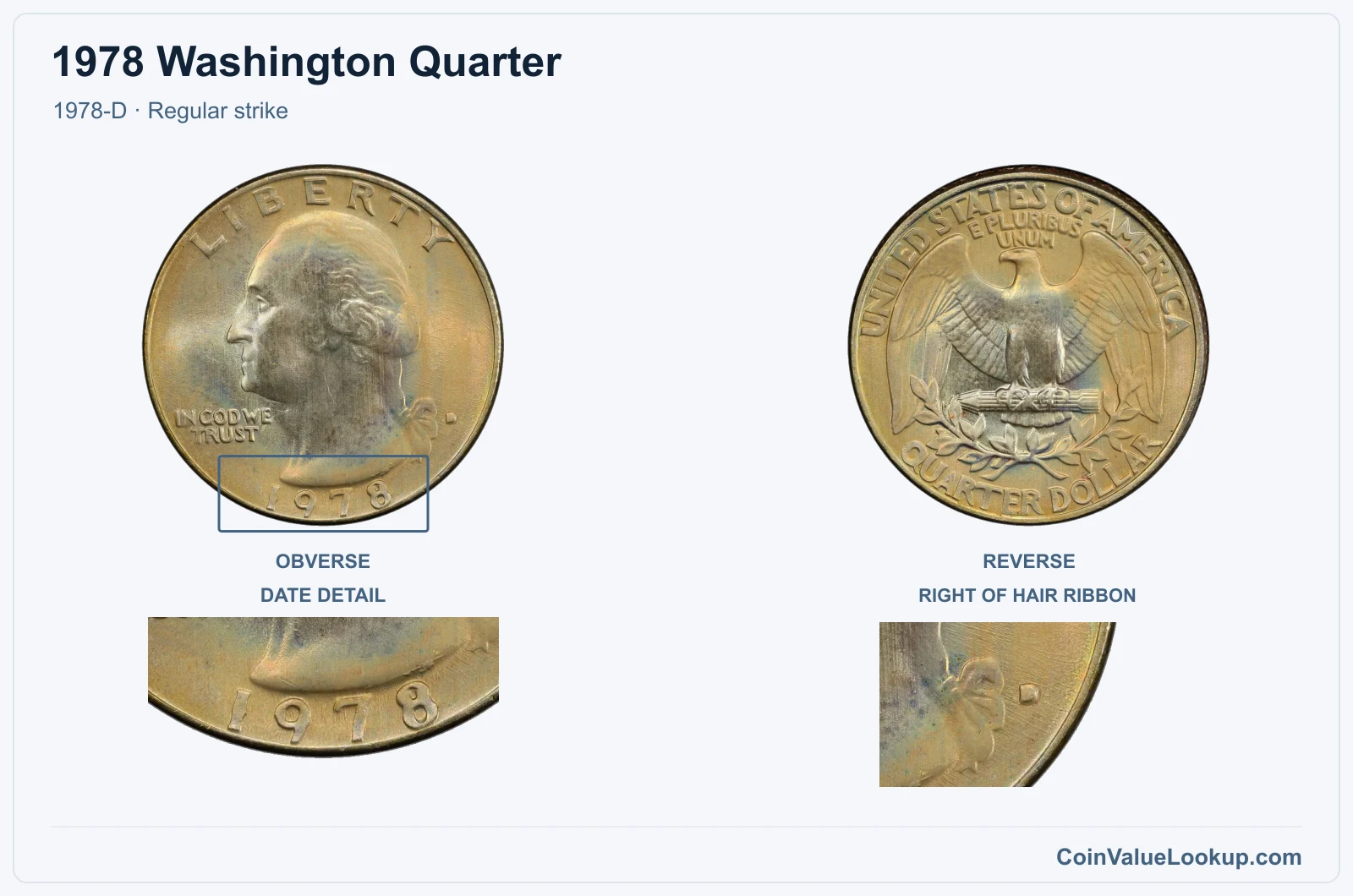
The 1978-D quarter carries a D mintmark near the date, indicating Denver production. Same copper-nickel clad composition, same design, same enormous mintage story as its Philadelphia sibling.
In circulated grades, it is a spender — face value only. The USA Coin Book guide estimate at MS65 is $7.29, identical to the Philadelphia version.
Uncirculated survivors need strong luster, minimal bag marks and full hair detail to reach that level. Denver strikes can sometimes show softer detail from worn dies, so distinguishing genuine wear from a weak strike takes careful comparison against a known sharp example.
| Range | Grade | Price | Auction Records | Appraisal |
|---|---|---|---|---|
| PO | PO 1 | — | Coin Identifier | |
| FR | FR 2 | — | Coin Identifier | |
| AG | AG 3 | — | Coin Identifier | |
| G | G 4 | — | Coin Identifier | |
| G 6 | — | Coin Identifier | ||
| VG | VG 8 | — | Coin Identifier | |
| VG 10 | — | Coin Identifier | ||
| F | F 12 | — | Coin Identifier | |
| F 15 | — | Coin Identifier | ||
| VF | VF 20 | — | Coin Identifier | |
| VF 25 | — | Coin Identifier | ||
| VF 30 | — | Coin Identifier | ||
| VF 35 | — | Coin Identifier | ||
| XF | XF 40 | — | Coin Identifier | |
| XF 45 | — | Coin Identifier | ||
| AU | AU 50 | — | Coin Identifier | |
| AU 53 | — | Coin Identifier | ||
| AU 55 | — | Coin Identifier | ||
| AU 58 | — | Coin Identifier | ||
| MS | MS 60 | — | Coin Identifier | |
| MS 61 | — | Coin Identifier | ||
| MS 62 | — | Coin Identifier | ||
| MS 63 | — | Coin Identifier | ||
| MS 64 | — | Coin Identifier | ||
| MS 65 | Coin Identifier | |||
| MS 66 | Coin Identifier | |||
| MS 67 | Coin Identifier | |||
| MS 68 | — | — | — | |
| MS 69 | — | — | — | |
| MS 70 | — | — | — |
1978 Washington Quarter — S Proof
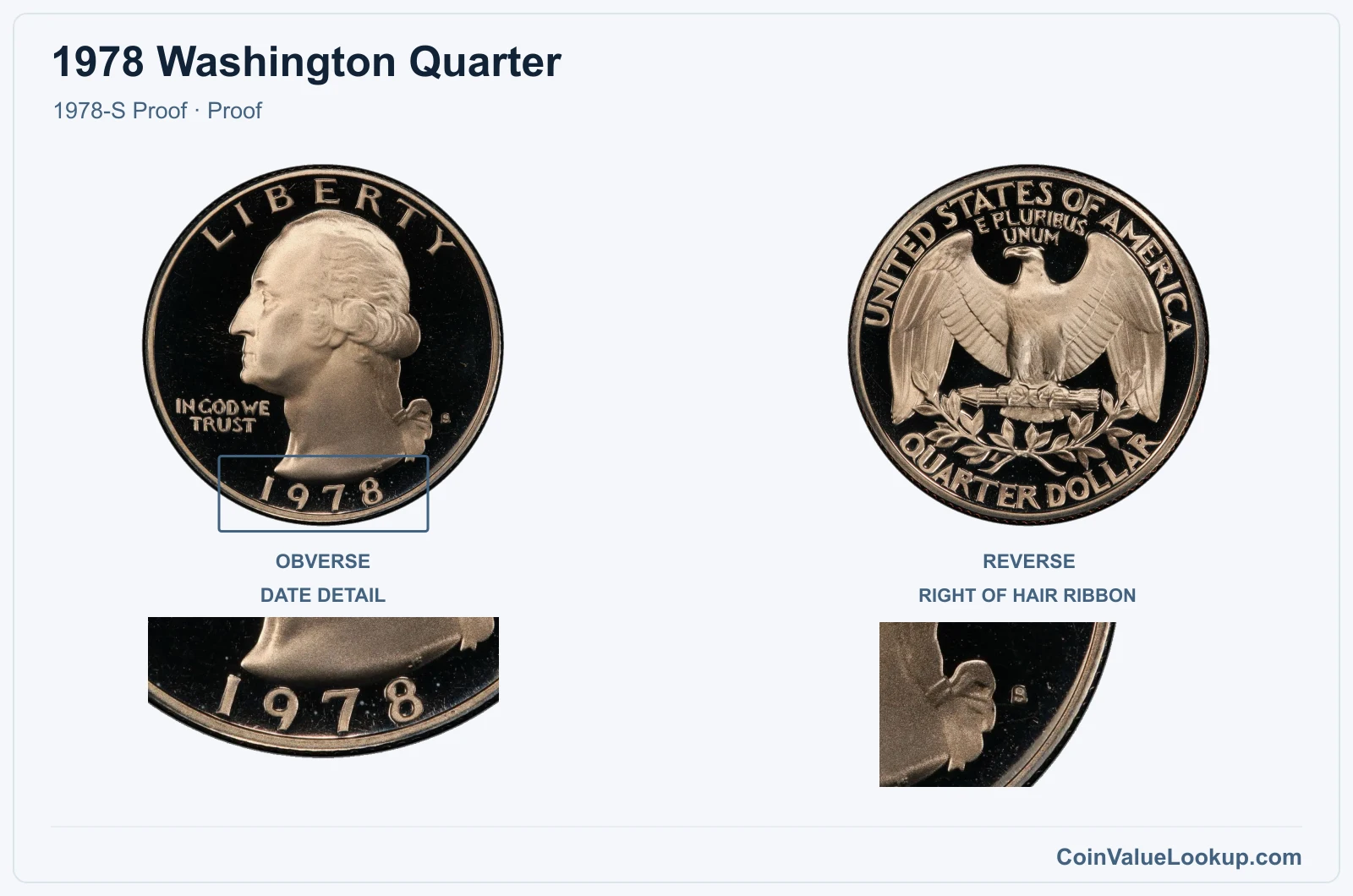
The 1978-S proof was struck at San Francisco exclusively for collector sets, not for circulation. It carries an S mintmark on the obverse.
Despite the special finish, it is the same copper-nickel clad composition as the business strikes — not silver.
A USA Coin Book guide estimate places PR65 examples around $6.25. Cameo and deep cameo contrast designations can affect desirability, but the guide figure cited here is a generic PR65 estimate, not specific to any contrast tier.
Proof coins should have mirror-like fields and sharply struck devices. Hairlines, haze or fingerprints knock the grade down quickly.
Handle these only by the edges.
| Range | Grade | Price | Auction Records | Appraisal |
|---|---|---|---|---|
| PR | PR 1 | — | Coin Identifier | |
| PR 2 | — | Coin Identifier | ||
| PR 3 | — | Coin Identifier | ||
| PR 4 | — | Coin Identifier | ||
| PR 6 | — | Coin Identifier | ||
| PR 8 | — | Coin Identifier | ||
| PR 10 | — | Coin Identifier | ||
| PR 12 | — | Coin Identifier | ||
| PR 15 | — | Coin Identifier | ||
| PR 20 | — | Coin Identifier | ||
| PR 25 | — | Coin Identifier | ||
| PR 30 | — | Coin Identifier | ||
| PR 35 | — | Coin Identifier | ||
| PR 40 | — | Coin Identifier | ||
| PR 45 | — | Coin Identifier | ||
| PR 50 | — | Coin Identifier | ||
| PR 53 | — | Coin Identifier | ||
| PR 55 | — | Coin Identifier | ||
| PR 58 | — | Coin Identifier | ||
| PR 60 | — | Coin Identifier | ||
| PR 61 | — | Coin Identifier | ||
| PR 62 | — | Coin Identifier | ||
| PR 63 | — | Coin Identifier | ||
| PR 64 | — | Coin Identifier | ||
| PR 65 | — | Coin Identifier | ||
| PR 66 | — | Coin Identifier | ||
| PR 67 | Coin Identifier | |||
| PR 68 | Coin Identifier | |||
| PR 69 | Coin Identifier | |||
| PR 70 | Coin Identifier |
1978 Washington Quarter Error List
1. 1978 Washington Quarter — Struck on a Cent Planchet
A 1978 Philadelphia quarter struck on a cent planchet is a dramatic wrong-planchet error. The coin will be noticeably smaller in diameter than a regular quarter and display a copper color instead of the normal silver tone.
The quarter's design appears on both faces, but portions near the rim are missing because the cent blank is too small to receive the full impression.
One example graded NGC MS66 Red sold for $1,440 at Heritage Auctions in September 2025. That is a single recorded result, not a guaranteed market price for every specimen.
Look-alikes include coins that have been copper-plated after minting, trimmed down or chemically altered. A genuine wrong-planchet strike shows correctly formed design elements with natural metal flow — not scratches, tool marks or uneven coating.
Professional authentication is the way to confirm this error.
2. 1978 Washington Quarter — Off-Center Strike
A 1978 Philadelphia off-center quarter has its design shifted from the normal centered position. One documented example shows approximately 10% displacement toward 10 o'clock, with a blank crescent visible on the opposite edge where the die did not contact the planchet.
The visible date is important. An off-center coin that still shows the full date and mintmark area is more collectible than one where that information is cut off.
Severity matters too — a 10% shift is mild, while 50% or more is dramatic and typically more desirable.
There is no adopted price range for this error. Value depends on the exact percentage of displacement, condition and whether the date is readable.
Post-mint damage — hammering, vise marks or deliberate distortion — can mimic an off-center look, so check for genuine struck surfaces on both sides.
3. 1978 Washington Quarter — Missing Clad Layer
A 1978 quarter with a missing clad layer is struck on a planchet that lost one of its outer copper-nickel layers before striking. The affected face typically shows a copper-toned surface instead of the usual silvery appearance, and the coin weighs less than the standard 5.67 grams.
Compare the edge to a normal quarter. On a regular coin, you see the copper core sandwiched between two clad layers.
A missing-clad coin will show an asymmetry there — one layer absent.
No numerical price is adopted for this error. Value depends on how visible the defect is and the coin's overall condition.
Toning, corrosion, or someone scraping off the surface layer after minting can produce a similar look, so authentication by a third-party grading service is the safest route.
4. 1978 Washington Quarter — Doubled Die Obverse
A 1978 quarter doubled die obverse shows consistent doubling on obverse design elements — typically letters, the date or profile details. The key word is consistent: every affected letter or feature shifts the same direction by roughly the same amount.
To check, examine the obverse lettering and date under magnification in good lighting. You are looking for separation, notching or a shelf-like secondary image on the letters.
Rotate the coin and confirm the doubling stays in the same orientation.
Machine doubling is the common look-alike. It produces flat, shelf-like distortion without the raised, separated character of a true doubled die.
Worn die impressions can also fool you. No numerical price is adopted here; value depends on the strength of the doubling, the specific variety and overall grade.
5. 1978 Washington Quarter — Broadstrike
A broadstrike happens when the collar die that normally contains the planchet during striking fails to engage. The result is a coin with outward metal spread — it looks slightly wider than normal, and the rim may be weak or missing entirely while the design is still roughly centered.
On a 1978 quarter, check the edge: a broadstruck coin lacks the reeded edge you would expect. The design may appear slightly flatter at the periphery because the metal flowed outward without confinement.
This error has been reported alongside filled D mintmark varieties on 1978 quarters. No numerical price is adopted.
Value depends on how dramatically the coin spread, whether the design is fully visible and overall condition. Coins flattened after leaving the mint — by a train, a vise, or creative boredom — are not broadstrikes.
6. 1978 Washington Quarter — Double / Multiple Strike
A double-struck or multiple-struck 1978 quarter received two or more impressions from the dies. If the coin shifted or rotated between strikes, you will see overlapping or displaced design images — two dates, two portraits, or ghosted lettering from the second hit.
This category has been reported in combination with off-center strikes on 1978 quarters, making for visually dramatic error coins. Look for two distinct impressions rather than the subtle shelf of a doubled die.
No numerical price is adopted. The value of a double strike depends on how visible and dramatic the second impression is, and the coin's condition.
Post-mint impressions — stamped with another object outside the mint — lack the precise die detail and uniform depth of a genuine second strike. Authentication matters here.
7. 1978 Washington Quarter — Improper Annealing
An improperly annealed 1978 quarter went through the heating and cooling process incorrectly before striking. The planchet may show unusual discoloration, a grainy or rough texture, or uneven surface tone that differs from normal luster.
Compare the surface and edge of your coin with a normal example. Annealing issues tend to affect the entire coin or large areas uniformly, not just a single spot.
No numerical price is adopted for this error. Value depends on how prominent the effect is and the coin's grade.
The tricky part is ruling out environmental toning, corrosion or heat damage applied after minting — all of which can look similar. Surface appearance alone is a screening clue, not proof.
Third-party grading services can evaluate whether the characteristics are consistent with a pre-strike manufacturing defect.
8. 1978 Washington Quarter — Lamination / Split Planchet
A lamination error on a 1978 quarter appears as peeling, flaking or separated metal on one or both faces. It results from impurities or gas trapped within the planchet alloy during production, which cause layers to split apart during or after striking.
Look for a retained metal flap, a missing chip exposing a different layer beneath, or a visible crack along the surface. Photograph the edge alongside the affected face — lamination splits often show clearly in the edge profile.
No numerical price is adopted. The size, location and visual impact of the lamination determine collector interest.
Scraping, corrosion, or someone deliberately peeling at the clad layer can mimic this error. A genuine lamination follows the coin's contour naturally and shows no tool marks or chemical residue.
Authentication is recommended for anything you suspect is a real lamination.