1975 Lincoln Penny Coin Value: How Much Is It Worth?
Most 1975 Lincoln pennies you pull from a jar are worth face value and not much more. In uncirculated condition at the MS65 level, a USA Coin Book guide estimate puts one at about $1.24.
The proof version struck at San Francisco carries a guide estimate around $4.27 in PR65. Where real money shows up is in authenticated mint errors, which can sell for well over $100 at auction.
Fast Way to Identify Your 1975 Lincoln Penny
Want a quick read on your 1975 penny? Upload clear photos of the front and back, and our identifier can give you a preliminary look at which version you have.
It checks for the mintmark location and general condition, helping you figure out whether you have a no-mintmark, a D, or an S proof before you dig deeper.
1975 Penny Value
Upload both sides of your 1975 Lincoln Penny.
Front Obverse
Upload photo
Back Reverse
Upload photo
Which 1975 Lincoln Penny Versions Are Worth Money?
- High-grade uncirculated examples with original red copper color (RD designation) carry stronger guide values than brown or cleaned coins.
- Authenticated striking errors such as off-center strikes, wrong-planchet strikes, and doubled dies can be worth significantly more than normal coins and should be assessed individually.
Step 1: Identify Your 1975 Lincoln Penny Mint Mark and Version
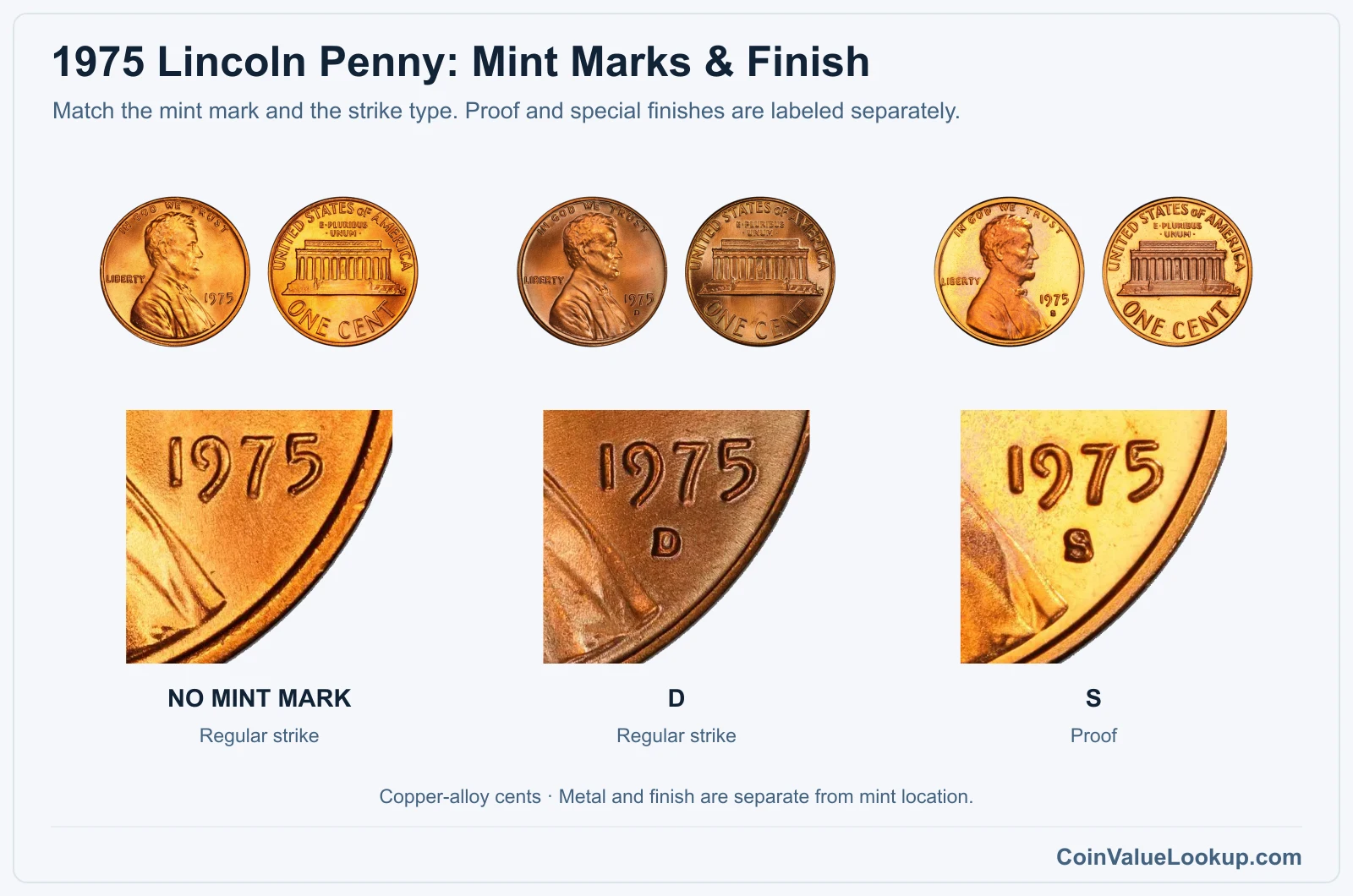
The 1975 Lincoln cent has the familiar Lincoln obverse and Memorial reverse on a plain-edge planchet. Normal composition is 95% copper and 5% zinc, with a nominal weight of 3.11 grams.
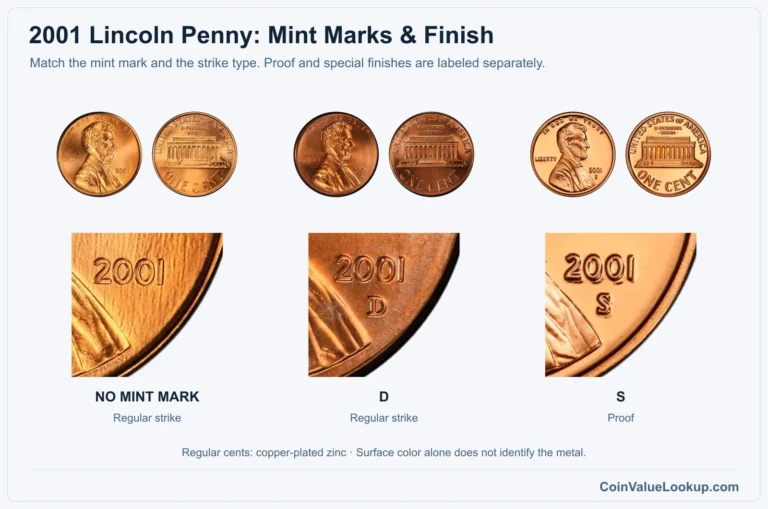
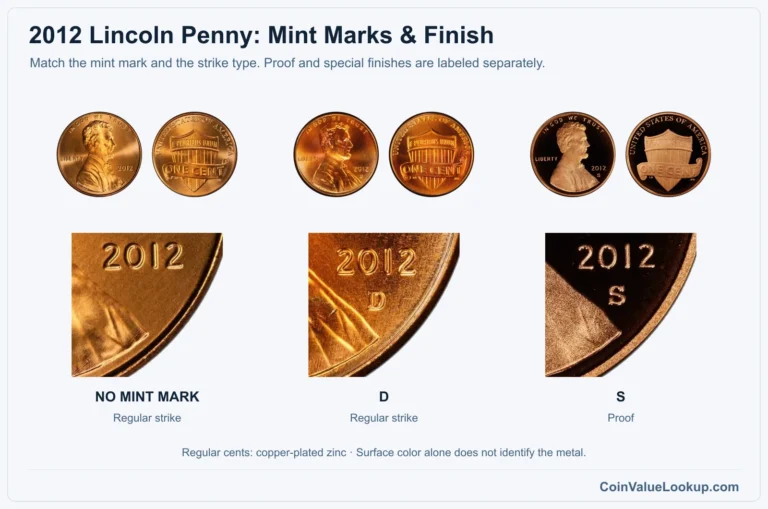
Three catalog branches exist. The no-mintmark version and the D (Denver) are business strikes made for circulation.
The S (San Francisco) was produced only as a collector proof; there is no normal S circulation issue for 1975.
Look below the date on the obverse to find the mintmark. A tiny "D" means Denver.
No letter at all is the Philadelphia-attributed branch. An "S" means you have a proof coin, and it should have mirror-like fields rather than the satin luster of a business strike.
Don't confuse the no-mintmark attribution with proof of a specific production facility. And the copper-color designations you see on certified holders, BN (brown), RB (red-brown), and RD (red), describe the surface color of the copper, not different alloys.
CAM and DCAM on proofs describe the contrast between frosted devices and mirror fields, not a separate metal or finish type.
Step 2: Check Your 1975 Lincoln Penny Grade
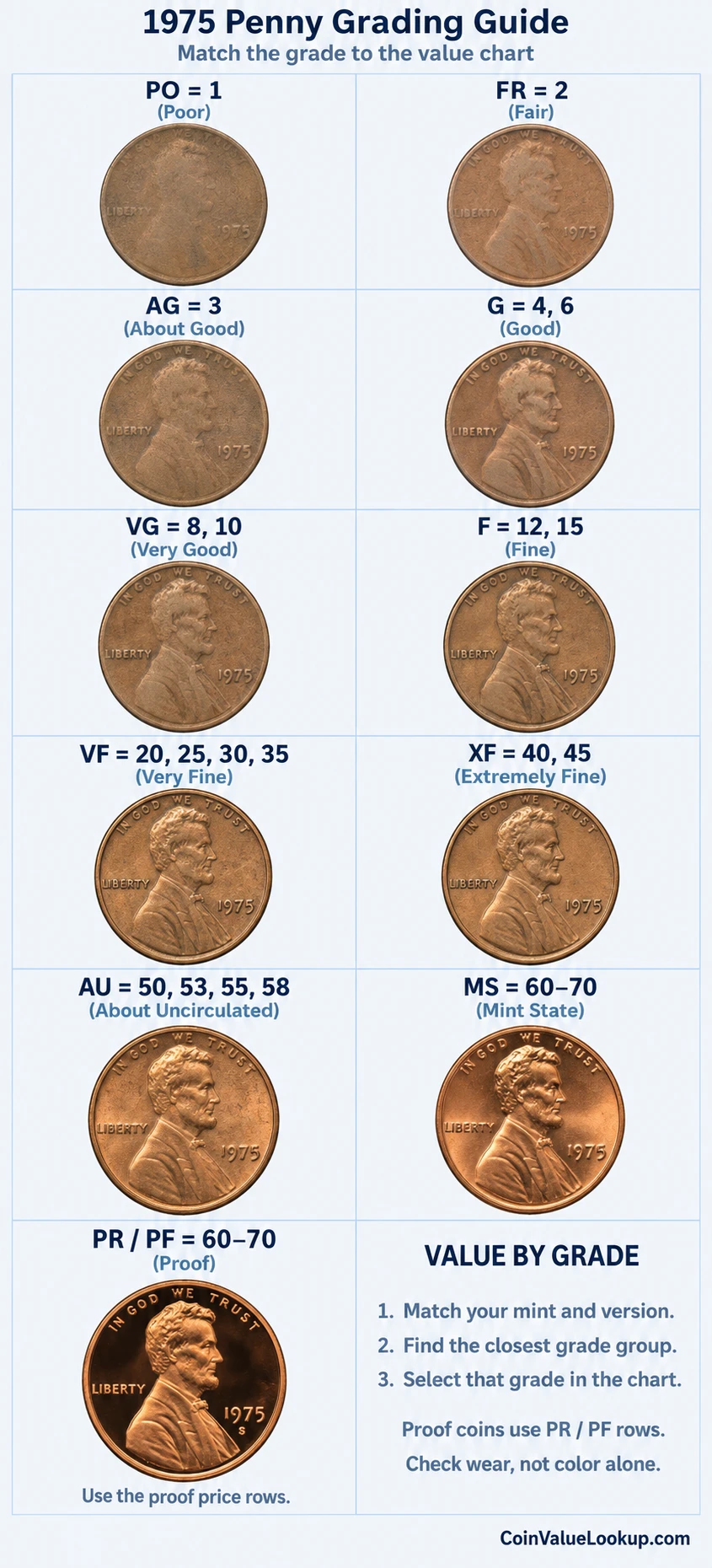
Start by checking Lincoln's cheekbone, jawline, and the hair detail above his ear. These high points lose definition first when the coin circulates.
On the reverse, the Memorial roof and the tops of the columns are your wear indicators.
An About Uncirculated coin will show slight friction on those high spots but retain most of its original luster. A true Mint State coin has no wear at all, just contact marks from other coins in bags or rolls.
Luster interruption on the high points is the dividing line between AU and MS, not color alone.
Use the comparison image to gauge where your coin falls. A brown coin with no wear still qualifies as Mint State; a bright red coin with rub on the cheek does not.
For proofs, look for hairlines from mishandling or cleaning, spots, and any surface damage. Never clean a copper coin or attempt to remove toning.
Cleaning destroys the original surface and tanks the value.
Step 3: Check 1975 Lincoln Penny Value by Mint and Version
1975 Lincoln Penny
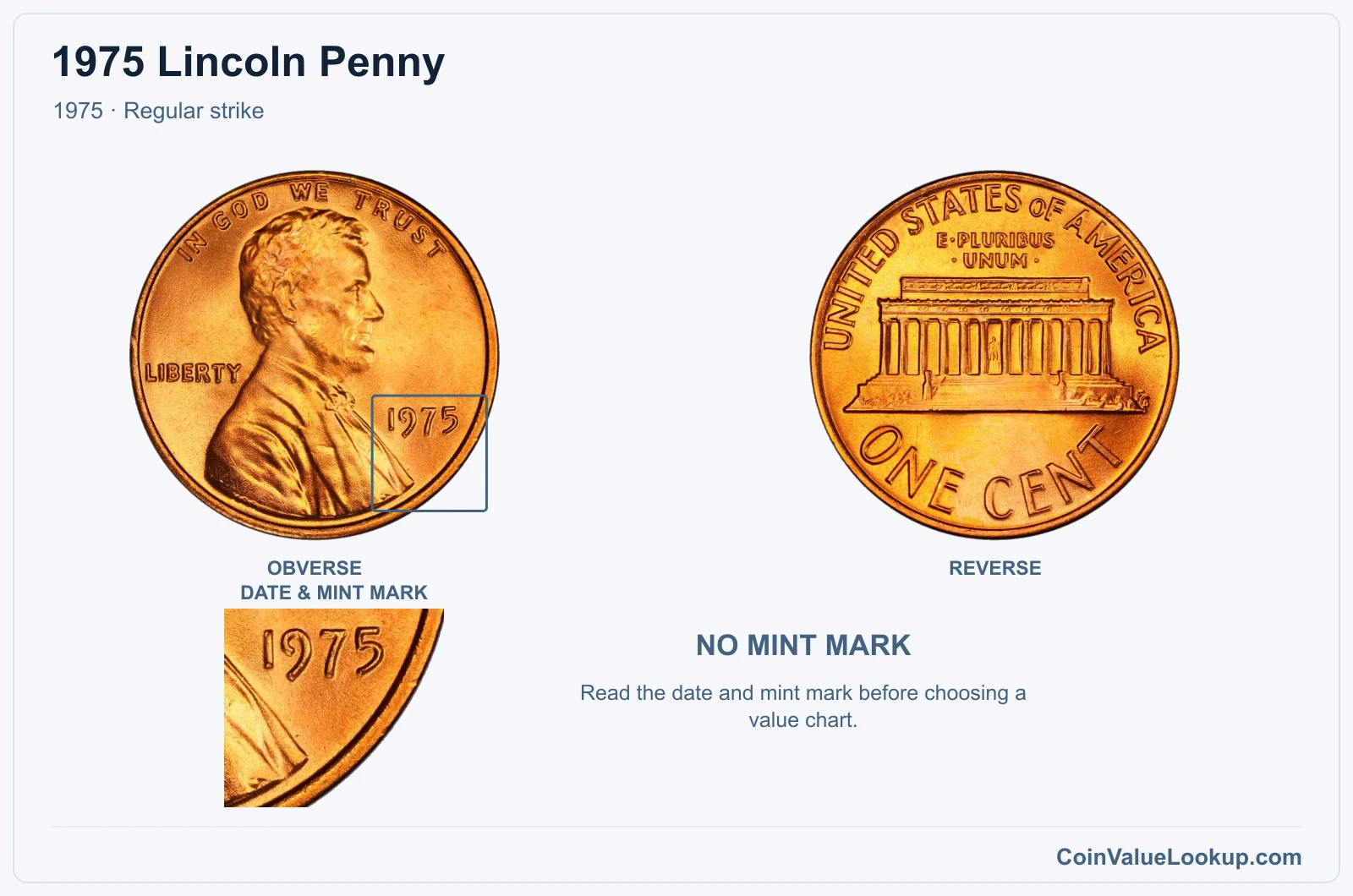
The 1975 no-mintmark penny is the Philadelphia-attributed business strike. It was made in huge quantities, so finding one is easy.
The challenge is finding one worth keeping.
What matters is the grade and the copper color. A USA Coin Book guide estimate places an MS65 example at about $1.24.
To reach that level, the coin needs full luster with minimal bag marks and no wear whatsoever. Original red surfaces push the value higher than a brown or red-brown example in the same technical grade.
If you're sorting through rolls, look for coins with bright, unspotted surfaces and sharp hair detail above Lincoln's ear. Those are your keepers.
| Range | Grade | Price | Auction Records | Appraisal |
|---|---|---|---|---|
| PO | PO 1 | — | Coin Identifier | |
| FR | FR 2 | — | Coin Identifier | |
| AG | AG 3 | — | Coin Identifier | |
| G | G 4 | — | Coin Identifier | |
| G 6 | — | Coin Identifier | ||
| VG | VG 8 | — | Coin Identifier | |
| VG 10 | — | Coin Identifier | ||
| F | F 12 | — | Coin Identifier | |
| F 15 | — | Coin Identifier | ||
| VF | VF 20 | — | Coin Identifier | |
| VF 25 | — | Coin Identifier | ||
| VF 30 | — | Coin Identifier | ||
| VF 35 | — | Coin Identifier | ||
| XF | XF 40 | — | Coin Identifier | |
| XF 45 | — | Coin Identifier | ||
| AU | AU 50 | — | Coin Identifier | |
| AU 53 | — | Coin Identifier | ||
| AU 55 | — | Coin Identifier | ||
| AU 58 | — | Coin Identifier | ||
| MS | MS 60 | — | Coin Identifier | |
| MS 61 | — | Coin Identifier | ||
| MS 62 | — | Coin Identifier | ||
| MS 63 | — | Coin Identifier | ||
| MS 64 | Coin Identifier | |||
| MS 65 | Coin Identifier | |||
| MS 66 | Coin Identifier | |||
| MS 67 | Coin Identifier | |||
| MS 68 | Coin Identifier | |||
| MS 69 | — | — | — | |
| MS 70 | — | — | — |
1975 Lincoln Penny — D
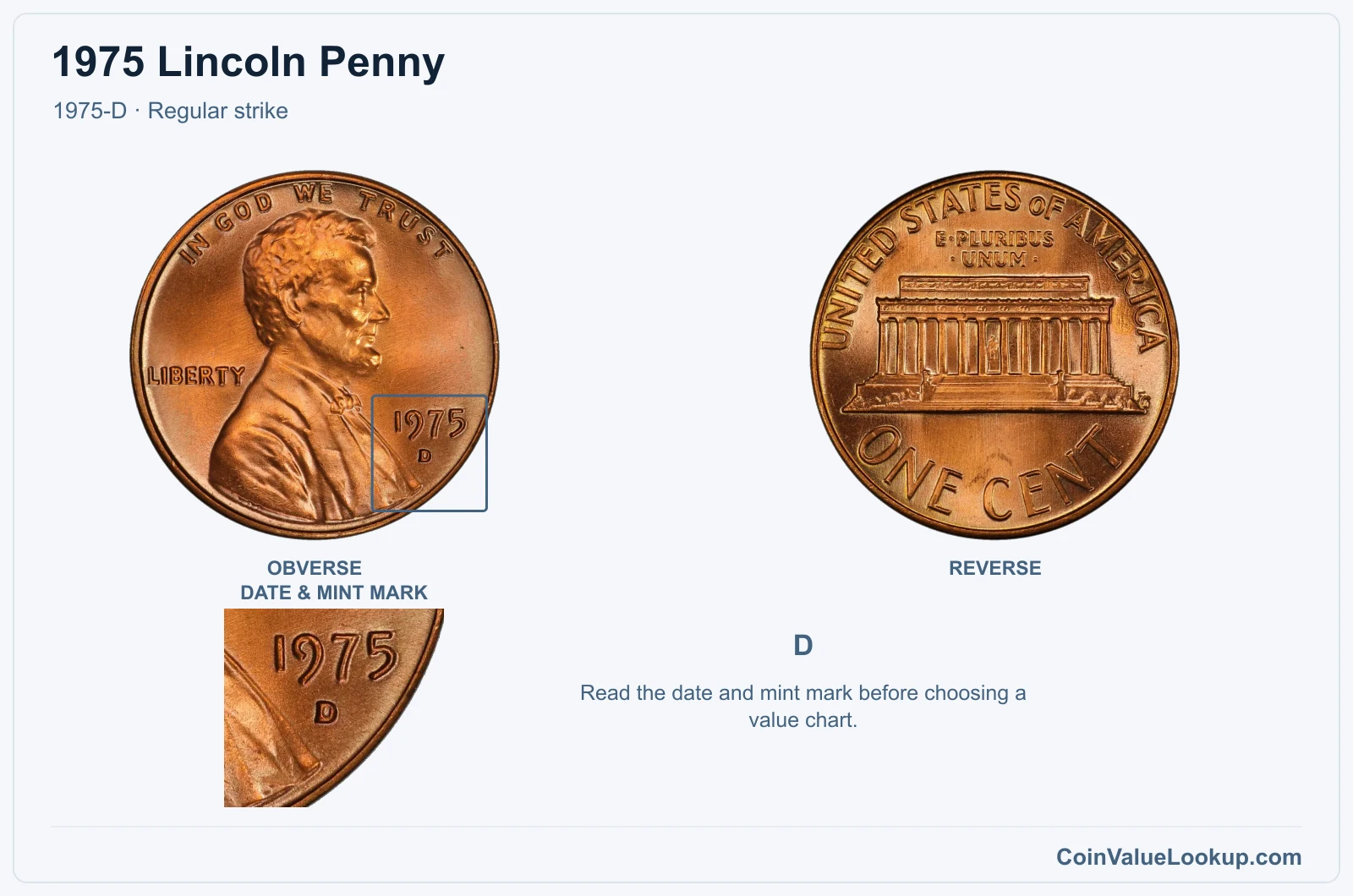
The 1975-D carries a small "D" mintmark below the date, identifying it as a Denver product. Like its no-mintmark sibling, the guide estimate at MS65 sits around $1.24 per USA Coin Book.
Condition and copper color are the deciding factors. A blast-white red example with clean fields is far more appealing than a dark, spotted one grading the same.
Check the mintmark area carefully; it is also where you might spot a repunched mintmark variety.
Coin Value Lookup is a handy starting point if you want to look up guide values for other dates and mints in the Lincoln series.
| Range | Grade | Price | Auction Records | Appraisal |
|---|---|---|---|---|
| PO | PO 1 | — | Coin Identifier | |
| FR | FR 2 | — | Coin Identifier | |
| AG | AG 3 | — | Coin Identifier | |
| G | G 4 | — | Coin Identifier | |
| G 6 | — | Coin Identifier | ||
| VG | VG 8 | — | Coin Identifier | |
| VG 10 | — | Coin Identifier | ||
| F | F 12 | — | Coin Identifier | |
| F 15 | — | Coin Identifier | ||
| VF | VF 20 | — | Coin Identifier | |
| VF 25 | — | Coin Identifier | ||
| VF 30 | — | Coin Identifier | ||
| VF 35 | — | Coin Identifier | ||
| XF | XF 40 | — | Coin Identifier | |
| XF 45 | — | Coin Identifier | ||
| AU | AU 50 | — | Coin Identifier | |
| AU 53 | — | Coin Identifier | ||
| AU 55 | — | Coin Identifier | ||
| AU 58 | — | Coin Identifier | ||
| MS | MS 60 | — | Coin Identifier | |
| MS 61 | — | Coin Identifier | ||
| MS 62 | — | Coin Identifier | ||
| MS 63 | — | Coin Identifier | ||
| MS 64 | Coin Identifier | |||
| MS 65 | Coin Identifier | |||
| MS 66 | Coin Identifier | |||
| MS 67 | Coin Identifier | |||
| MS 68 | — | Coin Identifier | ||
| MS 69 | — | — | — | |
| MS 70 | — | — | — |
1975 Lincoln Penny — S PR
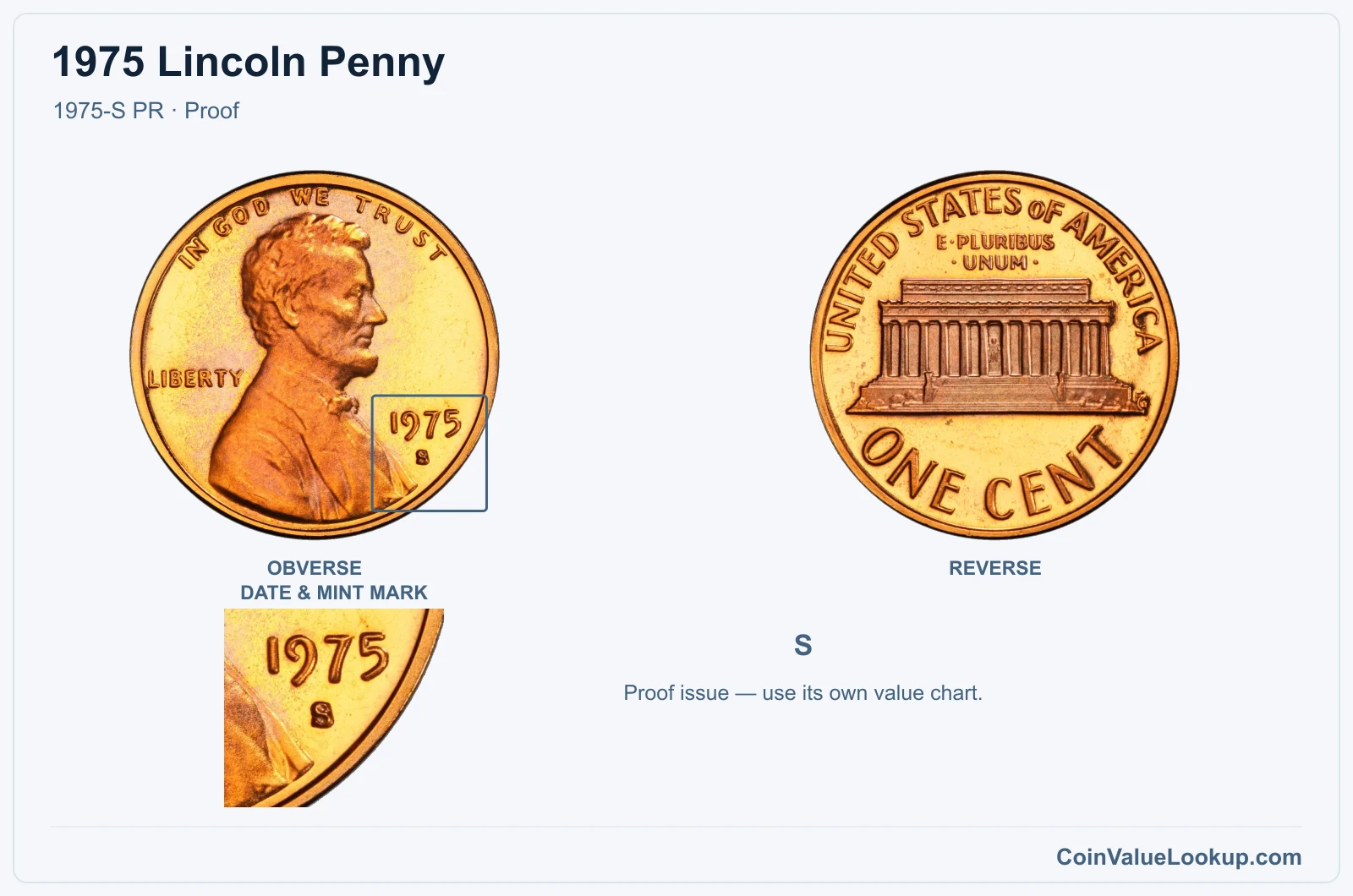
The 1975-S is a proof-only issue. You will not find one in pocket change; they came in sealed proof sets sold directly to collectors by the San Francisco Mint.
Proofs have mirror-like fields and sharply struck devices. A USA Coin Book guide estimate places a PR65 at about $4.27.
Coins with strong cameo or deep cameo contrast between frosted portraits and reflective fields tend to be more desirable, though no separate price for those contrast levels is adopted here.
When evaluating a proof, look for hairlines, haze, and fingerprints. These are the enemies of proof surfaces and the reason so many otherwise sharp coins sit in lower grades.
Handle by the edges only and store in non-PVC holders.
| Range | Grade | Price | Auction Records | Appraisal |
|---|---|---|---|---|
| PR | PR 1 | — | Coin Identifier | |
| PR 2 | — | Coin Identifier | ||
| PR 3 | — | Coin Identifier | ||
| PR 4 | — | Coin Identifier | ||
| PR 6 | — | Coin Identifier | ||
| PR 8 | — | Coin Identifier | ||
| PR 10 | — | Coin Identifier | ||
| PR 12 | — | Coin Identifier | ||
| PR 15 | — | Coin Identifier | ||
| PR 20 | — | Coin Identifier | ||
| PR 25 | — | Coin Identifier | ||
| PR 30 | — | Coin Identifier | ||
| PR 35 | — | Coin Identifier | ||
| PR 40 | — | Coin Identifier | ||
| PR 45 | — | Coin Identifier | ||
| PR 50 | — | Coin Identifier | ||
| PR 53 | — | Coin Identifier | ||
| PR 55 | — | Coin Identifier | ||
| PR 58 | — | Coin Identifier | ||
| PR 60 | — | Coin Identifier | ||
| PR 61 | — | Coin Identifier | ||
| PR 62 | — | Coin Identifier | ||
| PR 63 | — | Coin Identifier | ||
| PR 64 | Coin Identifier | |||
| PR 65 | Coin Identifier | |||
| PR 66 | Coin Identifier | |||
| PR 67 | Coin Identifier | |||
| PR 68 | Coin Identifier | |||
| PR 69 | Coin Identifier | |||
| PR 70 | — | — | — |
1975 Lincoln Penny Error List
1. 1975 Lincoln Penny — Struck on a Dime Blank
A 1975 cent struck on a dime-sized clad blank is a wrong-planchet error. The planchet weighs approximately 2.3 grams instead of the normal 3.11 grams, and it is noticeably smaller.
The cent dies impress the Lincoln and Memorial design onto this undersized blank, leaving the periphery incomplete or stretched because the blank does not fill the collar.
To identify one, weigh the coin and measure the diameter. A normal cent is 19 mm; a dime blank is about 17.9 mm.
The clad composition will also differ from the copper appearance of a standard cent.
Don't confuse this with a plated or environmentally damaged cent that merely looks silvery. An NGC MS61 example of this error sold for $305.50 at auction in April 2013.
Professional certification matters here because the blank attribution is critical to the value.
2. 1975 Lincoln Penny — Double Strike with Uniface Second Strike
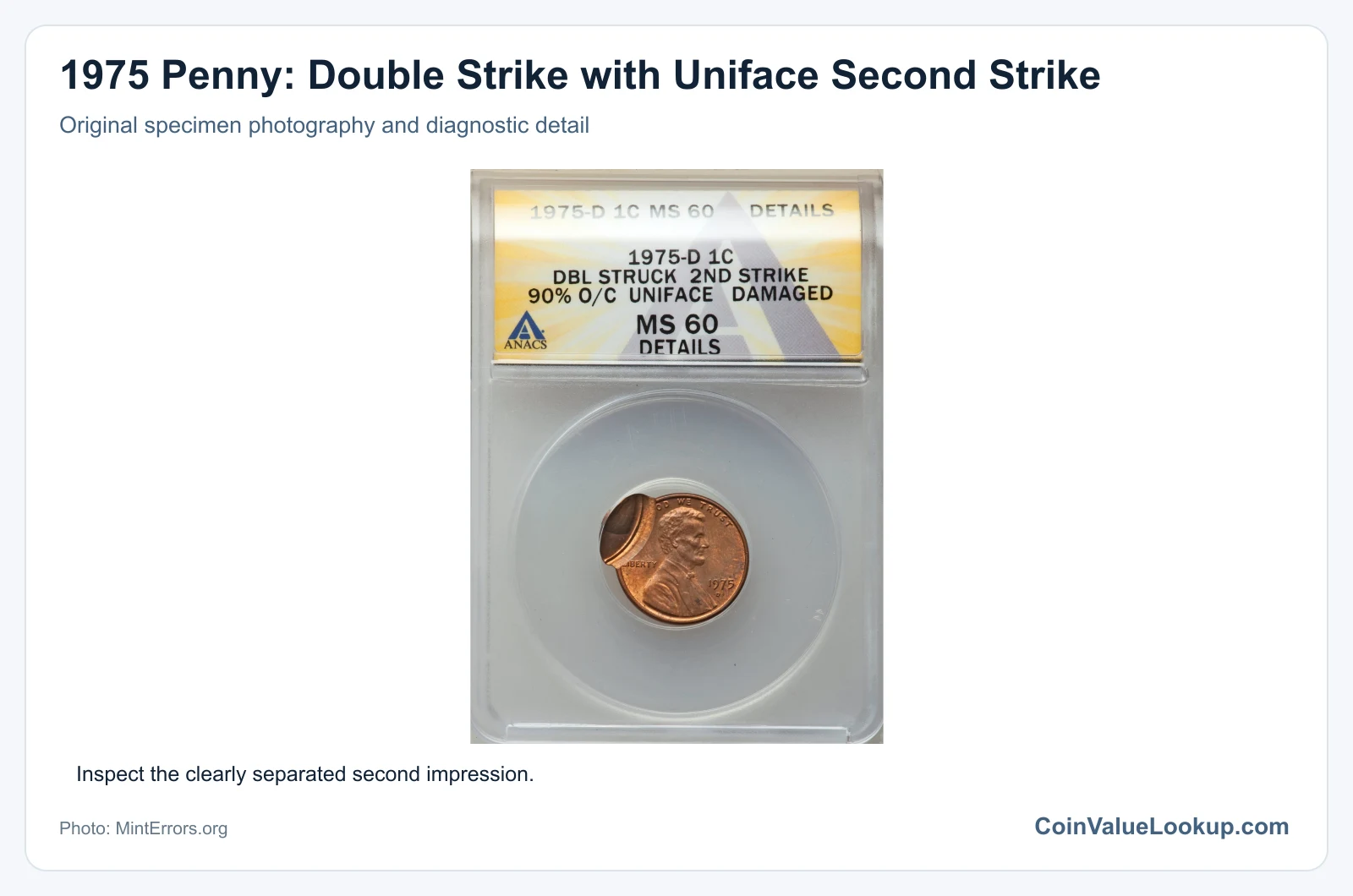
This error involves a 1975 no-mintmark cent that was struck twice, with the second strike landing roughly 95% off center and uniface. That means another blank sat between the coin and one die during the second hit, so only one side received an impression on that second strike.
You will see a nearly complete first-strike design plus a tiny, displaced second impression off to one side. The second impression only shows design on one face.
Do not mistake this for a doubled die, which is a consistent doubling across many coins from the same die. A double strike is a feeding error unique to one coin.
It also differs from a post-mint rim dent or vise mark, which would not carry design detail. An ANACS MS64 Red-Brown example sold for $144 in March 2021.
3. 1975 Lincoln Penny — Off-Center Strike
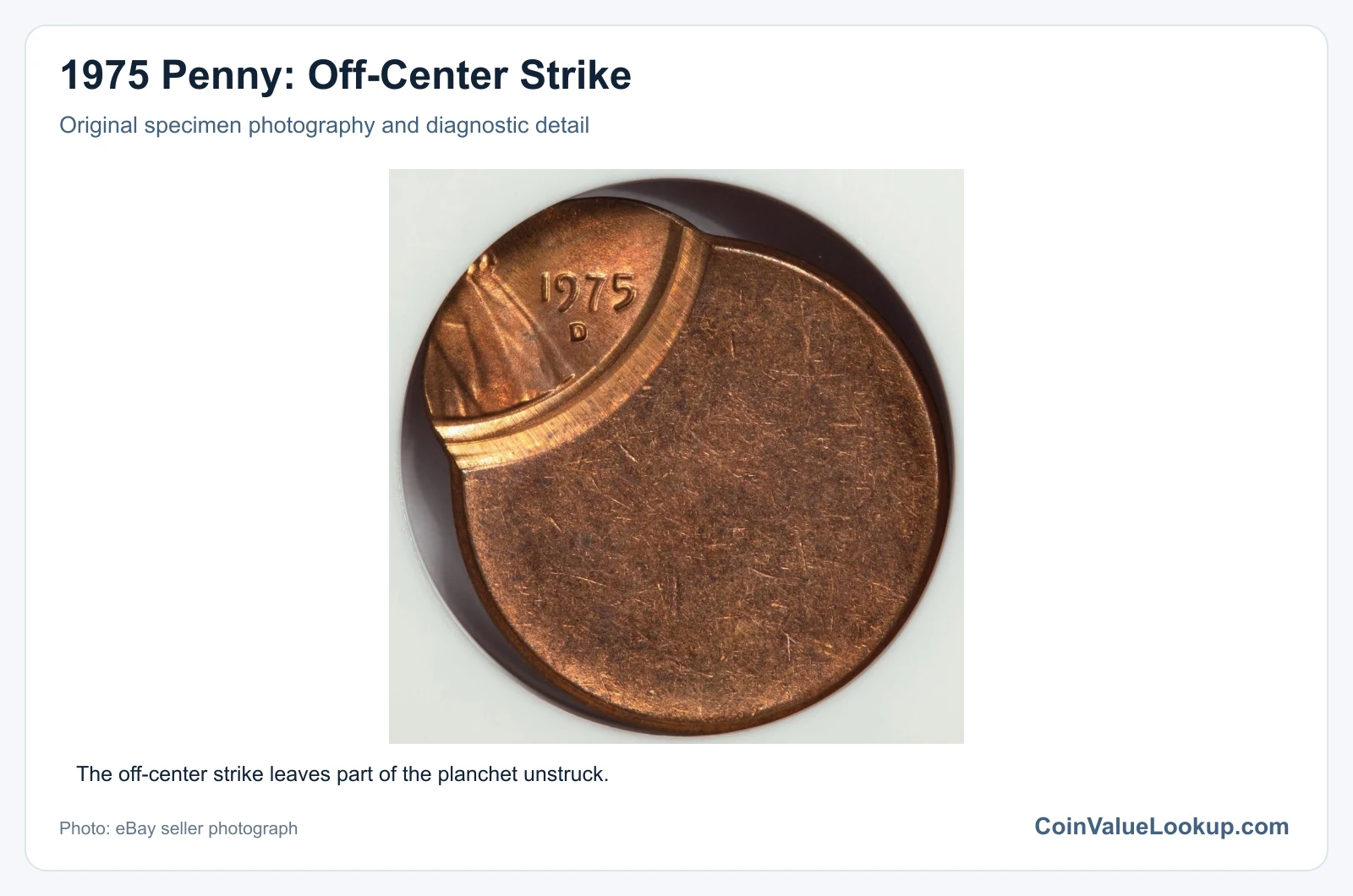
A 1975-D cent struck 65% off center has most of its design missing, with a large blank crescent where the planchet was not covered by the dies. Only about 35% of the Lincoln and Memorial design is present.
The key to value here is whether the date and D mintmark remain visible. Off-center strikes that retain a readable date and mintmark are far more collectible than those where the attribution is lost.
Don't confuse this with a misaligned die error, which shows a complete but shifted design still within the full diameter of the coin. An off-center strike has a genuinely blank area with no rim.
An ANACS MS62 Red example sold for $49 in January 2022, which gives you a ballpark for a well-attributed piece.
4. 1975 Lincoln Penny — Doubled Die Obverse
Doubled die obverse errors have been reported for the 1975 cent. This type of error results from a misalignment during the die-making process, producing consistent doubling on every coin struck by that particular die.
To check for it, compare the obverse lettering and design elements against a normal 1975 cent under the same lighting and magnification. Look for consistent separation or notching on letters like LIBERTY or IN GOD WE TRUST rather than a flat, shelf-like distortion.
Machine doubling is the most common lookalike. It produces a flat shelf of displaced metal rather than the rounded, separated profiles of a true doubled die.
The specific variety, its visibility, and the coin's condition all affect value, so professional authentication is the way to go before assuming you have a winner.
5. 1975 Lincoln Penny — Doubled Die Reverse
Doubled die reverse errors have also been reported for the 1975 cent. These show consistent doubling on the reverse legends or architectural details of the Memorial.
Compare your coin's reverse closely with a normal example. Pay attention to E PLURIBUS UNUM, ONE CENT, and the column lines.
True hub doubling will show separated or notched design elements that repeat across coins from the same die.
Machine doubling on the reverse looks similar at first glance but produces flat, shelf-like distortion without the rounded secondary image of a genuine doubled die. Random damage and die deterioration can also mimic doubling.
Value depends on the specific die, how dramatic the doubling is, and the coin's overall condition. Have it examined by a professional grading service if you suspect a match.
6. 1975 Lincoln Penny — Repunched Mintmark
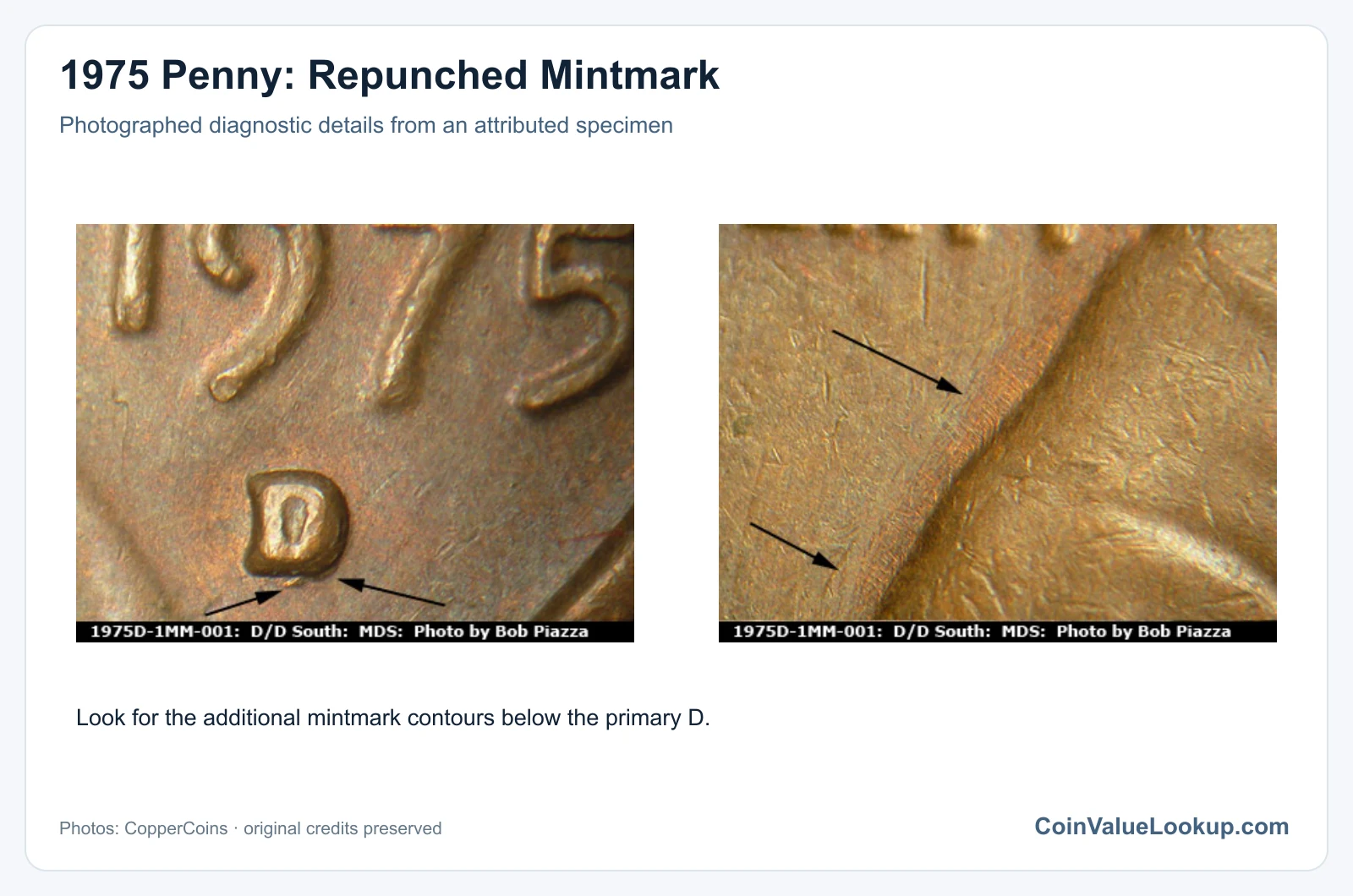
Repunched mintmark varieties have been reported for the 1975 cent. This error occurs when the mintmark punch was applied more than once in slightly different positions, leaving remnants of the earlier placement visible under magnification.
Inspect the mintmark closely at matching magnification alongside a normal coin. You are looking for traces of a second letter overlapping or offset from the primary mintmark.
The remnant may appear as a partial serif, a shadow, or a notch that does not belong.
Die chips or corrosion near the mintmark can create similar-looking anomalies, so be cautious. Machine doubling around the mintmark is another common lookalike.
Condition, clarity of the repunching, and collector demand for the specific variety all influence what the coin is worth.
7. 1975 Lincoln Penny — BIE Die Break
A BIE die break on a 1975 cent shows a small raised vertical line or blob between the letters B and E in LIBERTY. This happens when a crack forms in the die between those letters, and metal flows into the gap during striking.
The result looks like a tiny capital "I" squeezed between B and E, though it can also appear as a shapeless bump depending on the stage of the die crack. Check the surrounding surface; a genuine die break will be raised and consistent with the coin's strike, not scratched into the surface.
Dirt, debris, or a scratch across LIBERTY can mimic this error at a casual glance. Clean the area gently with acetone if needed, then re-examine.
Value varies with the size and sharpness of the break as well as the coin's overall condition.
8. 1975 Lincoln Penny — Die Break / Cud
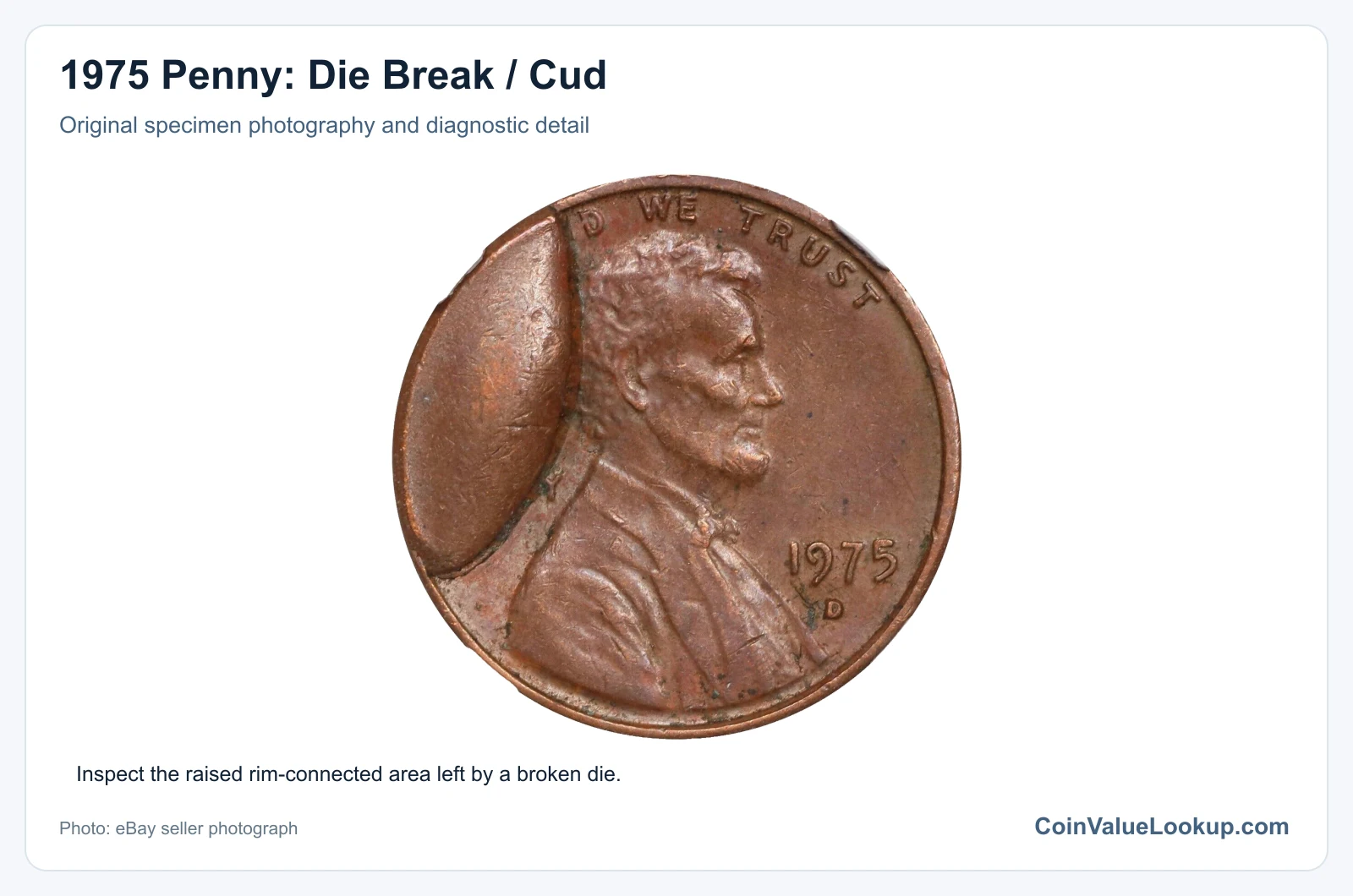
Die break and cud errors have been reported on 1975 cents. A cud is a specific type of die break where a piece of the die at the rim breaks away completely.
The result is a raised, featureless blob of metal on the coin that connects to the rim and replaces whatever design was in that area.
An interior die break works the same way but sits away from the rim, appearing as a raised irregular lump within the design. Both are caused by fatigue in the steel die.
Look at the boundary of the feature. A genuine cud has a smooth, flat top and sharp edges where it meets the remaining design.
A rim dent from post-mint damage will push metal inward and disturb the adjacent design differently. Corrosion can also raise irregular lumps, but those lack the clean boundary of a die break.
Condition and the size of the cud affect value.
9. 1975 Lincoln Penny — Die Cap / Capped-Die Strike
Die cap errors have been reported for the 1975 cent. A die cap forms when a struck coin sticks to the upper die and is not ejected.
Subsequent blanks are then struck against the stuck coin instead of the bare die, producing coins with a brockage image on one side.
The stuck coin itself becomes progressively cupped as repeated strikes bend it around the die, eventually forming a bottle-cap shape. It will show a normal image on the side that originally faced the lower die and a distorted, spread impression on the capped side.
Do not confuse a die cap with a coin that was simply bent or crushed in a vise after leaving the mint. A genuine cap shows progressive design spreading and thinning consistent with being struck multiple times while attached to a die.
Professional certification is strongly recommended for this error, as condition and the stage of capping determine its desirability.
10. 1975 Lincoln Penny — Fold-Over Strike
Fold-over strike errors have been reported for the 1975 cent. This occurs when a blank or partially struck planchet folds over on itself during the striking process.
The result is a coin that is roughly half its normal diameter but doubled in thickness, with design elements visible on both sides of the fold.
The key diagnostic is that the design wraps across the fold line, continuing from one layer to the other in a way that is physically impossible through post-mint bending. A coin bent after striking will show a sharp crease interrupting the design, not a design that flows over the fold.
Look at both sides carefully. A genuine fold-over has struck detail on the outer surfaces and may show a blank or mirror-image contact face where the two layers meet on the inside.
Value depends on how dramatic the fold is, whether the date remains visible, and the coin's overall condition.