1973 Washington Quarter Coin Value: How Much Is It Worth?
Most 1973 Washington quarters you pull from a jar are worth face value — 25 cents. Worn, circulated examples from Philadelphia or Denver are extremely common.
In higher uncirculated grades, a USA Coin Book guide estimate places an MS65 example around $7.29. Proof, variety and authenticated error coins are a different story and need to be evaluated on their own merits.
Fast Way to Identify Your 1973 Washington Quarter
Snap a clear photo of the front and back of your 1973 quarter and upload both images using the identifier on this page. You will receive a preliminary identification of your coin's mint, version and general type.
This is not a certification or authentication service, but it gives you a useful starting point before deciding whether professional grading is worthwhile.
1973 Washington Quarter Value
Upload both sides of your 1973 Washington Quarter.
Front Obverse
Upload photo
Back Reverse
Upload photo
Which 1973 Washington Quarter Versions Are Worth Money?
- The 1973 Philadelphia and Denver quarters in original, uncirculated condition around MS65 carry a guide estimate of roughly $7.29 each — far above face value for a common date.
- The 1973-S Proof in PR65 condition has a guide estimate near $6.25; coins with superior contrast or higher grades may differ.
- Authenticated errors like the flipover double strike (sold for $373.75 in MS64) and the Denver nickel-planchet strike (sold for $276 in MS64) represent the strongest premiums for this date.
- Off-center strikes, broadstrikes, clipped planchets, doubled dies and struck-through errors have also been reported for this year and can carry premiums depending on severity and condition.
Step 1: Identify Your 1973 Washington Quarter Mint Mark and Version
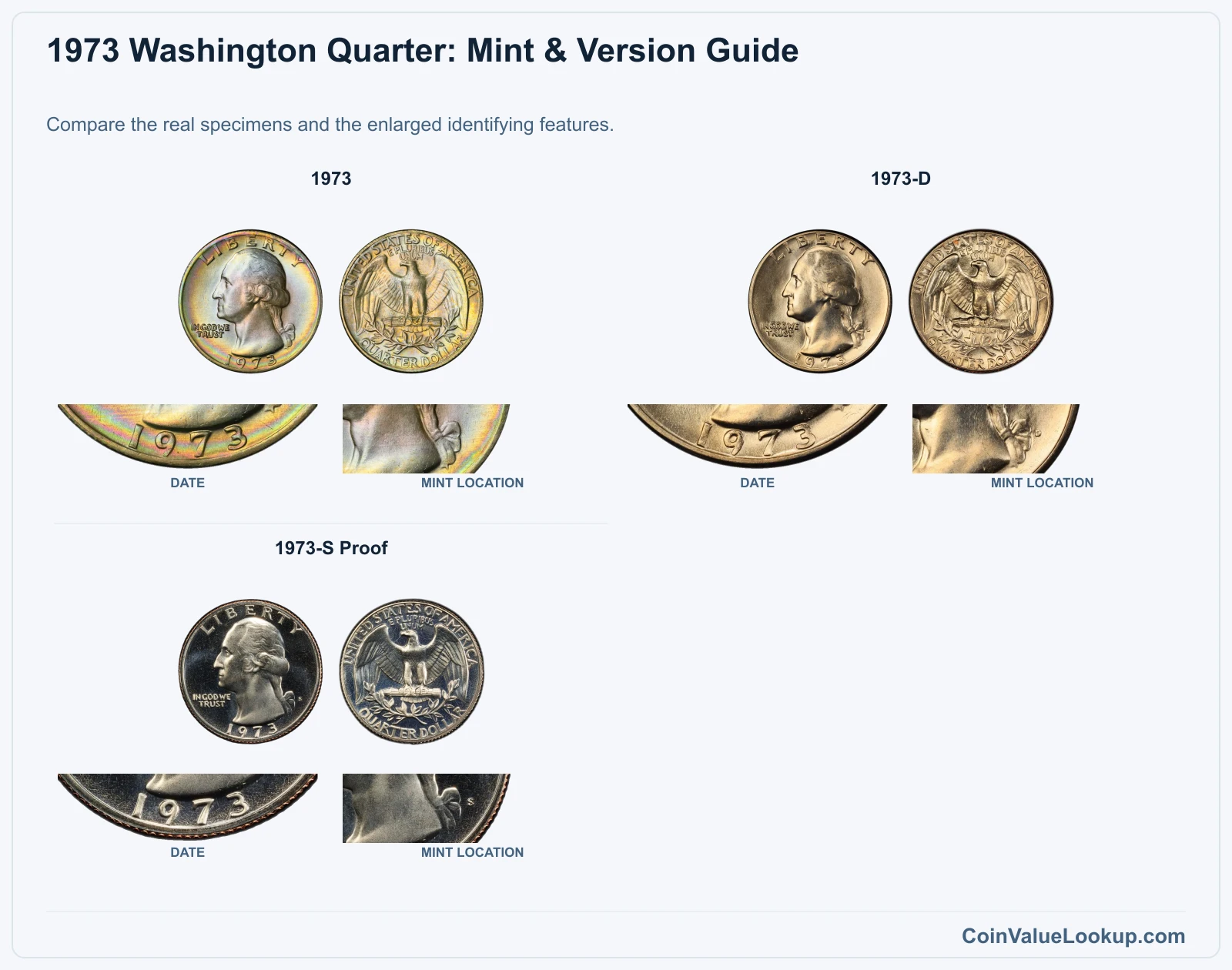
Three versions of the 1973 Washington quarter exist. The Philadelphia coin carries no mintmark.
The Denver coin shows a small "D" near the date on the obverse. The San Francisco coin has an "S" mintmark and was produced exclusively as a proof.
All three are copper-nickel clad, weighing a nominal 5.67 grams and measuring 24.3 mm across. The clad composition is 91.67% copper and 8.33% nickel overall.
An "S" mintmark does not mean silver for this year, so do not assume otherwise based on the letter alone.
To check, look at the edge. A clad quarter shows a visible copper-colored stripe sandwiched between the outer nickel layers.
Color can vary with wear and toning, so edge examination is more reliable than surface appearance. For exact alloy confirmation, professional testing is needed.
Step 2: Check Your 1973 Washington Quarter Grade
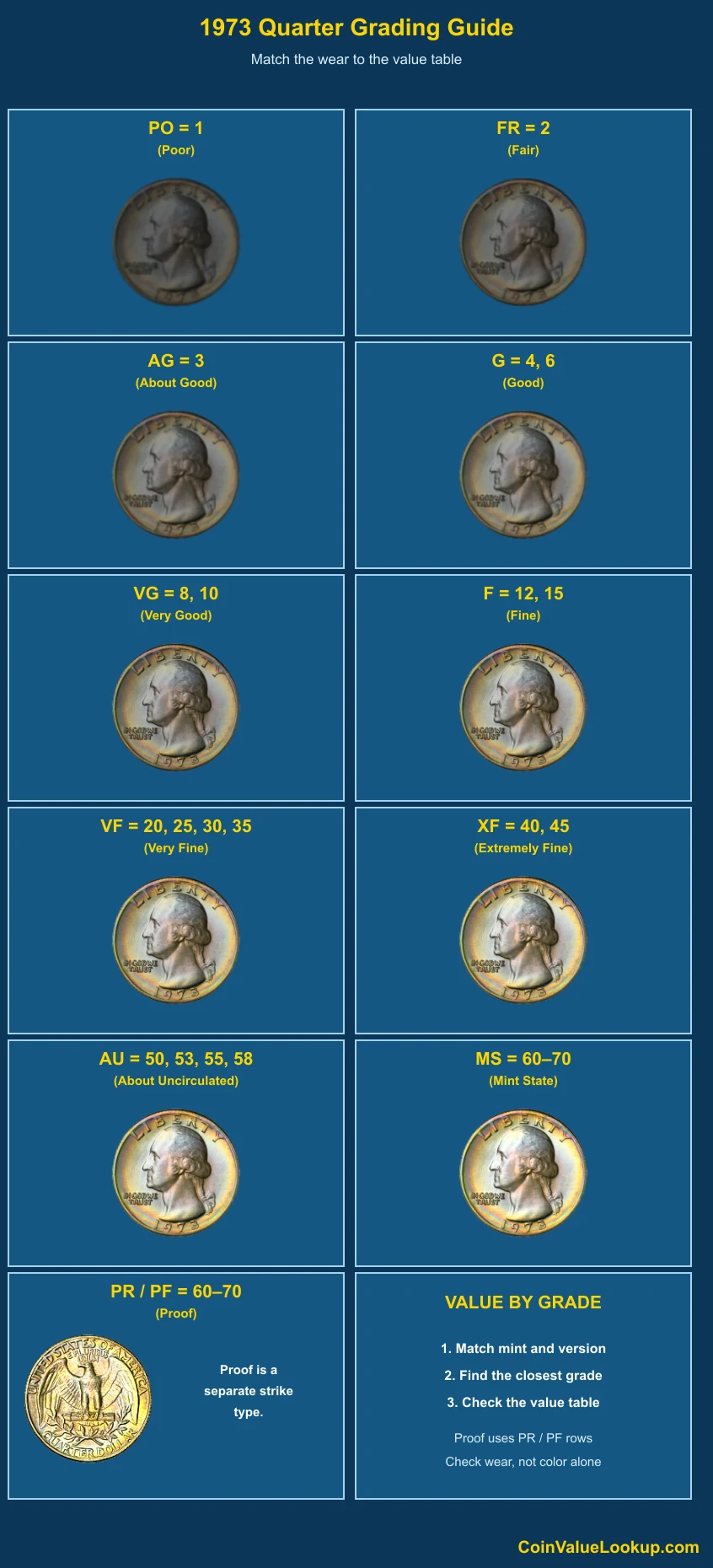
Focus on the hair detail above Washington's ear and along the cheek and jawline on the obverse. On the reverse, check the eagle's breast feathers.
These are the first areas where friction shows up.
Separate weak strikes from actual wear. A weakly struck coin may look worn but still have full original luster in the recessed areas.
True wear removes luster and flattens the highest points.
Look for contact marks, which are the bag nicks and scuffs from handling at the mint. These pull down the grade even on coins that never circulated.
Also inspect for cleaning hairlines under angled light — a cleaned coin grades lower than an original one at the same apparent wear level.
Use the comparison image to match your coin's detail against known grade benchmarks. Proof coins are graded on their own scale and judged by surface quality, not wear in the traditional sense.
Step 3: Check 1973 Washington Quarter Value by Mint and Version
1973 Washington Quarter
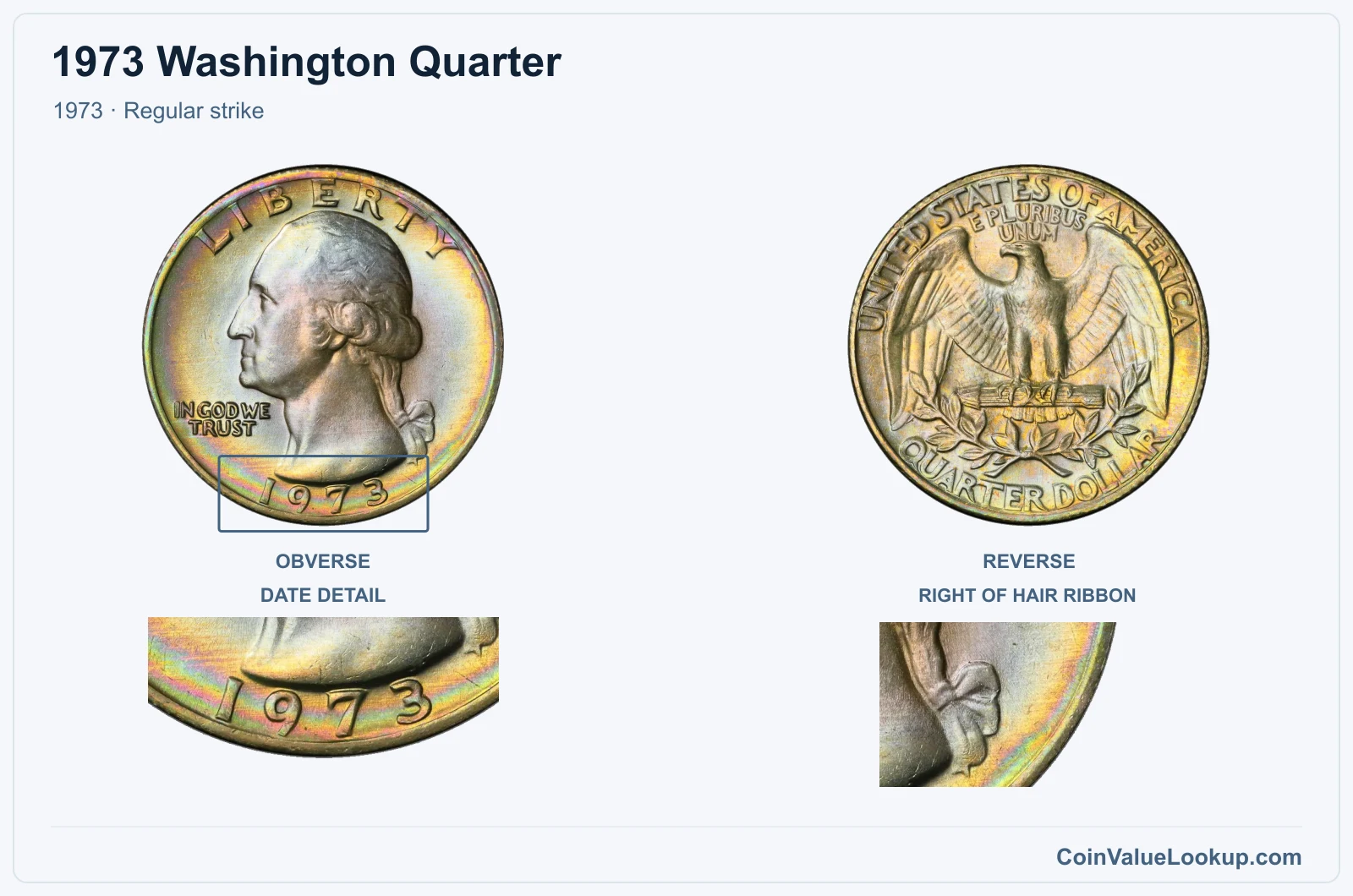
The 1973 Philadelphia quarter has no mintmark — the space near the date is blank. It is a standard copper-nickel clad business strike with Washington on the obverse and an eagle clutching arrows and olive branches on the reverse.
In circulated grades this coin is worth its face value of 25 cents. A USA Coin Book guide estimate places an MS65 example at about $7.29.
That is a retail guide figure, not a guaranteed offer, and lower uncirculated grades fall between face value and that number. The key to getting any premium is original, undamaged luster with minimal contact marks.
| Range | Grade | Price | Auction Records | Appraisal |
|---|---|---|---|---|
| PO | PO 1 | — | Coin Identifier | |
| FR | FR 2 | — | Coin Identifier | |
| AG | AG 3 | — | Coin Identifier | |
| G | G 4 | — | Coin Identifier | |
| G 6 | — | Coin Identifier | ||
| VG | VG 8 | — | Coin Identifier | |
| VG 10 | — | Coin Identifier | ||
| F | F 12 | — | Coin Identifier | |
| F 15 | — | Coin Identifier | ||
| VF | VF 20 | — | Coin Identifier | |
| VF 25 | — | Coin Identifier | ||
| VF 30 | — | Coin Identifier | ||
| VF 35 | — | Coin Identifier | ||
| XF | XF 40 | — | Coin Identifier | |
| XF 45 | — | Coin Identifier | ||
| AU | AU 50 | — | Coin Identifier | |
| AU 53 | — | Coin Identifier | ||
| AU 55 | — | Coin Identifier | ||
| AU 58 | — | Coin Identifier | ||
| MS | MS 60 | — | Coin Identifier | |
| MS 61 | — | Coin Identifier | ||
| MS 62 | — | Coin Identifier | ||
| MS 63 | — | Coin Identifier | ||
| MS 64 | Coin Identifier | |||
| MS 65 | Coin Identifier | |||
| MS 66 | Coin Identifier | |||
| MS 67 | Coin Identifier | |||
| MS 68 | — | — | — | |
| MS 69 | — | — | — | |
| MS 70 | — | — | — |
1973 Washington Quarter — D
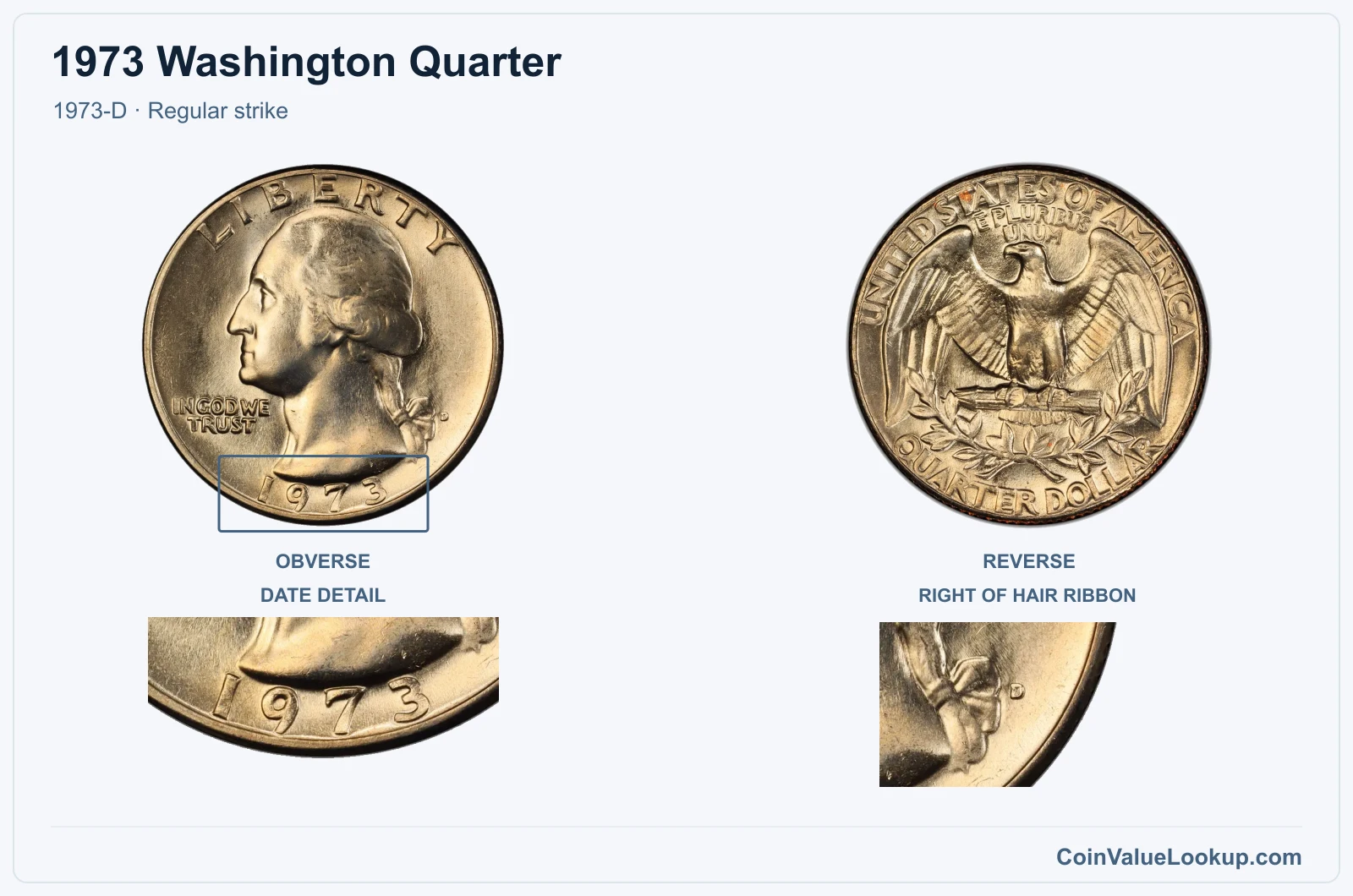
The 1973-D quarter carries a small "D" mintmark near the date, indicating production at the Denver Mint. Same copper-nickel clad composition as its Philadelphia sibling — 5.67 grams, 24.3 mm.
Circulated pieces are worth 25 cents. The USA Coin Book guide estimate for MS65 is $7.29.
Denver quarters from this era were produced in huge numbers, so finding one in pocket change is easy. Finding one in true gem condition with clean fields and strong luster is the hard part.
Coin Value Lookup is a good place to start when you want to look up guide values for other dates and mints in the Washington quarter series.
| Range | Grade | Price | Auction Records | Appraisal |
|---|---|---|---|---|
| PO | PO 1 | — | Coin Identifier | |
| FR | FR 2 | — | Coin Identifier | |
| AG | AG 3 | — | Coin Identifier | |
| G | G 4 | — | Coin Identifier | |
| G 6 | — | Coin Identifier | ||
| VG | VG 8 | — | Coin Identifier | |
| VG 10 | — | Coin Identifier | ||
| F | F 12 | — | Coin Identifier | |
| F 15 | — | Coin Identifier | ||
| VF | VF 20 | — | Coin Identifier | |
| VF 25 | — | Coin Identifier | ||
| VF 30 | — | Coin Identifier | ||
| VF 35 | — | Coin Identifier | ||
| XF | XF 40 | — | Coin Identifier | |
| XF 45 | — | Coin Identifier | ||
| AU | AU 50 | — | Coin Identifier | |
| AU 53 | — | Coin Identifier | ||
| AU 55 | — | Coin Identifier | ||
| AU 58 | — | Coin Identifier | ||
| MS | MS 60 | — | Coin Identifier | |
| MS 61 | — | Coin Identifier | ||
| MS 62 | — | Coin Identifier | ||
| MS 63 | Coin Identifier | |||
| MS 64 | Coin Identifier | |||
| MS 65 | Coin Identifier | |||
| MS 66 | Coin Identifier | |||
| MS 67 | Coin Identifier | |||
| MS 68 | — | Coin Identifier | ||
| MS 69 | — | — | — | |
| MS 70 | — | — | — |
1973 Washington Quarter — S Proof
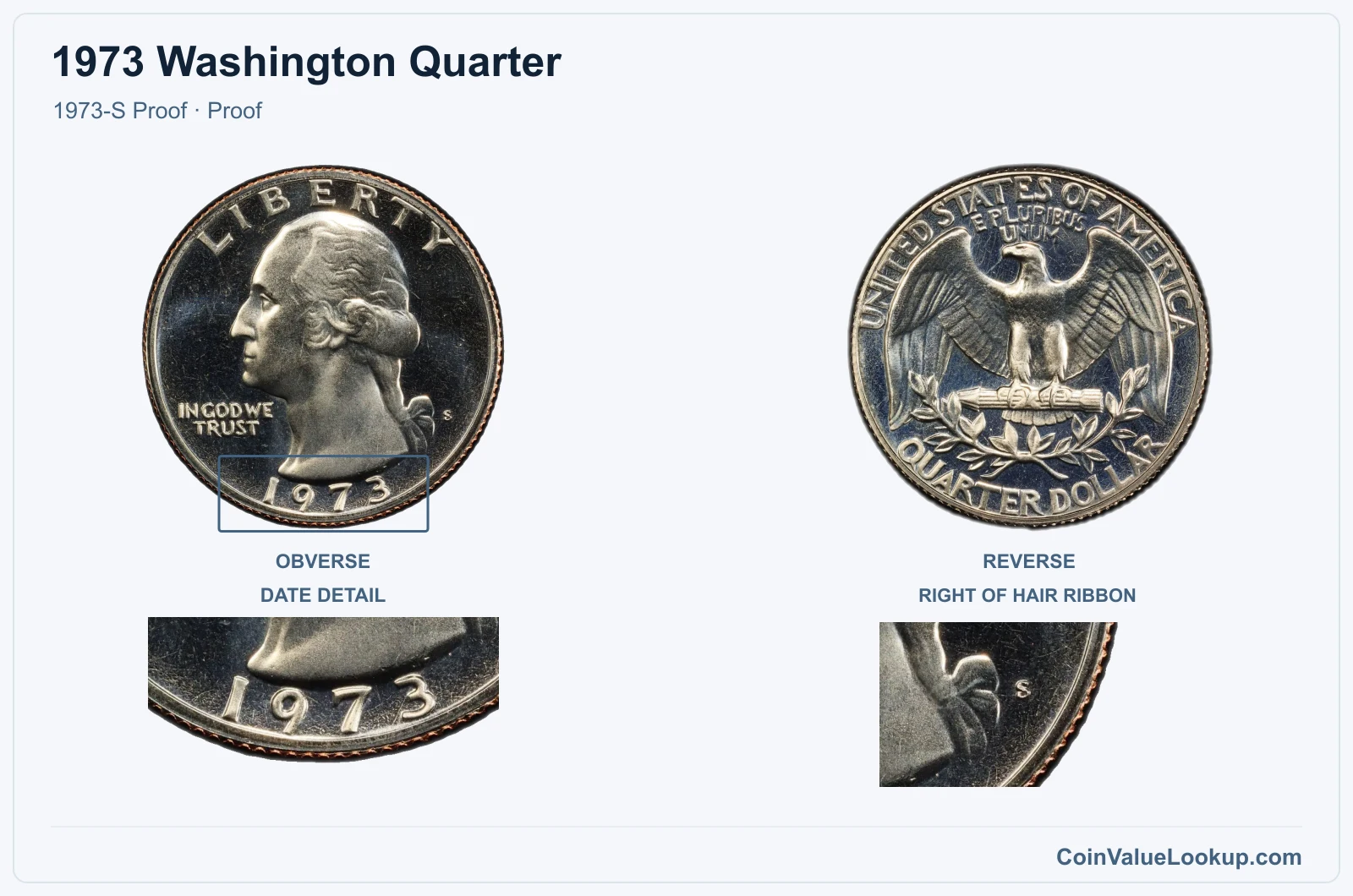
The 1973-S Proof was struck at the San Francisco Mint for collectors, not for circulation. It carries an "S" mintmark.
Despite the S, this is a copper-nickel clad coin, not silver.
Proof coins are struck with specially prepared dies on polished planchets, producing sharp detail and mirror-like fields. Some proofs show frosted raised devices against those mirror fields — this is a contrast designation, not a different metal or a higher numerical grade.
A USA Coin Book guide estimate for PR65 is about $6.25. Coins with strong cameo contrast or those grading well above PR65 may trade differently, but that generic PR65 figure is not a quote specific to any contrast tier.
| Range | Grade | Price | Auction Records | Appraisal |
|---|---|---|---|---|
| PR | PR 1 | — | Coin Identifier | |
| PR 2 | — | Coin Identifier | ||
| PR 3 | — | Coin Identifier | ||
| PR 4 | — | Coin Identifier | ||
| PR 6 | — | Coin Identifier | ||
| PR 8 | — | Coin Identifier | ||
| PR 10 | — | Coin Identifier | ||
| PR 12 | — | Coin Identifier | ||
| PR 15 | — | Coin Identifier | ||
| PR 20 | — | Coin Identifier | ||
| PR 25 | — | Coin Identifier | ||
| PR 30 | — | Coin Identifier | ||
| PR 35 | — | Coin Identifier | ||
| PR 40 | — | Coin Identifier | ||
| PR 45 | — | Coin Identifier | ||
| PR 50 | — | Coin Identifier | ||
| PR 53 | — | Coin Identifier | ||
| PR 55 | — | Coin Identifier | ||
| PR 58 | — | Coin Identifier | ||
| PR 60 | — | Coin Identifier | ||
| PR 61 | — | Coin Identifier | ||
| PR 62 | — | Coin Identifier | ||
| PR 63 | — | Coin Identifier | ||
| PR 64 | — | Coin Identifier | ||
| PR 65 | — | Coin Identifier | ||
| PR 66 | — | Coin Identifier | ||
| PR 67 | — | Coin Identifier | ||
| PR 68 | Coin Identifier | |||
| PR 69 | Coin Identifier | |||
| PR 70 | — | — | — |
1973 Washington Quarter Error List
1. 1973 Washington Quarter — Flipover Double Strike
A 1973 Philadelphia quarter exists that was struck once, flipped over inside the collar, and struck a second time. The result is dramatic: remnants of the first strike appear near the coin's perimeter, and a ghostly outline of Washington's portrait shows up on the reverse where it does not belong.
Look at both sides carefully. The first-strike design elements are displaced and partially overwritten by the second impression.
This pattern cannot be replicated by machine doubling or ordinary doubled dies, which affect only one face at a time and do not reverse the design orientation.
One example graded PCGS MS64 sold for $373.75 at Heritage Auctions in September 2008. That is one recorded sale for one specific coin, not a market range for every flipover.
Deliberate sandwich impressions or post-mint manipulation do not reproduce the documented in-collar flipover pattern.
2. 1973 Washington Quarter — Struck on a Nickel Planchet
A 1973-D quarter was struck on a nickel-denomination blank instead of the correct quarter planchet. The nickel blank weighs about 5.0 grams — lighter and smaller than the standard 5.67-gram quarter blank.
Because the blank was undersized, peripheral lettering and part of the last digit of the date are missing. Localized reeding shows where the smaller blank contacted the collar.
If you suspect you have one, weigh the coin carefully. The design should be a genuine Washington quarter — not a Jefferson nickel — just on the wrong-size planchet with incomplete coverage.
One example graded NGC MS64 sold for $276 at Heritage Auctions in June 2005. Post-mint cutting, hammering, plating or chemical damage can mimic an odd-size appearance.
Authentic wrong-planchet errors show properly struck surfaces with the design tapering off naturally at the blank's edge.
3. 1973 Washington Quarter — Off-Center Strike
Off-center strikes on 1973 quarters occur when the planchet is not properly seated between the dies at the moment of striking. The result is a displaced design with an unstruck crescent of blank metal on one side.
The degree of displacement matters a lot. A 5% off-center coin is a curiosity.
A 50% off-center coin with the full date still visible is far more desirable. Condition and the percentage of visible design drive the premium.
Do not confuse an off-center strike with a clipped planchet, which removes material before striking, or post-mint flattening, which distorts the coin without leaving an unstruck crescent. A one-sided die misalignment can look similar but usually produces a complete, slightly shifted design rather than a blank area.
4. 1973 Washington Quarter — Doubled Die Obverse
Doubled die obverse errors on 1973 quarters show consistent doubling on the lettering, date or design elements of the front face. The separation appears as a distinct secondary image or notching on affected areas.
To check, compare your coin's obverse letters and date numerals against a normal 1973 quarter under the same lighting. Genuine doubled die doubling is raised and consistent across the affected zone — it looks the same from multiple angles.
Machine doubling is the most common lookalike. It produces a flat, shelf-like distortion rather than a raised secondary image and generally adds little value.
Die wear and light reflections can also mimic doubling to the untrained eye. Value depends on the strength and visibility of the doubling as well as the coin's overall condition.
5. 1973 Washington Quarter — Broadstrike
A broadstrike happens when the collar — the ring that normally confines the planchet during striking — fails to engage. Without that confinement, the metal spreads outward under die pressure, producing a coin that is wider than normal with no reeded edge.
On a 1973 quarter broadstrike, the full design is typically present and centered, but the coin has a larger diameter and a smooth or irregular rim. This distinguishes it from an off-center strike, where the design itself is displaced.
Coins flattened after leaving the mint can look wider, but they lack the uniform metal flow of a genuine broadstrike and usually show surface damage. Value depends on the degree of spread, overall condition and whether the error is authenticated.
6. 1973 Washington Quarter — Clipped Planchet
Clipped planchet errors on 1973-D quarters result from the blank-cutting process at the mint. When the strip of metal is not fed correctly, the punch overlaps a previously cut hole, leaving a curved bite out of the resulting blank.
That missing section carries through to the finished coin.
Look for a curved absence along the rim, along with weakness in the design directly opposite the clip — the so-called Blakesley effect, where metal flow is reduced on the far side. The edge texture at the clip should look natural and unfinished, not filed or cut.
Post-mint damage like filing, cutting or corrosion can remove metal from a coin's edge, but these typically leave tool marks, sharp angles or pitting that differ from the smooth, factory-fresh curve of a genuine clip. Condition and clip size affect value.
7. 1973 Washington Quarter — Struck-Through Error
Struck-through errors happen when foreign material — grease, a fragment of metal, cloth or other debris — sits between the die and the planchet at the moment of striking. The result is a localized depression or incomplete area in the design where the obstruction blocked the die's impression.
On a 1973 quarter, look for a smooth, recessed area that does not match normal wear patterns. A grease fill-in tends to produce a soft, uniform blank spot, while a retained foreign object may leave an impression of its own shape in the coin's surface.
Do not confuse struck-through areas with ordinary wear, scratches or cleaning damage. Wear follows the coin's high points; a struck-through depression can appear anywhere, even in a protected recess.
Value depends on the size, location and visual drama of the obstruction, as well as the coin's overall condition.