1988 Washington Quarter Coin Value: How Much Is It Worth?
Most 1988 Washington quarters you pull from a jar are worth face value — 25 cents. These are copper-nickel clad coins struck in large numbers at Philadelphia and Denver.
In higher uncirculated grades, a USA Coin Book guide estimate puts the 1988-P at about $19 in MS65 and the 1988-D at roughly $12 in MS65. The 1988-S clad proof carries a PR65 guide estimate around $4.96.
Certain mint errors, though, can push values well beyond those figures.
Fast Way to Identify Your 1988 Washington Quarter
Snap a clear photo of the front and back of your 1988 quarter. Upload both images to our identifier for a preliminary look at which mint version you have and whether any obvious variety or error traits are visible.
This is not a substitute for professional authentication, but it gives you a solid starting point before deciding on next steps.
1988 Washington Quarter Value
Upload both sides of your 1988 Washington Quarter.
Front Obverse
Upload photo
Back Reverse
Upload photo
Which 1988 Washington Quarter Versions Are Worth Money?
- The 1988-P in MS65 carries a USA Coin Book guide estimate of about $19, making preserved uncirculated examples worth checking for quality.
- A 1988-P off-center strike graded ANACS MS63 sold for $109 at Heritage Auctions in January 2022 — genuine displacement errors are scarce for this date.
- A 1988-D missing obverse clad layer error, weighing only 4.8 grams, brought $156 in NGC MS62 at Heritage Auctions in November 2020.
- The 1988-S clad proof in PR65 has a guide estimate around $4.96; original packaging and clean surfaces help preserve value.
- High-grade 1988-D business strikes carry a guide estimate near $12 in MS65 — not pocket change, but you need strong original luster.
Step 1: Identify Your 1988 Washington Quarter Mint Mark and Version
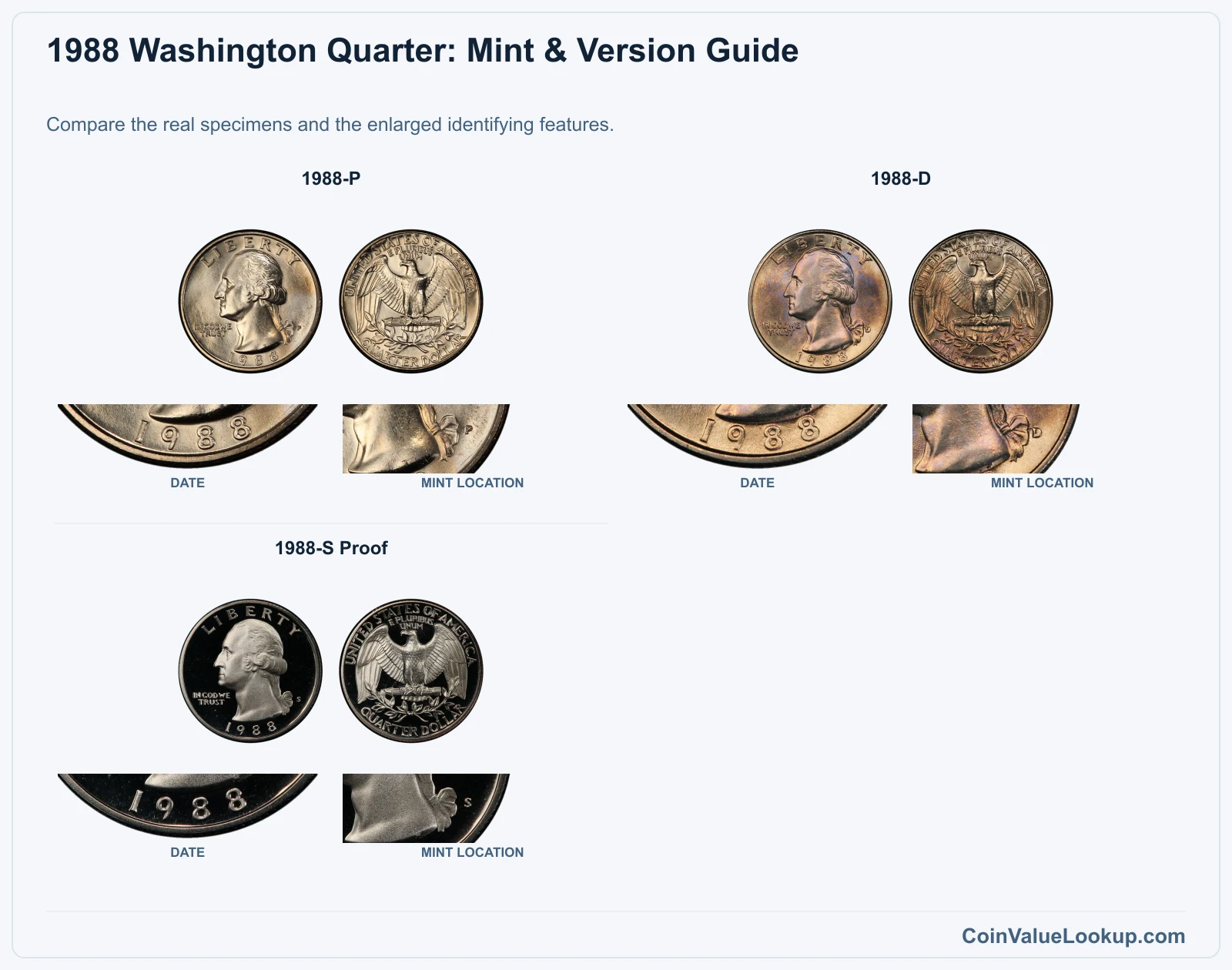
Three versions exist for the 1988 Washington quarter. Flip to the obverse and look near the date for a small mintmark letter.
A "P" means Philadelphia, a "D" means Denver, and an "S" means San Francisco proof.
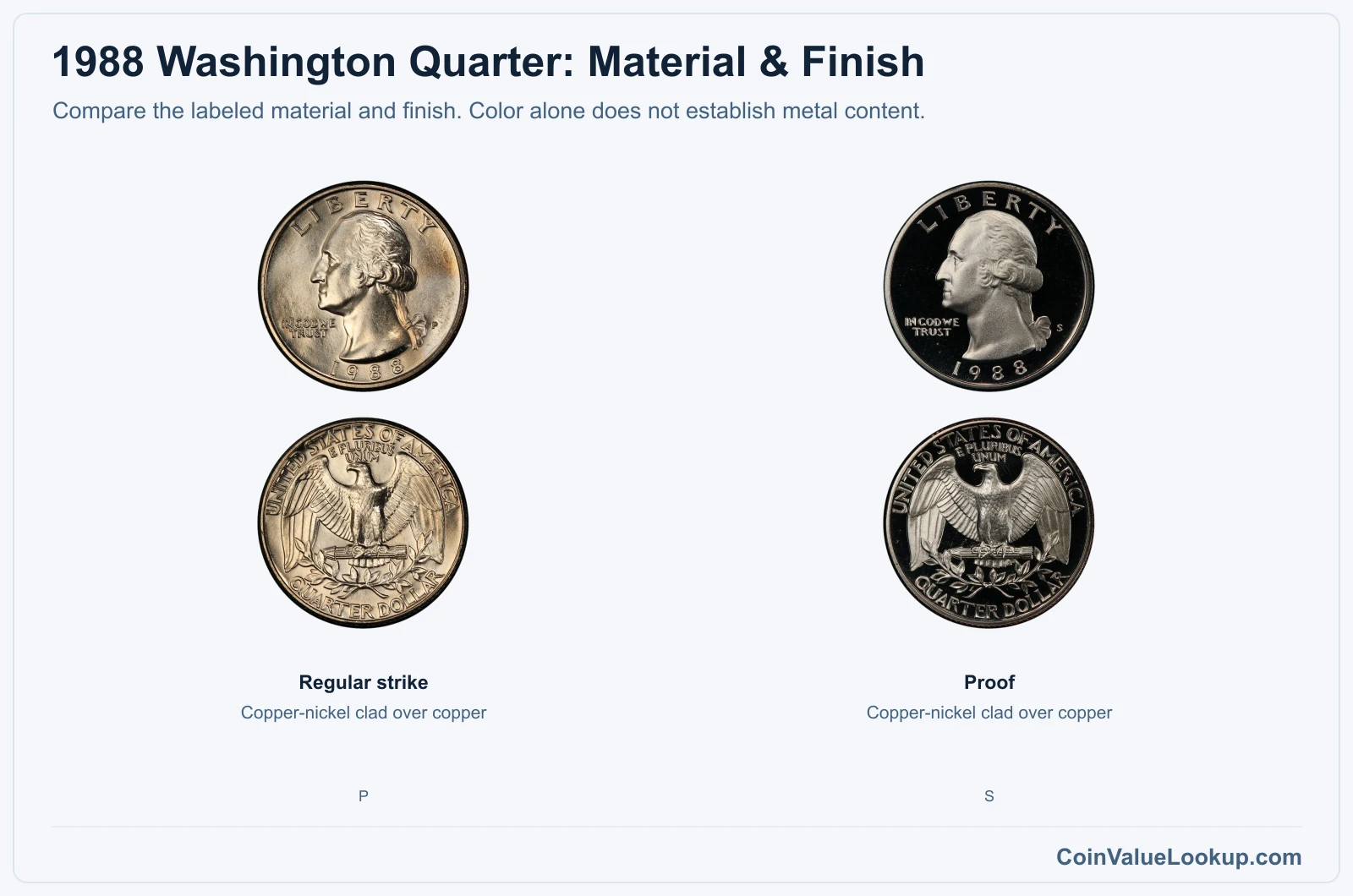
Philadelphia and Denver coins are business strikes made for everyday circulation. The San Francisco issue is a proof, produced with a special manufacturing finish for collectors, not a higher grade.
All three are copper-nickel clad, weighing about 5.67 grams and measuring roughly 24.3 mm in diameter. None contain silver.
If your coin looks coppery or reddish, that is likely discoloration or environmental damage rather than a missing clad layer — a genuine missing-layer error requires verification by weight and surface examination.
A blank-looking spot where the mintmark should be does not by itself establish an error. Grease-filled dies and wear can both obscure a mintmark, so a missing letter alone is not enough to confirm a valuable variety.
Step 2: Check Your 1988 Washington Quarter Grade
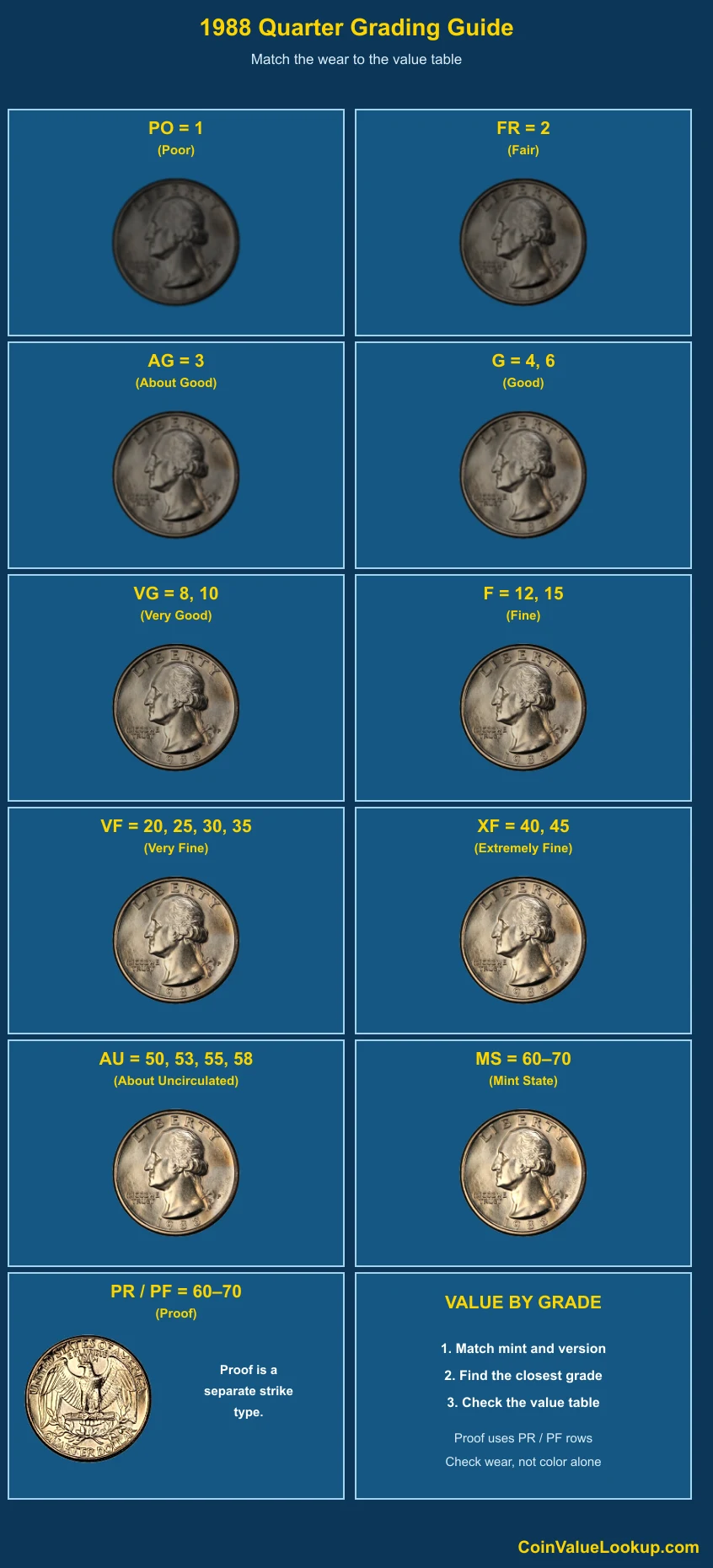
Start by checking the hair detail above Washington's ear. On a well-worn coin, that area goes flat first, followed by the cheekbone and jawline.
On the reverse, the eagle's breast feathers lose sharpness early.
Don't confuse brightness with grade. A polished coin can look shiny but still show heavy wear and cleaning hairlines, which actually reduce value.
What you want is original mint luster — that cartwheel glow when you tilt the coin under a light.
Contact marks and bag scratches matter in uncirculated grades. Compare your coin to the reference image to gauge where it falls.
Small nicks across the cheek or fields can separate an MS63 from an MS65.
For the 1988-S proof, look for mirror-like fields and sharp frosted devices. DCAM (Deep Cameo) refers to strong contrast between those two surface types — it is a designation about appearance, not metal content or a grade above Mint State.
Step 3: Check 1988 Washington Quarter Value by Mint and Version
1988 Washington Quarter — P
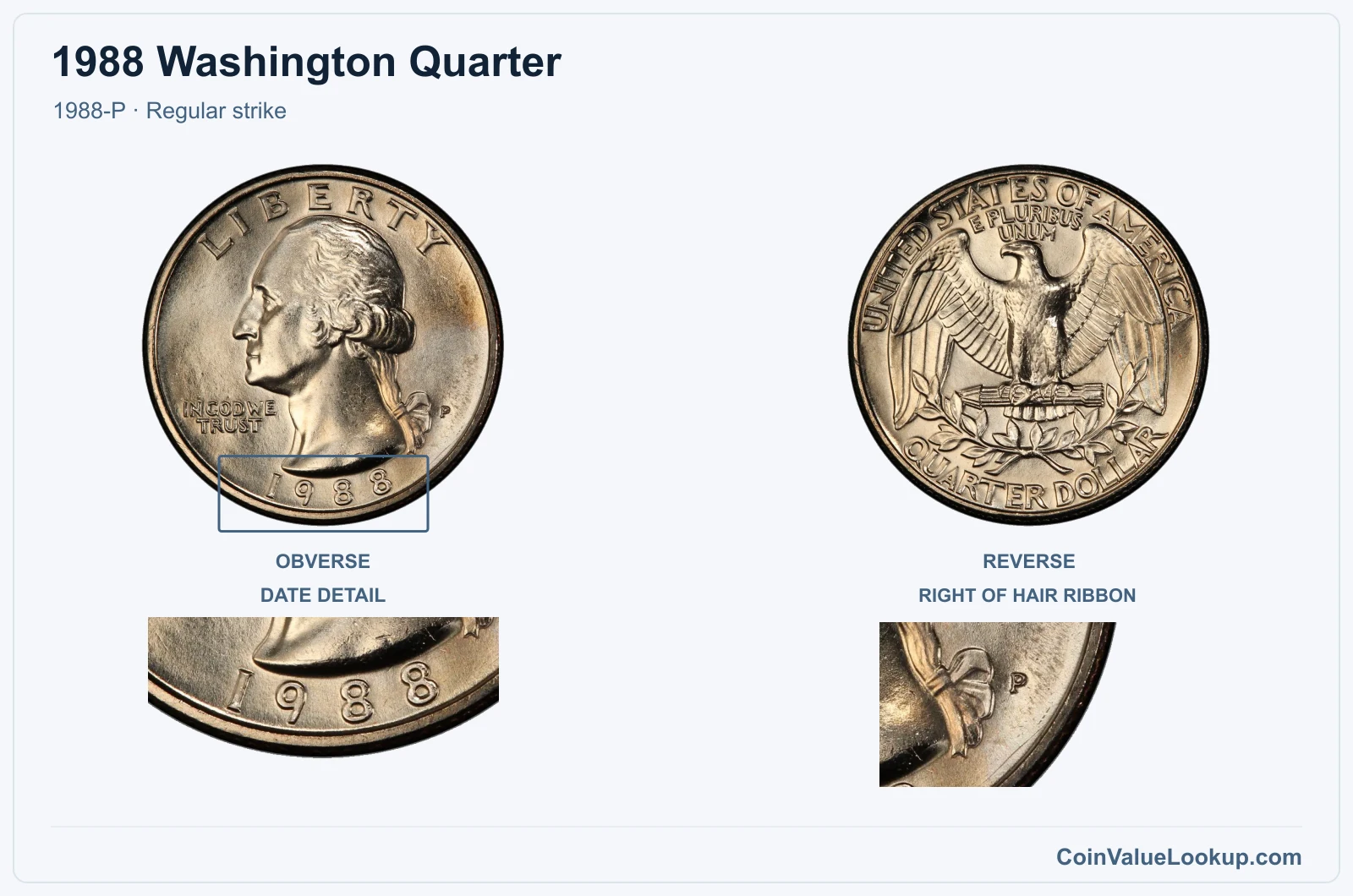
The 1988-P quarter was struck at Philadelphia for general circulation. You will see a small "P" mintmark on the obverse, near the date at about the 4 o'clock position.
It is a copper-nickel clad coin with a nominal weight of 5.67 grams.
In typical circulated condition, this coin is worth face value. A USA Coin Book guide estimate places MS65 examples at about $19, which makes it the highest-valued regular-issue branch for this year at that grade level.
To reach MS65, a coin needs full original luster with only minor contact marks.
If your 1988-P looks reddish or coppery, check the weight and edges carefully before assuming a clad-layer error. Simple discoloration from environmental exposure is far more common.
| Range | Grade | Price | Auction Records | Appraisal |
|---|---|---|---|---|
| PO | PO 1 | — | Coin Identifier | |
| FR | FR 2 | — | Coin Identifier | |
| AG | AG 3 | — | Coin Identifier | |
| G | G 4 | — | Coin Identifier | |
| G 6 | — | Coin Identifier | ||
| VG | VG 8 | — | Coin Identifier | |
| VG 10 | — | Coin Identifier | ||
| F | F 12 | — | Coin Identifier | |
| F 15 | — | Coin Identifier | ||
| VF | VF 20 | — | Coin Identifier | |
| VF 25 | — | Coin Identifier | ||
| VF 30 | — | Coin Identifier | ||
| VF 35 | — | Coin Identifier | ||
| XF | XF 40 | — | Coin Identifier | |
| XF 45 | — | Coin Identifier | ||
| AU | AU 50 | — | Coin Identifier | |
| AU 53 | — | Coin Identifier | ||
| AU 55 | — | Coin Identifier | ||
| AU 58 | — | Coin Identifier | ||
| MS | MS 60 | — | Coin Identifier | |
| MS 61 | — | Coin Identifier | ||
| MS 62 | Coin Identifier | |||
| MS 63 | Coin Identifier | |||
| MS 64 | Coin Identifier | |||
| MS 65 | Coin Identifier | |||
| MS 66 | Coin Identifier | |||
| MS 67 | Coin Identifier | |||
| MS 68 | — | — | — | |
| MS 69 | — | — | — | |
| MS 70 | — | — | — |
1988 Washington Quarter — D
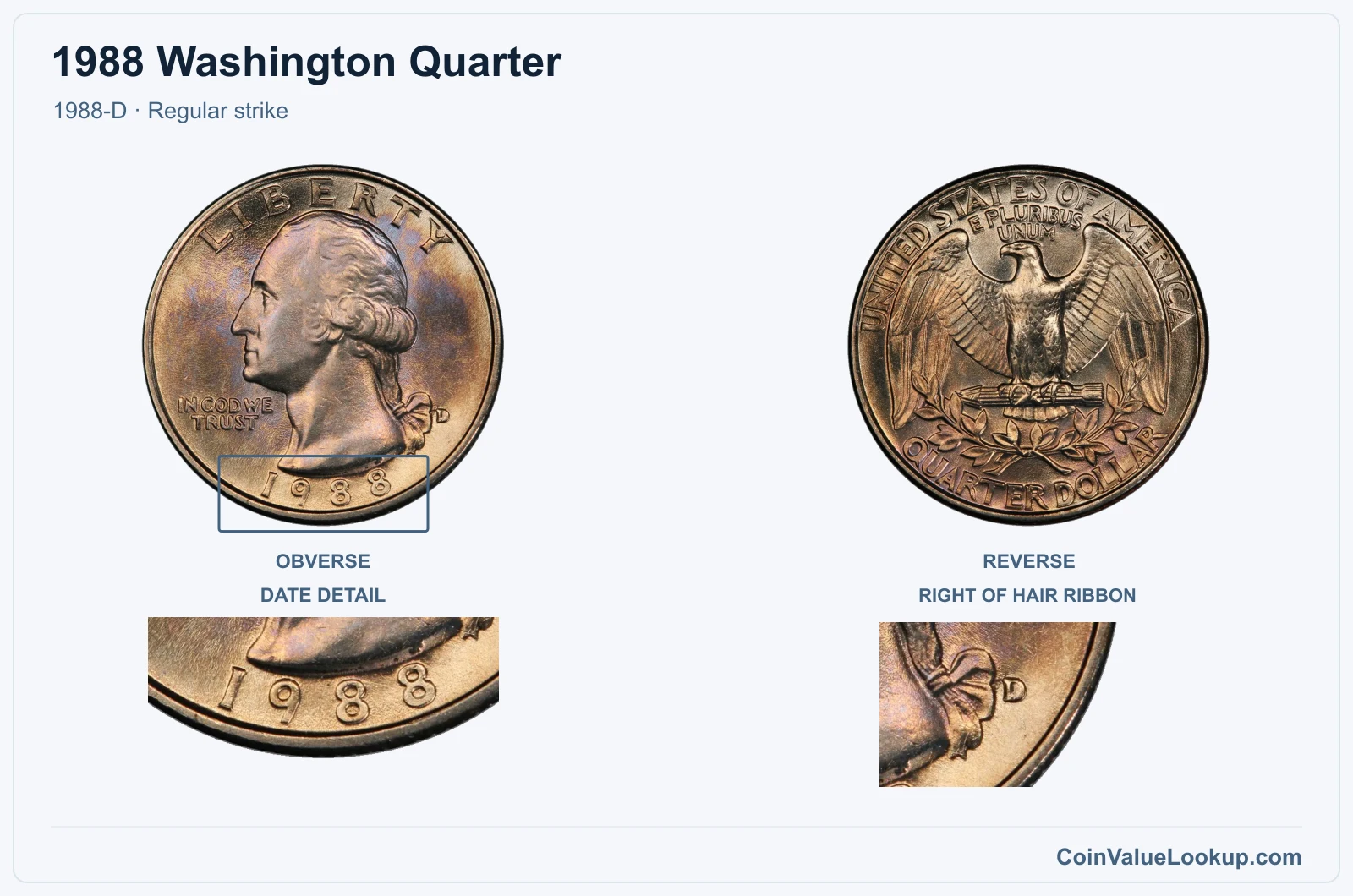
The 1988-D was produced at the Denver Mint and carries a "D" mintmark near the date on the obverse. Same copper-nickel clad composition, same 5.67-gram target weight, same Washington-and-eagle design.
Circulated examples are worth 25 cents. In MS65 condition, the USA Coin Book guide estimate is about $12.
That is a step below the Philadelphia issue at the same grade, but a clean, lustrous example is still worth setting aside.
Coin Value Lookup is a good place to look up guides for other dates and denominations if you are sorting through a batch of quarters. It can save you time deciding which coins deserve a closer look.
| Range | Grade | Price | Auction Records | Appraisal |
|---|---|---|---|---|
| PO | PO 1 | — | Coin Identifier | |
| FR | FR 2 | — | Coin Identifier | |
| AG | AG 3 | — | Coin Identifier | |
| G | G 4 | — | Coin Identifier | |
| G 6 | — | Coin Identifier | ||
| VG | VG 8 | — | Coin Identifier | |
| VG 10 | — | Coin Identifier | ||
| F | F 12 | — | Coin Identifier | |
| F 15 | — | Coin Identifier | ||
| VF | VF 20 | — | Coin Identifier | |
| VF 25 | — | Coin Identifier | ||
| VF 30 | — | Coin Identifier | ||
| VF 35 | — | Coin Identifier | ||
| XF | XF 40 | — | Coin Identifier | |
| XF 45 | — | Coin Identifier | ||
| AU | AU 50 | — | Coin Identifier | |
| AU 53 | — | Coin Identifier | ||
| AU 55 | — | Coin Identifier | ||
| AU 58 | — | Coin Identifier | ||
| MS | MS 60 | — | Coin Identifier | |
| MS 61 | — | Coin Identifier | ||
| MS 62 | — | Coin Identifier | ||
| MS 63 | Coin Identifier | |||
| MS 64 | Coin Identifier | |||
| MS 65 | Coin Identifier | |||
| MS 66 | Coin Identifier | |||
| MS 67 | Coin Identifier | |||
| MS 68 | — | — | — | |
| MS 69 | — | — | — | |
| MS 70 | — | — | — |
1988 Washington Quarter — S Proof
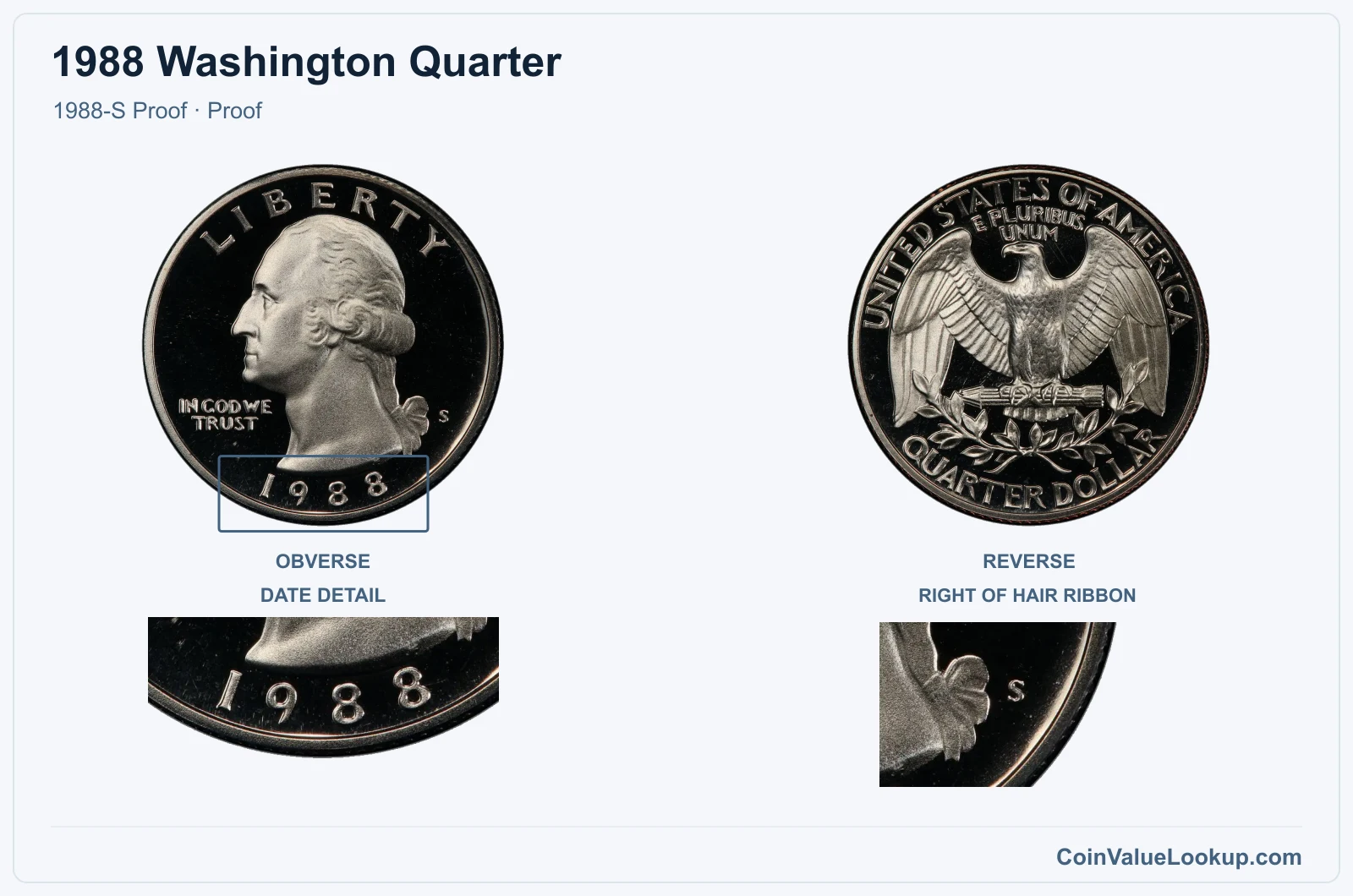
The 1988-S proof quarter was struck at the San Francisco Mint exclusively for collector sets. Look for the "S" mintmark on the obverse.
These are copper-nickel clad — no silver — with the same composition as the P and D issues.
Proof is a manufacturing method, not a grade. The dies are specially prepared to produce mirror-like fields and sharp details.
When the devices show strong frosted contrast against those mirror fields, the coin may earn a DCAM (Deep Cameo) designation, but that is a separate label from the numeric grade.
A USA Coin Book guide estimate puts a generic PR65 at about $4.96. That estimate applies to the standard clad proof and should not be confused with any silver-proof pricing, since no silver version is part of this issue.
| Range | Grade | Price | Auction Records | Appraisal |
|---|---|---|---|---|
| PR | PR 1 | — | Coin Identifier | |
| PR 2 | — | Coin Identifier | ||
| PR 3 | — | Coin Identifier | ||
| PR 4 | — | Coin Identifier | ||
| PR 6 | — | Coin Identifier | ||
| PR 8 | — | Coin Identifier | ||
| PR 10 | — | Coin Identifier | ||
| PR 12 | — | Coin Identifier | ||
| PR 15 | — | Coin Identifier | ||
| PR 20 | — | Coin Identifier | ||
| PR 25 | — | Coin Identifier | ||
| PR 30 | — | Coin Identifier | ||
| PR 35 | — | Coin Identifier | ||
| PR 40 | — | Coin Identifier | ||
| PR 45 | — | Coin Identifier | ||
| PR 50 | — | Coin Identifier | ||
| PR 53 | — | Coin Identifier | ||
| PR 55 | — | Coin Identifier | ||
| PR 58 | — | Coin Identifier | ||
| PR 60 | — | Coin Identifier | ||
| PR 61 | — | Coin Identifier | ||
| PR 62 | — | Coin Identifier | ||
| PR 63 | — | Coin Identifier | ||
| PR 64 | — | Coin Identifier | ||
| PR 65 | — | Coin Identifier | ||
| PR 66 | — | Coin Identifier | ||
| PR 67 | — | Coin Identifier | ||
| PR 68 | Coin Identifier | |||
| PR 69 | Coin Identifier | |||
| PR 70 | Coin Identifier |
1988 Washington Quarter Error List
1. 1988 Washington Quarter — Off-Center Strike
An off-center strike happens when the planchet is not properly seated between the dies at the moment of striking. The result is a crescent-shaped blank area on the coin where no design was impressed, with the remaining design shifted away from center.
For the 1988-P quarter, a confirmed example showed roughly 30 percent displacement toward the 1 o'clock position. Both the obverse and reverse must show the corresponding shift — one enlarged rim alone is not diagnostic.
You need to see the date and "P" mintmark to attribute it.
A 1988-P off-center quarter graded ANACS MS63 sold for $109 at Heritage Auctions in January 2022. Value depends on the percentage of displacement and whether the date remains visible.
Watch out for coins that were cut, filed or hammered after leaving the mint. Post-mint damage can mimic an odd shape, but it lacks the matching original strike surfaces on both faces.
2. 1988 Washington Quarter — Missing Obverse Clad Layer
A missing obverse clad layer error means the outer copper-nickel skin on the front of the coin was absent before striking. The exposed face shows the copper core, giving the obverse a distinctly copper-colored appearance while the reverse and edge look normal.
The key diagnostic is weight. A confirmed 1988-D example weighed just 4.8 grams — noticeably below the standard 5.67 grams.
That weight deficit matches the absent layer. A coin that merely looks reddish but weighs normal is almost certainly stained or corroded, not a genuine error.
One 1988-D missing obverse clad layer quarter graded NGC MS62 sold for $156 at Heritage Auctions in November 2020. Condition and the completeness of the copper surface affect value.
Do not confuse this with coins that have been chemically stripped, plated, or exposed to heat. Those alterations change color but leave the weight unchanged and often show uneven, splotchy surfaces rather than a consistent copper tone.
3. 1988 Washington Quarter — Struck-Through Error
A struck-through error occurs when foreign material — grease, a metal fragment, cloth fiber, or other debris — sits between the die and planchet during striking. The result is a localized depression or impression where the obstruction blocked the full design transfer.
For the 1988-P quarter, a grease-filled die can obscure the mintmark or other small design elements, leaving a smooth, filled-in look in that area. This is distinct from ordinary wear, which produces gradual flattening across high points rather than a sharply defined depression.
However, a blank-looking mintmark alone does not confirm this error. Wear and environmental buildup can mimic the appearance.
You need to see clean, original strike surfaces surrounding the affected area.
No specific price is adopted for this category. Value depends on the size, location and visual clarity of the struck-through area, as well as the coin's overall condition.
Professional attribution helps establish whether the effect is a genuine pre-strike obstruction rather than a scratch, cleaning mark, or worn detail.
4. 1988 Washington Quarter — Broadstrike
A broadstrike happens when a coin is struck without the restraining collar that normally forms the edge and controls the diameter. The metal spreads outward freely, making the coin slightly wider than normal with a smooth, featureless edge instead of the usual reeded rim.
For the 1988-P quarter, a broadstrike will show the full design on both sides but with the lettering and devices pushed slightly toward the periphery. The edge will be noticeably rounded and lack any reeding.
Don't confuse this with a coin that was flattened by a train, vise, or other post-mint force. Damage after striking usually distorts the design unevenly and may show surface marks or scoring.
A genuine broadstrike retains sharp, symmetrical detail consistent with a proper die impression.
No specific price is adopted for this error. Value varies with the degree of spread, the overall condition, and whether the coin has been professionally attributed.
5. 1988 Washington Quarter — Partial Collar Strike
A partial collar strike — sometimes called a railroad rim — occurs when only part of the planchet sits inside the collar during striking. One section of the edge shows normal reeding and diameter, while the opposite section expands outward and shows a stepped or shelf-like profile.
On a 1988-P quarter, look at the edge all the way around. A genuine partial collar produces a visible transition from normal edge to expanded edge, and that step is consistent and uniform along the affected arc.
This is easy to confuse with edge damage or a complete broadstrike. Edge dings from circulation create random dents rather than a smooth stepped shelf.
A broadstrike expands the entire circumference, not just one side.
No specific price is adopted here. The degree of the collar misalignment, the coin's condition, and professional attribution all influence what a partial collar example might bring.
6. 1988 Washington Quarter — Wrong Planchet / Off-Metal Strike
A wrong-planchet error means the quarter dies struck a blank intended for a different denomination. For the 1988-P quarter, this category has been reported as a strike on a nickel planchet.
If a quarter were struck on a nickel blank, the coin would be smaller and lighter than a normal quarter. The design would be incomplete around the edges because the smaller planchet cannot fill the full quarter die impression.
Weight and diameter measurements are the primary diagnostics — compare your coin to the standard 5.67-gram, 24.3-mm specs.
Coins that simply look odd in color or feel thin are far more likely to be plated, corroded, or acid-treated. Deliberate alterations do not produce the consistent, clean design cutoff that a genuine wrong-planchet strike displays.
No specific price is adopted for this error. Condition, the denomination of the wrong blank, and third-party certification all play a role in determining value.
7. 1988 Washington Quarter — Die Crack / Die Chip
Die cracks and die chips are raised features caused by physical damage to the die itself. A crack appears as a thin raised line running across the coin's surface, while a chip shows up as a small raised blob.
When a crack reaches the rim and a piece of the die breaks away entirely, the result is called a cud — a flat, featureless raised area connected to the rim.
For the 1988-P quarter, look for any raised lines or lumps that appear on the coin's surface, particularly near the rim. The feature should be raised above the field, not incised into it.
Scratches, corrosion deposits, and foreign material stuck to a coin can look similar at first glance. The difference is that a genuine die crack or chip will be raised, consistent across multiple examples from the same die, and positioned logically relative to the design.
No specific price is adopted. Value depends on the size, location, and visual impact of the break, plus the coin's overall grade.
8. 1988 Washington Quarter — Doubled Die
A doubled die results from a misalignment during die manufacturing that leaves a duplicated impression in the die itself. Every coin struck by that die shows the same doubling in the same location, which is what separates it from other forms of doubling.
On a 1988 quarter, look for consistent separation or notching on design elements — lettering, the date, or profile details. The doubling should appear identical under magnification each time you examine it, and it should match across multiple examples if others from the same die pair exist.
Do not confuse this with machine doubling, which is flat and shelf-like rather than showing distinct, raised design separation. Reflections, die wear, and post-mint impressions can also mimic the look.
True doubled dies show a clear second image with its own relief.
No specific price is adopted. The strength and location of the doubling, the coin's condition, and whether it has been professionally attributed all factor into what a doubled die might be worth.