1967 Roosevelt Dime Coin Value: How Much Is It Worth?
Most 1967 Roosevelt dimes you will find in pocket change are worth face value — ten cents. A guide estimate for an uncirculated MS65 business strike is about $2.50, while a non-cameo Special Mint Set specimen at SP65 runs around $8.
Higher grades, cameo designations, and authenticated mint errors occupy their own price tiers, so those deserve individual attention.
Fast Way to Identify Your 1967 Roosevelt Dime
The quickest way to start figuring out what you have is to snap clear photos of both sides of your coin and upload them here. Our identifier can offer a preliminary read on the version and general condition from front and back images.
It does not authenticate errors or assign a certified grade, but it gives you a solid starting point.
1967 Roosevelt Dime Value
Upload both sides of your 1967 Roosevelt Dime.
Front Obverse
Upload photo
Back Reverse
Upload photo
Which 1967 Roosevelt Dime Versions Are Worth Money?
- Determine whether your coin is a normal business strike or a genuine Special Mint Set issue before comparing any values.
- Original uncirculated condition with strong torch bands can improve a business strike's appeal beyond the base MS65 guide estimate.
- Clipped planchets and missing clad layers have been documented and sold at auction for this date.
- The absence of a mintmark is standard for 1967 and carries no error premium.
Step 1: Identify Your 1967 Roosevelt Dime Mint Mark and Version
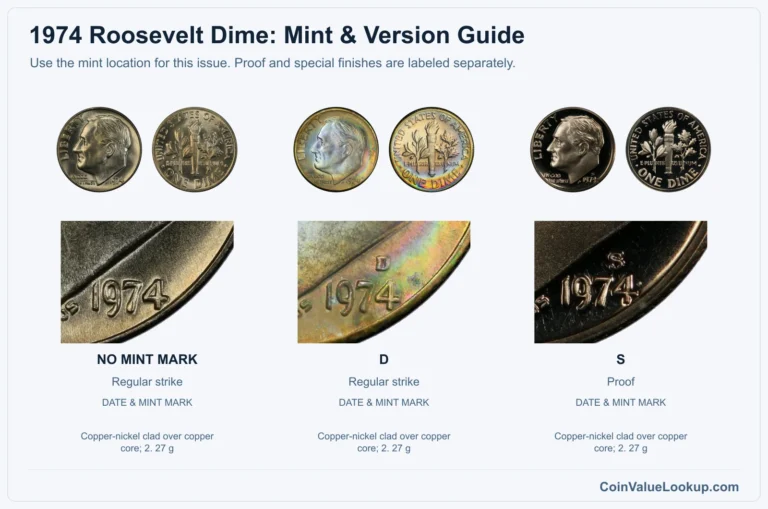
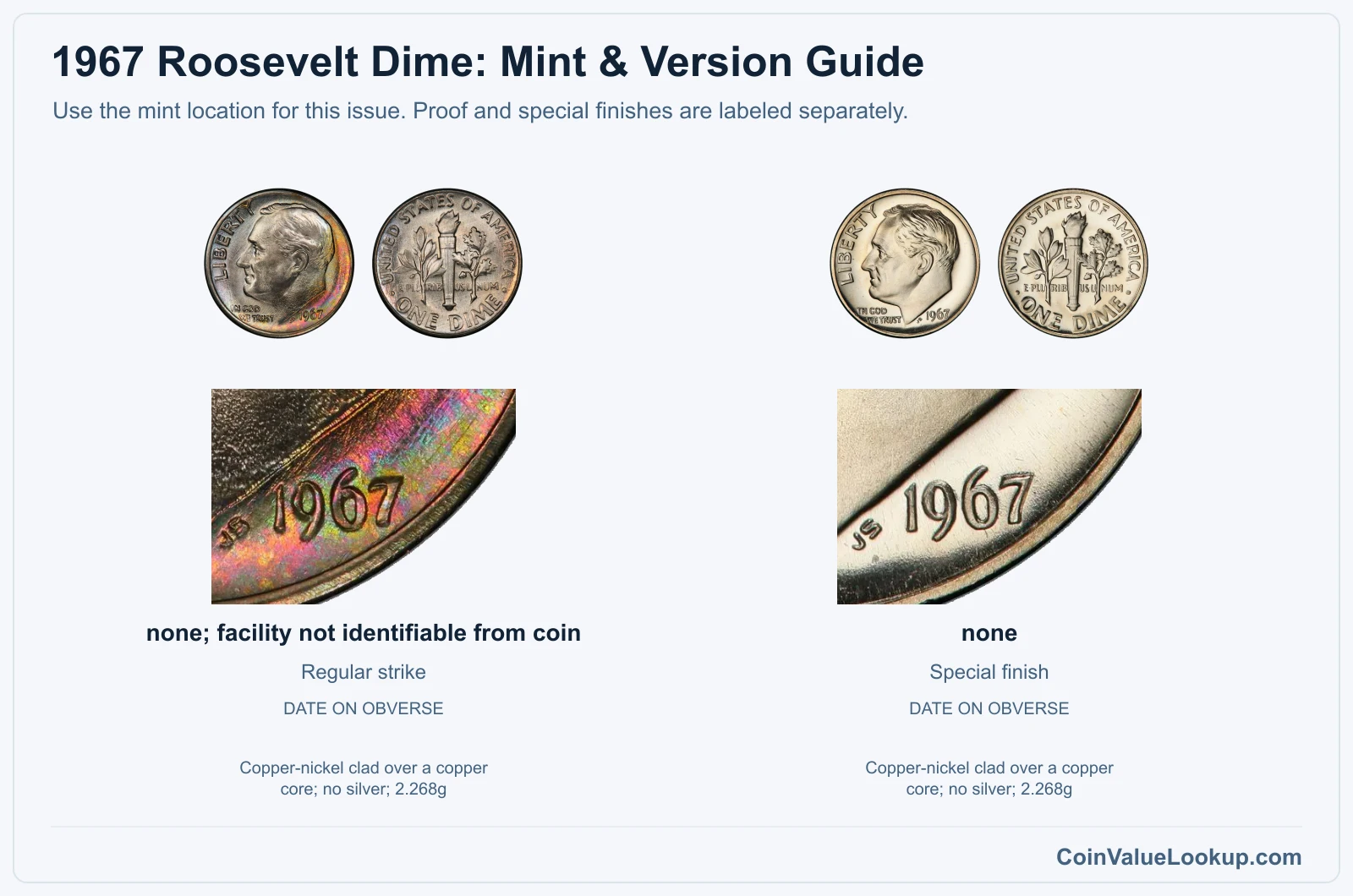
Every circulating U.S. coin dated 1965 through 1967 was struck without a mintmark. That is standard Mint policy for those years, so a blank space below the date does not indicate an error or a rare variety.
Do not assume your coin is from Philadelphia, Denver, or San Francisco based on the missing letter alone — the producing facility simply cannot be determined from the coin itself.
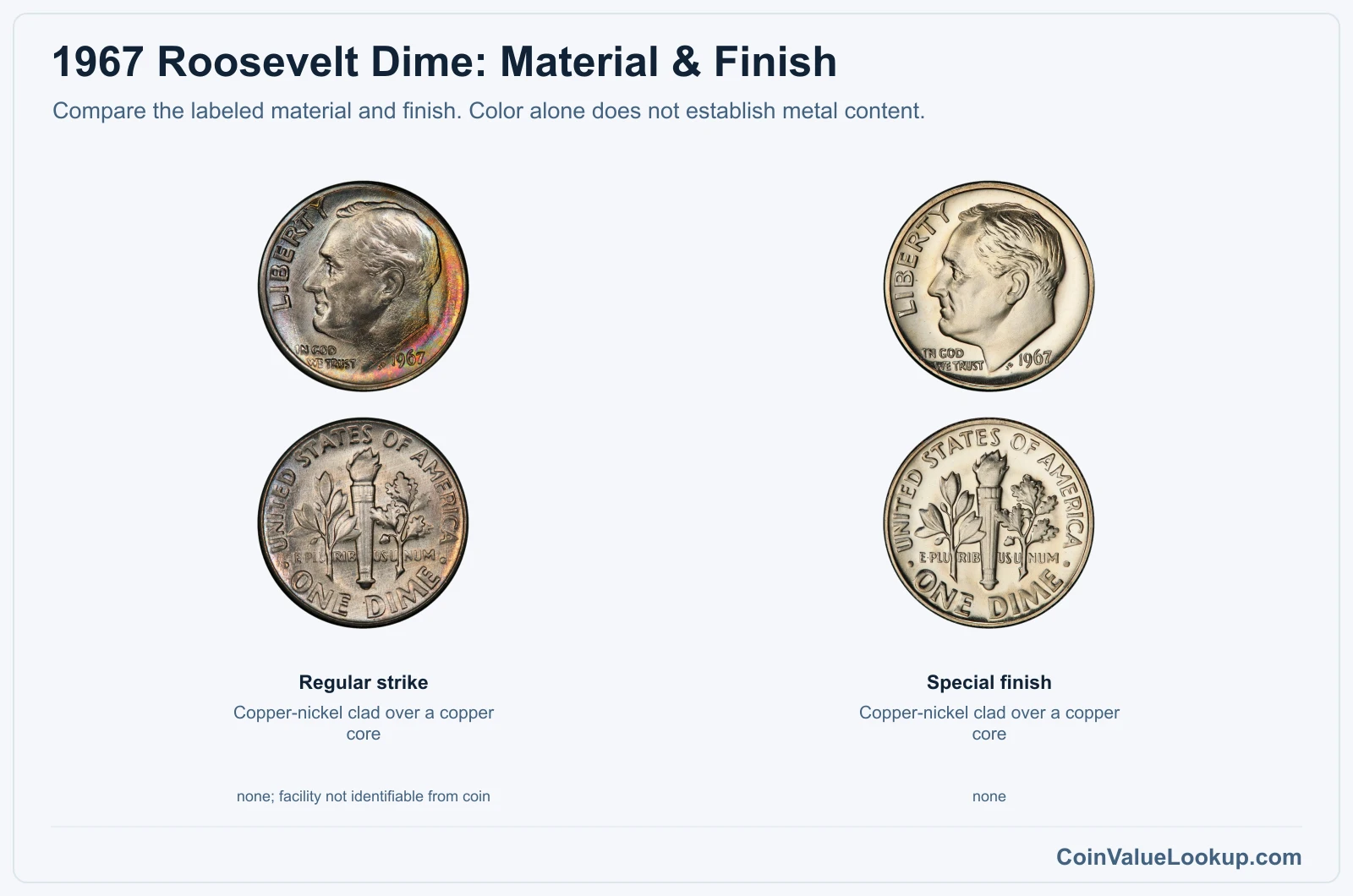
The 1967 dime uses a copper-nickel clad composition with a nominal weight of 2.268 grams and a reeded edge. You may notice a thin copper-colored line at the edge.
That is normal clad construction, not evidence of a transitional or off-metal strike.
Two main categories exist: ordinary business strikes made for circulation, and Special Mint Set (SMS) coins. SMS pieces have a distinct finish that can show sharper detail and sometimes a satin or semi-reflective surface, but shine alone is not enough to classify a coin as SMS.
Genuine SMS dimes are typically attributed by a grading service or traceable to original government packaging. Regular proof coins were not produced during 1965–1967, so do not confuse an SMS coin with a proof.
On the obverse, look for the familiar Roosevelt portrait and the date. On the reverse, check the torch flanked by olive and oak branches.
Both sides, along with the rim condition and edge, matter when comparing your piece to known types.
Step 2: Check Your 1967 Roosevelt Dime Grade
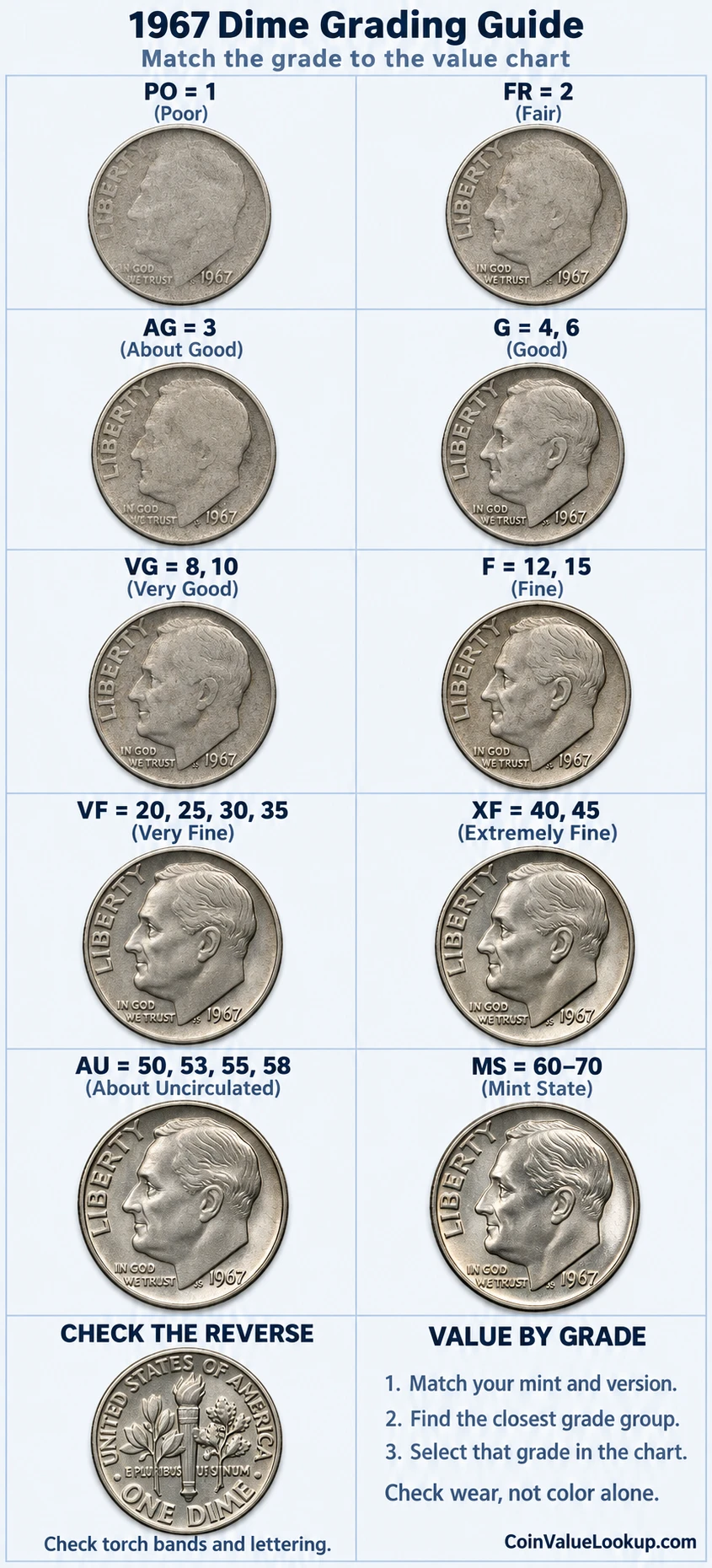
Start on the obverse. Roosevelt's cheekbone, jawline, and the hair above the ear are the first areas to lose sharpness from circulation.
A coin that still shows full hair detail and a crisp jaw with original luster is a strong uncirculated candidate.
Flip it over. The torch bands and the fine leaves on the olive and oak branches wear down with use.
"Full Bands" refers to clearly separated horizontal lines on the torch — this is a strike-quality attribute, not a manufacturing error. It can add a small premium in higher Mint State grades.
Brightness is not the same as grade. A cleaned or polished coin can look shiny but still carry wear or surface damage that drops its grade.
Compare your coin to the grading image to judge actual detail loss versus surface flash.
For SMS specimens, grading uses the SP scale instead of MS. Cameo or deep cameo designations apply to SMS coins that show strong contrast between frosted devices and reflective fields.
These are separate categories from a standard SMS finish, and they are typically confirmed by a professional grading service.
Coin Value Lookup is a handy place to look up coin guides when you want to compare values across different years and denominations of the Roosevelt dime series.
Step 3: Check 1967 Roosevelt Dime Value by Mint and Version
1967 Roosevelt Dime — No Mint Mark — Circulation Strike
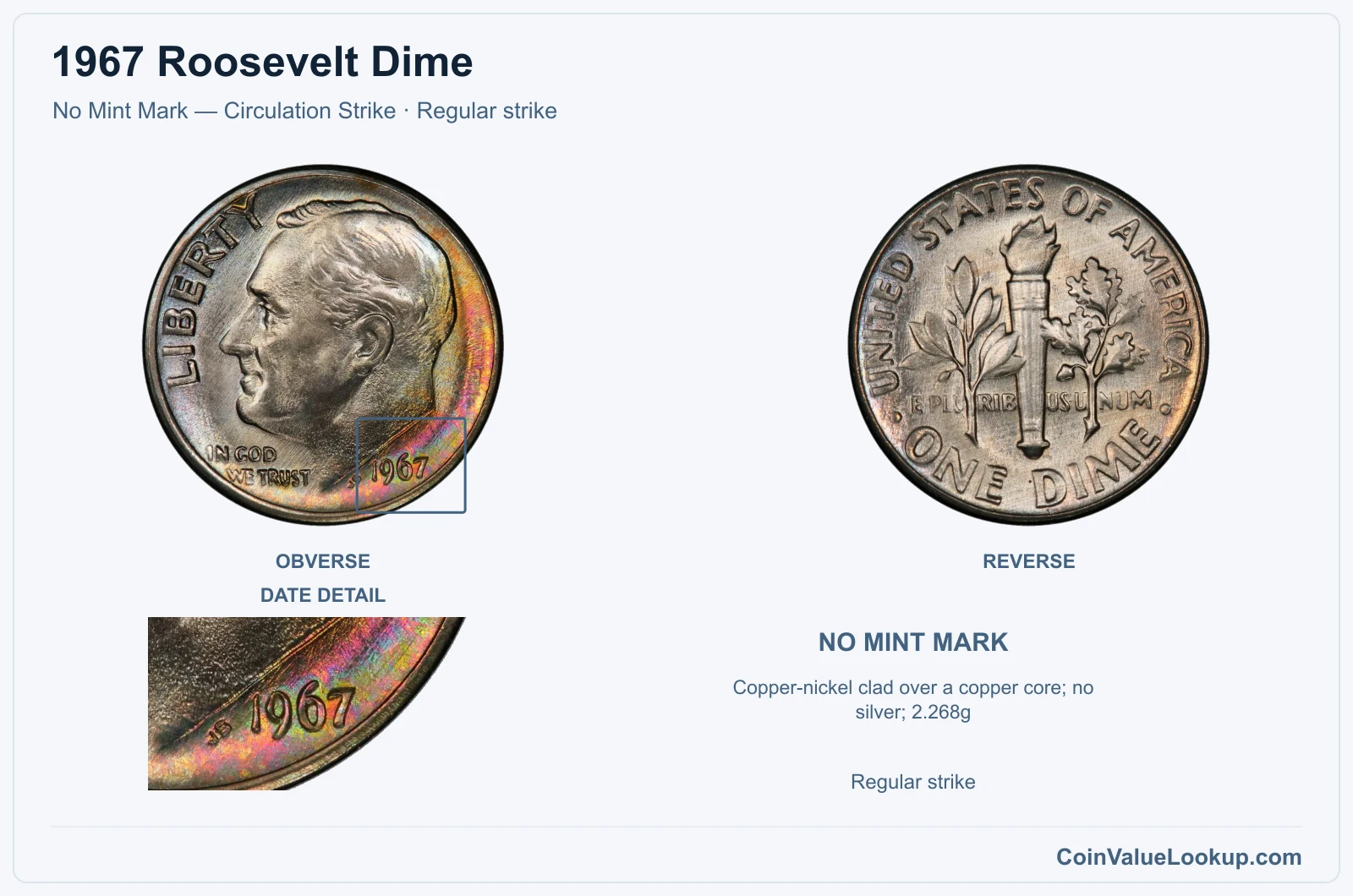
This is the coin most people have: a standard copper-nickel clad dime struck for everyday commerce. Weight should be close to 2.268 grams with a reeded edge.
There is no mintmark, and no way to tell which facility produced it.
Circulated examples are worth face value. A USA Coin Book guide estimate puts an MS65 example at roughly $2.50.
To reach that grade, the coin needs full original luster, minimal contact marks, and sharp detail on Roosevelt's hair and the torch bands. Anything below uncirculated is effectively a spender.
Range Grade
Price Auction Records Appraisal PO PO 1
—
Coin Identifier FR FR 2
—
Coin Identifier AG AG 3
—
Coin Identifier G G 4
—
Coin Identifier
G 6
—
Coin Identifier VG VG 8
—
Coin Identifier
VG 10
—
Coin Identifier F F 12
—
Coin Identifier
F 15
—
Coin Identifier VF VF 20
—
Coin Identifier
VF 25
—
Coin Identifier
VF 30
—
Coin Identifier
VF 35
—
Coin Identifier XF XF 40
—
Coin Identifier
XF 45
—
Coin Identifier AU AU 50
—
Coin Identifier
AU 53
—
Coin Identifier
AU 55
—
Coin Identifier
AU 58
—
Coin Identifier MS MS 60
—
Coin Identifier
MS 61
—
Coin Identifier
MS 62
—
Coin Identifier
MS 63
Coin Identifier
MS 64
—
Coin Identifier
MS 65
—
Coin Identifier
MS 66
Coin Identifier
MS 67
Coin Identifier
MS 68
Coin Identifier
MS 69
—
—
—
MS 70
—
—
—
1967 Roosevelt Dime — No Mint Mark — Special Mint Set
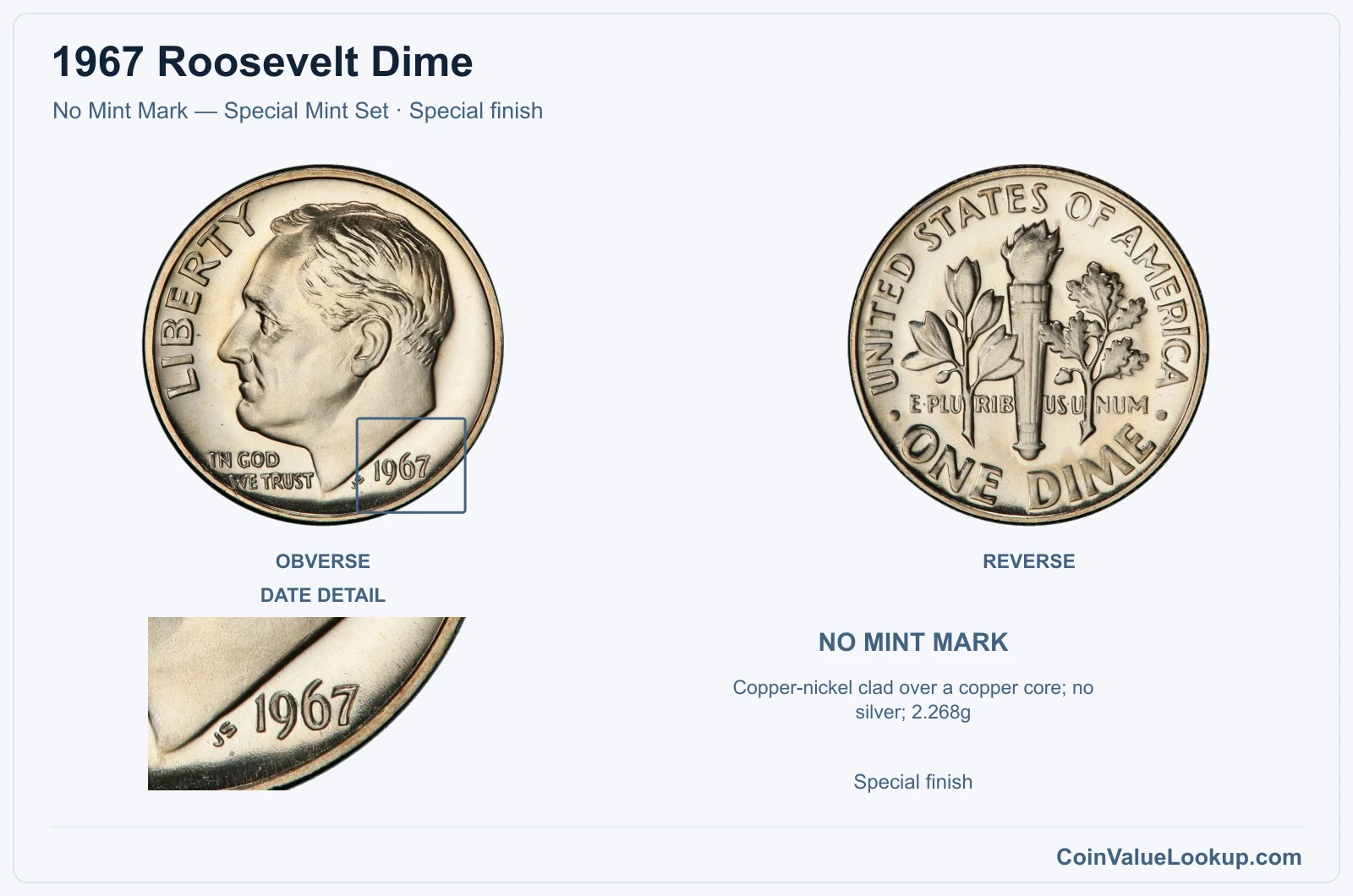
Special Mint Set dimes replaced traditional proof and uncirculated mint sets from 1965 through 1967. They carry the same copper-nickel clad composition and weight as business strikes, but the striking process produced a noticeably different finish — often sharper devices and sometimes a reflective or satin field.
A PCGS guide estimate for a non-cameo SP65 is about $8. Cameo and deep cameo examples command their own premiums and should be filtered separately if you are checking values.
Original SMS packaging supports identification but is not a substitute for a numerical grade. If you suspect you have one of these, professional attribution is the surest path to confirming it.
Range Grade
Price Auction Records Appraisal SP SP 1
—
Coin Identifier
SP 2
—
Coin Identifier
SP 3
—
Coin Identifier
SP 4
—
Coin Identifier
SP 6
—
Coin Identifier
SP 8
—
Coin Identifier
SP 10
—
Coin Identifier
SP 12
—
Coin Identifier
SP 15
—
Coin Identifier
SP 20
—
Coin Identifier
SP 25
—
Coin Identifier
SP 30
—
Coin Identifier
SP 35
—
Coin Identifier
SP 40
—
Coin Identifier
SP 45
—
Coin Identifier
SP 50
—
Coin Identifier
SP 53
—
Coin Identifier
SP 55
—
Coin Identifier
SP 58
—
Coin Identifier
SP 60
—
Coin Identifier
SP 61
—
Coin Identifier
SP 62
—
Coin Identifier
SP 63
—
Coin Identifier
SP 64
—
Coin Identifier
SP 65
Coin Identifier
SP 66
Coin Identifier
SP 67
Coin Identifier
SP 68
Coin Identifier
SP 69
Coin Identifier
SP 70
—
—
—
1967 Roosevelt Dime Error List
1. 1967 Roosevelt Dime — Clipped Planchet
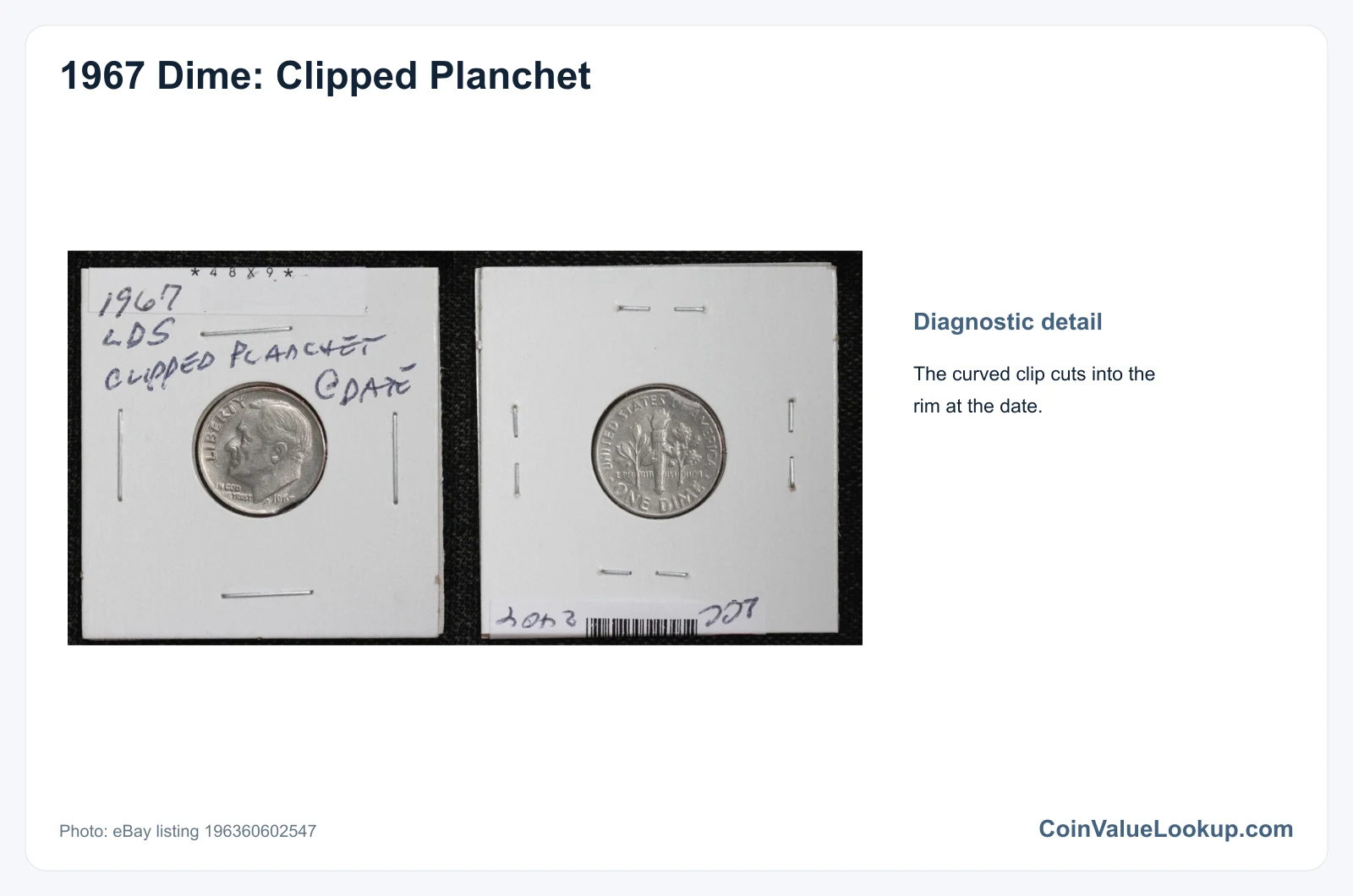
A clipped planchet occurs when the blank is punched from strip metal that overlaps a previously punched hole or the strip edge, leaving a missing section. On a 1967 dime, look for a curved or straight absence along the rim where the design fades into the defective edge.
There may be a corresponding area of weakness on the opposite side of the coin, called a Blakesley effect.
Do not confuse clipping with post-mint damage such as filing, biting, or corrosion eating the edge away. Genuine clips show original struck detail right up to the irregular boundary.
One documented example — an ANACS AU58 piece with curved and rim clips weighing 2.05 grams — sold for $30 at Heritage Auctions in March 2022. Weight and appearance together help support a clip attribution.
2. 1967 Roosevelt Dime — Missing Clad Layer
When one of the outer clad layers fails to bond to the copper core before striking, the result is a coin with a distinctly copper-toned face on the affected side. A genuine 1967 dime missing its obverse clad layer will weigh noticeably less than the standard 2.268 grams, and the exposed copper core should still show fully struck design detail.
The key distinction from fakes is that acid-stripped or ground coins tend to lose surface detail or show tool marks. A real missing-layer error retains sharp features on the exposed core because the die struck it directly.
A PCGS MS62 example of this error on a 1967 dime sold for $159 at Heritage Auctions in December 2024. Professional grading service attribution is important here, because visual similarity to damaged coins makes this one easy to misidentify.
3. 1967 Roosevelt Dime — Doubled Die Obverse
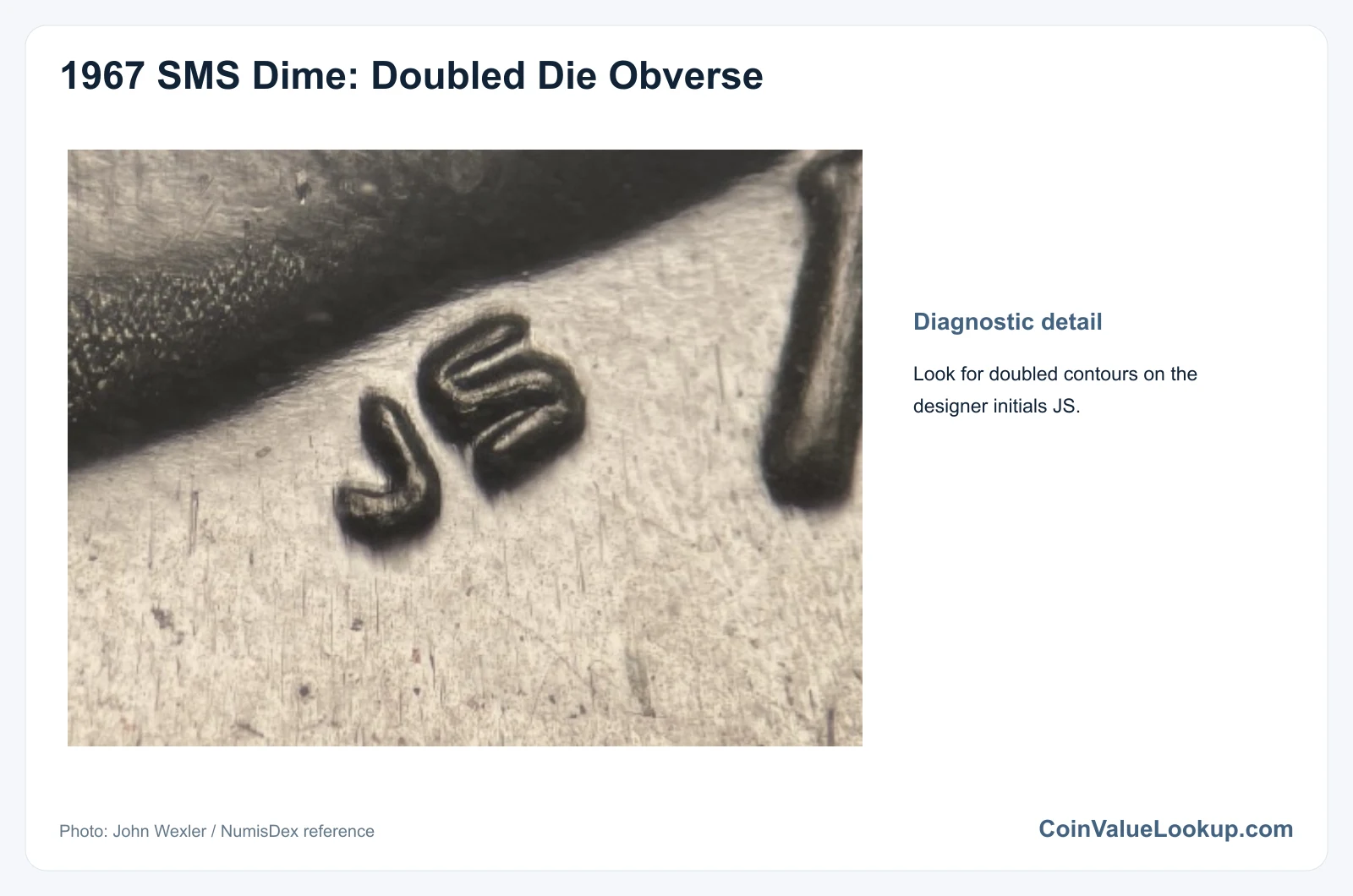
A doubled die obverse on a 1967 dime would show consistent doubling on design elements such as lettering, the date, or portions of Roosevelt's profile. The doubling results from a misaligned hub impression during die production, so it appears uniform across the affected area.
Under magnification, look for separation or notching on letter edges rather than a flat, shelf-like displacement. Machine doubling — caused by die bounce during striking — tends to produce a flat shelf and lacks the distinct raised secondary image of a true doubled die.
Reflections or lighting angles can also mimic doubling on lustrous coins.
Condition, the strength of visible doubling, and the specific variety all affect what a doubled die obverse is worth. No single price applies across the board.
4. 1967 Roosevelt Dime — Die-Adjustment / Low-Pressure Strike
A die-adjustment strike, sometimes called a setup strike, happens when press operators are calibrating striking pressure. The result is an abnormally weak impression across both sides of the coin, even on areas that show no actual wear.
To identify one, look for uniformly soft detail on obverse and reverse together. Unworn, lightly struck high points and mushy lettering are the hallmarks.
The coin should otherwise appear unhandled — luster intact, no rub on the cheek or torch.
This is tricky to confirm at home. Ordinary circulation wear, grease-filled dies, and plain weak strikes from a tired press can all produce similar-looking results.
Professional attribution matters here because weak detail alone does not prove a die-adjustment strike. Value depends on condition, the degree of weakness, and service confirmation of the error.
5. 1967 Roosevelt Dime — Off-Center Strike
An off-center strike happens when the planchet is not seated properly between the dies, shifting the design to one side and leaving a blank crescent on the opposite edge. The percentage of off-center displacement and whether the date remains visible are the two biggest factors that affect desirability.
On a 1967 dime, look for a displaced Roosevelt portrait with an unstruck area opposite the shift. The reeding may be absent or incomplete where the collar did not contain the blank.
A date that is fully legible makes identification straightforward; without it, assigning the coin to 1967 specifically becomes difficult.
Do not confuse an off-center strike with a clipped planchet, a one-sided die misalignment, or post-mint flattening. Genuine off-center errors show a complete design impression that is simply displaced.
Condition and the degree of displacement determine value, so individual assessment is necessary.
6. 1967 Roosevelt Dime — Broadstrike
A broadstrike occurs when a coin is struck outside or without the retaining collar that normally constrains the planchet during striking. The result is a coin that spreads outward, appearing slightly wider than normal and lacking a well-defined rim and reeding.
Check the edge profile. A broadstruck 1967 dime should have a smooth or irregular edge rather than normal reeding, and the full design should still be present — just expanded.
The coin will look noticeably flatter at the rim compared to a standard dime.
Post-mint flattening from a vise or hammer can mimic the spread look, but it usually distorts the design unevenly and may leave tool marks. An off-center strike shifts the design rather than spreading it uniformly.
Value depends on how dramatic the spread is and the coin's overall condition. Professional attribution strengthens any broadstrike claim.
7. 1967 Roosevelt Dime — Die Crack / Die Chip
Die cracks and die chips appear as raised lines or small raised blobs on the coin's surface. They form when a working die develops fractures from repeated use.
A crack that connects to the rim is straightforward; an interior break that produces a raised lump of metal is sometimes called a die chip or, when large enough at the rim, a cud.
On a 1967 dime, examine both sides under magnification for thin raised ridges crossing the fields or letters. These lines should be raised above the surface, not incised into it.
An incuse scratch or groove is post-mint damage, not a die crack.
Corrosion, adhesive residue, or other foreign material sitting on the surface can also look like a raised feature at a glance. The distinction is that a genuine die crack will be consistent with the struck surface and will not flake or scrape away.
Value varies with the size, location, and visual impact of the crack, so each piece deserves individual consideration.