1991 Lincoln Penny Coin Value: How Much Is It Worth?
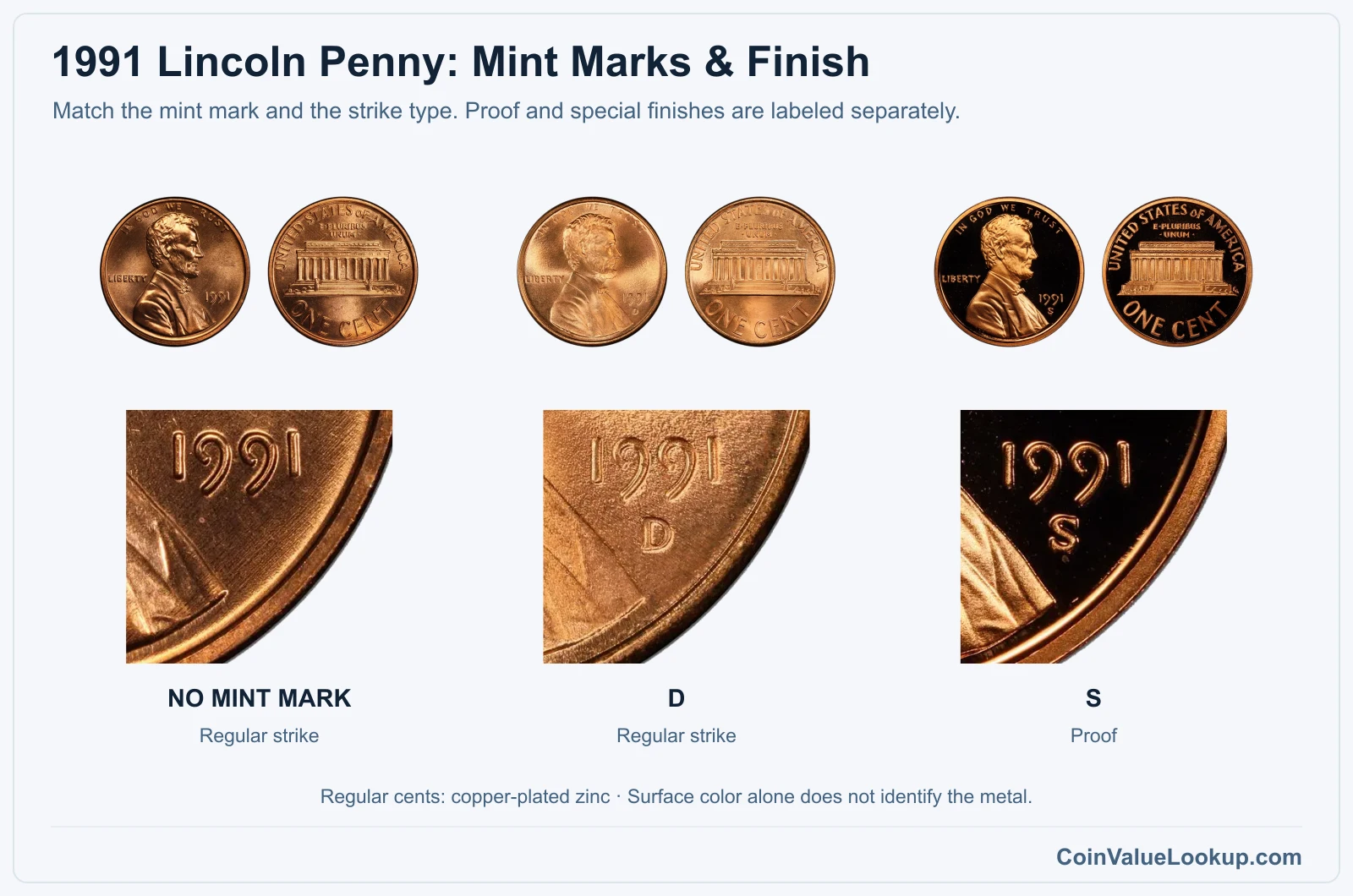
Most 1991 Lincoln pennies you find in change are worth face value. A USA Coin Book guide estimate places an ordinary uncirculated example at about $0.36 in MS65, while the 1991-S proof carries a guide estimate around $15.00 in PR65.
The real upside comes from dramatic striking errors or coins preserved in original high-grade condition with full copper color.
Fast Way to Identify Your 1991 Lincoln Penny
Want a quick read on your 1991 penny? Upload clear photos of the front and back, and the identifier can offer a preliminary take on which version you have and its general condition.
It is not a substitute for professional authentication, but it gives you a solid starting point before you dig deeper.
1991 Penny Value
Upload both sides of your 1991 Lincoln Penny.
Front Obverse
Upload photo
Back Reverse
Upload photo
Which 1991 Lincoln Penny Versions Are Worth Money?
- Dramatic striking errors like a cent struck over a dime have brought strong auction prices; one sold for $747.50 in 2006.
- A double-struck 1991 cent with an 85% displaced second impression sold for $149 in MS65 Red at auction in 2024.
- Proofs and original high-grade coins need finish and color-matched comparisons; dramatic error sale prices do not apply to normal pocket change.
Step 1: Identify Your 1991 Lincoln Penny Mint Mark and Version
The 1991 Lincoln cent uses the familiar Lincoln portrait obverse and Memorial reverse, struck on a copper-plated zinc planchet weighing about 2.50 grams with a plain edge. The composition is 97.5% zinc with 2.5% copper overall.
A copper color does not mean solid copper.
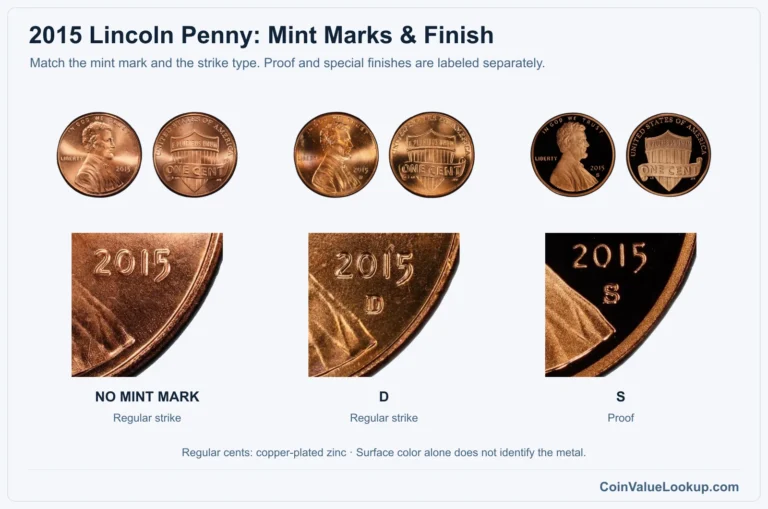
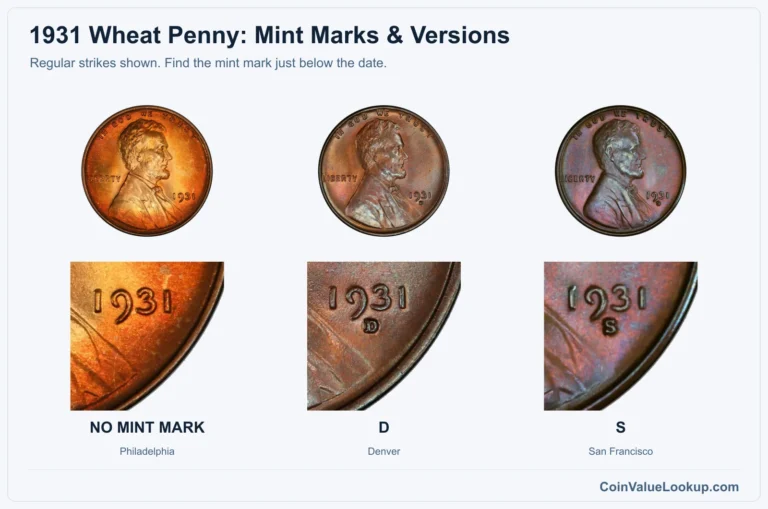
Three branches exist for this year. The Philadelphia issue carries no mintmark.
The Denver coin shows a small "D" below the date. The San Francisco proof has an "S" in the same position.
There was no S-mint circulation strike and no "P" mintmark on cents in this era.
The mintmark sits just below the date on the obverse. A missing mintmark alone does not indicate a rare proof omission.
When evaluating proofs, keep contrast designations like Cameo or Deep Cameo separate from the numerical grade and from color designations like Red, Red-Brown, or Brown. Those are filters for comparison, not alloy differences.
Step 2: Check Your 1991 Lincoln Penny Grade
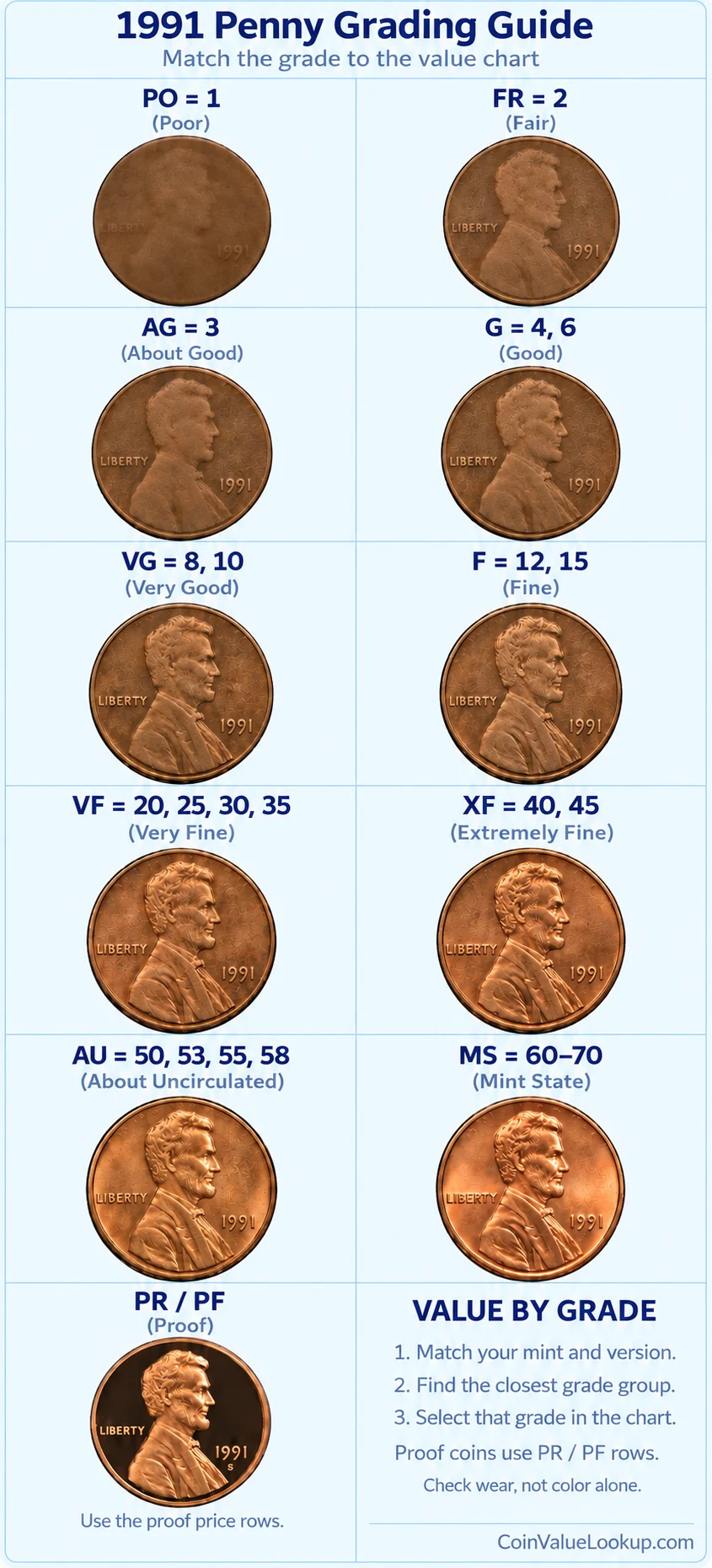
Start with Lincoln's cheekbone, jawline and hair detail on the obverse. Those are the highest points and the first places to show wear.
On the reverse, check the roof of the Memorial and the tops of the columns.
Grade by remaining luster, contact marks and actual wear, not by how red the copper looks. A coin can be full Red and still bag-marked enough to sit at MS63.
Use the comparison image to match your coin's wear pattern against known grade examples. Pay attention to the overall sharpness of the design, not just one spot.
Plating bubbles, splits and exposed zinc are surface issues on copper-plated zinc cents. They lower eye appeal and grade, but they are not striking errors.
Do not assume every gray zinc patch means you have a valuable variety.
Step 3: Check 1991 Lincoln Penny Value by Mint and Version
1991 Lincoln Penny
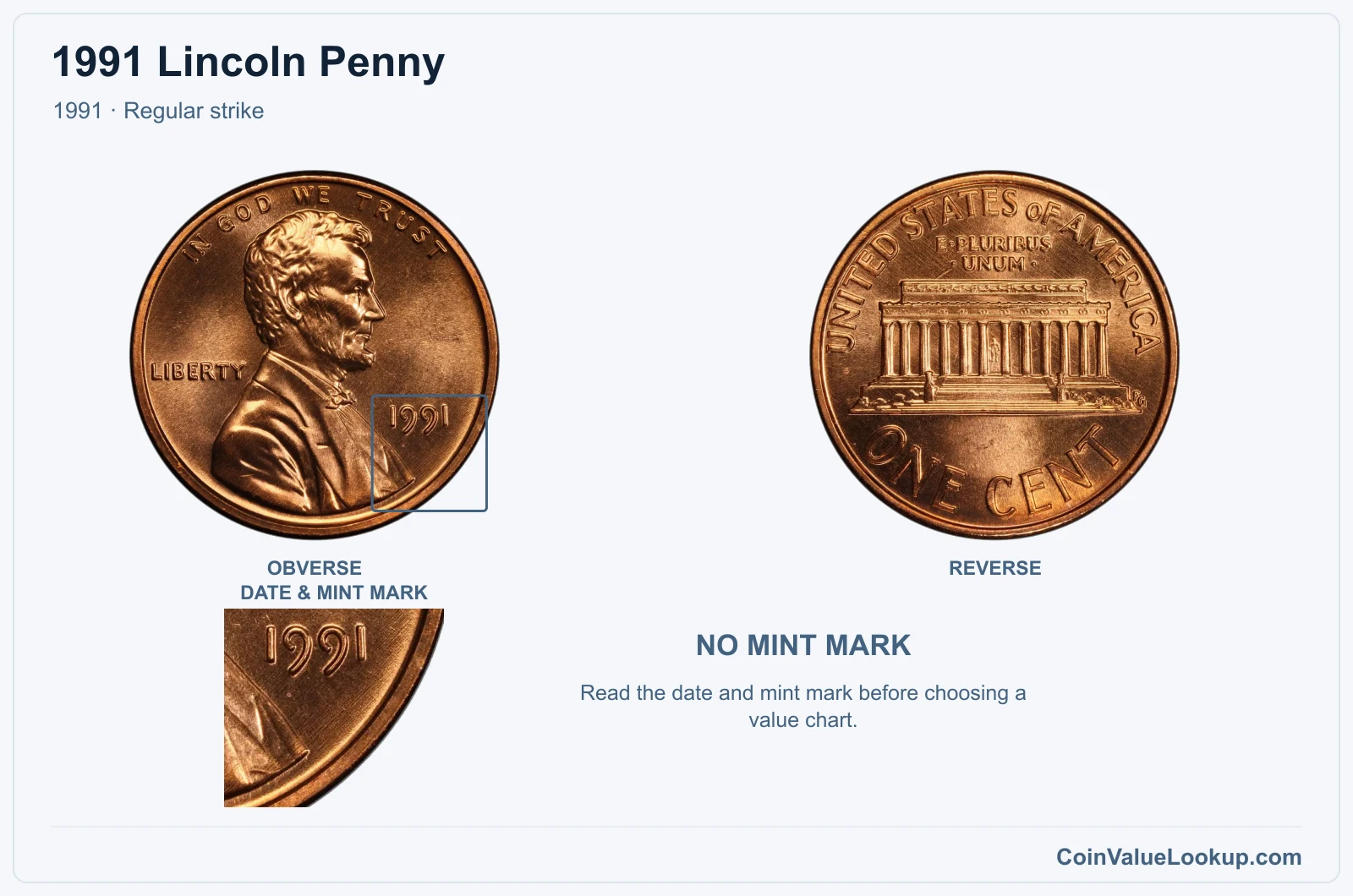
The 1991 Philadelphia penny has no mintmark below the date. It is a standard copper-plated zinc business strike weighing about 2.50 grams.
Billions were made, so circulated examples are worth face value.
In uncirculated condition, a USA Coin Book guide estimate puts this coin around $0.36 at MS65. That price assumes original surfaces and strong eye appeal.
Focus on copper color, luster and freedom from contact marks when comparing your coin to the guide grade.
| Range | Grade | Price | Auction Records | Appraisal |
|---|---|---|---|---|
| PO | PO 1 | — | Coin Identifier | |
| FR | FR 2 | — | Coin Identifier | |
| AG | AG 3 | — | Coin Identifier | |
| G | G 4 | — | Coin Identifier | |
| G 6 | — | Coin Identifier | ||
| VG | VG 8 | — | Coin Identifier | |
| VG 10 | — | Coin Identifier | ||
| F | F 12 | — | Coin Identifier | |
| F 15 | — | Coin Identifier | ||
| VF | VF 20 | — | Coin Identifier | |
| VF 25 | — | Coin Identifier | ||
| VF 30 | — | Coin Identifier | ||
| VF 35 | — | Coin Identifier | ||
| XF | XF 40 | — | Coin Identifier | |
| XF 45 | — | Coin Identifier | ||
| AU | AU 50 | — | Coin Identifier | |
| AU 53 | — | Coin Identifier | ||
| AU 55 | — | Coin Identifier | ||
| AU 58 | — | Coin Identifier | ||
| MS | MS 60 | — | Coin Identifier | |
| MS 61 | — | Coin Identifier | ||
| MS 62 | — | Coin Identifier | ||
| MS 63 | — | Coin Identifier | ||
| MS 64 | — | Coin Identifier | ||
| MS 65 | — | Coin Identifier | ||
| MS 66 | Coin Identifier | |||
| MS 67 | Coin Identifier | |||
| MS 68 | Coin Identifier | |||
| MS 69 | — | Coin Identifier | ||
| MS 70 | — | — | — |
1991 Lincoln Penny — D
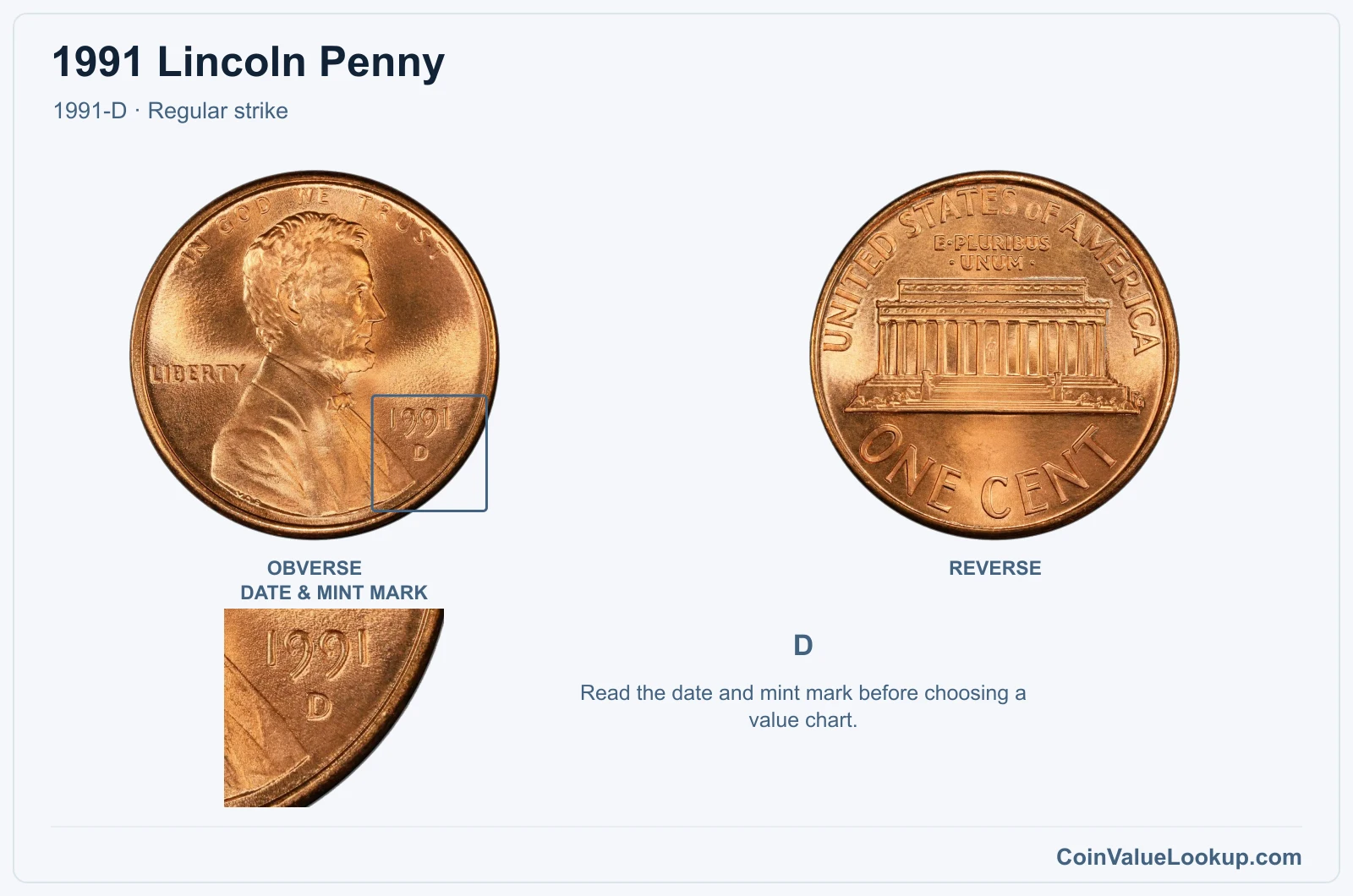
The 1991-D penny was struck at the Denver Mint and carries a small "D" below the date. Same copper-plated zinc composition, same 2.50-gram weight.
Like its Philadelphia sibling, it is common in all grades. The USA Coin Book guide estimate is about $0.36 at MS65.
Circulated pieces remain at face value. If yours looks uncirculated, check under magnification for bag marks and luster breaks before assuming a high grade.
Coin Value Lookup is a good place to look up guides for other dates and denominations if you are working through a collection or a jar of old change.
| Range | Grade | Price | Auction Records | Appraisal |
|---|---|---|---|---|
| PO | PO 1 | — | Coin Identifier | |
| FR | FR 2 | — | Coin Identifier | |
| AG | AG 3 | — | Coin Identifier | |
| G | G 4 | — | Coin Identifier | |
| G 6 | — | Coin Identifier | ||
| VG | VG 8 | — | Coin Identifier | |
| VG 10 | — | Coin Identifier | ||
| F | F 12 | — | Coin Identifier | |
| F 15 | — | Coin Identifier | ||
| VF | VF 20 | — | Coin Identifier | |
| VF 25 | — | Coin Identifier | ||
| VF 30 | — | Coin Identifier | ||
| VF 35 | — | Coin Identifier | ||
| XF | XF 40 | — | Coin Identifier | |
| XF 45 | — | Coin Identifier | ||
| AU | AU 50 | — | Coin Identifier | |
| AU 53 | — | Coin Identifier | ||
| AU 55 | — | Coin Identifier | ||
| AU 58 | — | Coin Identifier | ||
| MS | MS 60 | — | Coin Identifier | |
| MS 61 | — | Coin Identifier | ||
| MS 62 | — | Coin Identifier | ||
| MS 63 | — | Coin Identifier | ||
| MS 64 | — | Coin Identifier | ||
| MS 65 | Coin Identifier | |||
| MS 66 | Coin Identifier | |||
| MS 67 | Coin Identifier | |||
| MS 68 | Coin Identifier | |||
| MS 69 | Coin Identifier | |||
| MS 70 | — | — | — |
1991 Lincoln Penny — S PR
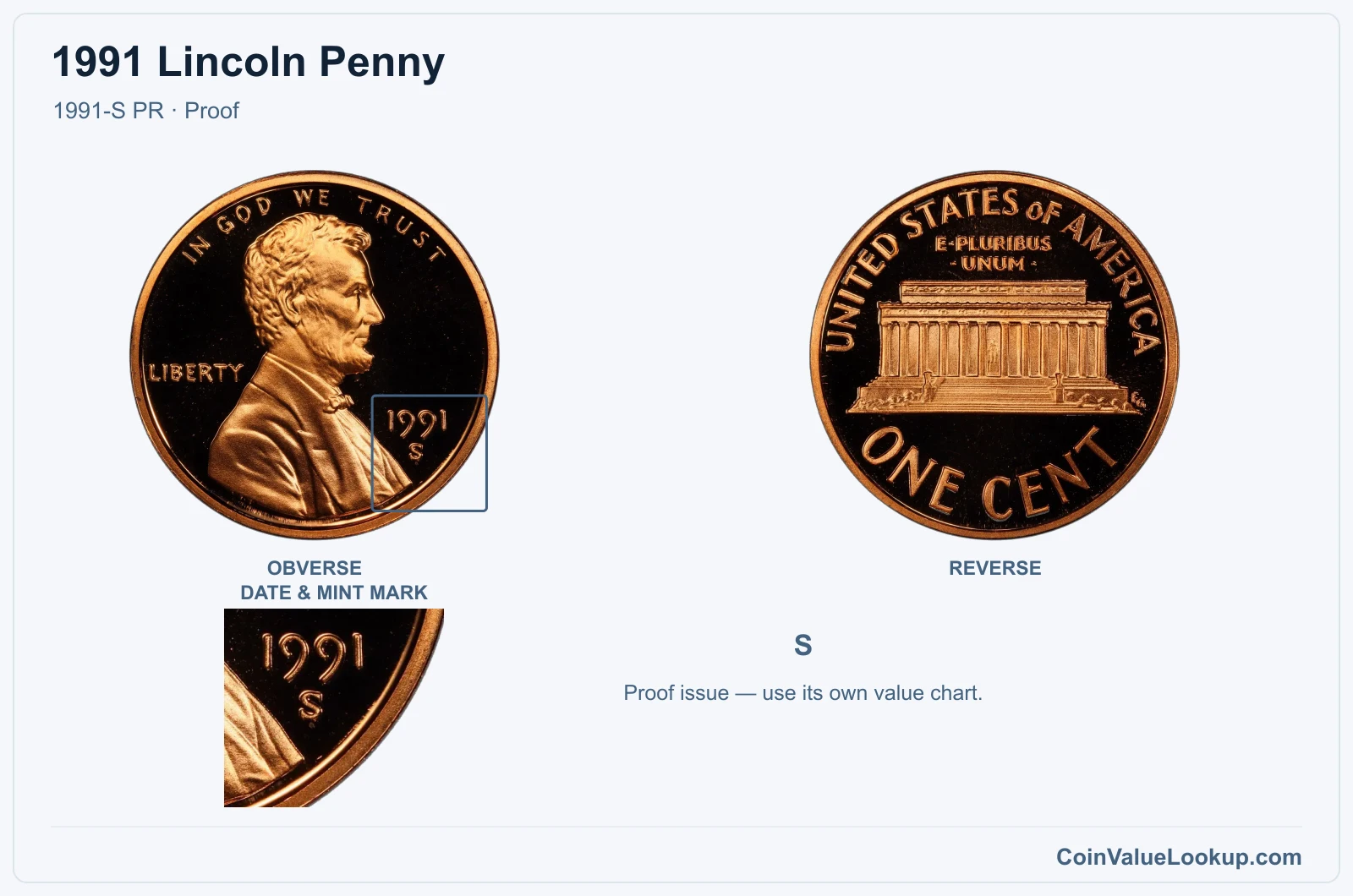
The 1991-S proof was made at San Francisco exclusively for collector sets. It has the "S" mintmark below the date and shows the sharp, mirror-like fields characteristic of proof production.
Remember, proof is a manufacturing method, not a grade above Mint State.
A USA Coin Book guide estimate places this coin at about $15.00 in PR65. Contrast designations such as Cameo or Deep Cameo and color grades like Red are separate filters and affect value differently.
Look for hairlines, haze and toning when evaluating your proof, since these are the common condition issues on proof surfaces.
| Range | Grade | Price | Auction Records | Appraisal |
|---|---|---|---|---|
| PR | PR 1 | — | Coin Identifier | |
| PR 2 | — | Coin Identifier | ||
| PR 3 | — | Coin Identifier | ||
| PR 4 | — | Coin Identifier | ||
| PR 6 | — | Coin Identifier | ||
| PR 8 | — | Coin Identifier | ||
| PR 10 | — | Coin Identifier | ||
| PR 12 | — | Coin Identifier | ||
| PR 15 | — | Coin Identifier | ||
| PR 20 | — | Coin Identifier | ||
| PR 25 | — | Coin Identifier | ||
| PR 30 | — | Coin Identifier | ||
| PR 35 | — | Coin Identifier | ||
| PR 40 | — | Coin Identifier | ||
| PR 45 | — | Coin Identifier | ||
| PR 50 | — | Coin Identifier | ||
| PR 53 | — | Coin Identifier | ||
| PR 55 | — | Coin Identifier | ||
| PR 58 | — | Coin Identifier | ||
| PR 60 | Coin Identifier | |||
| PR 61 | — | Coin Identifier | ||
| PR 62 | — | Coin Identifier | ||
| PR 63 | — | Coin Identifier | ||
| PR 64 | — | Coin Identifier | ||
| PR 65 | — | Coin Identifier | ||
| PR 66 | — | Coin Identifier | ||
| PR 67 | — | Coin Identifier | ||
| PR 68 | Coin Identifier | |||
| PR 69 | Coin Identifier | |||
| PR 70 | Coin Identifier |
1991 Lincoln Penny Error List
1. 1991 Lincoln Penny — Cent Struck over a Dime
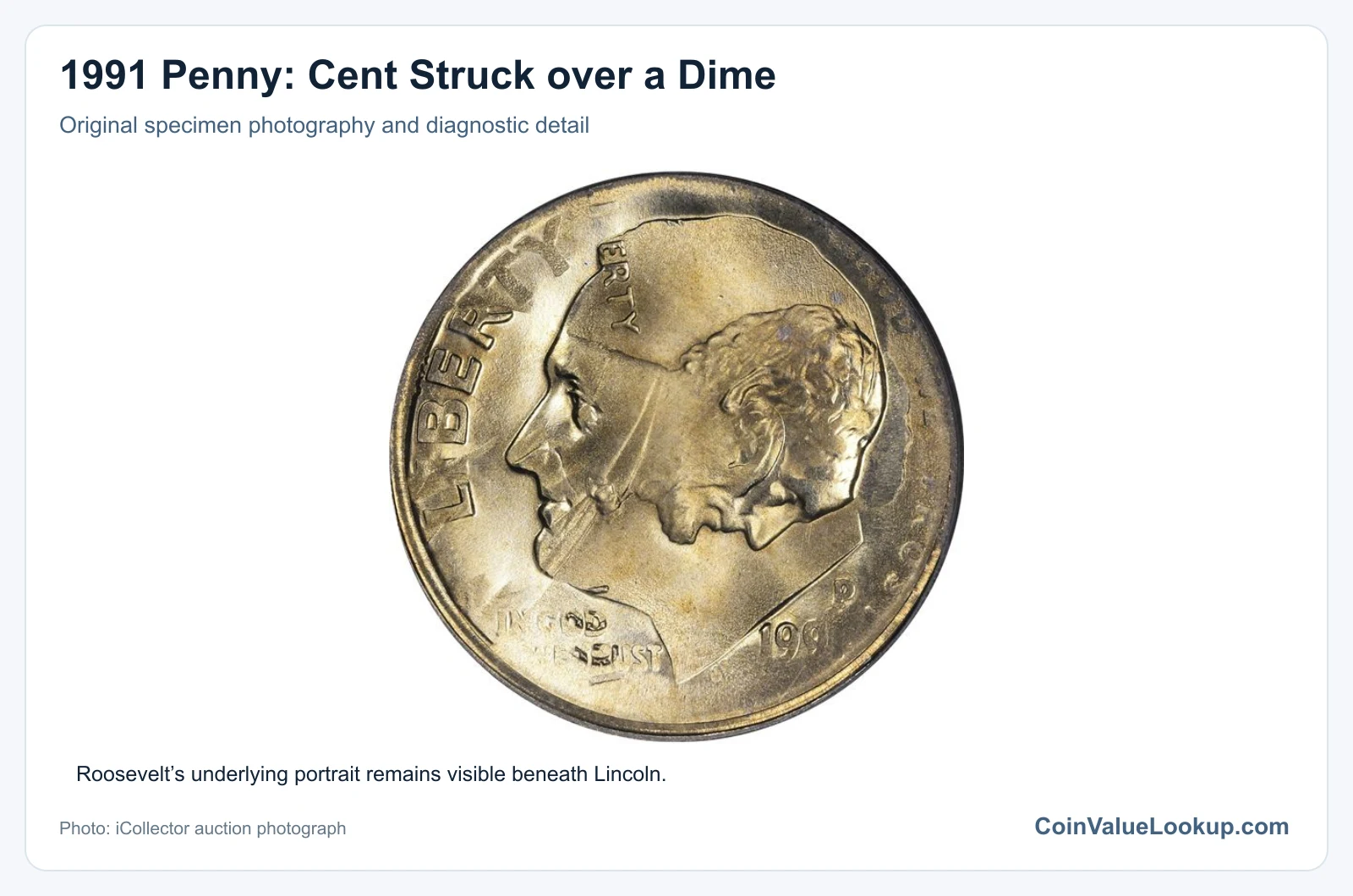
This is one of the more spectacular 1991 cent errors. The coin was struck as a Lincoln cent on a planchet that was already a struck 1991-P Roosevelt dime.
Both the cent design and remnants of the earlier dime design survive on the coin, which is how it gets attributed.
Look for traces of the Roosevelt portrait and torch from the dime underneath the Lincoln cent design. The cent date should be readable separately from the host dime date.
This is different from a cent struck on a blank dime planchet, because the dime was already a finished coin before the cent dies hit it.
An ANACS MS63 example sold for $747.50 at auction in April 2006. That is a single recorded sale, not a general market range.
Professional attribution is important here because a post-mint alteration or simple damage could mimic some features.
2. 1991 Lincoln Penny — Off-Center Strike
An off-center 1991 penny shows the design shifted so that part of the planchet received no impression, leaving an unstruck crescent along one edge. The key is that the date and enough design remain to attribute the coin to 1991.
A 15% off-center 1991 no-mintmark cent graded ANACS MS64 Red sold for $35 at auction in March 2022. More dramatic shifts generally bring higher prices, but only if the date is still visible.
Do not confuse a slightly misaligned die with a true off-center strike. A misaligned die shifts the design but the collar still contains the planchet, so you get a full-diameter coin with uneven rim width.
A genuine off-center strike has metal extending beyond the normal boundary on one side and a blank area on the other.
3. 1991 Lincoln Penny — Double Strike with Displaced Impression
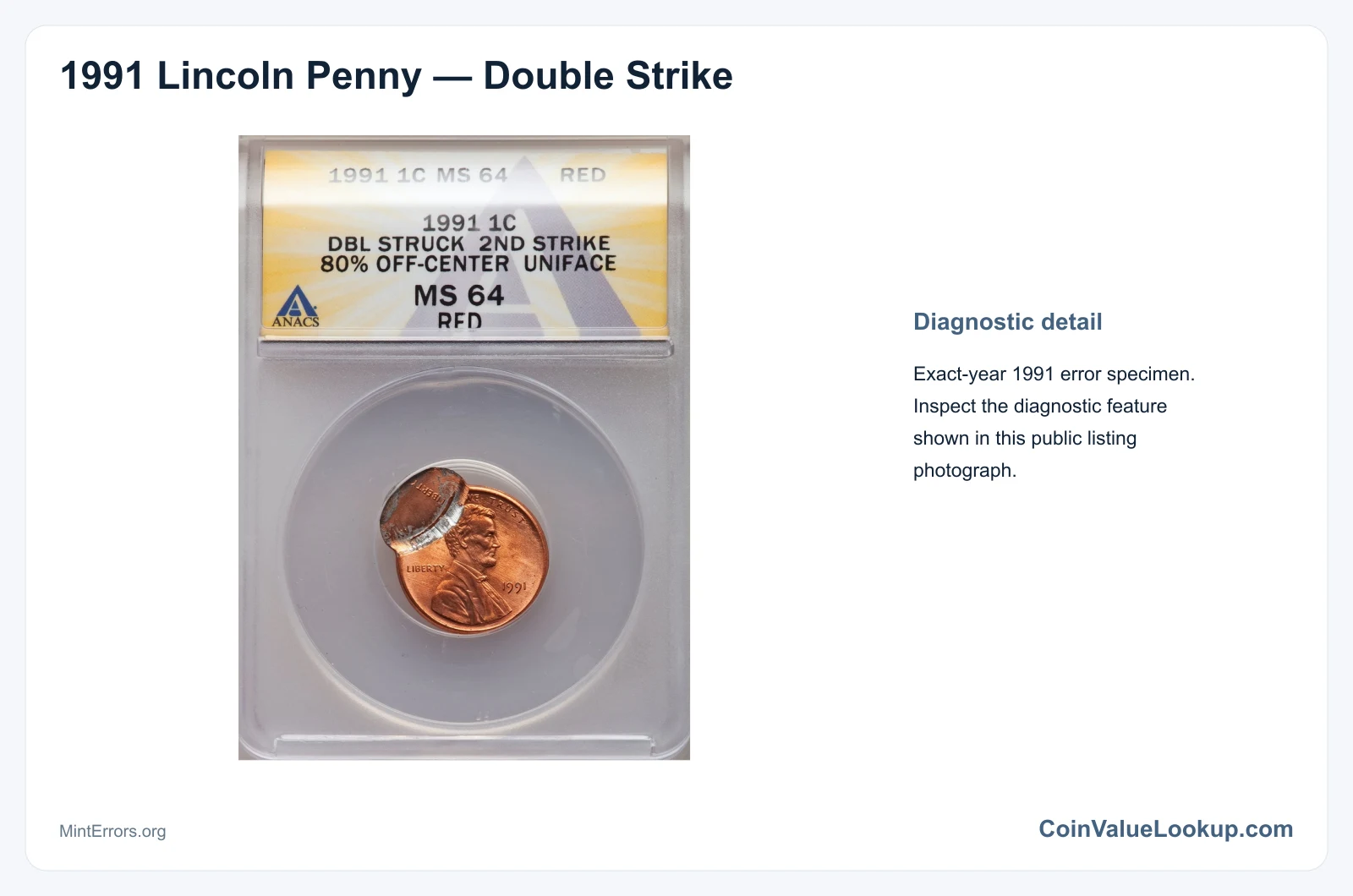
A double-struck cent received two impressions from the dies, with the second strike landing in a different position. On this type of 1991 error, the second strike was about 85% off center, leaving two distinct overlapping designs visible on the coin.
A PCGS MS65 Red example sold for $149 at auction in March 2024. That sale involved a no-mintmark Philadelphia cent.
The two separate design impressions and their positions relative to each other are the main diagnostics.
Do not confuse this with a doubled die, which is a single strike from a die that has doubled design elements. Machine doubling, which shows flat shelf-like displacement, is also different.
A vise-made novelty coin pressed after leaving the mint will lack the metal flow characteristics of a genuine second strike.
4. 1991 Lincoln Penny — Doubled Die Obverse
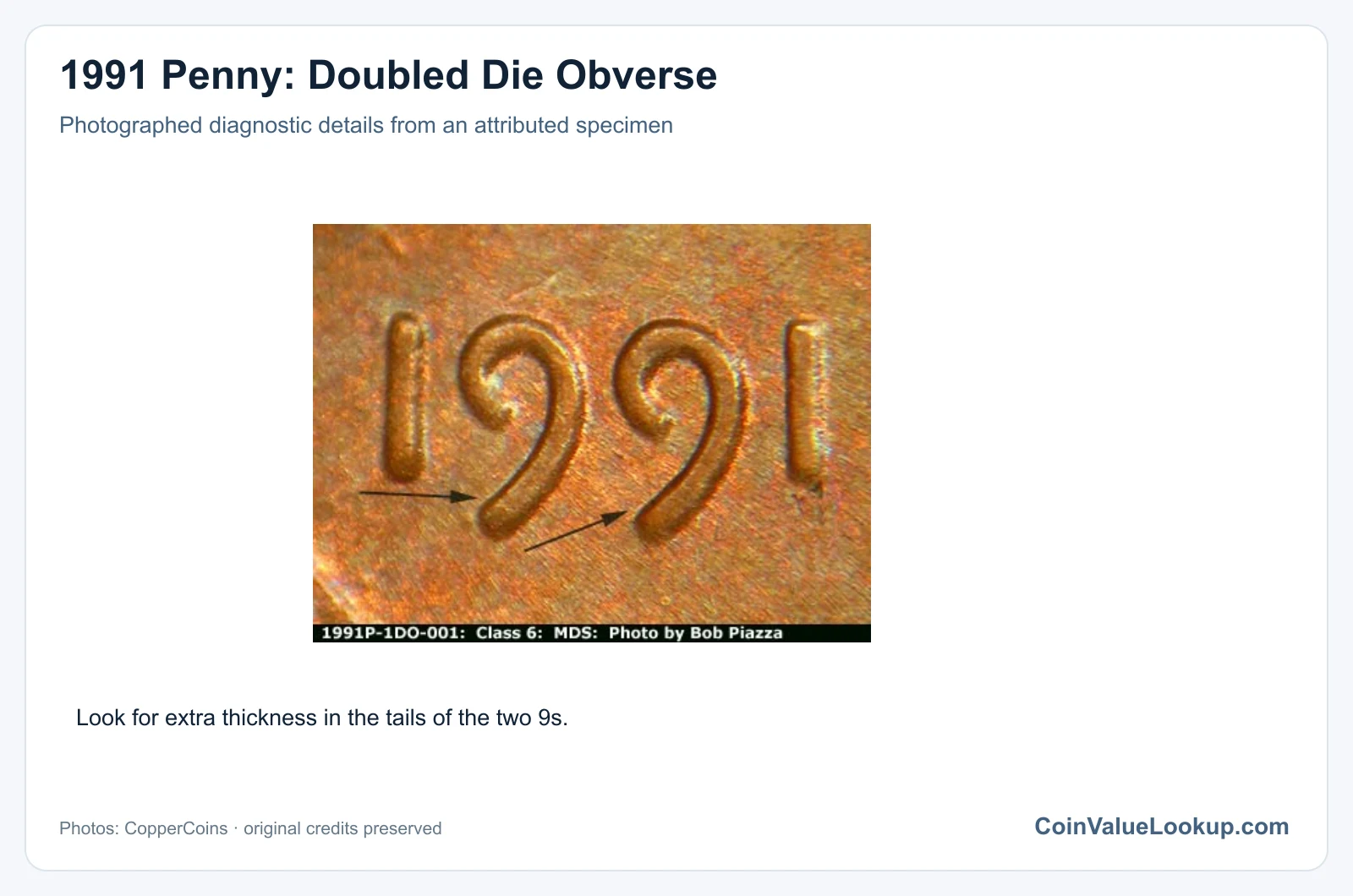
A doubled die obverse on the 1991 cent shows consistent doubling of design elements, such as letters or date digits, caused by a misalignment during die manufacturing. The doubling appears the same on every coin struck by that die.
Compare the obverse lettering and date on your coin to a normal 1991 cent under good lighting and magnification. Look for separation, notching or extra thickness on letters that remains consistent in direction across multiple elements.
Machine doubling is the common lookalike. It tends to produce a flat, shelf-like displacement rather than the rounded, separated profiles of a true doubled die.
Reflections and worn die contours can also fool you. Value depends on the specific die, the visibility of the doubling and the coin's condition.
5. 1991 Lincoln Penny — Doubled Die Reverse / Extra Columns
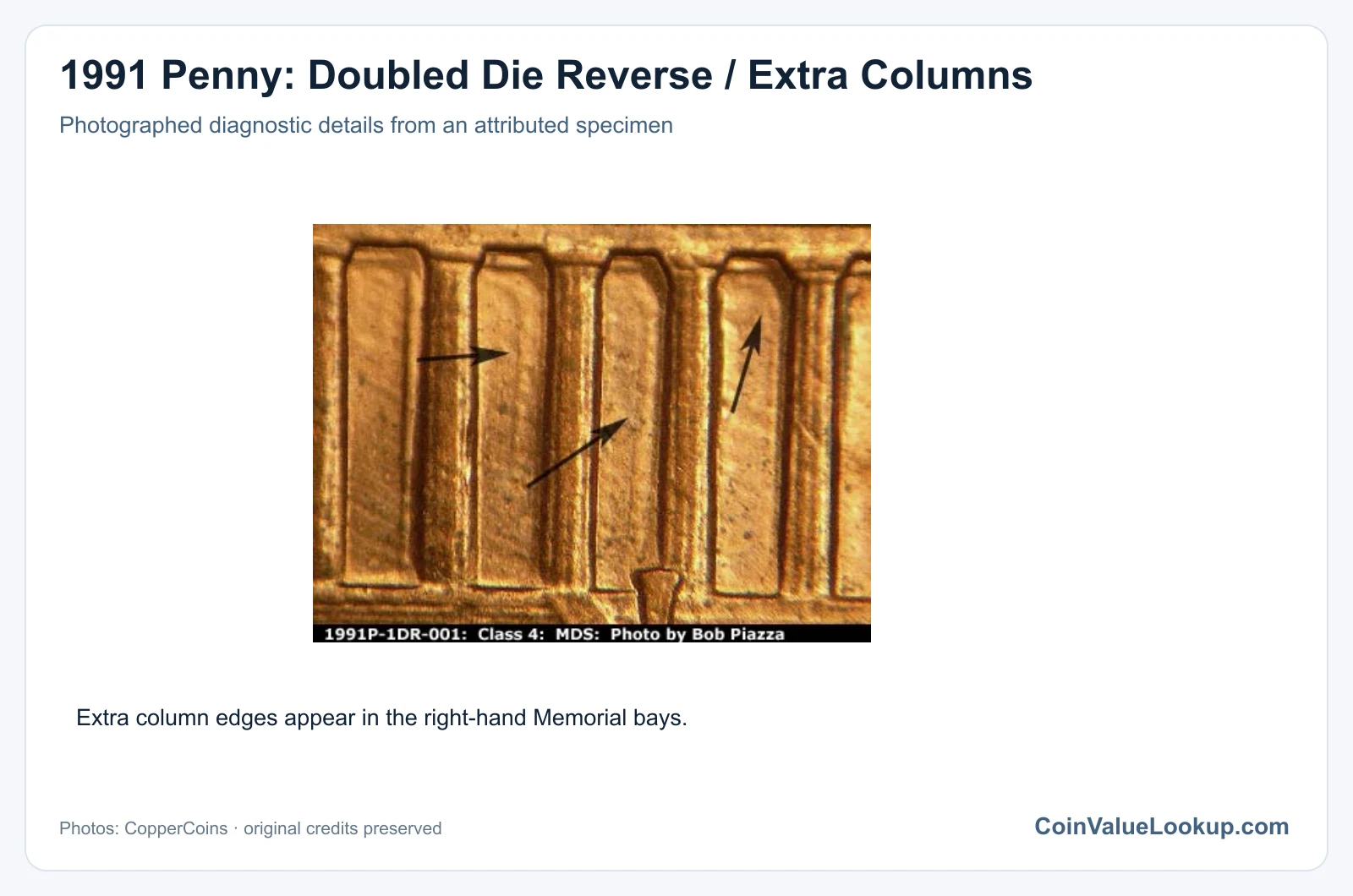
A doubled die reverse on the 1991 cent involves consistent doubling of reverse design elements, sometimes described as extra columns or doubled lettering. Like its obverse counterpart, this originates from a die production error and repeats across all coins from that die.
Examine the reverse legends and the Memorial columns closely, comparing with a normal coin. True doubled die features show consistent direction and are visible across multiple design elements rather than being isolated to one spot.
Machine doubling, random contact marks and reflections can all mimic a doubled die reverse. Machine doubling typically appears as flat, shelf-like displacement without the rounded secondary image.
Condition, the degree of visible doubling and the specific die variety all influence what such a coin might bring.
6. 1991 Lincoln Penny — BIE Die Break
A BIE die break shows a small raised vertical line or blob between the letters B and E in LIBERTY. It is caused by a crack or chip in the die that fills with metal during striking.
Check your 1991 cent's LIBERTY under magnification. The raised feature should appear between B and E, rising from the field.
It will be consistent in shape and position.
Dirt, scratches or a piece of foreign material stuck to the coin can look similar. A genuine BIE break is raised metal that is part of the coin's surface, not sitting on top of it.
Value depends on condition, the size and clarity of the break and collector demand for the particular die.
7. 1991 Lincoln Penny — Struck-Through Error
A struck-through error occurs when foreign material, such as grease, a thread or a metal fragment, gets between the die and the planchet during striking. The result is a localized depression, a strange texture or an area of missing detail on the finished coin.
Look for a defined area where the design is weak, absent or shows an impression of whatever object was trapped. A grease fill-in tends to obliterate detail smoothly, while a retained foreign object may leave a more textured imprint.
Ordinary wear, cleaning and scratches can create weak spots that look vaguely similar. The difference is that a struck-through has crisp boundaries and occurs in the context of otherwise normal striking.
Value depends on the size, location and visual drama of the obstruction.
8. 1991 Lincoln Penny — Broadstrike
A broadstrike happens when the collar die fails to contain the planchet during striking. The coin spreads outward, producing a piece that is wider than normal with a missing or distorted rim, but the design remains roughly centered.
Look at the edge profile. A broadstruck cent will lack the normal raised rim and may show metal spread beyond the standard diameter.
The design should still be mostly complete and centered.
Do not confuse this with an off-center strike, which shifts the design to one side and leaves a blank crescent. Also watch out for coins that have been flattened after minting, such as on railroad tracks.
Those lack the metal flow patterns of a genuine broadstrike. Value depends on the degree of spread and overall condition.
9. 1991 Lincoln Penny — Clipped Planchet
A clipped planchet error means the blank was incomplete before it was struck. The missing portion can be curved, straight or irregular, depending on how the punching or cutting went wrong during blank preparation.
Look for a section of the coin that is simply missing, with an edge that shows original blank texture rather than a filed or cut surface. Weakness in the design opposite the clip, known as the Blakesley effect, is a helpful confirming diagnostic.
Post-mint damage such as edge cuts, filed notches or corrosion can mimic a clip. A genuine clip will have consistent metal flow and edge texture that differs from deliberate removal.
Value depends on the size of the missing area and the coin's condition.
10. 1991 Lincoln Penny — Unplated / Partly Unplated Planchet
An unplated or partly unplated 1991 cent appears grayish or silvery because the copper plating is missing from some or all of the surface, exposing the zinc core underneath. This can happen when the plating step is skipped or fails during blank preparation.
The exposed zinc surface should look uniform and original, not rough or corroded. Check the edge and weight for consistency with a normal cent.
Coins that have had their plating chemically stripped after minting are the main lookalike. Chemical removal often leaves an uneven, pitted or discolored surface that differs from the smoother look of an originally unplated blank.
Corrosion and environmental damage can also strip plating over time. Value depends on the extent of missing plating and the coin's overall condition.
11. 1991 Lincoln Penny — Brockage
A brockage occurs when a previously struck coin sticks to one die, then impresses its design into the next coin fed into the press. The result is one normal side and one side showing an incuse, mirror-image version of the same design.
Look for a sunken, reversed impression on one face. The mirror-image design should correspond to the opposite side of a Lincoln cent, and the depth and detail should be consistent with a struck impression rather than a pressed copy.
A die clash leaves faint ghost traces of the opposite design but does not produce a full incuse mirror image. Coins pressed together outside the mint lack the force and alignment of genuine brockages.
Value depends on the completeness of the brockage impression and condition.
12. 1991 Lincoln Penny — Clashed Dies
Clashed dies leave ghost impressions of the opposite design on a coin's surface. This happens when the obverse and reverse dies strike each other without a planchet between them, transferring faint design elements onto each die face.
On a 1991 cent, look for traces of the Memorial design in the fields around Lincoln's portrait, or Lincoln's profile faintly visible in the reverse fields. The ghost features should align with where the opposing design would naturally fall.
Scratches, random raised lines and light brockage impressions can look similar. A genuine clash shows features that correspond to the known opposing die layout.
Value depends on the strength and clarity of the clash marks and the coin's overall condition.