1943 Jefferson Nickel Coin Value: How Much Is It Worth?
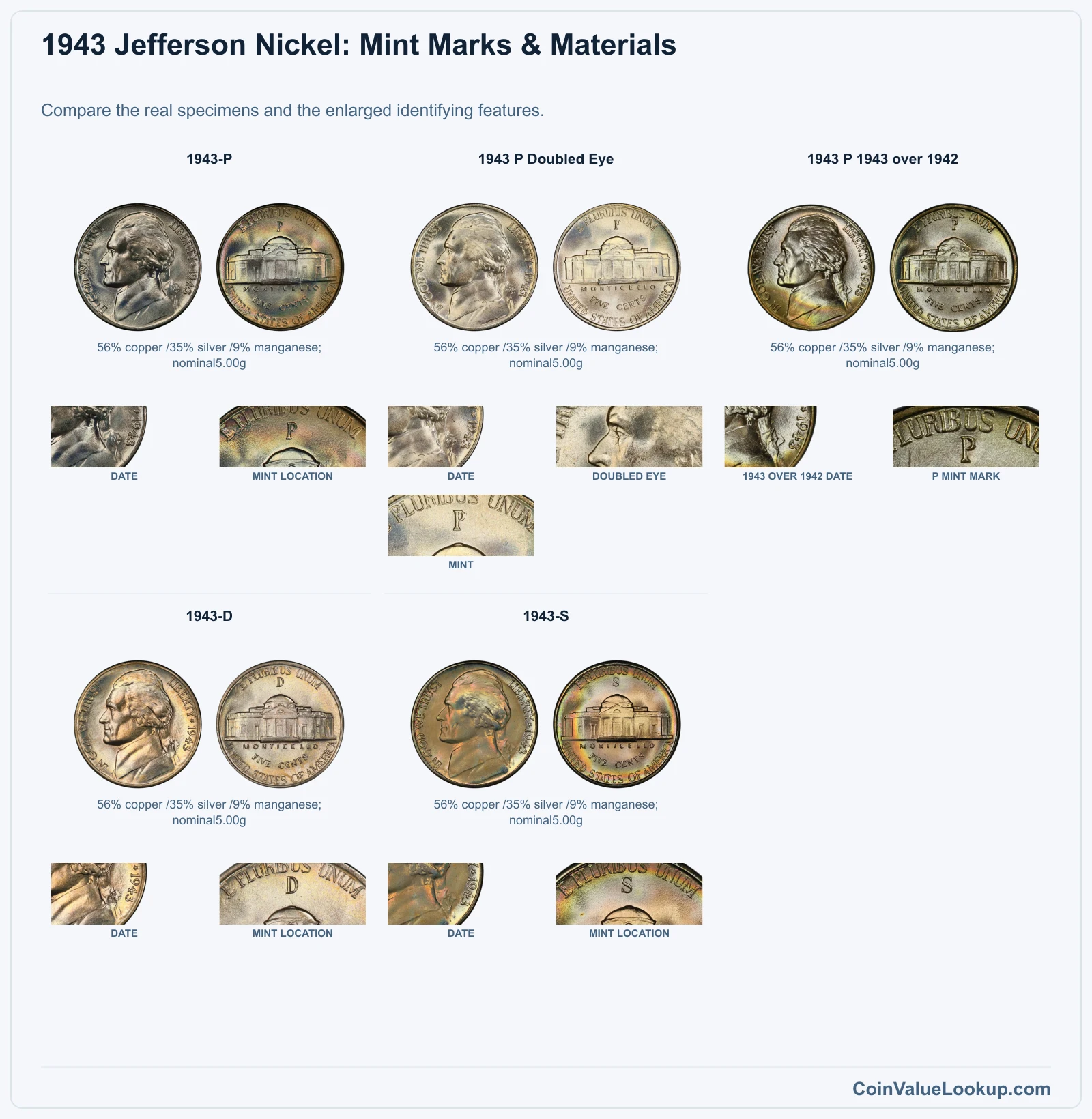
The 1943 Jefferson nickel is a wartime silver coin, struck in an alloy of 56% copper, 35% silver, and 9% manganese. A circulated example in VF20 condition carries a guide estimate around $6.08, while uncirculated pieces at MS65 run about $28 for ordinary mint issues.
Price depends on mint, condition, and whether a recognized variety is present. Proof, Full Steps, and authenticated error coins follow separate value tracks.
Fast Way to Identify Your 1943 Jefferson Nickel
Snap clear photos of the front and back of your 1943 nickel and upload them for a preliminary identification. This helps confirm the mintmark location, date details, and overall condition.
It is not a substitute for professional authentication or exact grading, but it gives you a solid starting point for figuring out which version you hold.
1943 Jefferson Nickel Value
Upload both sides of your 1943 Jefferson Nickel.
Front Obverse
Upload photo
Back Reverse
Upload photo
Which 1943 Jefferson Nickel Versions Are Worth Money?
- Uncirculated examples with full original luster and strong Monticello steps can command premiums; a Full Steps designation should be certified before assuming higher value.
- All three mints struck wartime silver coins whose intrinsic metal value fluctuates with the silver market.
- The 1943 Doubled Eye variety from Philadelphia shows a distinct second eye contour and carries guide values well above the normal issue.
- The 1943-P overdate (1943 over 1942) is the scarcest regular variety, with guide estimates reaching $793 at MS65.
Step 1: Identify Your 1943 Jefferson Nickel Mint Mark and Version
Every regular-issue 1943 nickel was struck in the wartime silver alloy, so expect a large P, D, or S mintmark positioned above the dome of Monticello on the reverse. If you do not see that large mintmark, the coin needs authentication rather than an automatic premium.
The nominal specs are 21.2 mm diameter and 5.00 grams. Weigh and photograph both sides, paying attention to the date and mintmark.
Color alone cannot tell you the metal composition, since toning and environmental damage change surface appearance over time.
Separate honest wear from problems like corrosion, polishing, or old jewelry mounting damage. A coin that has been cleaned or holed is a different conversation from one that simply circulated for decades.
Step 2: Check Your 1943 Jefferson Nickel Grade
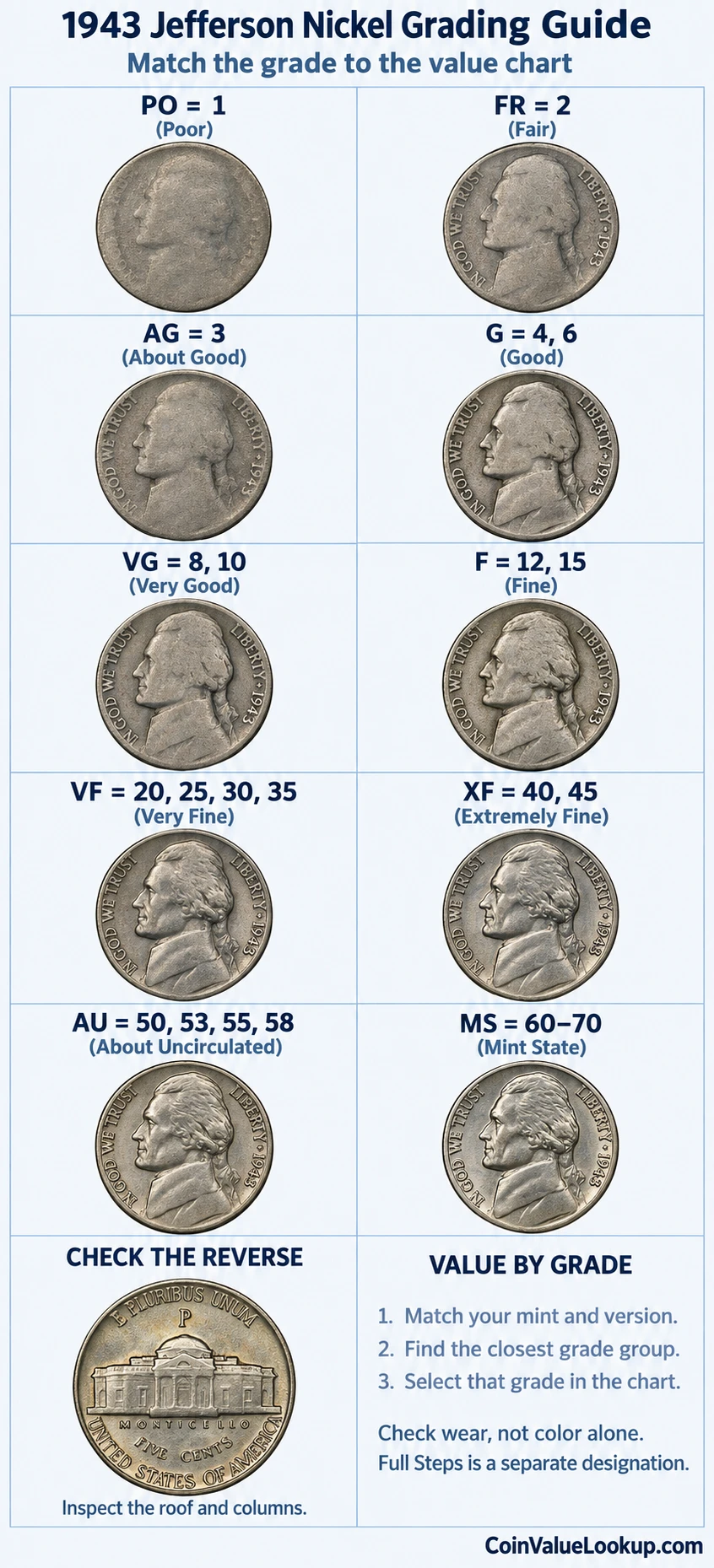
Start on the obverse: check Jefferson's cheekbone and the hair above his ear. Those are the first spots to lose detail as a coin circulates.
Then flip to the reverse and examine the roof and columns of Monticello.
Luster matters. A coin with original, undisturbed mint luster across both sides is in a different league from one that looks shiny because someone polished it.
Compare your coin to the reference image to judge how much original surface remains.
Full Steps is a separate designation applied only to qualifying Mint State coins. It requires at least five clearly separated steps on Monticello under PCGS criteria.
A weak strike can blur those steps without any actual wear, so missing steps alone do not mean a coin is circulated.
Step 3: Check 1943 Jefferson Nickel Value by Mint and Version
1943 Jefferson Nickel — P
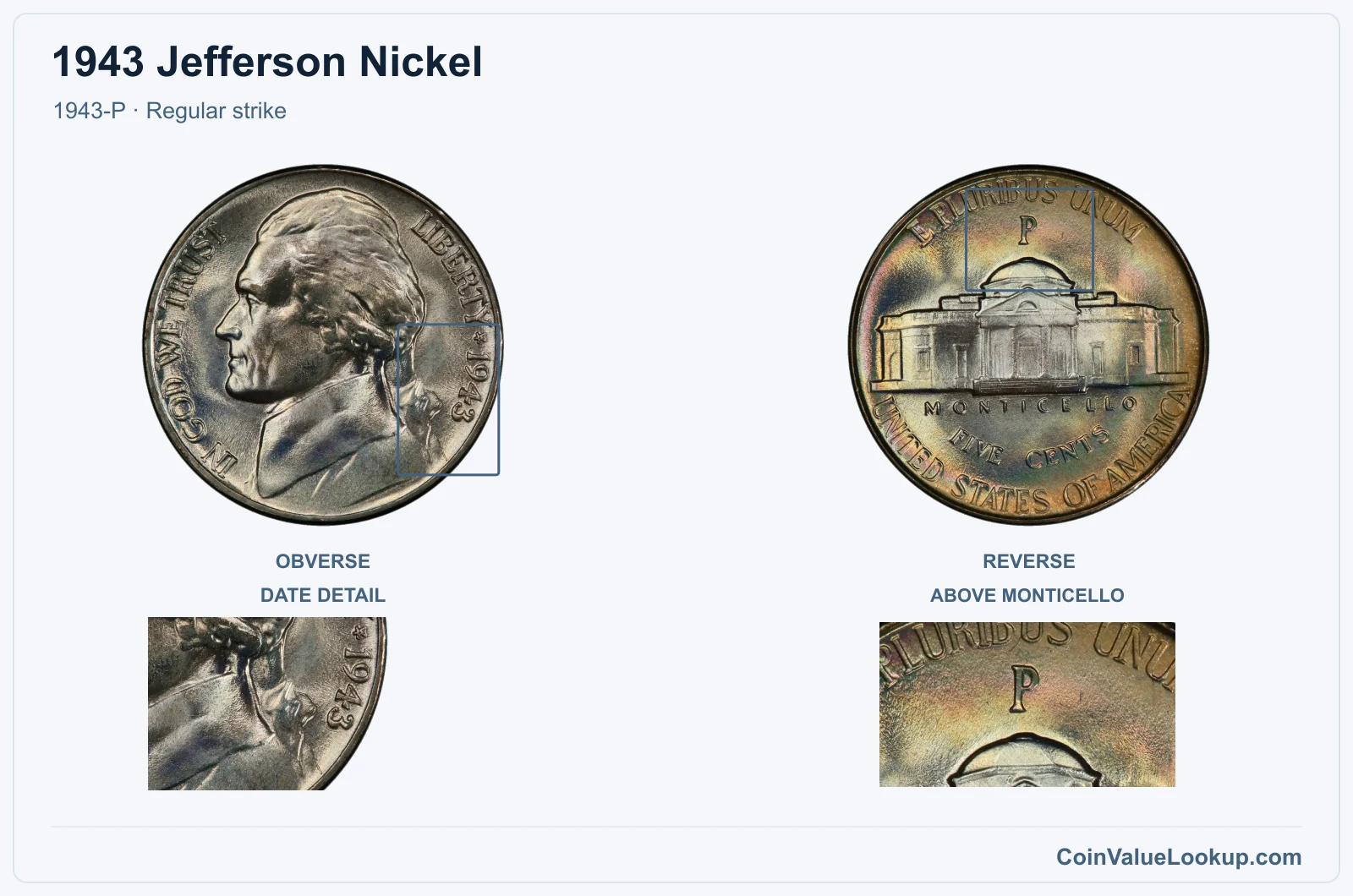
The 1943-P is the Philadelphia issue, identified by a large P above the Monticello dome on the reverse. Like all 1943 nickels, it is struck in the wartime silver alloy.
In circulated VF20 condition, the USA Coin Book guide places it around $6.08. An MS60 uncirculated example runs about $10.01, climbing to roughly $28 at MS65.
Silver content gives every 1943 nickel a metal-value floor that shifts with the market. Full Steps examples in Mint State are a separate tier and should not be compared to ordinary strike prices without certification.
| Range | Grade | Price | Auction Records | Appraisal |
|---|---|---|---|---|
| PO | PO 1 | — | Coin Identifier | |
| FR | FR 2 | — | Coin Identifier | |
| AG | AG 3 | — | Coin Identifier | |
| G | G 4 | — | Coin Identifier | |
| G 6 | — | Coin Identifier | ||
| VG | VG 8 | — | Coin Identifier | |
| VG 10 | — | Coin Identifier | ||
| F | F 12 | — | Coin Identifier | |
| F 15 | — | Coin Identifier | ||
| VF | VF 20 | — | Coin Identifier | |
| VF 25 | — | Coin Identifier | ||
| VF 30 | — | Coin Identifier | ||
| VF 35 | — | Coin Identifier | ||
| XF | XF 40 | — | Coin Identifier | |
| XF 45 | — | Coin Identifier | ||
| AU | AU 50 | Coin Identifier | ||
| AU 53 | — | Coin Identifier | ||
| AU 55 | Coin Identifier | |||
| AU 58 | Coin Identifier | |||
| MS | MS 60 | — | Coin Identifier | |
| MS 61 | — | Coin Identifier | ||
| MS 62 | — | Coin Identifier | ||
| MS 63 | Coin Identifier | |||
| MS 64 | Coin Identifier | |||
| MS 65 | Coin Identifier | |||
| MS 66 | Coin Identifier | |||
| MS 67 | Coin Identifier | |||
| MS 68 | Coin Identifier | |||
| MS 69 | — | — | — | |
| MS 70 | — | — | — |
1943 Jefferson Nickel — P Doubled Eye
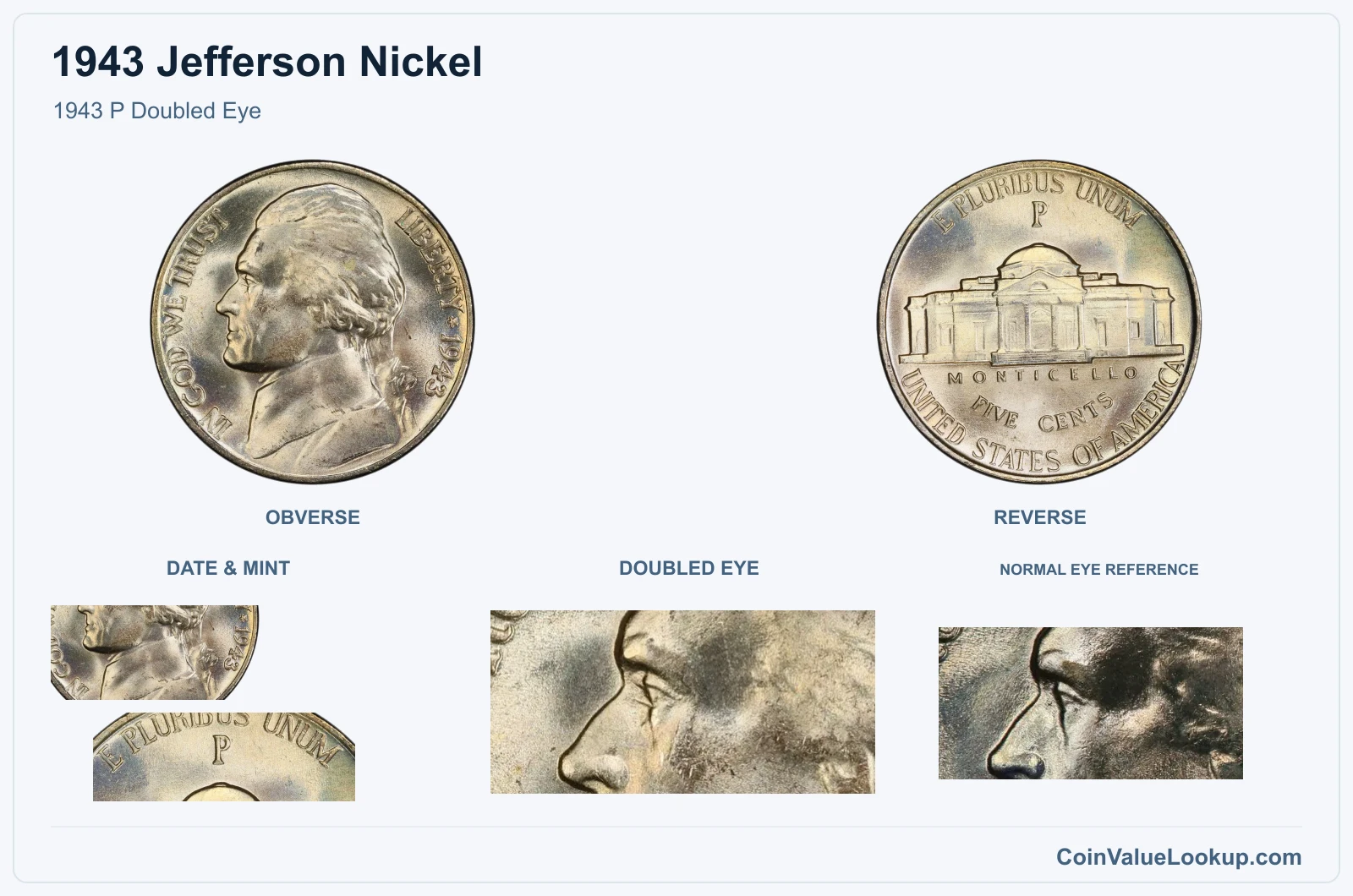
This Philadelphia variety shows a second, offset contour around Jefferson's eye on the obverse. You need magnification to confirm it.
A scratch or a trick of lighting is not the same thing, so compare carefully against a normal 1943-P.
PCGS guide estimates place the Doubled Eye at about $40 in VF20, $157 at MS60, and $559 at MS65. Those are substantial jumps over the ordinary Philadelphia issue.
Grade and Full Steps status remain separate considerations. Have the variety authenticated before assuming these values apply to your coin.
Coin Value Lookup is a good place to look up guides for this and other Jefferson nickel dates when you want to compare values across different years and mints.
| Range | Grade | Price | Auction Records | Appraisal |
|---|---|---|---|---|
| PO | PO 1 | — | Coin Identifier | |
| FR | FR 2 | — | Coin Identifier | |
| AG | AG 3 | — | Coin Identifier | |
| G | G 4 | — | Coin Identifier | |
| G 6 | — | Coin Identifier | ||
| VG | VG 8 | Coin Identifier | ||
| VG 10 | — | Coin Identifier | ||
| F | F 12 | — | Coin Identifier | |
| F 15 | — | Coin Identifier | ||
| VF | VF 20 | Coin Identifier | ||
| VF 25 | — | Coin Identifier | ||
| VF 30 | — | Coin Identifier | ||
| VF 35 | Coin Identifier | |||
| XF | XF 40 | — | Coin Identifier | |
| XF 45 | — | Coin Identifier | ||
| AU | AU 50 | Coin Identifier | ||
| AU 53 | — | Coin Identifier | ||
| AU 55 | — | Coin Identifier | ||
| AU 58 | Coin Identifier | |||
| MS | MS 60 | — | Coin Identifier | |
| MS 61 | — | Coin Identifier | ||
| MS 62 | — | Coin Identifier | ||
| MS 63 | Coin Identifier | |||
| MS 64 | Coin Identifier | |||
| MS 65 | Coin Identifier | |||
| MS 66 | Coin Identifier | |||
| MS 67 | Coin Identifier | |||
| MS 68 | — | — | — | |
| MS 69 | — | — | — | |
| MS 70 | — | — | — |
1943 Jefferson Nickel — P 1943 over 1942
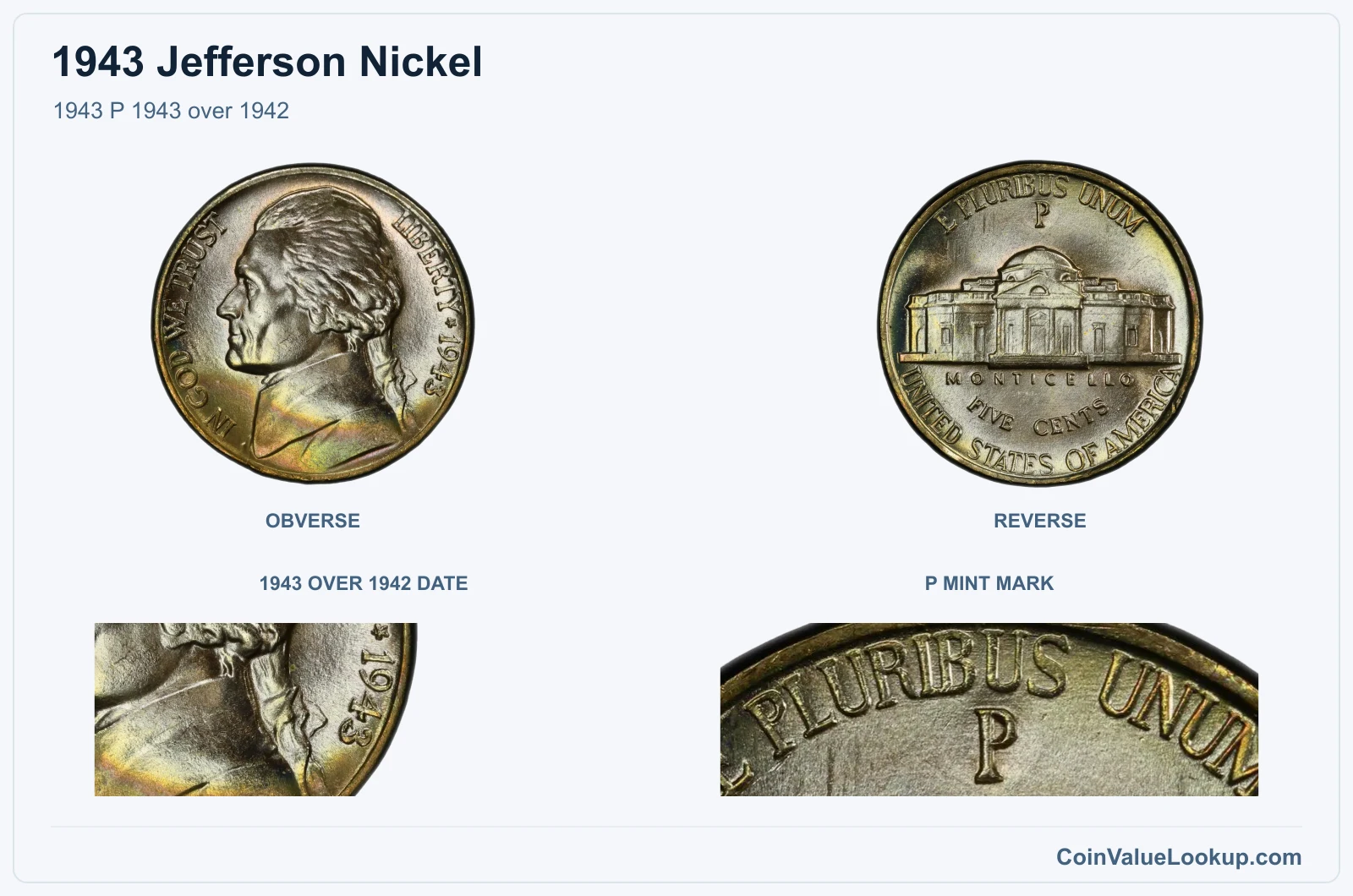
The 1943 over 1942 overdate is a Philadelphia-mint variety where remnants of an underlying 2 are visible within or beneath the final 3 of the date. You need a loupe and good lighting to spot it.
The reverse must carry the large P above the dome, confirming the Philadelphia wartime issue.
PCGS guide estimates run about $63 in VF20, $347 at MS60, and roughly $793 at MS65, making it the highest-valued standard variety in this year. As always, grade and any Full Steps designation are assessed independently.
Authentication is essential because post-mint scratches near the date can mimic an overdate to the hopeful eye.
| Range | Grade | Price | Auction Records | Appraisal |
|---|---|---|---|---|
| PO | PO 1 | — | Coin Identifier | |
| FR | FR 2 | — | Coin Identifier | |
| AG | AG 3 | — | Coin Identifier | |
| G | G 4 | — | Coin Identifier | |
| G 6 | — | Coin Identifier | ||
| VG | VG 8 | Coin Identifier | ||
| VG 10 | — | Coin Identifier | ||
| F | F 12 | Coin Identifier | ||
| F 15 | Coin Identifier | |||
| VF | VF 20 | Coin Identifier | ||
| VF 25 | — | Coin Identifier | ||
| VF 30 | — | Coin Identifier | ||
| VF 35 | — | Coin Identifier | ||
| XF | XF 40 | — | Coin Identifier | |
| XF 45 | Coin Identifier | |||
| AU | AU 50 | Coin Identifier | ||
| AU 53 | Coin Identifier | |||
| AU 55 | Coin Identifier | |||
| AU 58 | Coin Identifier | |||
| MS | MS 60 | — | Coin Identifier | |
| MS 61 | — | Coin Identifier | ||
| MS 62 | Coin Identifier | |||
| MS 63 | Coin Identifier | |||
| MS 64 | Coin Identifier | |||
| MS 65 | Coin Identifier | |||
| MS 66 | Coin Identifier | |||
| MS 67 | Coin Identifier | |||
| MS 68 | — | — | — | |
| MS 69 | — | — | — | |
| MS 70 | — | — | — |
1943 Jefferson Nickel — D
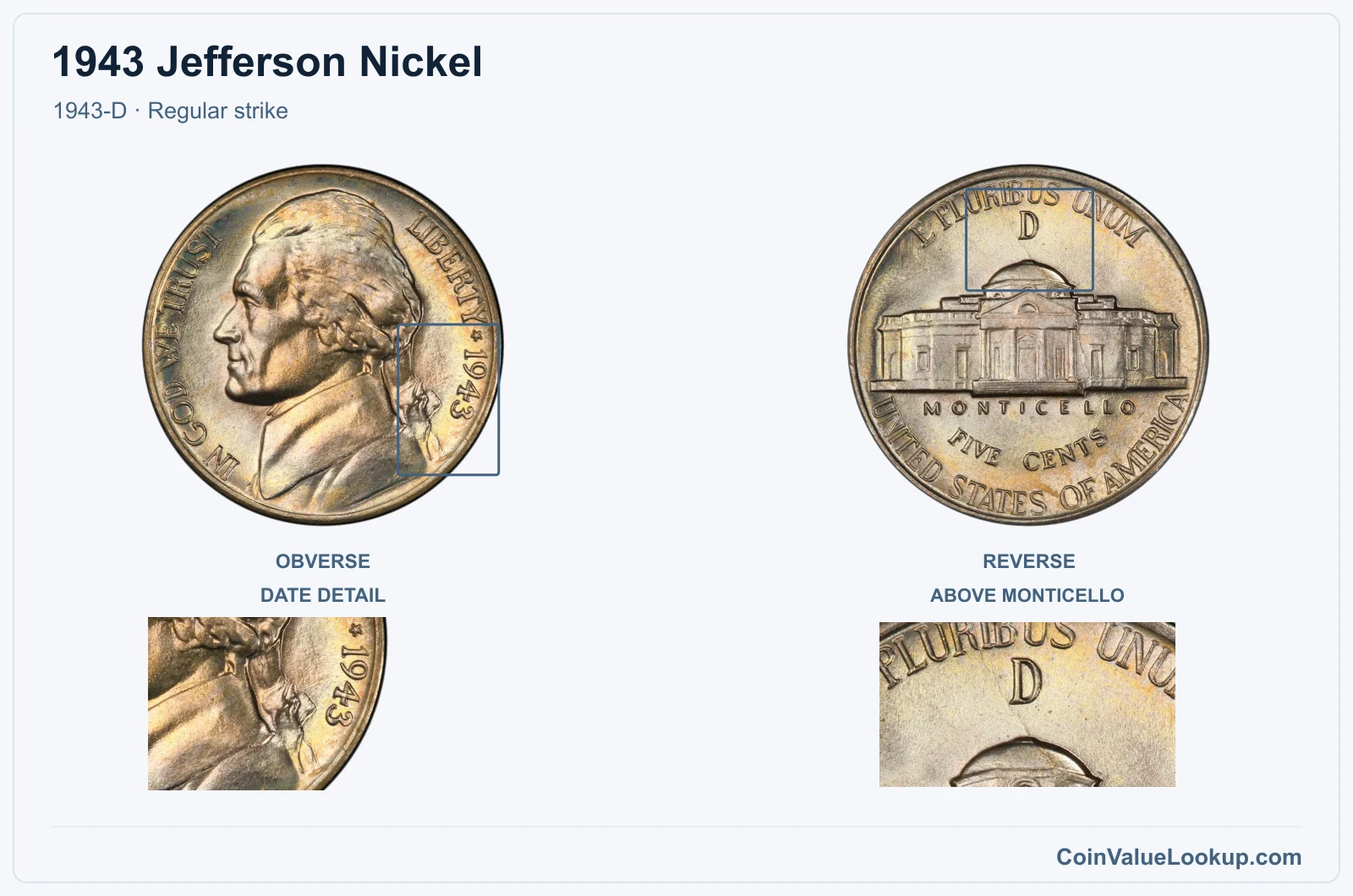
Denver's 1943-D carries a large D above the Monticello dome. Same wartime silver alloy, same 5.00-gram target weight.
In circulated VF20 condition, the guide estimate sits at about $6.08, identical to the Philadelphia issue.
At MS60 the Denver coin edges slightly higher at roughly $11.36, then levels off at about $28 for MS65. Look for the mintmark placement above the dome rather than to the right of Monticello, which is where D and S appear on regular copper-nickel Jefferson nickels from other years.
| Range | Grade | Price | Auction Records | Appraisal |
|---|---|---|---|---|
| PO | PO 1 | — | Coin Identifier | |
| FR | FR 2 | — | Coin Identifier | |
| AG | AG 3 | — | Coin Identifier | |
| G | G 4 | — | Coin Identifier | |
| G 6 | — | Coin Identifier | ||
| VG | VG 8 | — | Coin Identifier | |
| VG 10 | — | Coin Identifier | ||
| F | F 12 | — | Coin Identifier | |
| F 15 | — | Coin Identifier | ||
| VF | VF 20 | — | Coin Identifier | |
| VF 25 | — | Coin Identifier | ||
| VF 30 | — | Coin Identifier | ||
| VF 35 | — | Coin Identifier | ||
| XF | XF 40 | — | Coin Identifier | |
| XF 45 | — | Coin Identifier | ||
| AU | AU 50 | — | Coin Identifier | |
| AU 53 | — | Coin Identifier | ||
| AU 55 | — | Coin Identifier | ||
| AU 58 | — | Coin Identifier | ||
| MS | MS 60 | — | Coin Identifier | |
| MS 61 | — | Coin Identifier | ||
| MS 62 | — | Coin Identifier | ||
| MS 63 | — | Coin Identifier | ||
| MS 64 | Coin Identifier | |||
| MS 65 | Coin Identifier | |||
| MS 66 | Coin Identifier | |||
| MS 67 | Coin Identifier | |||
| MS 68 | Coin Identifier | |||
| MS 69 | — | — | — | |
| MS 70 | — | — | — |
1943 Jefferson Nickel — S
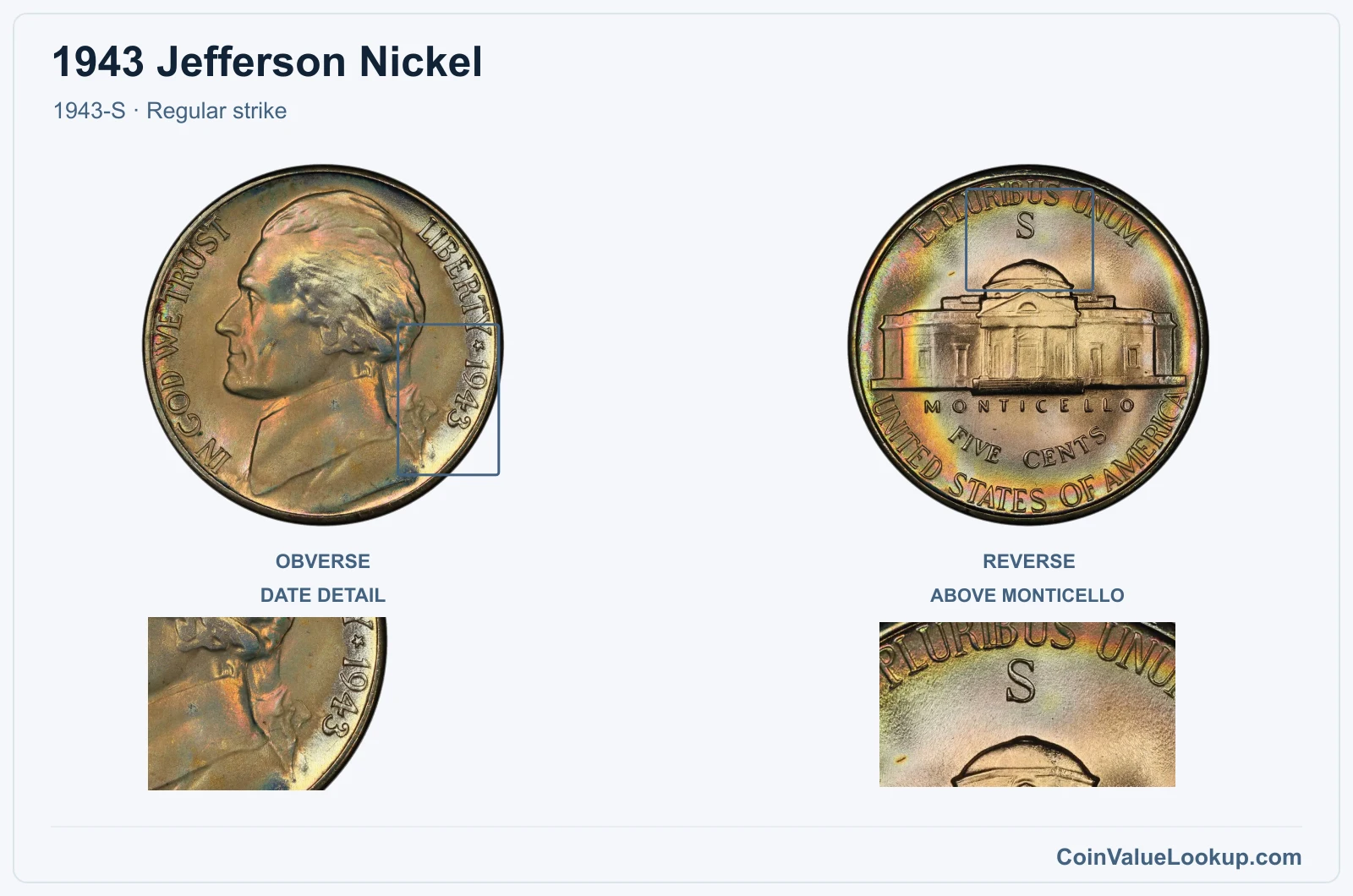
The San Francisco 1943-S shows a large S above Monticello's dome. It shares the same wartime silver composition and the same circulated guide value of approximately $6.08 in VF20 as the P and D issues.
Uncirculated pieces at MS60 come in around $10.01, reaching about $28 at MS65 per the USA Coin Book guide. The silver content provides a shifting metal-value baseline.
As with any wartime nickel, Full Steps coins in Mint State are priced separately and should be certified before claiming that premium.
| Range | Grade | Price | Auction Records | Appraisal |
|---|---|---|---|---|
| PO | PO 1 | — | Coin Identifier | |
| FR | FR 2 | — | Coin Identifier | |
| AG | AG 3 | — | Coin Identifier | |
| G | G 4 | — | Coin Identifier | |
| G 6 | — | Coin Identifier | ||
| VG | VG 8 | — | Coin Identifier | |
| VG 10 | — | Coin Identifier | ||
| F | F 12 | — | Coin Identifier | |
| F 15 | — | Coin Identifier | ||
| VF | VF 20 | — | Coin Identifier | |
| VF 25 | — | Coin Identifier | ||
| VF 30 | — | Coin Identifier | ||
| VF 35 | — | Coin Identifier | ||
| XF | XF 40 | — | Coin Identifier | |
| XF 45 | — | Coin Identifier | ||
| AU | AU 50 | — | Coin Identifier | |
| AU 53 | — | Coin Identifier | ||
| AU 55 | — | Coin Identifier | ||
| AU 58 | — | Coin Identifier | ||
| MS | MS 60 | — | Coin Identifier | |
| MS 61 | — | Coin Identifier | ||
| MS 62 | — | Coin Identifier | ||
| MS 63 | Coin Identifier | |||
| MS 64 | Coin Identifier | |||
| MS 65 | Coin Identifier | |||
| MS 66 | Coin Identifier | |||
| MS 67 | Coin Identifier | |||
| MS 68 | Coin Identifier | |||
| MS 69 | — | — | — | |
| MS 70 | — | — | — |
1943 Jefferson Nickel Error List
1. 1943 Jefferson Nickel — Doubled Eye
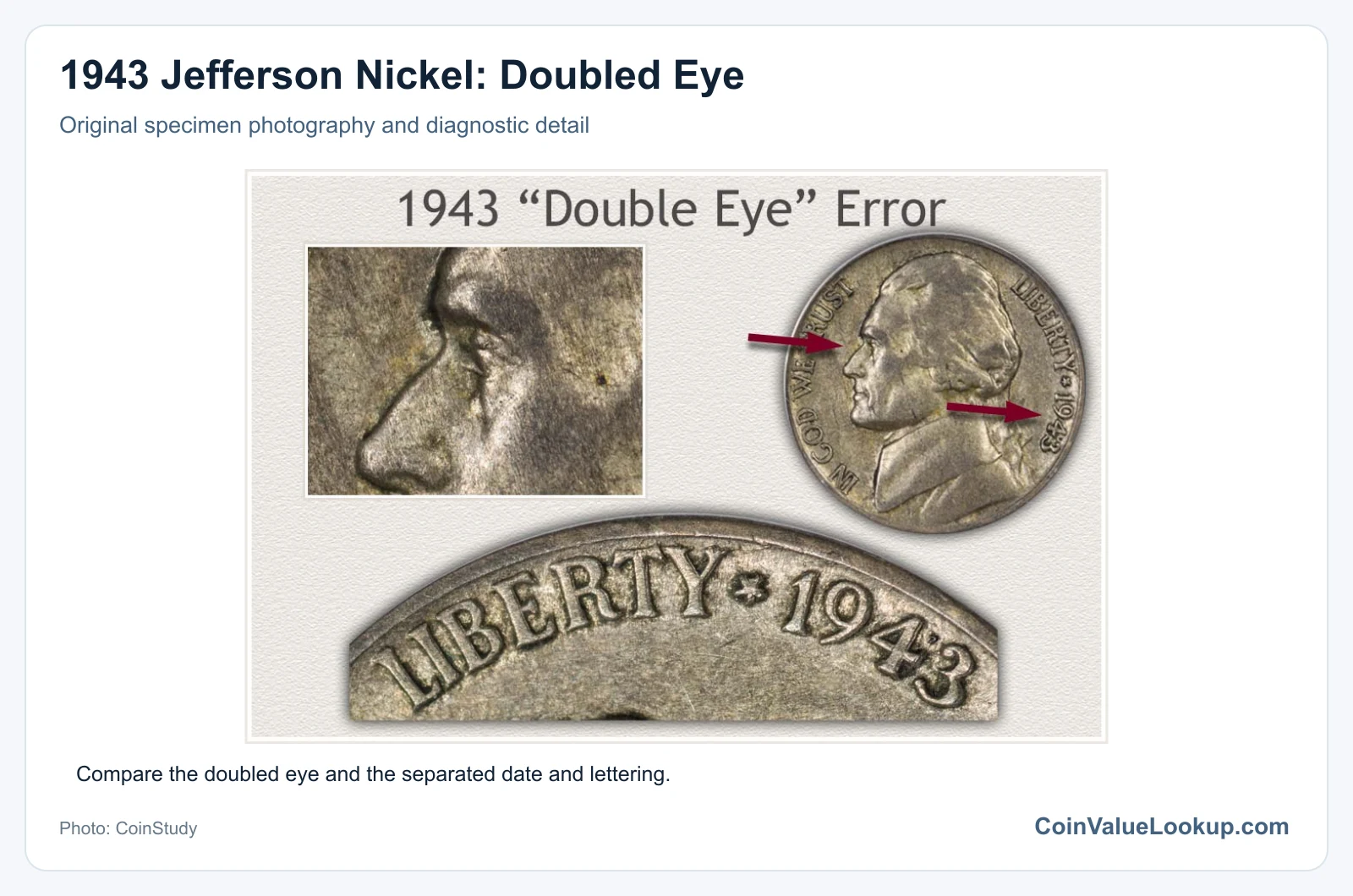
The Doubled Eye variety is a Philadelphia-mint obverse doubled die. Under magnification, look for a distinct second contour around Jefferson's eye.
It should appear as a clear, consistent doubling of the eye outline, not a random gouge or a reflection that moves when you tilt the coin.
Machine doubling, which is flat and shelf-like, can mimic this effect at first glance. A genuine doubled die shows raised, separated detail.
Compare your coin side by side with a normal 1943-P at matching magnification.
PCGS guide estimates place this variety at about $40 in VF20, $157 in MS60, and $559 at MS65. Professional authentication is the only reliable way to confirm the variety and unlock those values.
2. 1943 Jefferson Nickel — over1942 date
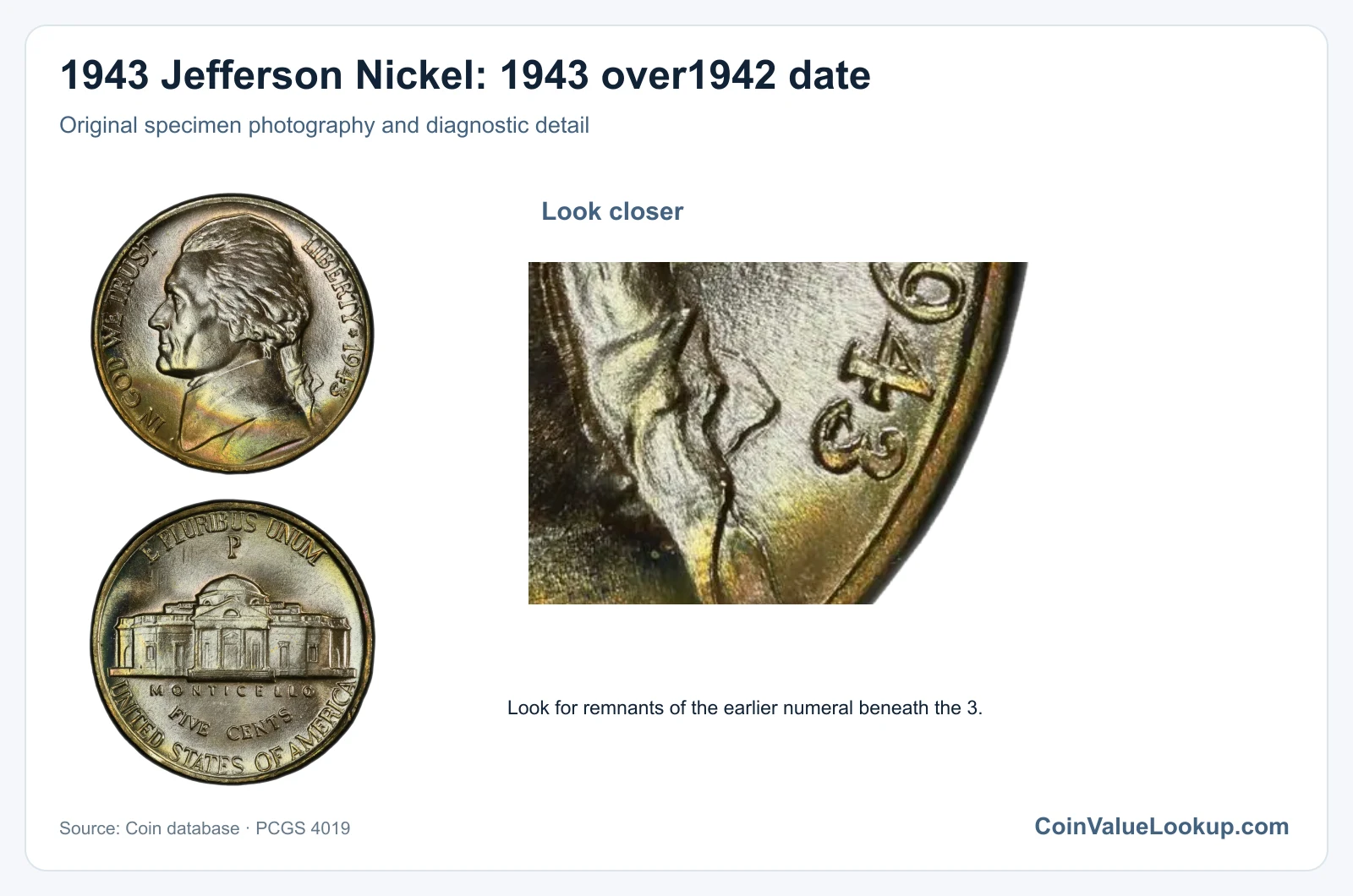
The 1943 over 1942 overdate is exclusive to the Philadelphia mint. Remnants of the underlying 2 are visible at the base or within the final digit 3 of the date.
Photograph the date area at high magnification alongside the full reverse showing the large P.
Post-mint scratches, recut numbers, and random die chips near the 3 can fool you. Genuine overdate traces are consistent with die preparation, not surface damage.
If it only looks right from one angle, be skeptical.
PCGS guide values run approximately $63 at VF20, $347 at MS60, and $793 at MS65. This is the year's most valuable recognized variety, so third-party certification is strongly recommended before any transaction.
3. 1943 Jefferson Nickel — Struck on a steel cent planchet
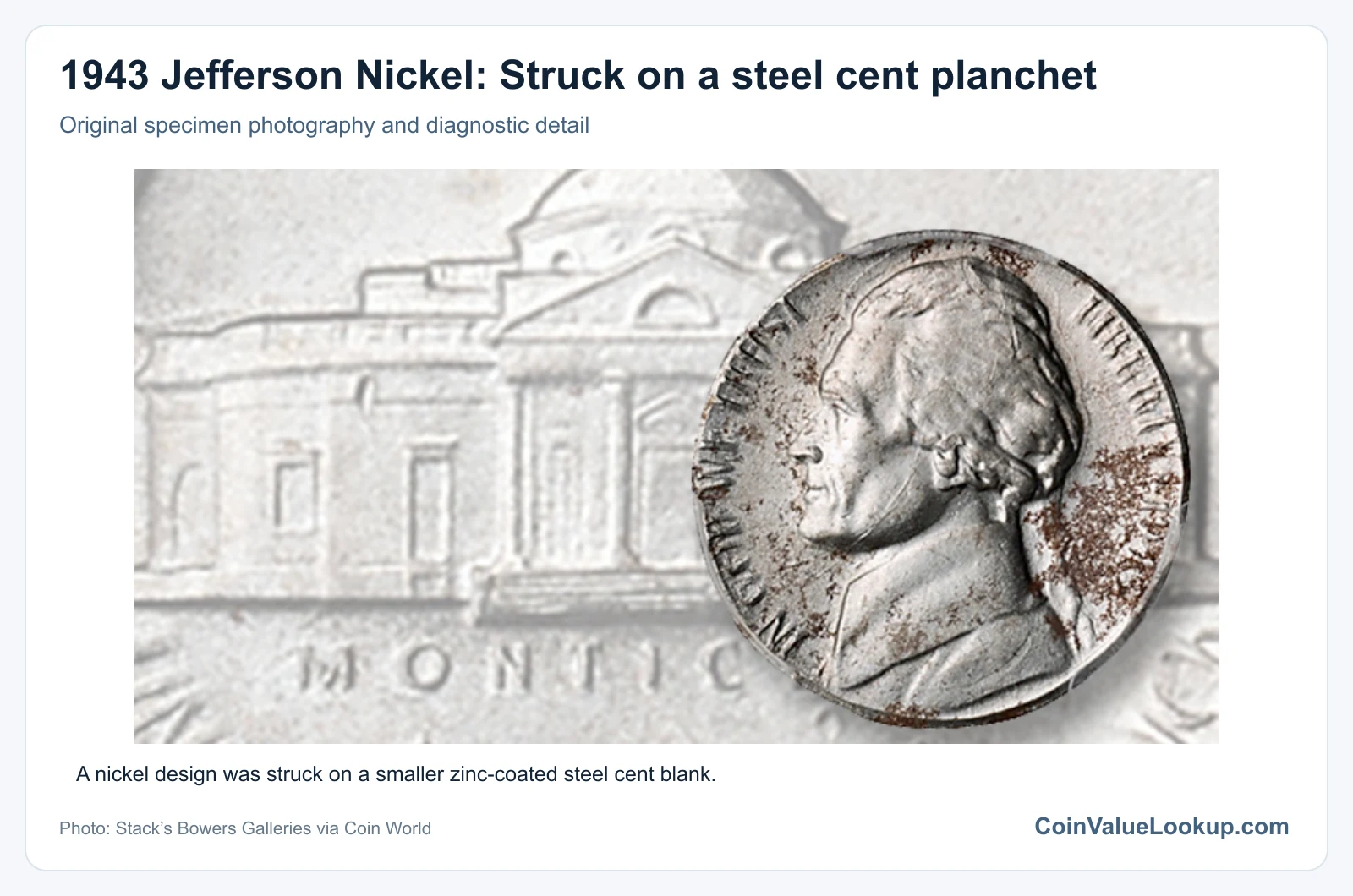
A 1943 nickel struck on a steel cent planchet is a wrong-planchet error. The zinc-coated steel blank is physically smaller than a standard nickel blank, so the finished coin shows incomplete outer legends and a slightly undersized appearance.
It will respond to a magnet, but magnetic attraction alone does not prove authenticity.
Do not confuse this with a 1943 Lincoln steel cent or a war nickel that someone plated. A genuine wrong-planchet error carries the Jefferson portrait and Monticello design on a visibly undersized, magnetically responsive flan.
A Heritage Auctions sale in December 2023 recorded a San Francisco example graded PCGS AU55 at $3,120. That is a single reported result, not a broad market range.
Professional authentication is essential for an error of this magnitude.
4. 1943 Jefferson Nickel — Repunched Mintmark
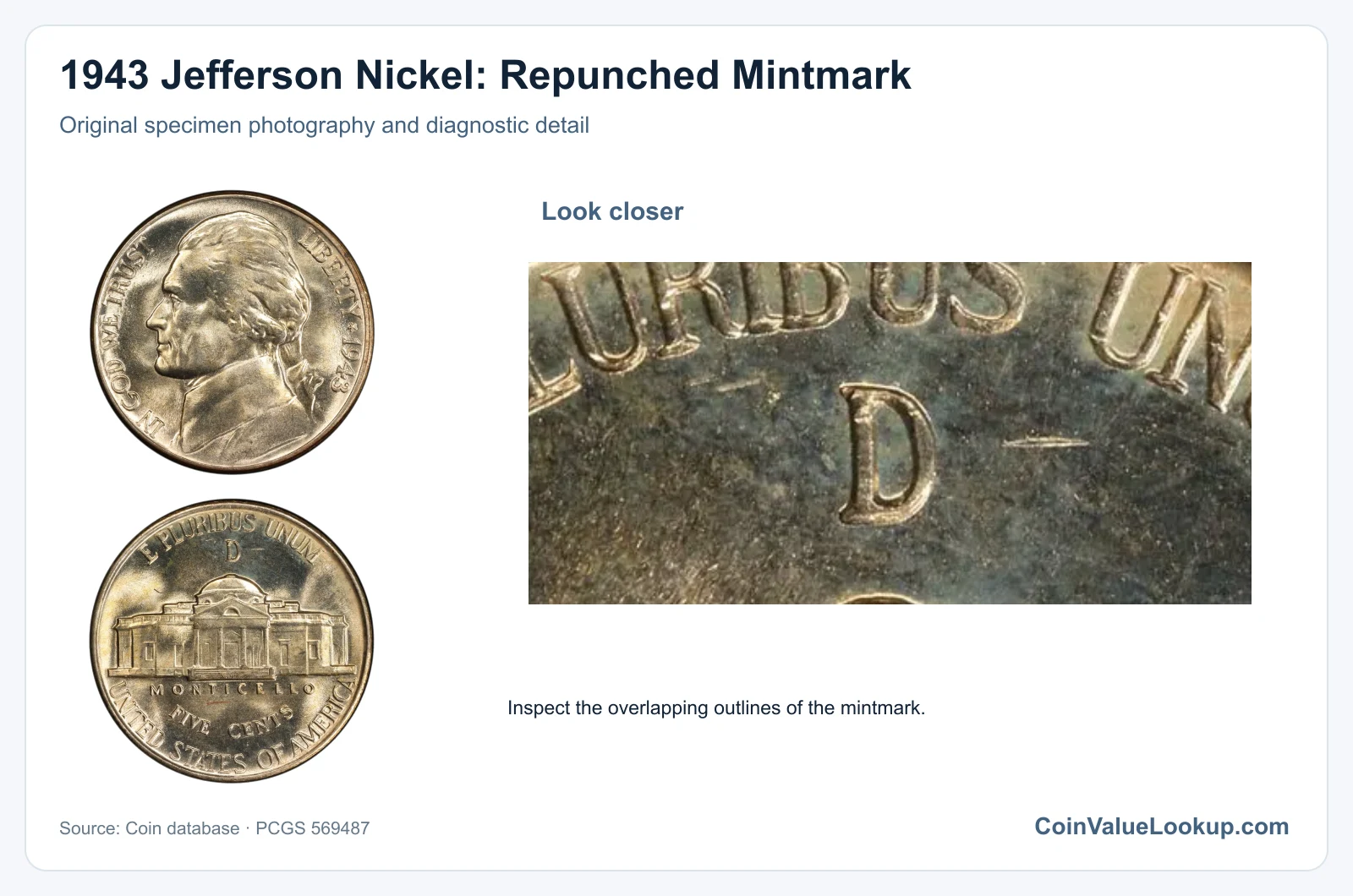
A repunched mintmark on the 1943-D nickel shows remnants of a separately positioned D punch near the primary mintmark above the Monticello dome. Under magnification you may see traces of a second D that is slightly offset.
Do not confuse this with machine doubling, which tends to produce flat, shelf-like distortion rather than a distinctly doubled letter. Die chips or corrosion around the mintmark area can also create misleading shapes.
Compare your coin's mintmark at the same magnification against a known normal example.
Condition, the visibility of the repunching, and the specific variety all affect value. Professional authentication helps confirm the error and establish a fair basis for pricing.
5. 1943 Jefferson Nickel — Off-Center Strike
An off-center strike occurs when the planchet is not properly seated between the dies at the moment of striking. The result is a displaced design with an unstruck crescent of blank metal along one edge.
The date should remain visible for the coin to be collectible. More displacement generally means more collector interest, but only up to the point where key design elements disappear.
A clipped planchet, one-sided die misalignment, or post-mint flattening can resemble an off-center strike, so look carefully at the blank area and edge profile.
Value depends on condition, the degree of off-center displacement, and which design elements survive. Each piece is evaluated individually, so professional assessment is worthwhile.
6. 1943 Jefferson Nickel — Lamination / Split Planchet
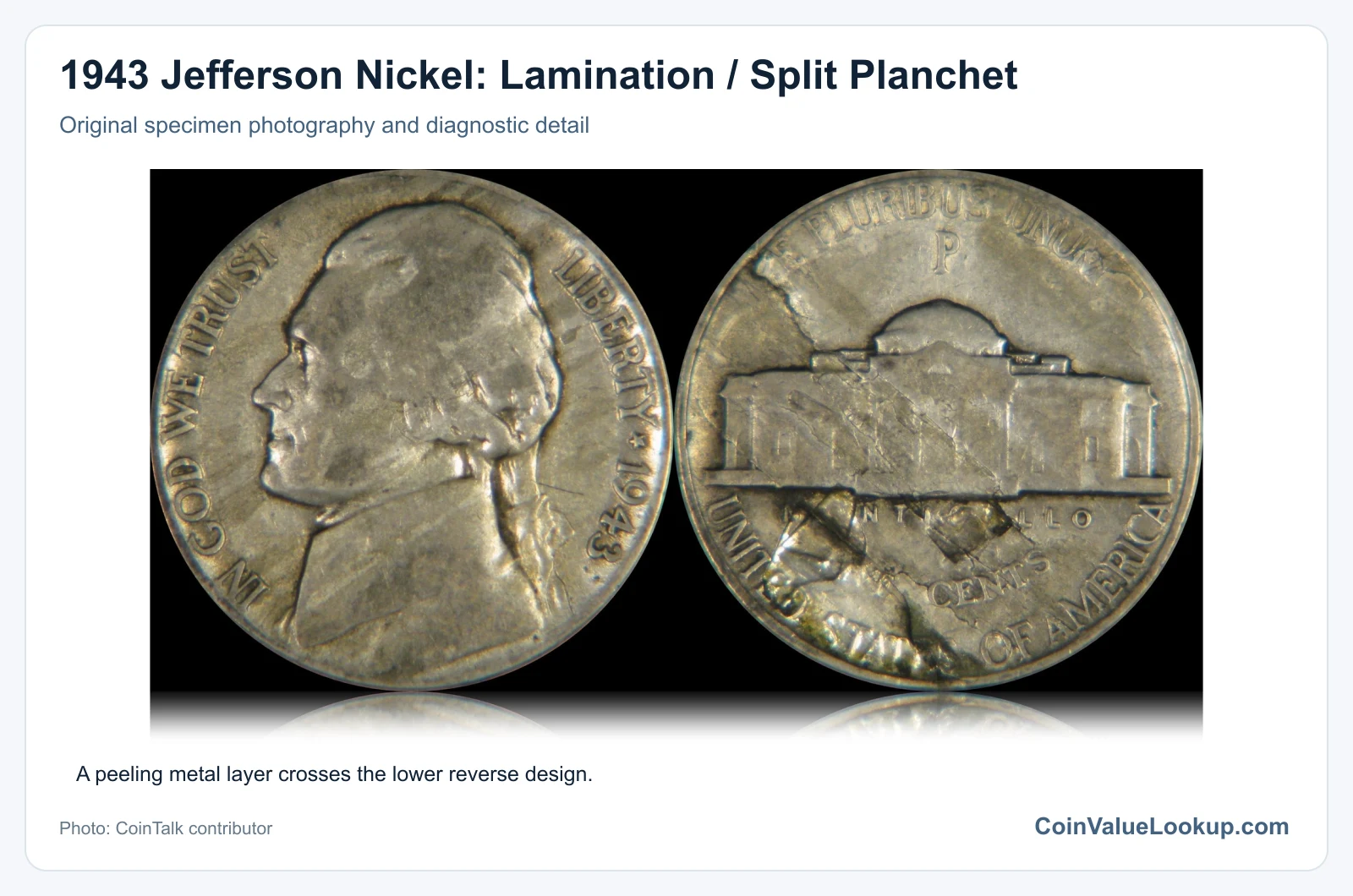
A retained lamination flap on a 1943 nickel appears as peeling metal or a raised flap where the alloy has separated internally. Photograph the affected face and the coin's edge together, since the separation is often visible in profile.
This is a planchet defect caused during the metal-rolling process, not something done after the coin left the mint. Scraping, corrosion, or deliberate cutting can look similar at first glance.
A genuine lamination shows a natural separation within the metal layers and typically follows the contour of the planchet rather than cutting sharply across the design.
Value depends on the size and location of the flaw, overall condition, and whether the flap is fully retained. Individual assessment by a grading service is the surest route to confirming the error.