1985 Lincoln Penny Coin Value: How Much Is It Worth?
Most 1985 Lincoln pennies you find in pocket change are worth face value. In higher uncirculated grades, a USA Coin Book guide estimate places the no-mintmark and Denver issues around $0.36 at MS65.
Proof versions struck in San Francisco carry a guide estimate near $6.25 at PR65. The real action is in authenticated mint errors, which are assessed individually based on the specific error, condition and severity.
Fast Way to Identify Your 1985 Lincoln Penny
Want a quick read on your 1985 penny? Upload clear photos of both the front and back of your coin for a preliminary identification.
Good lighting and a steady shot help distinguish mintmarks, surface conditions and potential errors. This is not a substitute for professional authentication, but it gets you pointed in the right direction.
1985 Penny Value
Upload both sides of your 1985 Lincoln Penny.
Front Obverse
Upload photo
Back Reverse
Upload photo
Which 1985 Lincoln Penny Versions Are Worth Money?
- Uncirculated examples with full original red (RD) copper color and clean surfaces command the strongest premiums among normal strikes.
- Authenticated striking errors like unplated blanks, bonded pairs, and significant off-center strikes can reach well into the hundreds of dollars at auction.
- A gray or silver-toned penny may be an unplated zinc error, but only if authenticated; stripped or corroded coins are not mint errors.
Step 1: Identify Your 1985 Lincoln Penny Mint Mark and Version
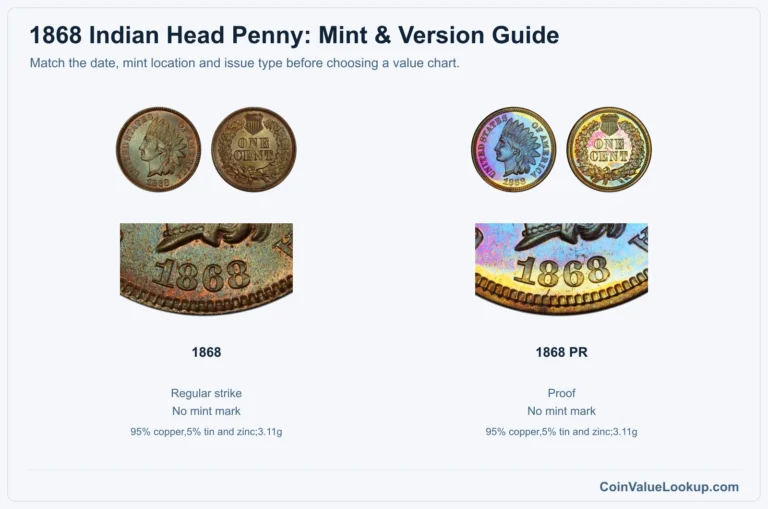
The 1985 Lincoln cent has the familiar Lincoln portrait on the obverse and the Lincoln Memorial on the reverse, with a plain (smooth) edge. The standard composition is copper-plated zinc, weighing about 2.50 grams.
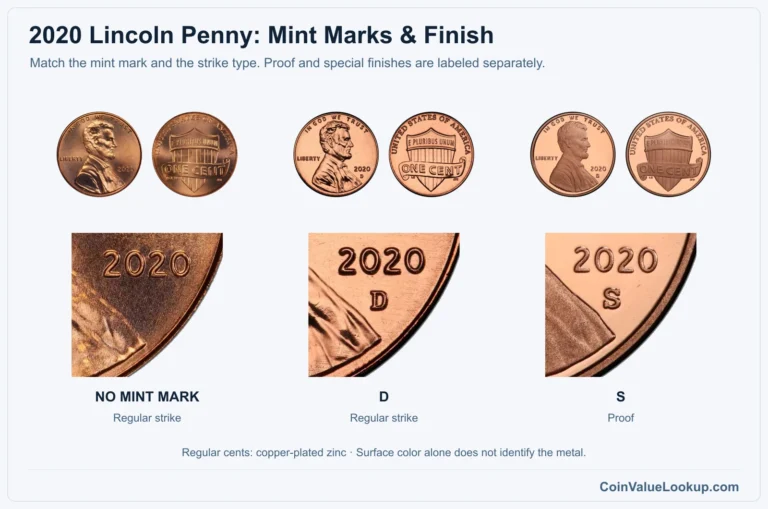
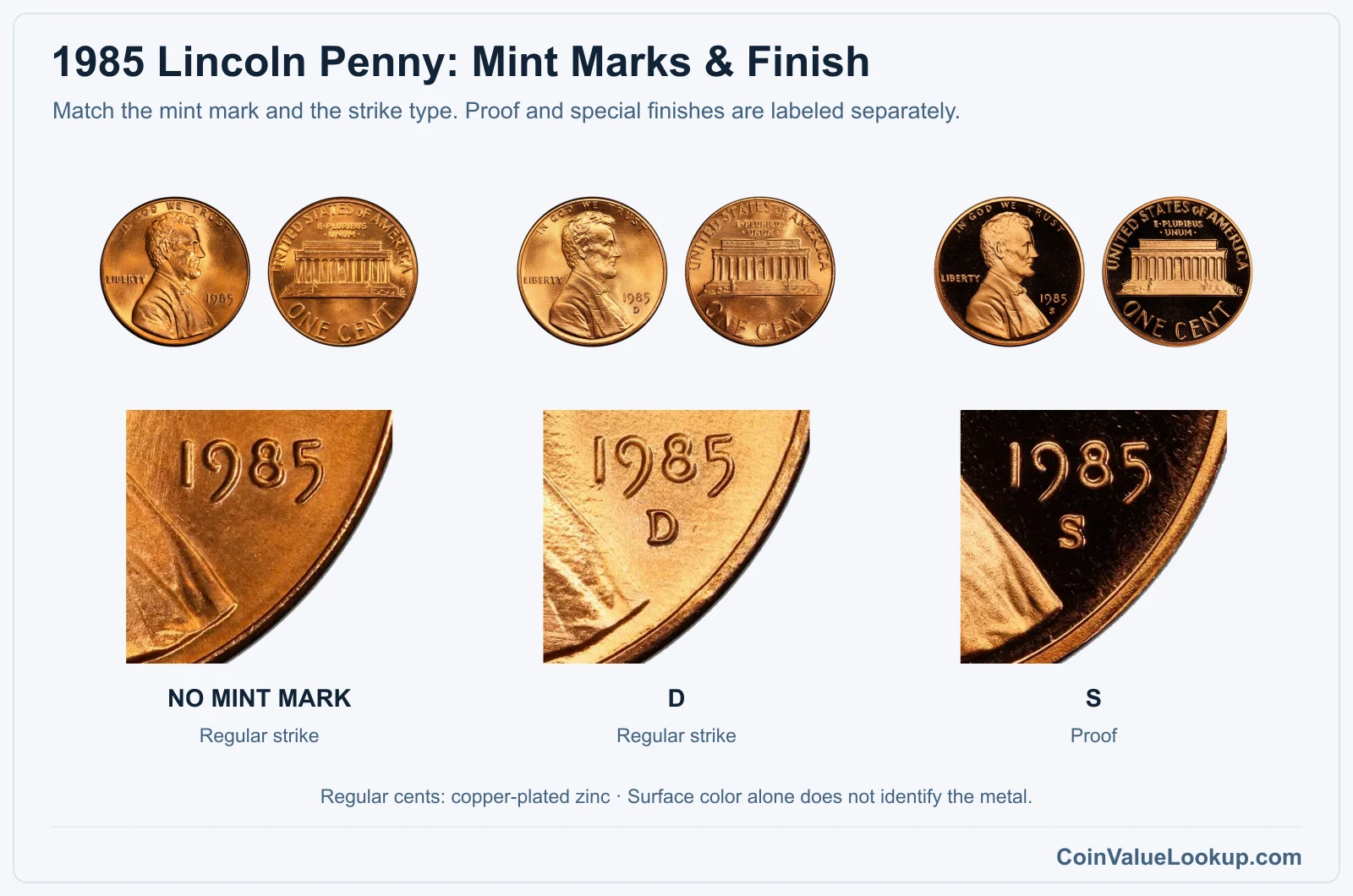
Three catalog branches exist for this year. The no-mintmark version and the D (Denver) mintmark are business strikes meant for circulation.
The S (San Francisco) version is a collector proof only; no normal S-mint circulation pennies were made in 1985.
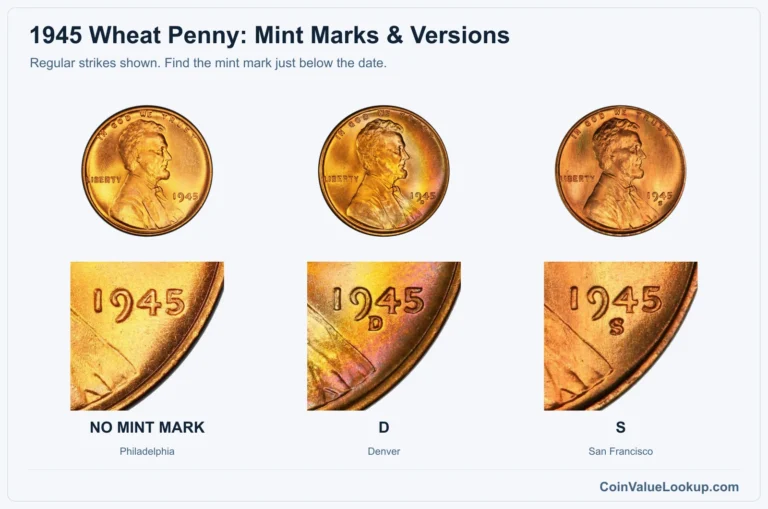
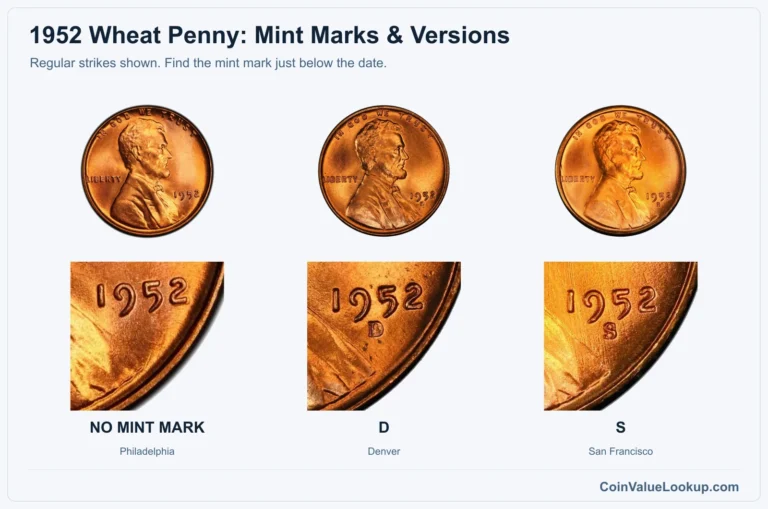
Check below the date on the obverse for the mintmark. A tiny "D" means Denver.
No letter at all is the Philadelphia-attributed branch. An "S" means you have a proof coin, which should show mirror-like fields rather than the satiny luster of a business strike.
Copper-color designations like BN (brown), RB (red-brown) and RD (red) describe the surface toning, not different metals. Similarly, Cameo (CAM) and Deep Cameo (DCAM) describe the contrast on proofs, not a separate alloy.
A no-mintmark penny does not automatically confirm which facility struck it; it is simply the catalog attribution for coins without a visible mintmark.
Step 2: Check Your 1985 Lincoln Penny Grade
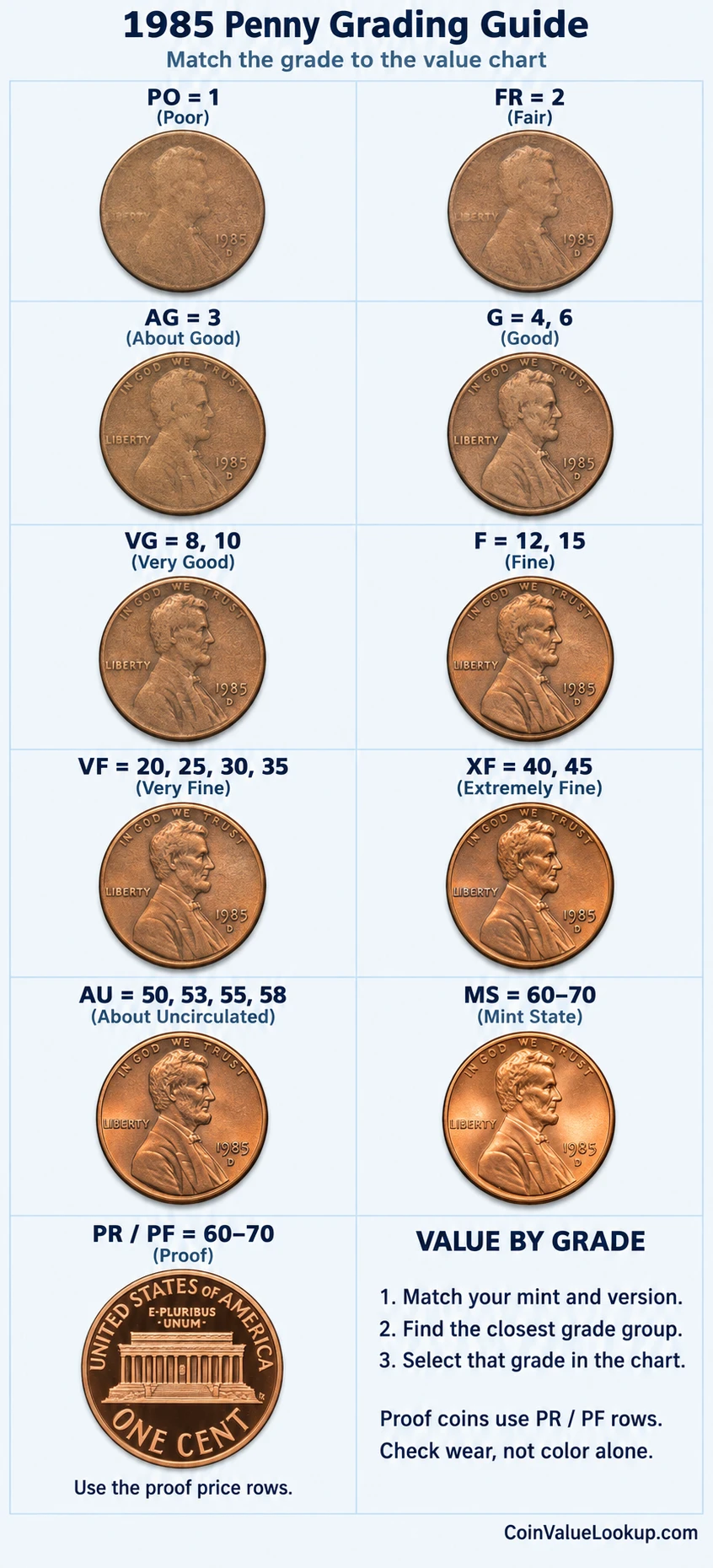
Start by examining Lincoln's cheekbone, jaw and the hair detail above his ear. These are the first places to lose sharpness.
On the reverse, check the Memorial roof and columns for flatness.
The difference between About Uncirculated (AU) and Mint State (MS) comes down to luster and high-point wear. If the original mint luster is broken on those high points, even slightly, the coin grades AU regardless of how bright it looks.
Color alone does not determine grade.
For proofs, look for hairlines from handling or cleaning, spots, and any plating damage. Never clean a copper-surfaced coin or attempt to remove plating; both actions destroy collector value.
Use the comparison image to match your coin's wear level against known grade examples.
Step 3: Check 1985 Lincoln Penny Value by Mint and Version
1985 Lincoln Penny
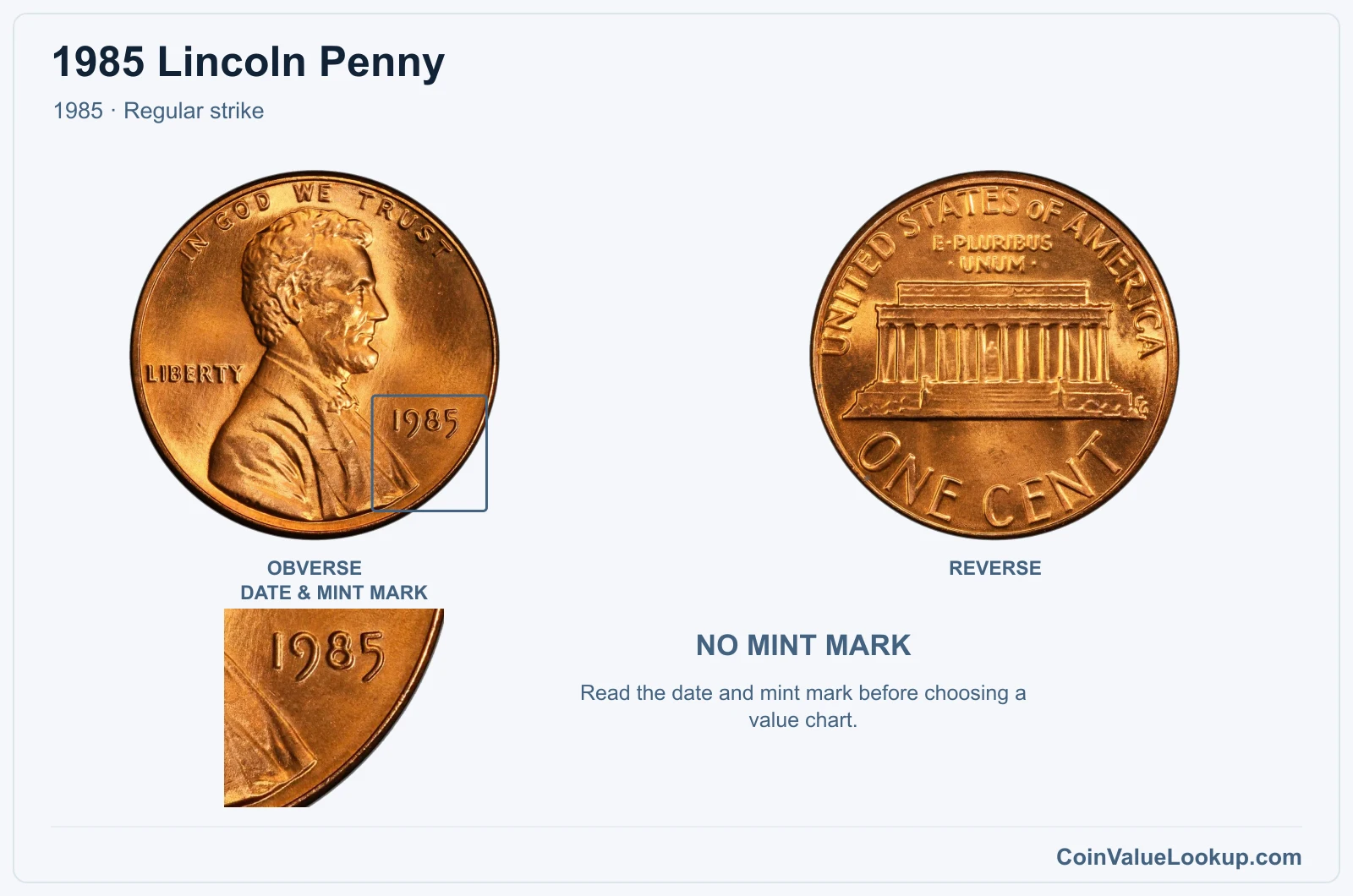
The 1985 no-mintmark penny is the Philadelphia-attributed business strike, made on a copper-plated zinc planchet at 2.50 grams. Billions were produced, so circulated examples are common.
A USA Coin Book guide estimate puts an MS65 example at about $0.36.
What separates a valuable one from a spender is surface preservation and copper color. Full red (RD) luster with minimal marks is the target.
Don't confuse a proof's mirrored fields with a higher Mint State grade; they're different manufacturing processes entirely.
| Range | Grade | Price | Auction Records | Appraisal |
|---|---|---|---|---|
| PO | PO 1 | — | Coin Identifier | |
| FR | FR 2 | — | Coin Identifier | |
| AG | AG 3 | — | Coin Identifier | |
| G | G 4 | — | Coin Identifier | |
| G 6 | — | Coin Identifier | ||
| VG | VG 8 | — | Coin Identifier | |
| VG 10 | — | Coin Identifier | ||
| F | F 12 | — | Coin Identifier | |
| F 15 | — | Coin Identifier | ||
| VF | VF 20 | — | Coin Identifier | |
| VF 25 | — | Coin Identifier | ||
| VF 30 | — | Coin Identifier | ||
| VF 35 | — | Coin Identifier | ||
| XF | XF 40 | — | Coin Identifier | |
| XF 45 | — | Coin Identifier | ||
| AU | AU 50 | — | Coin Identifier | |
| AU 53 | — | Coin Identifier | ||
| AU 55 | — | Coin Identifier | ||
| AU 58 | — | Coin Identifier | ||
| MS | MS 60 | — | Coin Identifier | |
| MS 61 | — | Coin Identifier | ||
| MS 62 | — | Coin Identifier | ||
| MS 63 | — | Coin Identifier | ||
| MS 64 | Coin Identifier | |||
| MS 65 | — | Coin Identifier | ||
| MS 66 | Coin Identifier | |||
| MS 67 | Coin Identifier | |||
| MS 68 | Coin Identifier | |||
| MS 69 | — | Coin Identifier | ||
| MS 70 | — | — | — |
1985 Lincoln Penny — D
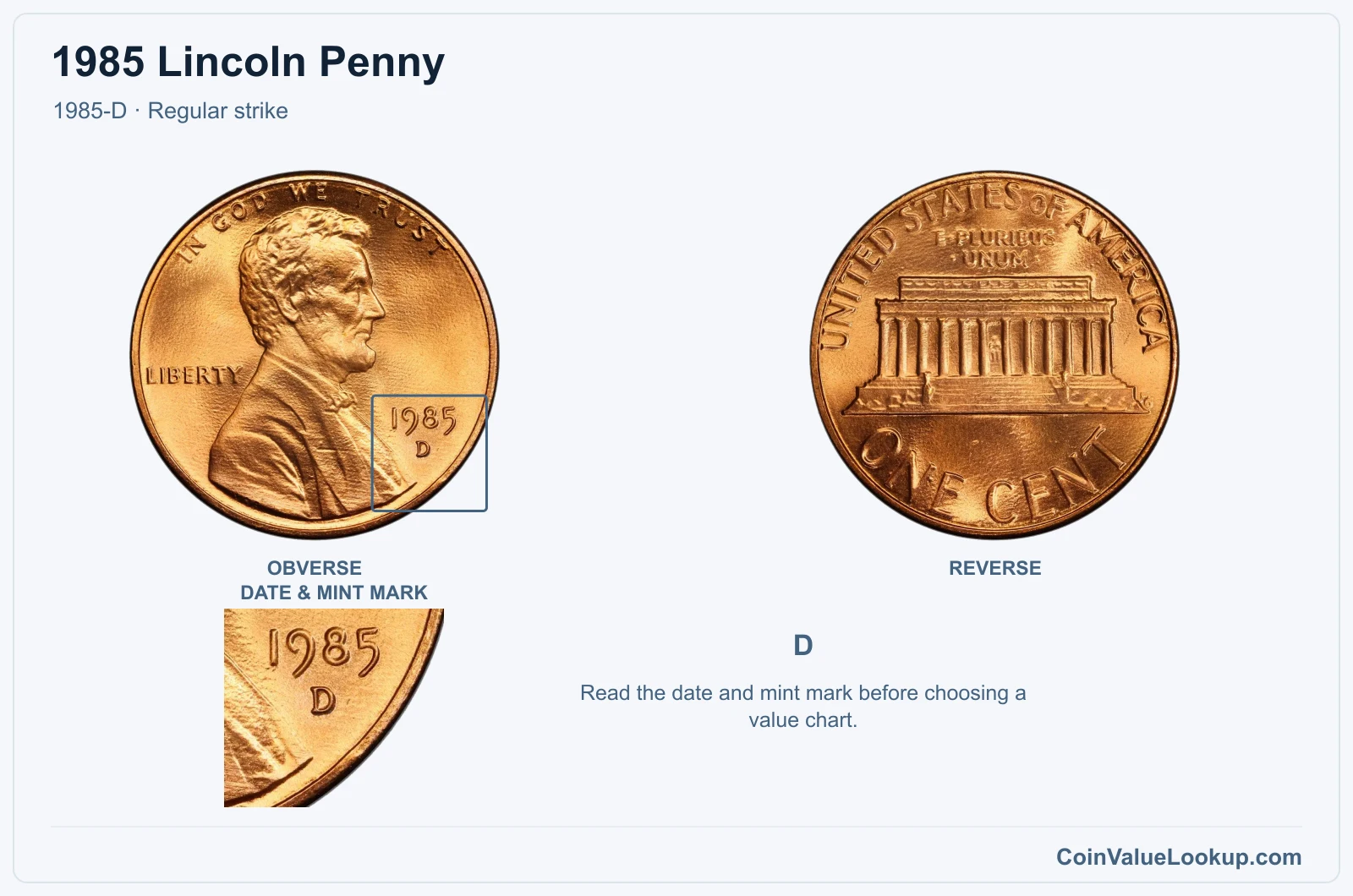
The 1985-D carries a small "D" mintmark below the date, identifying it as a Denver product. Same copper-plated zinc composition, same 2.50-gram weight.
The USA Coin Book guide estimate at MS65 is about $0.36.
Denver cents from this year are plentiful. As with the no-mintmark version, condition and original copper color drive any premium.
Look for clean fields and sharp hair detail above Lincoln's ear. A well-preserved MS65 or higher with red surfaces is the sweet spot for this date.
| Range | Grade | Price | Auction Records | Appraisal |
|---|---|---|---|---|
| PO | PO 1 | — | Coin Identifier | |
| FR | FR 2 | — | Coin Identifier | |
| AG | AG 3 | — | Coin Identifier | |
| G | G 4 | — | Coin Identifier | |
| G 6 | — | Coin Identifier | ||
| VG | VG 8 | — | Coin Identifier | |
| VG 10 | — | Coin Identifier | ||
| F | F 12 | — | Coin Identifier | |
| F 15 | — | Coin Identifier | ||
| VF | VF 20 | — | Coin Identifier | |
| VF 25 | — | Coin Identifier | ||
| VF 30 | — | Coin Identifier | ||
| VF 35 | — | Coin Identifier | ||
| XF | XF 40 | — | Coin Identifier | |
| XF 45 | — | Coin Identifier | ||
| AU | AU 50 | — | Coin Identifier | |
| AU 53 | — | Coin Identifier | ||
| AU 55 | — | Coin Identifier | ||
| AU 58 | — | Coin Identifier | ||
| MS | MS 60 | — | Coin Identifier | |
| MS 61 | — | Coin Identifier | ||
| MS 62 | — | Coin Identifier | ||
| MS 63 | — | Coin Identifier | ||
| MS 64 | — | Coin Identifier | ||
| MS 65 | Coin Identifier | |||
| MS 66 | Coin Identifier | |||
| MS 67 | Coin Identifier | |||
| MS 68 | Coin Identifier | |||
| MS 69 | Coin Identifier | |||
| MS 70 | — | — | — |
1985 Lincoln Penny — S PR
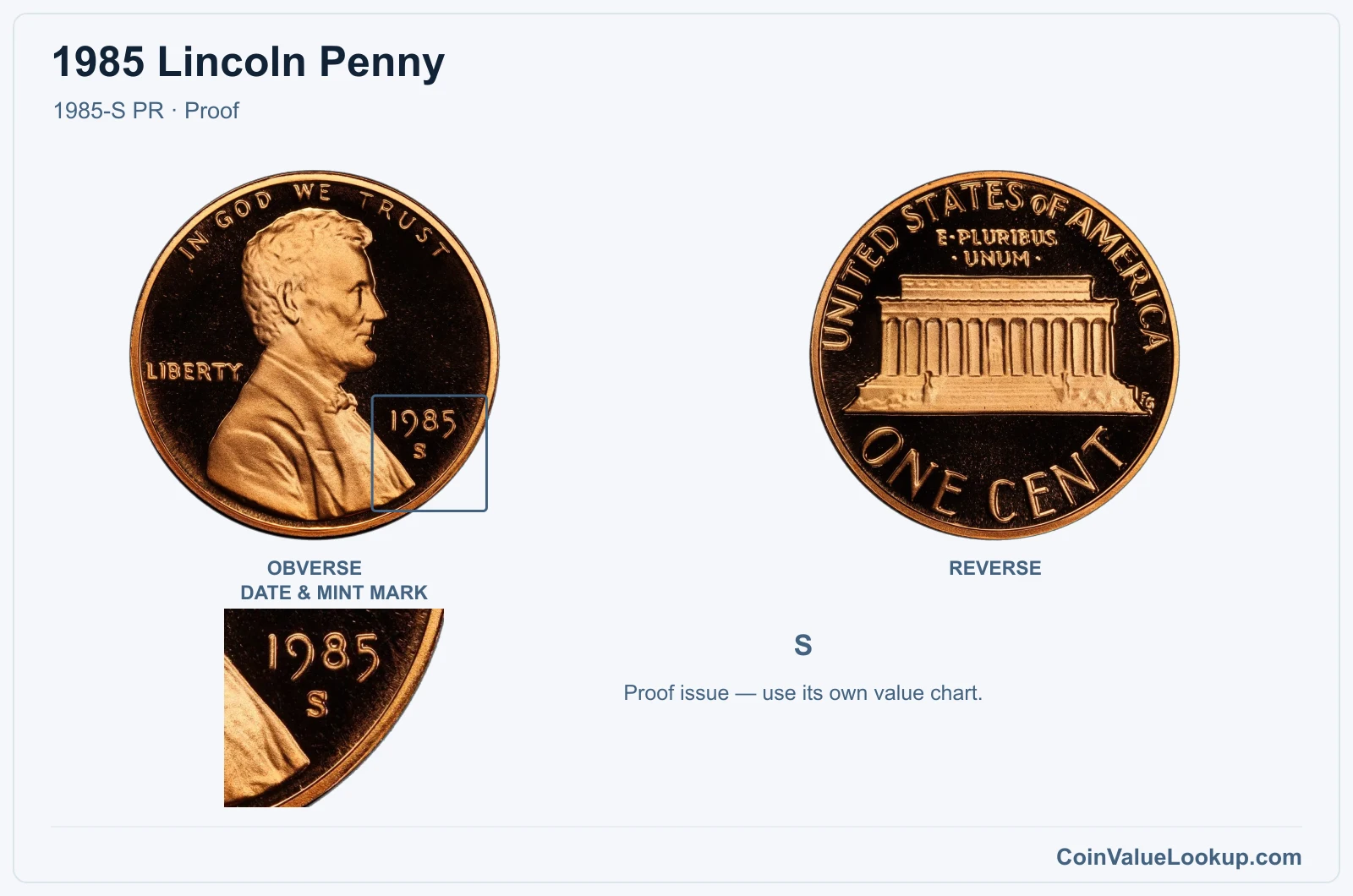
The 1985-S proof was struck at San Francisco exclusively for collector sets. These coins display mirror-like fields and sharp design relief.
The USA Coin Book guide estimate at PR65 is approximately $6.25.
Proofs with strong contrast between frosted devices and reflective fields are described as Cameo or Deep Cameo; those terms refer to the visual contrast, not a different metal. Hairlines from mishandling are the most common grade limiter.
Keep them in their original capsule whenever possible.
Coin Value Lookup is a handy starting point if you want to look up guide values for other years and denominations in the Lincoln series.
| Range | Grade | Price | Auction Records | Appraisal |
|---|---|---|---|---|
| PR | PR 1 | — | Coin Identifier | |
| PR 2 | — | Coin Identifier | ||
| PR 3 | — | Coin Identifier | ||
| PR 4 | — | Coin Identifier | ||
| PR 6 | — | Coin Identifier | ||
| PR 8 | — | Coin Identifier | ||
| PR 10 | — | Coin Identifier | ||
| PR 12 | — | Coin Identifier | ||
| PR 15 | — | Coin Identifier | ||
| PR 20 | — | Coin Identifier | ||
| PR 25 | — | Coin Identifier | ||
| PR 30 | — | Coin Identifier | ||
| PR 35 | — | Coin Identifier | ||
| PR 40 | — | Coin Identifier | ||
| PR 45 | — | Coin Identifier | ||
| PR 50 | — | Coin Identifier | ||
| PR 53 | — | Coin Identifier | ||
| PR 55 | — | Coin Identifier | ||
| PR 58 | — | Coin Identifier | ||
| PR 60 | Coin Identifier | |||
| PR 61 | — | Coin Identifier | ||
| PR 62 | — | Coin Identifier | ||
| PR 63 | — | Coin Identifier | ||
| PR 64 | — | Coin Identifier | ||
| PR 65 | — | Coin Identifier | ||
| PR 66 | — | Coin Identifier | ||
| PR 67 | — | Coin Identifier | ||
| PR 68 | Coin Identifier | |||
| PR 69 | Coin Identifier | |||
| PR 70 | Coin Identifier |
1985 Lincoln Penny Error List
1. 1985 Lincoln Penny — Unplated Zinc Blank
An unplated 1985-D cent was struck on a zinc planchet that never received its copper coating. The result is a uniformly gray coin with the texture and detail of a normal strike, just without any copper color at all.
Authentication matters here. Acid-stripped coins, corroded pennies and silver-plated novelties can all look gray.
The difference is that a genuine unplated error retains full struck detail and shows no etching, pitting or residue from chemical removal. Weight should be slightly below the normal 2.50 grams since the copper layer is absent.
An ICG MS60 example of this error sold for $80.50 at auction in August 2004. That is a single recorded sale, not a guaranteed market price.
Value depends on authentication, surface preservation and grade.
2. 1985 Lincoln Penny — Two-Planchet Bonded Pair
A two-planchet bonded pair occurs when two blanks feed into the press together and fuse during striking. The 1985 no-mintmark bonded die-cap pair weighs about 5.0 grams, roughly double a single cent, confirming two planchets.
Look for nested, cap-like rims and fused surfaces. Both exterior faces should show struck design elements.
Do not attempt to separate the two coins; they are valued as a complete pair.
A genuine bonded pair looks nothing like two pennies glued together. The fusion is metallic, with distorted rims that flow into each other.
An NGC MS68 Red pair sold for $881.25 in February 2014, but that is one auction result for one specific pair. Condition and completeness determine individual value.
3. 1985 Lincoln Penny — Off-Center Strike
A 75% off-center 1985 no-mintmark cent exists with only a small portion of the design impressed on the planchet. One example graded PCGS MS64 Red has been documented.
Most of the blank remains unstruck, with the partial impression showing enough of the date to attribute the year.
For an off-center error to have meaningful collector value, the date must be readable. An undated blank sliver could be from any year and is far less desirable.
Also verify that the missing area is genuinely unstruck metal, not a coin that was cut or ground down after leaving the mint.
No adopted price range exists for this error. Value depends on the percentage off center, date visibility, authenticated grade and overall condition.
4. 1985 Lincoln Penny — Doubled Die Obverse
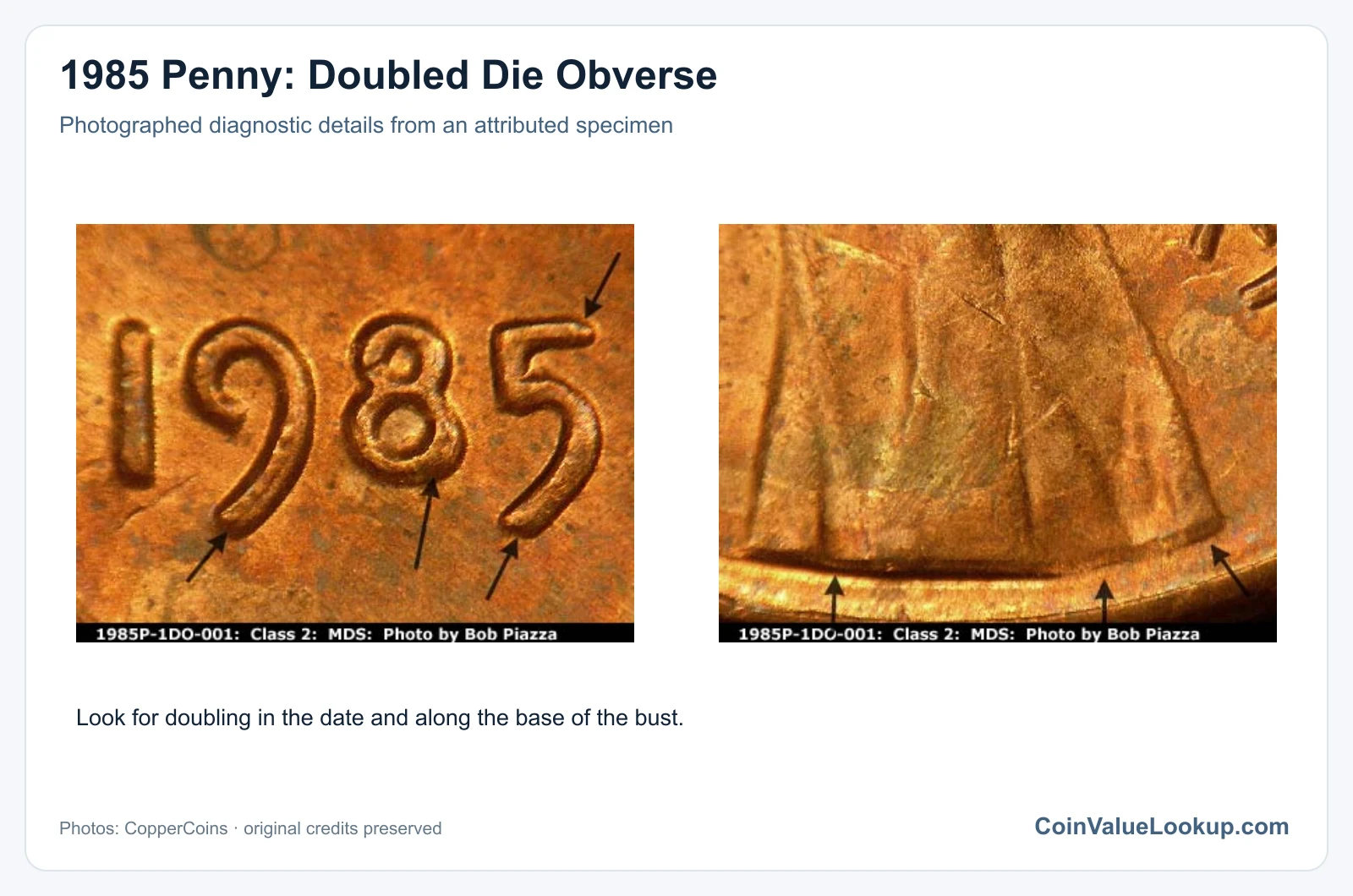
Doubled die obverse errors have been reported for the 1985 cent. This type of error shows consistent doubling on obverse lettering or design elements, visible as separation or notching when compared to a normal coin under the same lighting.
The key word is consistent. True hub doubling repeats in the same direction across affected design elements.
Machine doubling, by contrast, tends to produce a flat, shelf-like distortion and is far less valuable. Reflections and worn die contours can also mimic doubling to the untrained eye.
No specific price range is adopted for this category. Value depends on the visibility of the doubling, the specific die involved, and the coin's overall condition.
Professional authentication is strongly recommended before assuming you have a doubled die.
5. 1985 Lincoln Penny — Repunched Mintmark
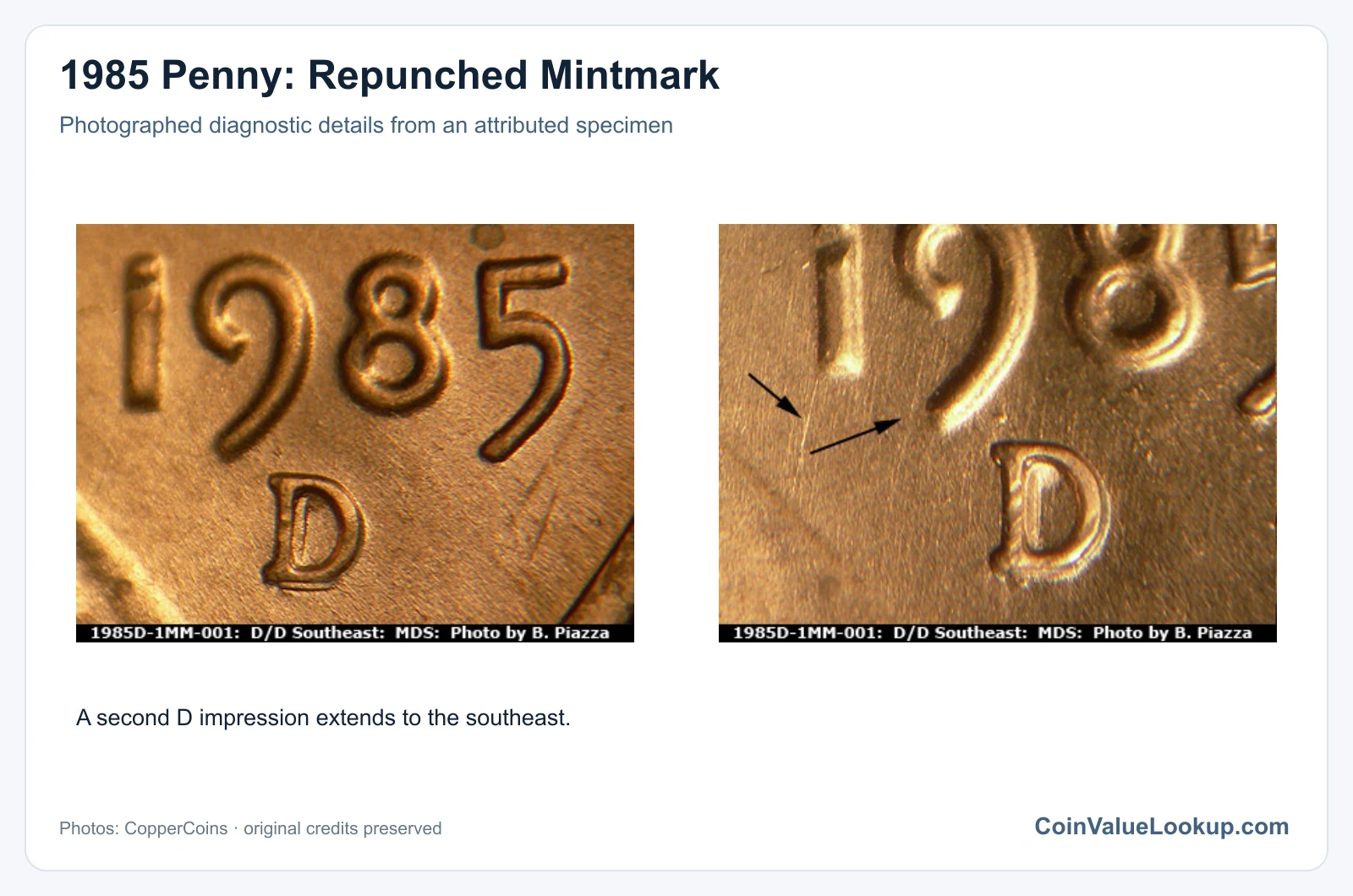
Repunched mintmark errors have been reported for the 1985 cent. A repunched mintmark shows traces of a previous punch position near or under the final mintmark, visible under magnification.
To check, compare your mintmark closely against a normal example at the same magnification. Look for a ghost image, extra serif or partial second impression near the main letter.
Die chips, corrosion around the mintmark or machine doubling can create similar-looking artifacts but lack the distinct second-punch character.
No adopted price range exists. The value of a repunched mintmark depends on how visible the repunching is, the coin's grade and surface quality, and whether a professional grading service confirms the attribution.
6. 1985 Lincoln Penny — Broadstrike
Broadstrike errors have been reported for the 1985 cent. A broadstrike happens when the coin is struck without the retaining collar that normally forms the edge and controls diameter.
The result is a coin that spreads outward, appearing wider than normal with a missing or distorted rim.
Check the edge profile carefully. A genuine broadstrike has metal flow that extends beyond the normal diameter, and the design may appear slightly stretched.
A coin that was simply flattened after minting, or one struck off center, is a different situation entirely.
No specific price range is adopted. Value depends on how dramatic the spread is, the preservation of design detail, and authenticated grade.
7. 1985 Lincoln Penny — BIE Die Break
BIE die break errors have been reported for the 1985 cent. The name refers to a raised vertical line or blob that appears between the letters B and E in LIBERTY, caused by a crack or chip in the die.
These are fun to hunt for because they are visible without heavy magnification. The raised area should be part of the coin's metal, not dirt or debris sitting on the surface.
A scratch across the letters or a glued fragment will not have the same smooth, raised character as a genuine die break.
No adopted price is available. BIE breaks are a popular collecting niche, but value varies with the size and clarity of the break, overall coin condition, and collector demand for the specific die.
8. 1985 Lincoln Penny — Clipped Planchet
Clipped planchet errors have been reported for the 1985 cent. A clip occurs when the blank is punched from strip metal that overlaps a previously punched hole, leaving a curved missing section.
Straight clips and ragged clips also exist but are less common.
Genuine clips often show a characteristic weakness in the design on the opposite side of the coin from the missing area, caused by incomplete metal flow during striking. The edge at the clip should have a natural, unstruck texture rather than a filed or cut appearance.
No adopted price range exists. Value depends on clip size, type, whether the date remains visible, and the coin's authenticated condition.
A tiny nick on the rim from post-mint damage is not a clip.
9. 1985 Lincoln Penny — Doubled Die Reverse
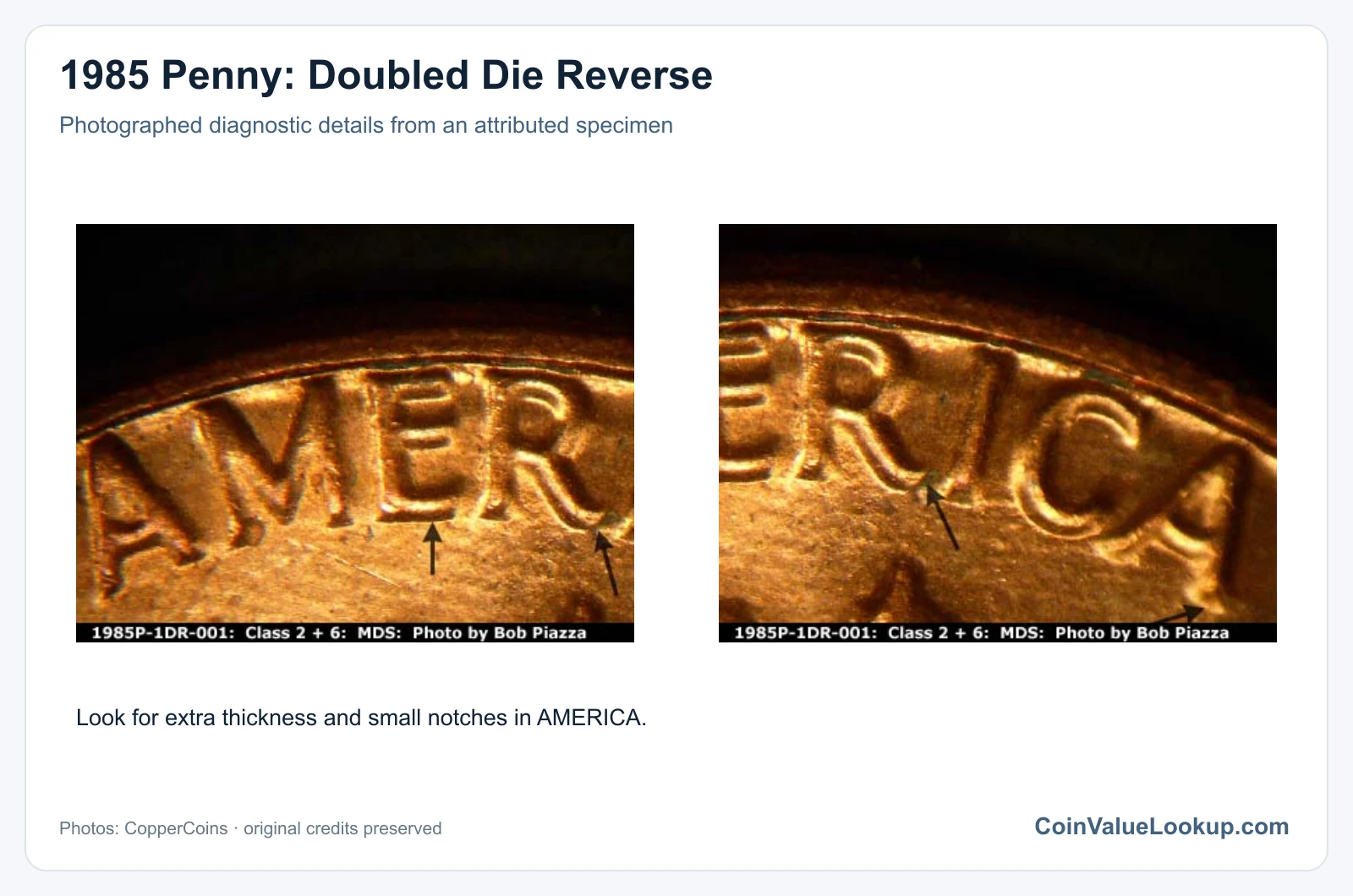
Doubled die reverse errors have been reported for the 1985 cent. This is the reverse counterpart of the doubled die obverse: look for consistent doubling on the Memorial columns, lettering or other reverse design elements.
Compare your coin's reverse to a normal example under matching magnification and lighting. True doubling shows separation or notching that repeats in the same direction across multiple design elements.
Machine doubling creates a flat shelf and is mechanically different. Random nicks or corrosion should not be confused with die doubling either.
No specific price range is adopted for this error. Value depends on the visibility and extent of the doubling, the authenticated die variety, and the coin's overall grade and surface condition.