1962 Franklin Half Dollar Coin Value: How Much Is It Worth?
The 1962 Franklin Half Dollar is a 90% silver coin that remains popular with collectors and silver stackers alike. Guide estimates for this date range from about $32.00 in well-worn grades up to around $118.00 in gem uncirculated condition, depending on the mint, finish, and overall preservation.
These are guide anchors from USA Coin Book, not guaranteed selling prices or current silver-melt quotes.
Mint origin, surface condition, and strike quality all play a role in what your particular coin is worth. Cleaned or damaged pieces trade well below problem-free examples at the same grade.
Full Bell Lines pieces and proof issues carry their own premiums.
Fast Way to Identify Your 1962 Franklin Half Dollar
The quickest way to start figuring out what you have is to upload clear photos of both sides of your coin. A front and back image lets us provide a preliminary identification of your mint, version, and approximate condition.
Snap the photos in even lighting, avoid glare, and try to keep the coin flat and in focus. This is not a substitute for professional authentication or certification, but it gets the conversation started.
1962 Franklin Half Dollar Value
Upload both sides of your 1962 Franklin Half Dollar.
Front Obverse
Upload photo
Back Reverse
Upload photo
Which 1962 Franklin Half Dollar Versions Are Worth Money?
- 1962 (Philadelphia) business strike: Guide values from $32.00 in G4 to $118.00 in MS65. Higher-grade examples with Full Bell Lines detail command additional premiums.
- 1962-D (Denver) business strike: Same guide range, $32.00 in G4 to $118.00 in MS65. Look for the D mintmark above the Liberty Bell on the reverse.
- 1962 PR (proof): Guide value of $48.00 at PR65. Proofs have mirrored fields and sharp devices; cameo contrast pieces may trade differently.
- Error varieties such as the Bugs Bunny die clash and Doubled Die Obverse have been reported for this date and are worth checking with magnification.
Step 1: Identify Your 1962 Franklin Half Dollar Mint Mark and Version
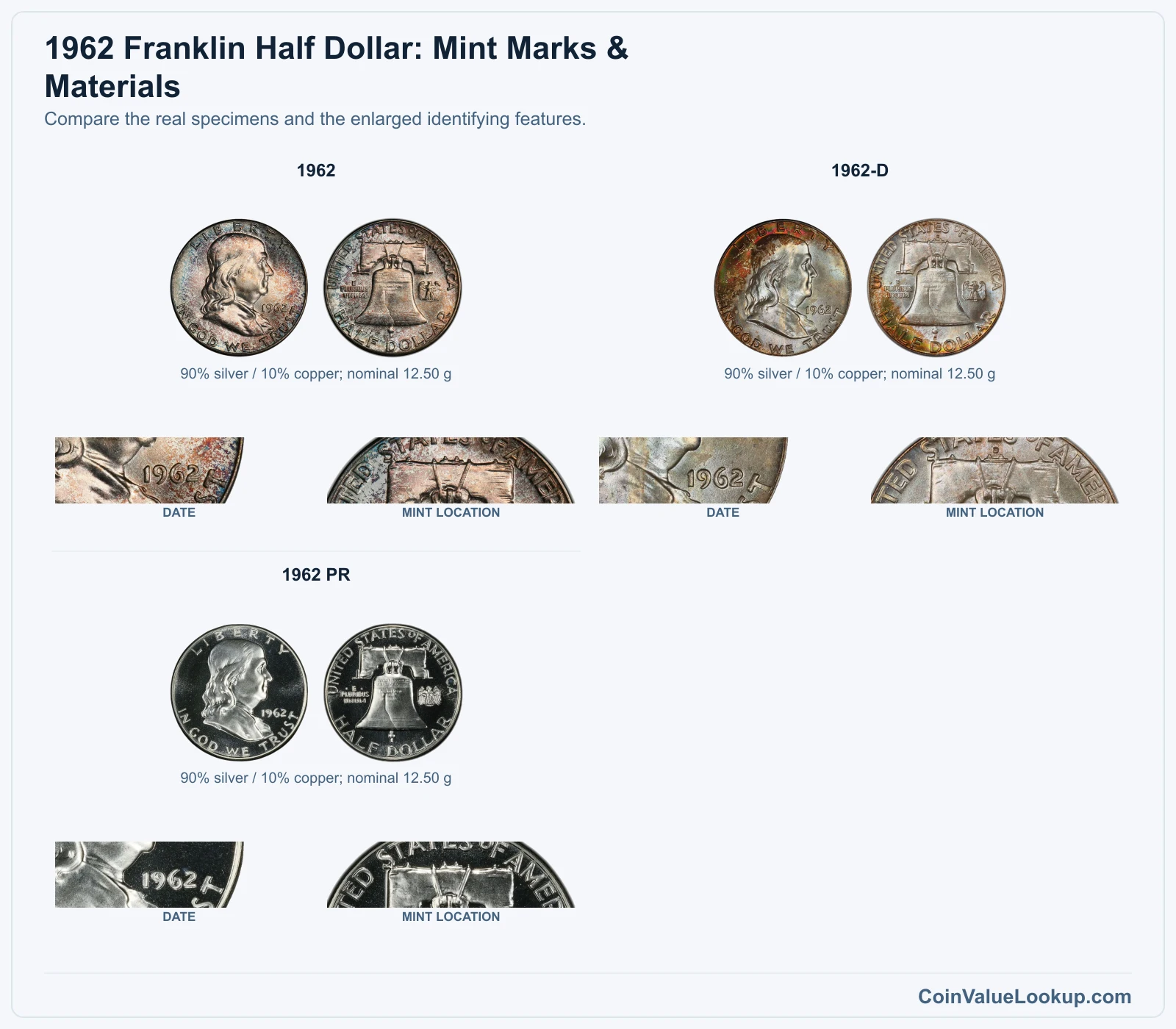
All 1962 Franklin Half Dollars are struck in 90% silver and 10% copper, weighing a nominal 12.50 grams. Toning or patina does not change that alloy.
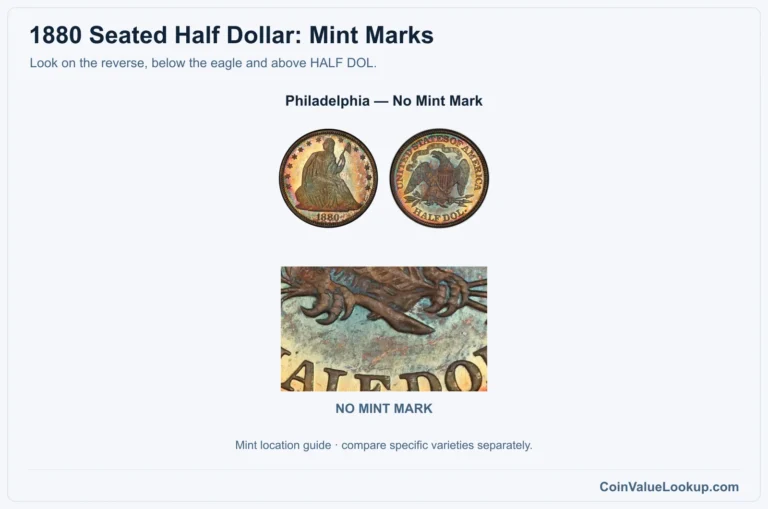
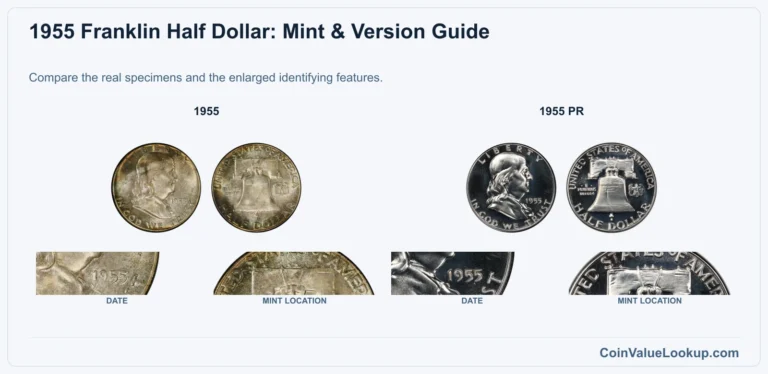
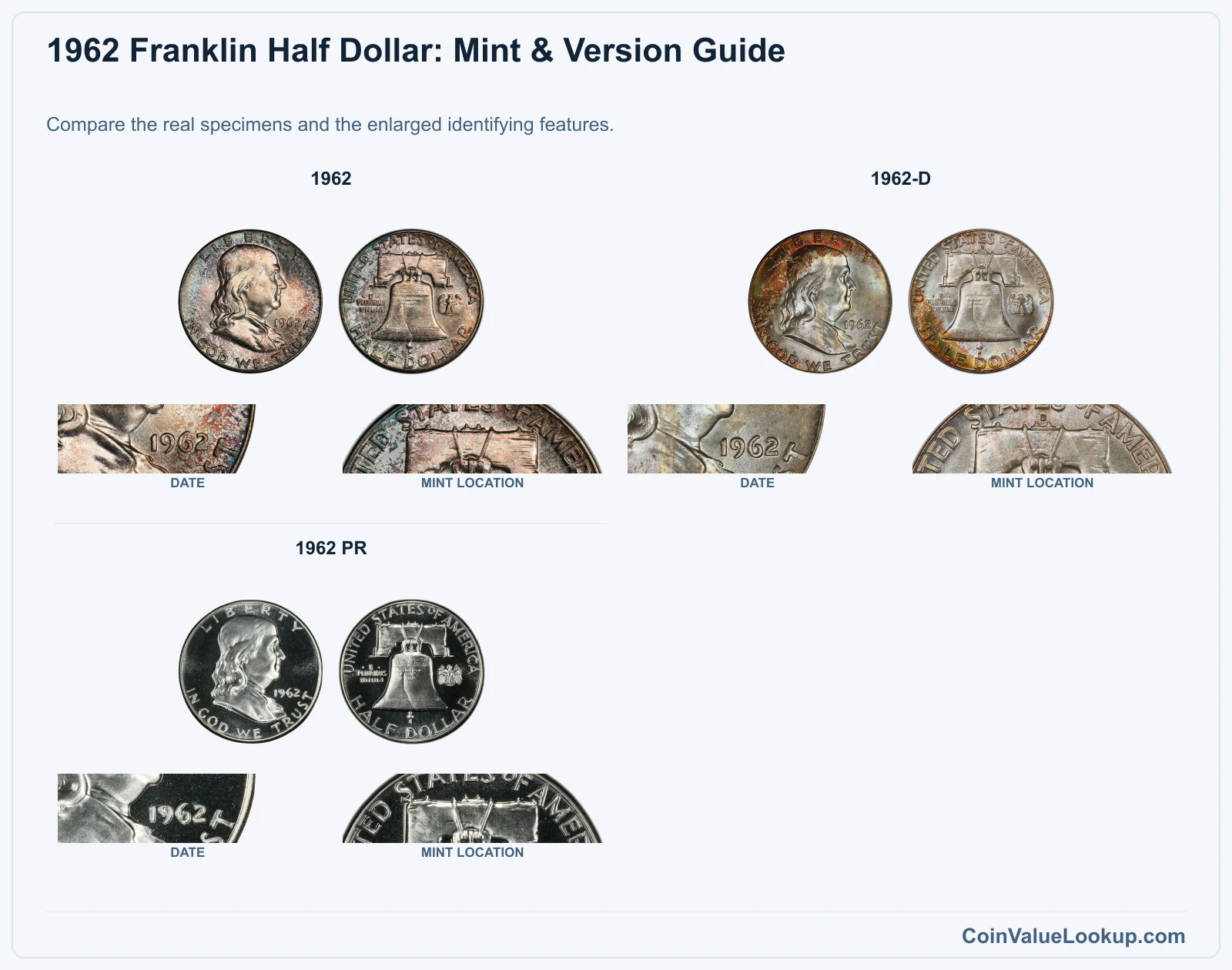
Flip the coin to the reverse and look above the Liberty Bell, just below the words E PLURIBUS UNUM. If there is no mintmark, the coin was struck in Philadelphia.
A small "D" means Denver.
This year produced three distinct branches: the 1962 Philadelphia business strike, the 1962-D Denver business strike, and the 1962 Philadelphia proof. Proofs show mirrored fields and razor-sharp devices; a polished circulation strike is not a proof, no matter how shiny it looks.
If you are browsing other dates and denominations, Coin Value Lookup is a handy place to look up coin guides across the entire U.S. series. It can help you quickly narrow down what else might be sitting in that cigar box.
Step 2: Check Your 1962 Franklin Half Dollar Grade
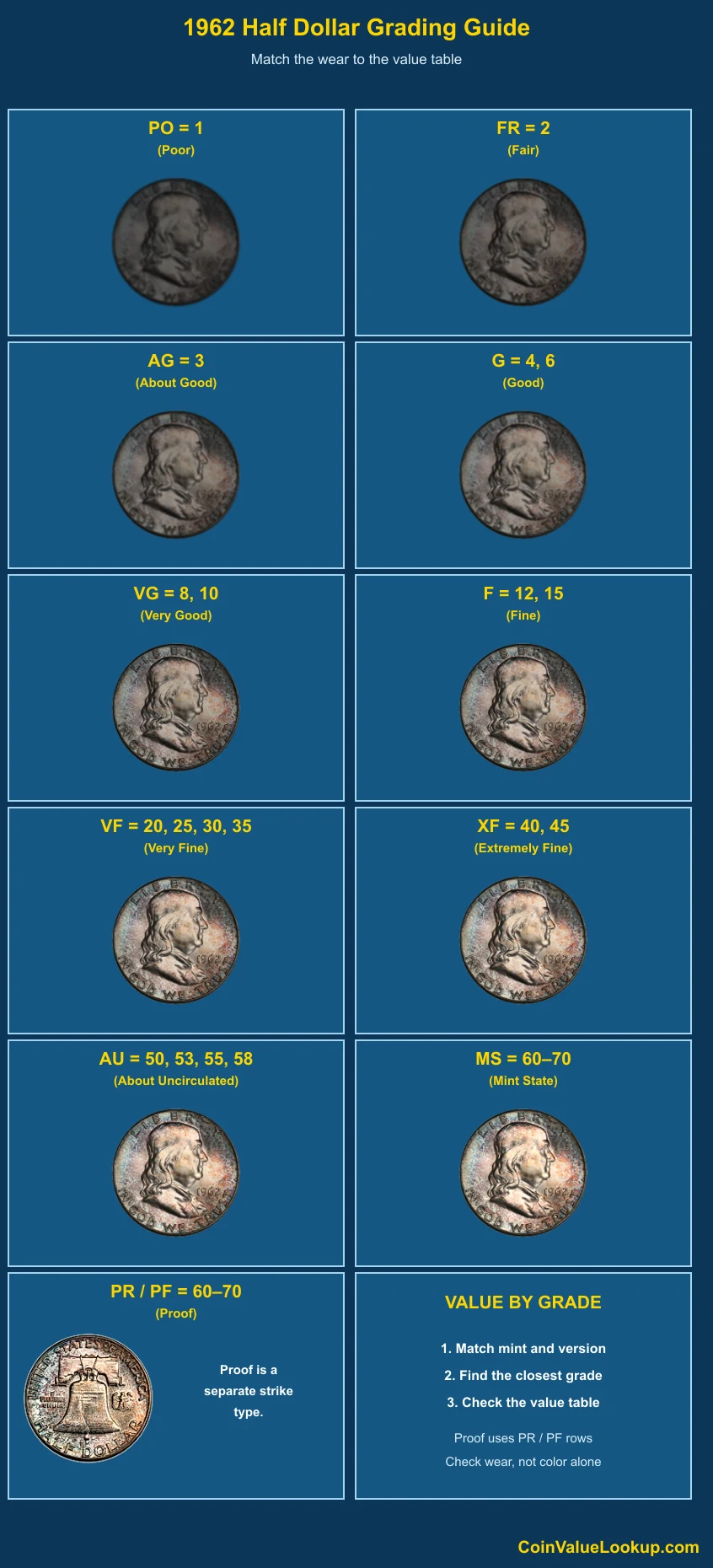
Start with Franklin's cheek and the hair detail behind his ear. On a well-circulated coin, the cheek is flat and the hair strands merge into a smooth blob.
A coin with only light wear will still show individual hair lines and a defined shoulder.
On the reverse, check the lettering around the Liberty Bell and the lower bell lines. The comparison image for this type shows how these details fade as wear progresses from About Uncirculated down through lower grades.
Contact marks are different from wear. Marks are random dings; wear is directional smoothing on the high points.
Both affect grade, but mixing them up leads to bad self-assessments.
Full Bell Lines is a strike-detail designation, not a grade. A coin can be MS65 without FBL, or MS63 with FBL.
Proof surfaces are graded separately, looking for hairlines, haze, and cameo contrast rather than circulation wear.
Step 3: Check 1962 Franklin Half Dollar Value by Mint and Version
1962 Franklin Half Dollar
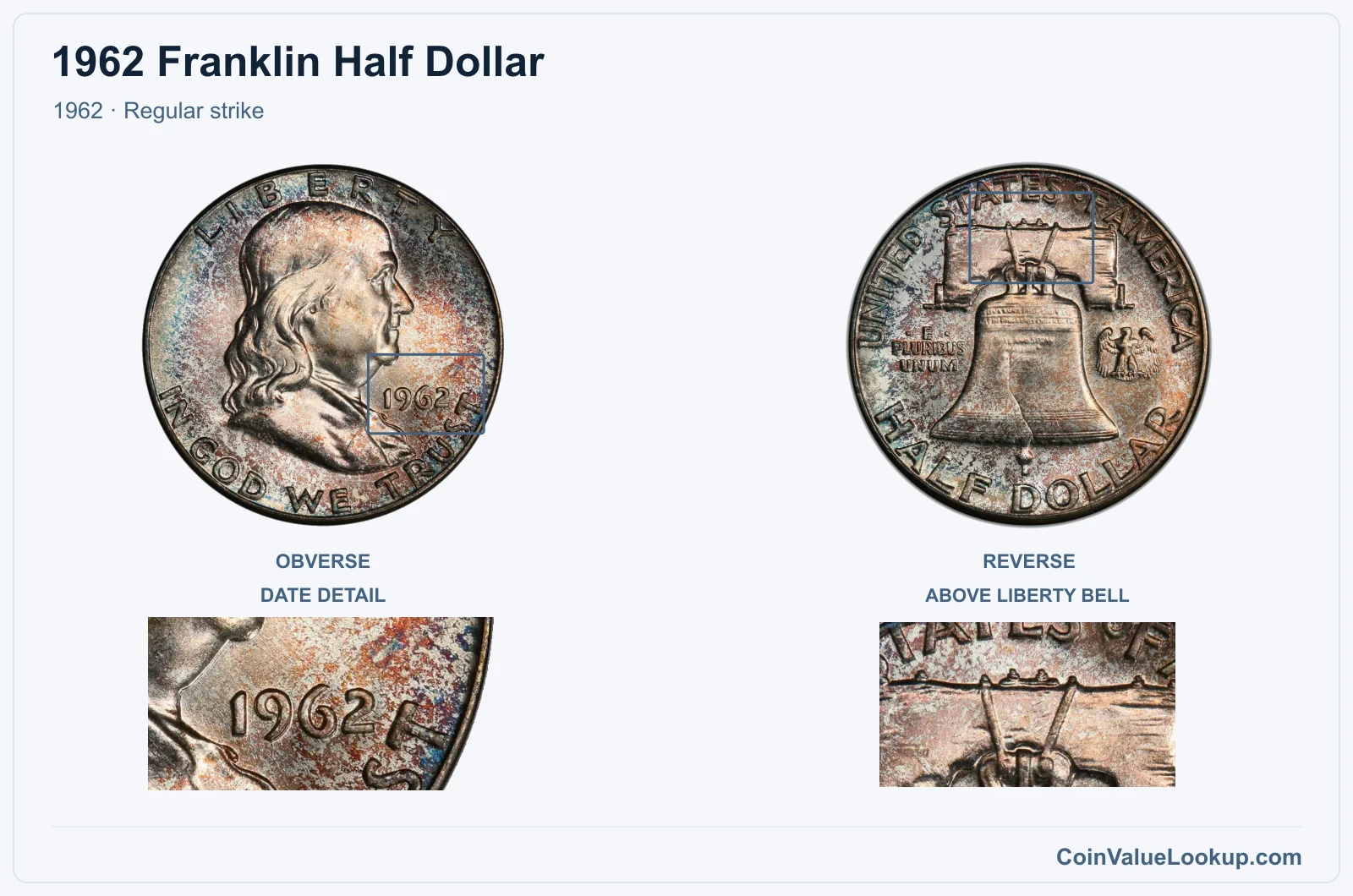
The 1962 Philadelphia business strike carries no mintmark on the reverse. In well-worn Good-4 condition, USA Coin Book lists it at about $32.00, reflecting the coin's silver content more than any numismatic premium.
A gem MS65 example jumps to roughly $118.00.
Before comparing your coin to the price chart, confirm it actually has no mintmark and that the surfaces are original. Cleaning, scratches, or environmental damage pull a coin below what a problem-free example would bring.
Full Bell Lines is a strike-quality designation indicating intact lower bell lines; it can raise the premium but is a separate consideration from the overall grade.
Range Grade
Price Auction Records Appraisal PO PO 1
—
Coin Identifier FR FR 2
—
Coin Identifier AG AG 3
—
Coin Identifier G G 4
—
Coin Identifier
G 6
—
Coin Identifier VG VG 8
—
Coin Identifier
VG 10
—
Coin Identifier F F 12
—
Coin Identifier
F 15
—
Coin Identifier VF VF 20
—
Coin Identifier
VF 25
—
Coin Identifier
VF 30
—
Coin Identifier
VF 35
—
Coin Identifier XF XF 40
—
Coin Identifier
XF 45
—
Coin Identifier AU AU 50
—
Coin Identifier
AU 53
Coin Identifier
AU 55
—
Coin Identifier
AU 58
Coin Identifier MS MS 60
Coin Identifier
MS 61
Coin Identifier
MS 62
Coin Identifier
MS 63
Coin Identifier
MS 64
Coin Identifier
MS 65
Coin Identifier
MS 66
Coin Identifier
MS 67
—
—
—
MS 68
—
—
—
MS 69
—
—
—
MS 70
—
—
—
1962 Franklin Half Dollar — D
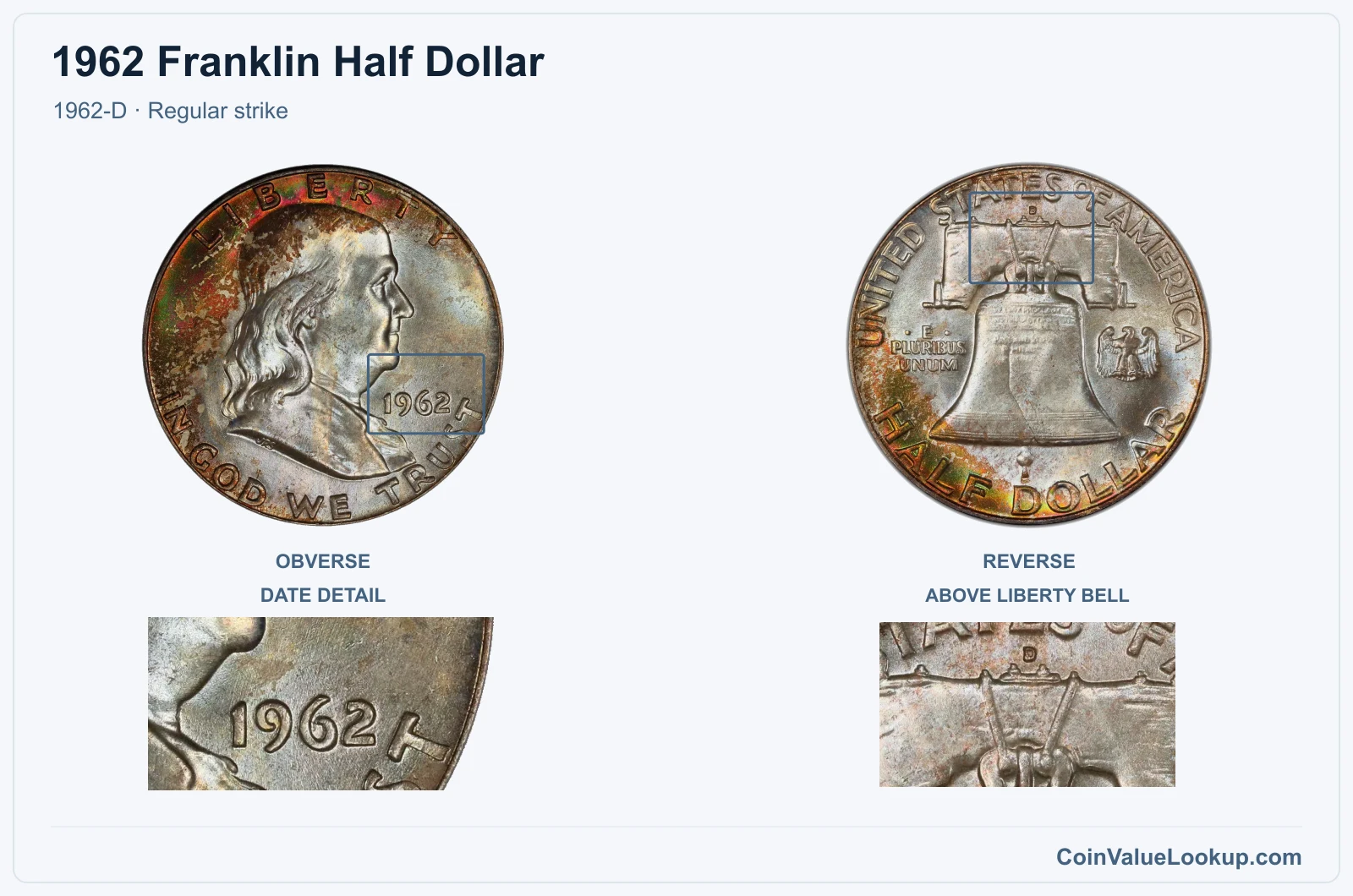
The 1962-D comes from Denver and carries a small D mintmark on the reverse, positioned above the Liberty Bell below E PLURIBUS UNUM. Guide values mirror the Philadelphia issue: about $32.00 at G4 and $118.00 at MS65, per USA Coin Book.
Denver struck large quantities of Franklin halves in 1962, so finding one is not hard. The challenge is finding one with clean, original surfaces in upper grades.
Cleaned or polished coins lose the natural luster that graders look for. As with the Philadelphia strikes, Full Bell Lines detail is a separate strike designation, not a different version or metal.
Range Grade
Price Auction Records Appraisal PO PO 1
—
Coin Identifier FR FR 2
—
Coin Identifier AG AG 3
—
Coin Identifier G G 4
—
Coin Identifier
G 6
—
Coin Identifier VG VG 8
—
Coin Identifier
VG 10
—
Coin Identifier F F 12
—
Coin Identifier
F 15
—
Coin Identifier VF VF 20
—
Coin Identifier
VF 25
—
Coin Identifier
VF 30
—
Coin Identifier
VF 35
—
Coin Identifier XF XF 40
—
Coin Identifier
XF 45
—
Coin Identifier AU AU 50
Coin Identifier
AU 53
—
Coin Identifier
AU 55
Coin Identifier
AU 58
Coin Identifier MS MS 60
—
Coin Identifier
MS 61
—
Coin Identifier
MS 62
Coin Identifier
MS 63
Coin Identifier
MS 64
Coin Identifier
MS 65
Coin Identifier
MS 66
Coin Identifier
MS 67
—
—
—
MS 68
—
—
—
MS 69
—
—
—
MS 70
—
—
—
1962 Franklin Half Dollar — PR
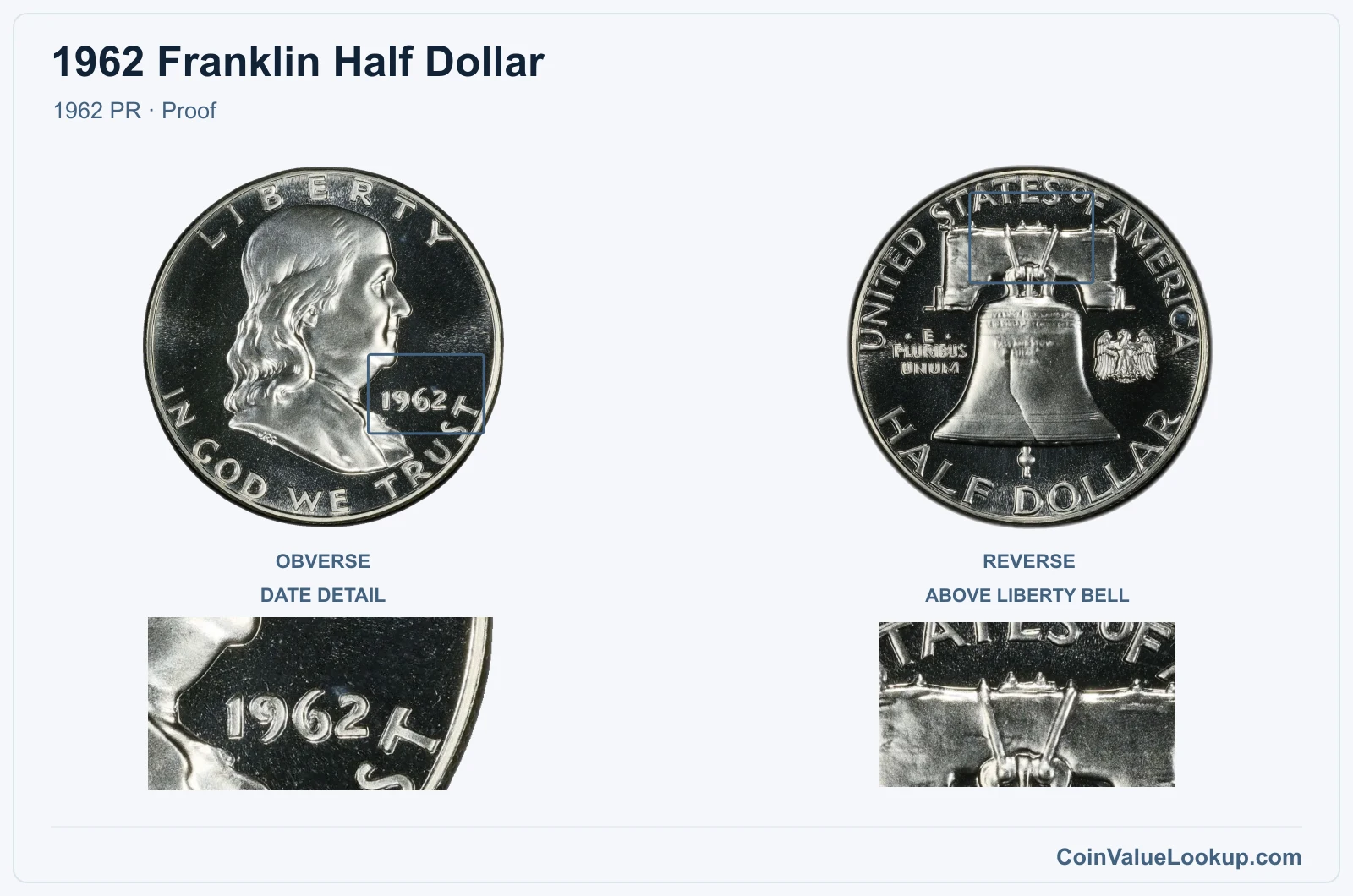
The 1962 proof was struck at Philadelphia with no mintmark, using specially prepared dies and polished planchets. These coins have mirrored fields and sharply defined devices that no amount of polishing can replicate on a business strike.
USA Coin Book places a PR65 example at about $48.00. When grading a proof, you are looking for hairlines from mishandling, haze from improper storage, and whether the coin shows cameo contrast between frosted devices and reflective fields.
A proof with heavy hairlines or cleaning will grade lower regardless of how sharp the strike appears.
Range Grade
Price Auction Records Appraisal PR PR 1
—
Coin Identifier
PR 2
—
Coin Identifier
PR 3
—
Coin Identifier
PR 4
—
Coin Identifier
PR 6
—
Coin Identifier
PR 8
—
Coin Identifier
PR 10
—
Coin Identifier
PR 12
—
Coin Identifier
PR 15
—
Coin Identifier
PR 20
—
Coin Identifier
PR 25
—
Coin Identifier
PR 30
—
Coin Identifier
PR 35
—
Coin Identifier
PR 40
—
Coin Identifier
PR 45
—
Coin Identifier
PR 50
—
Coin Identifier
PR 53
—
Coin Identifier
PR 55
—
Coin Identifier
PR 58
—
Coin Identifier
PR 60
Coin Identifier
PR 61
Coin Identifier
PR 62
Coin Identifier
PR 63
Coin Identifier
PR 64
Coin Identifier
PR 65
Coin Identifier
PR 66
Coin Identifier
PR 67
Coin Identifier
PR 68
Coin Identifier
PR 69
Coin Identifier
PR 70
—
—
—
1962 Franklin Half Dollar Error List
1. 1962 Franklin Half Dollar — Bugs Bunny Die Clash
The "Bugs Bunny" die clash on the 1962 Franklin Half Dollar is one of the more visually entertaining mint errors in the series. It occurs when obverse and reverse dies strike together without a planchet between them, transferring design elements from one die face to the other.
The result on Franklin's portrait is a set of raised lines near his mouth that look like buck teeth, hence the nickname.
To check your coin, examine Franklin's lips and mouth area under magnification. Compare it side by side with a normal 1962 half.
The clash marks are raised and consistent, not random scratches or tooling marks. Scratches, post-mint damage, or brockage effects can mimic the look to the untrained eye.
No specific price range is adopted for this variety; value depends on the clarity of the clash, overall coin condition, and collector demand for the specific example.
2. 1962 Franklin Half Dollar — Doubled Die Obverse
A Doubled Die Obverse on the 1962 Franklin Half Dollar shows consistent doubling in the obverse lettering or design elements. This is a die-manufacturing error where a working die received a second, slightly offset impression during its creation.
Look at the obverse inscriptions under magnification. Genuine doubled die doubling appears as separation or notching in the letters, consistent in direction across affected areas.
It should not look like a flat shelf or a shadow; that is usually machine doubling, which is a far less valuable strike artifact.
Reflections from proof-like surfaces and contours from a worn die can also fool you. A side-by-side comparison with a normal 1962 half under the same lighting is essential.
No numerical price is adopted for this variety. The premium depends on the strength of the doubling, the coin's condition, and market interest.
3. 1962 Franklin Half Dollar — Repunched Mintmark
The 1962-D Repunched Mintmark occurs specifically on Denver-struck coins. During this era, mintmarks were punched into working dies by hand, and a misaligned second punch sometimes left traces of the original position.
Check the D mintmark above the Liberty Bell on the reverse. Under magnification, look for remnants of a second D partially visible beneath or offset from the primary mark.
The extra impression should be consistent and clearly from a punch, not random.
Do not confuse this with machine doubling around the mintmark, which shows a flat, shelf-like distortion. Die chips or corrosion pitting near the mark can also create misleading shapes.
No price range is adopted for this variety. Value depends on visibility of the repunching, the coin's overall grade, and collector demand for Franklin RPM examples.
4. 1962 Franklin Half Dollar — Off-Center Strike
An off-center strike on a 1962 Franklin Half Dollar means the planchet was not seated properly in the collar when the dies struck it. The result is a design that is visibly shifted to one side, with an unstruck crescent of blank metal on the opposite edge.
The key collector preference is that the date remains fully visible; without a readable date, the coin loses much of its appeal. More dramatic off-center percentages tend to bring higher premiums, but only up to the point where the date disappears.
Do not confuse a genuine off-center strike with a clipped planchet, which removes a curved section of metal, or with one-sided misalignment where the reverse is shifted independently. Post-mint flattening from damage can also fake a partial blank area.
No specific price range is adopted here; value varies with the percentage of off-center shift, date visibility, and overall condition.