1909 Indian Head Penny Coin Value: How Much Is It Worth?
The 1909 Indian Head penny holds a special place as the final year of a series that ran for half a century. Guide values for the regular Philadelphia business strike range from about $12 in G4 to $103 in MS63, while the scarce San Francisco issue climbs from roughly $376 in G4 to $1,599 in MS63.
Proofs carry their own pricing. These are retail guide estimates, not guaranteed offers, and actual results depend on the exact branch, grade and surface quality of your coin.
Fast Way to Identify Your 1909 Indian Head Penny
The quickest way to start figuring out what you have is to snap clear photos of both sides of your coin and upload them here. This gives you a preliminary identification of the mint, design type and general condition.
It is not a substitute for professional authentication or certified grading, but it points you in the right direction before you dig deeper.
1909 Indian Head Penny Value
Upload both sides of your 1909 Indian Head Penny.
Front Obverse
Upload photo
Back Reverse
Upload photo
Which 1909 Indian Head Penny Versions Are Worth Money?
- The 1909-S is the key date of the pair, with guide values starting around $376 even in well-worn G4 condition, making any genuine example worth careful inspection.
- The 1909 Philadelphia business strike is affordable in lower grades at roughly $12 in G4, but original uncirculated examples at MS63 can reach around $103.
- Proof 1909 Indian Head cents carry a guide value near $313 at PR63 and require verified proof surfaces, not just a shiny coin.
- Doubled die obverse examples with a distinctive large L over small L on the ribbon have been documented and require individual assessment by a professional grading service.
- Off-center strikes and wrong-planchet errors are reported for this date and can carry significant premiums depending on severity and authentication.
Step 1: Identify Your 1909 Indian Head Penny Mint Mark and Version
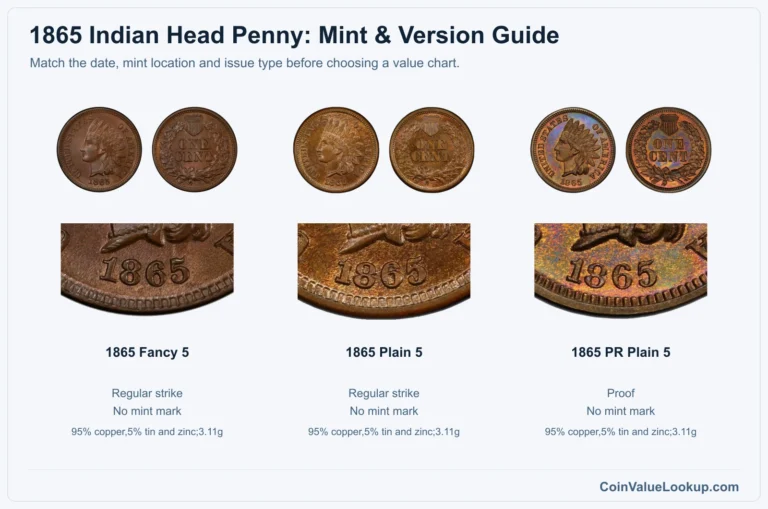
First, confirm you actually have an Indian Head cent and not a 1909 Lincoln penny. The obverse shows a figure wearing a feathered headdress, and the reverse features an oak wreath surrounding a shield.
If you see wheat ears on the back, that is a Lincoln cent and belongs on a different page entirely.
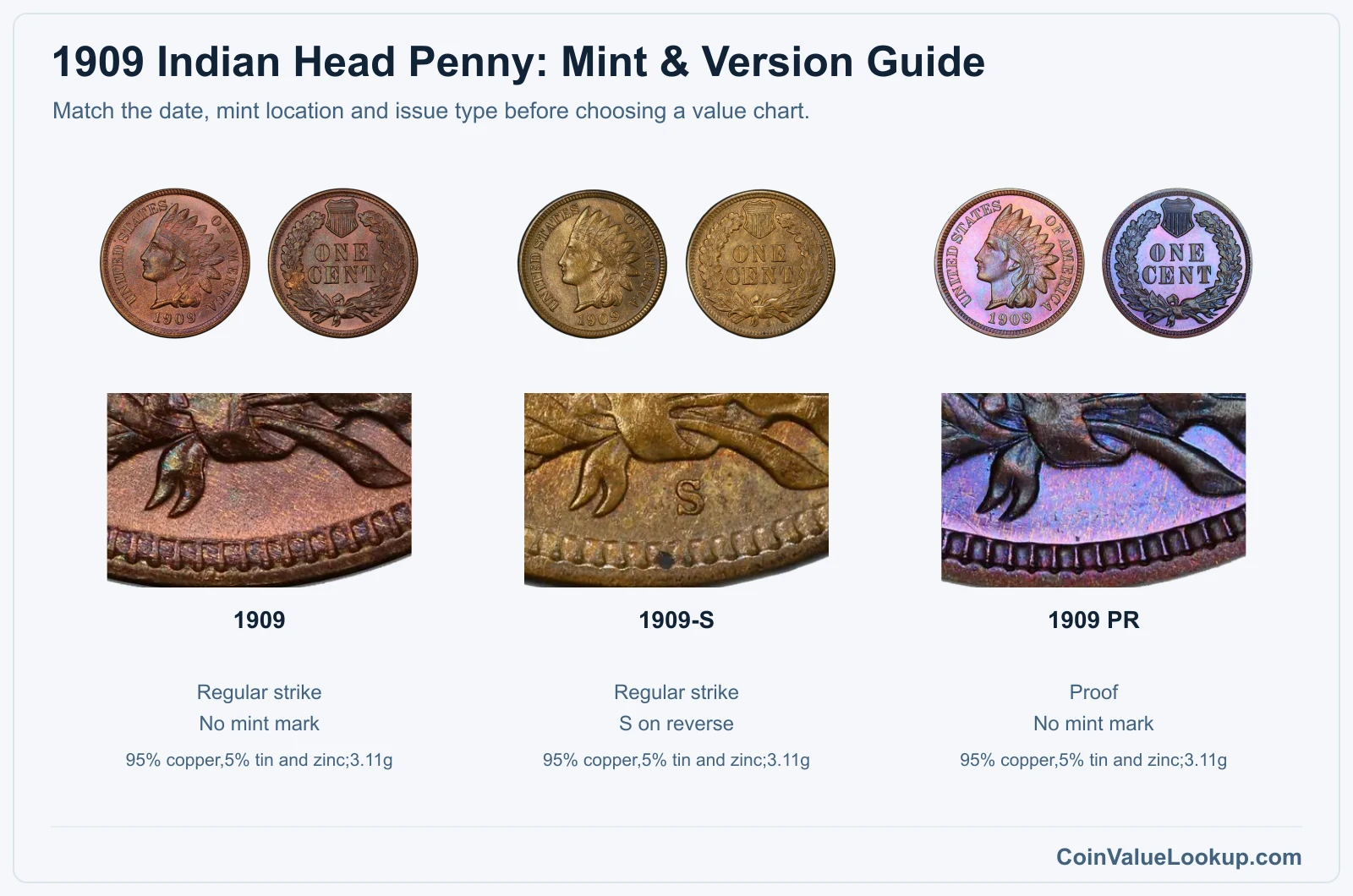
No mintmark means Philadelphia. If there is a small "S" sitting below the wreath on the reverse, you have the San Francisco issue, which is considerably scarcer.
The 1909 Indian Head cent is struck in bronze, weighing about 3.11 grams, composed of 95% copper with 5% tin and zinc. Do not confuse it with the earlier copper-nickel Indian cents, which are heavier at roughly 4.67 grams and have a different look and feel.
Proof coins were also struck at Philadelphia. A proof is a method of manufacture involving specially prepared dies and planchets, not simply a high grade.
Mirrored surfaces alone do not confirm proof origin. Look for sharp rims, full mirror fields and deliberate striking characteristics rather than just a shiny coin that has been polished.
Step 2: Check Your 1909 Indian Head Penny Grade
Start with the headband. On a well-worn coin, the letters in LIBERTY disappear progressively.
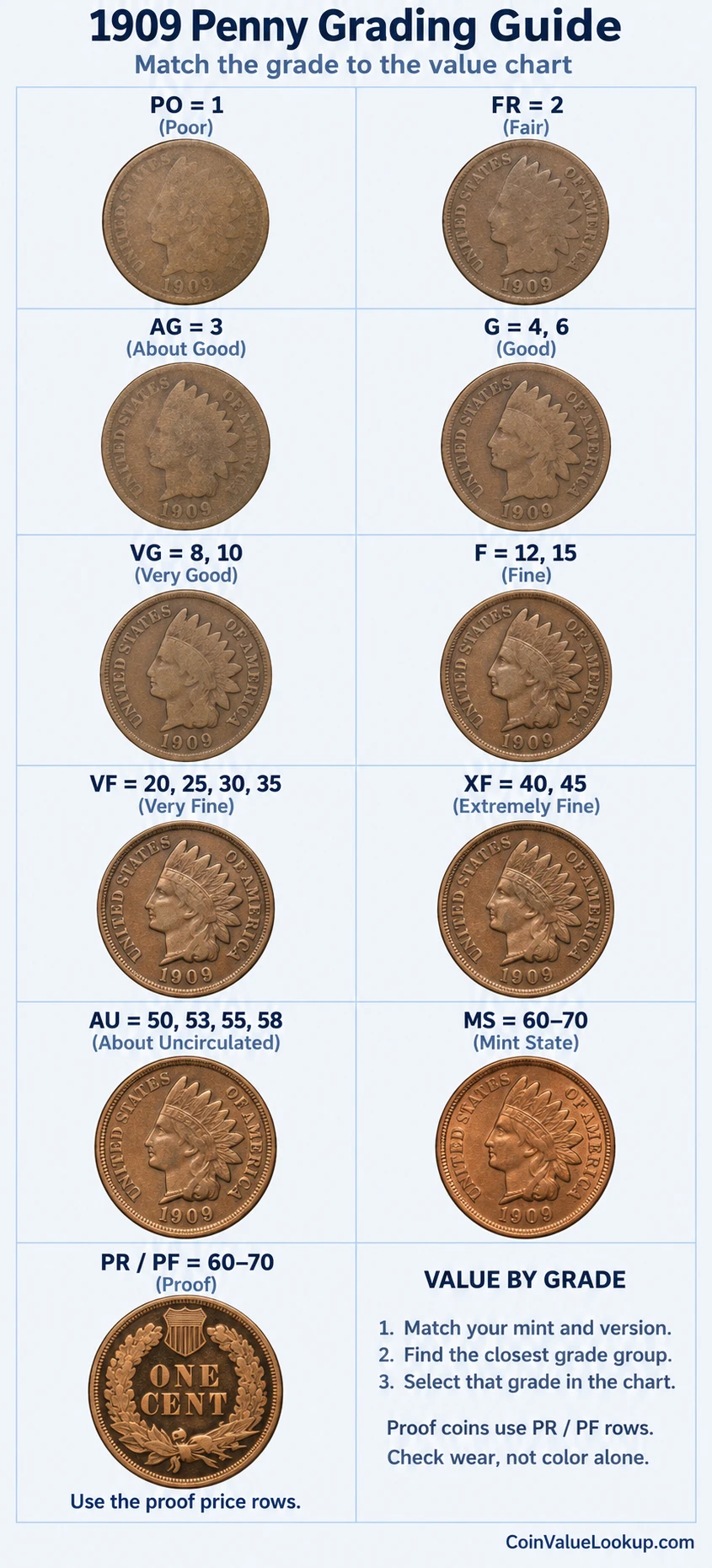
A G4 coin will show a smooth headband with little or no lettering visible, while higher grades retain increasingly sharp letters. But do not grade from LIBERTY alone.
Check the feather tips above the headband and the hair detail below. These are high points that wear first.
A soft original strike, however, can leave feathers mushy even on an uncirculated coin, so compare multiple areas before deciding.
The cheek and the diamonds on the ribbon are other reliable wear checkpoints. On the reverse, look at the wreath leaves and the shield detail.
Luster matters a lot once you get into the mint-state range. Original surfaces with full cartwheel luster are far more desirable than cleaned or retoned coins.
Bronze color designations like BN, RB and RD refer to how much original red copper color remains. They describe appearance, not a different material.
Use the comparison image to match your coin against known grade examples. Surface problems such as scratches, corrosion, environmental damage or evidence of cleaning will lower a coin's marketability regardless of the technical wear grade.
Step 3: Check 1909 Indian Head Penny Value by Mint and Version
1909 Indian Head Penny
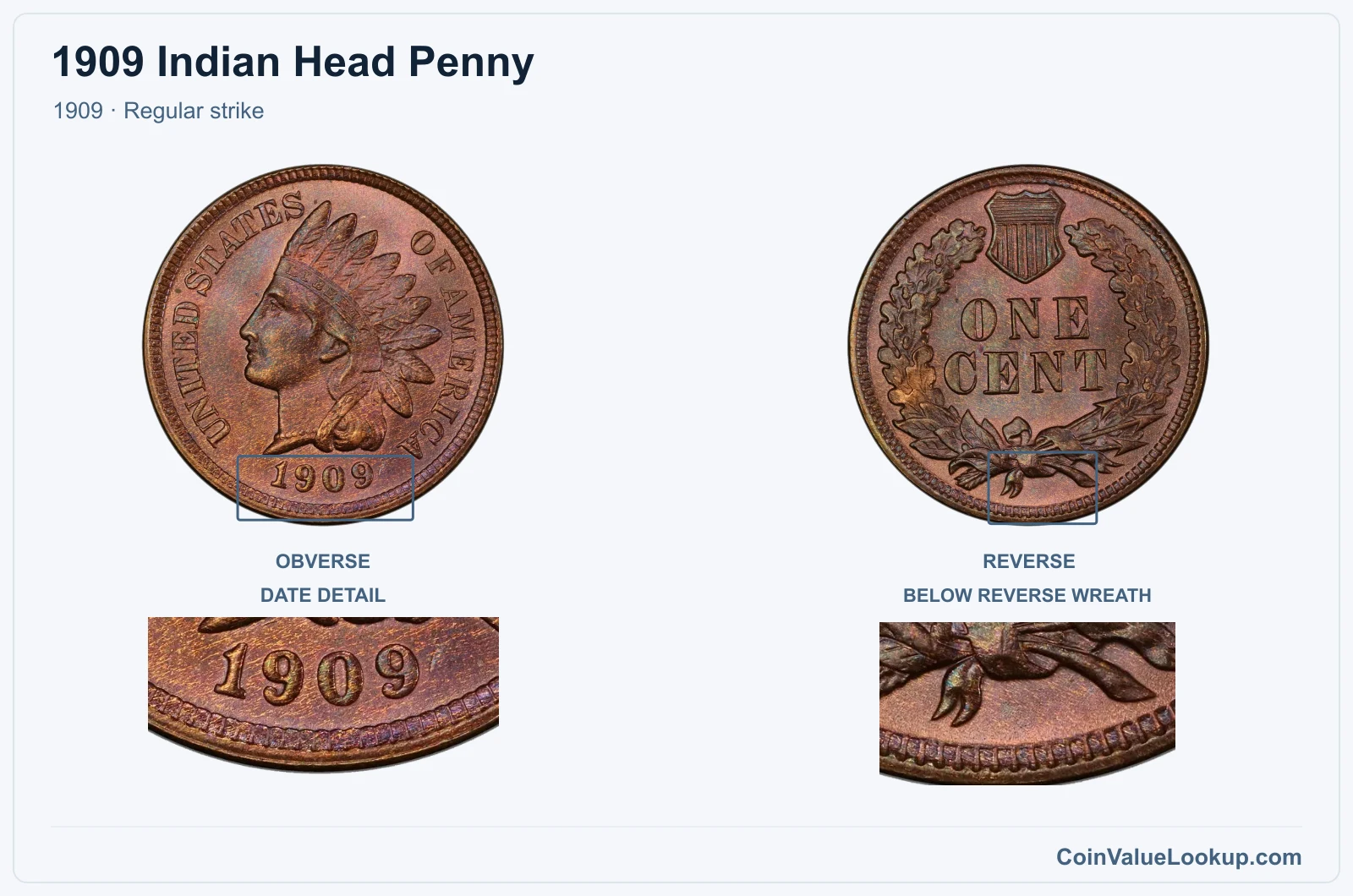
The 1909 Philadelphia business strike is the common branch of this final-year issue. It carries no mintmark.
Look for the Indian portrait on the obverse and the oak wreath with shield on the reverse.
Guide values run about $12 at G4, which is a heavily worn but readable coin, up to roughly $103 at MS63, an uncirculated example with moderate contact marks. These are retail guide estimates from USA Coin Book.
Original surfaces matter here. A cleaned or corroded coin will sell for less than these figures suggest, and a coin with strong remaining red color could do better.
Compare like grade and original surfaces when evaluating yours.
| Range | Grade | Price | Auction Records | Appraisal |
|---|---|---|---|---|
| PO | PO 1 | — | Coin Identifier | |
| FR | FR 2 | — | Coin Identifier | |
| AG | AG 3 | — | Coin Identifier | |
| G | G 4 | — | Coin Identifier | |
| G 6 | — | Coin Identifier | ||
| VG | VG 8 | — | Coin Identifier | |
| VG 10 | — | Coin Identifier | ||
| F | F 12 | — | Coin Identifier | |
| F 15 | — | Coin Identifier | ||
| VF | VF 20 | — | Coin Identifier | |
| VF 25 | — | Coin Identifier | ||
| VF 30 | — | Coin Identifier | ||
| VF 35 | Coin Identifier | |||
| XF | XF 40 | — | Coin Identifier | |
| XF 45 | Coin Identifier | |||
| AU | AU 50 | Coin Identifier | ||
| AU 53 | Coin Identifier | |||
| AU 55 | — | Coin Identifier | ||
| AU 58 | Coin Identifier | |||
| MS | MS 60 | — | Coin Identifier | |
| MS 61 | Coin Identifier | |||
| MS 62 | Coin Identifier | |||
| MS 63 | Coin Identifier | |||
| MS 64 | Coin Identifier | |||
| MS 65 | Coin Identifier | |||
| MS 66 | Coin Identifier | |||
| MS 67 | — | — | — | |
| MS 68 | — | — | — | |
| MS 69 | — | — | — | |
| MS 70 | — | — | — |
1909 Indian Head Penny — S
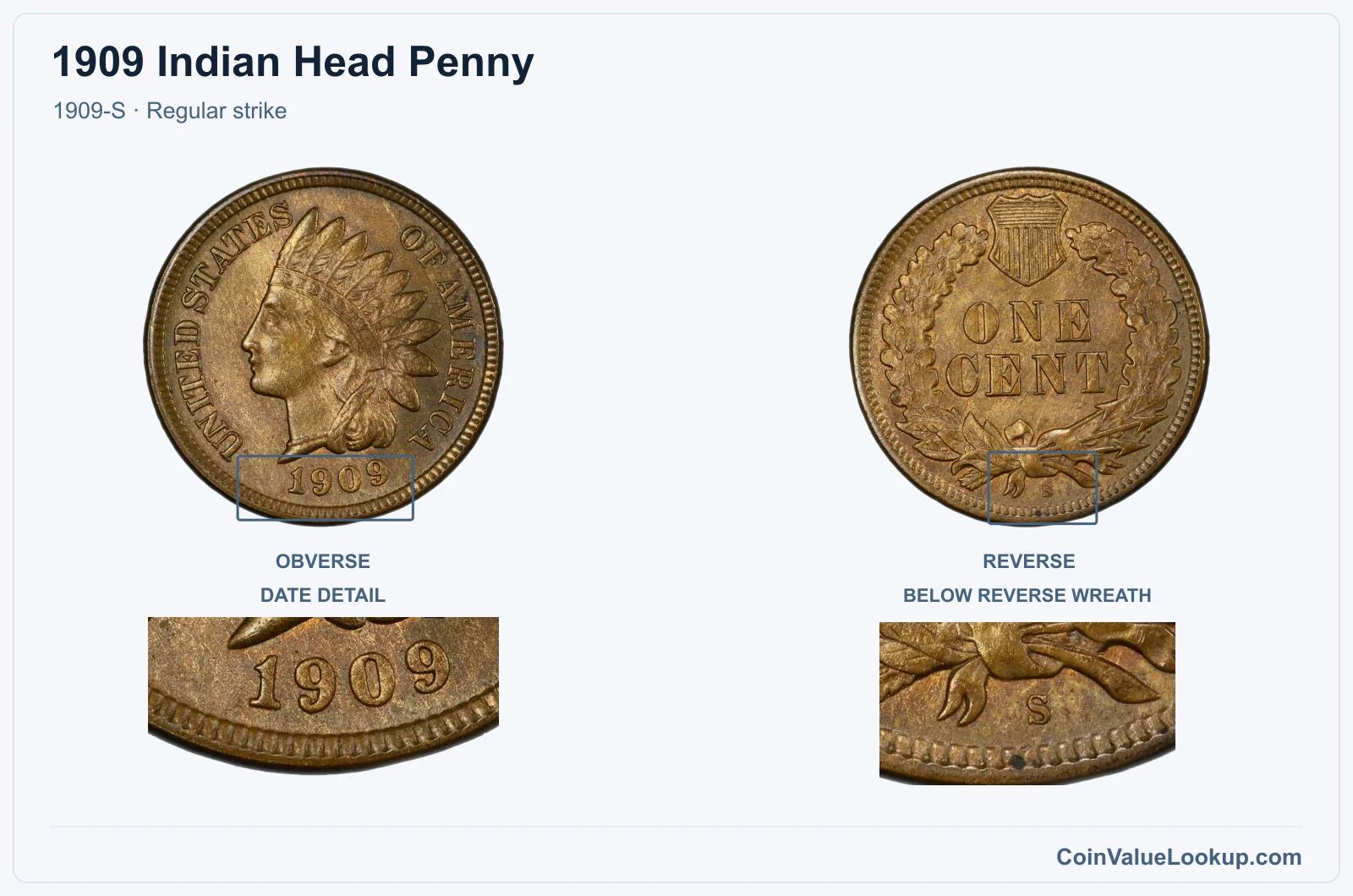
This is the one everyone checks for. The 1909-S Indian Head cent was struck at the San Francisco Mint and carries a small "S" mintmark below the wreath on the reverse.
It is the scarce final-year branch and one of the most recognized dates in the entire Indian cent series.
Guide values sit around $376 at G4 and climb to approximately $1,599 at MS63. Even a beat-up example has real value, so take the time to verify the mintmark is genuine.
Counterfeit and added mintmarks exist for this date because the premium is so large.
Coin Value Lookup is a good starting point if you want to look up guide values for other coins in the series or compare what different years and mints are bringing.
The coin is bronze, 3.11 grams, identical composition to the Philadelphia strike. Do not borrow rare-variety pricing from other sources when evaluating a standard 1909-S.
Stick to the correct branch and grade.
| Range | Grade | Price | Auction Records | Appraisal |
|---|---|---|---|---|
| PO | PO 1 | — | Coin Identifier | |
| FR | FR 2 | — | Coin Identifier | |
| AG | AG 3 | — | Coin Identifier | |
| G | G 4 | Coin Identifier | ||
| G 6 | Coin Identifier | |||
| VG | VG 8 | Coin Identifier | ||
| VG 10 | Coin Identifier | |||
| F | F 12 | Coin Identifier | ||
| F 15 | Coin Identifier | |||
| VF | VF 20 | Coin Identifier | ||
| VF 25 | Coin Identifier | |||
| VF 30 | Coin Identifier | |||
| VF 35 | Coin Identifier | |||
| XF | XF 40 | Coin Identifier | ||
| XF 45 | Coin Identifier | |||
| AU | AU 50 | Coin Identifier | ||
| AU 53 | Coin Identifier | |||
| AU 55 | Coin Identifier | |||
| AU 58 | Coin Identifier | |||
| MS | MS 60 | — | Coin Identifier | |
| MS 61 | Coin Identifier | |||
| MS 62 | Coin Identifier | |||
| MS 63 | Coin Identifier | |||
| MS 64 | Coin Identifier | |||
| MS 65 | Coin Identifier | |||
| MS 66 | — | Coin Identifier | ||
| MS 67 | — | — | — | |
| MS 68 | — | — | — | |
| MS 69 | — | — | — | |
| MS 70 | — | — | — |
1909 Indian Head Penny — PR
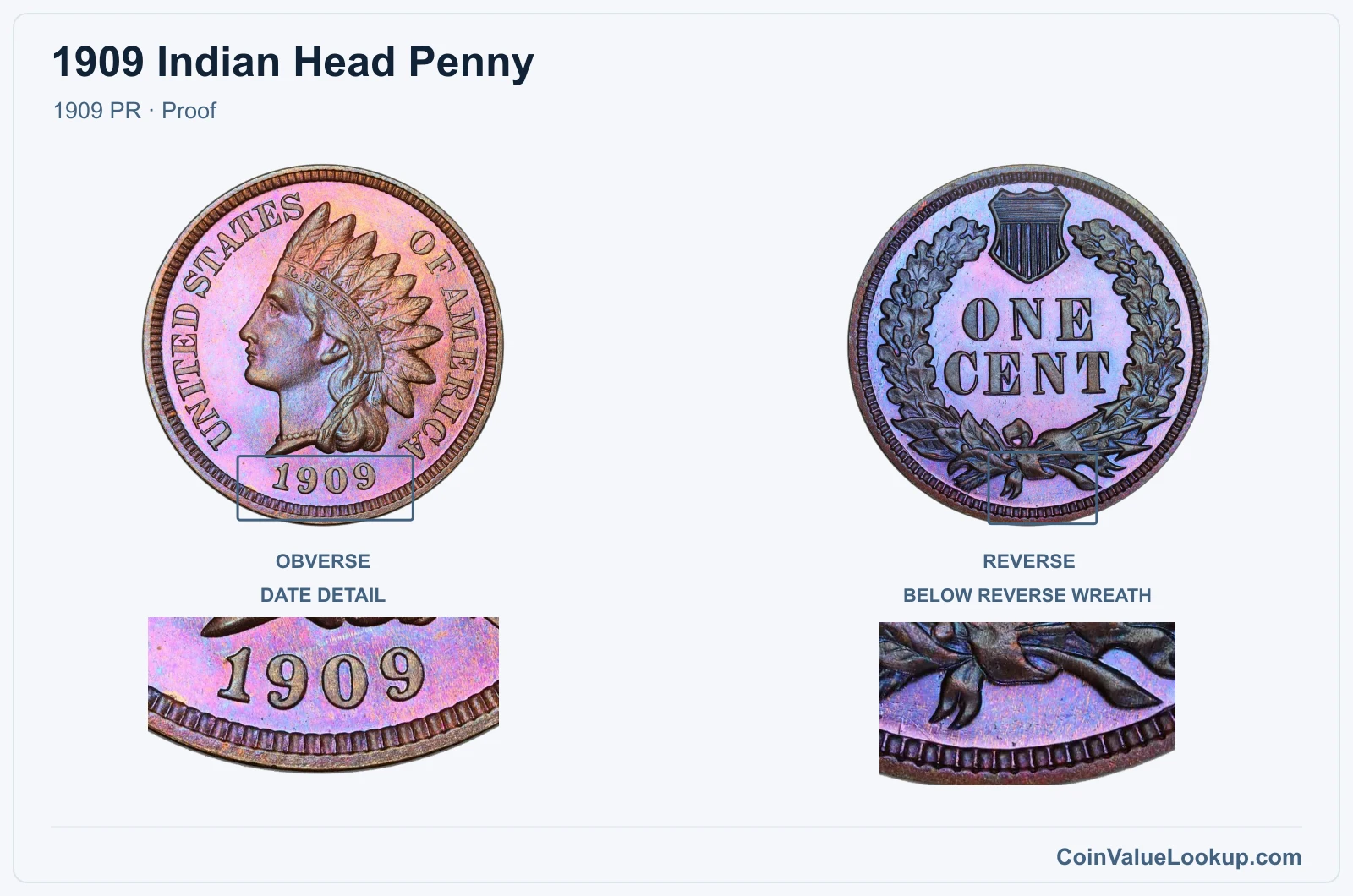
Philadelphia also produced proof Indian Head cents in 1909. These were struck with specially prepared dies on carefully selected planchets, yielding sharp detail and mirrored fields.
A PR63 example carries a guide value of about $313 according to USA Coin Book. Proof coins need verification beyond just looking shiny.
Check for squared-off rims, deeply mirrored fields free of cartwheel luster, and full design sharpness that goes beyond what even a nice business strike shows.
A polished circulation coin is not a proof, no matter how reflective it looks. If you suspect you have one, professional authentication is the safest route.
Cleaning or harsh dipping will damage proof surfaces and reduce desirability substantially.
| Range | Grade | Price | Auction Records | Appraisal |
|---|---|---|---|---|
| PR | PR 1 | — | Coin Identifier | |
| PR 2 | — | Coin Identifier | ||
| PR 3 | — | Coin Identifier | ||
| PR 4 | — | Coin Identifier | ||
| PR 6 | — | Coin Identifier | ||
| PR 8 | — | Coin Identifier | ||
| PR 10 | — | Coin Identifier | ||
| PR 12 | — | Coin Identifier | ||
| PR 15 | — | Coin Identifier | ||
| PR 20 | — | Coin Identifier | ||
| PR 25 | — | Coin Identifier | ||
| PR 30 | — | Coin Identifier | ||
| PR 35 | — | Coin Identifier | ||
| PR 40 | — | Coin Identifier | ||
| PR 45 | — | Coin Identifier | ||
| PR 50 | — | Coin Identifier | ||
| PR 53 | — | Coin Identifier | ||
| PR 55 | — | Coin Identifier | ||
| PR 58 | — | Coin Identifier | ||
| PR 60 | — | Coin Identifier | ||
| PR 61 | Coin Identifier | |||
| PR 62 | Coin Identifier | |||
| PR 63 | Coin Identifier | |||
| PR 64 | Coin Identifier | |||
| PR 65 | Coin Identifier | |||
| PR 66 | Coin Identifier | |||
| PR 67 | — | — | — | |
| PR 68 | — | — | — | |
| PR 69 | — | — | — | |
| PR 70 | — | — | — |
1909 Indian Head Penny Error List
1. 1909 Indian Head Penny — Doubled Die Obverse
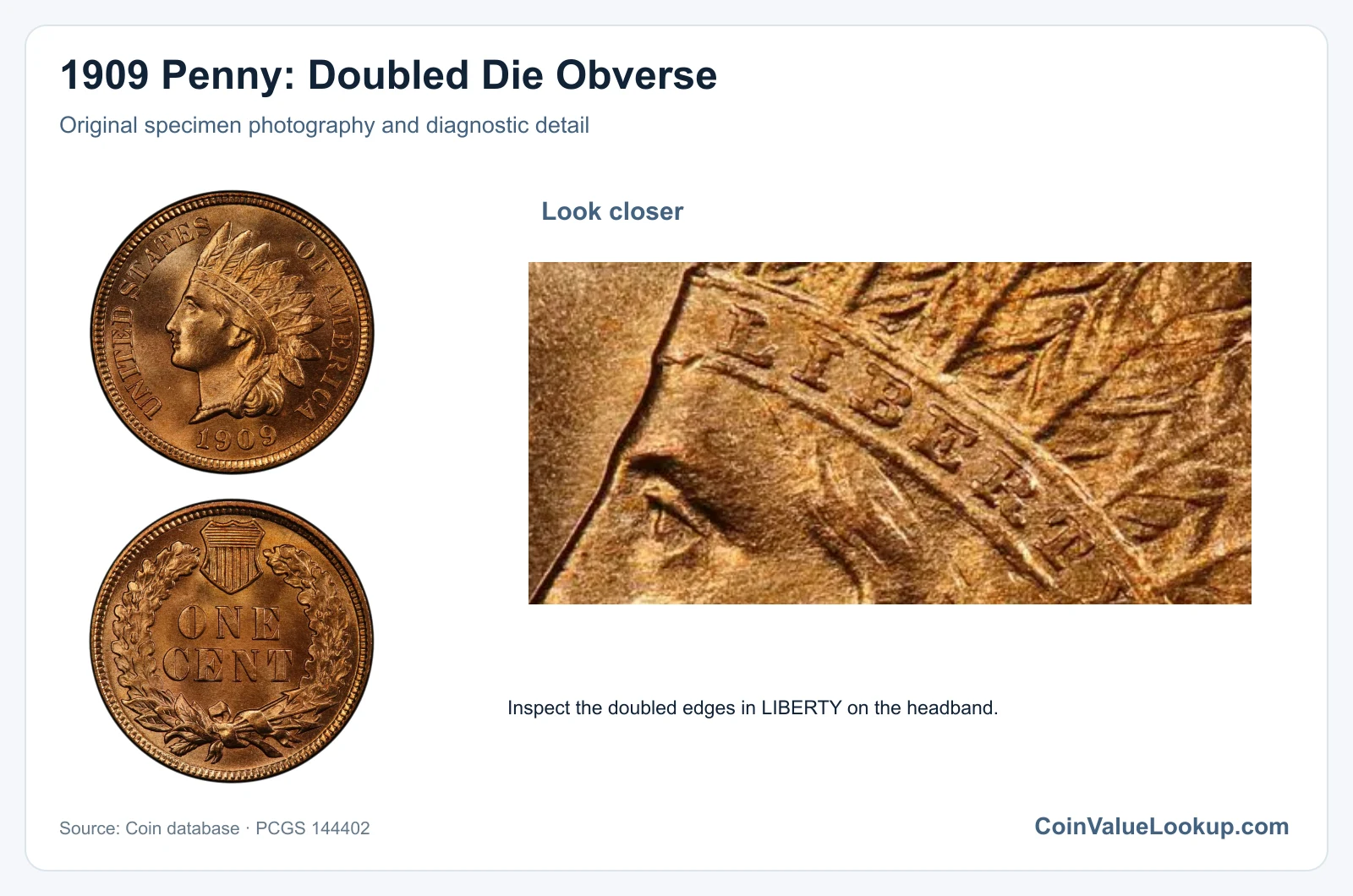
A doubled die obverse has been documented on the 1909 Indian Head cent. The key diagnostic is on the ribbon: look for a large L sitting over a smaller L, the result of hub doubling during die production.
This is not the same as the normal large L that appears on standard 1909 cents.
To check, compare your coin's ribbon area closely with a known normal example under magnification. The doubling should be consistent and raised, not flat or shelf-like.
Watch out for lookalikes. Machine doubling produces a flat, shelf-like appearance rather than the rounded, raised profile of a true hub-doubled die.
Reflections, worn die contours and strike anomalies can also mimic doubling to the untrained eye.
No specific price range is supported for this variety. Value depends on the authenticated identity of the die, the severity of the doubling and the coin's overall condition.
Professional grading service attribution is the reliable path to confirming what you have.
2. 1909 Indian Head Penny — Wrong Planchet / Off-Metal Strike
A wrong-planchet or off-metal strike occurs when a coin is struck on a blank intended for a different denomination or composition. For the 1909 Indian Head cent, this category has been reported in published error references.
To evaluate a suspect coin, compare the weight, diameter and edge characteristics against the standard 3.11-gram bronze planchet. A genuine wrong-planchet strike will show the full or partial Indian Head design impressed onto an obviously different blank.
The design may be incomplete if the blank was smaller than intended.
Be cautious with lookalikes. Plating, chemical alteration, acid-treated surfaces and deliberate post-mint modifications can make a normal coin look like it was struck on the wrong metal.
Corrosion can also change a coin's appearance and weight enough to cause confusion.
No supported price range exists for this category. Each example requires individual assessment based on authenticated identity, the specific planchet involved and the coin's condition.
3. 1909 Indian Head Penny — Off-Center Strike
An off-center strike happens when the planchet is not properly seated between the dies, resulting in part of the design being displaced and an unstruck crescent of blank metal on one side. This error has been reported for the 1909 Indian Head cent.
The diagnostic is straightforward: look for a shifted design with a visible blank crescent area. The most collectible off-center examples still show the full date, because without a readable date the coin cannot be attributed to a specific year.
Do not confuse off-center strikes with clipped planchets, which show a curved missing section but retain a centered design. One-sided die misalignment and post-mint flattening can also create misleading appearances.
No specific price range is adopted for this error. Value depends heavily on the percentage of off-center displacement, date visibility, overall condition and professional authentication.
A 5% shift is far less dramatic than a 50% shift with a full date showing.