2017 Lincoln Penny Coin Value: How Much Is It Worth?
Most 2017 Lincoln pennies you pull from pocket change are worth face value — one cent. A coin in uncirculated condition with original bright surfaces can do better; a guide estimate for an MS65 business strike is around $0.36.
Standard San Francisco proofs carry a PR65 guide estimate of about $6.26. Collector finishes, major varieties, and genuine mint errors occupy their own pricing tiers entirely, so those deserve a closer look below.
Fast Way to Identify Your 2017 Lincoln Penny
The quickest way to start figuring out what you have is to upload clear photos of both sides of your coin. Snap the obverse (Lincoln's portrait) and the reverse (Union Shield) in good lighting, and our identifier can offer a preliminary read on your coin's mint, finish, and basic type.
That first step helps you zero in on the right branch before you dig into grading or error hunting.
2017 Penny Value
Upload both sides of your 2017 Lincoln Penny.
Front Obverse
Upload photo
Back Reverse
Upload photo
Which 2017 Lincoln Penny Versions Are Worth Money?
- Uncirculated 2017-P and 2017-D cents with full original red luster can sell above face value; guide estimate is $0.36 at MS65.
- 2017-S standard proofs are collector-only issues with a PR65 guide estimate of about $6.26 — worth checking your proof sets.
- The 2017-S Enhanced Uncirculated cent is a distinct San Francisco finish sold in special sets; value depends on authenticated identity and condition.
- Doubled die obverse and doubled die reverse varieties are reported for this year and can carry premiums when authenticated.
- Off-center strikes with a visible date and wrong-planchet errors are scarce mint mistakes that attract specialist buyers.
Step 1: Identify Your 2017 Lincoln Penny Mint Mark and Version
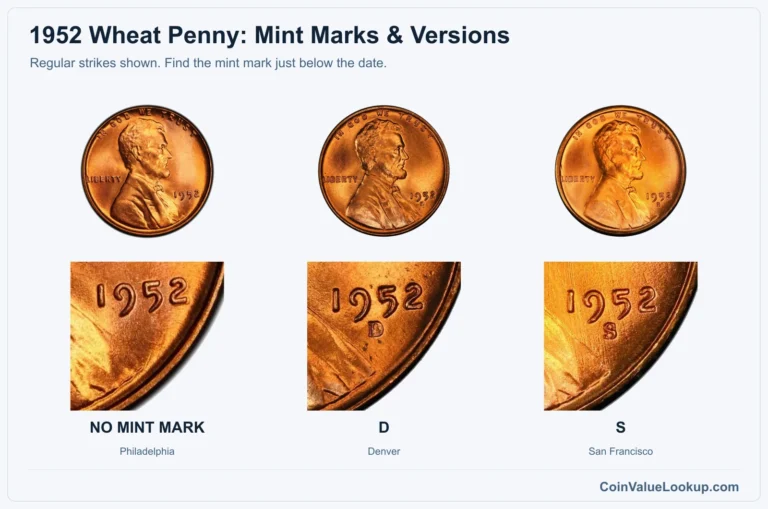
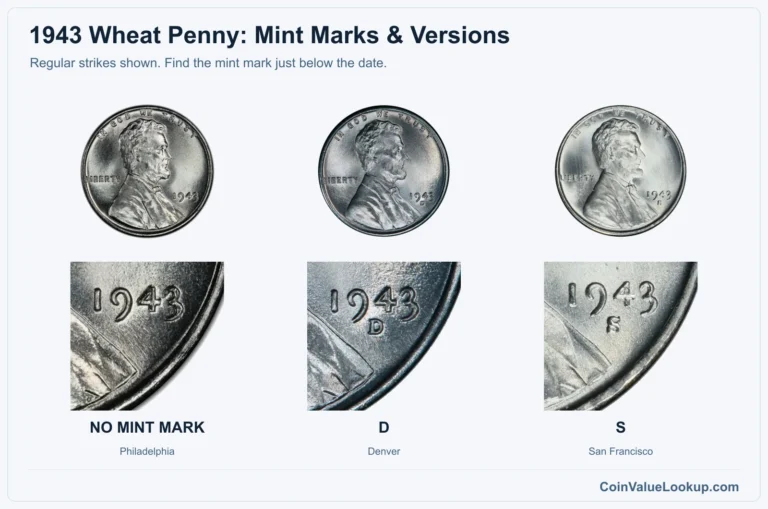
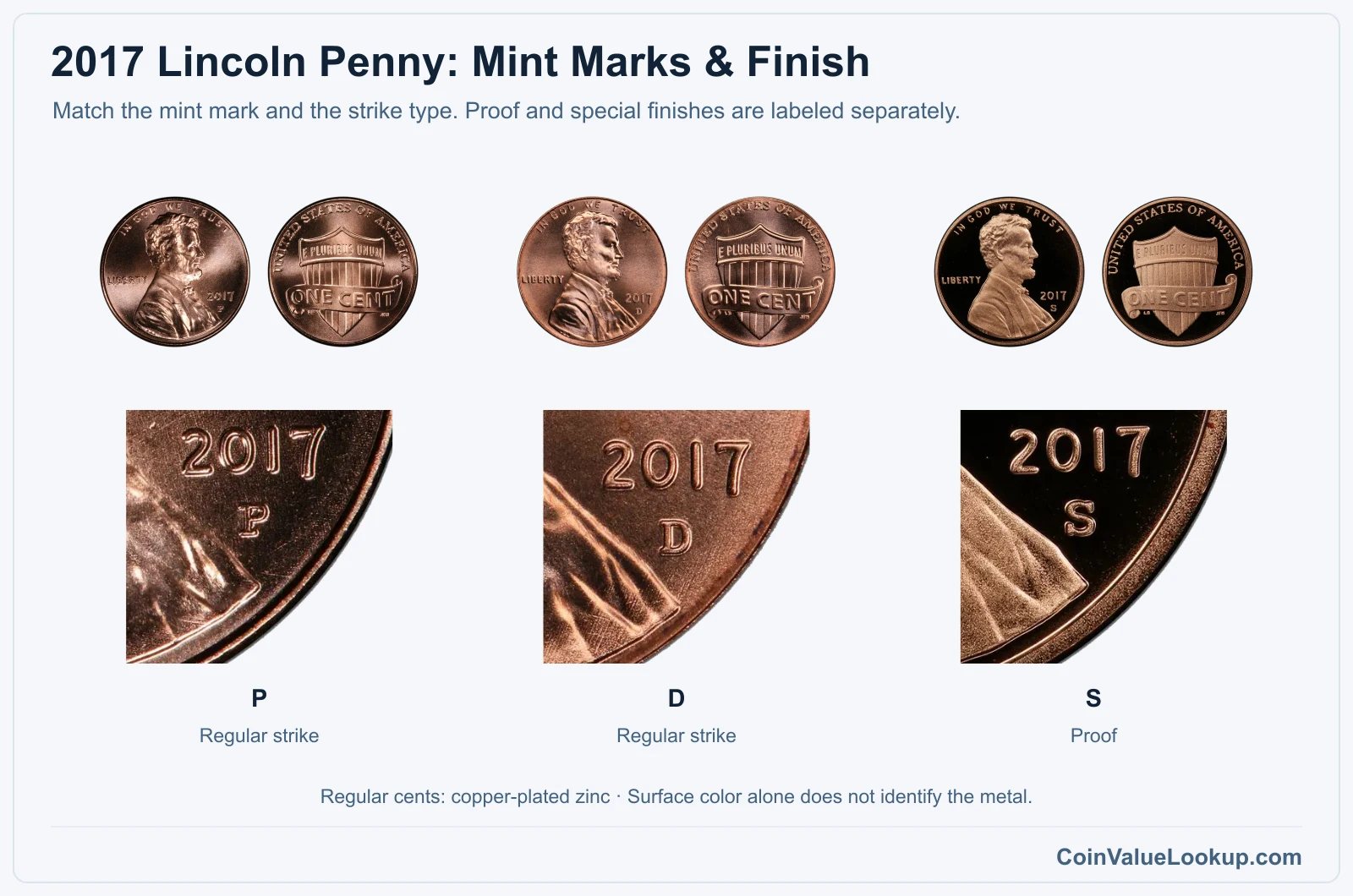
Flip your 2017 penny over and confirm it shows the Union Shield reverse — that design has been standard since 2010. Now look just below the date on the obverse for the mintmark.
A "P" means Philadelphia, a "D" means Denver, and an "S" means San Francisco.
Philadelphia and Denver strikes are ordinary business-strike cents made for circulation. San Francisco produced two distinct collector coins this year: a standard proof and a separate enhanced uncirculated finish.
Those are not the same thing, and lumping them together will steer you wrong on value.
All standard 2017 cents are copper-plated zinc, weighing about 2.50 grams. You cannot reliably identify an off-metal error by color alone — weight and diameter matter more.
If your coin looks odd, weigh it before jumping to conclusions.
Step 2: Check Your 2017 Lincoln Penny Grade
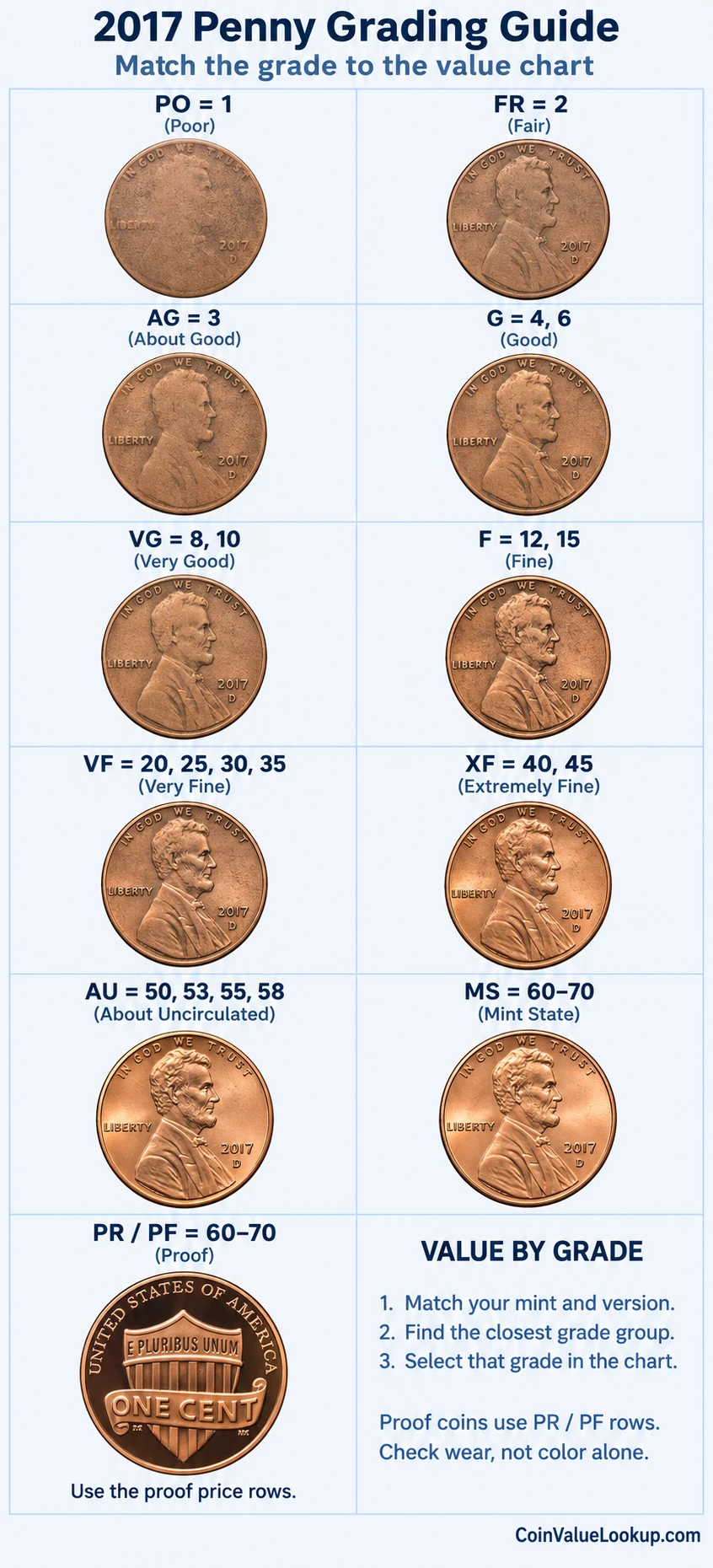
Start with Lincoln's cheekbone and jawline on the obverse. On a well-worn coin, those high points flatten first, and you lose the fine hair detail above his ear.
A lightly circulated piece retains some luster in the protected areas around the letters and date.
On the reverse, check the horizontal lines across the shield and the clarity of the lettering in ONE CENT. Fuzzy shield lines and soft letter edges signal moderate wear.
Color designations — RD (red), RB (red-brown), and BN (brown) — describe the remaining original copper tone, not the amount of wear. A coin can be fully uncirculated but brown from toning.
Use the comparison image to match your coin's wear level against known grade examples.
Proof and enhanced uncirculated coins are graded on their own scales. A proof's mirror fields and sharp rims are manufacturing traits, not indicators of a grade above Mint State.
Step 3: Check 2017 Lincoln Penny Value by Mint and Version
2017 Lincoln Penny — P Shield
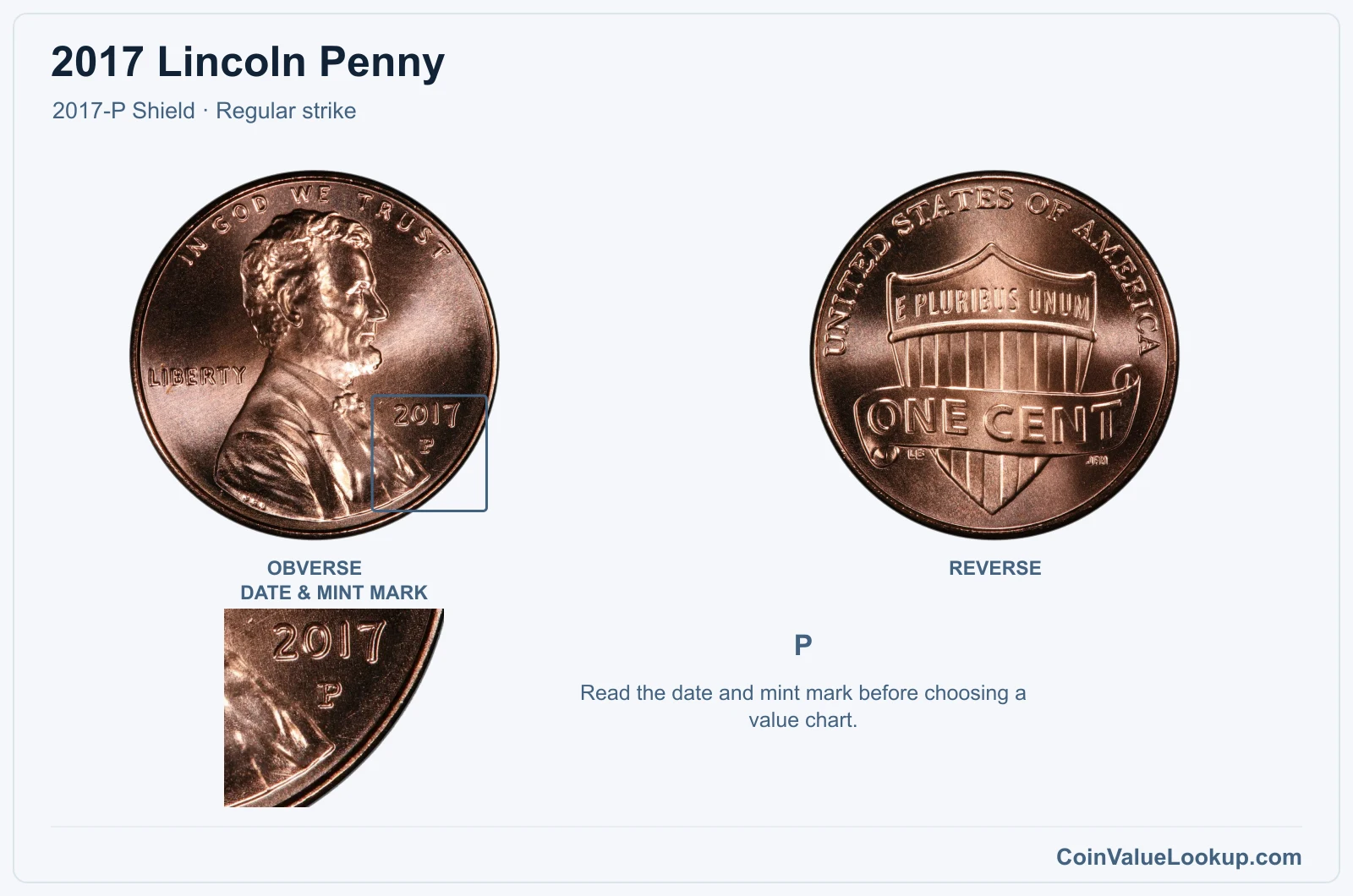
The 2017-P is the standard Philadelphia business strike, identifiable by the small "P" mintmark below the date. It carries the Lincoln portrait obverse and Union Shield reverse on a copper-plated zinc planchet weighing about 2.50 grams.
In worn condition, this coin is worth one cent. Even lightly circulated examples rarely trade above face value.
At MS65, a guide estimate puts it around $0.36 — so the premium lives almost entirely in pristine, original-surface coins with full red color. Look for unbroken luster and no contact marks on Lincoln's cheek if you think yours might qualify.
| Range | Grade | Price | Auction Records | Appraisal |
|---|---|---|---|---|
| PO | PO 1 | — | Coin Identifier | |
| FR | FR 2 | — | Coin Identifier | |
| AG | AG 3 | — | Coin Identifier | |
| G | G 4 | — | Coin Identifier | |
| G 6 | — | Coin Identifier | ||
| VG | VG 8 | — | Coin Identifier | |
| VG 10 | — | Coin Identifier | ||
| F | F 12 | — | Coin Identifier | |
| F 15 | — | Coin Identifier | ||
| VF | VF 20 | — | Coin Identifier | |
| VF 25 | — | Coin Identifier | ||
| VF 30 | — | Coin Identifier | ||
| VF 35 | — | Coin Identifier | ||
| XF | XF 40 | — | Coin Identifier | |
| XF 45 | — | Coin Identifier | ||
| AU | AU 50 | — | Coin Identifier | |
| AU 53 | — | Coin Identifier | ||
| AU 55 | — | Coin Identifier | ||
| AU 58 | — | Coin Identifier | ||
| MS | MS 60 | — | Coin Identifier | |
| MS 61 | — | Coin Identifier | ||
| MS 62 | — | Coin Identifier | ||
| MS 63 | — | Coin Identifier | ||
| MS 64 | — | Coin Identifier | ||
| MS 65 | — | Coin Identifier | ||
| MS 66 | — | Coin Identifier | ||
| MS 67 | — | Coin Identifier | ||
| MS 68 | — | Coin Identifier | ||
| MS 69 | — | — | — | |
| MS 70 | — | — | — |
2017 Lincoln Penny — D Shield
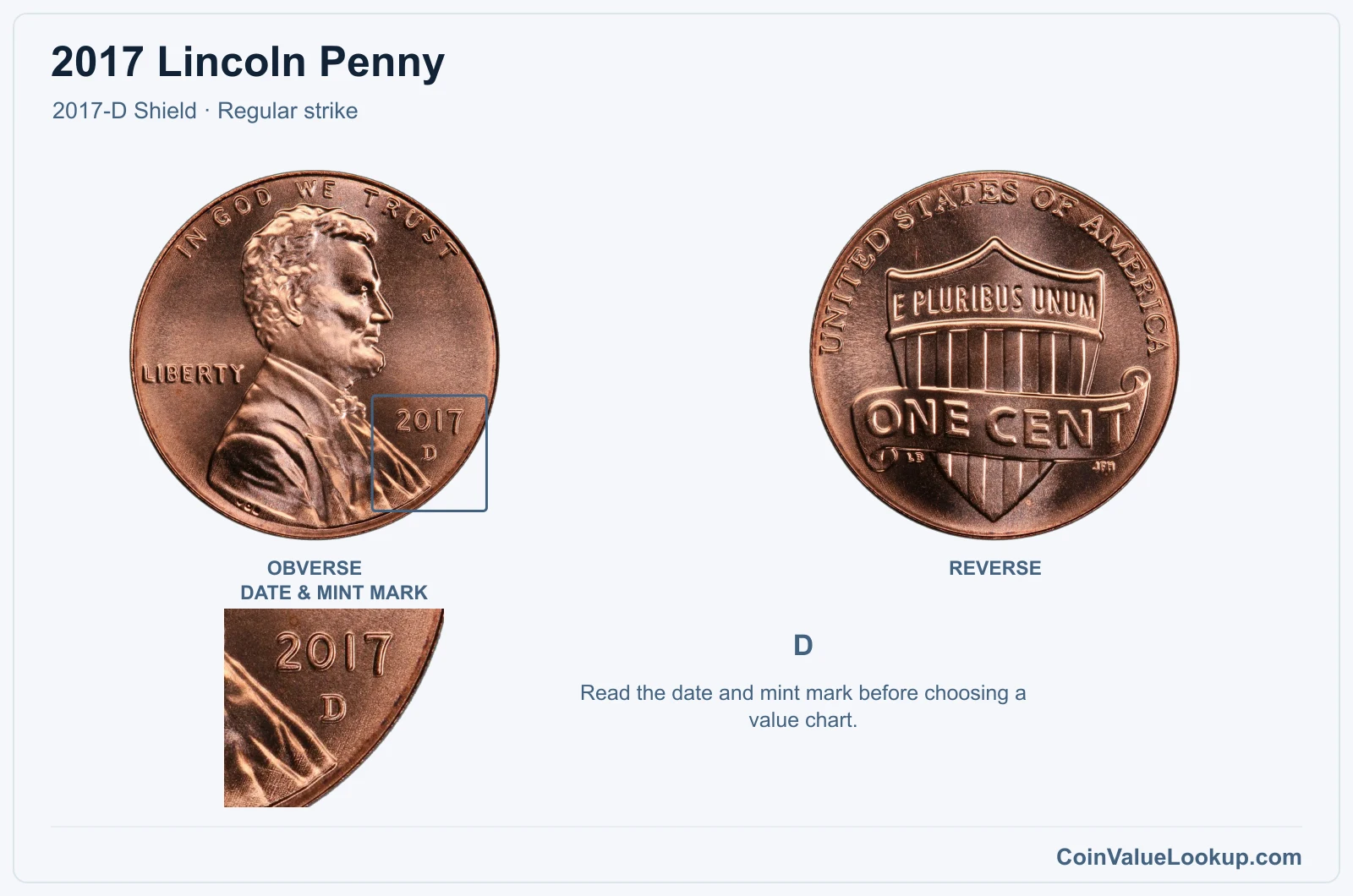
Denver's 2017-D cent is the companion business strike, marked by a "D" below the date. Same copper-plated zinc composition, same 2.50-gram weight, same Union Shield reverse.
Pricing mirrors the Philadelphia issue closely. Circulated pieces are face value.
The MS65 guide estimate is $0.36, identical to the P mint. To have any collector appeal, a 2017-D needs to be uncirculated with strong original red surfaces and minimal bag marks.
If it came out of a roll you set aside in 2017, you might have a shot.
| Range | Grade | Price | Auction Records | Appraisal |
|---|---|---|---|---|
| PO | PO 1 | — | Coin Identifier | |
| FR | FR 2 | — | Coin Identifier | |
| AG | AG 3 | — | Coin Identifier | |
| G | G 4 | — | Coin Identifier | |
| G 6 | — | Coin Identifier | ||
| VG | VG 8 | — | Coin Identifier | |
| VG 10 | — | Coin Identifier | ||
| F | F 12 | — | Coin Identifier | |
| F 15 | — | Coin Identifier | ||
| VF | VF 20 | — | Coin Identifier | |
| VF 25 | — | Coin Identifier | ||
| VF 30 | — | Coin Identifier | ||
| VF 35 | — | Coin Identifier | ||
| XF | XF 40 | — | Coin Identifier | |
| XF 45 | — | Coin Identifier | ||
| AU | AU 50 | — | Coin Identifier | |
| AU 53 | — | Coin Identifier | ||
| AU 55 | — | Coin Identifier | ||
| AU 58 | — | Coin Identifier | ||
| MS | MS 60 | — | Coin Identifier | |
| MS 61 | — | Coin Identifier | ||
| MS 62 | — | Coin Identifier | ||
| MS 63 | — | Coin Identifier | ||
| MS 64 | — | Coin Identifier | ||
| MS 65 | — | Coin Identifier | ||
| MS 66 | — | Coin Identifier | ||
| MS 67 | — | Coin Identifier | ||
| MS 68 | — | Coin Identifier | ||
| MS 69 | — | — | — | |
| MS 70 | — | — | — |
2017 Lincoln Penny — S Shield PR
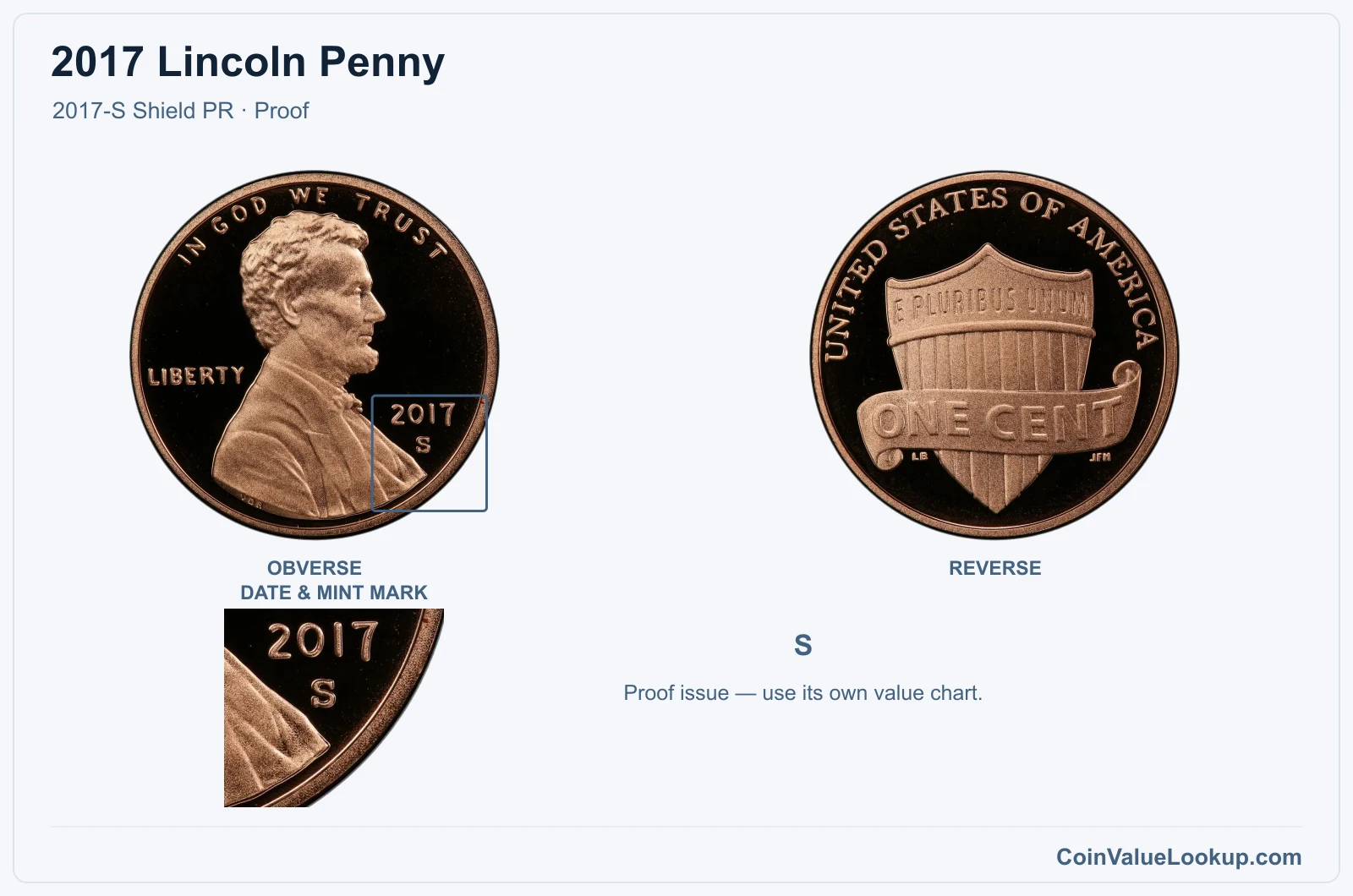
The 2017-S proof cent was struck at San Francisco for collector sets, not for circulation. It features mirror-like fields and sharply struck details that distinguish it immediately from a business strike.
The mintmark is an "S" below the date.
At PR65, a guide estimate is approximately $6.26. These coins should show clean, reflective surfaces with no haze or fingerprints.
Cameo contrast — frosted devices against mirror fields — is a separate consideration from the base proof designation.
Coin Value Lookup is a handy starting point if you want to compare this proof's value against other dates in the Lincoln Shield series.
| Range | Grade | Price | Auction Records | Appraisal |
|---|---|---|---|---|
| PR | PR 1 | — | Coin Identifier | |
| PR 2 | — | Coin Identifier | ||
| PR 3 | — | Coin Identifier | ||
| PR 4 | — | Coin Identifier | ||
| PR 6 | — | Coin Identifier | ||
| PR 8 | — | Coin Identifier | ||
| PR 10 | — | Coin Identifier | ||
| PR 12 | — | Coin Identifier | ||
| PR 15 | — | Coin Identifier | ||
| PR 20 | — | Coin Identifier | ||
| PR 25 | — | Coin Identifier | ||
| PR 30 | — | Coin Identifier | ||
| PR 35 | — | Coin Identifier | ||
| PR 40 | — | Coin Identifier | ||
| PR 45 | — | Coin Identifier | ||
| PR 50 | — | Coin Identifier | ||
| PR 53 | — | Coin Identifier | ||
| PR 55 | — | Coin Identifier | ||
| PR 58 | — | Coin Identifier | ||
| PR 60 | — | Coin Identifier | ||
| PR 61 | — | Coin Identifier | ||
| PR 62 | — | Coin Identifier | ||
| PR 63 | — | Coin Identifier | ||
| PR 64 | — | Coin Identifier | ||
| PR 65 | — | Coin Identifier | ||
| PR 66 | — | Coin Identifier | ||
| PR 67 | — | Coin Identifier | ||
| PR 68 | — | Coin Identifier | ||
| PR 69 | — | Coin Identifier | ||
| PR 70 | — | Coin Identifier |
2017 Lincoln Penny — S Enhanced Uncirculated
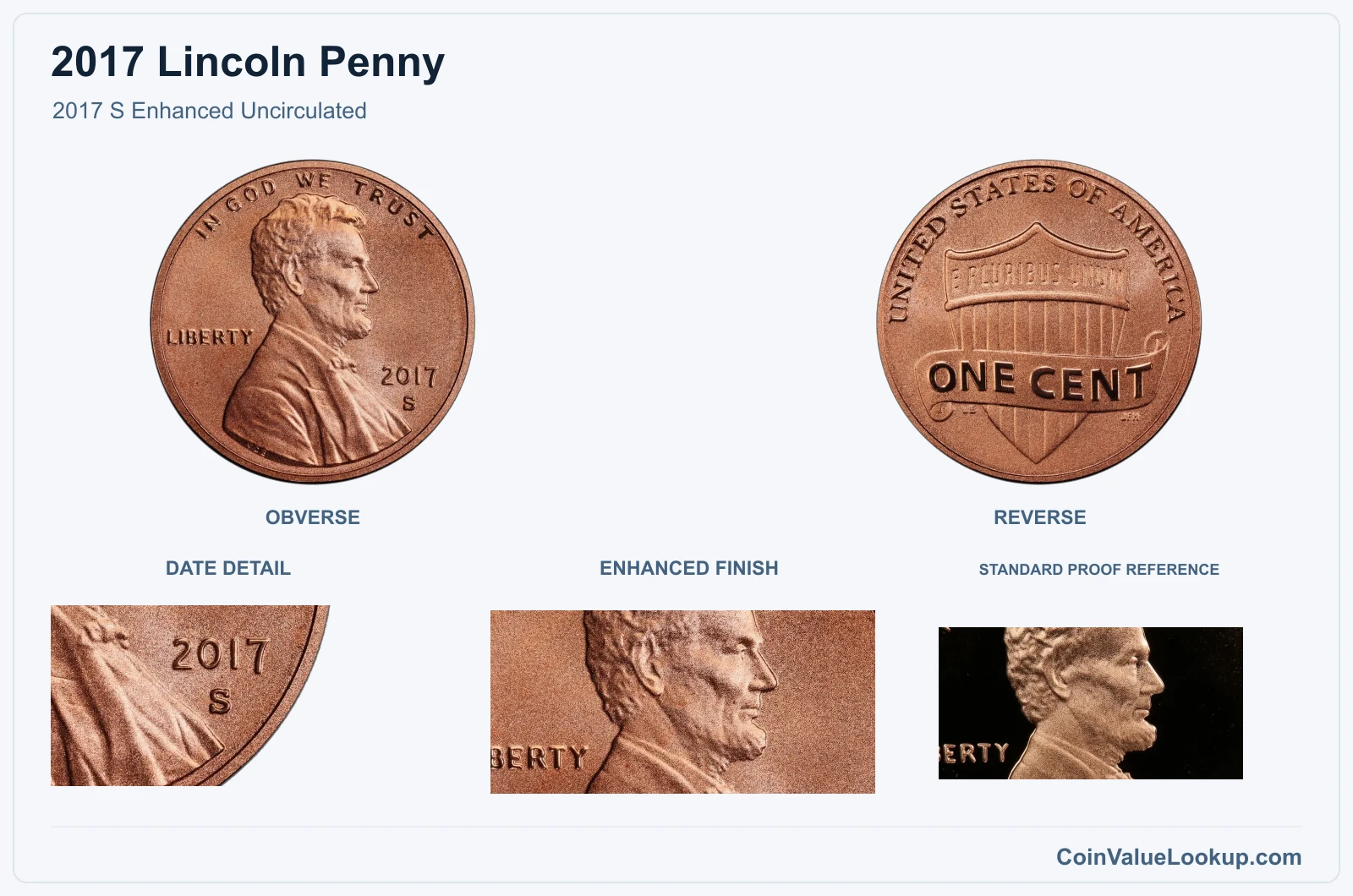
The 2017-S Enhanced Uncirculated cent is a special San Francisco issue included in collector sets that year. It uses a selectively finished striking process that gives it a different look from both the standard S proof and ordinary business strikes.
Do not confuse it with the regular proof — they are separate products.
This coin carries the same copper-plated zinc composition and Union Shield reverse as other 2017 cents, but the surface treatment is the distinguishing feature. No specific guide price has been adopted for this version, so value depends on the individual coin's authenticated identity, condition, and market demand at the time of sale.
If you have one, professional authentication is the practical next step.
Range Grade
Price Auction Records Appraisal SP SP 1
—
Coin Identifier
SP 2
—
Coin Identifier
SP 3
—
Coin Identifier
SP 4
—
Coin Identifier
SP 6
—
Coin Identifier
SP 8
—
Coin Identifier
SP 10
—
Coin Identifier
SP 12
—
Coin Identifier
SP 15
—
Coin Identifier
SP 20
—
Coin Identifier
SP 25
—
Coin Identifier
SP 30
—
Coin Identifier
SP 35
—
Coin Identifier
SP 40
—
Coin Identifier
SP 45
—
Coin Identifier
SP 50
—
Coin Identifier
SP 53
—
Coin Identifier
SP 55
—
Coin Identifier
SP 58
—
Coin Identifier
SP 60
—
Coin Identifier
SP 61
—
Coin Identifier
SP 62
—
Coin Identifier
SP 63
—
Coin Identifier
SP 64
—
Coin Identifier
SP 65
—
Coin Identifier
SP 66
—
Coin Identifier
SP 67
—
Coin Identifier
SP 68
—
Coin Identifier
SP 69
—
Coin Identifier
SP 70
—
Coin Identifier
2017 Lincoln Penny Error List
1. 2017 Lincoln Penny — Doubled Die Obverse
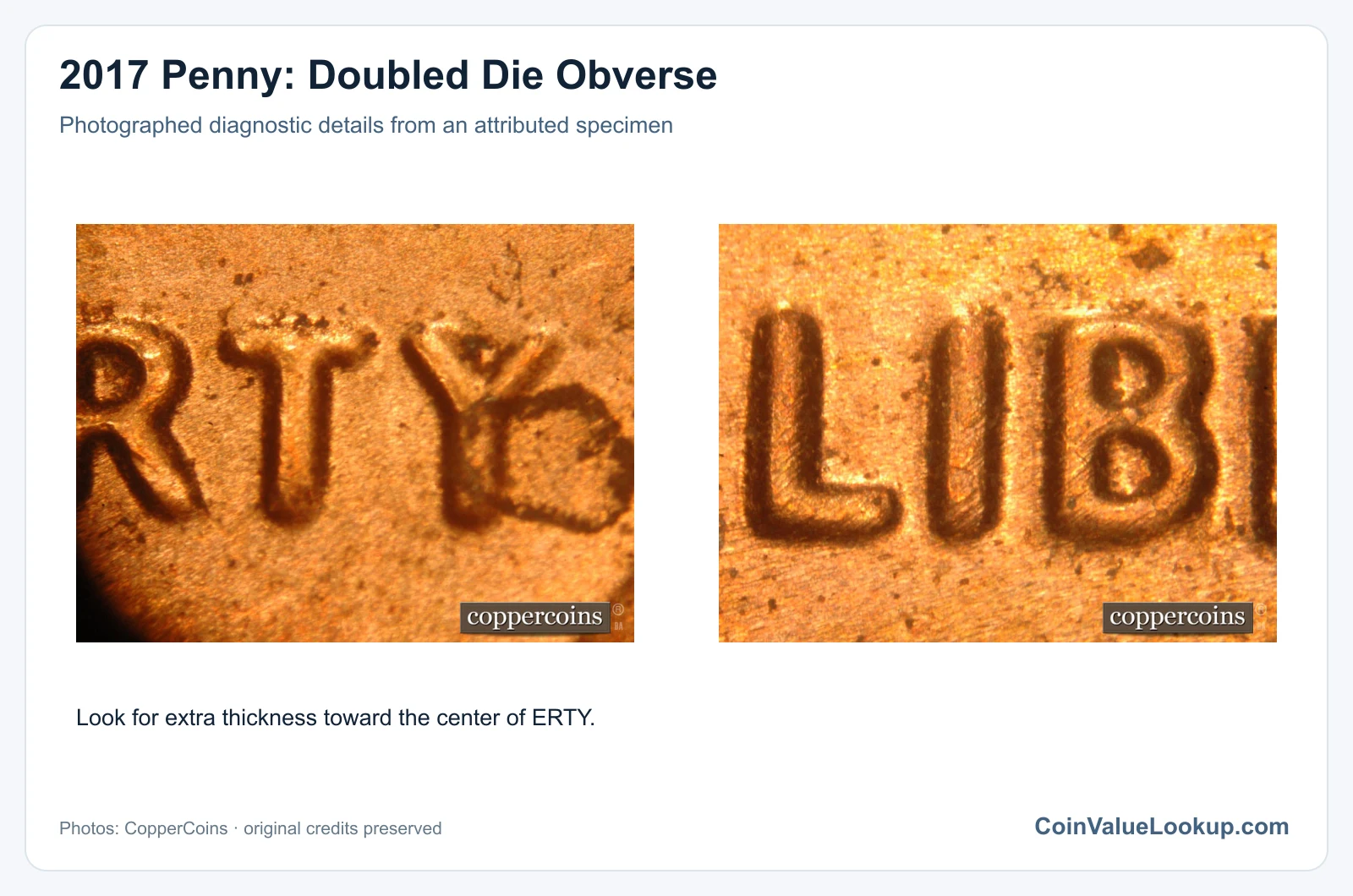
A doubled die obverse on a 2017 Lincoln cent shows consistent doubling on the obverse lettering or design elements — typically visible as separation or notching on letters in LIBERTY or IN GOD WE TRUST. The key word is consistent: every example struck from that die shows the same doubling in the same place.
Under magnification, compare your coin's obverse letters against a normal 2017 cent in similar lighting. Genuine hub doubling produces a distinct secondary image with depth, not just a flat shelf along one side of the letter.
Machine doubling — caused by die bounce during striking — creates a flat, shelf-like distortion that lacks the sharp definition of a true doubled die. Reflections and worn die contours can also mimic doubling.
No specific price has been adopted for this variety; value depends on authentication, the strength of the doubling, and overall coin condition.
2. 2017 Lincoln Penny — Doubled Die Reverse
A doubled die reverse affects the back of the coin — look at ONE CENT, E PLURIBUS UNUM, or the shield lines for signs of consistent separation in the lettering or design contours. The doubling should repeat identically across every coin struck from that same die.
Compare your reverse closely against a normal 2017 cent under magnification. Genuine doubled dies show a clear secondary image with definition, not a mushy spread.
Machine doubling on the reverse looks similar at first glance but tends to produce flat, shelf-like distortion without true separation. Random post-mint damage — nicks, scratches, or corrosion — can also create misleading effects.
No adopted price exists for this variety, so individual value depends on professional authentication, doubling strength, and the coin's overall grade.
3. 2017 Lincoln Penny — Struck-Through Error
A struck-through error happens when foreign material — grease, a fragment of metal, thread, or debris — sits between the die and the planchet during striking. The result is a localized depression or incomplete area in the design where the obstruction blocked the strike.
On a 2017 cent, look for an impression that doesn't match normal wear. A grease-filled die produces a smooth, shallow blank area, while a retained foreign object can leave an impression of whatever got caught.
Don't confuse this with ordinary wear, cleaning scratches, or a weakly struck area from a tired die. Genuine struck-through errors have clear boundaries and sit within otherwise normal surrounding detail.
Value depends on the size, location, and visual drama of the obstruction, plus overall coin condition — professional authentication helps establish what you actually have.
4. 2017 Lincoln Penny — Wrong Planchet / Off-Metal Strike
A wrong-planchet error means the 2017 Lincoln cent dies struck a blank intended for a different denomination or even a different country's coin. These are scarce and dramatic when genuine.
The first check is weight. A normal 2017 cent weighs about 2.50 grams on a 19.05 mm planchet.
If your coin is noticeably heavier, lighter, or a different diameter, that's a starting clue. Look at the edge and the completeness of the design — a smaller planchet won't receive the full impression.
Plating loss, corrosion, acid damage, and deliberate alterations can all make a normal cent look like something exotic. Weigh before you celebrate.
No adopted price exists for this error on the 2017 cent; value is assessed individually based on the authenticated wrong planchet's identity and the coin's condition.
5. 2017 Lincoln Penny — Off-Center Strike
An off-center strike occurs when the planchet isn't properly seated between the dies, so the design prints off to one side, leaving an unstruck crescent of blank metal. The percentage of off-center displacement and whether the date remains visible are the two biggest factors for collector interest.
A 2017 cent struck, say, 10% off-center with a full date is a mild but collectible error. More dramatic shifts — 30% to 50% with the date intact — tend to draw stronger demand.
Don't confuse a clipped planchet or a rim dent with an off-center strike. Clips follow the curve of the original blank, while post-mint damage won't show the characteristic unstruck crescent.
No specific price is adopted for this error; individual coins are assessed by degree of displacement, date visibility, and overall condition.
6. 2017 Lincoln Penny — BIE Die Break
The BIE error is a specific type of die break that creates a small raised vertical line between the letters B and E in LIBERTY on the obverse. It looks a bit like a capital I squeezed in there — hence the name.
On a 2017 cent, inspect LIBERTY under magnification. A genuine BIE is a raised blob or bridge of metal connecting the field between B and E, caused by a crack or chip in the die face.
It should be raised above the surrounding surface, not incised into it.
Dirt, scratches, or glue residue can sit in the same spot and fool you at first glance. If it wipes off or sits below the surface, it's not a die break.
No adopted price exists for this variety; value depends on the size and clarity of the break plus the coin's overall grade and authentication.
7. 2017 Lincoln Penny — Die Break / Cud
A cud is a major die break that reaches the rim of the coin. When a chunk of the die breaks away, the corresponding area on the coin shows a raised, featureless blob of metal connected to the rim, with the normal design missing underneath.
On a 2017 cent, look along the rim on both sides for any raised, smooth lump that displaces part of the legend or design. The boundary between the cud and the normal design should be fairly sharp.
Rim dings from being dropped or run through machines can mimic a cud, but post-mint damage pushes metal inward rather than raising it. Interior die chips that don't connect to the rim are a related but separate category.
No adopted price is available for this error; individual assessment considers the cud's size, location, and the coin's authenticated condition.