1843 Braided Hair Cent Coin Value: How Much Is It Worth?
The 1843 Braided Hair Cent is a copper large cent struck at Philadelphia in three distinct business-strike varieties, plus a rare proof issue. Guide estimates for the ordinary branches range from about $30 in G4 to $2,032 in MS63, depending on which variety you hold.
Identifying the exact variety matters because the price spread between branches is significant even in higher grades.
Fast Way to Identify Your 1843 Braided Hair Cent
The quickest way to start figuring out what you have is to upload clear photos of both the front and back of your coin. Our identifier can give you a preliminary read on the variety and general condition, helping you decide whether deeper research is worthwhile.
Good lighting and a steady shot make all the difference.
1843 Braided Hair Cent Value
Upload both sides of your 1843 Braided Hair Cent.
Front Obverse
Upload photo
Back Reverse
Upload photo
Which 1843 Braided Hair Cent Versions Are Worth Money?
- The Petite Head, Large Letters variety reaches the highest listed guide estimate at about $2,032 in MS63, making it the branch to check first in uncirculated condition.
- Proof Petite Head, Small Letters examples are a separate manufacturing category and require individual professional assessment; no standard guide price is adopted.
- The Petite Head, Small Letters and Mature Head business strikes each list up to about $1,344 in MS63, still well above their shared $30 floor in G4.
- Recognized mint errors such as die breaks, off-center strikes, and laminations on any 1843 cent deserve closer inspection and professional evaluation.
Step 1: Identify Your 1843 Braided Hair Cent Mint Mark and Version
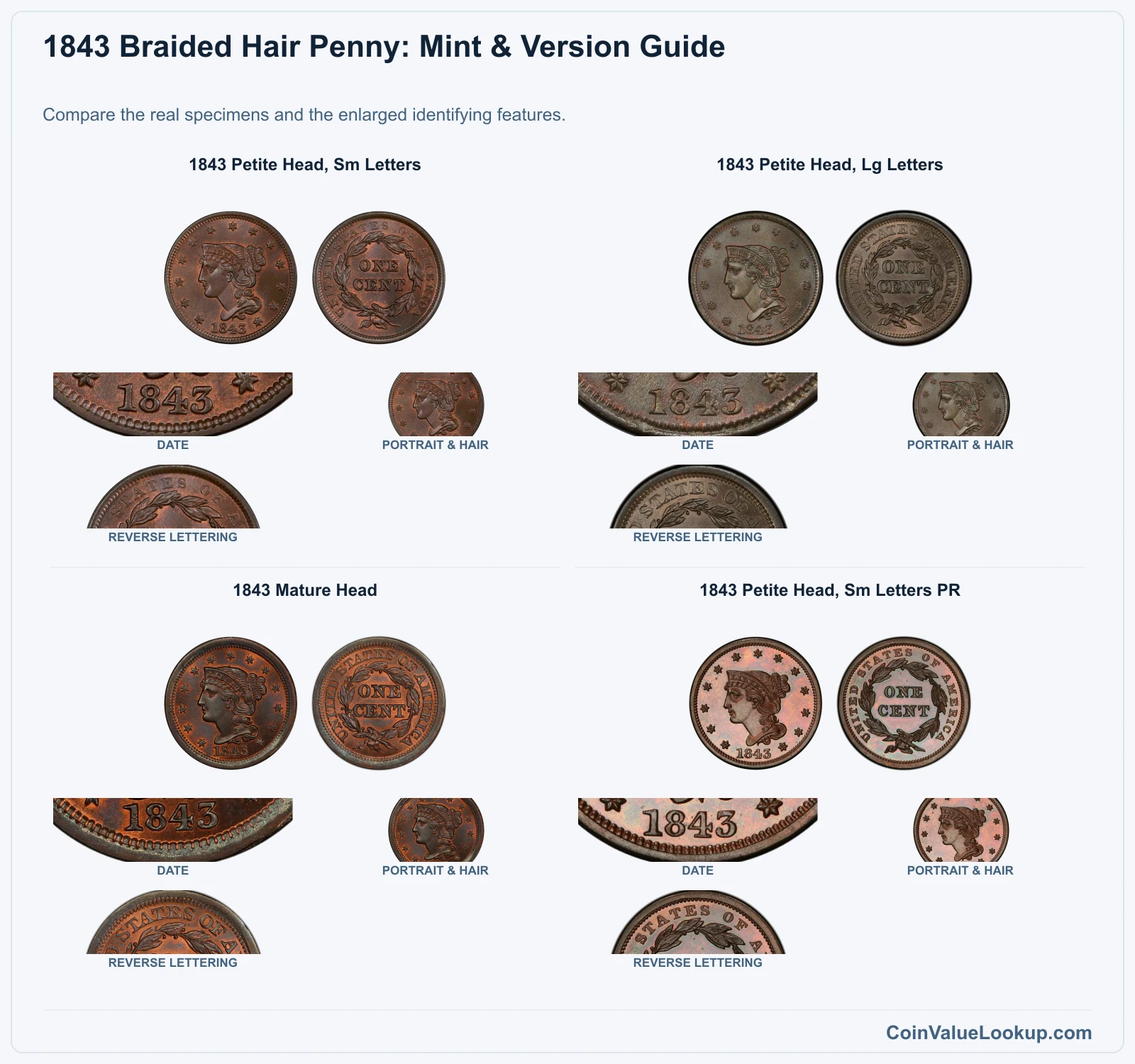
All 1843 Braided Hair Cents were struck at Philadelphia, so none carry a mintmark. The year comes in three business-strike flavors: Petite Head with Small Letters, Petite Head with Large Letters, and Mature Head with Large Letters.
A separate proof version exists for the Petite Head, Small Letters die pair.
The Petite Head portrait is noticeably smaller and more delicate than the Mature Head, which has a bolder, broader face and heavier hair detail. Once you have the head type sorted, compare the reverse legend size.
Small Letters are visibly thinner and more tightly spaced than Large Letters.
Inspect both sides carefully, including the edge. Date-punch shape and wreath details help confirm the correct category.
Weight should be around 10.89 grams for all varieties, but wear, corrosion, and normal production tolerances mean weight alone cannot prove authenticity or variety.
Step 2: Check Your 1843 Braided Hair Cent Grade
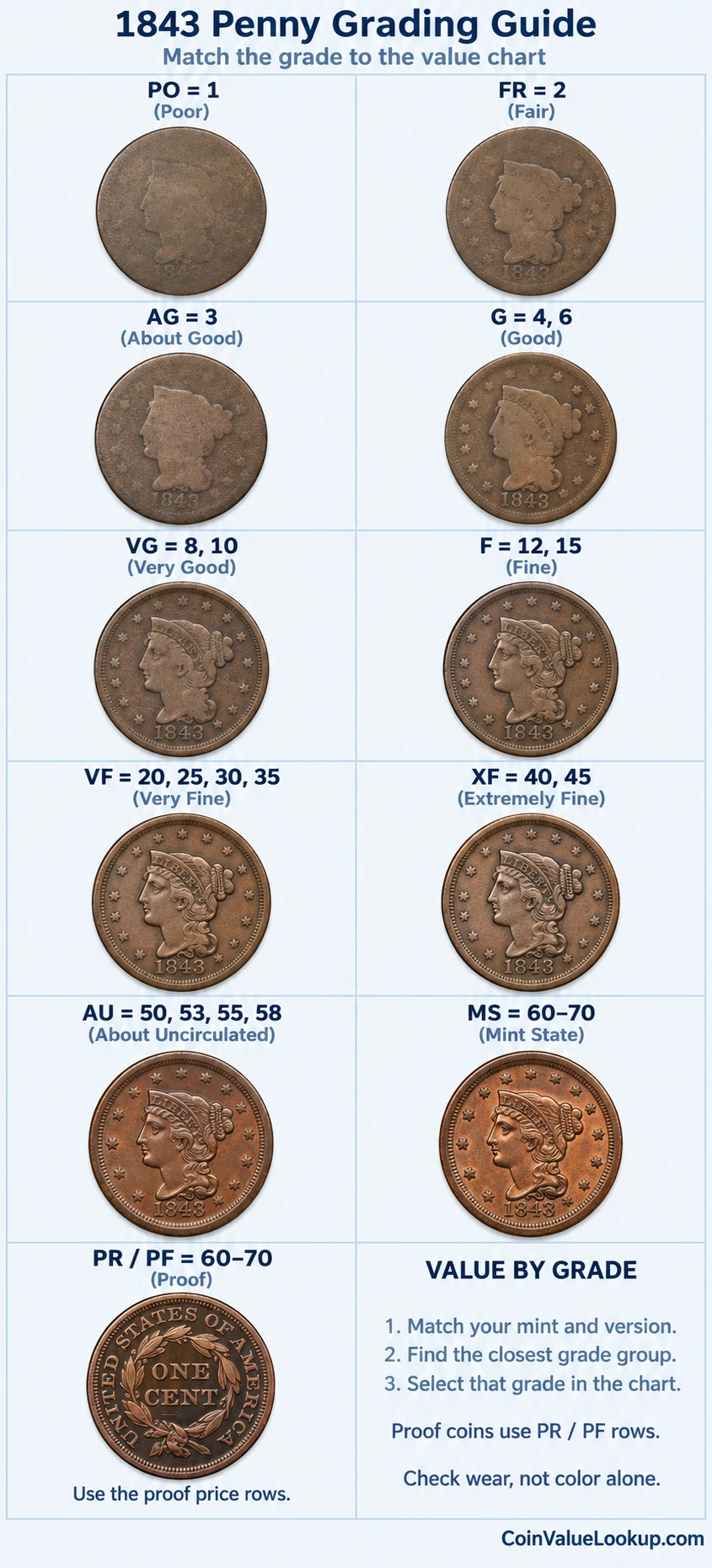
Focus on Liberty's hair above the ear, her cheek, and the braid detail on the obverse. On the reverse, check the sharpness of individual wreath leaves and the crispness of the lettering.
Compare your coin side-by-side with the grade comparison image to get a realistic read.
A well-worn G4 coin will show a smooth portrait outline with almost no hair detail, while an MS63 will have full braid definition and original luster. Copper cents often show mixed brown and red toning, described as BN, RB, or RD.
These are color descriptors, not different metals or automatic grade bumps.
Do not confuse a weak strike with heavy wear. Some 1843 cents left the press soft in spots, and that is a production trait, not circulation damage.
Corrosion, porosity, and old cleanings can all lower a coin's market appeal well below what the technical grade might suggest.
Step 3: Check 1843 Braided Hair Cent Value by Mint and Version
1843 Braided Hair Cent — Petite Head, Sm Letters
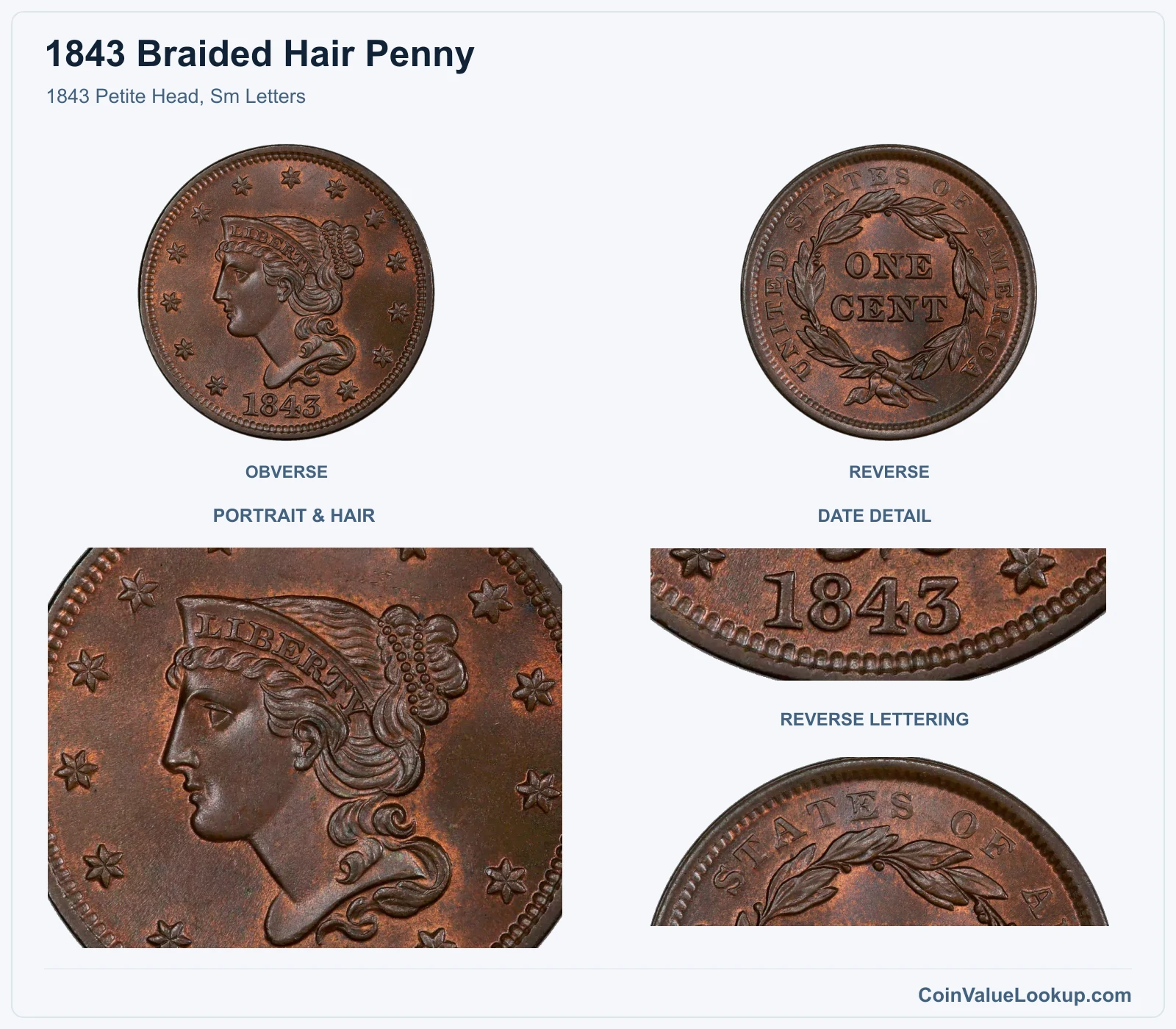
This is the Petite Head paired with Small Letters on the reverse. Liberty's portrait is compact, and the reverse legend uses noticeably thin, closely spaced characters.
All were struck in copper at Philadelphia with no mintmark.
Guide estimates run from roughly $30 in G4 to about $1,344 in MS63. The spread is wide, so accurate grading pays off.
In circulated grades this variety is affordable, but clean, problem-free mint-state examples carry a real premium.
| Range | Grade | Price | Auction Records | Appraisal |
|---|---|---|---|---|
| PO | PO 1 | — | Coin Identifier | |
| FR | FR 2 | — | Coin Identifier | |
| AG | AG 3 | — | Coin Identifier | |
| G | G 4 | — | Coin Identifier | |
| G 6 | — | Coin Identifier | ||
| VG | VG 8 | — | Coin Identifier | |
| VG 10 | — | Coin Identifier | ||
| F | F 12 | Coin Identifier | ||
| F 15 | Coin Identifier | |||
| VF | VF 20 | Coin Identifier | ||
| VF 25 | Coin Identifier | |||
| VF 30 | Coin Identifier | |||
| VF 35 | Coin Identifier | |||
| XF | XF 40 | Coin Identifier | ||
| XF 45 | Coin Identifier | |||
| AU | AU 50 | Coin Identifier | ||
| AU 53 | Coin Identifier | |||
| AU 55 | Coin Identifier | |||
| AU 58 | Coin Identifier | |||
| MS | MS 60 | — | Coin Identifier | |
| MS 61 | Coin Identifier | |||
| MS 62 | Coin Identifier | |||
| MS 63 | Coin Identifier | |||
| MS 64 | Coin Identifier | |||
| MS 65 | Coin Identifier | |||
| MS 66 | Coin Identifier | |||
| MS 67 | — | — | — | |
| MS 68 | — | — | — | |
| MS 69 | — | — | — | |
| MS 70 | — | — | — |
1843 Braided Hair Cent — Petite Head, Lg Letters
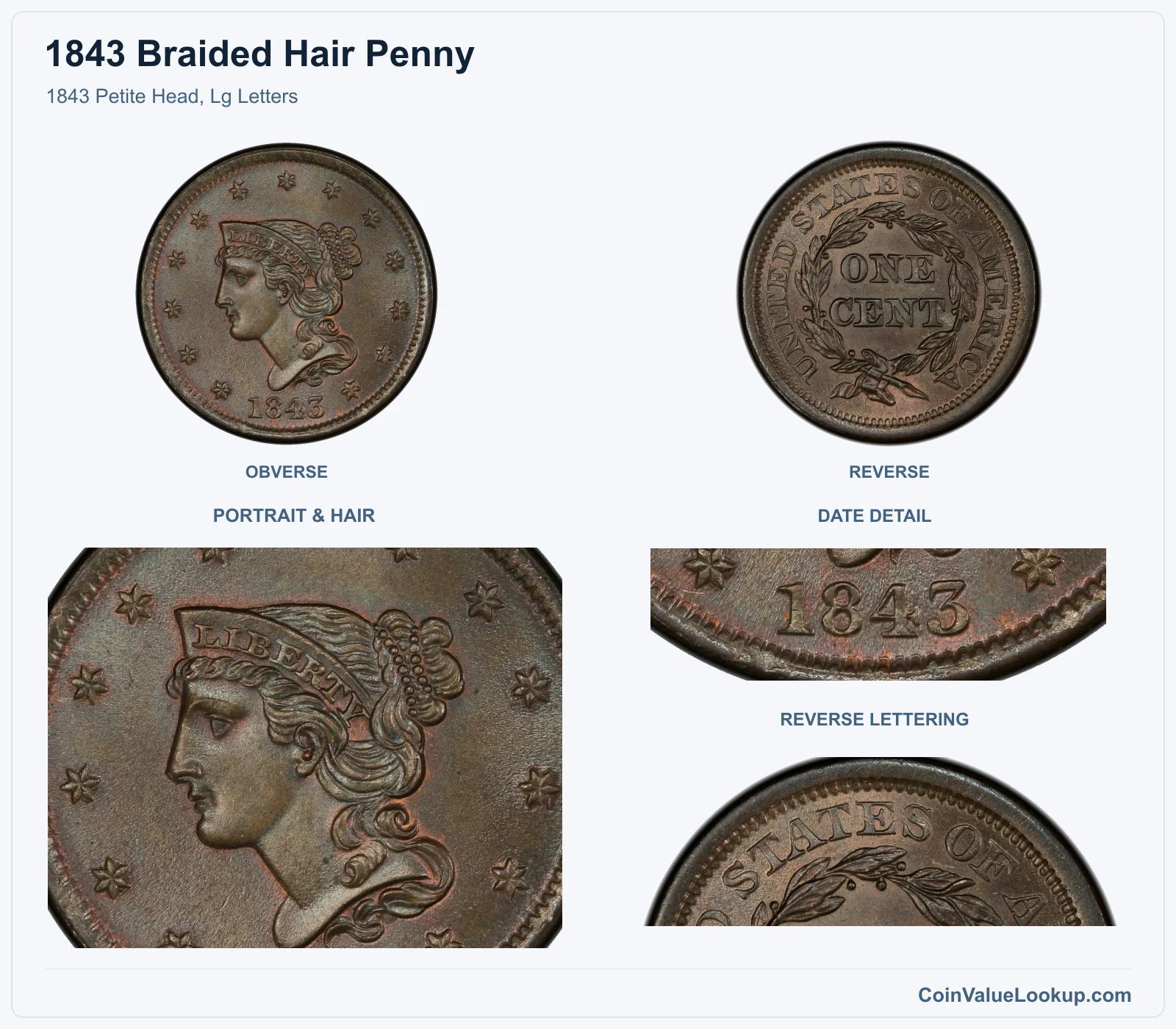
Same Petite Head obverse, but the reverse legend switches to visibly larger, bolder letters. That reverse letter size is the key diagnostic; flip the coin over and the difference from the Small Letters version is obvious once you know to look.
Guide estimates range from about $30 in G4 up to approximately $2,032 in MS63, the highest listed figure among the 1843 business-strike varieties. The jump in value at the top end likely reflects the combination of variety demand and the difficulty of finding fully original uncirculated copper from this era.
Coin Value Lookup is a handy starting point if you want to compare this variety against other Braided Hair dates or different denominations altogether.
| Range | Grade | Price | Auction Records | Appraisal |
|---|---|---|---|---|
| PO | PO 1 | — | Coin Identifier | |
| FR | FR 2 | — | Coin Identifier | |
| AG | AG 3 | — | Coin Identifier | |
| G | G 4 | — | Coin Identifier | |
| G 6 | — | Coin Identifier | ||
| VG | VG 8 | — | Coin Identifier | |
| VG 10 | — | Coin Identifier | ||
| F | F 12 | — | Coin Identifier | |
| F 15 | — | Coin Identifier | ||
| VF | VF 20 | Coin Identifier | ||
| VF 25 | — | Coin Identifier | ||
| VF 30 | Coin Identifier | |||
| VF 35 | — | Coin Identifier | ||
| XF | XF 40 | Coin Identifier | ||
| XF 45 | Coin Identifier | |||
| AU | AU 50 | Coin Identifier | ||
| AU 53 | — | Coin Identifier | ||
| AU 55 | Coin Identifier | |||
| AU 58 | Coin Identifier | |||
| MS | MS 60 | — | Coin Identifier | |
| MS 61 | Coin Identifier | |||
| MS 62 | Coin Identifier | |||
| MS 63 | Coin Identifier | |||
| MS 64 | Coin Identifier | |||
| MS 65 | Coin Identifier | |||
| MS 66 | — | Coin Identifier | ||
| MS 67 | — | — | — | |
| MS 68 | — | — | — | |
| MS 69 | — | — | — | |
| MS 70 | — | — | — |
1843 Braided Hair Cent — Mature Head
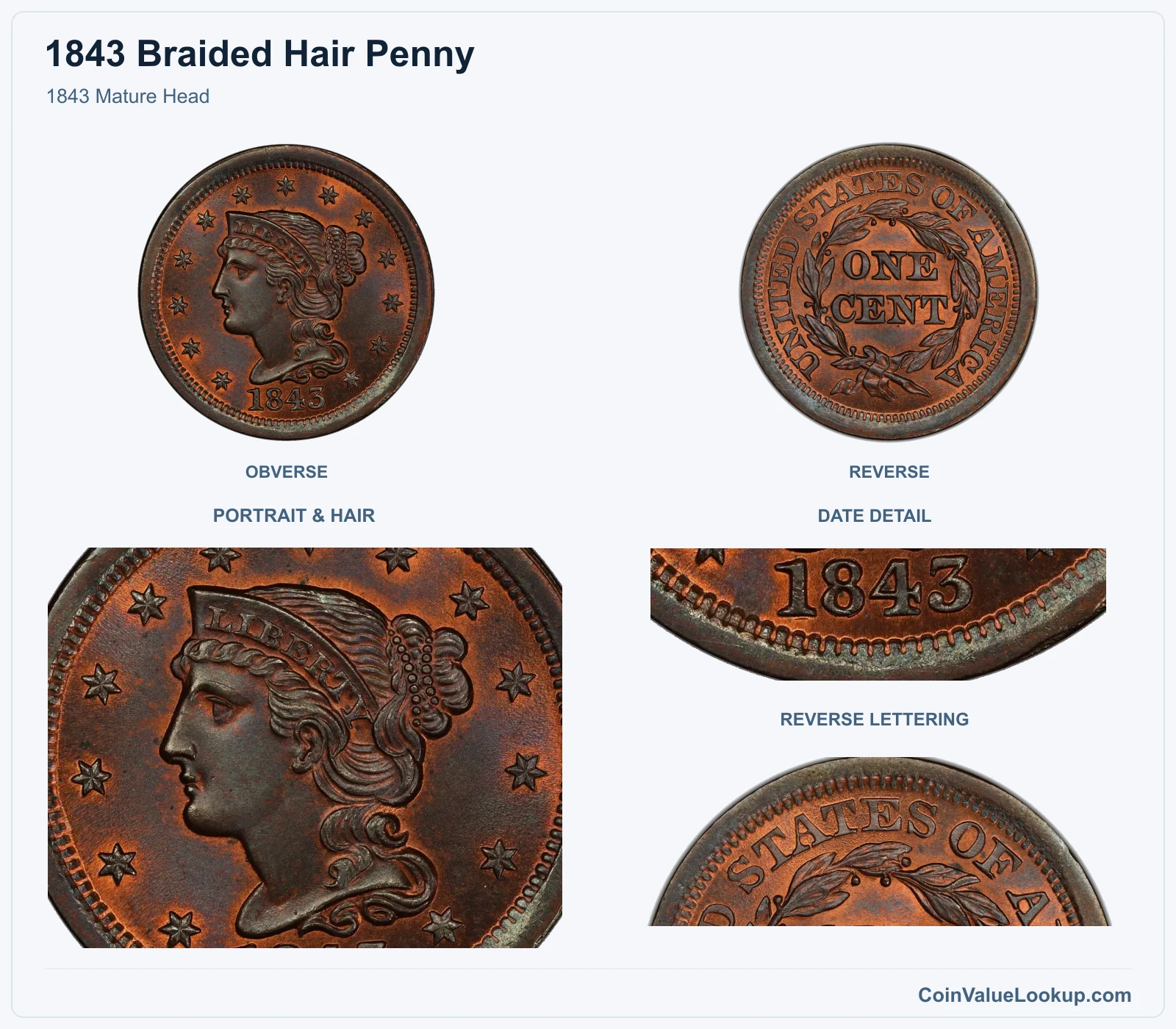
The Mature Head is a distinctly different portrait from the Petite Head. Liberty's face is broader and more boldly rendered, with heavier hair strands and a larger overall bust.
The reverse uses Large Letters, matching the Petite Head, Large Letters reverse style, so the obverse portrait is the deciding factor.
Guide values sit at roughly $30 in G4 and climb to about $1,344 in MS63. In lower grades, all three business-strike varieties share the same ballpark, but the Mature Head diverges from the Petite Large Letters branch as you approach uncirculated territory.
| Range | Grade | Price | Auction Records | Appraisal |
|---|---|---|---|---|
| PO | PO 1 | — | Coin Identifier | |
| FR | FR 2 | — | Coin Identifier | |
| AG | AG 3 | — | Coin Identifier | |
| G | G 4 | — | Coin Identifier | |
| G 6 | — | Coin Identifier | ||
| VG | VG 8 | — | Coin Identifier | |
| VG 10 | — | Coin Identifier | ||
| F | F 12 | — | Coin Identifier | |
| F 15 | — | Coin Identifier | ||
| VF | VF 20 | Coin Identifier | ||
| VF 25 | Coin Identifier | |||
| VF 30 | — | Coin Identifier | ||
| VF 35 | Coin Identifier | |||
| XF | XF 40 | Coin Identifier | ||
| XF 45 | Coin Identifier | |||
| AU | AU 50 | Coin Identifier | ||
| AU 53 | Coin Identifier | |||
| AU 55 | Coin Identifier | |||
| AU 58 | Coin Identifier | |||
| MS | MS 60 | Coin Identifier | ||
| MS 61 | — | Coin Identifier | ||
| MS 62 | Coin Identifier | |||
| MS 63 | Coin Identifier | |||
| MS 64 | Coin Identifier | |||
| MS 65 | Coin Identifier | |||
| MS 66 | — | — | — | |
| MS 67 | — | — | — | |
| MS 68 | — | — | — | |
| MS 69 | — | — | — | |
| MS 70 | — | — | — |
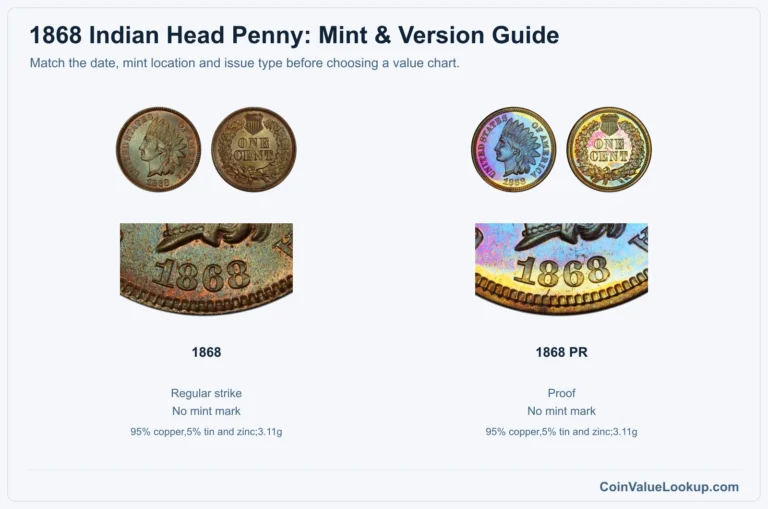
1843 Braided Hair Cent — Petite Head, Sm Letters PR
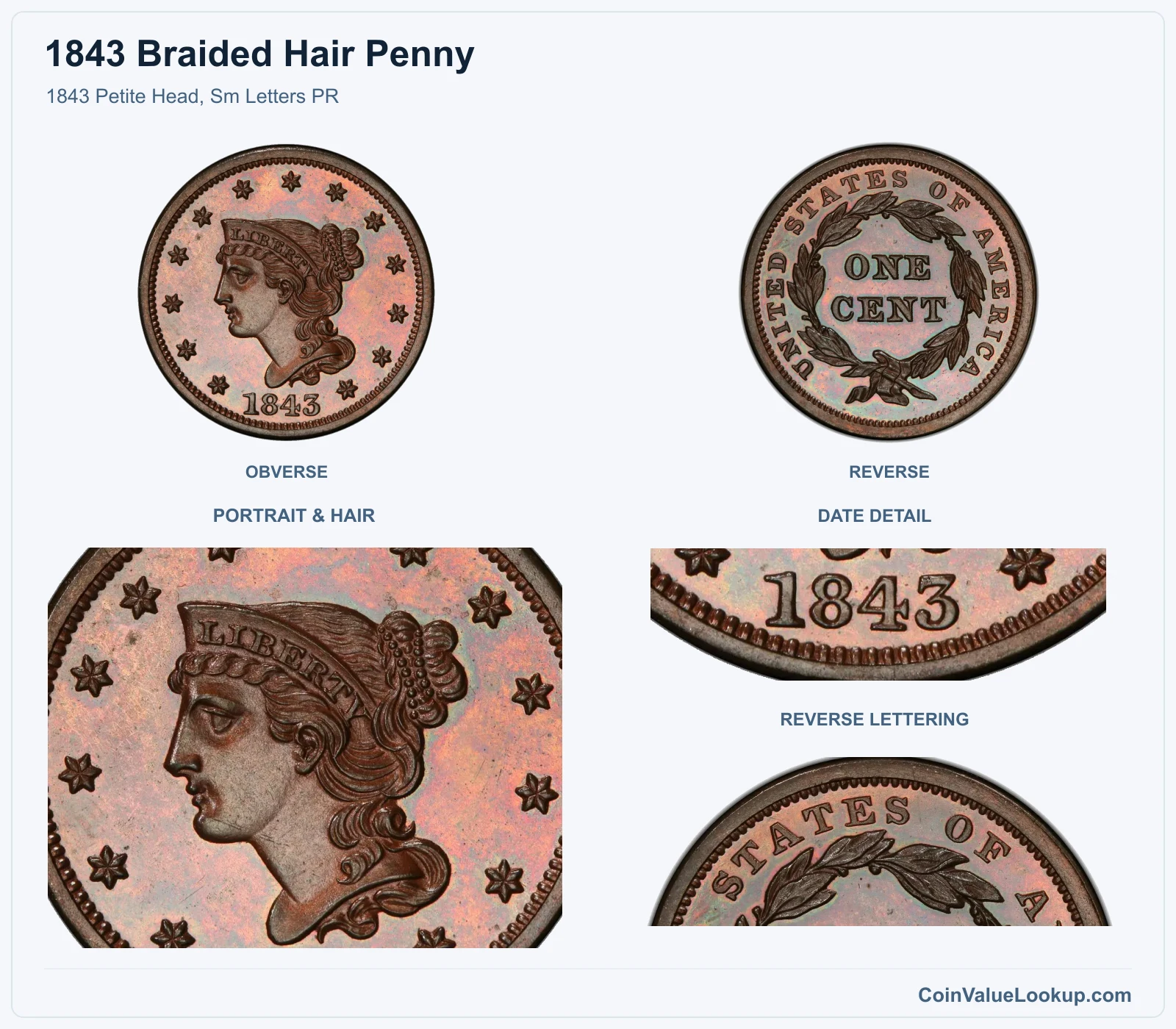
This is the proof version of the Petite Head, Small Letters die pairing. Proof is a method of manufacture, not a grade above Mint State.
Genuine proofs were struck on specially prepared planchets with polished dies, producing sharp rims, full detail, and mirror-like fields.
No standard guide price is adopted for this issue. Each example requires individual professional assessment based on authenticated identity, surface quality, and overall condition.
A polished or cleaned business strike is not a proof, no matter how shiny it looks. Die characteristics, rim structure, and surface texture all factor into proper attribution.
If you suspect you have one, third-party certification is the prudent next step.
| Range | Grade | Price | Auction Records | Appraisal |
|---|---|---|---|---|
| PR | PR 1 | — | Coin Identifier | |
| PR 2 | — | Coin Identifier | ||
| PR 3 | — | Coin Identifier | ||
| PR 4 | — | Coin Identifier | ||
| PR 6 | — | Coin Identifier | ||
| PR 8 | — | Coin Identifier | ||
| PR 10 | — | Coin Identifier | ||
| PR 12 | — | Coin Identifier | ||
| PR 15 | — | Coin Identifier | ||
| PR 20 | — | Coin Identifier | ||
| PR 25 | — | Coin Identifier | ||
| PR 30 | — | Coin Identifier | ||
| PR 35 | — | Coin Identifier | ||
| PR 40 | — | Coin Identifier | ||
| PR 45 | — | Coin Identifier | ||
| PR 50 | — | Coin Identifier | ||
| PR 53 | — | Coin Identifier | ||
| PR 55 | — | Coin Identifier | ||
| PR 58 | — | Coin Identifier | ||
| PR 60 | — | Coin Identifier | ||
| PR 61 | — | Coin Identifier | ||
| PR 62 | — | Coin Identifier | ||
| PR 63 | Coin Identifier | |||
| PR 64 | Coin Identifier | |||
| PR 65 | — | Coin Identifier | ||
| PR 66 | — | Coin Identifier | ||
| PR 67 | — | — | — | |
| PR 68 | — | — | — | |
| PR 69 | — | — | — | |
| PR 70 | — | — | — |
1843 Braided Hair Cent Error List
1. 1843 Braided Hair Cent — Lamination / Split Planchet
A lamination error shows peeling metal, a retained flap, or visible separation within the copper planchet. On an 1843 cent, look for a layer lifting away from the surface, sometimes folded back, sometimes missing entirely and leaving a recessed void.
Photograph the edge and the affected face together so the depth and extent are clear. This kind of error occurs when impurities or gas pockets trapped during planchet production cause the metal to split apart under striking pressure.
Do not confuse lamination with scraping damage, active corrosion, or a deliberately cut coin. Post-mint damage tends to show tool marks or irregular edges, while a genuine lamination follows the contour of the planchet.
No standard price is adopted for this error; value depends on the severity, the underlying variety, and the coin's authenticated condition.
2. 1843 Braided Hair Cent — Die Crack
Die cracks appear as raised, irregular lines running across the coin's fields or devices. They form when a working die develops a fracture, and that fracture transfers as a raised ridge onto every coin struck afterward.
To confirm a die crack on your 1843 cent, look for a line that sits above the surrounding surface, not scratched into it. An incuse scratch, corrosion channel, or tool mark will be recessed or rough, not raised.
Photograph the full coin with the date visible and then get a tight closeup of the crack itself.
No adopted price range exists for this error. The value of a die-cracked 1843 cent depends on the crack's size, location, the specific variety, and the coin's overall grade and surface quality.
Professional evaluation is recommended for prominent examples.
3. 1843 Braided Hair Cent — Die Break / Cud
A cud is a specific type of die break where a piece of the die rim chips away completely, leaving a raised, featureless blob of metal that connects to the coin's rim. Smaller interior die breaks can also occur but do not qualify as true cuds.
On an 1843 Braided Hair Cent, check the rim area carefully. A cud will interrupt the normal design and show a smooth, raised mass with a clear boundary where the design resumes.
Do not mistake a rim dent, corrosion buildup, or a small interior die chip for a cud. Rim damage from circulation is recessed or uneven, while a cud is always raised and uniform.
No standard price is adopted. A cud's collectibility depends on its size, position, and how much design it displaces, along with the host coin's variety and condition.
4. 1843 Braided Hair Cent — Off-Center Strike
An off-center strike happens when the planchet is not properly seated between the dies at the moment of striking. The result is a displaced design with an unstruck crescent of blank metal on one side.
The key collecting criterion is whether the date remains fully visible. An 1843 cent struck noticeably off center with a readable date is far more desirable than one where the date has shifted out of the field entirely.
Photograph both sides so the extent of displacement is clear.
Watch out for lookalikes. A straight-clipped planchet removes metal before striking, while post-mint flattening or vise damage can push the design off in a way that mimics misalignment.
Genuine off-center errors show consistent design displacement on both faces. No adopted price exists; each piece is evaluated individually based on the percentage off center, date visibility, variety, and overall condition.