1852 Braided Hair Cent Coin Value: How Much Is It Worth?
The 1852 Braided Hair Cent is a copper large cent struck at Philadelphia, and guide estimates for ordinary business strikes range from about $30 in G4 to $437 in MS63 according to USA Coin Book. That is not the full market picture.
Proof examples and major mint errors require individual assessment, so identifying your exact variety is the essential first step.
Fast Way to Identify Your 1852 Braided Hair Cent
Snap clear photos of the front and back of your 1852 cent and upload them for a preliminary identification. Good lighting at a slight angle helps capture hair detail and surface condition.
This quick step can narrow down whether you have an ordinary business strike, a possible proof, or something with a mint error worth investigating further.
1852 Braided Hair Cent Value
Upload both sides of your 1852 Braided Hair Cent.
Front Obverse
Upload photo
Back Reverse
Upload photo
Which 1852 Braided Hair Cent Versions Are Worth Money?
- Business strikes range from roughly $30 in G4 to $437 in MS63 per USA Coin Book; original surfaces and sharp detail drive the higher end.
- Proof 1852 cents exist but require expert attribution of die characteristics and surfaces; no standard guide price is adopted, so individual assessment is essential.
- Mint errors such as off-center strikes or clipped planchets on this date are reported and can carry premiums that depend on severity and authentication.
- Coins with full braid detail, original color, and no cleaning or corrosion command stronger prices within any grade level.
Step 1: Identify Your 1852 Braided Hair Cent Mint Mark and Version
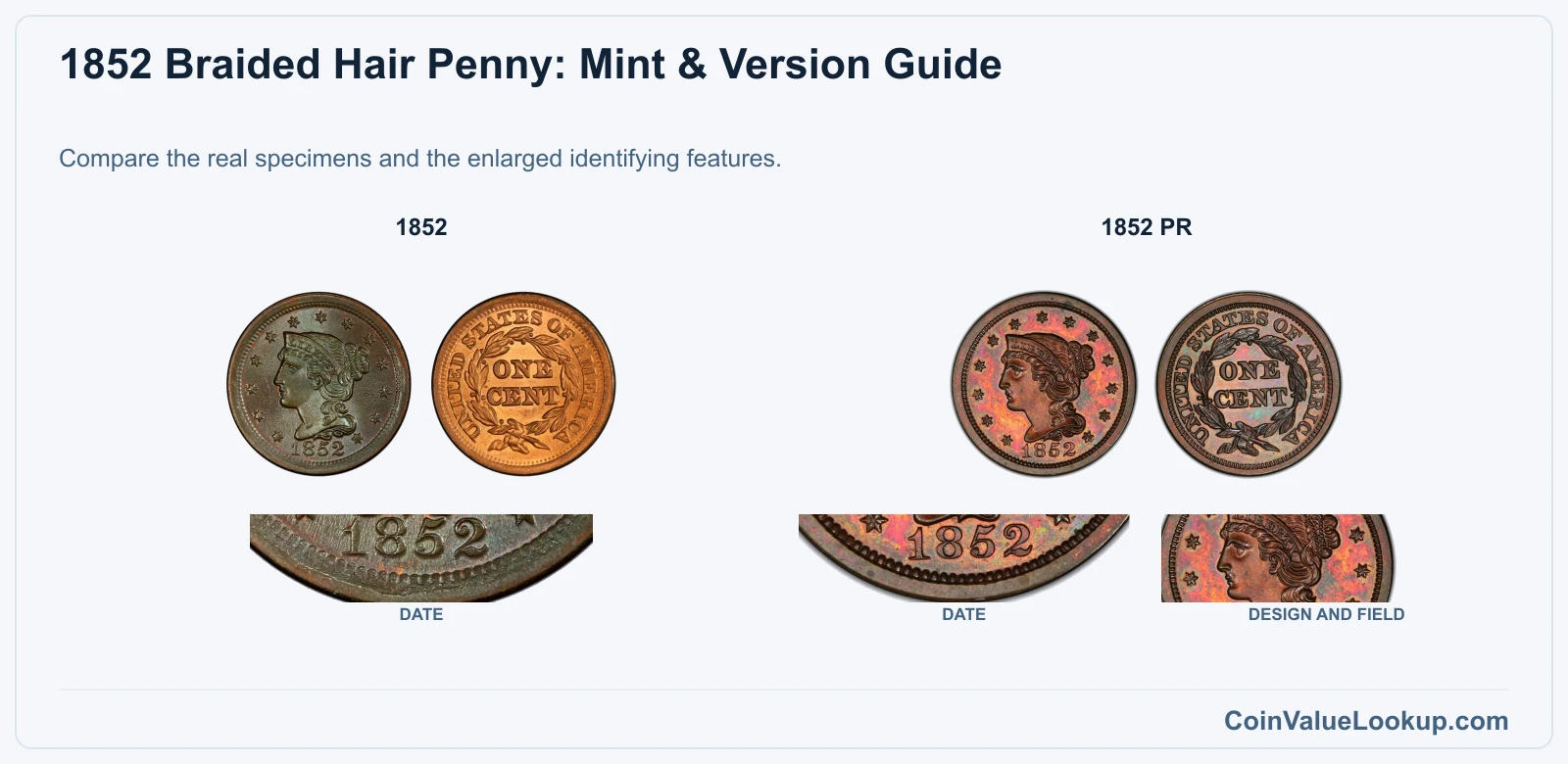
The 1852 Braided Hair Cent shows Liberty facing left with her hair gathered in a braided bun, surrounded by thirteen stars and the date below. The reverse displays the denomination ONE CENT inside a laurel wreath.
All 1852 cents were struck at Philadelphia, so there is no mintmark to look for.
Do not assume any branch-mint varieties exist for this date. If someone tells you they have an 1852 cent with a mintmark, that coin is either misidentified or altered.
Look at the date punch style, the legend wording, and the wreath details on both sides. These can help you confirm you actually have a Braided Hair cent and not a similar-looking earlier type.
Weight should be around 10.89 grams in copper, but wear, corrosion, and normal production tolerances mean weight alone cannot prove authenticity.
Separate ordinary business strikes from proofs by examining the surfaces and rim characteristics, not just shininess. A polished coin is not a proof.
Proof status is a manufacturing category requiring attribution of die characteristics, surface quality, and rim finish.
Step 2: Check Your 1852 Braided Hair Cent Grade
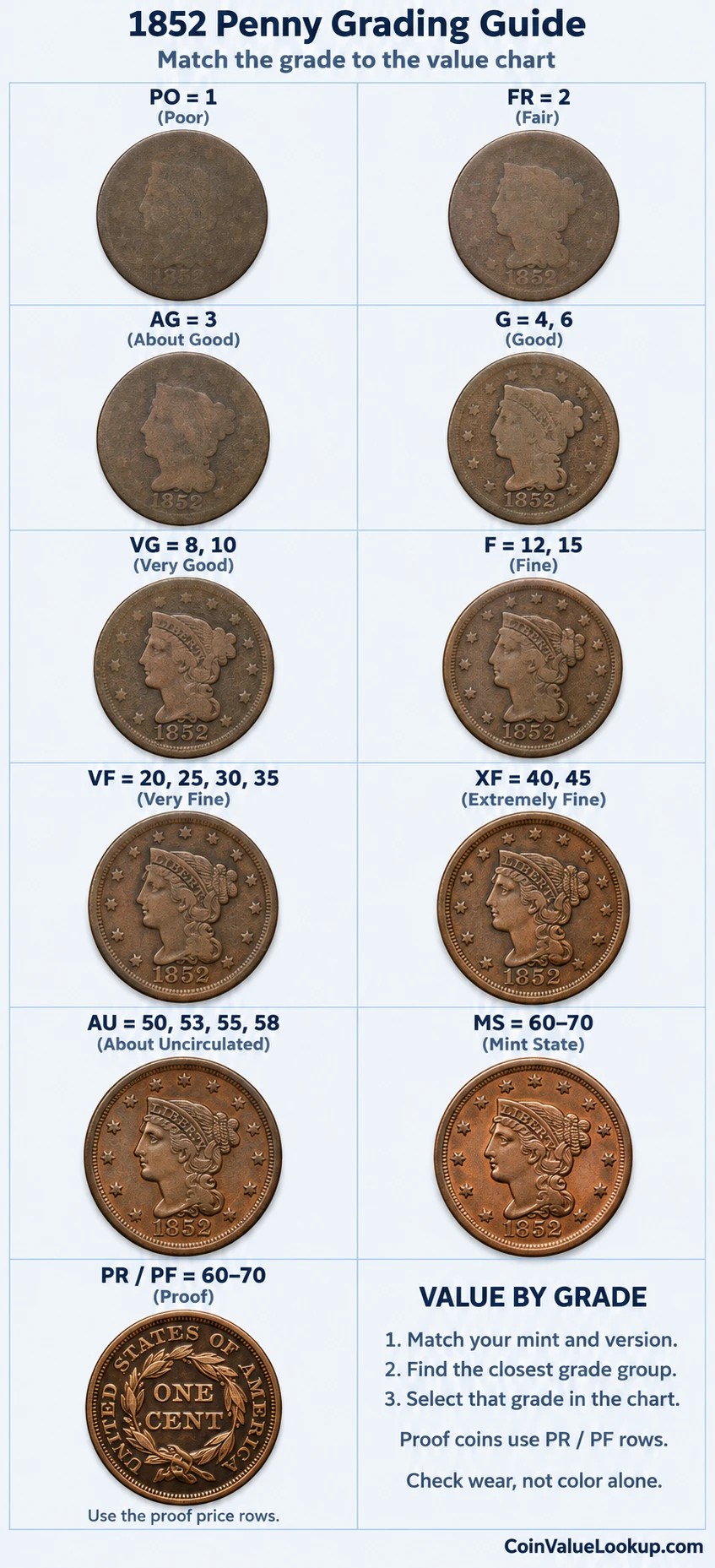
Start with the portrait. On a well-worn example the hair above Liberty's ear will be flat, and the braid detail nearly gone.
A mid-grade coin retains most braid strands and some cheek definition, while a mint-state piece shows full hair detail with original luster.
Flip to the reverse and check the wreath leaves. Individual leaf veins vanish early in circulation, so their presence signals a higher grade.
Compare your coin against the reference image to see where your wear pattern falls.
Don't confuse a weak strike with honest wear. A weakly struck coin may look worn on the high points but show no actual contact marks or edge rounding.
Corrosion and porosity also mimic wear but leave pitted or rough surfaces that hurt market value regardless of remaining detail.
On copper cents, color designations like BN, RB, and RD describe how much original red remains. They are color attributes, not separate alloys or grade levels.
A brown coin can still be high grade if the detail and surfaces are strong.
Step 3: Check 1852 Braided Hair Cent Value by Mint and Version
1852 Braided Hair Cent
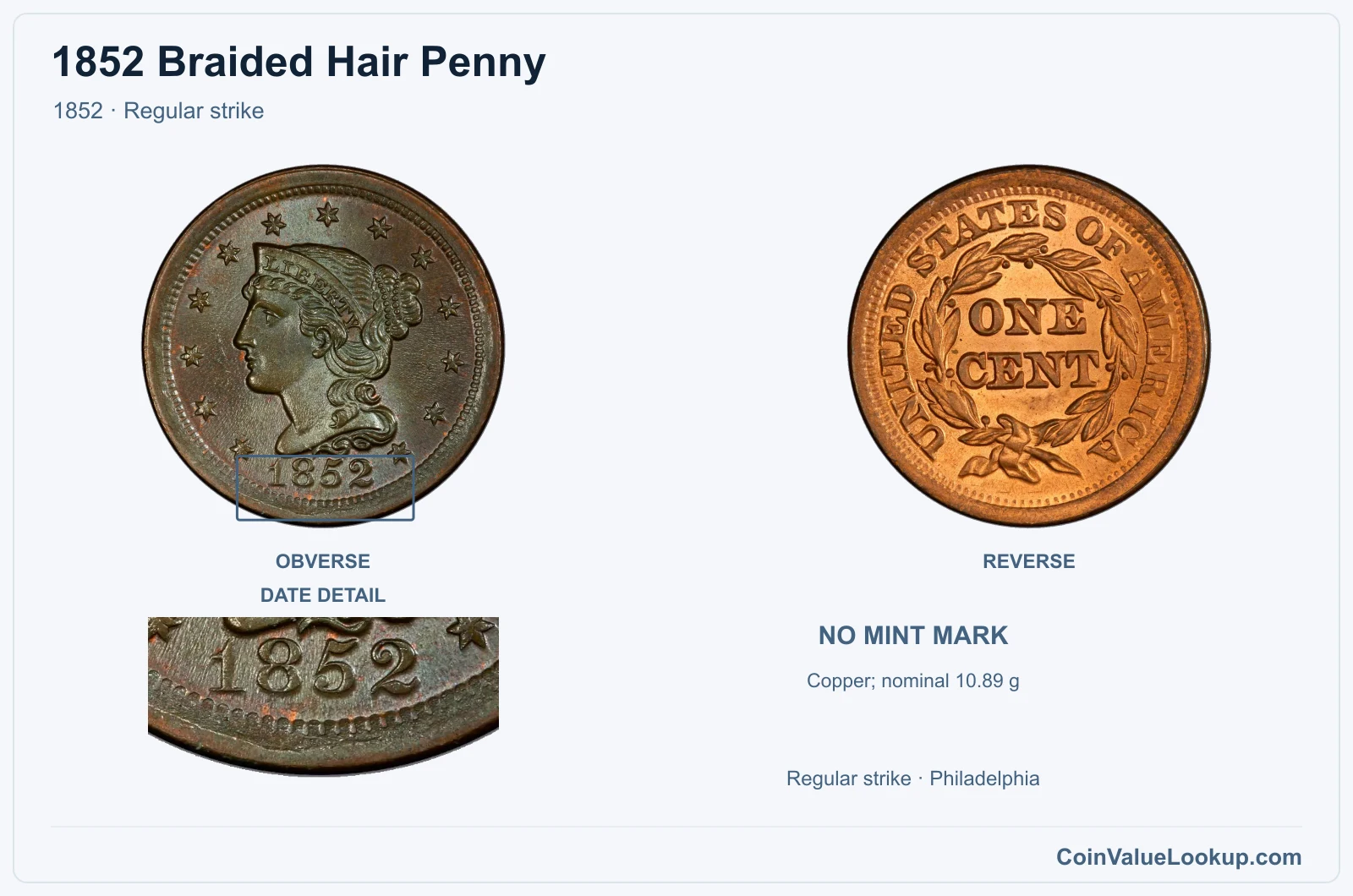
The standard 1852 Braided Hair Cent is a copper business strike from Philadelphia, weighing nominally 10.89 grams. No mintmark appears on this date.
USA Coin Book lists guide estimates from about $30 in G4 up to $437 in MS63.
To confirm you have the right type, match Liberty's braided portrait on the obverse and the ONE CENT wreath on the reverse. Original surfaces matter more than brightness.
A cleaned or corroded coin with strong detail will still lag behind one with natural, undisturbed patina in the same technical grade.
| Range | Grade | Price | Auction Records | Appraisal |
|---|---|---|---|---|
| PO | PO 1 | — | Coin Identifier | |
| FR | FR 2 | — | Coin Identifier | |
| AG | AG 3 | — | Coin Identifier | |
| G | G 4 | — | Coin Identifier | |
| G 6 | — | Coin Identifier | ||
| VG | VG 8 | Coin Identifier | ||
| VG 10 | — | Coin Identifier | ||
| F | F 12 | — | Coin Identifier | |
| F 15 | — | Coin Identifier | ||
| VF | VF 20 | Coin Identifier | ||
| VF 25 | Coin Identifier | |||
| VF 30 | Coin Identifier | |||
| VF 35 | Coin Identifier | |||
| XF | XF 40 | Coin Identifier | ||
| XF 45 | Coin Identifier | |||
| AU | AU 50 | Coin Identifier | ||
| AU 53 | Coin Identifier | |||
| AU 55 | Coin Identifier | |||
| AU 58 | Coin Identifier | |||
| MS | MS 60 | Coin Identifier | ||
| MS 61 | Coin Identifier | |||
| MS 62 | Coin Identifier | |||
| MS 63 | Coin Identifier | |||
| MS 64 | Coin Identifier | |||
| MS 65 | Coin Identifier | |||
| MS 66 | Coin Identifier | |||
| MS 67 | Coin Identifier | |||
| MS 68 | — | — | — | |
| MS 69 | — | — | — | |
| MS 70 | — | — | — |
1852 Braided Hair Cent — PR
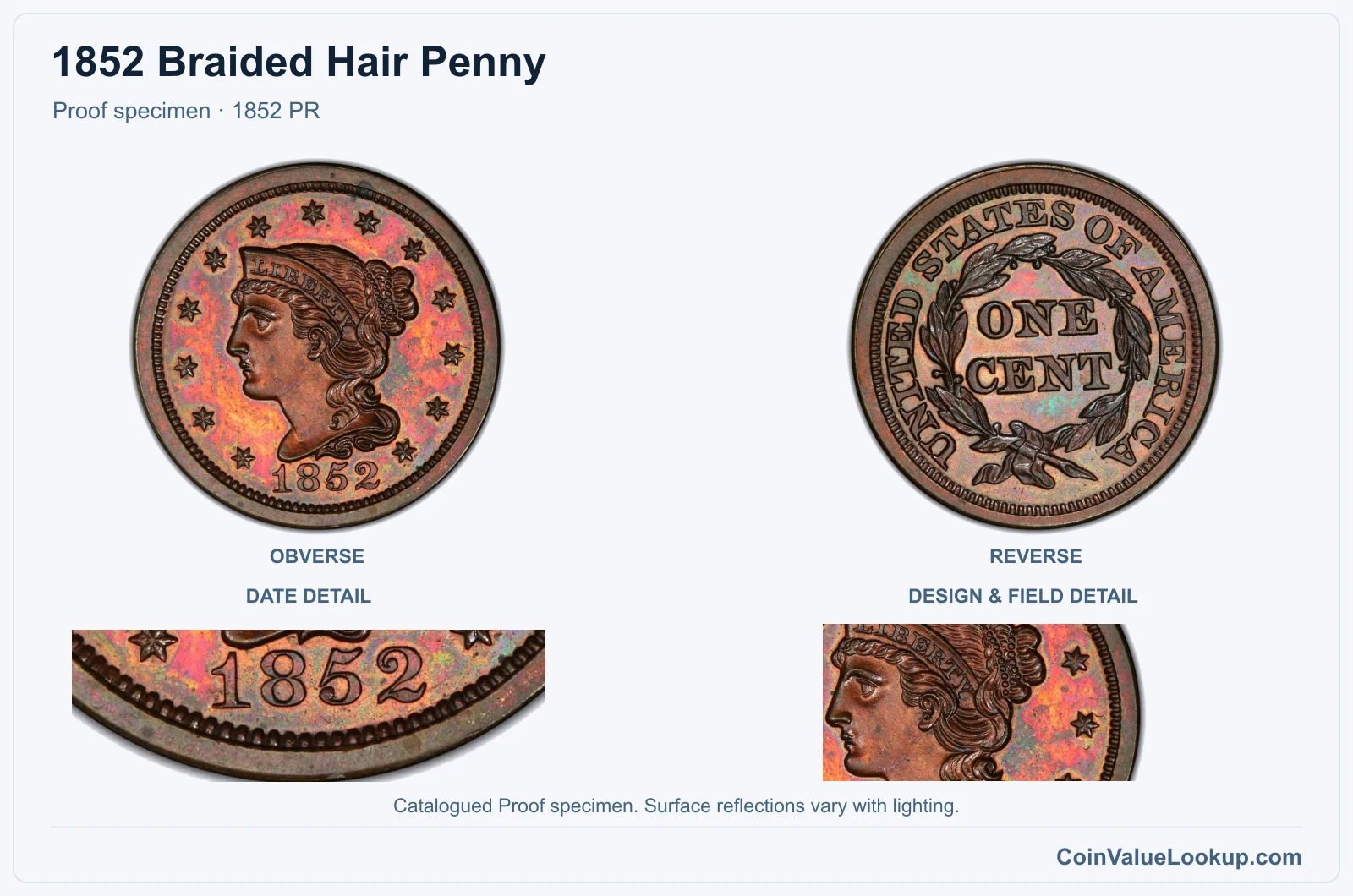
Proof versions of the 1852 Braided Hair Cent were produced at Philadelphia, also in copper at the same nominal weight. These are genuinely rare coins, and no standard numeric price range is adopted here because each example must be evaluated on its own merits.
A real proof shows squared, mirrored rims, reflective fields, and sharp design elements produced by specially prepared dies. Polishing a business strike does not create these features.
If you suspect you have a proof, look for consistent mirror-like surfaces across the entire field, not just localized shine.
Coin Value Lookup is a good starting point if you want to compare your coin against other Braided Hair dates and denominations. Authentication by a recognized grading service is strongly recommended before buying or selling any coin claimed as a proof of this era.
| Range | Grade | Price | Auction Records | Appraisal |
|---|---|---|---|---|
| PR | PR 1 | — | Coin Identifier | |
| PR 2 | — | Coin Identifier | ||
| PR 3 | — | Coin Identifier | ||
| PR 4 | — | Coin Identifier | ||
| PR 6 | — | Coin Identifier | ||
| PR 8 | — | Coin Identifier | ||
| PR 10 | — | Coin Identifier | ||
| PR 12 | — | Coin Identifier | ||
| PR 15 | — | Coin Identifier | ||
| PR 20 | — | Coin Identifier | ||
| PR 25 | — | Coin Identifier | ||
| PR 30 | — | Coin Identifier | ||
| PR 35 | — | Coin Identifier | ||
| PR 40 | — | Coin Identifier | ||
| PR 45 | — | Coin Identifier | ||
| PR 50 | — | Coin Identifier | ||
| PR 53 | — | Coin Identifier | ||
| PR 55 | — | Coin Identifier | ||
| PR 58 | — | Coin Identifier | ||
| PR 60 | — | Coin Identifier | ||
| PR 61 | — | Coin Identifier | ||
| PR 62 | — | Coin Identifier | ||
| PR 63 | — | Coin Identifier | ||
| PR 64 | — | Coin Identifier | ||
| PR 65 | — | — | — | |
| PR 66 | — | — | — | |
| PR 67 | — | — | — | |
| PR 68 | — | — | — | |
| PR 69 | — | — | — | |
| PR 70 | — | — | — |
1852 Braided Hair Cent Error List
1. 1852 Braided Hair Cent — Clipped Planchet
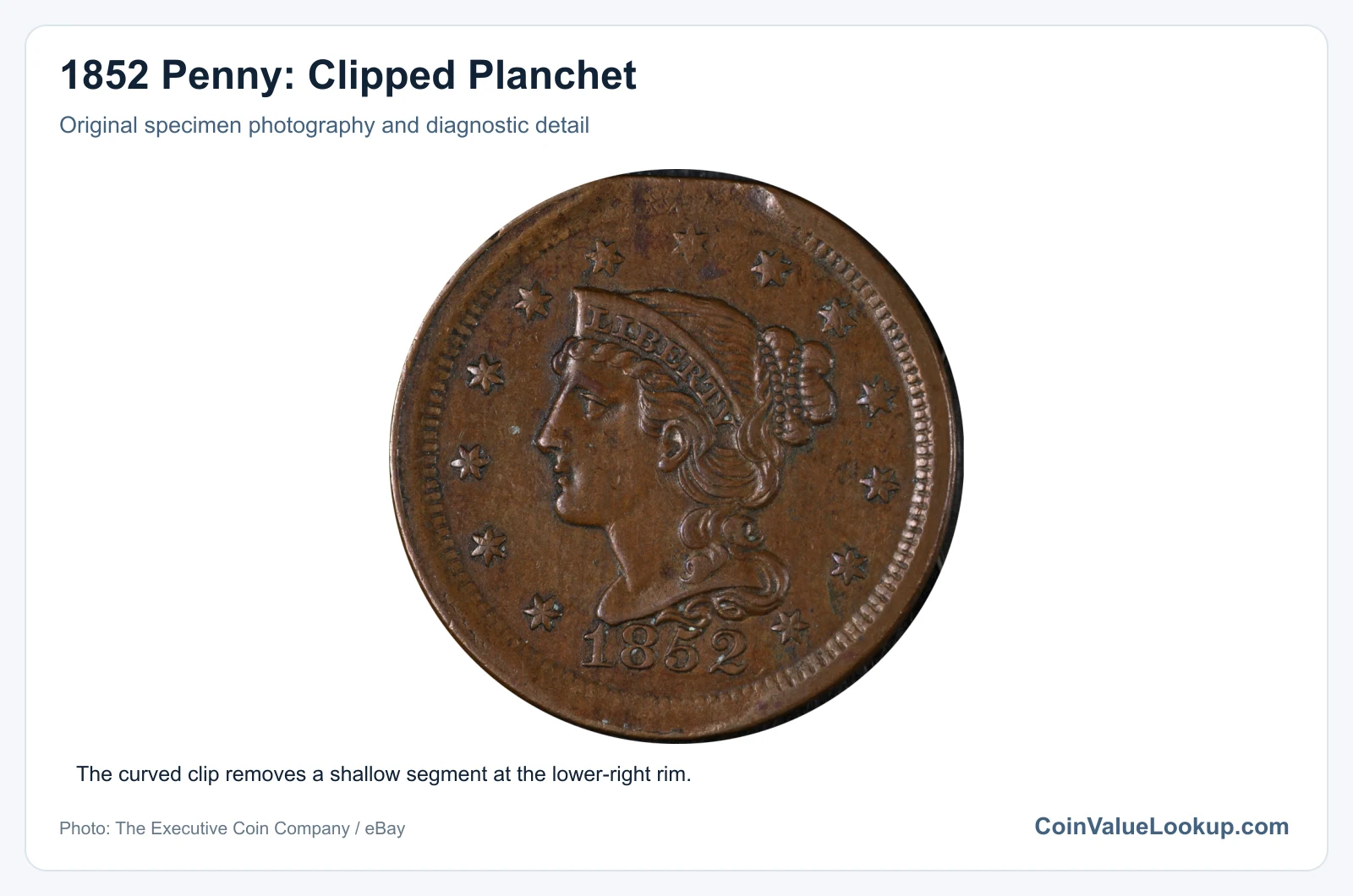
A clipped planchet error on an 1852 Braided Hair Cent means a portion of the original copper blank was missing before the coin was struck. You will see a curved, straight, or ragged area where metal is simply absent from the edge, and the design near that area may show weakness because the metal could not flow fully into the die.
Look at the opposite side of the coin from the clip. Genuine clips often produce a slight area of weakness there.
The edge texture at the clip should look natural and unworked, not filed or cut.
Don't confuse a clip with post-mint damage like someone filing a notch, cutting the edge, or corrosion eating away the rim. Those lack the corresponding design weakness.
No standard price is adopted for this error; value depends on the clip's size, the coin's overall condition, and authentication.
2. 1852 Braided Hair Cent — Off-Center Strike
An off-center strike happens when the planchet is not seated properly between the dies. The result is a displaced design with a blank, unstruck crescent on one side of the coin.
The more dramatic the shift, the more visually striking the error.
For this date, the key is whether the date remains visible. An off-center 1852 cent with a readable date is far more attributable than one where the date disappeared into the unstruck area.
Don't mistake a clipped planchet or one-sided die misalignment for an off-center strike. Post-mint flattening from a vise or hammer can also mimic the look.
A genuine off-center coin shows the full die impression, just shifted, with an unstruck area of original planchet surface. No numeric price is adopted; value depends on the percentage off-center, date visibility, and authenticated condition.
3. 1852 Braided Hair Cent — Misaligned Die
A misaligned die error occurs when one die shifts laterally so the design on that face is displaced relative to the opposite face or the blank itself. On an 1852 Braided Hair Cent, you will see the obverse or reverse design sitting off to one side while the other face appears properly centered.
This is different from an off-center strike, where the entire planchet missed the die area. With a misaligned die, the coin is fully struck but one face is noticeably shifted.
It is also distinct from die rotation, which involves an angular twist rather than a lateral slide.
Watch out for lookalikes. A tilted photograph can create the illusion of misalignment, and post-mint rim damage sometimes fools people.
Compare both sides carefully against a normal example. No standard price is adopted for this error; each piece needs individual assessment based on the degree of misalignment and overall condition.
4. 1852 Braided Hair Cent — Rotated Dies
Rotated dies produce a coin where the obverse and reverse are turned relative to each other beyond the normal alignment. To test your 1852 cent, hold the obverse upright and flip the coin top to bottom along a vertical axis.
The reverse should appear upright on a normally aligned US coin. If it is tilted noticeably, you may have a die rotation error.
The degree of rotation matters. A slight rotation of a few degrees is less dramatic than a full 90 or 180 degree turn.
Greater rotation generally attracts more collector interest.
Be careful not to confuse this with simply turning the coin sideways in your hand, or with a photograph taken at an odd angle. Compare against a known normal example.
No numeric price is adopted for rotated die errors on this date; value depends on the rotation severity and the coin's authenticated condition.
5. 1852 Braided Hair Cent — Lamination / Split Planchet
A lamination or split planchet error shows metal peeling, flaking, or separating within the copper itself. On an 1852 Braided Hair Cent, look for a retained flap of metal lifting away from the surface, or a visible layer where the copper has split apart.
Photographing the edge alongside the affected face helps document the extent.
These errors originate from impurities or gas trapped in the copper during the rolling and preparation of planchet stock. The separation happens during or before striking, not from decades of environmental damage afterward.
Corrosion can mimic a lamination by creating flaky, rough surfaces, and scraping or deliberate cutting can also look similar at first glance. Genuine laminations tend to follow the contour of the planchet and reveal fresh-looking metal underneath the separated layer.
No standard price is adopted here; the value of a lamination error depends on its size, visual impact, and professional authentication.