1812 Classic Head Cent Coin Value: How Much Is It Worth?
The 1812 Classic Head cent is a copper coin struck at Philadelphia during the War of 1812 era. Guide estimates for ordinary circulated examples range from about $148 in G4 to $2,728 in EF40, according to USA Coin Book.
Identify the exact date-punch variety first, because rare proofs, restrikes, and major errors require separate assessment beyond these figures.
Fast Way to Identify Your 1812 Classic Head Cent
Snap clear photos of both the front and back of your 1812 cent and upload them here. Our identifier can offer a preliminary read on which variety you may have, whether Small Date or Large Date, plus flag anything unusual.
Good lighting and a steady hand help a lot. This is preliminary identification, not authentication or certification.
1812 Classic Head Cent Value
Upload both sides of your 1812 Classic Head Cent.
Front Obverse
Upload photo
Back Reverse
Upload photo
Which 1812 Classic Head Cent Versions Are Worth Money?
- Small Date and Large Date are the two ordinary date-punch varieties; identifying yours correctly is the first step to an accurate value.
- Circulated examples in both varieties carry guide estimates from $148 at G4 to $2,728 at EF40, per USA Coin Book.
- Mint errors such as off-center strikes, brockages, and die breaks on confirmed 1812 cents can carry premiums that depend on severity, authentication, and condition.
- Problem-free higher-grade survivors are scarce after two centuries of handling, so surface quality matters as much as sharpness.
Step 1: Identify Your 1812 Classic Head Cent Mint Mark and Version
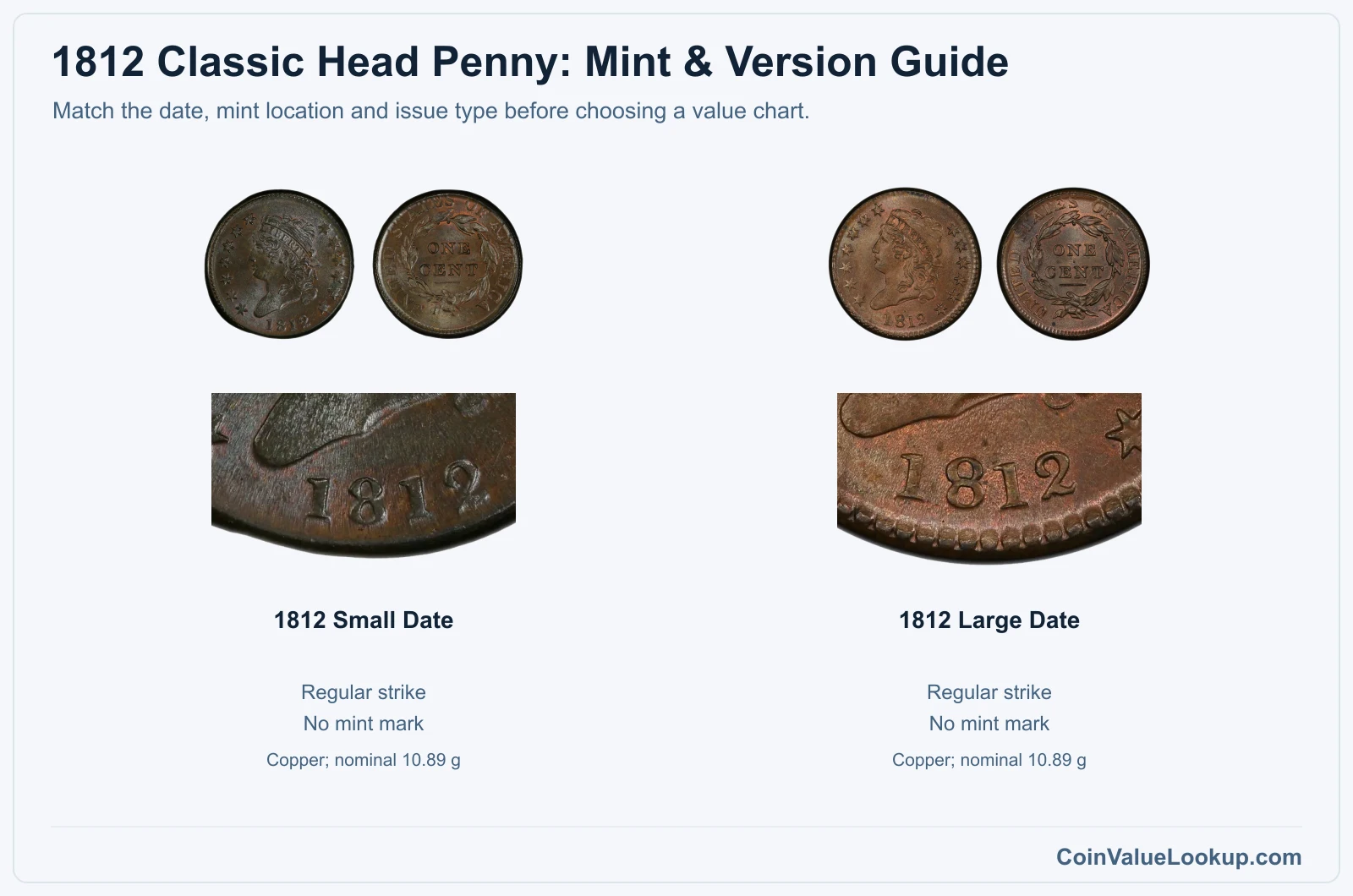
Philadelphia was the only mint striking these cents, so there is no mintmark to hunt for. The two ordinary branches are Small Date and Large Date, distinguished by the size and spacing of the numerals punched into the die.
Hold your coin at arm's length, then bring it close: on the Small Date, the digits sit noticeably tighter and shorter relative to the bust truncation, while the Large Date digits are taller and more spread out.
Beyond the date punch, confirm the Classic Head obverse (a leftward-facing Liberty wearing a headband inscribed LIBERTY) paired with a reverse wreath enclosing the denomination. Check the edge for expected plain or lettered characteristics consistent with the series.
Weight should be around 10.89 grams in copper, but wear, corrosion, and period production tolerances mean weight alone cannot prove authenticity. Use it as supporting evidence alongside design details.
Step 2: Check Your 1812 Classic Head Cent Grade
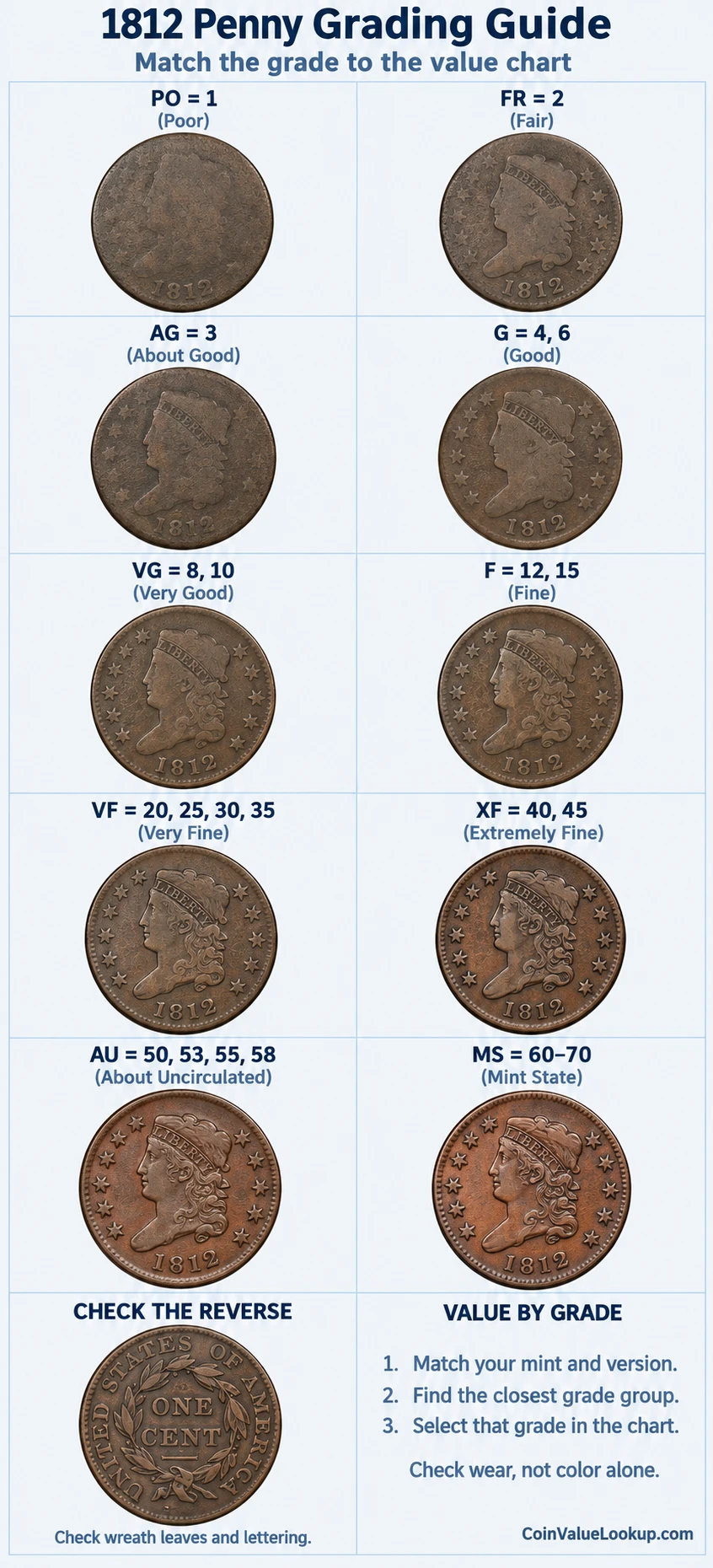
Start with the portrait. On a well-worn Good-4 example, the headband lettering is mostly gone and the hair curls merge into the cheek.
As you move up the scale, look for separation between individual hair strands above the ear and sharpness in the headband letters.
On the reverse, the wreath leaves tell the story. In lower grades the leaf veins vanish and the stems flatten.
By EF40, most leaf detail survives with only light friction on the highest points.
Compare your coin side by side with the reference image on this page. Surface problems matter a great deal on early copper.
Porosity, old cleaning, and environmental damage can knock market appeal well below what the remaining design sharpness might suggest.
Color designations like BN, RB, and RD describe how much original red copper tone remains. They are color attributes, not separate alloys or grades.
A coin graded MS63BN simply shows mostly brown toning rather than original mint red.
Step 3: Check 1812 Classic Head Cent Value by Mint and Version
1812 Classic Head Cent — Small Date
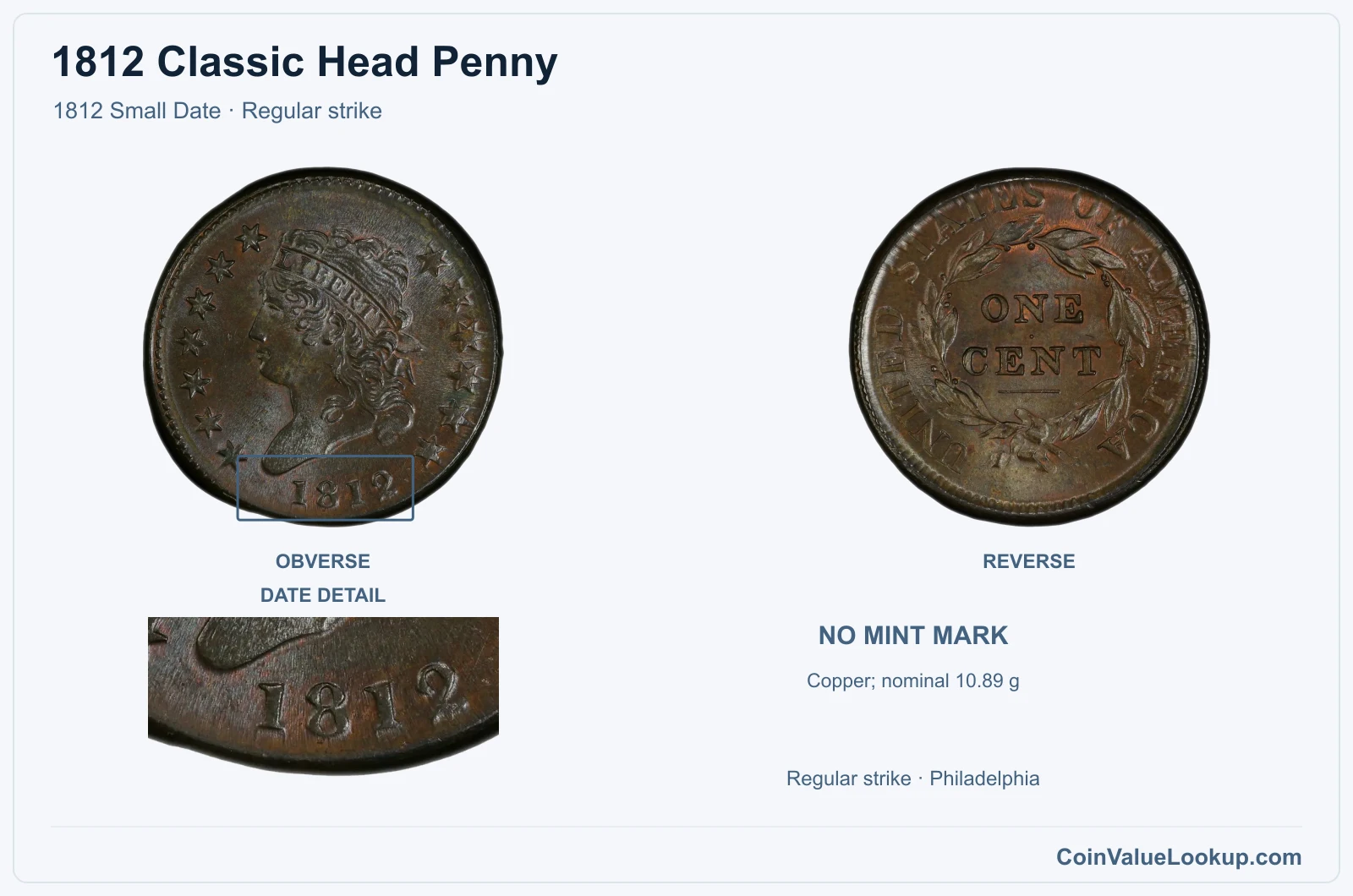
The 1812 Small Date is one of two ordinary date-punch variants for this year, both struck at Philadelphia in copper with a nominal weight of 10.89 grams. You will not find a mintmark.
To identify the Small Date, focus on the numerals in the date. They are shorter, more compact, and sit closer together compared to the Large Date.
The "1" and "2" are the easiest to compare if you have examples of both handy.
USA Coin Book lists guide estimates of about $148 in G4 and $2,728 in EF40 for this variety. These are guide figures, not guaranteed sale prices.
Actual market value depends on surface quality, color, and whether the coin has been cleaned or damaged.
| Range | Grade | Price | Auction Records | Appraisal |
|---|---|---|---|---|
| PO | PO 1 | — | Coin Identifier | |
| FR | FR 2 | — | Coin Identifier | |
| AG | AG 3 | Coin Identifier | ||
| G | G 4 | Coin Identifier | ||
| G 6 | Coin Identifier | |||
| VG | VG 8 | Coin Identifier | ||
| VG 10 | Coin Identifier | |||
| F | F 12 | Coin Identifier | ||
| F 15 | Coin Identifier | |||
| VF | VF 20 | Coin Identifier | ||
| VF 25 | Coin Identifier | |||
| VF 30 | Coin Identifier | |||
| VF 35 | Coin Identifier | |||
| XF | XF 40 | Coin Identifier | ||
| XF 45 | Coin Identifier | |||
| AU | AU 50 | Coin Identifier | ||
| AU 53 | Coin Identifier | |||
| AU 55 | Coin Identifier | |||
| AU 58 | Coin Identifier | |||
| MS | MS 60 | — | Coin Identifier | |
| MS 61 | Coin Identifier | |||
| MS 62 | Coin Identifier | |||
| MS 63 | Coin Identifier | |||
| MS 64 | Coin Identifier | |||
| MS 65 | Coin Identifier | |||
| MS 66 | — | Coin Identifier | ||
| MS 67 | — | — | — | |
| MS 68 | — | — | — | |
| MS 69 | — | — | — | |
| MS 70 | — | — | — |
1812 Classic Head Cent — Large Date
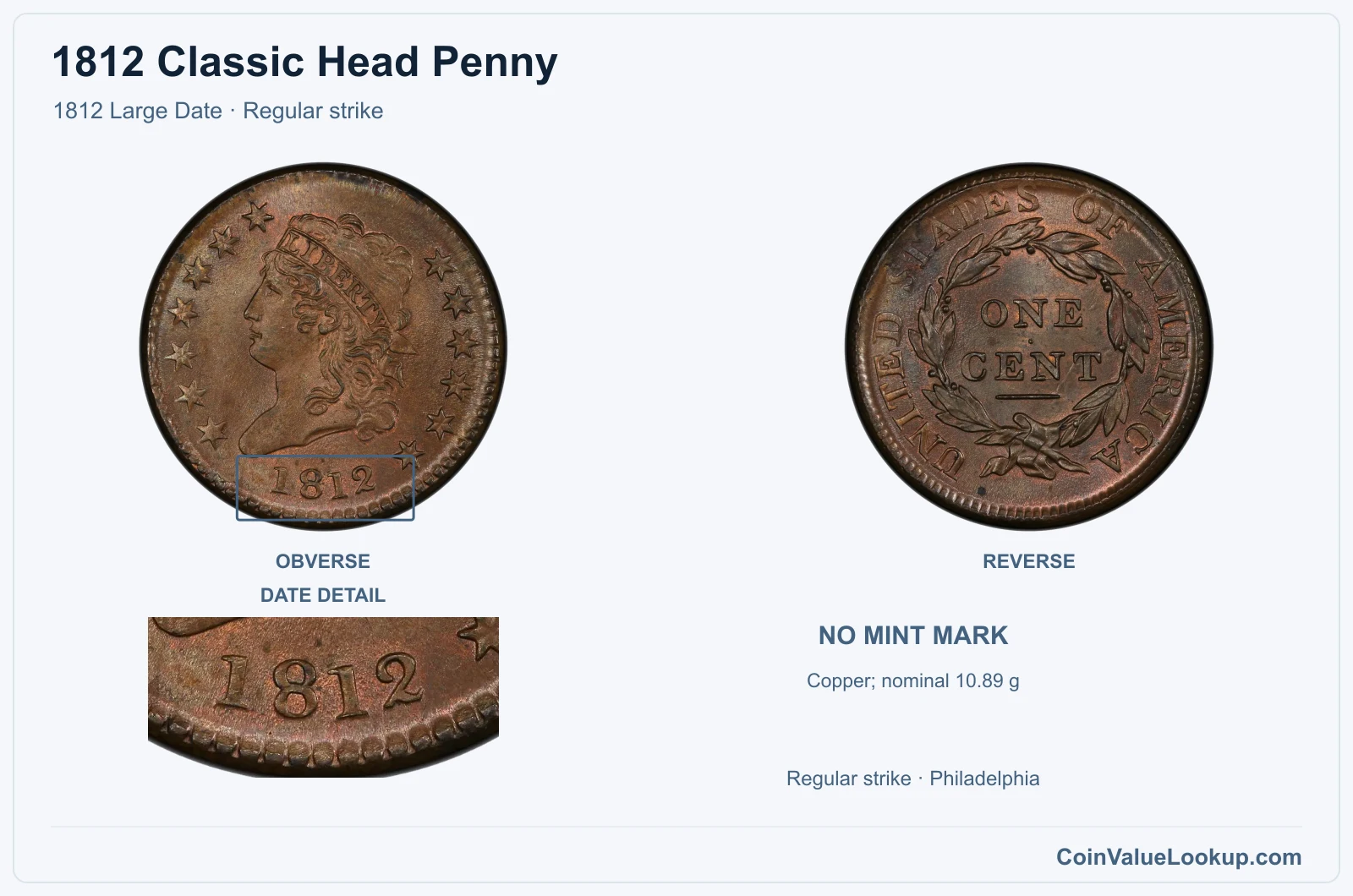
The 1812 Large Date shares the same Philadelphia copper composition and Classic Head design as its Small Date sibling. The difference is purely in the date punch: the numerals are taller, wider, and more spread across the exergue area below the bust.
Coin Value Lookup is a handy starting point if you are comparing values across multiple early copper dates or want to look up other coin guides.
USA Coin Book guide estimates for the Large Date match the Small Date at roughly $148 in G4 and $2,728 in EF40. That parity is normal for ordinary date-punch variants within the same year.
As always, the coin in your hand may be worth more or less depending on its actual condition, surfaces, and provenance.
| Range | Grade | Price | Auction Records | Appraisal |
|---|---|---|---|---|
| PO | PO 1 | — | Coin Identifier | |
| FR | FR 2 | Coin Identifier | ||
| AG | AG 3 | Coin Identifier | ||
| G | G 4 | Coin Identifier | ||
| G 6 | Coin Identifier | |||
| VG | VG 8 | Coin Identifier | ||
| VG 10 | Coin Identifier | |||
| F | F 12 | Coin Identifier | ||
| F 15 | Coin Identifier | |||
| VF | VF 20 | Coin Identifier | ||
| VF 25 | Coin Identifier | |||
| VF 30 | Coin Identifier | |||
| VF 35 | Coin Identifier | |||
| XF | XF 40 | Coin Identifier | ||
| XF 45 | Coin Identifier | |||
| AU | AU 50 | Coin Identifier | ||
| AU 53 | Coin Identifier | |||
| AU 55 | Coin Identifier | |||
| AU 58 | Coin Identifier | |||
| MS | MS 60 | — | Coin Identifier | |
| MS 61 | Coin Identifier | |||
| MS 62 | Coin Identifier | |||
| MS 63 | Coin Identifier | |||
| MS 64 | Coin Identifier | |||
| MS 65 | Coin Identifier | |||
| MS 66 | Coin Identifier | |||
| MS 67 | — | — | — | |
| MS 68 | — | — | — | |
| MS 69 | — | — | — | |
| MS 70 | — | — | — |
1812 Classic Head Cent Error List
1. 1812 Classic Head Cent — Lamination / Split Planchet
A lamination error on an 1812 Classic Head cent shows as peeling metal, a retained flap, or a visible split within the copper planchet. It happens when impurities or voids inside the blank separate under the pressure of striking.
Photograph the edge and the affected face together so the depth of the separation is clear.
Do not confuse a lamination with surface scraping, active corrosion, or a coin that was deliberately cut or filed after leaving the mint. Genuine laminations follow the contour of the planchet rather than showing sharp, straight tool marks.
No numeric price range is adopted for this error. Value depends on the authenticated identity of the coin, the severity and visual impact of the lamination, and overall condition.
Individual assessment by a professional service is the safest path.
2. 1812 Classic Head Cent — Off-Center Strike
An off-center strike happens when the planchet is not seated properly between the dies. On an 1812 cent, you will see the design shifted to one side with a blank crescent of unstruck copper on the opposite side.
The date should still be visible for the coin to be positively attributed to 1812.
Watch for lookalikes. A clipped planchet removes metal from the blank before striking, which is a different error.
Post-mint flattening or a one-sided die misalignment can also mimic an off-center appearance to an untrained eye.
No adopted price range exists for this error on the 1812 cent. The premium depends on the percentage off-center, date visibility, authenticated identity, and the coin's overall condition.
Severe off-center strikes with full dates tend to draw the most attention.
3. 1812 Classic Head Cent — Die Crack
Die cracks appear as thin raised lines running across the fields or through design elements on the coin. They are the result of stress fractures in the steel die, and they transferred onto every coin struck after the crack formed.
On an 1812 cent, look for lines that cross Liberty's portrait or cut through the reverse wreath.
Do not mistake incuse scratches, corrosion tracks, or tool marks for die cracks. A genuine die crack is raised above the coin's surface, not cut into it.
Rotate the coin under a light source; a crack will catch light the same way the surrounding design does.
No numeric price data is adopted for die cracks on this issue. Value depends on the crack's size, location, visual impact, and the coin's authenticated identity and condition.
4. 1812 Classic Head Cent — Die Break / Cud
A cud is a specific type of die break where a chunk of the die rim breaks away, leaving a raised, featureless blob of metal connected to the rim of the coin. On an 1812 cent, check along the entire rim for any area that looks like a smooth lump rather than sharp design or lettering.
Smaller interior die chips and ordinary rim dents from post-mint damage are common lookalikes. A true cud is raised, connects to the rim, and displaces part of the normal design.
Corrosion lumps may mimic the shape but will not have the same smooth, struck-metal texture.
No supported price range is adopted for cuds on this date. Premiums vary with the size and location of the break, the coin's condition, and authenticated attribution.
A large obverse cud affecting the portrait will draw more interest than a small one near the denticles.
5. 1812 Classic Head Cent — Brockage
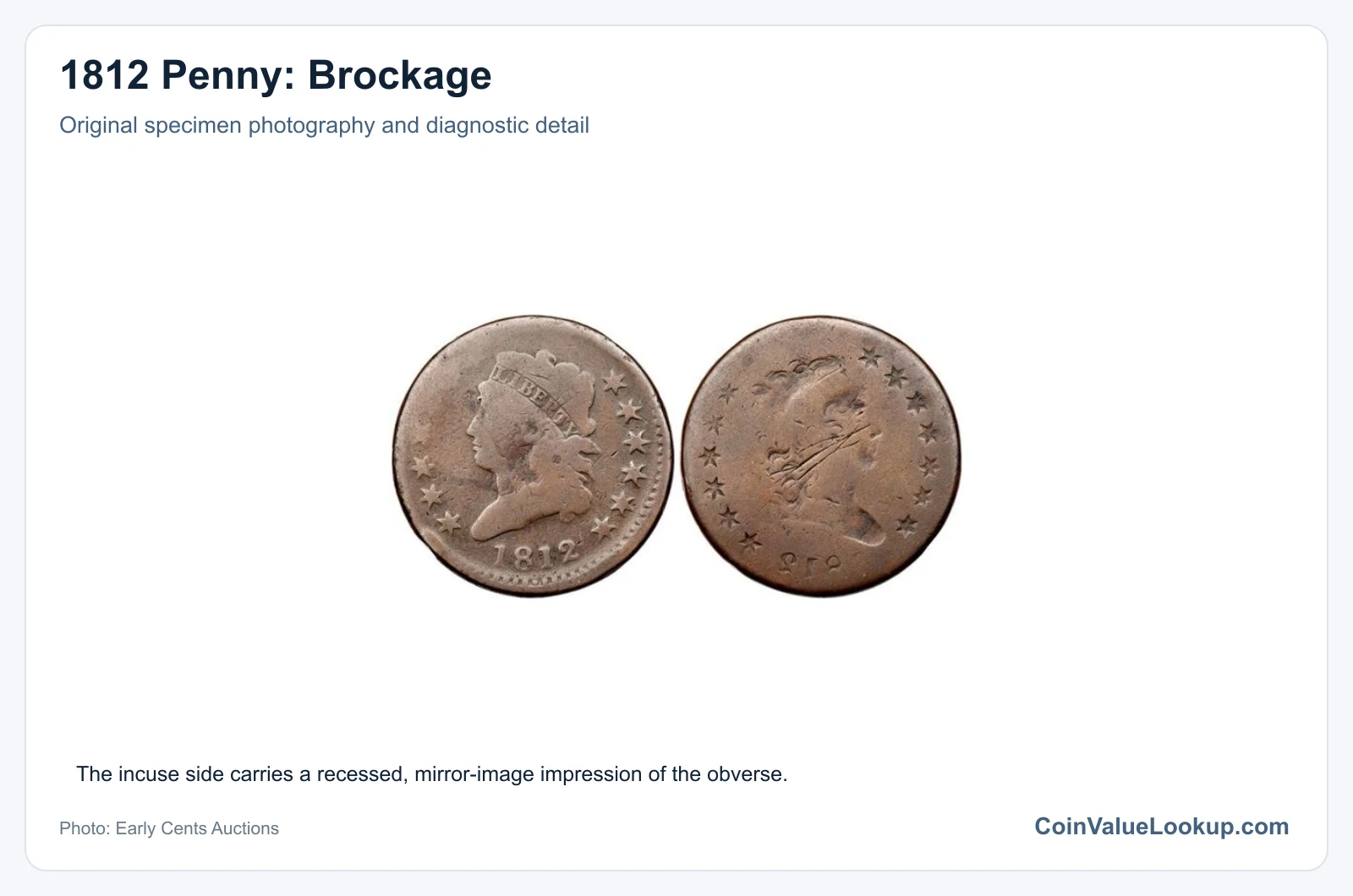
A brockage occurs when a previously struck coin sticks to a die and impresses its image into the next blank. The result is one normal side and one side showing a mirror-image, incuse version of the same or opposite design.
On a copper cent this large, the effect is dramatic and hard to miss.
Die clashes and post-mint pressing can look similar at first glance. A die clash leaves faint ghost outlines but keeps both sides in correct orientation.
A brockage shows a clear reversed impression with noticeable depth, and the affected side will read backwards.
No numeric price is adopted for brockage errors on the 1812 cent. These are genuinely scarce on early copper.
Value hinges on the completeness of the mirror impression, authenticated identity, and overall preservation.
6. 1812 Classic Head Cent — Misaligned Die
A misaligned die shifts one face of the coin off-center relative to the opposite face or the planchet, but the blank itself was seated correctly. Compare both sides: the obverse design may be centered while the reverse is noticeably shifted, or vice versa.
This differs from a full off-center strike, where the entire coin is displaced.
Tilted photographs, post-mint rim damage, and rotational die errors are common sources of confusion. A true misalignment shows a consistent directional shift on one side with a normal, centered opposite side.
No adopted price range exists for this error on the 1812 cent. Market interest depends on the degree of misalignment, the coin's overall condition, and whether the error has been authenticated.
Minor shifts are common in early copper production and carry modest premiums at best.