1829 Coronet Head Cent Coin Value: How Much Is It Worth?
The 1829 Coronet Head Cent is a copper large cent struck at Philadelphia, and its value depends heavily on which reverse lettering variety you have. Guide estimates range from about $38 in Good-4 condition up to $14,880 in MS-63, depending on the exact variety.
Identifying your specific version is the first step before any price applies.
Fast Way to Identify Your 1829 Coronet Head Cent
The quickest way to start figuring out what you have is to upload clear photos of the front and back of your coin. Our identifier can provide a preliminary identification of the variety and condition based on those images.
Snap both sides in good light, keep the coin flat, and avoid any glare from plastic holders.
1829 Coronet Head Cent Value
Upload both sides of your 1829 Coronet Head Cent.
Front Obverse
Upload photo
Back Reverse
Upload photo
Which 1829 Coronet Head Cent Versions Are Worth Money?
- The Medium Letters variety carries the higher guide value in mint state, reaching $14,880 at MS-63 versus $3,248 for Large Letters at the same grade.
- Even in circulated Good-4 condition, both varieties carry guide values in the $38 to $43 range, so worn examples still hold collector interest.
- Proof 1829 cents exist but require professional attribution of die characteristics, surfaces, and rims; they are priced individually rather than from a standard scale.
- Certain mint errors such as brockages, off-center strikes, and die breaks are reported for this date and can add value beyond the base coin, though each needs individual assessment.
Step 1: Identify Your 1829 Coronet Head Cent Mint Mark and Version
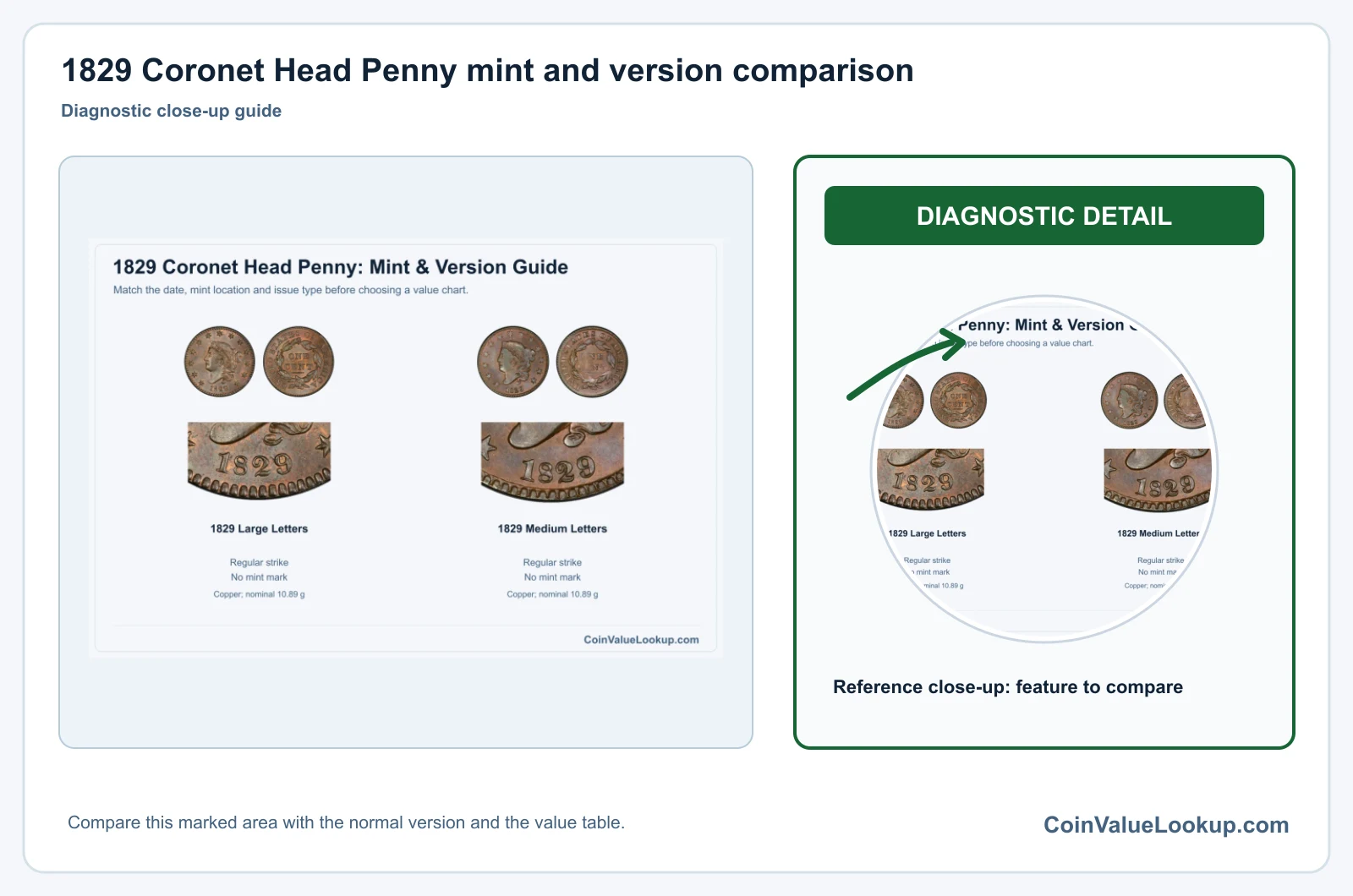
All 1829 Coronet Head Cents were struck at Philadelphia, so there is no mintmark to look for. The key distinction between the two business-strike varieties is the size of the lettering on the reverse, specifically the legend punches around the wreath.
"Large Letters" and "Medium Letters" refer to those reverse punches, not to any difference in the portrait.
Flip the coin over and study the words UNITED STATES OF AMERICA. Compare the height and spacing of the letters against known references for each variety.
The difference is real but subtle, so side-by-side comparison with attributed examples helps enormously.
Also check weight and edge details. The nominal weight is about 10.89 grams in copper, but wear, corrosion, and normal production tolerances mean weight alone will not prove authenticity or variety.
Look at the overall design: Liberty wearing a coronet on the obverse, a wreath with denomination on the reverse.
Proof examples exist for 1829, but a shiny coin is not automatically a proof. Proof is a specific manufacturing method with distinct die characteristics, sharp rims, and particular surface qualities.
Polished or cleaned business strikes get misidentified as proofs constantly.
Step 2: Check Your 1829 Coronet Head Cent Grade
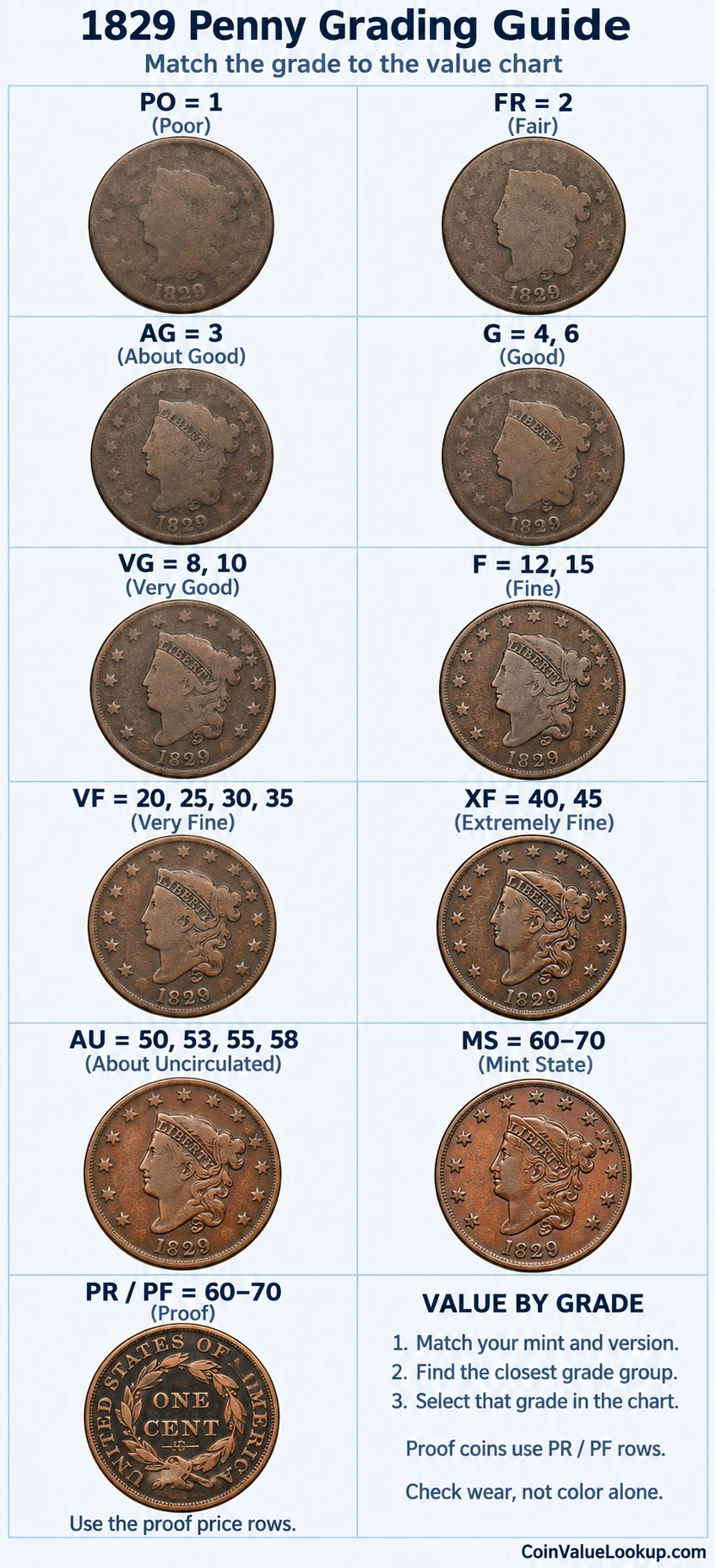
Start with the obverse portrait. On a well-worn coin, Liberty's hair curls above the forehead and behind the ear will be nearly flat, and the word LIBERTY on the coronet may be partially or fully worn away.
A coin grading Good-4 will show a clear outline of the head with major details gone.
At mid-grades like Very Fine, the hair should show distinct separation in the curls, though the highest points will be softened. The wreath leaves on the reverse will retain most veining detail.
Mint-state examples display full original detail with no wear on the cheek or hair. Color matters on copper: BN (brown), RB (red-brown), and RD (red) describe the surface color, not different metals.
A fully red coin commands a premium over a brown one at the same technical grade.
Use the comparison image to check your coin against known grade benchmarks. Be honest about surface problems.
Corrosion pits, porosity, old cleaning, and scratches can all reduce a coin's market appeal well below what the wear level alone would suggest. A coin with VF detail but heavy corrosion will not sell like a problem-free VF.
Step 3: Check 1829 Coronet Head Cent Value by Mint and Version
1829 Coronet Head Cent — Large Letters
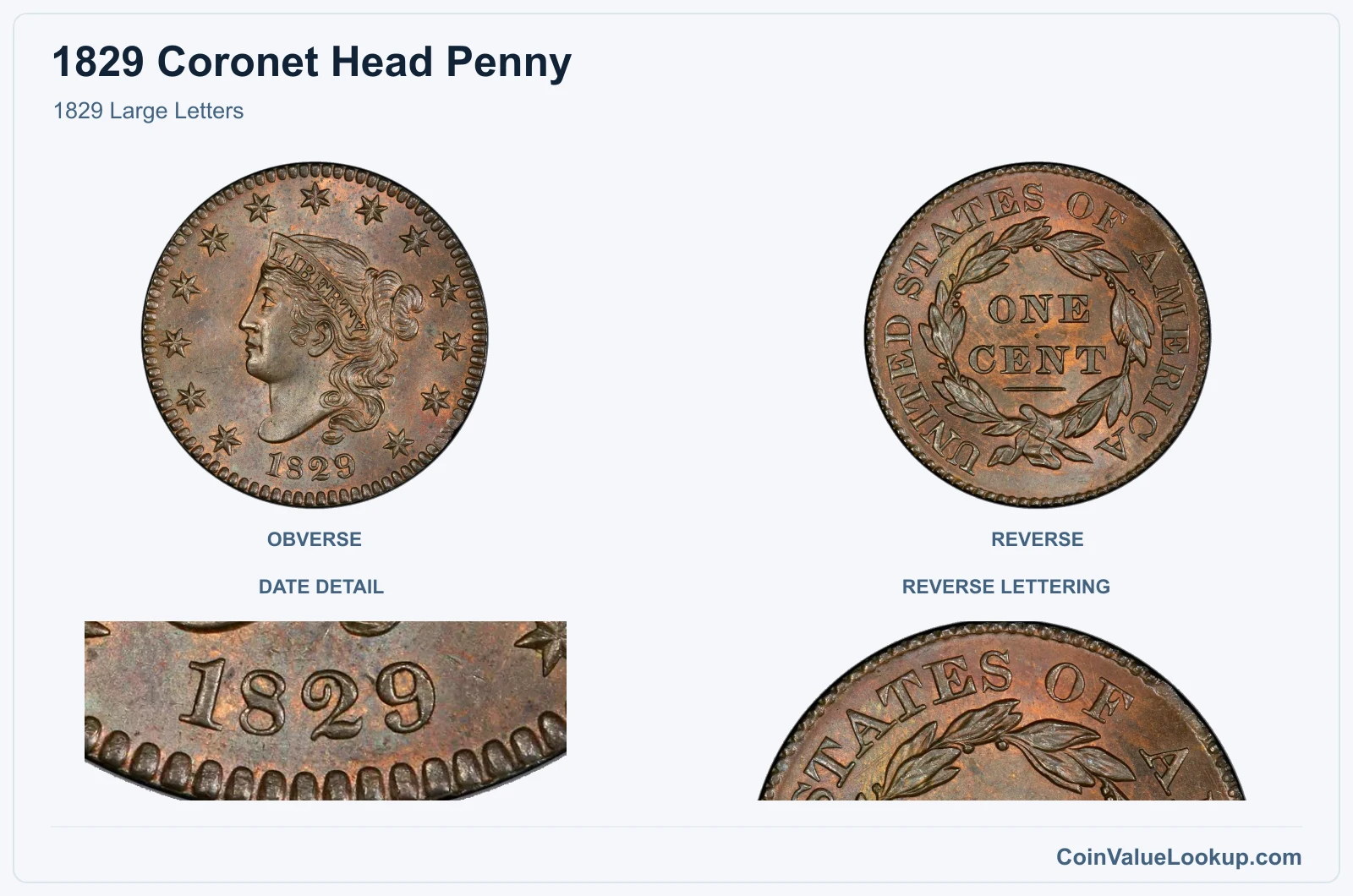
The 1829 Large Letters cent uses taller, more widely spaced letter punches on the reverse legend. It is a copper business strike from Philadelphia weighing nominally 10.89 grams.
Guide estimates place this variety at about $38 in Good-4 and $3,248 in MS-63.
Compare the reverse lettering carefully against an attributed Large Letters example. The distinction from Medium Letters is entirely about punch size in the legend, not anything on the obverse portrait.
Both varieties share the same basic Coronet Head design.
| Range | Grade | Price | Auction Records | Appraisal |
|---|---|---|---|---|
| PO | PO 1 | — | Coin Identifier | |
| FR | FR 2 | — | Coin Identifier | |
| AG | AG 3 | — | Coin Identifier | |
| G | G 4 | Coin Identifier | ||
| G 6 | Coin Identifier | |||
| VG | VG 8 | — | Coin Identifier | |
| VG 10 | — | Coin Identifier | ||
| F | F 12 | Coin Identifier | ||
| F 15 | Coin Identifier | |||
| VF | VF 20 | Coin Identifier | ||
| VF 25 | Coin Identifier | |||
| VF 30 | Coin Identifier | |||
| VF 35 | Coin Identifier | |||
| XF | XF 40 | Coin Identifier | ||
| XF 45 | Coin Identifier | |||
| AU | AU 50 | Coin Identifier | ||
| AU 53 | Coin Identifier | |||
| AU 55 | Coin Identifier | |||
| AU 58 | Coin Identifier | |||
| MS | MS 60 | — | Coin Identifier | |
| MS 61 | Coin Identifier | |||
| MS 62 | Coin Identifier | |||
| MS 63 | Coin Identifier | |||
| MS 64 | Coin Identifier | |||
| MS 65 | Coin Identifier | |||
| MS 66 | Coin Identifier | |||
| MS 67 | — | — | — | |
| MS 68 | — | — | — | |
| MS 69 | — | — | — | |
| MS 70 | — | — | — |
1829 Coronet Head Cent — Medium Letters
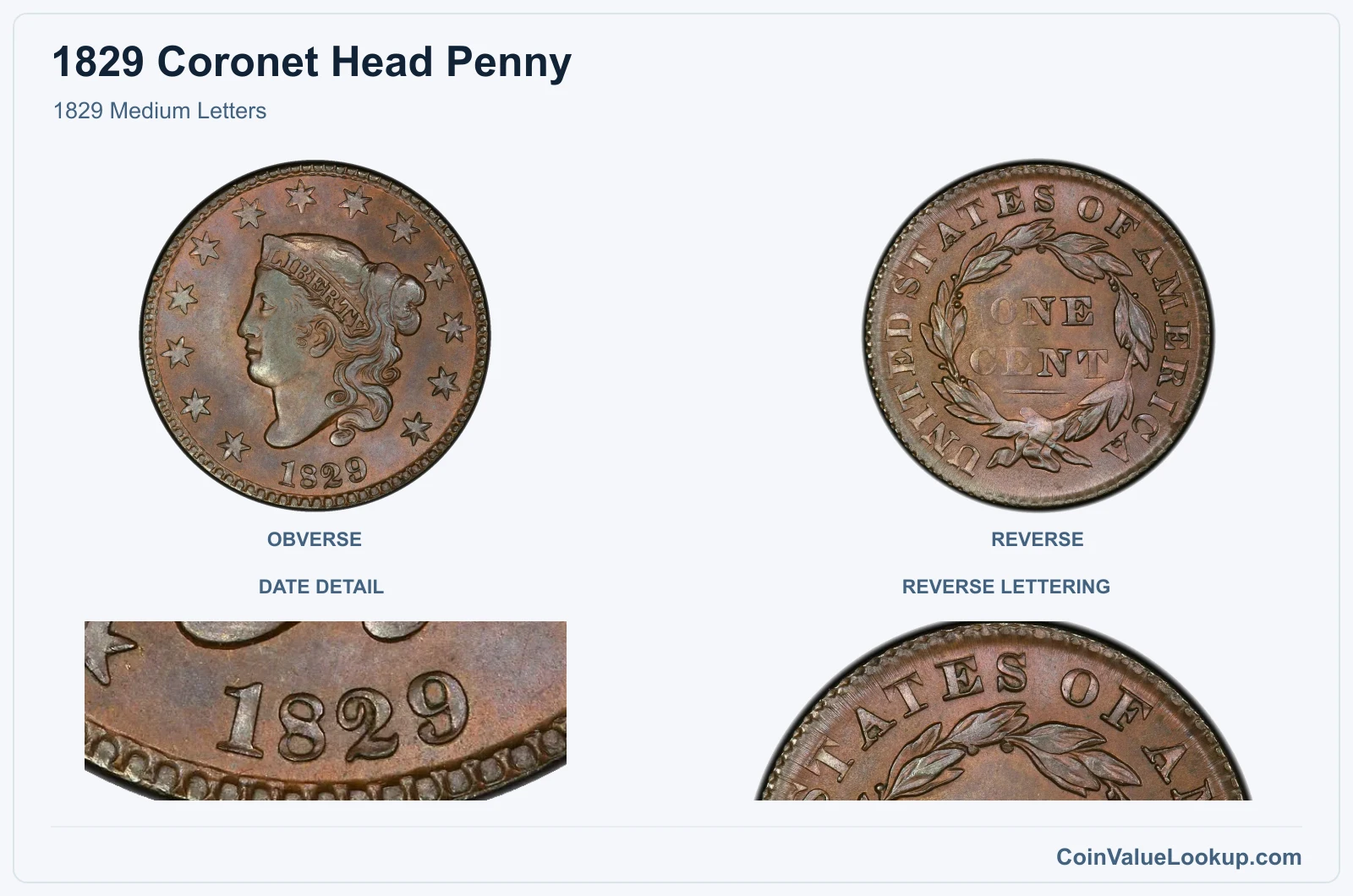
The 1829 Medium Letters cent features slightly smaller, more compact letter punches on the reverse. Same Philadelphia mint, same copper composition, same nominal weight.
Guide estimates run from roughly $43 at Good-4 up to $14,880 at MS-63, making it the pricier of the two business-strike varieties at the upper end.
That MS-63 figure is a guide estimate from USA Coin Book, not a guaranteed sale price, but it signals genuine collector demand for high-grade survivors. In lower circulated grades the two varieties are close in value, so the real payoff for identifying Medium Letters comes if your coin has strong remaining detail and clean surfaces.
Coin Value Lookup is a useful starting point if you want to look up guide values for other dates and denominations in the Coronet Head series.
| Range | Grade | Price | Auction Records | Appraisal |
|---|---|---|---|---|
| PO | PO 1 | — | Coin Identifier | |
| FR | FR 2 | — | Coin Identifier | |
| AG | AG 3 | — | Coin Identifier | |
| G | G 4 | — | Coin Identifier | |
| G 6 | — | Coin Identifier | ||
| VG | VG 8 | Coin Identifier | ||
| VG 10 | Coin Identifier | |||
| F | F 12 | — | Coin Identifier | |
| F 15 | Coin Identifier | |||
| VF | VF 20 | Coin Identifier | ||
| VF 25 | Coin Identifier | |||
| VF 30 | Coin Identifier | |||
| VF 35 | Coin Identifier | |||
| XF | XF 40 | Coin Identifier | ||
| XF 45 | Coin Identifier | |||
| AU | AU 50 | Coin Identifier | ||
| AU 53 | Coin Identifier | |||
| AU 55 | Coin Identifier | |||
| AU 58 | Coin Identifier | |||
| MS | MS 60 | — | Coin Identifier | |
| MS 61 | Coin Identifier | |||
| MS 62 | Coin Identifier | |||
| MS 63 | — | Coin Identifier | ||
| MS 64 | Coin Identifier | |||
| MS 65 | — | — | — | |
| MS 66 | — | — | — | |
| MS 67 | — | — | — | |
| MS 68 | — | — | — | |
| MS 69 | — | — | — | |
| MS 70 | — | — | — |
1829 Coronet Head Cent — Proof
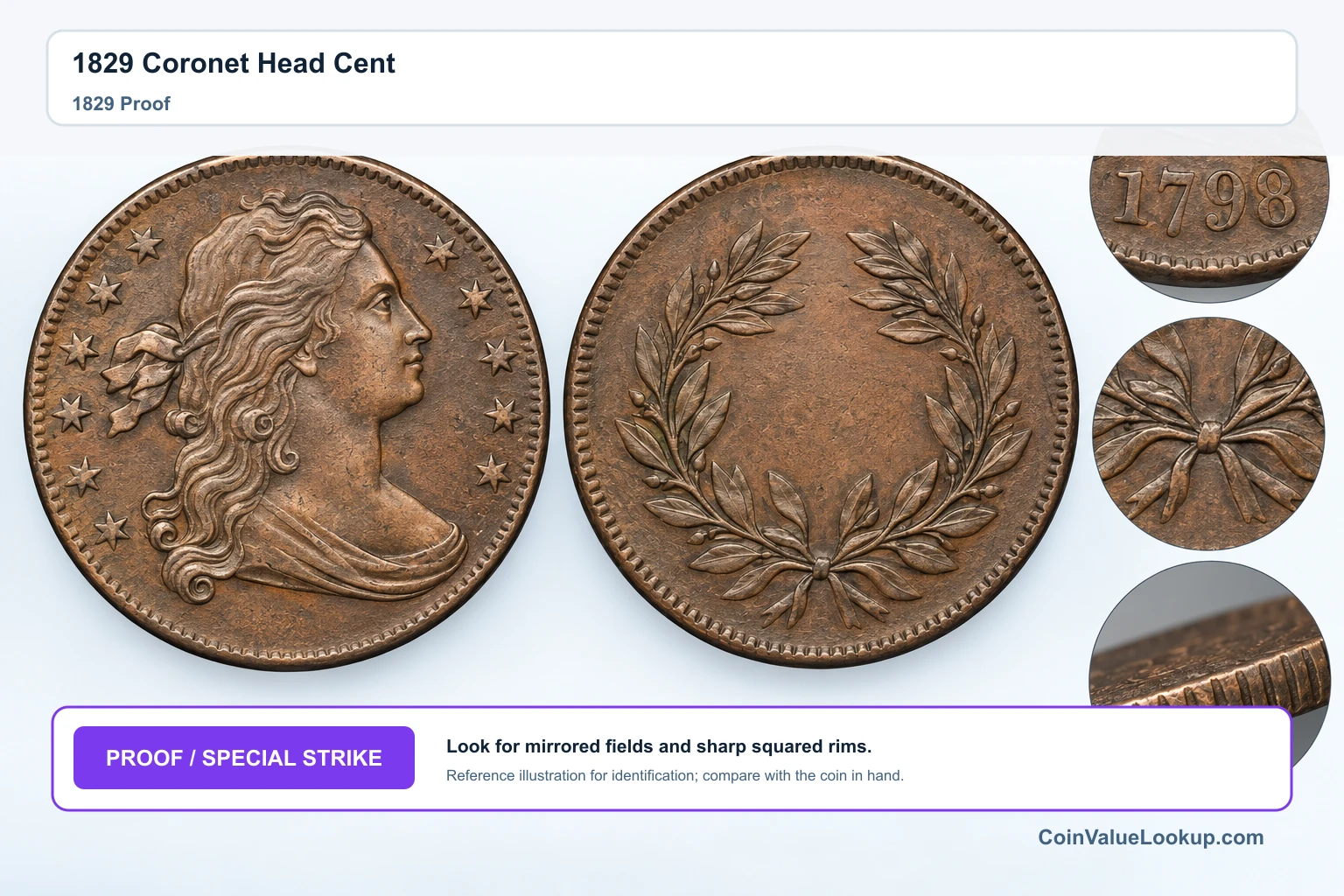
Proof 1829 Coronet Head Cents are genuinely rare early proofs. They were made using specially prepared dies and planchets at Philadelphia, producing sharp rims, full detail, and distinctive surface qualities that differ from even the finest business strikes.
No standard numeric price range is adopted for these. Each proof example is assessed individually based on its authenticated identity, surface preservation, and specific die characteristics.
A polished business strike is not a proof, no matter how shiny it looks. Proper attribution requires examining the rims, die state, and overall finish against documented proof diagnostics.
If you believe you have a proof 1829 cent, professional third-party authentication is the appropriate next step. The value hinges entirely on whether the coin is genuine and how well its original proof surfaces have survived.
| Range | Grade | Price | Auction Records | Appraisal |
|---|---|---|---|---|
| PR | PR 1 | — | Coin Identifier | |
| PR 2 | — | Coin Identifier | ||
| PR 3 | — | Coin Identifier | ||
| PR 4 | — | Coin Identifier | ||
| PR 6 | — | Coin Identifier | ||
| PR 8 | — | Coin Identifier | ||
| PR 10 | — | Coin Identifier | ||
| PR 12 | — | Coin Identifier | ||
| PR 15 | — | Coin Identifier | ||
| PR 20 | — | Coin Identifier | ||
| PR 25 | — | Coin Identifier | ||
| PR 30 | — | Coin Identifier | ||
| PR 35 | — | Coin Identifier | ||
| PR 40 | — | Coin Identifier | ||
| PR 45 | — | Coin Identifier | ||
| PR 50 | — | Coin Identifier | ||
| PR 53 | — | Coin Identifier | ||
| PR 55 | — | Coin Identifier | ||
| PR 58 | — | Coin Identifier | ||
| PR 60 | — | Coin Identifier | ||
| PR 61 | — | Coin Identifier | ||
| PR 62 | — | Coin Identifier | ||
| PR 63 | — | Coin Identifier | ||
| PR 64 | Coin Identifier | |||
| PR 65 | — | — | — | |
| PR 66 | — | — | — | |
| PR 67 | — | — | — | |
| PR 68 | — | — | — | |
| PR 69 | — | — | — | |
| PR 70 | — | — | — |
1829 Coronet Head Cent Error List
1. 1829 Coronet Head Cent — Brockage
A brockage on an 1829 Coronet Head Cent happens when a previously struck coin stays on the die and impresses its design into the next blank. The result is one normal side and one side showing an incuse, mirror-image version of the design.
The incuse impression will be sunk into the surface rather than raised.
Do not confuse a brockage with a die clash, which leaves faint ghostly impressions from the opposing die but does not produce a full mirror image. Post-mint damage from being pressed against another coin can also mimic the look.
Genuine brockages show consistent metal flow and proper strike characteristics.
No standard price range is adopted for this error. Value depends on the authenticated identity of the coin, the completeness of the brockage impression, and overall condition.
2. 1829 Coronet Head Cent — Off-Center Strike
An off-center strike occurs when the planchet is not properly seated between the dies, producing a coin with the design shifted to one side and a blank crescent on the opposite edge. On an 1829 cent, the degree of displacement and whether the date remains visible are the two biggest factors in collector interest.
A coin struck five percent off-center looks like a minor curiosity. One struck twenty or thirty percent off while retaining a readable 1829 date is a different story entirely.
Look carefully at the unstruck area: it should show the original planchet surface, not a filed or flattened edge.
Do not mistake a clipped planchet or post-mint flattening for an off-center strike. No standard price range applies; each piece requires individual assessment based on its degree of displacement, date visibility, and surface quality.
3. 1829 Coronet Head Cent — Clipped Planchet
A clipped planchet error means the blank was incomplete before it was struck, usually because it overlapped the edge of the strip during the cutting process. The missing portion can be curved, straight, or irregular depending on how the overlap occurred.
On an 1829 cent, look for a section of the rim and design that is simply absent, with the adjacent area showing weakness in the strike. Metal flow opposite the clip often produces a characteristic area of softness called the Blakesley effect.
This weakness helps confirm a genuine clip versus post-mint damage.
Filed notches, deliberate edge cuts, and corrosion can all remove metal from the rim. Those are not mint errors.
No standard price is adopted for clipped 1829 cents; value depends on the type and size of the clip, overall preservation, and authenticated attribution.
4. 1829 Coronet Head Cent — Die Crack
Die cracks show up as thin raised lines running across the surface of the coin. They form when the steel die develops fractures from repeated use and pressure.
On an 1829 Coronet Head Cent, look for raised lines that cross the fields or cut through the lettering and devices.
These lines are raised because metal fills the crack in the die during striking. That is the key distinction from scratches, which are incuse, cut into the coin's surface.
Corrosion lines and tool marks are also typically recessed rather than raised.
Minor die cracks are common on early copper and add modest interest. More dramatic cracks that span the entire coin or distort the design attract more attention.
No standard price range is adopted; value depends on the severity and location of the crack, the coin's overall grade, and surface condition.
5. 1829 Coronet Head Cent — Die Break / Cud
A cud is a specific type of die break where a piece of the die along the rim breaks away completely. The missing section leaves a raised, featureless blob of metal on the struck coin that connects to the rim.
It replaces whatever design element was in that area.
Smaller interior die breaks can also occur, leaving raised lumps within the design field, but a true cud by definition touches the rim. Check that the raised area is genuinely part of the strike and not a rim dent, solder blob, or corrosion buildup applied after minting.
On 1829 cents, cuds can appear anywhere along the rim on either side. No standard price range is adopted for this error.
Value is assessed individually based on the size of the cud, which side it appears on, and the overall condition of the coin.
6. 1829 Coronet Head Cent — Rotated Dies
Normal United States coins have a specific die alignment: when you hold the obverse upright and flip the coin top to bottom, the reverse should also appear upright. A rotated die error means the reverse appears turned at an angle relative to the obverse.
To check for this, hold your 1829 cent with Liberty right-side up, then rotate the coin on its horizontal axis like turning a page. If the reverse wreath and lettering are tilted, you may have a die rotation.
Slight rotations of a few degrees are relatively minor. Larger rotations, especially near 90 or 180 degrees, are more significant.
Be careful that you are not simply holding the coin sideways or looking at a rotated photograph. No standard price applies here.
Each rotated die example is valued individually based on the degree of rotation, overall condition, and authenticated confirmation of the error.