1833 Coronet Head Cent Coin Value: How Much Is It Worth?
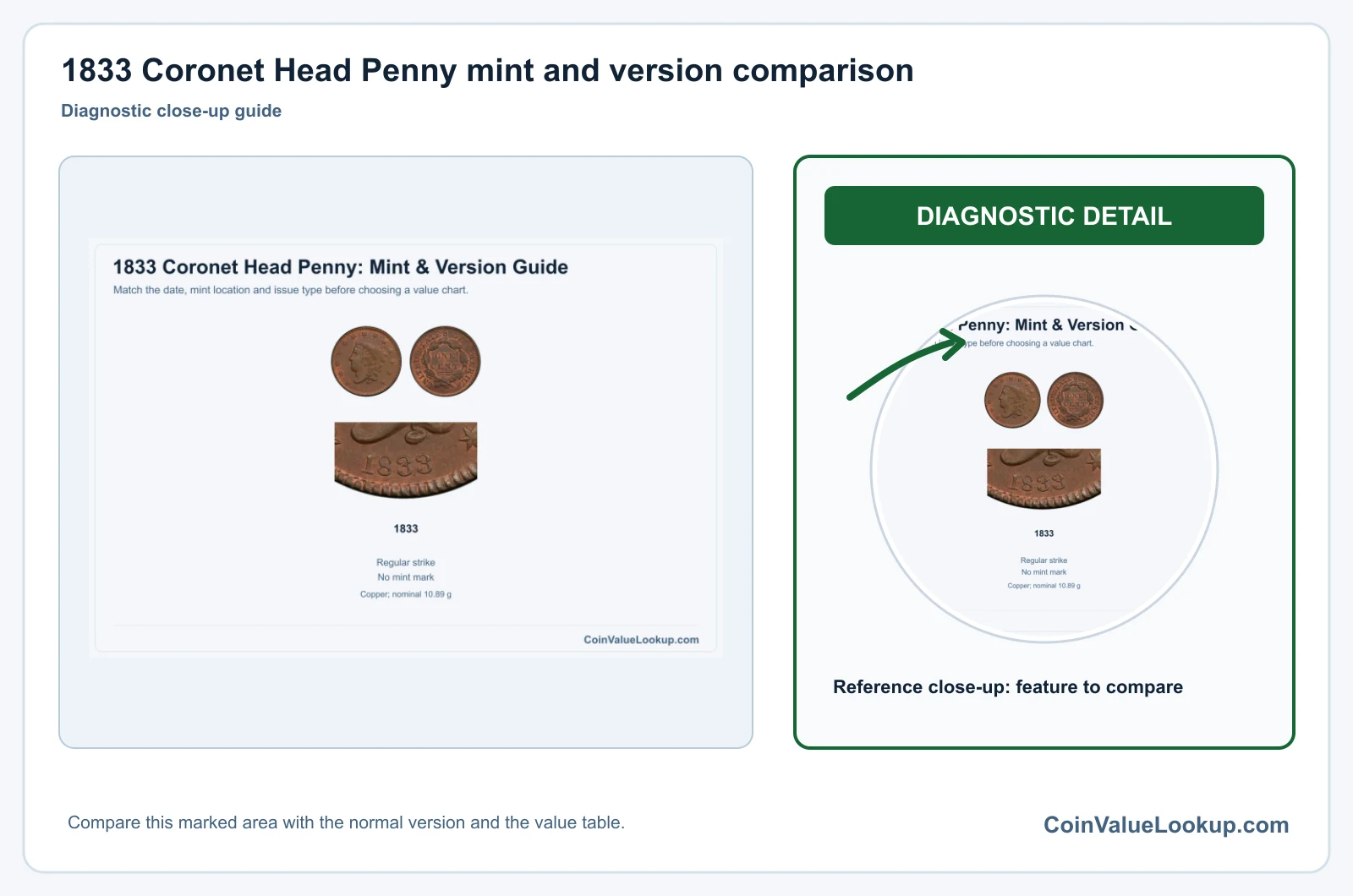
The 1833 Coronet Head Cent is a copper large cent struck at Philadelphia, and guide estimates from USA Coin Book place business strikes between roughly $38 in Good-4 condition and $1,127 in MS63. That is not the full market picture — proof examples and major errors sit outside that range entirely.
Identifying the exact variety you hold is the essential first step before assigning any value.
Fast Way to Identify Your 1833 Coronet Head Cent
The quickest way to start figuring out what you have is to upload clear photos of the front and back of your coin. Our identifier can offer a preliminary read on the series, design type, and approximate condition.
It is not a substitute for professional authentication, but it points you in the right direction fast.
1833 Coronet Head Cent Value
Upload both sides of your 1833 Coronet Head Cent.
Front Obverse
Upload photo
Back Reverse
Upload photo
Which 1833 Coronet Head Cent Versions Are Worth Money?
- Business strikes in higher grades command significantly more — a USA Coin Book guide estimate jumps from $38 at Good-4 to $1,127 at MS63, so condition is the biggest value driver on ordinary examples.
- Proof examples of the 1833 Coronet Head Cent are a separate category requiring professional attribution; no standard business-strike price applies, and individual assessment is essential.
- Rotated die errors on this date are a reported category worth inspecting for, since misaligned dies create a visually obvious oddity that can add collector interest.
- Die cracks — raised lines crossing the coin's surface from failing dies — are another reported error category that may carry a premium depending on size and location.
Step 1: Identify Your 1833 Coronet Head Cent Mint Mark and Version
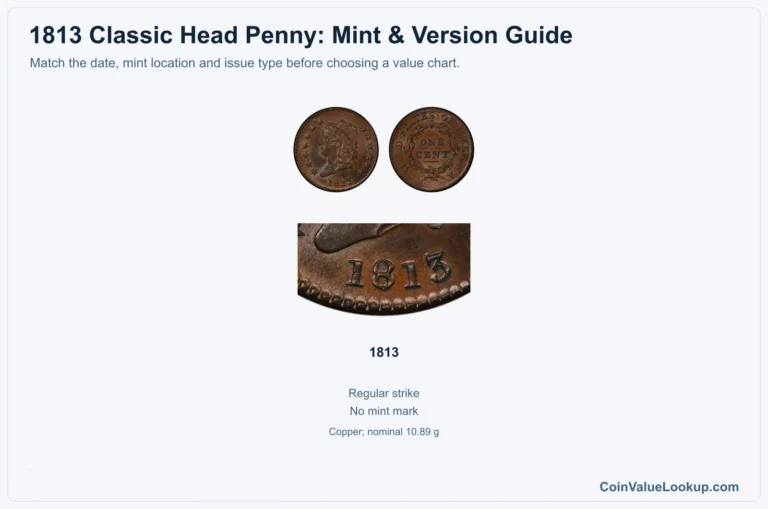
The 1833 Coronet Head Cent shows Liberty wearing a coronet inscribed LIBERTY on the obverse, with thirteen stars around the border and the date below. The reverse displays ONE CENT inside a laurel wreath.
All examples were struck at Philadelphia, so there is no mintmark to look for — do not assume a branch-mint version exists.
Separating business strikes from proofs matters. A proof is a manufacturing method involving specially prepared dies and planchets, not simply a shiny coin.
Polished or well-preserved business strikes can fool you; genuine early proofs require attribution of die characteristics, rim finish, and surface quality by someone who knows what to look for.
Check weight as supporting evidence — the nominal spec is 10.89 grams of copper — but wear, corrosion, and the production tolerances of 1830s minting mean weight alone cannot prove authenticity. Examine the date-punch shape, legend wording, and wreath details on both sides.
Those physical clues narrow down the correct category far better than a kitchen scale.
Step 2: Check Your 1833 Coronet Head Cent Grade
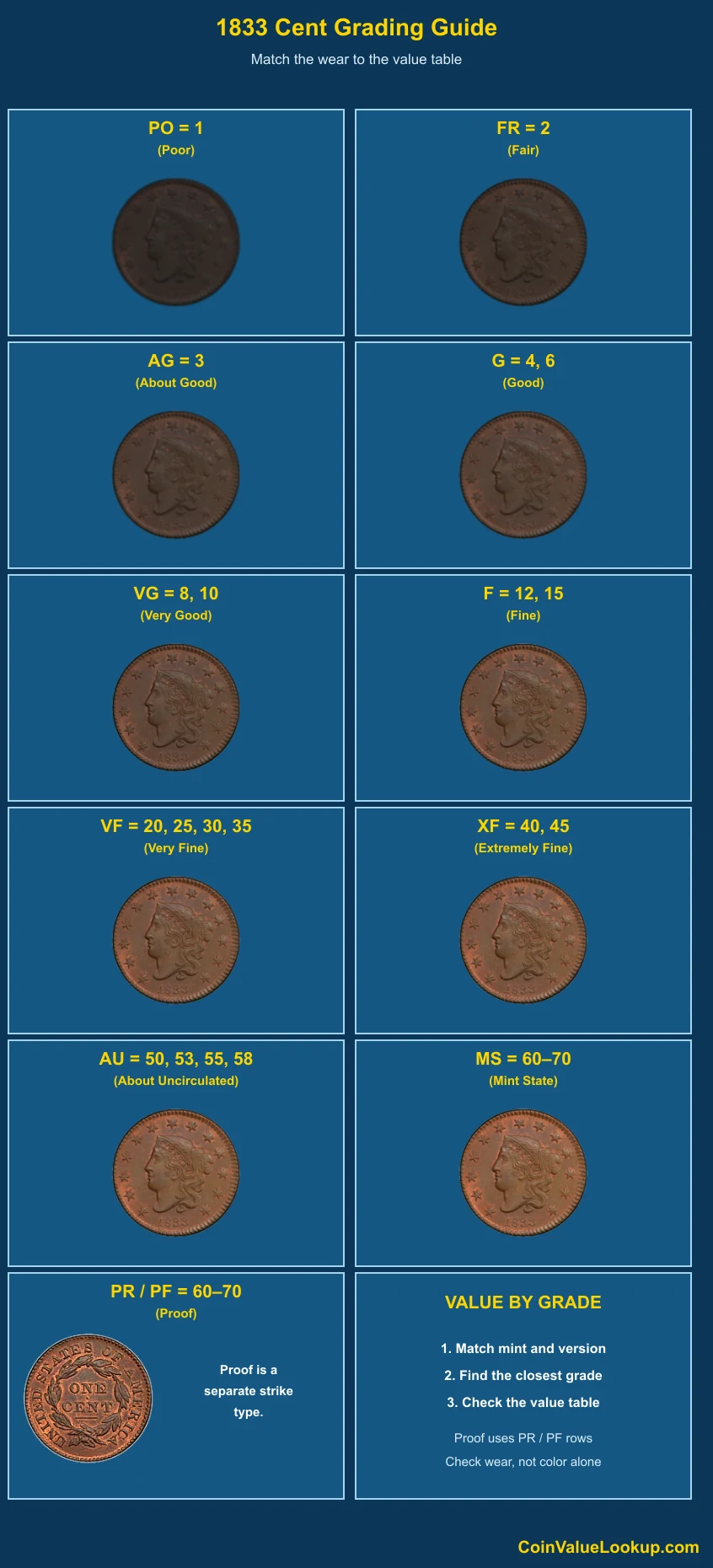
Start by examining Liberty's hair detail above the ear and across the forehead, plus the condition of her cheek. On the reverse, check whether individual leaf veins in the wreath are still visible and whether the lettering retains sharp edges.
Compare your coin against the reference image showing wear progression for this type.
Circulation wear looks different from a weak strike. A weakly struck coin may lack detail in specific, localized spots even when the rest is sharp, while honest wear removes high points gradually and uniformly.
Corrosion and porosity also eat detail but leave a pitted, rough texture that circulated wear does not.
Surface problems — cleaning, scratches, environmental damage — can lower market value well below what the remaining detail would suggest. On copper cents, you will also see color designations: BN (brown), RB (red-brown), and RD (red).
These describe how much original mint color remains, not different metals. Most survivors from 1833 are solidly BN, and that is perfectly normal for a coin approaching two centuries old.
Step 3: Check 1833 Coronet Head Cent Value by Mint and Version
1833 Coronet Head Cent
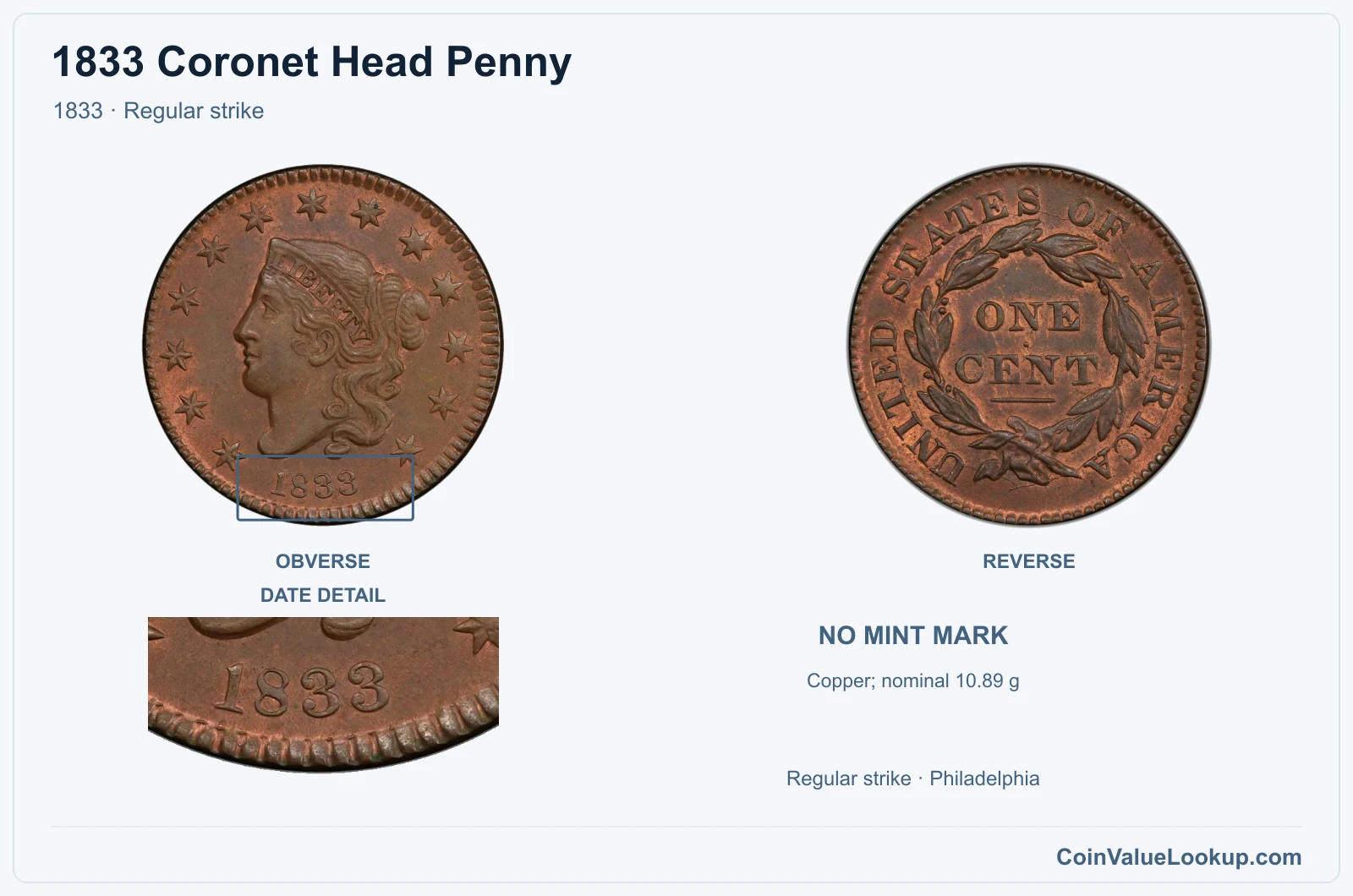
The standard 1833 Coronet Head Cent is a copper business strike produced at Philadelphia with no mintmark. USA Coin Book guide estimates range from about $38 in Good-4 to $1,127 in MS63.
That spread tells you condition is doing most of the heavy lifting on value.
Look for the classic Coronet obverse with thirteen stars flanking Liberty and a clean ONE CENT reverse inside a wreath. Original brown surfaces with no signs of cleaning or tooling are what the market rewards.
A coin with sharp hair detail above the ear and full wreath leaves is in a different league from a flat, worn example.
Coin Value Lookup is a good starting point when you want to compare your coin against guide values for this and other series.
| Range | Grade | Price | Auction Records | Appraisal |
|---|---|---|---|---|
| PO | PO 1 | — | Coin Identifier | |
| FR | FR 2 | — | Coin Identifier | |
| AG | AG 3 | Coin Identifier | ||
| G | G 4 | Coin Identifier | ||
| G 6 | Coin Identifier | |||
| VG | VG 8 | Coin Identifier | ||
| VG 10 | Coin Identifier | |||
| F | F 12 | Coin Identifier | ||
| F 15 | Coin Identifier | |||
| VF | VF 20 | Coin Identifier | ||
| VF 25 | Coin Identifier | |||
| VF 30 | Coin Identifier | |||
| VF 35 | Coin Identifier | |||
| XF | XF 40 | Coin Identifier | ||
| XF 45 | Coin Identifier | |||
| AU | AU 50 | Coin Identifier | ||
| AU 53 | Coin Identifier | |||
| AU 55 | Coin Identifier | |||
| AU 58 | Coin Identifier | |||
| MS | MS 60 | — | Coin Identifier | |
| MS 61 | Coin Identifier | |||
| MS 62 | Coin Identifier | |||
| MS 63 | Coin Identifier | |||
| MS 64 | Coin Identifier | |||
| MS 65 | Coin Identifier | |||
| MS 66 | Coin Identifier | |||
| MS 67 | — | — | — | |
| MS 68 | — | — | — | |
| MS 69 | — | — | — | |
| MS 70 | — | — | — |
1833 Coronet Head Cent — Proof
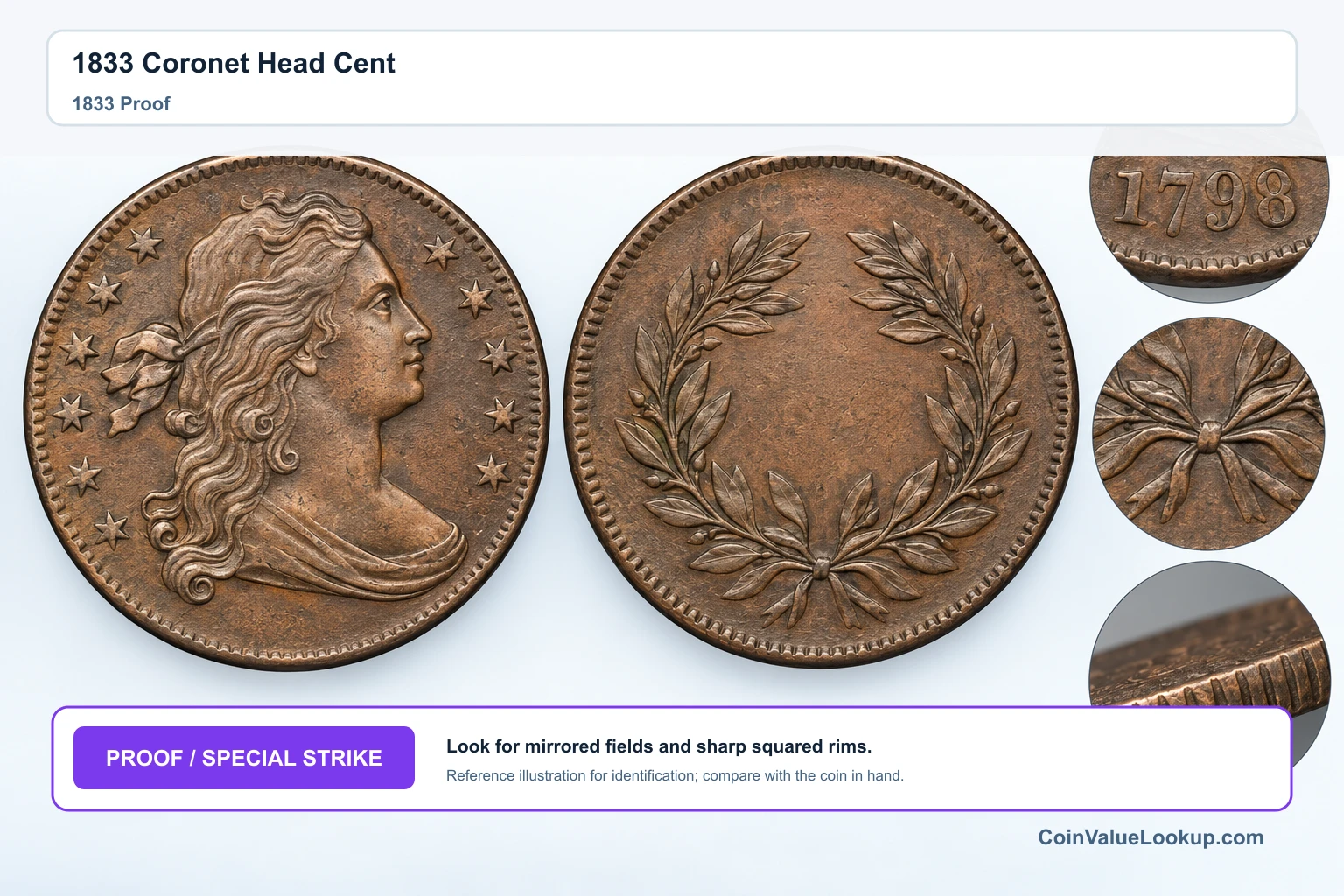
The 1833 Proof Coronet Head Cent is a cataloged early proof, meaning it was struck using specially prepared dies on a carefully selected planchet. These are genuinely rare coins.
Simply having a shiny or well-preserved cent does not make it a proof — you need diagnostic die characteristics, squared rims, and mirror-like fields that come from the manufacturing process, not from polishing.
No standard business-strike pricing applies here. Each proof trades on its own merits: the quality of surfaces, the sharpness of detail, and whether a recognized grading service has authenticated and attributed it.
Individual assessment by a specialist is the only responsible way to establish value. PCGS lists proof branches for the Coronet Head series, confirming this as a recognized category, but a catalog listing is not the same thing as a recent sale price.
Values by grade are not available for this coin yet.
1833 Coronet Head Cent Error List
1. 1833 Coronet Head Cent — Rotated Dies
A rotated die error occurs when one of the two dies is misaligned relative to the other, causing the obverse and reverse to sit at an unexpected angle. To check, hold the obverse upright and flip the coin top-to-bottom along a vertical axis.
On a normal US coin, the reverse should also appear upright. If it is tilted — say 15, 45, or 90 degrees off — you may have a rotated die error.
Be careful with lookalikes. A photograph taken at an angle, or simply turning the coin sideways in your hand, can create the illusion of rotation.
Always compare against known normal alignment. This error category is reported for the 1833 Coronet Head Cent, but no specific numeric premium has been established here.
Value depends on the degree of rotation, the coin's overall condition, and whether a professional service confirms the error.
2. 1833 Coronet Head Cent — Die Crack
Die cracks show up as thin, raised lines running across the coin's surface — through the fields, across letters, or over design elements. They happen when a die begins to fail under repeated striking pressure.
The key word is raised: the metal fills the crack in the die, leaving a ridge you can feel with a fingertip or see under magnification.
Do not confuse die cracks with scratches, which are incuse (cut into the surface). Corrosion lines and tool marks also sit below the surface rather than above it.
A genuine die crack will follow a continuous path and cannot be rubbed away. This category is reported for the 1833 Coronet Head Cent, but no adopted price range exists.
The size, location, and drama of the crack all influence desirability, and professional attribution is the safest route to confirming what you have.