1839 Coronet Head Cent Coin Value: How Much Is It Worth?
The 1839 Coronet Head cent is one of the more complex years in the series, with at least four distinct business-strike varieties plus a rare proof. Guide estimates for ordinary branches range from about $43 in G4 to over $120,000 in MS63 for the scarce 1839/6 overdate.
Identifying your exact variety is the essential first step, because the price gap between a common Head of 1838 and that overdate is enormous.
Fast Way to Identify Your 1839 Coronet Head Cent
Want a quick read on which 1839 variety you have? Upload clear photos of the front and back of your coin, and our identifier will offer a preliminary match to the correct branch.
It cannot authenticate, certify a grade, or guarantee a price, but it will point you in the right direction before you spend time squinting at hair curls.
1839 Coronet Head Cent Value
Upload both sides of your 1839 Coronet Head Cent.
Front Obverse
Upload photo
Back Reverse
Upload photo
Which 1839 Coronet Head Cent Versions Are Worth Money?
- The 1839/6 overdate is the standout, with guide values from $860 in G4 to over $120,000 in MS63, dwarfing every other business-strike branch.
- The Silly Head variety carries slightly higher guide estimates than the Head of 1838 or Booby Head across comparable grades, starting around $56 in G4.
- The Head of 1838 Proof is a rare early proof issue; no standard numeric range applies, and each example requires individual assessment based on authenticated identity and condition.
- Prominent mint errors such as die cracks, cuds, off-center strikes, and the overdate can add collector interest beyond ordinary date value.
Step 1: Identify Your 1839 Coronet Head Cent Mint Mark and Version
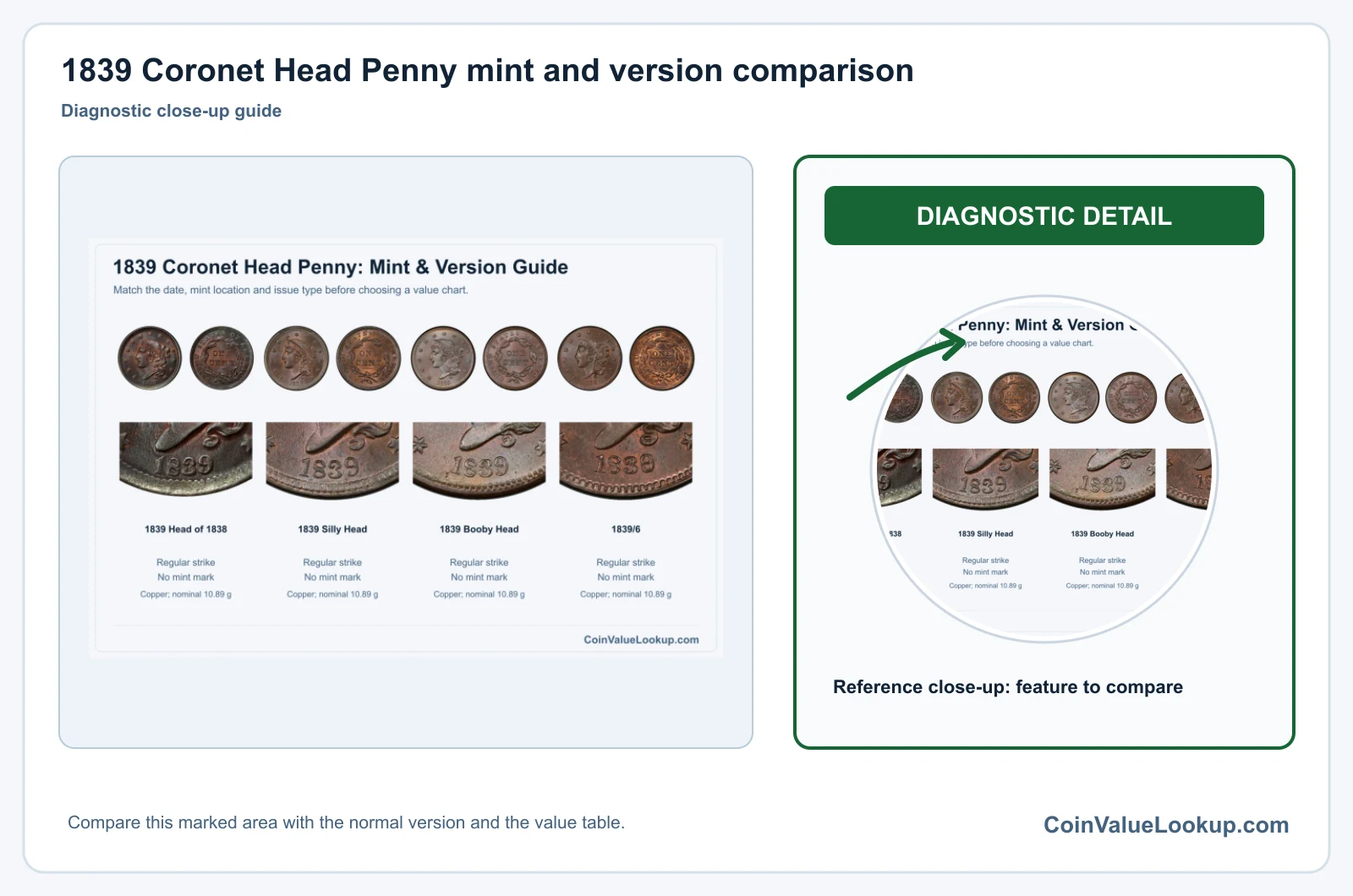
All 1839 Coronet Head cents were struck at Philadelphia, so none carry a mintmark. Four business-strike varieties exist under the Coronet design: Head of 1838, Silly Head, Booby Head, and the 1839/6 overdate.
A fifth branch, the Type of 1840, belongs to the Braided Hair series and is a different design altogether.
The quickest way to sort them is the hair. On the Booby Head, hair curls wrap around and below the bust truncation, the lowest edge of the portrait.
On the Silly Head, the shoulder area does not extend past the hair.
The Head of 1838 retains the prior year's beaded-cord style in the hair. If you see traces of a "6" lurking beneath the final digit of the date, you have the 1839/6 overdate, which is far scarcer than any of the standard varieties.
Look at both faces and the edge. Date-punch shape, legend wording, and wreath details all help confirm the correct category.
Weight should be close to the nominal 10.89 grams for copper, but wear, corrosion, and production tolerances mean weight alone cannot prove authenticity.
Step 2: Check Your 1839 Coronet Head Cent Grade
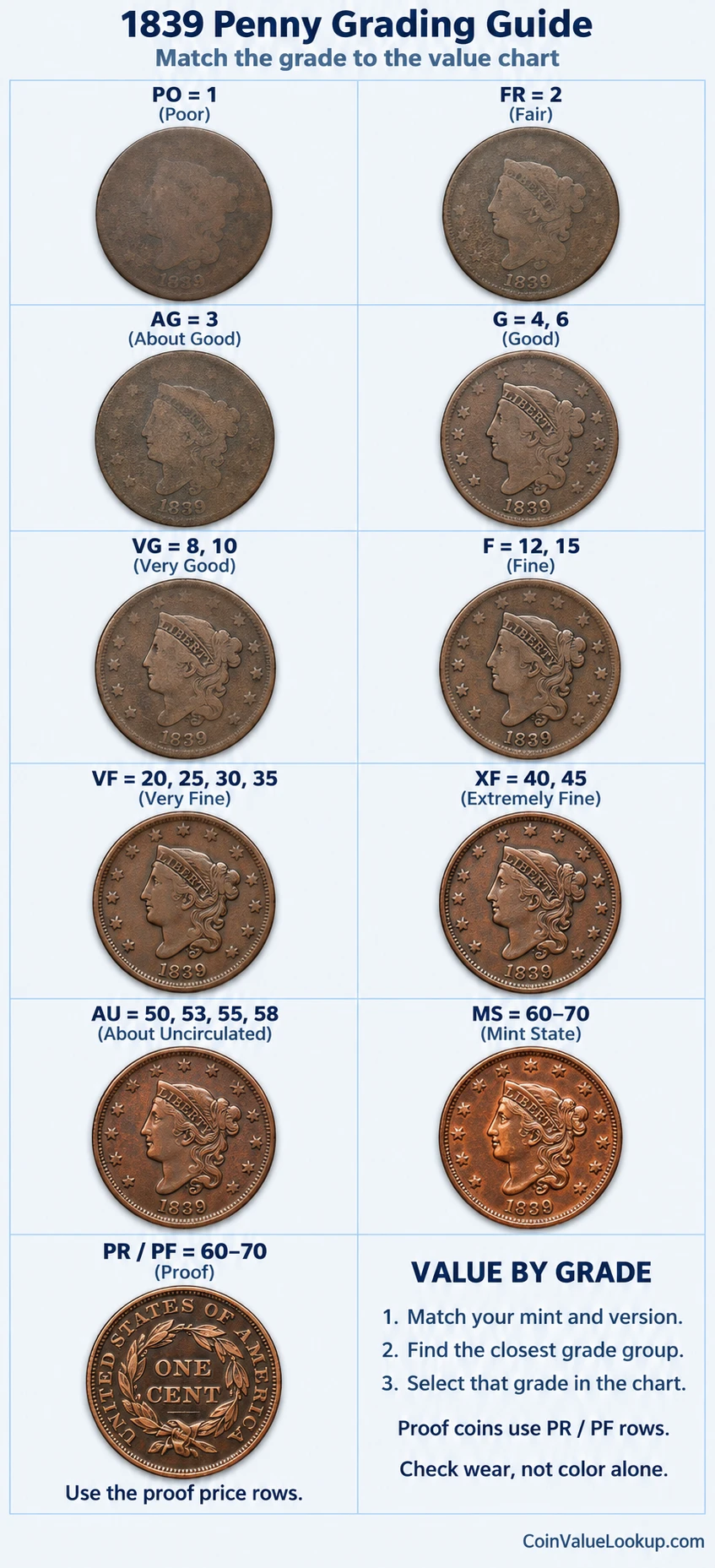
Start with the portrait. On well-worn examples, Liberty's hair above the ear and cheek flatness tell you the most.
Compare your coin's remaining detail against like-type grade images, paying attention to how much relief survives on the wreath leaves and lettering on the reverse.
Separate honest circulation wear from other problems. A weakly struck coin can look worn even in high grade, and corrosion or porosity eats detail in patterns that differ from normal wear.
Surface issues like cleaning, scratches, or environmental damage can substantially reduce market value even if the underlying detail is strong.
On copper cents, color designations such as BN, RB, and RD describe how much original red mint luster remains. They are color attributes, not different alloys.
A full-red example commands a premium over a brown one at the same grade.
Proof is a manufacturing method, not a grade above Mint State. A polished business strike is not a proof.
Genuine proofs show specific die characteristics, mirror fields, and rim profiles that distinguish them from circulation issues.
Step 3: Check 1839 Coronet Head Cent Value by Mint and Version
1839 Coronet Head Cent — Head of 1838
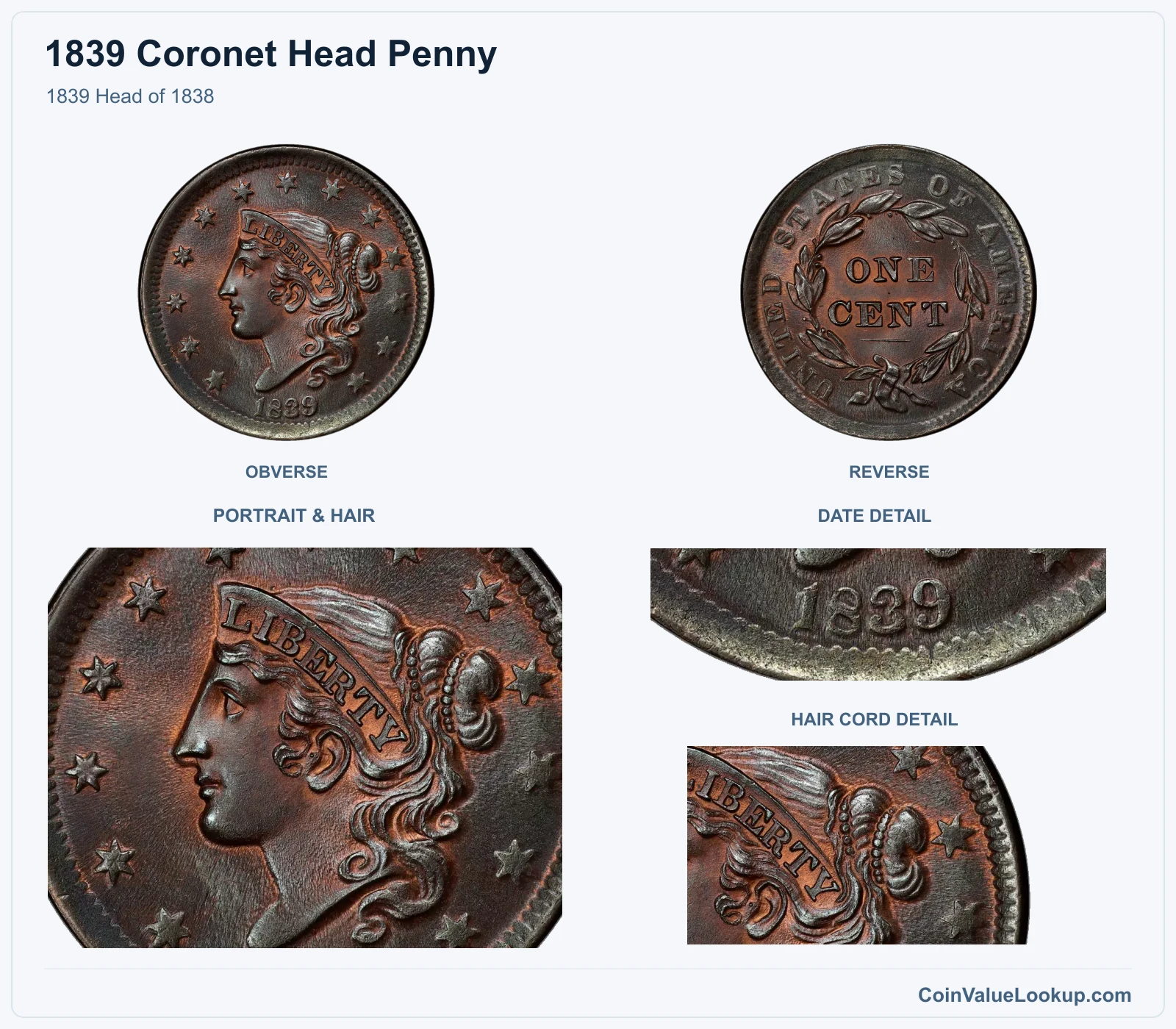
The Head of 1838 variety carries the prior year's portrait style forward into 1839, identifiable by its beaded cords in the hair. It is a copper cent weighing nominally 10.89 grams, struck at Philadelphia with no mintmark.
Guide values run from about $43 in G4 up to roughly $1,878 in MS63. That makes it the most affordable entry point for the year in low grades.
In hand, look for the distinctive beaded texture along the hair cords near the coronet, which distinguishes it from the Silly Head and Booby Head.
| Range | Grade | Price | Auction Records | Appraisal |
|---|---|---|---|---|
| PO | PO 1 | — | Coin Identifier | |
| FR | FR 2 | — | Coin Identifier | |
| AG | AG 3 | — | Coin Identifier | |
| G | G 4 | — | Coin Identifier | |
| G 6 | — | Coin Identifier | ||
| VG | VG 8 | Coin Identifier | ||
| VG 10 | — | Coin Identifier | ||
| F | F 12 | Coin Identifier | ||
| F 15 | Coin Identifier | |||
| VF | VF 20 | Coin Identifier | ||
| VF 25 | Coin Identifier | |||
| VF 30 | — | Coin Identifier | ||
| VF 35 | Coin Identifier | |||
| XF | XF 40 | Coin Identifier | ||
| XF 45 | Coin Identifier | |||
| AU | AU 50 | Coin Identifier | ||
| AU 53 | Coin Identifier | |||
| AU 55 | Coin Identifier | |||
| AU 58 | Coin Identifier | |||
| MS | MS 60 | — | Coin Identifier | |
| MS 61 | Coin Identifier | |||
| MS 62 | Coin Identifier | |||
| MS 63 | Coin Identifier | |||
| MS 64 | Coin Identifier | |||
| MS 65 | Coin Identifier | |||
| MS 66 | Coin Identifier | |||
| MS 67 | Coin Identifier | |||
| MS 68 | — | — | — | |
| MS 69 | — | — | — | |
| MS 70 | — | — | — |
1839 Coronet Head Cent — Silly Head
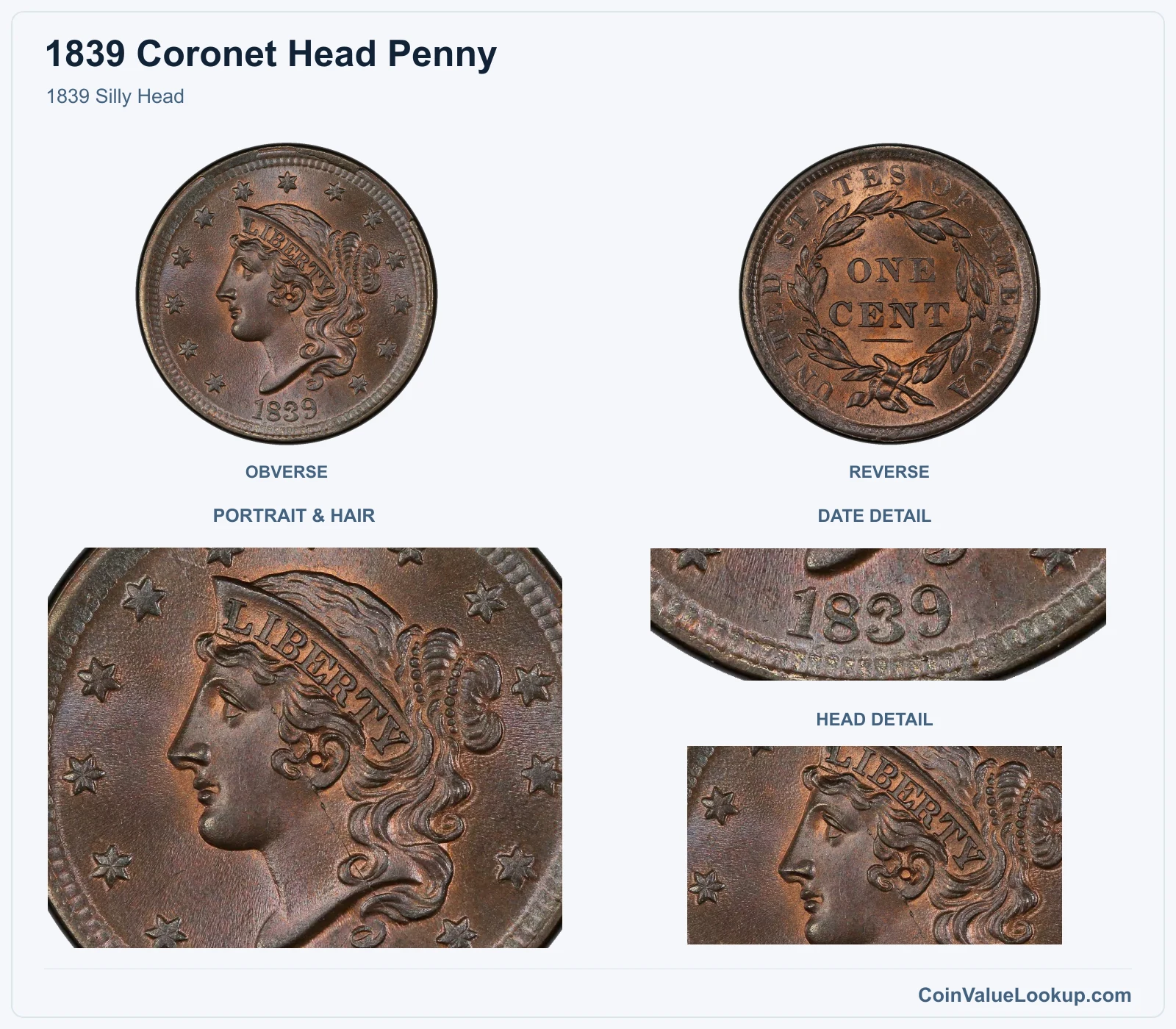
The Silly Head gets its colorful name from the somewhat awkward proportions of Liberty's portrait. The key diagnostic: the shoulder does not extend beyond the hair on this variety.
Struck in copper at Philadelphia, it shares the same nominal 10.89-gram weight as its siblings. Guide estimates place it at about $56 in G4 and around $2,111 in MS63, giving it a slight premium over the Head of 1838 and Booby Head at equivalent grades.
Compare the bust line carefully, because the Silly Head and Booby Head are the two most commonly confused varieties.
| Range | Grade | Price | Auction Records | Appraisal |
|---|---|---|---|---|
| PO | PO 1 | — | Coin Identifier | |
| FR | FR 2 | — | Coin Identifier | |
| AG | AG 3 | — | Coin Identifier | |
| G | G 4 | — | Coin Identifier | |
| G 6 | — | Coin Identifier | ||
| VG | VG 8 | — | Coin Identifier | |
| VG 10 | — | Coin Identifier | ||
| F | F 12 | Coin Identifier | ||
| F 15 | Coin Identifier | |||
| VF | VF 20 | Coin Identifier | ||
| VF 25 | Coin Identifier | |||
| VF 30 | Coin Identifier | |||
| VF 35 | Coin Identifier | |||
| XF | XF 40 | Coin Identifier | ||
| XF 45 | Coin Identifier | |||
| AU | AU 50 | Coin Identifier | ||
| AU 53 | Coin Identifier | |||
| AU 55 | Coin Identifier | |||
| AU 58 | Coin Identifier | |||
| MS | MS 60 | — | Coin Identifier | |
| MS 61 | Coin Identifier | |||
| MS 62 | Coin Identifier | |||
| MS 63 | Coin Identifier | |||
| MS 64 | Coin Identifier | |||
| MS 65 | Coin Identifier | |||
| MS 66 | Coin Identifier | |||
| MS 67 | Coin Identifier | |||
| MS 68 | — | — | — | |
| MS 69 | — | — | — | |
| MS 70 | — | — | — |
1839 Coronet Head Cent — Booby Head
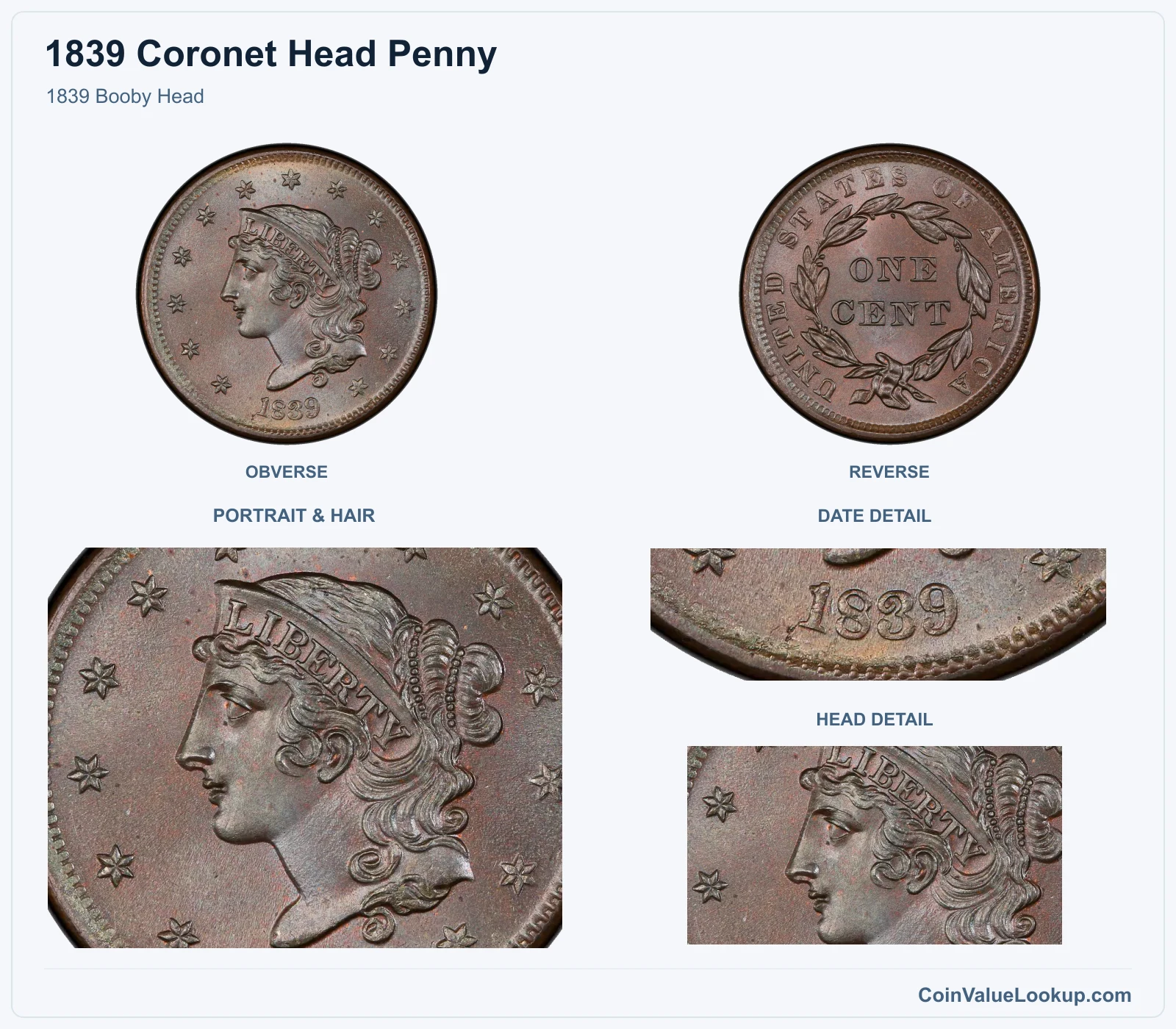
The Booby Head is the variety where hair curls wrap around and below the bust truncation. That feature is the single fastest way to identify it.
Guide estimates sit at roughly $50 in G4 and about $1,746 in MS63, making it comparable to the Head of 1838 in market terms. All examples are copper, struck at Philadelphia without a mintmark.
On well-worn coins the diagnostic curls can be faint, so tilt the coin under good light and look at the lowest edge of the portrait before deciding.
Coin Value Lookup is a handy starting point if you want to compare this variety's values against other years in the Coronet Head cent series.
| Range | Grade | Price | Auction Records | Appraisal |
|---|---|---|---|---|
| PO | PO 1 | — | Coin Identifier | |
| FR | FR 2 | — | Coin Identifier | |
| AG | AG 3 | — | Coin Identifier | |
| G | G 4 | — | Coin Identifier | |
| G 6 | Coin Identifier | |||
| VG | VG 8 | — | Coin Identifier | |
| VG 10 | Coin Identifier | |||
| F | F 12 | Coin Identifier | ||
| F 15 | Coin Identifier | |||
| VF | VF 20 | Coin Identifier | ||
| VF 25 | Coin Identifier | |||
| VF 30 | Coin Identifier | |||
| VF 35 | Coin Identifier | |||
| XF | XF 40 | Coin Identifier | ||
| XF 45 | Coin Identifier | |||
| AU | AU 50 | Coin Identifier | ||
| AU 53 | Coin Identifier | |||
| AU 55 | Coin Identifier | |||
| AU 58 | Coin Identifier | |||
| MS | MS 60 | Coin Identifier | ||
| MS 61 | Coin Identifier | |||
| MS 62 | Coin Identifier | |||
| MS 63 | Coin Identifier | |||
| MS 64 | Coin Identifier | |||
| MS 65 | Coin Identifier | |||
| MS 66 | Coin Identifier | |||
| MS 67 | — | Coin Identifier | ||
| MS 68 | — | — | — | |
| MS 69 | — | — | — | |
| MS 70 | — | — | — |
1839 Coronet Head Cent — /6
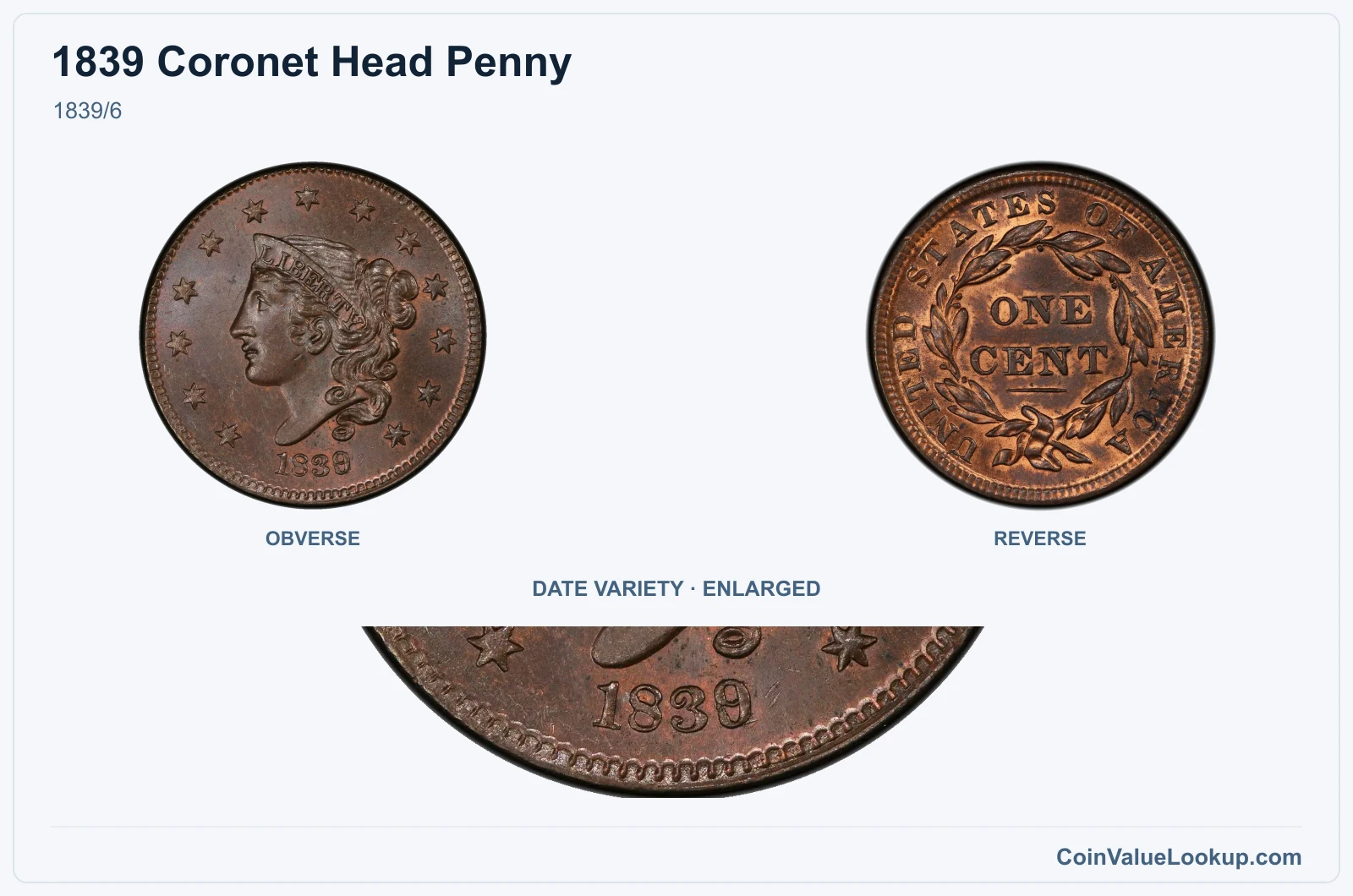
This is the one that gets collectors excited. The 1839/6 overdate shows remnants of a "6" beneath the final "9" in the date, evidence that an 1836-dated die was re-punched for 1839 use.
It uses the plain cords style.
Guide values reflect its scarcity: roughly $860 in G4 climbing to approximately $120,114 in MS63. That MS63 figure alone dwarfs every other business-strike 1839 variety by a wide margin.
Confirming the overdate requires magnification; look for the curved top of the underlying "6" peeking out below and to the right of the "9." Even heavily worn examples command strong premiums, so take your time examining the date area before dismissing a rough-looking coin.
| Range | Grade | Price | Auction Records | Appraisal |
|---|---|---|---|---|
| PO | PO 1 | — | Coin Identifier | |
| FR | FR 2 | — | Coin Identifier | |
| AG | AG 3 | — | Coin Identifier | |
| G | G 4 | — | Coin Identifier | |
| G 6 | Coin Identifier | |||
| VG | VG 8 | Coin Identifier | ||
| VG 10 | Coin Identifier | |||
| F | F 12 | Coin Identifier | ||
| F 15 | Coin Identifier | |||
| VF | VF 20 | Coin Identifier | ||
| VF 25 | Coin Identifier | |||
| VF 30 | Coin Identifier | |||
| VF 35 | Coin Identifier | |||
| XF | XF 40 | Coin Identifier | ||
| XF 45 | Coin Identifier | |||
| AU | AU 50 | Coin Identifier | ||
| AU 53 | — | Coin Identifier | ||
| AU 55 | — | Coin Identifier | ||
| AU 58 | Coin Identifier | |||
| MS | MS 60 | — | — | — |
| MS 61 | — | — | — | |
| MS 62 | — | — | — | |
| MS 63 | — | — | — | |
| MS 64 | — | — | — | |
| MS 65 | Coin Identifier | |||
| MS 66 | — | — | — | |
| MS 67 | — | — | — | |
| MS 68 | — | — | — | |
| MS 69 | — | — | — | |
| MS 70 | — | — | — |
1839 Coronet Head Cent — Head of1838 Proof
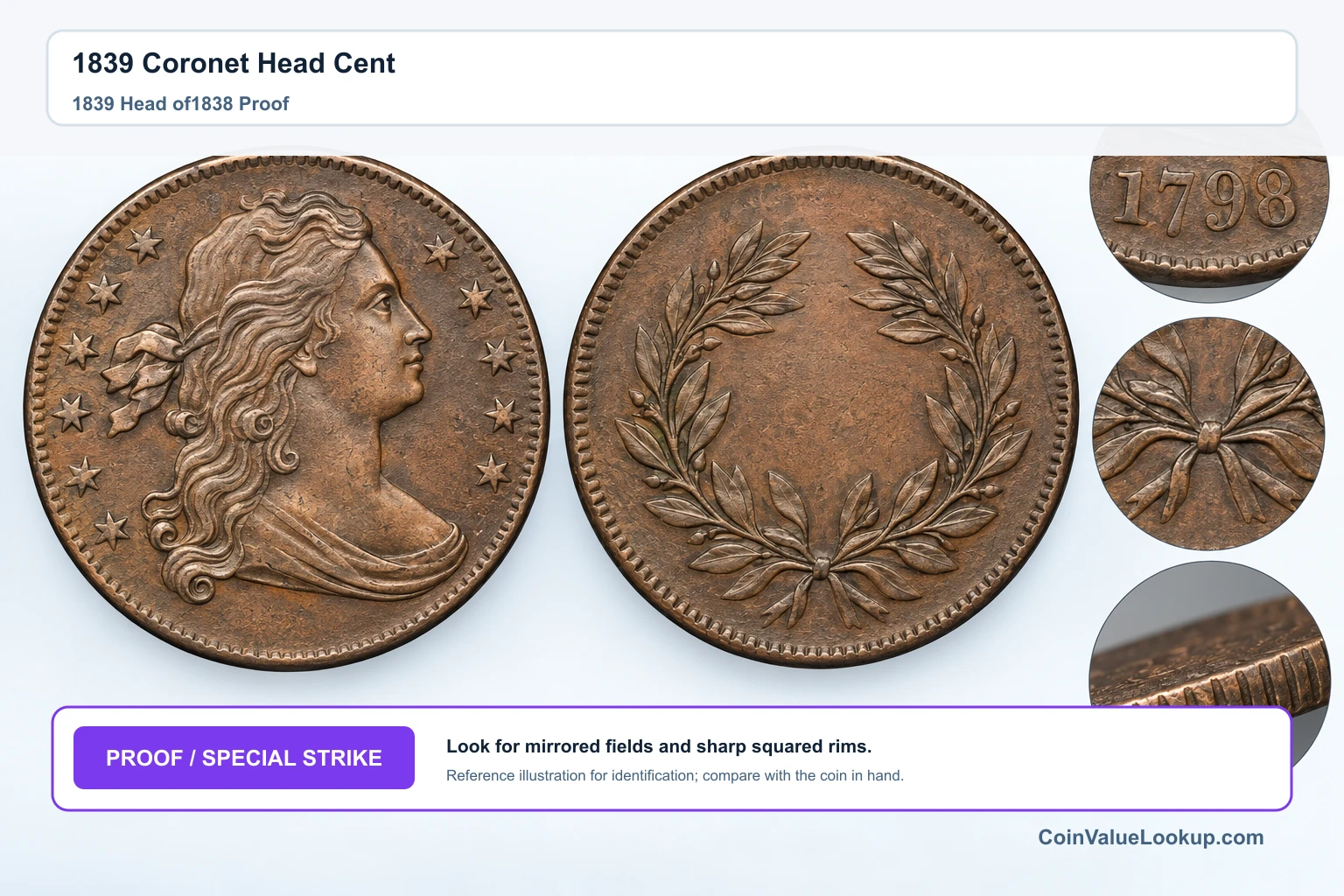
The 1839 Head of 1838 Proof is a rare early proof striking in copper. Genuine proofs from this era display mirror-like fields, sharp rims, and specific die characteristics that set them apart from any business strike, no matter how well preserved.
No standard numeric price range is adopted for this issue. Each example must be evaluated individually based on its authenticated identity, surface condition, and die characteristics.
A polished business strike is not a proof, and attribution of manufacture is critical. If you suspect you have one, professional authentication is the logical next step rather than relying on visual impressions alone.
Values by grade are not available for this coin yet.
1839 Coronet Head Cent Error List
1. 1839 Coronet Head Cent — Die Crack
Die cracks appear as thin raised lines running across the coin's surface, sometimes crossing both fields and design elements. They form when the steel die develops a fracture during use, and the crack fills with metal during striking.
To identify one, look for a fine raised thread that follows no logical design contour. It may run from the rim into the portrait or across the reverse wreath.
The line is raised, which separates it from a scratch or tool mark, both of which are incised into the surface. Corrosion lines can mimic cracks but tend to be irregular and pitted rather than sharp.
No specific numeric premium is adopted for die cracks on 1839 cents. Value depends on the crack's size, location, and the coin's overall condition and variety.
2. 1839 Coronet Head Cent — Die Break / Cud
A cud is a raised blob of metal connected to the rim, caused by a piece of the die breaking away entirely. The missing die fragment leaves a void that fills with metal during striking, producing a featureless lump where design detail should be.
To confirm a cud, check that the raised area connects to the rim and that design elements beneath it are absent, not merely weak. A rim dent or heavy corrosion buildup can look similar, but dents are depressed, and corrosion has a rough, pitted texture rather than a smooth, featureless lump.
Interior die chips that do not reach the rim are a related but separate category.
No adopted numeric range exists for cuds on 1839 cents. Assessment depends on size, position, the underlying variety, and overall grade.
3. 1839 Coronet Head Cent — Lamination / Split Planchet
Lamination errors show up as peeling metal, a retained flap, or visible separation within the copper planchet. They result from impurities or gas pockets trapped during the rolling process before the blank was cut and struck.
Look for a thin layer of metal lifting away from the coin's surface, sometimes still attached at one edge. Photograph the edge and the affected face together, because the separation is often easier to see in profile.
Scraping, deliberate cutting, or corrosion-driven flaking can all mimic a lamination, but those tend to show irregular edges or surface pitting rather than a clean metallic peel.
No numeric premium is adopted for lamination errors on the 1839 cent. Evaluation depends on severity, location, and the coin's variety and condition.
4. 1839 Coronet Head Cent — Off-Center Strike
An off-center strike occurs when the planchet is not properly seated between the dies, producing a displaced design and an unstruck crescent of blank metal on one side. The farther off center, the more dramatic the visual effect.
The key collector requirement is that the date remains fully visible. Without a readable date, an off-center cent loses much of its attribution value.
To distinguish it from a clipped planchet, check the blank area: an off-center strike leaves a smooth, full-thickness crescent, while a clip shows a curved or straight edge cut through the metal.
No standard numeric premium is adopted for off-center 1839 cents. Value depends on the percentage of displacement, date visibility, and overall condition.
5. 1839 Coronet Head Cent — Rotated Dies
On a normally aligned U.S. coin, if you hold the obverse upright and flip the coin top to bottom, the reverse should also appear upright. A rotated-die error means the reverse is turned some number of degrees from that standard orientation.
To check, hold Liberty's head upright, then flip the coin along its vertical axis. If the wreath and denomination on the reverse are tilted, you may have a rotation error.
Be careful that you are flipping top-to-bottom, not left-to-right, and that the coin itself is not simply turned in a photograph.
No adopted price range exists for rotated-die 1839 cents. The premium depends on the degree of rotation and overall coin condition.
6. 1839 Coronet Head Cent — Overdate
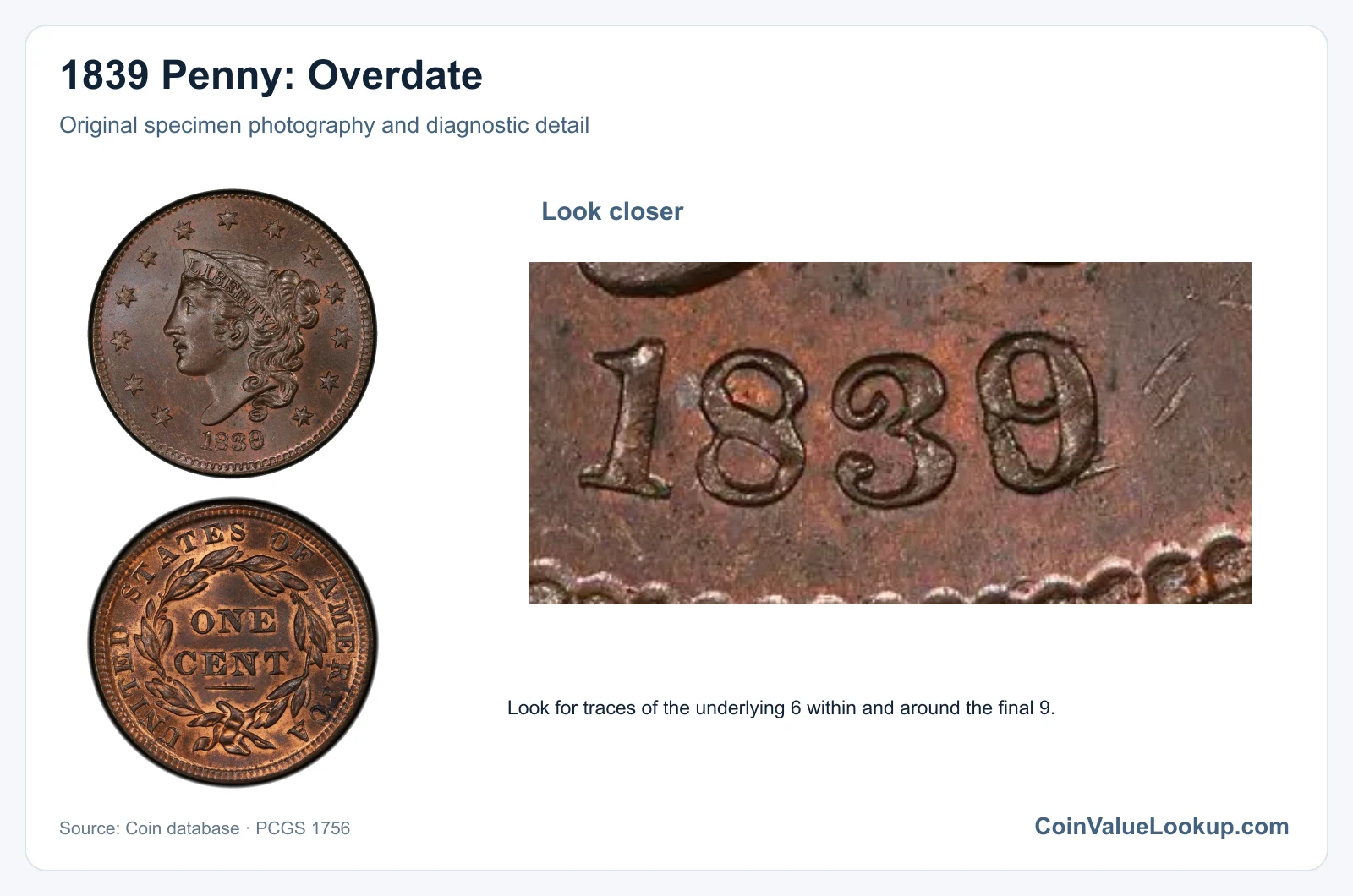
The 1839/6 overdate is actually a recognized variety with its own listing, covered in detail above. Beyond that cataloged branch, the overdate error category describes any instance where remnants of an earlier date digit survive beneath the final punched numerals.
Look for traces of underlying digit shapes that do not match the intended date. On the 1839/6, you can see the curved top of a "6" beneath the "9" with magnification.
Do not confuse a damaged or corroded date for an overdate; wear and post-mint hits can distort numerals in ways that superficially resemble repunching. Ordinary variation in date-punch fonts is also not an overdate.
No separate numeric premium is adopted for overdates beyond the cataloged 1839/6 variety. Each piece requires individual assessment of its die characteristics and authenticity.