1802 Draped Bust Cent Coin Value: How Much Is It Worth?
The 1802 Draped Bust Cent is a coin that commands respect even in well-worn condition. Guide estimates for the ordinary varieties range from about $103 in G4 to $2,340 in EF40, depending on the exact branch you hold.
Three distinct reverse varieties exist for this date, and identifying yours correctly is the first step toward understanding its value. These guide figures are not guaranteed offers, and rare proofs, restrikes or major errors fall outside this range entirely.
Fast Way to Identify Your 1802 Draped Bust Cent
The quickest way to start figuring out what you have is to upload clear photos of the front and back of your coin. Our identifier can give you a preliminary read on the variety, date and general condition from those images alone.
It will not authenticate, certify or assign a final grade, but it narrows the field fast so you know where to look next.
1802 Draped Bust Cent Value
Upload both sides of your 1802 Draped Bust Cent.
Front Obverse
Upload photo
Back Reverse
Upload photo
Which 1802 Draped Bust Cent Versions Are Worth Money?
- The 1802 1/000 Fraction variety carries the highest listed guide values, reaching about $2,340 at EF40, due to its visibly blundered denomination fraction.
- The 1802 Stemless Wreath (No Stems) variety lists around $1,746 at EF40; confirm the stems were never engraved rather than simply worn away.
- Mint errors such as brockages, double strikes and clipped planchets on any 1802 variety deserve individual professional evaluation since no standard price range is established.
Step 1: Identify Your 1802 Draped Bust Cent Mint Mark and Version
All 1802 Draped Bust Cents were struck at Philadelphia. There is no mintmark to hunt for, so do not let anyone convince you a branch-mint version exists.
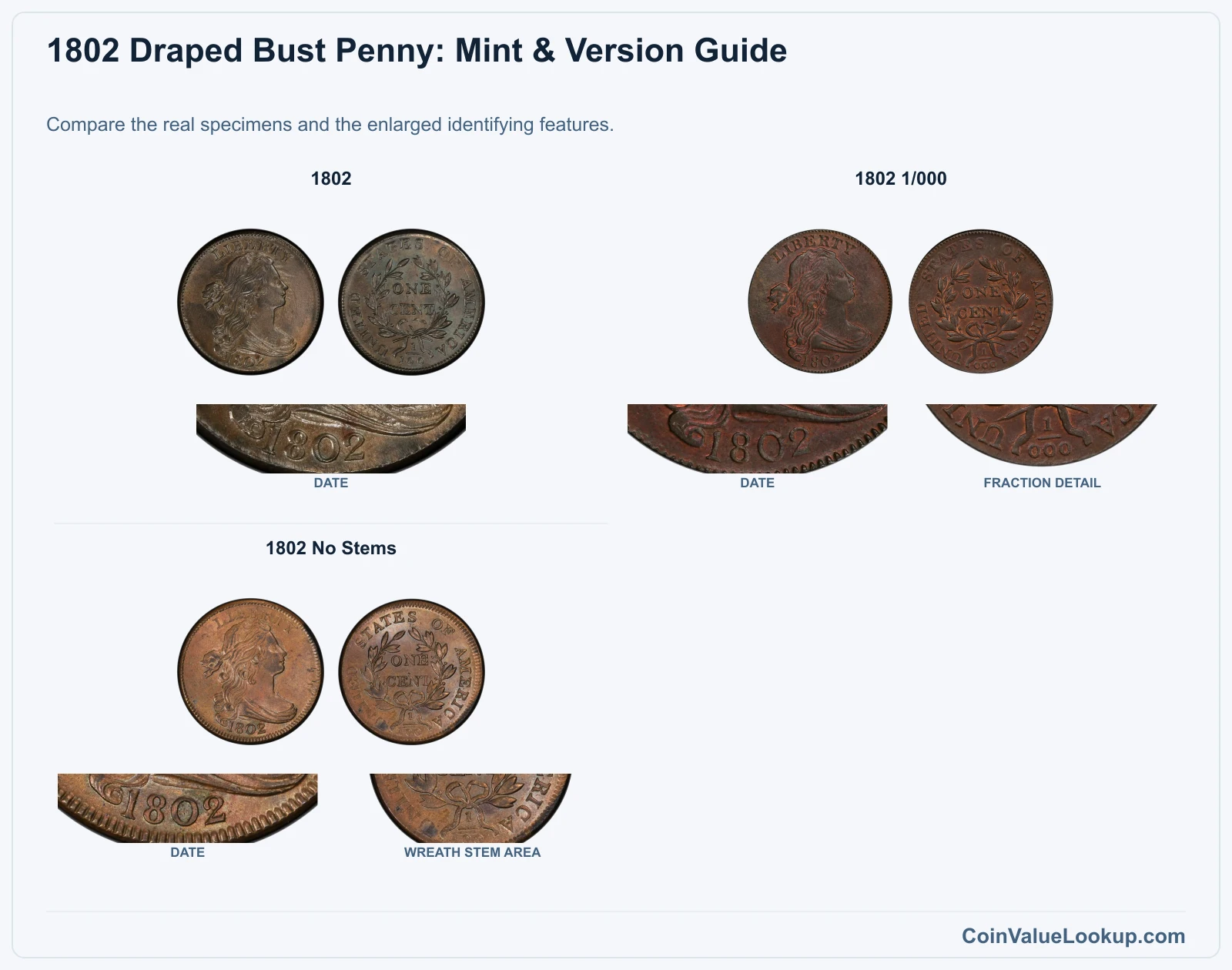
The three recognized varieties for this date are the Normal Reverse, the 1/000 Fraction, and the Stemless Wreath (No Stems). Telling them apart requires careful inspection of the reverse.
For the fraction variety, look at the denomination below the wreath. A normal coin reads 1/100.
On the 1/000 variety, the numerator "1" is punched over three zeros, creating a distinctly blundered fraction. This is a die-level error, not wear.
The No Stems variety is trickier. On a genuine Stemless Wreath coin, the wreath leaves were engraved without stems from the start.
If you simply see missing stems on a heavily worn coin, that is wear, not the variety. Compare your wreath to a known No Stems example and look for clean, intentional leaf bases rather than smoothed-away detail.
Weight can support your identification. The nominal specification is 10.89 grams of copper.
But production tolerances in 1802 were loose, and corrosion or cleaning can shift weight, so do not rely on the scale alone. Check the date-punch style, the legend spacing and the wreath construction together.
Step 2: Check Your 1802 Draped Bust Cent Grade
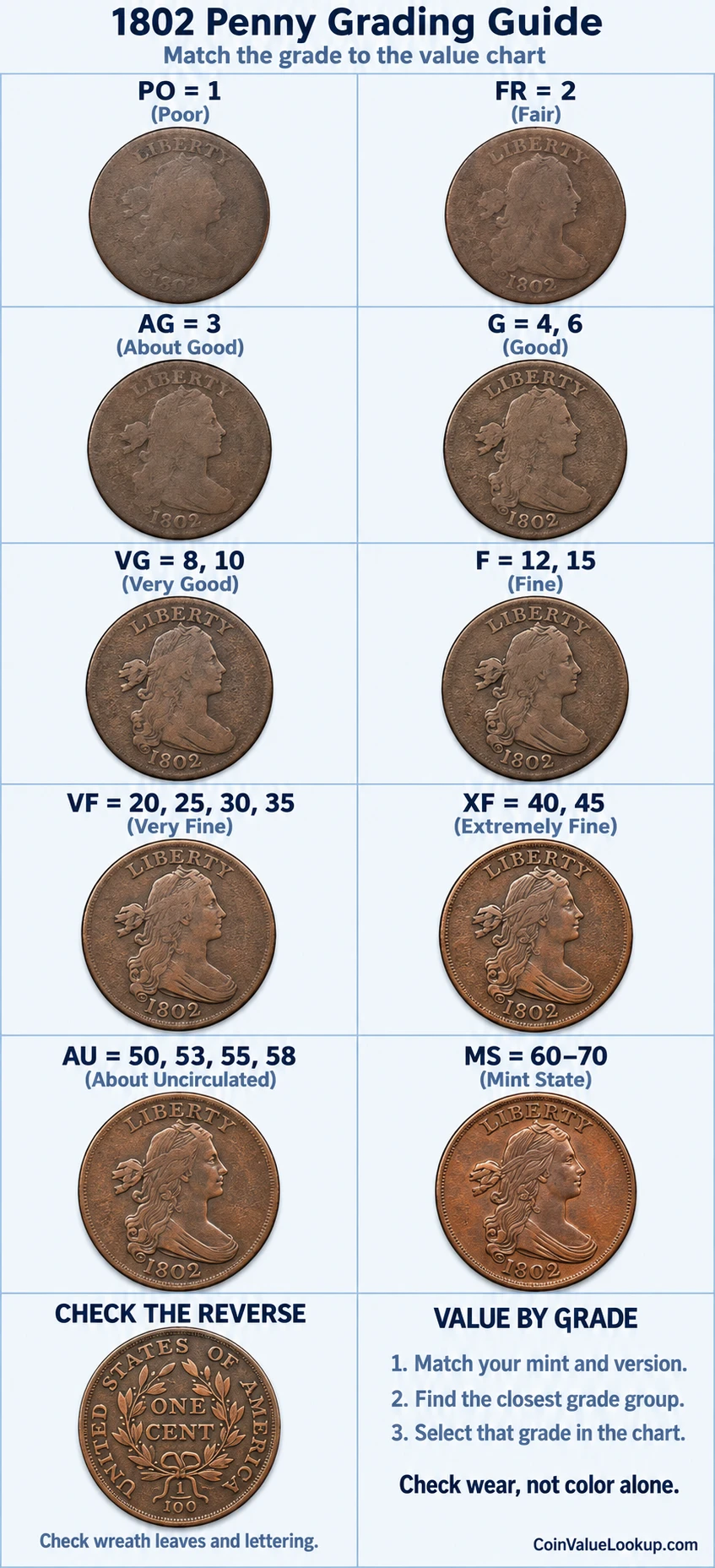
Start with the obverse portrait. On a high-grade example, Liberty's hair curls are individually defined from forehead to shoulder, and the cheek shows a gentle roundness without flat spots.
As the coin wears toward Good, those curls merge into a flat mass and the cheek loses all contour.
Flip it over. The wreath leaves should show individual veins and sharp edges in higher grades.
By G4, you will see an outline of the wreath but little interior detail.
Use the comparison image to match your coin against known grade benchmarks for the Draped Bust type. Pay attention to the highest points first: hair above the ear, the ribbon bow, and the leaf tips.
Do not confuse a weak strike with honest wear. Some 1802 cents left the press with soft detail in spots, and that is a production characteristic, not circulation damage.
Likewise, corrosion, porosity and old cleaning can disguise the true wear level. These surface problems often reduce market value well below what the remaining sharpness would suggest.
Color designations like BN, RB and RD describe how much original red copper color survives. They are not separate alloys or grades.
Most surviving 1802 cents are solidly brown.
Step 3: Check 1802 Draped Bust Cent Value by Mint and Version
1802 Draped Bust Cent
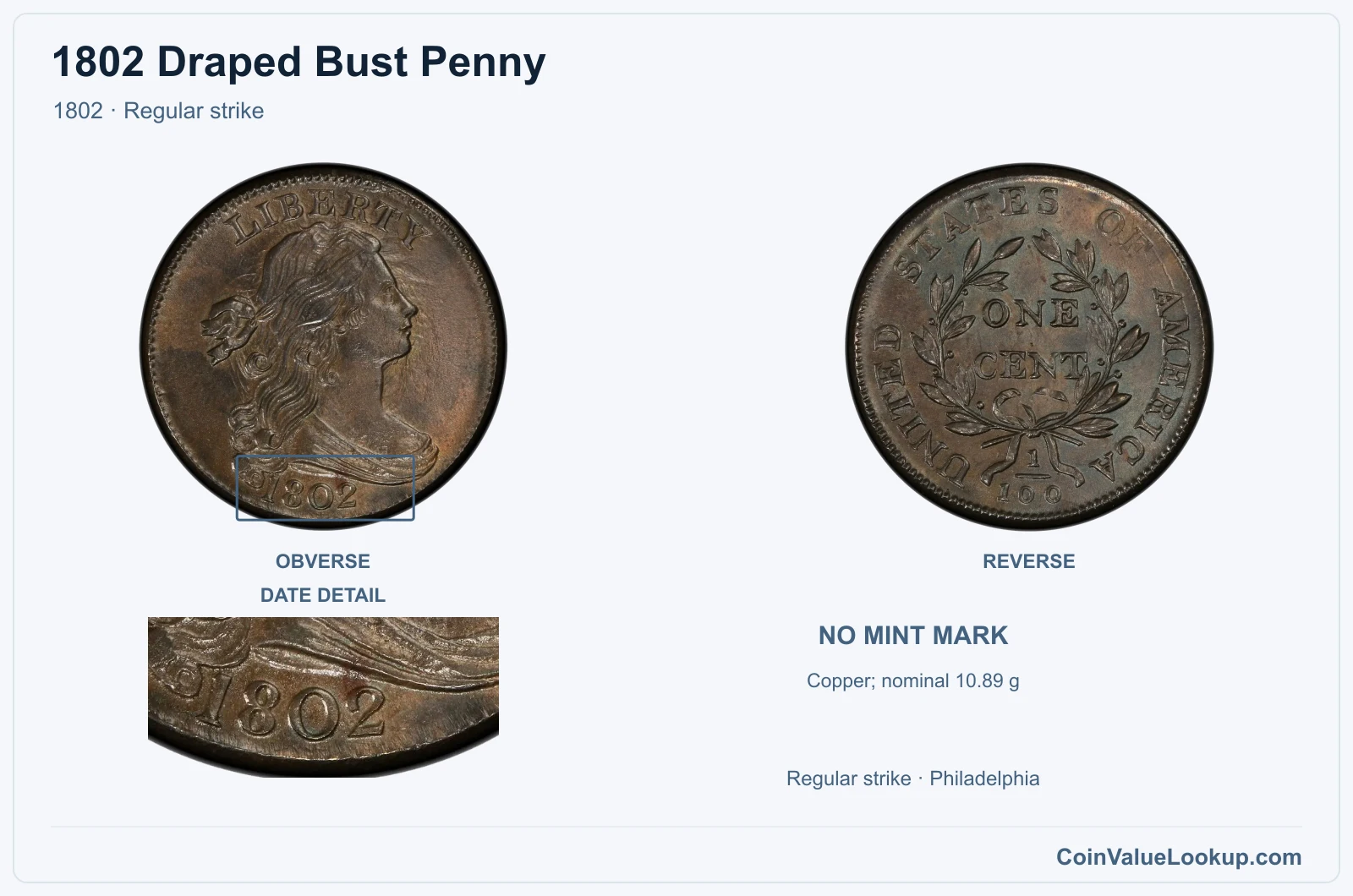
This is the baseline 1802 Draped Bust Cent with a normal reverse. The fraction reads 1/100 cleanly, and the wreath has its stems intact.
Guide estimates from USA Coin Book place it around $103 in G4 and roughly $1,599 at EF40.
To confirm you have the Normal Reverse, check two things. First, the fraction under the wreath should show a clear "1" over "100" without extra digits or over-punching.
Second, the wreath leaves should connect to visible stems when the coin has enough detail to show them. If both check out, you are looking at the standard variety.
If you are researching other Draped Bust dates or different series, Coin Value Lookup can help you find the right guide quickly. It is a useful starting point when you want to compare values across years or denominations.
| Range | Grade | Price | Auction Records | Appraisal |
|---|---|---|---|---|
| PO | PO 1 | Coin Identifier | ||
| FR | FR 2 | Coin Identifier | ||
| AG | AG 3 | Coin Identifier | ||
| G | G 4 | Coin Identifier | ||
| G 6 | Coin Identifier | |||
| VG | VG 8 | Coin Identifier | ||
| VG 10 | Coin Identifier | |||
| F | F 12 | Coin Identifier | ||
| F 15 | Coin Identifier | |||
| VF | VF 20 | Coin Identifier | ||
| VF 25 | Coin Identifier | |||
| VF 30 | Coin Identifier | |||
| VF 35 | Coin Identifier | |||
| XF | XF 40 | Coin Identifier | ||
| XF 45 | Coin Identifier | |||
| AU | AU 50 | Coin Identifier | ||
| AU 53 | Coin Identifier | |||
| AU 55 | Coin Identifier | |||
| AU 58 | Coin Identifier | |||
| MS | MS 60 | — | Coin Identifier | |
| MS 61 | Coin Identifier | |||
| MS 62 | Coin Identifier | |||
| MS 63 | Coin Identifier | |||
| MS 64 | Coin Identifier | |||
| MS 65 | — | Coin Identifier | ||
| MS 66 | — | — | — | |
| MS 67 | — | — | — | |
| MS 68 | — | — | — | |
| MS 69 | — | — | — | |
| MS 70 | — | — | — |
1802 Draped Bust Cent — 1/000
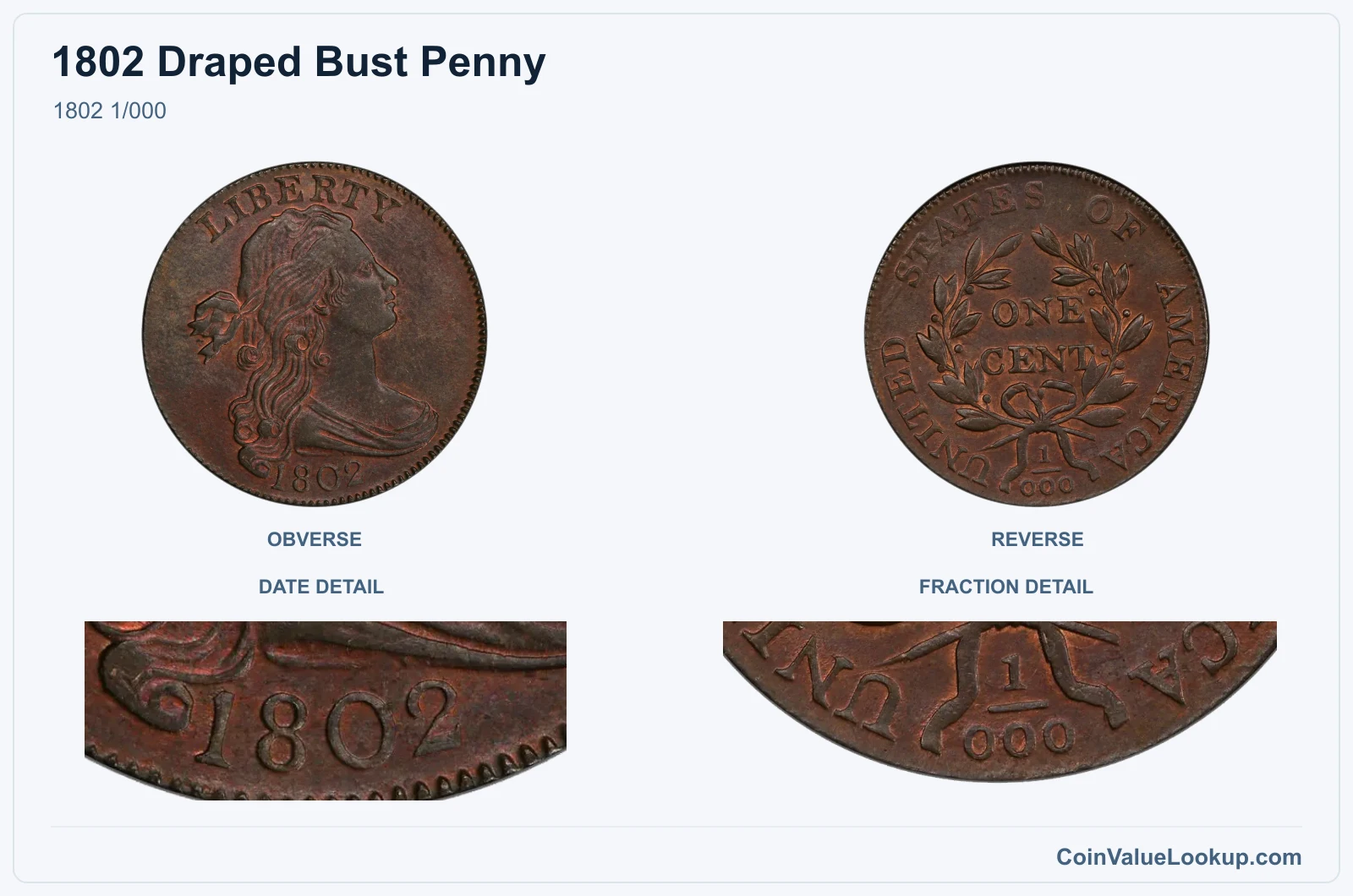
The 1802 1/000 variety is the one that makes collectors lean in. On the reverse, the fraction that should read 1/100 instead shows a "1" punched over three zeros.
You can see the underlying digits crowding the space, and the result is unmistakable under magnification.
USA Coin Book guide estimates put this branch at roughly $154 in G4 and about $2,340 at EF40, the highest listed figures among the three 1802 varieties. That premium exists because the blundered fraction is a die-level anomaly baked into every coin struck from that particular reverse die.
It is not damage, not wear, and not a trick of the light. Even in lower grades the extra digits usually remain visible, which helps identification considerably.
| Range | Grade | Price | Auction Records | Appraisal |
|---|---|---|---|---|
| PO | PO 1 | — | Coin Identifier | |
| FR | FR 2 | — | Coin Identifier | |
| AG | AG 3 | — | Coin Identifier | |
| G | G 4 | — | Coin Identifier | |
| G 6 | Coin Identifier | |||
| VG | VG 8 | Coin Identifier | ||
| VG 10 | — | Coin Identifier | ||
| F | F 12 | Coin Identifier | ||
| F 15 | Coin Identifier | |||
| VF | VF 20 | Coin Identifier | ||
| VF 25 | Coin Identifier | |||
| VF 30 | Coin Identifier | |||
| VF 35 | Coin Identifier | |||
| XF | XF 40 | — | Coin Identifier | |
| XF 45 | Coin Identifier | |||
| AU | AU 50 | Coin Identifier | ||
| AU 53 | Coin Identifier | |||
| AU 55 | Coin Identifier | |||
| AU 58 | — | Coin Identifier | ||
| MS | MS 60 | — | Coin Identifier | |
| MS 61 | — | Coin Identifier | ||
| MS 62 | — | Coin Identifier | ||
| MS 63 | — | Coin Identifier | ||
| MS 64 | — | Coin Identifier | ||
| MS 65 | — | — | — | |
| MS 66 | — | — | — | |
| MS 67 | — | — | — | |
| MS 68 | — | — | — | |
| MS 69 | — | — | — | |
| MS 70 | — | — | — |
1802 Draped Bust Cent — No Stems
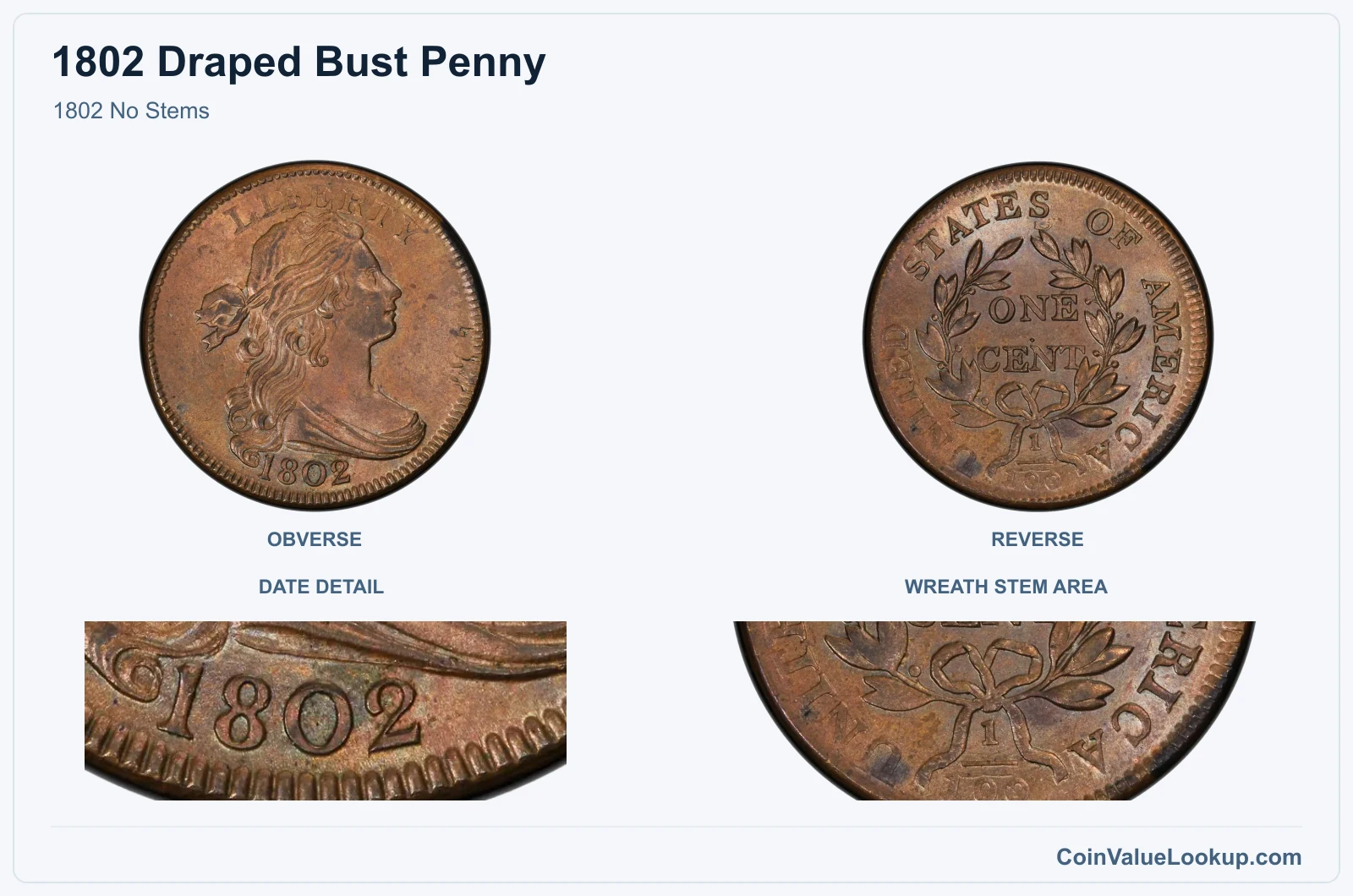
The 1802 No Stems variety features a wreath engraved without stems connecting the leaves. This was an intentional die design, not a product of die wear or coin circulation.
That distinction matters a lot, because plenty of heavily worn normal-reverse cents look stemless at first glance.
To identify this variety honestly, examine the base of the wreath leaves where they meet the bow. On a genuine Stemless Wreath die, the leaves attach directly and cleanly.
On a worn Normal Reverse coin, you will often see irregular remnants or ghostly outlines of stems.
Guide estimates from USA Coin Book run about $123 in G4 up to approximately $1,746 at EF40. Solid values, but only if the variety is correctly attributed.
| Range | Grade | Price | Auction Records | Appraisal |
|---|---|---|---|---|
| PO | PO 1 | — | Coin Identifier | |
| FR | FR 2 | Coin Identifier | ||
| AG | AG 3 | Coin Identifier | ||
| G | G 4 | Coin Identifier | ||
| G 6 | Coin Identifier | |||
| VG | VG 8 | Coin Identifier | ||
| VG 10 | Coin Identifier | |||
| F | F 12 | — | Coin Identifier | |
| F 15 | Coin Identifier | |||
| VF | VF 20 | Coin Identifier | ||
| VF 25 | Coin Identifier | |||
| VF 30 | Coin Identifier | |||
| VF 35 | Coin Identifier | |||
| XF | XF 40 | Coin Identifier | ||
| XF 45 | Coin Identifier | |||
| AU | AU 50 | Coin Identifier | ||
| AU 53 | Coin Identifier | |||
| AU 55 | Coin Identifier | |||
| AU 58 | Coin Identifier | |||
| MS | MS 60 | — | Coin Identifier | |
| MS 61 | Coin Identifier | |||
| MS 62 | Coin Identifier | |||
| MS 63 | Coin Identifier | |||
| MS 64 | Coin Identifier | |||
| MS 65 | — | — | — | |
| MS 66 | — | — | — | |
| MS 67 | — | — | — | |
| MS 68 | — | — | — | |
| MS 69 | — | — | — | |
| MS 70 | — | — | — |
1802 Draped Bust Cent Error List
1. 1802 Draped Bust Cent — Clipped Planchet
A clipped planchet means part of the original copper blank was missing before the coin was struck. You will see a curved, straight or irregular section absent from the edge, and the design near that area may show weakness because the metal could not fill the die completely.
Look at the opposite side of the coin from the clip for a corresponding area of softness in the strike.
Do not confuse a clip with a filed edge, a post-mint cut or corrosion eating into the rim. Genuine clips show metal flow consistent with striking, while damage after minting tends to leave sharp or irregular tool marks.
No standard price range is established for clipped 1802 cents; value depends on the authenticated variety, the size and type of clip, and overall condition.
2. 1802 Draped Bust Cent — Die Crack
Die cracks appear as raised lines running across the coin's surface. They form when the steel die fractures during use, and the crack fills with metal during striking, leaving a thin ridge on the finished coin.
On an 1802 cent, look for lines that cross fields, letters or design elements in a continuous path.
The key word is raised. A scratch or tool mark is incuse, cutting into the surface.
Corrosion lines tend to be irregular and pitted rather than sharply raised. Trace the crack from start to finish and note whether it follows a logical stress pattern across the die.
No established price range exists for die-crack examples on this date. Value depends on the crack's prominence, location and the coin's authenticated grade and variety.
3. 1802 Draped Bust Cent — Die Break / Cud
A cud is a specific type of die break where a chunk of the die near the rim breaks away entirely. The result is a raised, featureless blob of metal on the coin that connects to the rim, replacing whatever design was in that area.
Smaller interior die breaks can also occur but are technically not cuds unless they reach the rim.
Check the boundary of the raised area. A genuine cud has a defined edge where the intact die met the broken section.
A rim dent pushes metal inward and looks entirely different. Corrosion buildup can mimic a cud to the untrained eye, but it lacks the sharp boundary and uniform raised surface.
Pricing requires individual assessment based on the cud's size, location, and the coin's overall authenticated condition.
4. 1802 Draped Bust Cent — Clashed Dies
Clashed dies result when the obverse and reverse dies strike each other without a planchet between them. The impact transfers ghost images of one die onto the other.
On a clashed 1802 cent, you might see faint traces of the wreath in the obverse field or hints of Liberty's portrait lurking behind the reverse design.
These ghost images should align with where the opposite design would naturally appear during a normal strike. Random raised lines, scratches or environmental damage will not line up that way.
A brockage is a different error entirely, involving an actual struck coin stuck to a die.
No standard pricing exists for clashed-die 1802 cents. The visibility of the clash, the authenticated variety and the coin's grade all factor into individual value.
5. 1802 Draped Bust Cent — Brockage
A brockage occurs when a previously struck coin sticks to one of the dies and then impresses its design into the next blank that enters the press. The result is one normal side and one side showing an incuse, mirror-image version of the same design.
It is a dramatic error and hard to miss once you know what to look for.
The mirrored image should be reversed left-to-right and recessed into the surface. If the impression is raised rather than incuse, or if it does not mirror the opposite face cleanly, you may be looking at a die clash or post-mint damage from two coins being pressed together outside the mint.
Brockages on early copper cents are individually assessed. Authenticated identity, sharpness of the brockage impression and overall preservation determine value.
6. 1802 Draped Bust Cent — Double / Multiple Strike
A double or multiple strike happens when the coin receives two or more impressions from the dies, usually with some shift or rotation between hits. You will see two distinct sets of design elements overlapping or displaced from each other.
The effect can be subtle or wildly dramatic.
Do not confuse this with a doubled die, which is a different category entirely. A doubled die shows doubling within a single impression because the die itself carried doubled features.
A double strike shows separate, independently positioned impressions. Also rule out post-mint squeeze damage, where two coins are pressed together after leaving the mint.
No adopted price range exists. Each double-struck 1802 cent needs professional evaluation based on the degree of displacement, the number of strikes and overall condition.
7. 1802 Draped Bust Cent — Indented Strike
An indented strike occurs when another blank or object sits partially on top of the planchet during striking. The result is a depressed, bounded area on one side of the coin where the overlapping piece blocked the die.
The rest of the design strikes up normally around it.
The shape and edges of the depression are your main clues. A genuine indent has a defined perimeter that corresponds to the edge of whatever was overlapping.
A post-mint dent, by contrast, usually shows irregular edges and displaced metal without that clean boundary. If the depressed area contains a mirrored design rather than a blank impression, you are looking at a brockage instead.
Value is determined individually, factoring in the indent's size, the authenticated variety and the coin's preservation.
8. 1802 Draped Bust Cent — Blundered Fraction / Reverse Lettering
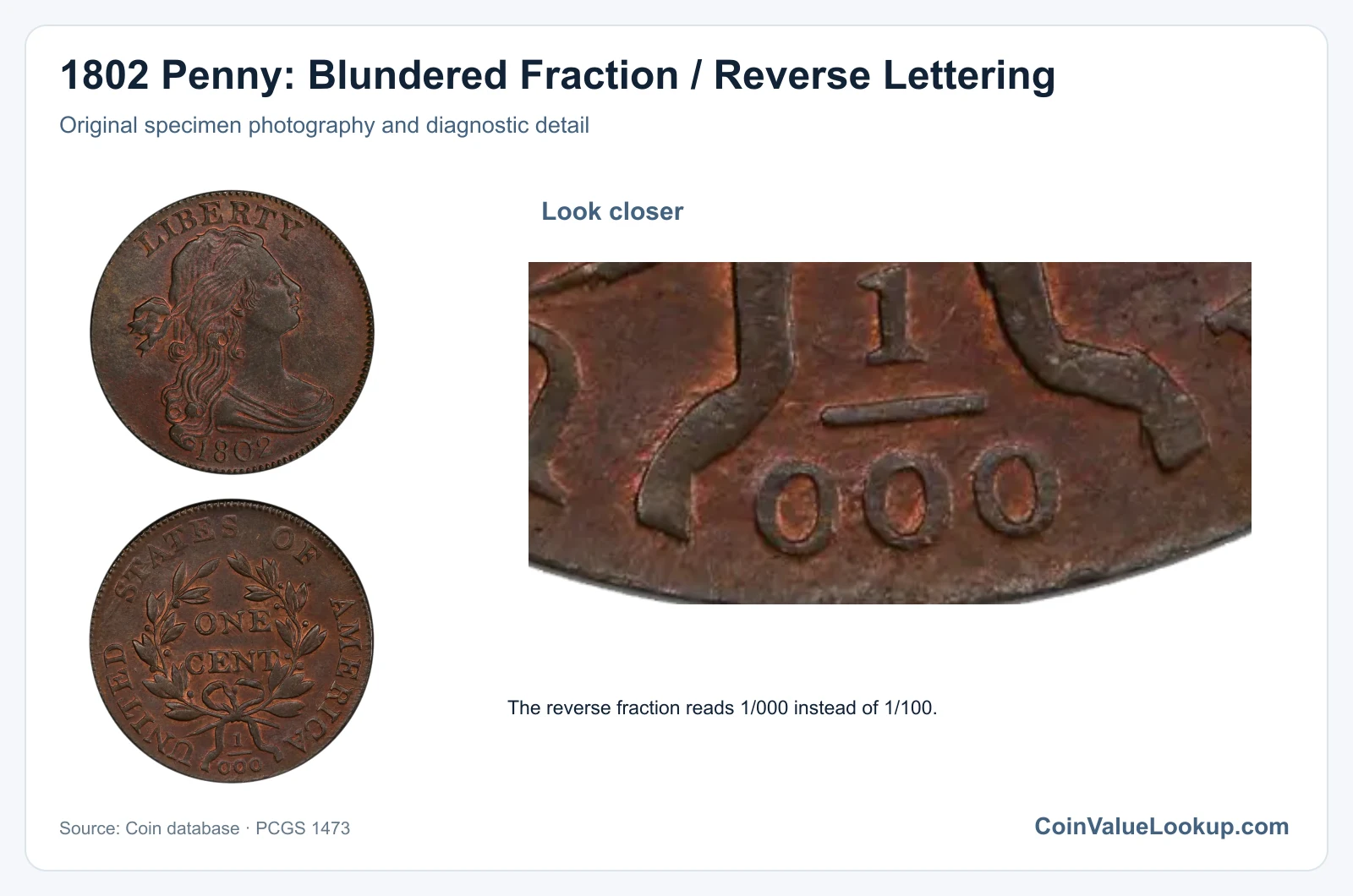
This category covers errors in the reverse fraction or lettering beyond the recognized 1/000 variety. Compare your coin's denomination fraction against a normal 1/100 and examine the UNITED STATES OF AMERICA legend letter by letter.
You are looking for extra digits, missing characters, re-cut letters or corrected punches that differ from the standard layout.
Wear can obscure fraction digits and make a normal coin look blundered. Before jumping to conclusions, compare under magnification and good light.
A scratched-out fraction bar or a corroded digit is damage, not a mint error. Genuine blunders come from the die and will appear consistent and struck into the surface.
No standard price range is established for this category on 1802 cents. Professional authentication and the specific nature of the blunder determine individual value.