1856 Flying Eagle Cent Coin Value: How Much Is It Worth?
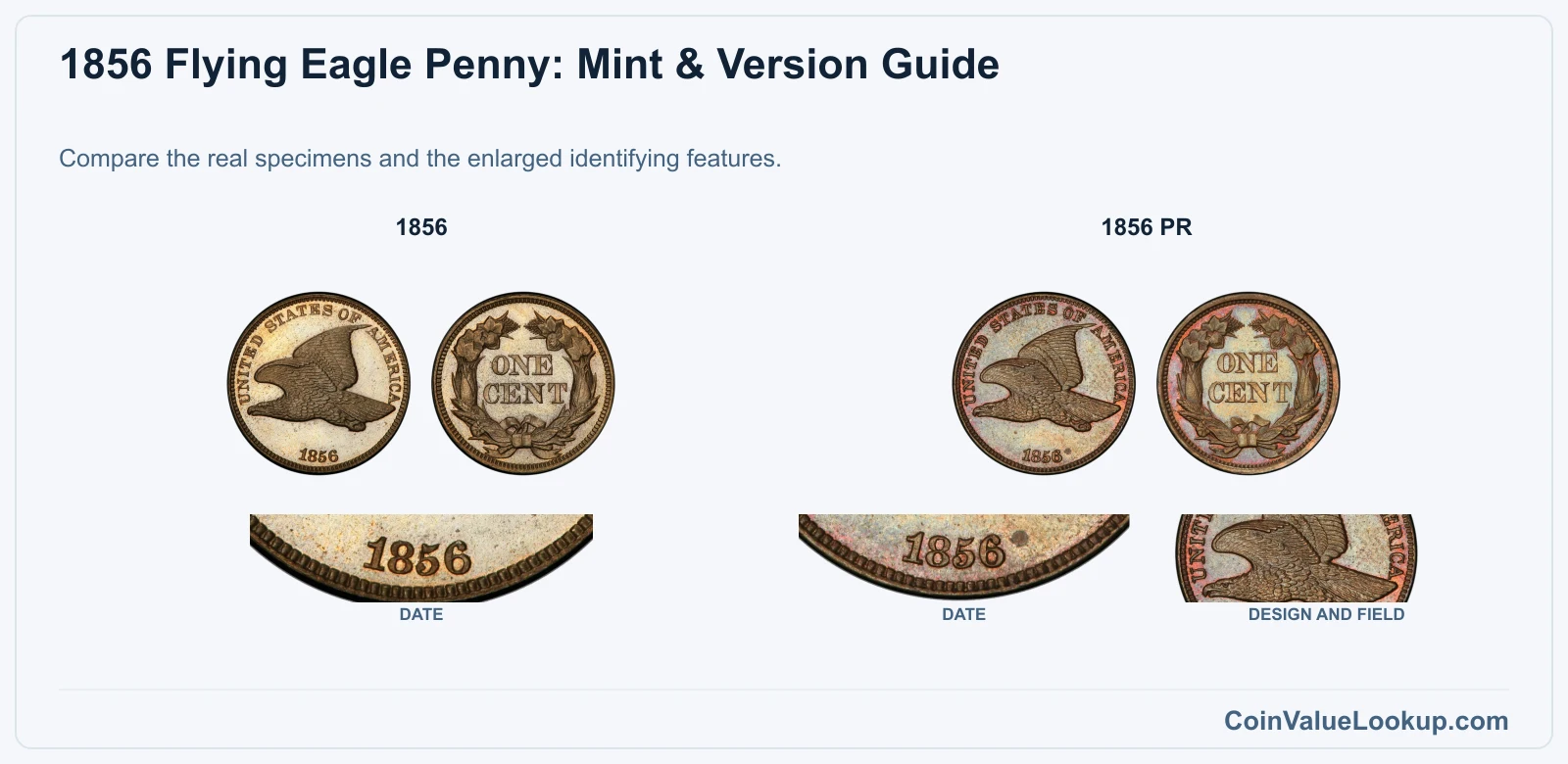
The 1856 Flying Eagle Cent is not a regular-issue coin. It is a pattern piece, struck in limited numbers at Philadelphia to demonstrate a proposed new cent design, with later restrikes also known.
Guide estimates for the non-proof catalog branch run from roughly $9,332 in G4 to $30,623 in MS63, while the proof branch carries a separate value around $21,885 in PR63. Your exact variety and condition matter enormously, so read on before drawing conclusions.
Fast Way to Identify Your 1856 Flying Eagle Cent
The quickest way to start figuring out what you have is to upload clear photos of the front and back of your coin. Our identifier can give you a preliminary read on the design, date and general type.
It will not authenticate, certify or precisely grade your coin, but it helps you zero in on the right variety before doing deeper research.
1856 Flying Eagle Cent Value
Upload both sides of your 1856 Flying Eagle Cent.
Front Obverse
Upload photo
Back Reverse
Upload photo
Which 1856 Flying Eagle Cent Versions Are Worth Money?
- The 1856 Flying Eagle is a pattern issue, not mass-produced for circulation, which is why even low-grade examples start near $9,332 (G4 guide).
- Proof examples are cataloged separately, with a PR63 guide value around $21,885; correct proof attribution requires examining surfaces, rims and die characteristics.
- Later restrikes exist alongside original strikings, so precise identification of your coin's manufacture history affects its market position.
- Struck-through errors on this date have been reported; authenticated examples with clear obstruction impressions deserve individual assessment.
- Cleaning, corrosion or tooling can dramatically reduce the appeal and value of any 1856 Flying Eagle, even if underlying detail remains sharp.
Step 1: Identify Your 1856 Flying Eagle Cent Mint Mark and Version
First things first: the 1856 Large Cent (Braided Hair design, large copper planchet) and the 1856 Flying Eagle Cent (small copper-nickel planchet) are completely different coins. If your coin is big and copper-colored with a braided-hair portrait, you are in the wrong guide.
The Flying Eagle shows an eagle in flight on the obverse and a wreath surrounding ONE CENT on the reverse.
All 1856 Flying Eagle cents were struck at Philadelphia and carry no mintmark. Do not go hunting for a "D" or "S" on this date; branch mints did not produce them.
Because 1856 Flying Eagles are patterns with known restrikes, correct attribution matters more than usual. Look carefully at both faces and the edge.
Date-punch shape, legend wording and wreath details can shift which catalog slot your coin belongs in.
Weight and material offer supporting evidence. These coins are 88% copper and 12% nickel, nominally 4.67 grams, struck on a 19 mm planchet.
But wear, corrosion and original production tolerances mean weight alone will not prove authenticity. A professional attribution service is the safest route for a coin in this price range.
Step 2: Check Your 1856 Flying Eagle Cent Grade
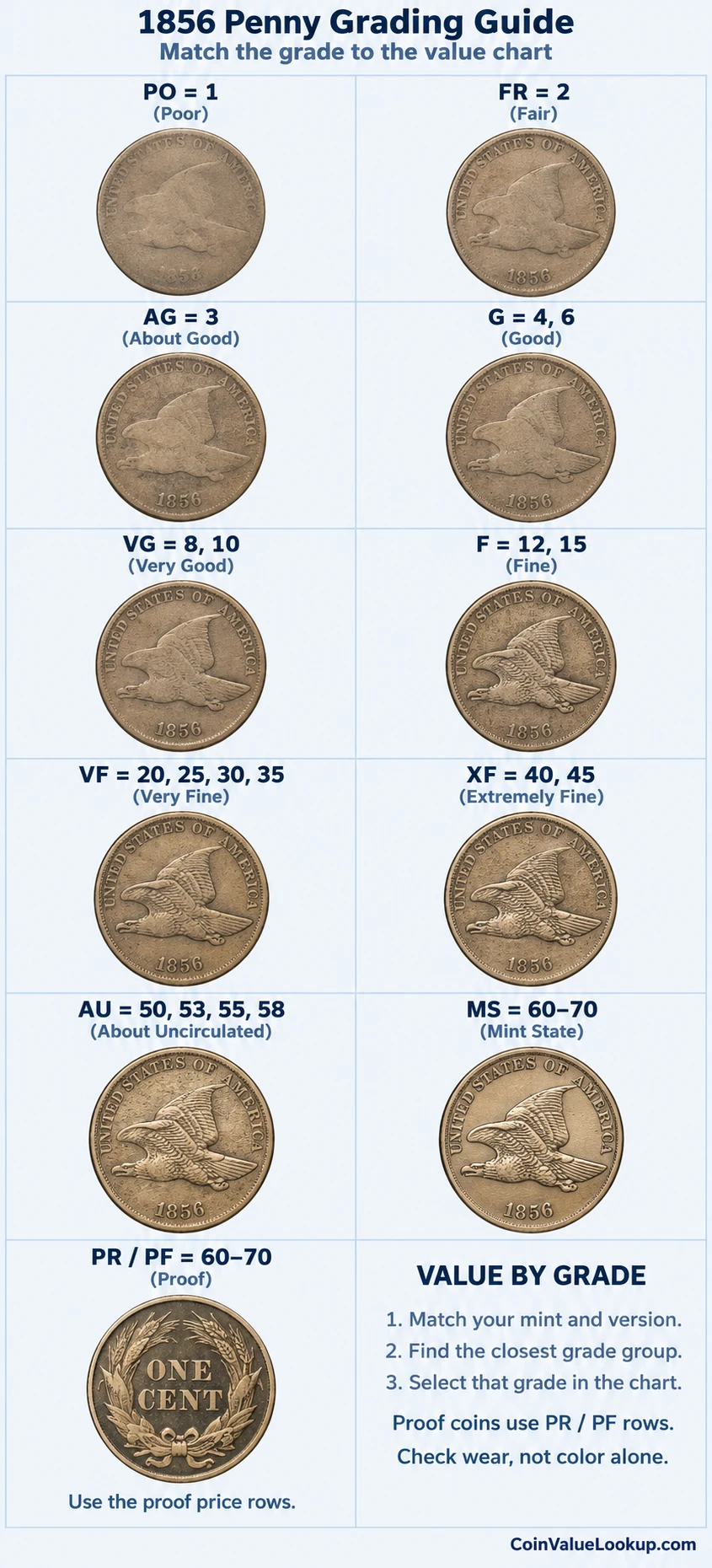
When evaluating condition, examine the eagle's head, breast and wing feathers on the obverse. On the reverse, check the leaf relief in the wreath and the crispness of the lettering.
Compare your coin side by side with the reference image showing wear stages for this type.
Do not confuse detail lost to circulation with a weak original strike or surface problems like corrosion and porosity. A coin with sharp underlying detail but rough, corroded surfaces will trade for much less than a clean, naturally worn example at the same nominal grade.
Color designations like BN, RB and RD describe the remaining original color on copper-nickel surfaces. They are not separate alloys or bonus grades.
Proof is a manufacturing method involving specially prepared dies and planchets, not an automatic promotion above Mint State. A dull, impaired proof can grade lower than a fresh uncirculated coin.
Step 3: Check 1856 Flying Eagle Cent Value by Mint and Version
1856 Flying Eagle Cent
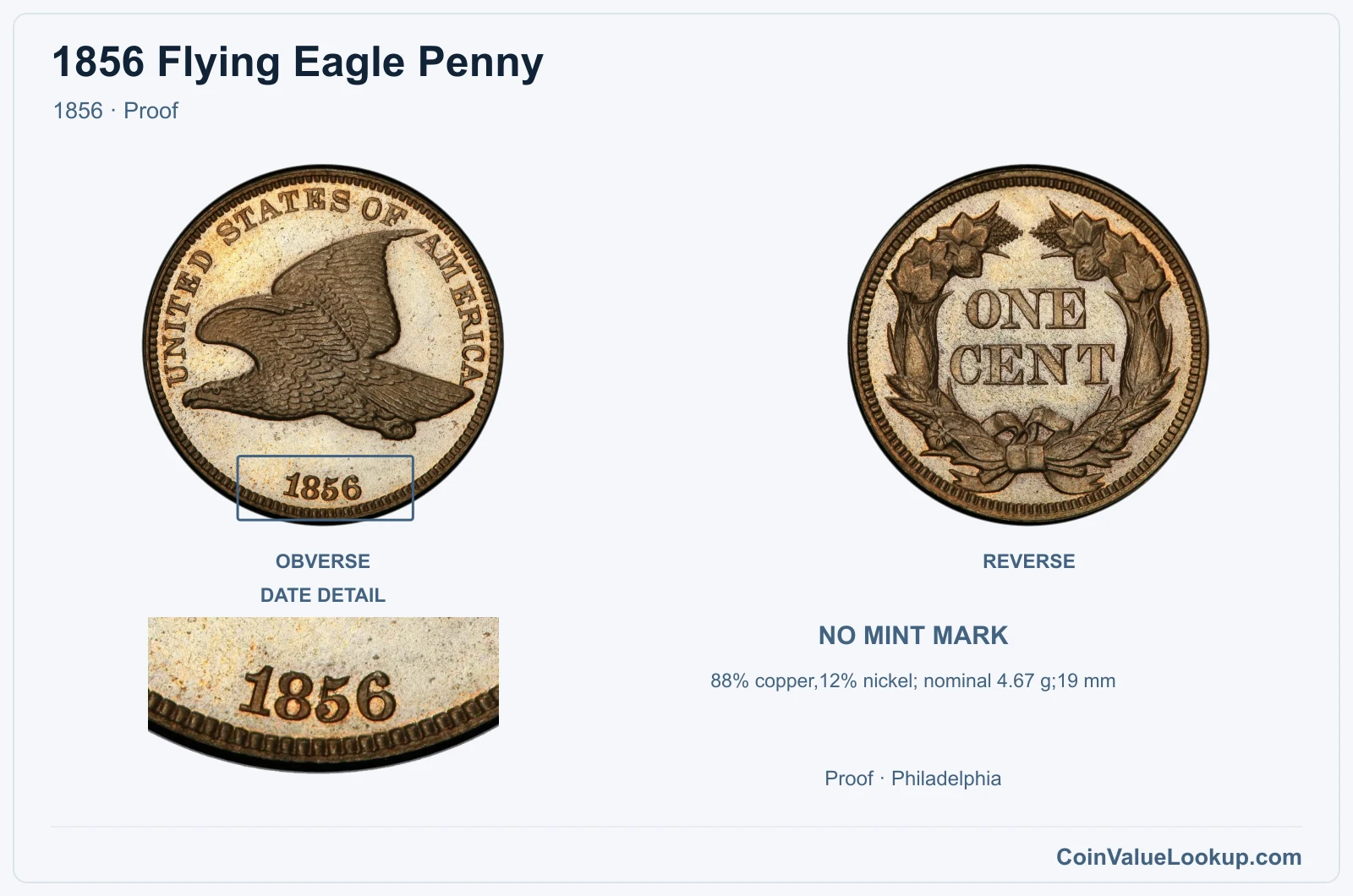
The standard 1856 Flying Eagle Cent is a pattern coin, not a routine circulation issue. It was struck at Philadelphia with no mintmark, on an 88% copper and 12% nickel planchet weighing about 4.67 grams at 19 mm.
The design shows a flying eagle on the obverse and a wreath enclosing ONE CENT on the reverse.
Guide estimates from USA Coin Book place this non-proof branch at approximately $9,332 in G4 and $30,623 in MS63. Those figures reflect the coin's status as a low-mintage pattern with collector demand across all grades.
Later restrikes are known, so confirming whether your piece is an original striking or a restrike is part of proper attribution. If you are exploring values for other dates or series, Coin Value Lookup is a handy starting point for finding the right guide.
| Range | Grade | Price | Auction Records | Appraisal |
|---|---|---|---|---|
| PO | PO 1 | — | Coin Identifier | |
| FR | FR 2 | — | Coin Identifier | |
| AG | AG 3 | — | Coin Identifier | |
| G | G 4 | — | Coin Identifier | |
| G 6 | — | Coin Identifier | ||
| VG | VG 8 | Coin Identifier | ||
| VG 10 | Coin Identifier | |||
| F | F 12 | Coin Identifier | ||
| F 15 | Coin Identifier | |||
| VF | VF 20 | Coin Identifier | ||
| VF 25 | Coin Identifier | |||
| VF 30 | Coin Identifier | |||
| VF 35 | Coin Identifier | |||
| XF | XF 40 | Coin Identifier | ||
| XF 45 | Coin Identifier | |||
| AU | AU 50 | Coin Identifier | ||
| AU 53 | Coin Identifier | |||
| AU 55 | Coin Identifier | |||
| AU 58 | Coin Identifier | |||
| MS | MS 60 | — | Coin Identifier | |
| MS 61 | Coin Identifier | |||
| MS 62 | Coin Identifier | |||
| MS 63 | Coin Identifier | |||
| MS 64 | Coin Identifier | |||
| MS 65 | Coin Identifier | |||
| MS 66 | Coin Identifier | |||
| MS 67 | — | — | — | |
| MS 68 | — | — | — | |
| MS 69 | — | — | — | |
| MS 70 | — | — | — |
1856 Flying Eagle Cent — PR
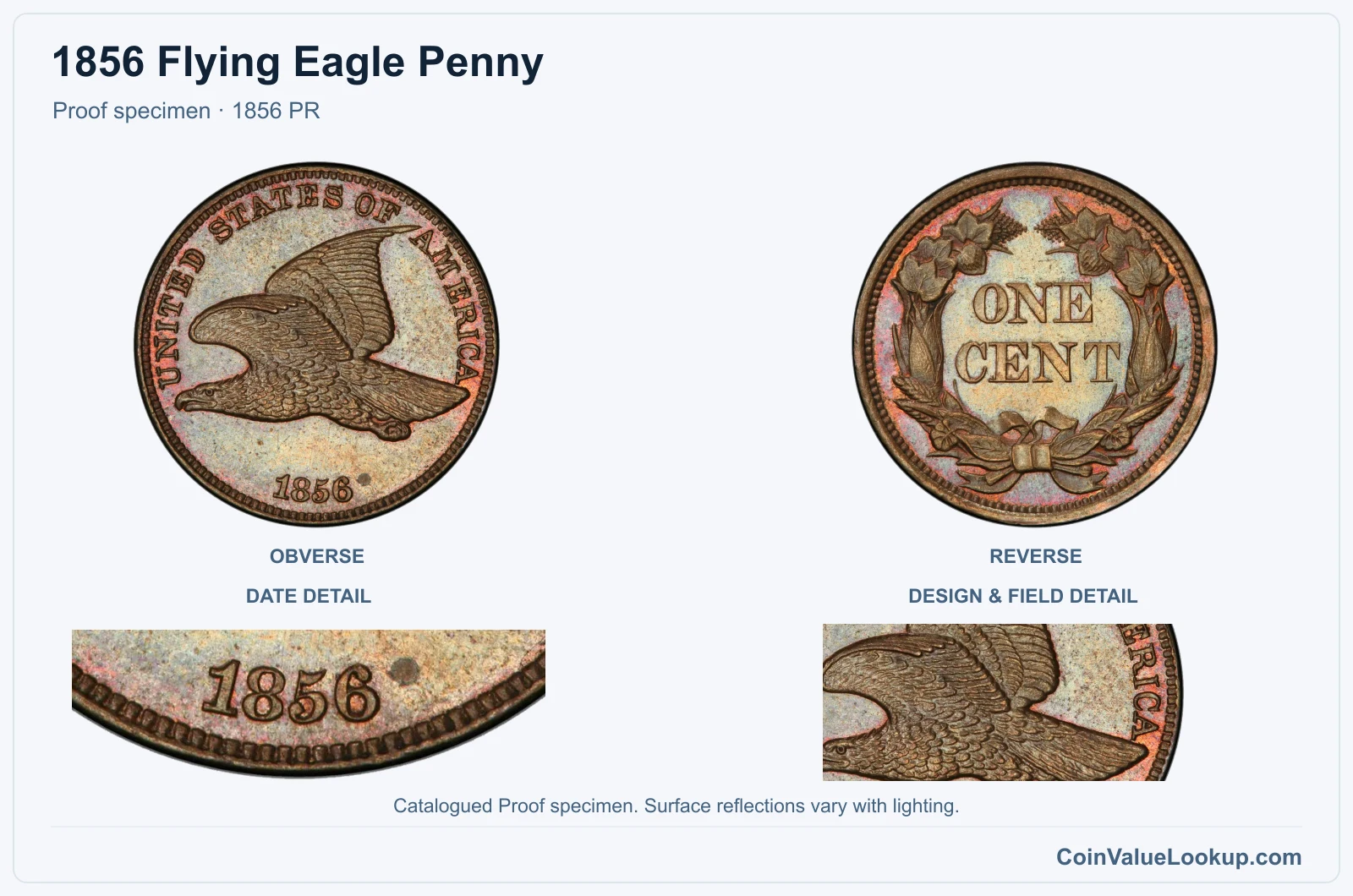
The 1856 Proof Flying Eagle Cent is a separately cataloged branch, struck with proof-quality dies and planchets at Philadelphia. Same alloy and dimensions as the non-proof pattern: 88% copper, 12% nickel, roughly 4.67 grams, 19 mm.
A PR63 guide value sits around $21,885 according to USA Coin Book.
Here is the critical part: polishing a coin does not make it a proof. True proof attribution requires examination of the coin's surfaces, rims and die characteristics consistent with proof manufacture.
Restrikes also exist in proof format, adding another layer to proper identification. Because ordinary business-strike prices do not transfer to proofs (and vice versa), getting the manufacturing category right is essential before estimating value.
Professional third-party attribution is strongly recommended for any coin at this level.
| Range | Grade | Price | Auction Records | Appraisal |
|---|---|---|---|---|
| PR | PR 1 | — | Coin Identifier | |
| PR 2 | — | Coin Identifier | ||
| PR 3 | — | Coin Identifier | ||
| PR 4 | — | Coin Identifier | ||
| PR 6 | — | Coin Identifier | ||
| PR 8 | Coin Identifier | |||
| PR 10 | Coin Identifier | |||
| PR 12 | Coin Identifier | |||
| PR 15 | Coin Identifier | |||
| PR 20 | Coin Identifier | |||
| PR 25 | Coin Identifier | |||
| PR 30 | Coin Identifier | |||
| PR 35 | Coin Identifier | |||
| PR 40 | Coin Identifier | |||
| PR 45 | Coin Identifier | |||
| PR 50 | Coin Identifier | |||
| PR 53 | Coin Identifier | |||
| PR 55 | Coin Identifier | |||
| PR 58 | Coin Identifier | |||
| PR 60 | — | Coin Identifier | ||
| PR 61 | Coin Identifier | |||
| PR 62 | Coin Identifier | |||
| PR 63 | Coin Identifier | |||
| PR 64 | Coin Identifier | |||
| PR 65 | Coin Identifier | |||
| PR 66 | Coin Identifier | |||
| PR 67 | — | Coin Identifier | ||
| PR 68 | — | — | — | |
| PR 69 | — | — | — | |
| PR 70 | — | — | — |
1856 Flying Eagle Cent Error List
1. 1856 Flying Eagle Cent — Struck-Through Error
A struck-through error occurs when foreign material sits between the die and the planchet during striking, leaving a localized depression or incomplete design area on the finished coin. On an 1856 Flying Eagle, the reported scope involves the obverse.
Look for a distinct impression or flattened zone that does not match the surrounding design, sometimes showing the texture of whatever object was trapped.
Do not confuse this with ordinary wear, scratches, cleaning marks or a weak strike. Wear removes metal gradually and follows high points; a struck-through creates an abrupt, often sharply bordered anomaly.
Grease fills can also look similar but tend to produce softer, more uniform missing detail rather than a discrete impression of a solid object.
No supported numeric price range is available for this error on the 1856 date. Value depends entirely on the authenticated identity of the coin, the severity and visual appeal of the error, and overall condition.
Individual professional assessment is the way to go.