1865 Indian Head Penny Coin Value: How Much Is It Worth?
The 1865 Indian Head penny sits in a sweet spot for collectors: common enough to find, scarce enough to matter. Selected guide values for ordinary business strikes range from about $21 at G4 to $207 at MS63, depending on the date variety and condition.
Those are guide estimates, not guaranteed buy prices, and they assume original, undamaged surfaces. Proofs, major varieties, and mint errors each require their own separate evaluation.
Fast Way to Identify Your 1865 Indian Head Penny
The quickest way to start figuring out what your 1865 Indian Head penny is worth is to upload clear photos of both the front and back. Our identifier can give you a preliminary read on which variety you have and its general condition.
Just make sure both sides are well-lit and in focus so the date digits and design details come through.
1865 Indian Head Penny Value
Upload both sides of your 1865 Indian Head Penny.
Front Obverse
Upload photo
Back Reverse
Upload photo
Which 1865 Indian Head Penny Versions Are Worth Money?
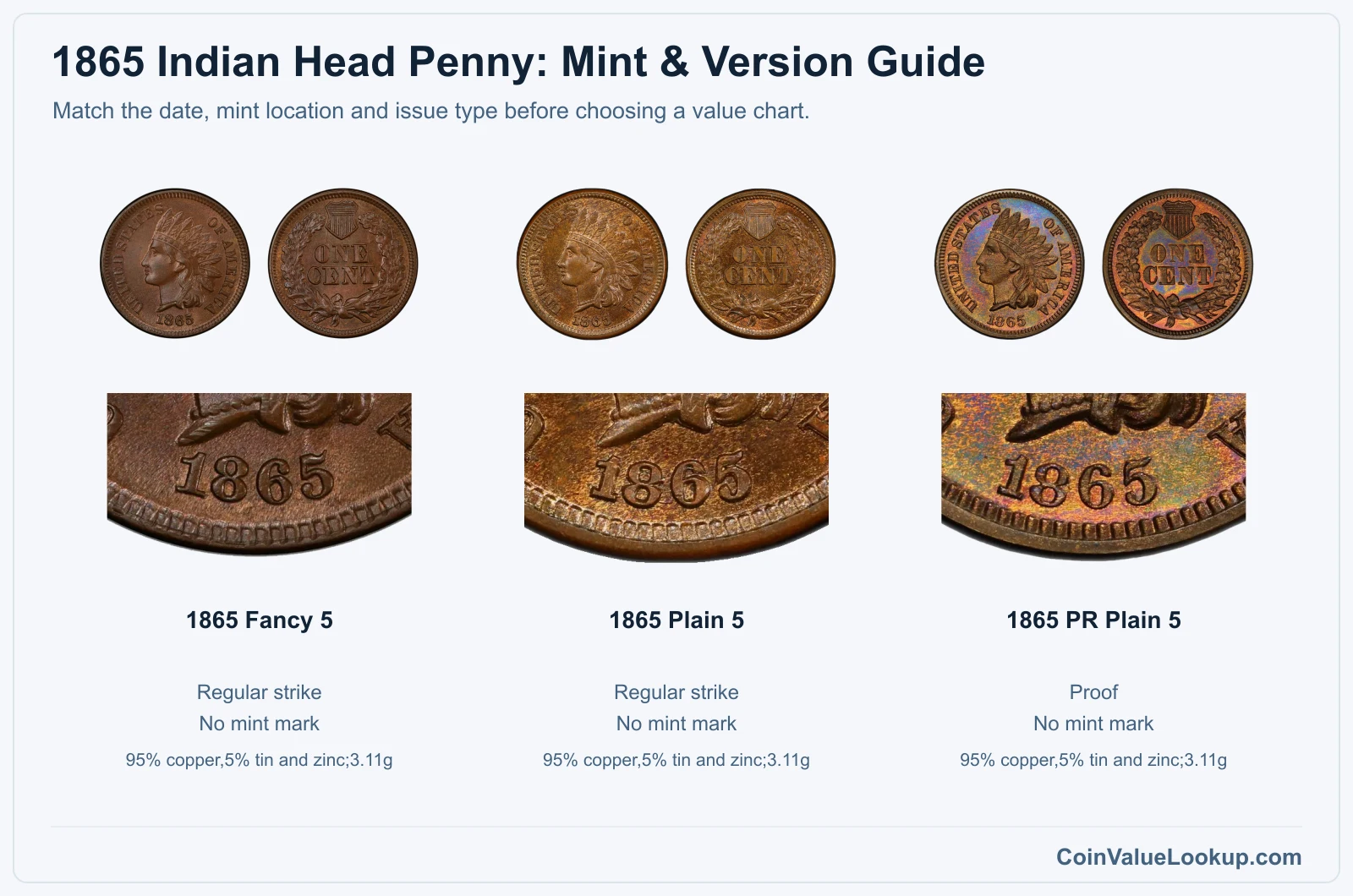
- The Plain 5 business strike is less common than the Fancy 5 and carries higher guide values at comparable grades, such as $65 at VF25 versus $44 for the Fancy 5.
- Proofs exist only with the Plain 5 date style; a guide value near $468 at PR63 reflects the proof premium for this year.
- Original uncirculated surfaces with remaining red color can command more than typical brown examples, so check for natural luster before assuming a coin is ordinary.
- Mint errors such as doubled die reverses, die cracks, and repunched dates have been reported for this year and each requires individual assessment for value.
Step 1: Identify Your 1865 Indian Head Penny Mint Mark and Version
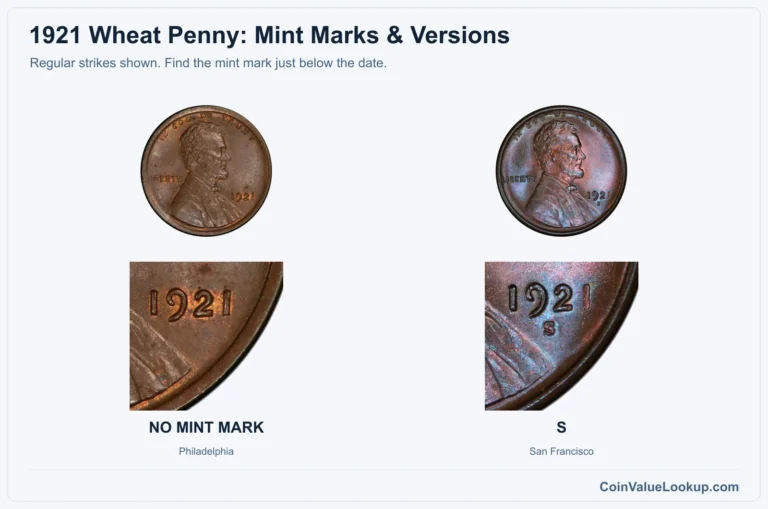
Every 1865 Indian Head cent was struck at Philadelphia. There is no mintmark on this coin, and the small "L" you might spot on the ribbon behind the portrait is the designer's initial, not a mint identifier.
The big fork in the road for 1865 is the shape of the "5" in the date. The Fancy 5 variety has a distinctly curved top, while the Plain 5 has a flat, straight top.
Grab a loupe and look closely at the upper stroke of the final digit. The Plain 5 is the less common of the two for business strikes.
All 1865 proofs use the Plain 5 design. If someone offers you a "Fancy 5 proof," that combination does not exist.
Make sure you are actually looking at an Indian Head cent and not confusing it with a Lincoln cent or an earlier Flying Eagle design. The obverse shows a Liberty portrait wearing a feathered headdress, and the reverse features an oak wreath surrounding a shield.
The coin is bronze, weighing about 3.11 grams, composed of 95% copper with 5% tin and zinc. A proof is a specific manufacturing method with mirrored surfaces and sharp rims; polishing a business strike does not create a proof.
Step 2: Check Your 1865 Indian Head Penny Grade
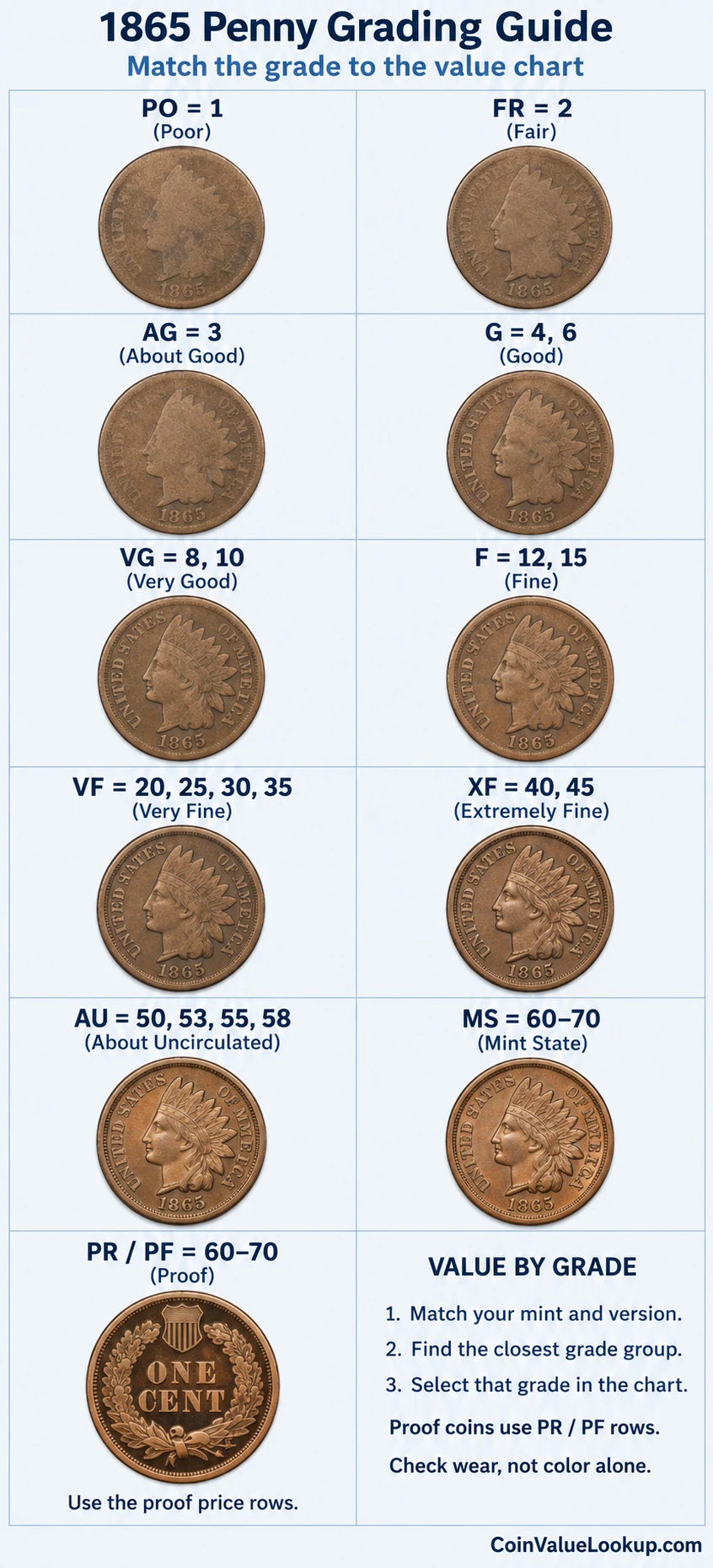
Start with the headband. The word LIBERTY is incused across it, and the letters wear down progressively as the coin circulates.
On a well-worn piece only a couple of letters may remain; on a mid-grade coin you should see the full word with some softness.
Next check the feather tips above the headband and the hair curls below the ear. These are high-relief areas that show wear first.
Move to the reverse and examine the wreath leaves and the shield at the top.
Here is where 1865 gets tricky: some coins left the mint with a soft strike, especially in the feather and hair areas. A weakly struck coin can look worn when it is not.
Check luster in the protected fields around the devices. If the fields still glow with original mint frost, the missing detail is likely strike-related, not wear.
The comparison image is your friend here. Hold your coin next to it and match the overall sharpness at matching angles.
Bronze color designations like BN, RB, and RD describe how much original red copper tone remains. They are color calls, not separate materials.
Cleaning, corrosion, and environmental damage all reduce a coin's market appeal regardless of the remaining detail.
Step 3: Check 1865 Indian Head Penny Value by Mint and Version
1865 Indian Head Penny — Fancy 5
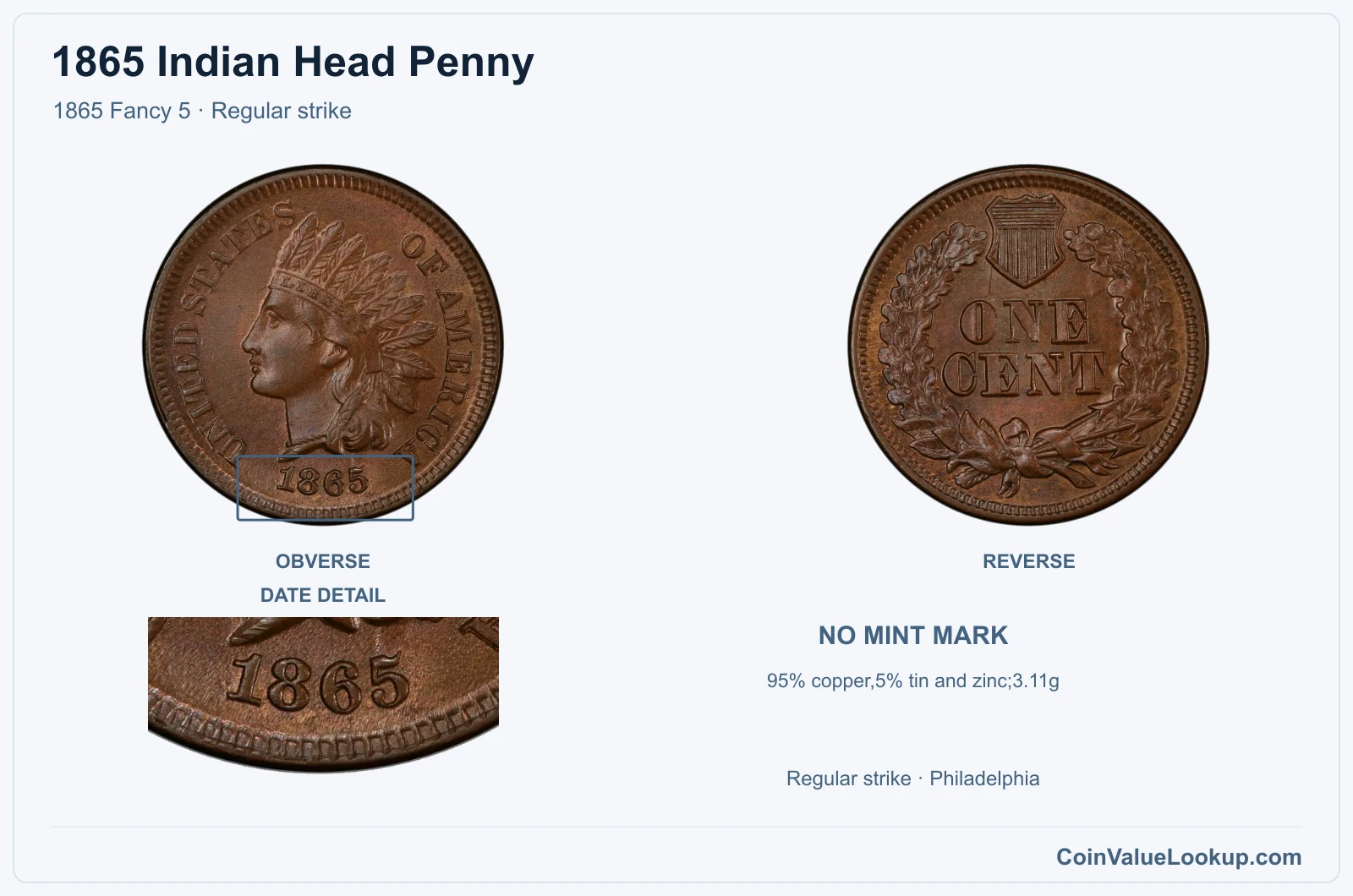
The 1865 Fancy 5 is the more frequently encountered business strike variety. Look at the top of the final digit in the date: if it curves gracefully, you have the Fancy 5.
This coin is bronze, struck at Philadelphia with no mintmark, weighing about 3.11 grams.
Guide values place the Fancy 5 around $44 at VF25 and $185 at MS60, both in brown preservation. Those figures assume original, problem-free surfaces.
Cleaned or corroded coins sell for less regardless of their remaining detail. Compare your coin's date digit carefully before settling on a variety.
| Range | Grade | Price | Auction Records | Appraisal |
|---|---|---|---|---|
| PO | PO 1 | — | Coin Identifier | |
| FR | FR 2 | — | Coin Identifier | |
| AG | AG 3 | — | Coin Identifier | |
| G | G 4 | — | Coin Identifier | |
| G 6 | — | Coin Identifier | ||
| VG | VG 8 | — | Coin Identifier | |
| VG 10 | — | Coin Identifier | ||
| F | F 12 | — | Coin Identifier | |
| F 15 | — | Coin Identifier | ||
| VF | VF 20 | — | Coin Identifier | |
| VF 25 | — | Coin Identifier | ||
| VF 30 | — | Coin Identifier | ||
| VF 35 | — | Coin Identifier | ||
| XF | XF 40 | Coin Identifier | ||
| XF 45 | Coin Identifier | |||
| AU | AU 50 | Coin Identifier | ||
| AU 53 | Coin Identifier | |||
| AU 55 | Coin Identifier | |||
| AU 58 | Coin Identifier | |||
| MS | MS 60 | Coin Identifier | ||
| MS 61 | Coin Identifier | |||
| MS 62 | Coin Identifier | |||
| MS 63 | Coin Identifier | |||
| MS 64 | Coin Identifier | |||
| MS 65 | Coin Identifier | |||
| MS 66 | Coin Identifier | |||
| MS 67 | — | — | — | |
| MS 68 | — | — | — | |
| MS 69 | — | — | — | |
| MS 70 | — | — | — |
1865 Indian Head Penny — Plain 5
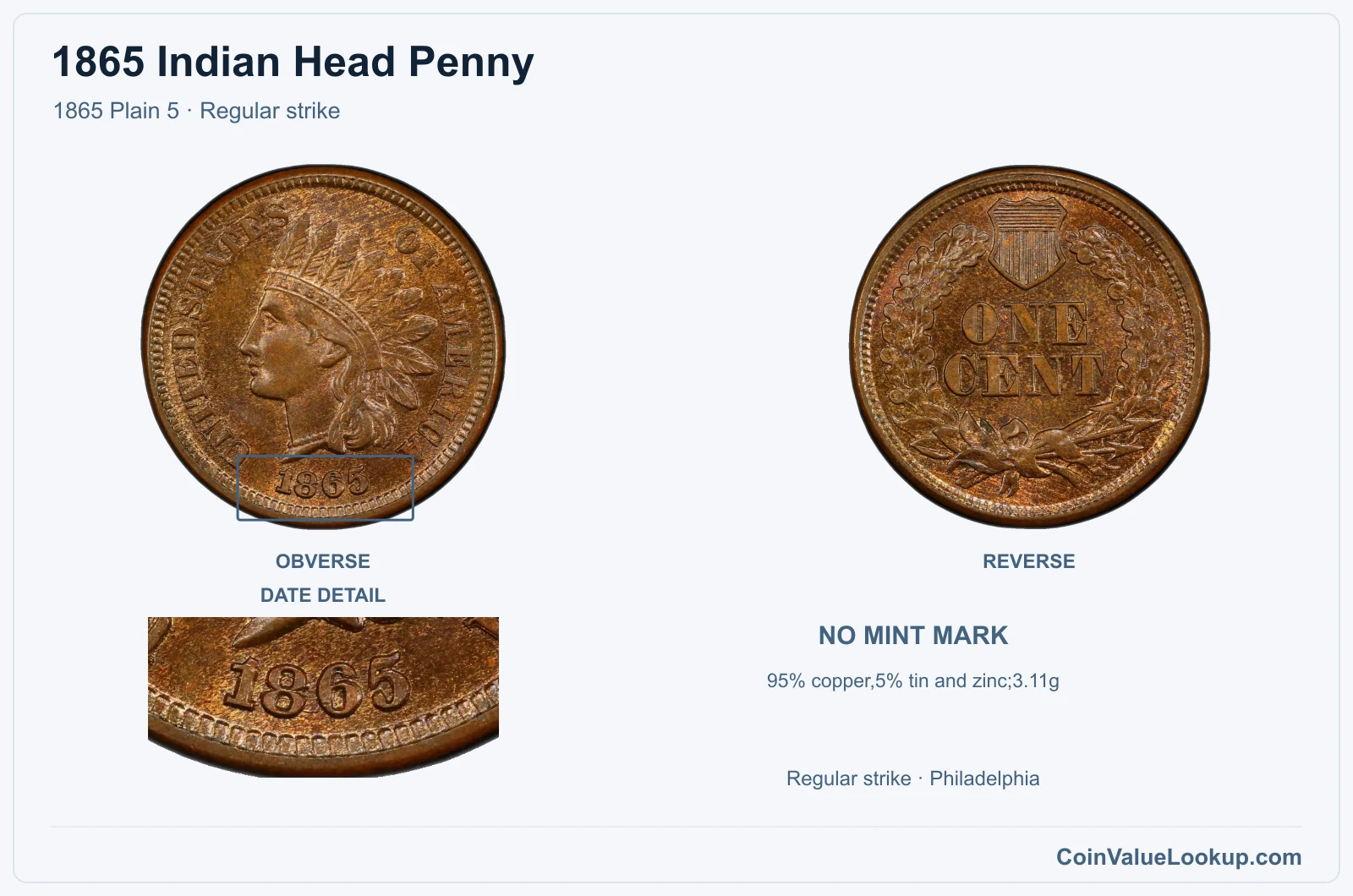
The 1865 Plain 5 is the scarcer business strike variety and carries a noticeable premium. The top of the "5" in the date is flat and straight rather than curved.
It is the same bronze composition and Philadelphia mintage as the Fancy 5, so the date digit is your only distinguishing mark.
Guide values run about $65 at VF25 and $250 at MS60 in brown, noticeably higher than the Fancy 5 at the same grades. Because the difference between the two date styles can be subtle on worn coins, use magnification and compare side by side with a reference image before deciding which version you hold.
Coin Value Lookup is a good starting point if you want to look up guides for other dates and denominations in this series while you have your loupe out.
| Range | Grade | Price | Auction Records | Appraisal |
|---|---|---|---|---|
| PO | PO 1 | — | Coin Identifier | |
| FR | FR 2 | — | Coin Identifier | |
| AG | AG 3 | — | Coin Identifier | |
| G | G 4 | Coin Identifier | ||
| G 6 | — | Coin Identifier | ||
| VG | VG 8 | — | Coin Identifier | |
| VG 10 | — | Coin Identifier | ||
| F | F 12 | — | Coin Identifier | |
| F 15 | — | Coin Identifier | ||
| VF | VF 20 | — | Coin Identifier | |
| VF 25 | — | Coin Identifier | ||
| VF 30 | — | Coin Identifier | ||
| VF 35 | Coin Identifier | |||
| XF | XF 40 | Coin Identifier | ||
| XF 45 | Coin Identifier | |||
| AU | AU 50 | Coin Identifier | ||
| AU 53 | — | Coin Identifier | ||
| AU 55 | Coin Identifier | |||
| AU 58 | Coin Identifier | |||
| MS | MS 60 | Coin Identifier | ||
| MS 61 | — | Coin Identifier | ||
| MS 62 | Coin Identifier | |||
| MS 63 | Coin Identifier | |||
| MS 64 | Coin Identifier | |||
| MS 65 | Coin Identifier | |||
| MS 66 | — | — | — | |
| MS 67 | — | — | — | |
| MS 68 | — | — | — | |
| MS 69 | — | — | — | |
| MS 70 | — | — | — |
1865 Indian Head Penny — PR Plain 5
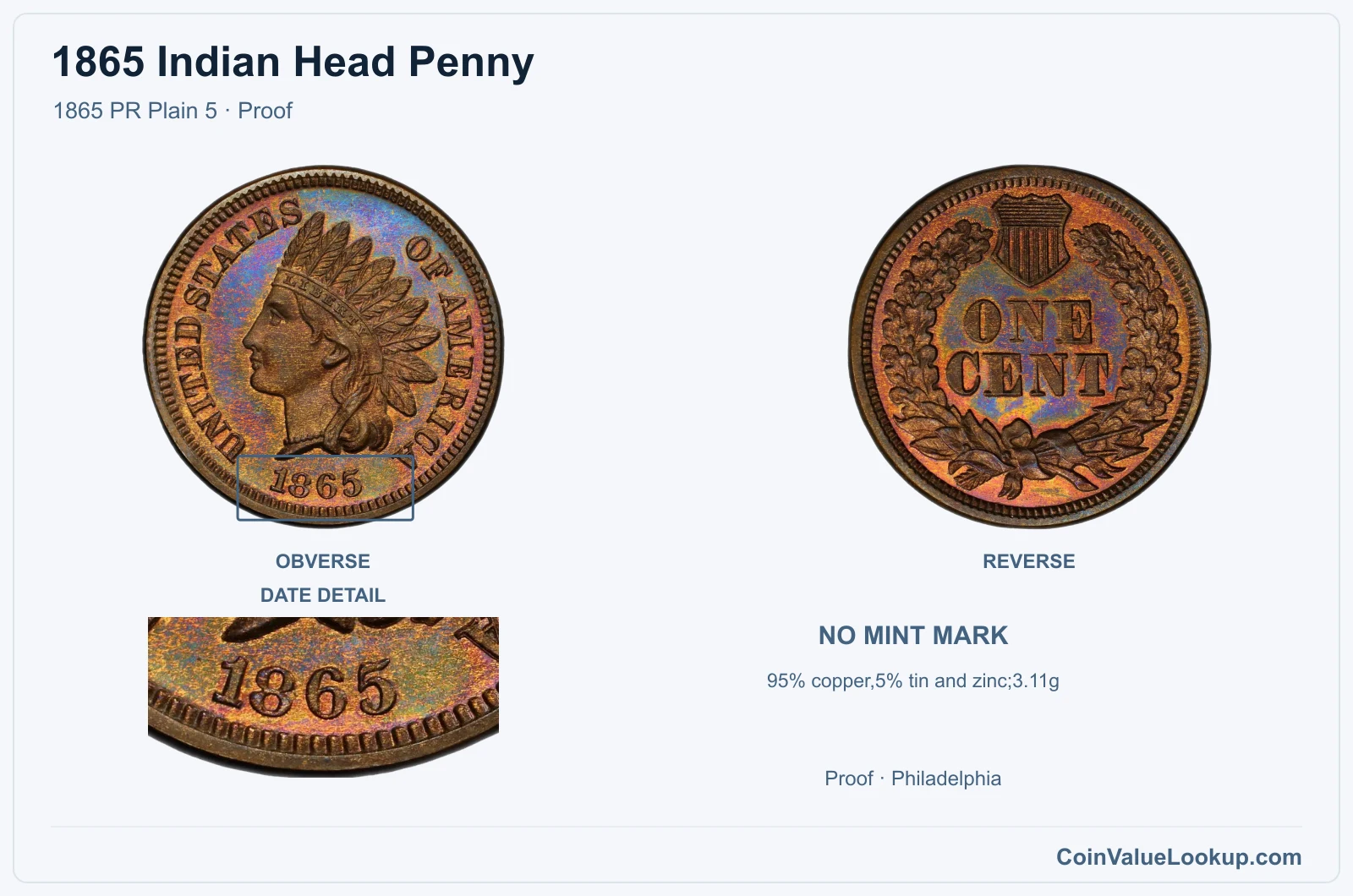
The 1865 proof Indian Head cent exists only with the Plain 5 date style. These were deliberately struck on polished planchets using specially prepared dies, producing mirrored fields and crisp design edges that business strikes cannot match.
The rim profile tends to be squarer and more uniform.
A guide value of about $468 at PR63 gives you a rough benchmark, but proof coins vary widely based on toning, hairlines, and eye appeal. Do not assume your coin is a proof simply because it looks shiny.
Polished or lightly circulated business strikes can mimic the reflective surface, but they lack the sharp rim geometry and full die detail of a genuine proof. Authentication by a recognized grading service is the safest path to confirming proof status.
| Range | Grade | Price | Auction Records | Appraisal |
|---|---|---|---|---|
| PR | PR 1 | — | Coin Identifier | |
| PR 2 | — | Coin Identifier | ||
| PR 3 | — | Coin Identifier | ||
| PR 4 | — | Coin Identifier | ||
| PR 6 | — | Coin Identifier | ||
| PR 8 | — | Coin Identifier | ||
| PR 10 | — | Coin Identifier | ||
| PR 12 | — | Coin Identifier | ||
| PR 15 | — | Coin Identifier | ||
| PR 20 | — | Coin Identifier | ||
| PR 25 | — | Coin Identifier | ||
| PR 30 | — | Coin Identifier | ||
| PR 35 | — | Coin Identifier | ||
| PR 40 | — | Coin Identifier | ||
| PR 45 | — | Coin Identifier | ||
| PR 50 | — | Coin Identifier | ||
| PR 53 | — | Coin Identifier | ||
| PR 55 | — | Coin Identifier | ||
| PR 58 | — | Coin Identifier | ||
| PR 60 | — | Coin Identifier | ||
| PR 61 | — | Coin Identifier | ||
| PR 62 | — | Coin Identifier | ||
| PR 63 | Coin Identifier | |||
| PR 64 | Coin Identifier | |||
| PR 65 | Coin Identifier | |||
| PR 66 | Coin Identifier | |||
| PR 67 | — | — | — | |
| PR 68 | — | — | — | |
| PR 69 | — | — | — | |
| PR 70 | — | — | — |
1865 Indian Head Penny Error List
1. 1865 Indian Head Penny — Die Crack
A die crack shows up as a thin raised line running across the coin's surface. It can cross open fields, cut through letters, or trace along the rim.
The line is raised because the crack in the steel die creates a recessed channel that fills with metal during striking.
To distinguish a die crack from post-mint damage, check whether the line is raised above the surrounding surface. Scratches and scrapes are incuse, meaning they cut into the metal.
Corrosion lines tend to be irregular and pitted rather than sharply defined. Die cracks on 1865 Indian cents have been cataloged, but each example must be evaluated individually based on its length, location, and the coin's overall condition.
No fixed price range applies across the board.
2. 1865 Indian Head Penny — Die Break / Cud
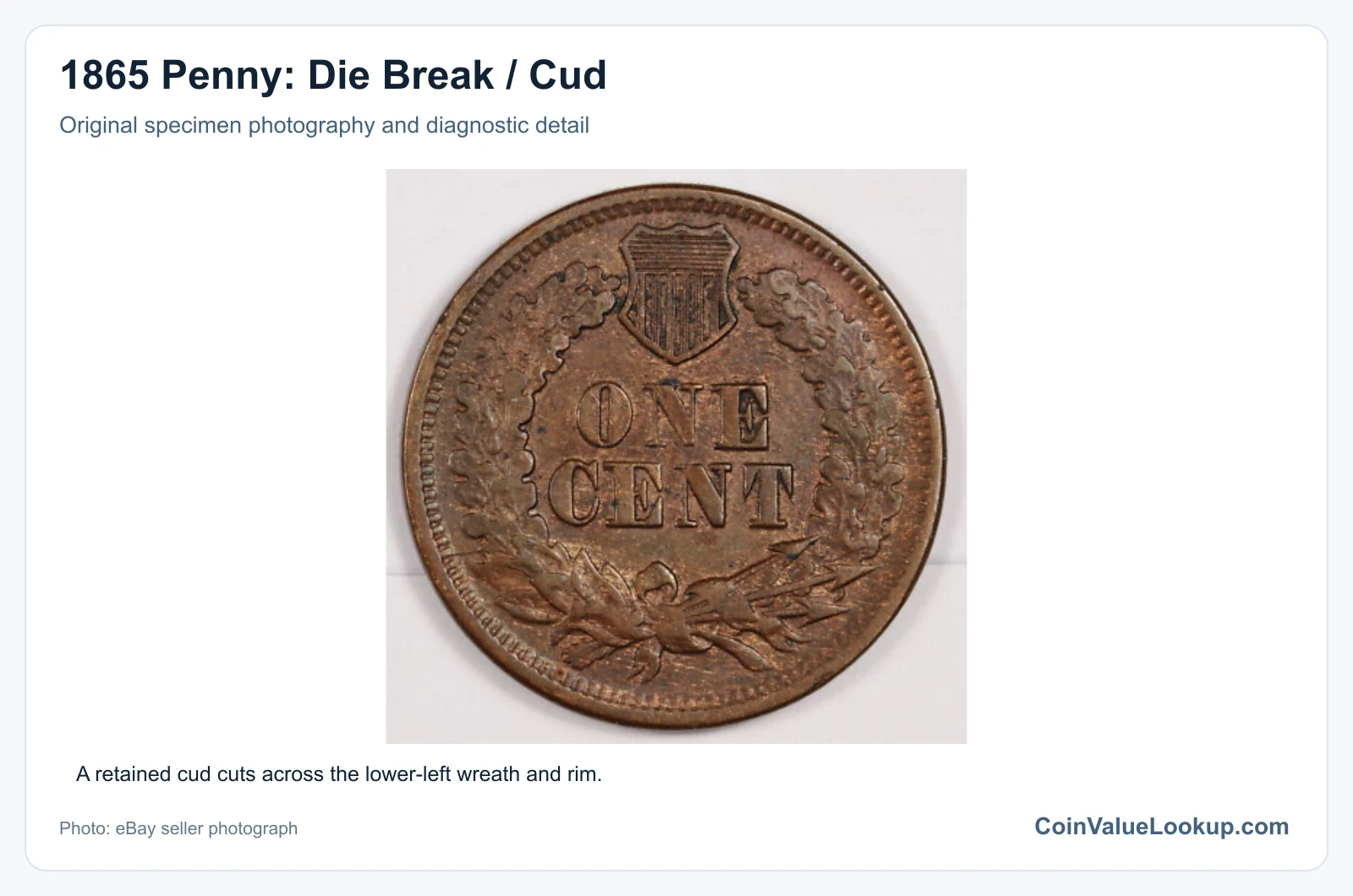
A die break or cud appears as a raised, shapeless blob on the coin where a piece of the die steel broke away. A true cud connects to the rim, because the broken chunk fell from the die's edge.
Interior breaks that do not reach the rim are called retained die breaks.
The raised area typically obliterates part of the design beneath it. Check that the blob is raised and that surrounding design elements flow into it naturally.
A rim dent or corrosion lump will look different under magnification: dents push metal inward, while corrosion has a pitted, granular texture. Die breaks on 1865 Indian cents are documented, but value depends entirely on the break's size, location, and the coin's authenticated condition.
3. 1865 Indian Head Penny — Doubled Die Reverse
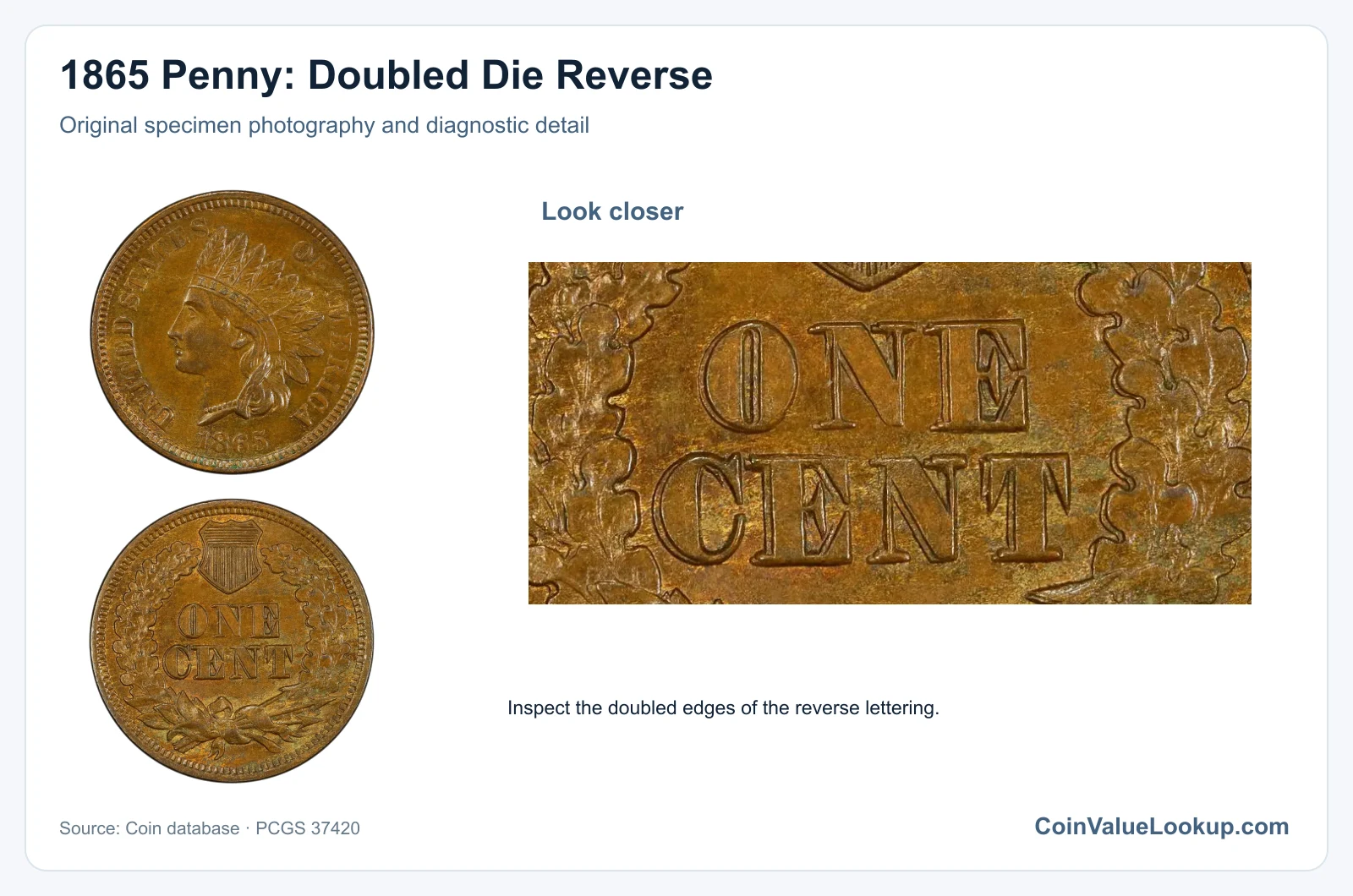
A doubled die reverse on an 1865 Indian Head cent means the reverse die received a second, slightly offset impression during its manufacture. The result is visible doubling on the wreath, lettering, or shield elements of the struck coin.
Compare the reverse legends and leaf details against a known normal example. True hub doubling produces a consistent offset direction across multiple design elements.
Machine doubling, by contrast, tends to show flat, shelf-like displacement and often appears only on high points. Reflections or photographic artifacts can also mimic doubling in images.
If you see what looks like doubled lettering, examine it under magnification from multiple angles. Value depends on the strength and visibility of the doubling, along with the coin's grade and surface quality.
Individual assessment by an authentication service is the reliable route.
4. 1865 Indian Head Penny — Repunched Date
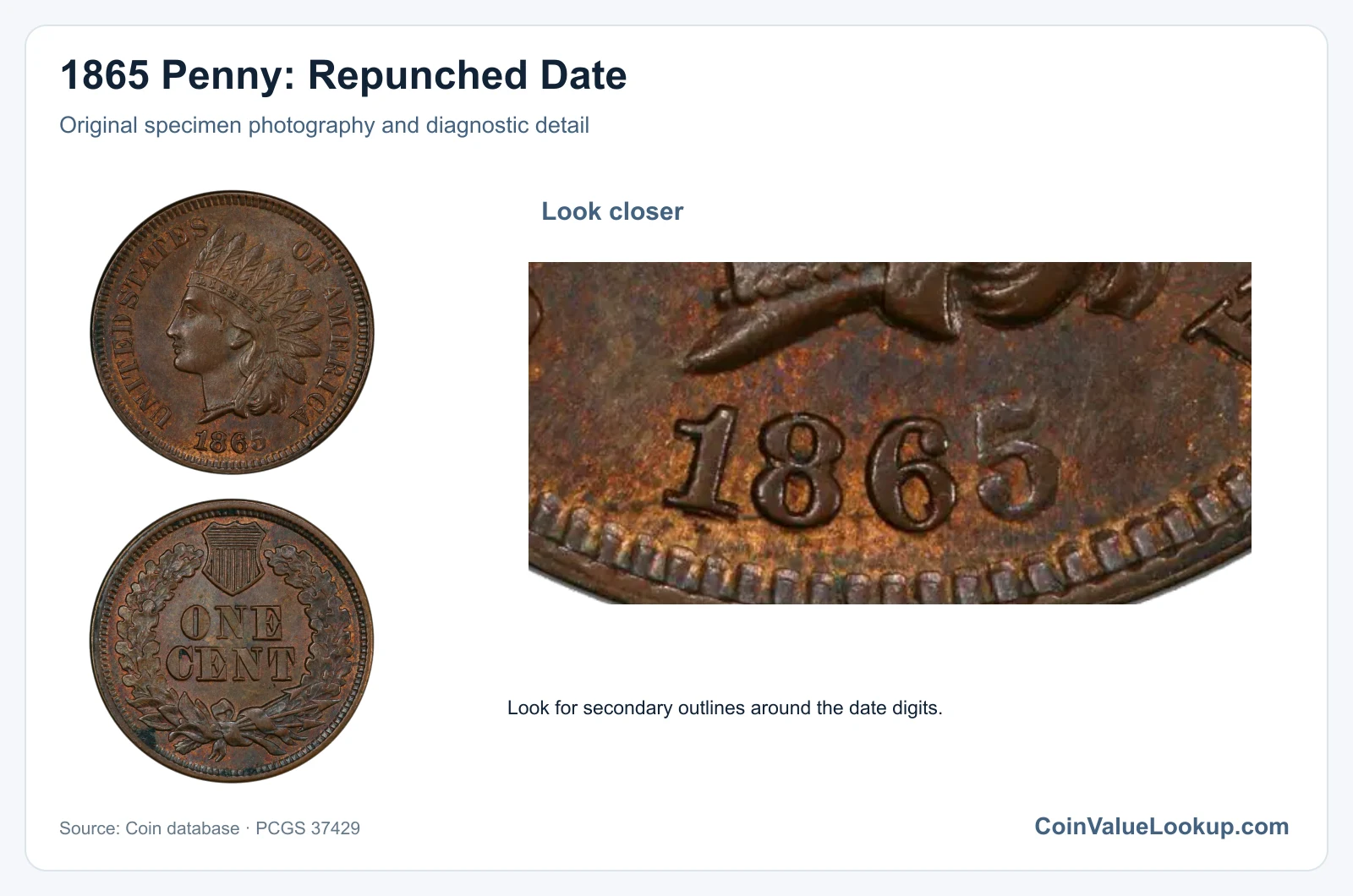
In the hand-punch era, date digits were punched into the die individually. If the punch landed slightly off position and was corrected, remnants of the first impression can remain visible beside or beneath the final digits.
That is a repunched date.
On an 1865 Indian cent, look for faint ghost outlines of one or more numerals next to the sharp, final date. The extra impressions usually show as partial serifs or curves peeking out from behind the correctly placed digit.
Do not confuse this with machine doubling, which produces flat shelf-like distortion, or with simple damage to the date area. Each repunched date variety is valued individually based on its clarity, the specific digits affected, and the coin's overall condition.
5. 1865 Indian Head Penny — Misplaced Date
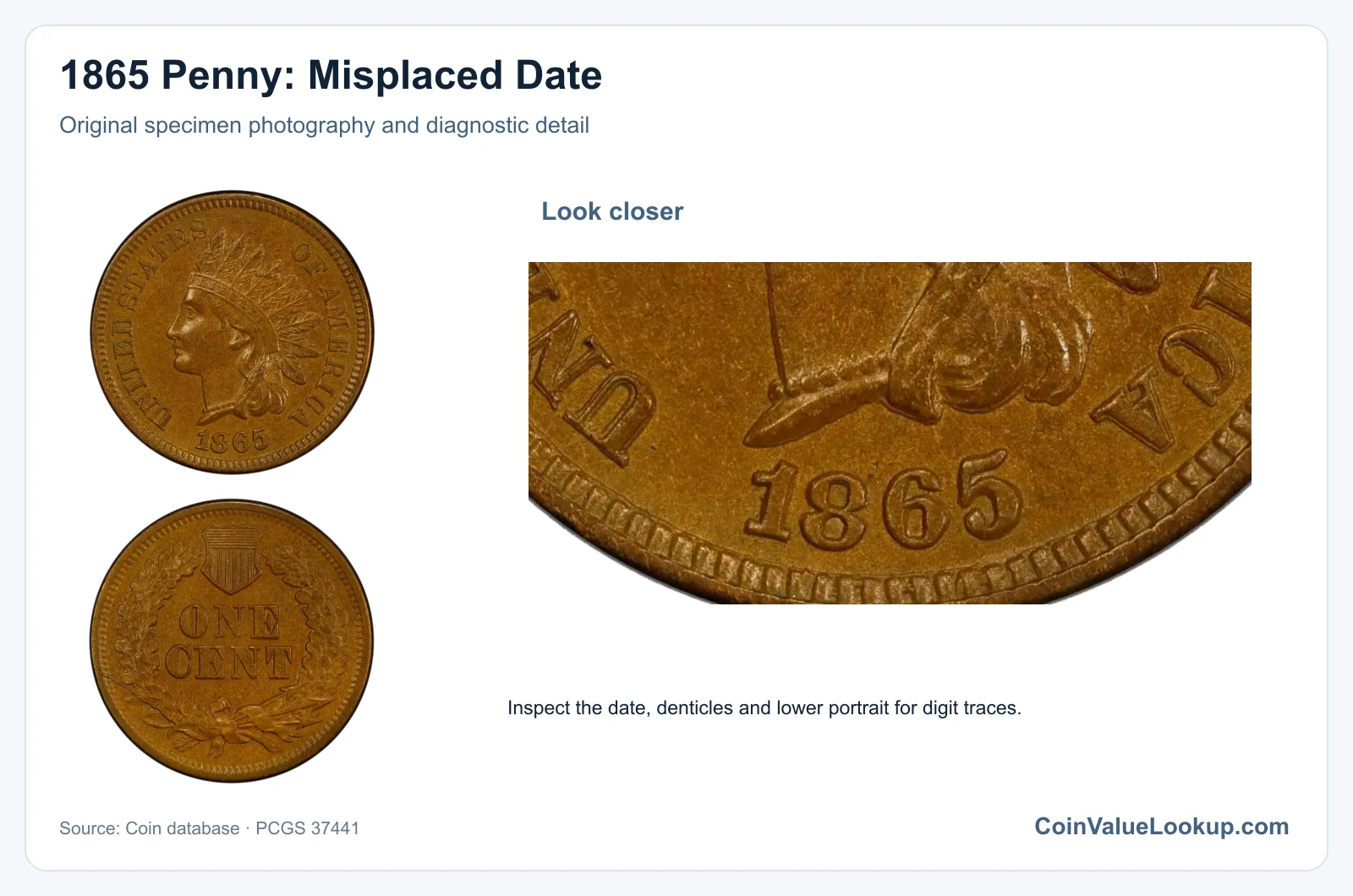
A misplaced date occurs when one or more date digits were first punched into the wrong area of the die, usually too close to the denticles or partially embedded in the portrait base. The die-maker then corrected the position, but traces of the misplaced punch remain on the finished coin.
Look for partial numeral shapes lurking in the denticles or in the field near the bust truncation, away from where the final date sits. These fragments should clearly resemble portions of a specific digit.
Die chips, random scratches, or tiny bumps that do not match the contour of a date numeral are not misplaced dates. Confirmed examples are documented for this year, but pricing depends on the visibility of the misplaced digits and the coin's authenticated grade.
6. 1865 Indian Head Penny — Rotated Dies
Normal United States coins are struck in medal alignment: flip the coin top to bottom and the reverse should appear upright. A rotated die error means the obverse and reverse dies were misaligned, so the back image tilts when you flip the coin.
To test, hold the obverse upright and rotate the coin on its vertical axis like turning a page. If the reverse is noticeably tilted rather than perfectly upright, you may have a rotation error.
Make sure you are flipping correctly; turning the coin sideways will give a false reading, and a rotated photograph does not count. The degree of rotation matters for value.
Minor rotations are relatively common; dramatic shifts of 45 degrees or more attract more collector interest. Each piece needs individual assessment based on the rotation angle and the coin's condition.
7. 1865 Indian Head Penny — Clashed Dies
Clashed dies result from the obverse and reverse dies striking each other without a planchet between them. The impact transfers a mirror-image impression of one die's design onto the face of the other.
When the next coin is struck, you can see faint ghost outlines of the opposite design in the fields.
On an 1865 Indian cent, look for traces of the wreath or shield appearing on the obverse, or the portrait outline showing in the reverse field. The transferred elements should line up with where the opposing die features would sit during a normal strike.
Random scratches, raised lines, or brockage errors can look similar at first glance but will not align correctly with the opposite design. Value depends on the clash's visibility and the coin's overall condition.
8. 1865 Indian Head Penny — Die Chip
A die chip is a small, raised lump on the coin's surface caused by a tiny piece of the die breaking away. The resulting void in the die fills with metal during striking, creating a blob that usually sits inside or adjacent to a letter, numeral, or design element.
Check whether the raised area blends into the surrounding struck detail. A genuine die chip flows naturally from the adjacent design because it was created during the striking process.
A gouge, glued debris, or displaced-metal impact will usually show sharp edges or sit unnaturally on the surface. Die chips have been cataloged on 1865 Indian cents.
Their value is assessed individually based on size, location, and the coin's authenticated grade. Chips within prominent letters or the date tend to draw more collector attention than those lost in open fields.