1872 Indian Head Penny Coin Value: How Much Is It Worth?
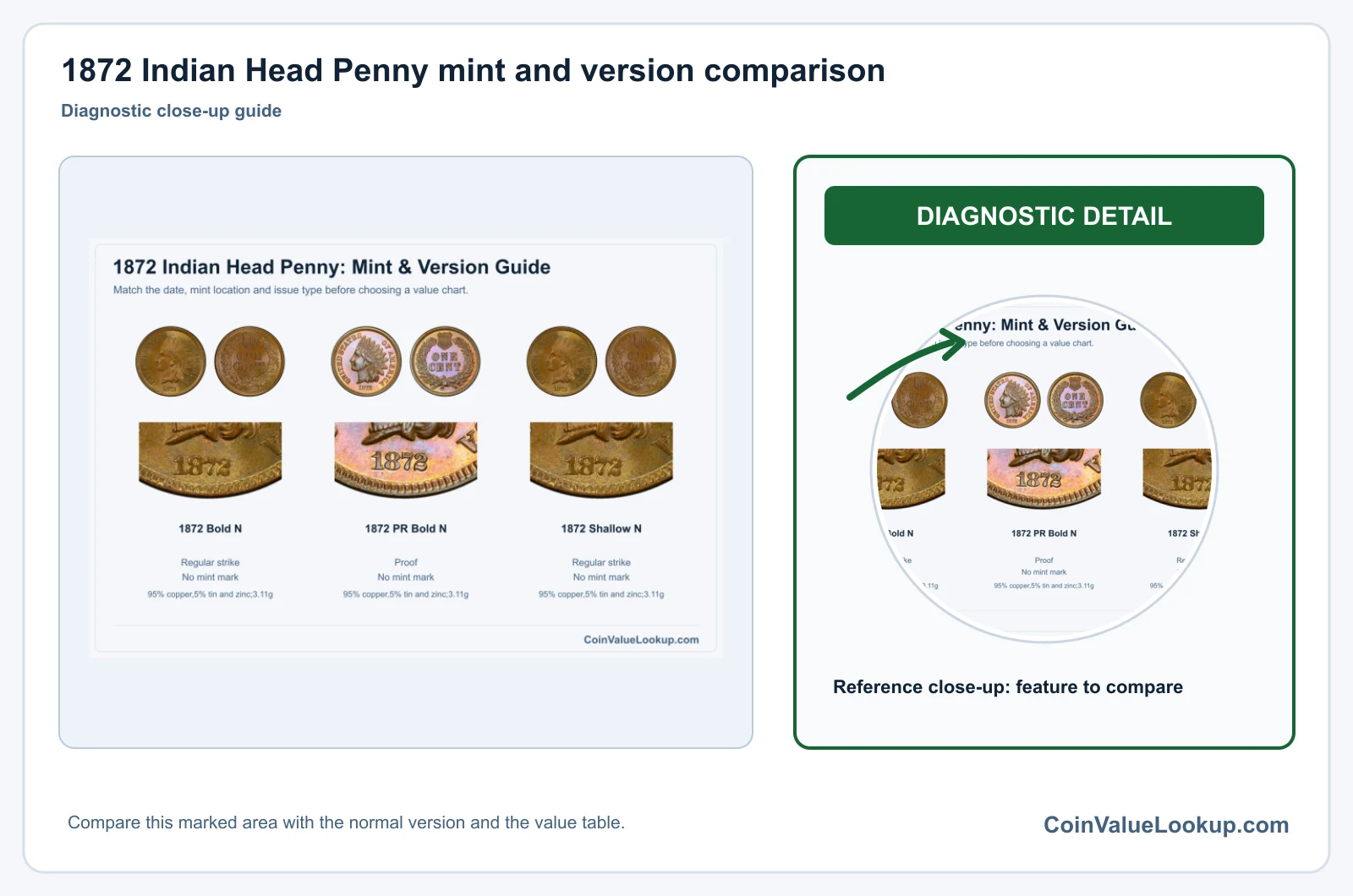
An 1872 Indian Head penny is a legitimately scarce early bronze issue, and guide values reflect that. Selected guide anchors for ordinary business strikes range from about $154 at G4 (a well-worn but readable coin) to around $1,390 at MS63 (a choice uncirculated example with original luster), depending on which reverse hub variety you hold.
Proofs, major varieties, and mint errors require separate evaluation, so read on before settling on a number.
Fast Way to Identify Your 1872 Indian Head Penny
The quickest way to start figuring out what your 1872 Indian Head penny is worth is to upload clear photos of the front and back. Our identifier can give you a preliminary read on the coin's version and approximate condition.
Good lighting and a steady shot matter more than an expensive camera, so a phone works fine.
1872 Indian Head Penny Value
Upload both sides of your 1872 Indian Head Penny.
Front Obverse
Upload photo
Back Reverse
Upload photo
Which 1872 Indian Head Penny Versions Are Worth Money?
- The Shallow N variety at MS63 carries the highest listed guide value at $1,390, so check that reverse N carefully on any uncirculated example.
- Bold N business strikes range from about $154 at G4 to $1,243 at MS63 in selected guide estimates.
- Proof Bold N examples carry a guide anchor near $666 at PR63; confirm genuine proof surfaces before assuming this category.
- Mint errors such as doubled dies, cuds, and repunched dates have been reported for this date and can affect value independently of the hub variety.
Step 1: Identify Your 1872 Indian Head Penny Mint Mark and Version
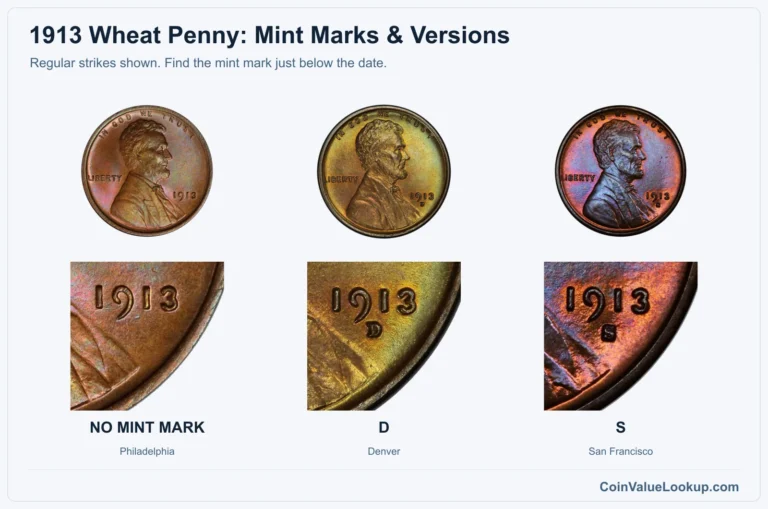
Every regular 1872 Indian cent was struck at Philadelphia. There is no mintmark to look for.
The small "L" on the ribbon behind the portrait is a designer's initial, not a mint identifier, so do not confuse it with a mintmark.
The key split this year is the reverse hub variety. Look at the word ONE on the back.
The Bold N version has a crisply defined, full-relief letter N, while the Shallow N shows a noticeably flatter, less sharply formed N. This is a hub difference built into the die, not a result of wear.
You need to compare at similar grades to see it clearly; a worn Bold N can mimic the look of a Shallow N if you are not careful.
Make sure you are actually holding an Indian Head cent: the obverse shows a portrait wearing a feathered headdress, and the reverse features an oak wreath surrounding a shield at the top. Do not mix this up with a Flying Eagle cent (different bird, different era) or a Lincoln wheat penny.
If your coin has deeply mirrored fields and squared-off rims, it may be a proof, but proof is a manufacturing method, not a condition grade. A polished or cleaned business strike is not a proof, no matter how shiny it looks.
Step 2: Check Your 1872 Indian Head Penny Grade
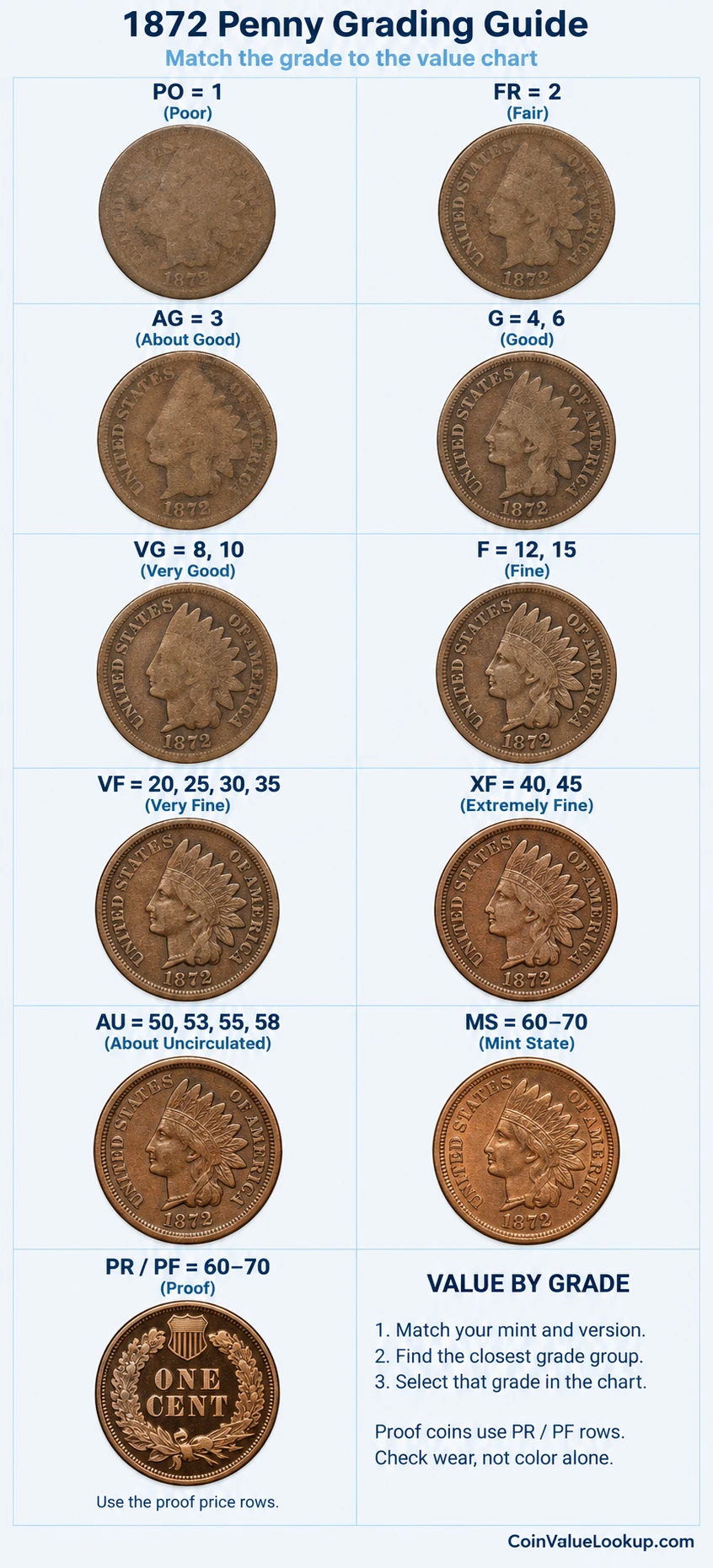
Start with the headband. The word LIBERTY is incused across it, and the letters fade in a predictable order as the coin wears.
On a G4 example, LIBERTY is mostly gone and the portrait is a flat outline with minimal detail. Move up to VF and you will see partial feather separation and a readable LIBERTY.
Check the cheek and hair above the ear next. These are high points that lose detail first.
On the reverse, the wreath leaves and bow show progressive flattening as grade drops.
A soft original strike can fool you. Some 1872 cents left the press with incomplete feather or diamond detail even before anyone spent them.
Do not downgrade a coin based on one weak area alone; look at the overall package of wear, luster, and surface quality. Use the comparison image to match your coin against known grade benchmarks.
Color designations like BN (brown), RB (red-brown), and RD (red) describe how much original copper color remains. These are not separate materials.
A full red coin at the same grade typically brings a premium, but the guide prices listed here do not specify a color tier, so treat them as general anchors rather than color-specific targets.
Step 3: Check 1872 Indian Head Penny Value by Mint and Version
1872 Indian Head Penny — Bold N
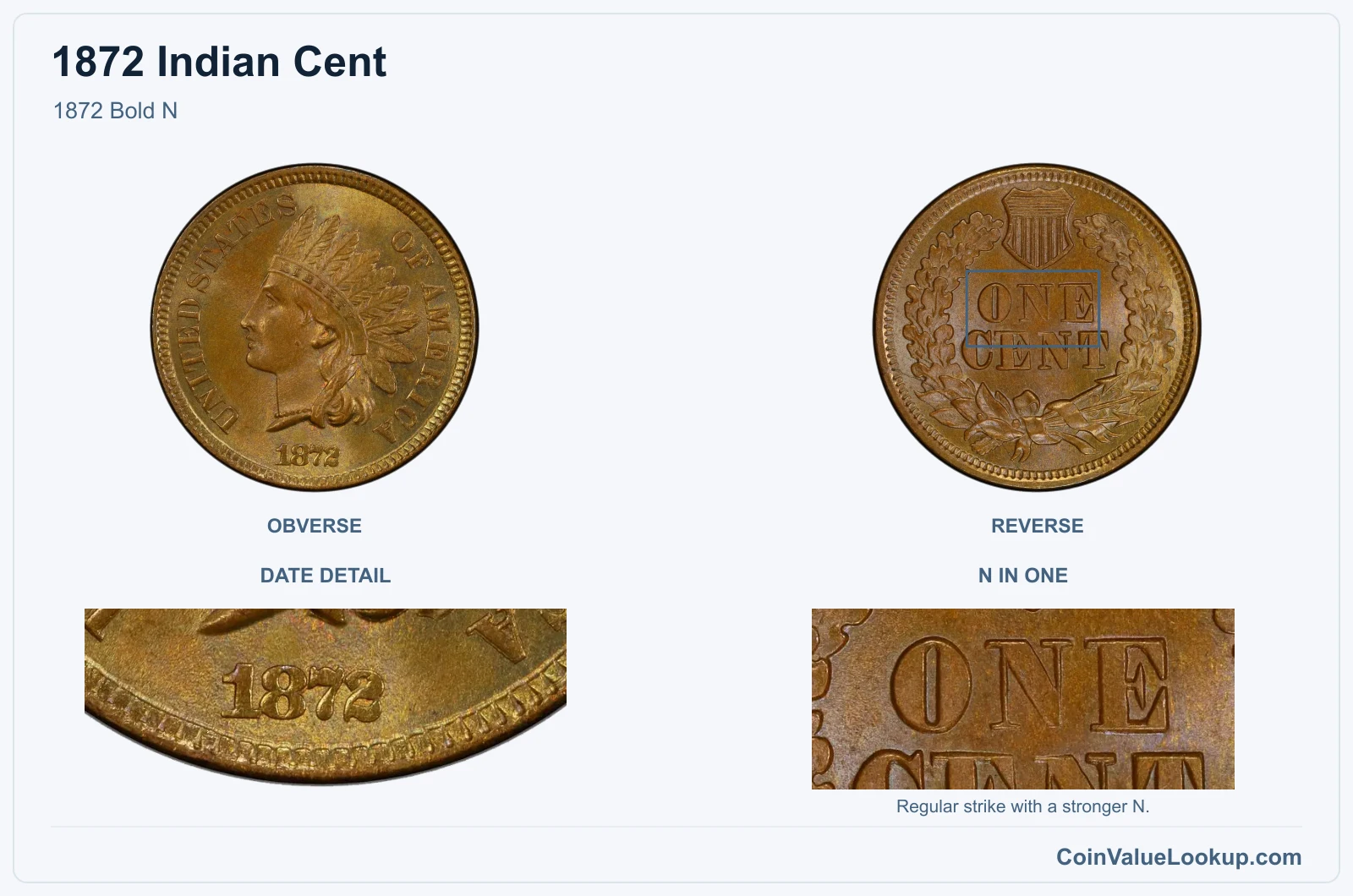
This is the standard business-strike 1872 Indian cent with the Bold N reverse hub. Look at the letter N in ONE on the reverse: it should appear fully formed with strong, well-defined relief.
The Bold N uses the newer reverse hub introduced around 1870.
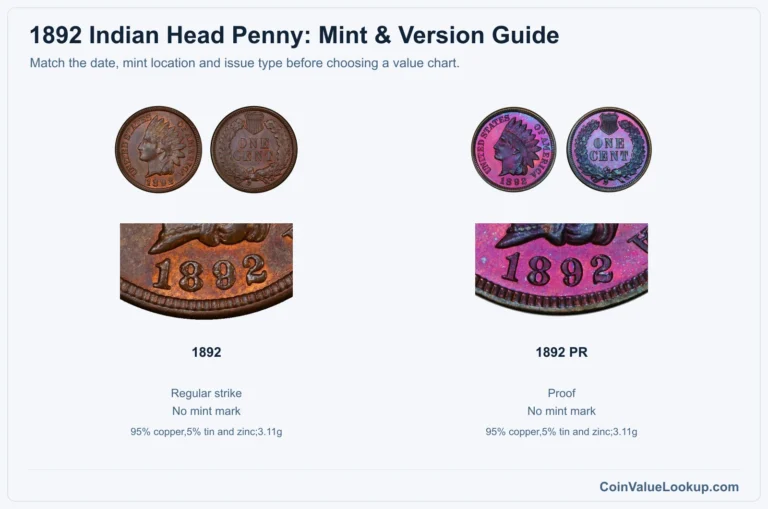
All examples were struck at Philadelphia with no mintmark, on bronze planchets of 95% copper and 5% tin and zinc, weighing 3.11 grams. Selected guide anchors place this version at roughly $154 in G4 and $1,243 in MS63, per USA Coin Book.
These are retail guide estimates, not guaranteed sale prices. Compare like grades and original surfaces when shopping; do not borrow pricing from rarer varieties.
| Range | Grade | Price | Auction Records | Appraisal |
|---|---|---|---|---|
| PO | PO 1 | — | Coin Identifier | |
| FR | FR 2 | Coin Identifier | ||
| AG | AG 3 | Coin Identifier | ||
| G | G 4 | Coin Identifier | ||
| G 6 | Coin Identifier | |||
| VG | VG 8 | Coin Identifier | ||
| VG 10 | Coin Identifier | |||
| F | F 12 | Coin Identifier | ||
| F 15 | Coin Identifier | |||
| VF | VF 20 | Coin Identifier | ||
| VF 25 | Coin Identifier | |||
| VF 30 | Coin Identifier | |||
| VF 35 | Coin Identifier | |||
| XF | XF 40 | Coin Identifier | ||
| XF 45 | Coin Identifier | |||
| AU | AU 50 | Coin Identifier | ||
| AU 53 | Coin Identifier | |||
| AU 55 | Coin Identifier | |||
| AU 58 | Coin Identifier | |||
| MS | MS 60 | — | Coin Identifier | |
| MS 61 | Coin Identifier | |||
| MS 62 | Coin Identifier | |||
| MS 63 | Coin Identifier | |||
| MS 64 | Coin Identifier | |||
| MS 65 | Coin Identifier | |||
| MS 66 | Coin Identifier | |||
| MS 67 | — | — | — | |
| MS 68 | — | — | — | |
| MS 69 | — | — | — | |
| MS 70 | — | — | — |
1872 Indian Head Penny — PR Bold N
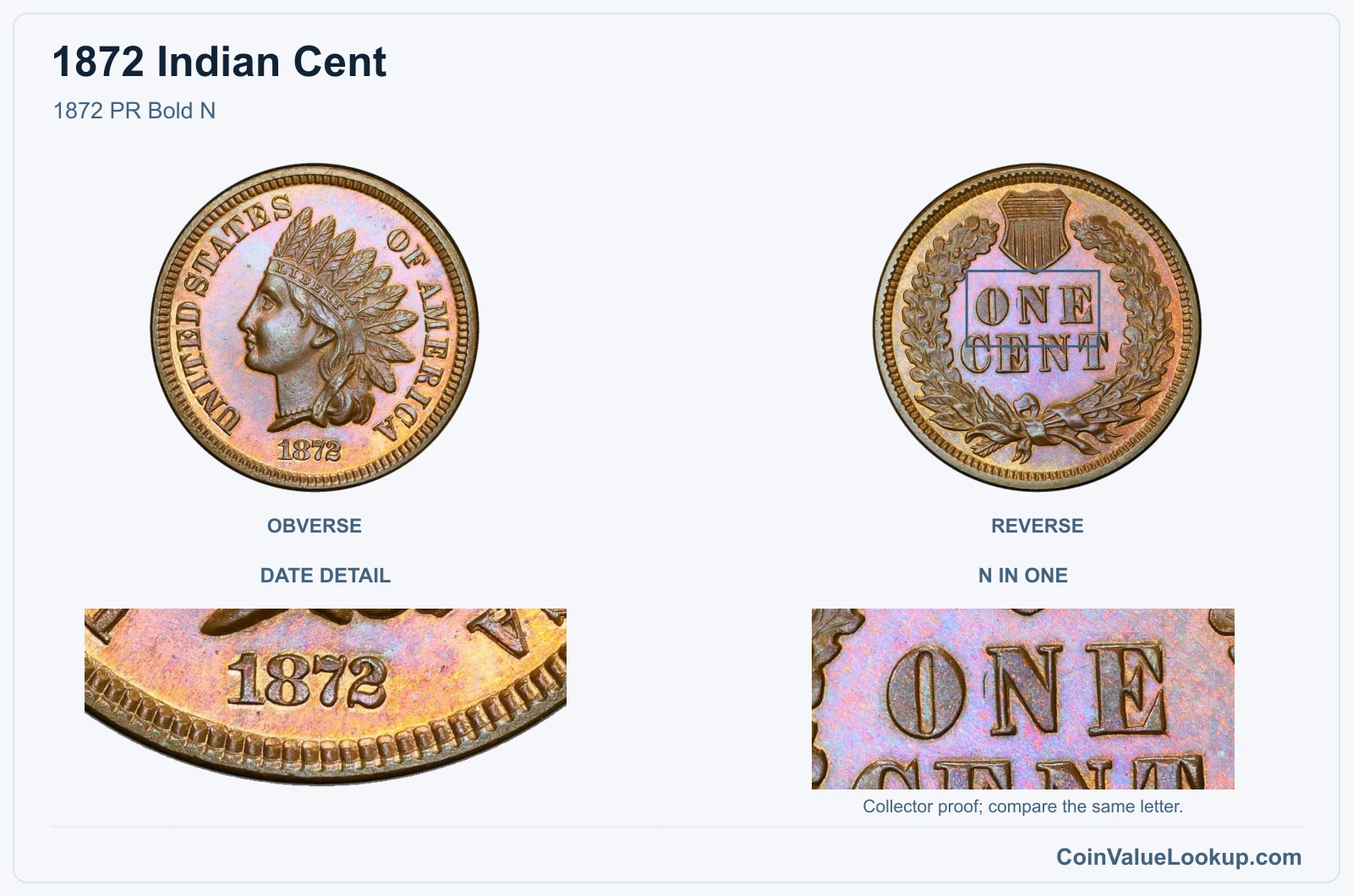
The proof version of the 1872 Bold N is a deliberately struck coin with mirrored fields and sharp detail, produced for collectors at the Philadelphia Mint. It shares the same 95% copper, 5% tin and zinc composition and 3.11-gram weight as the business strike, but the manufacturing process is completely different.
A selected guide anchor places the PR63 example at about $666, according to USA Coin Book. That is a guide estimate for one grade, not a blanket price for all proof conditions.
Coin Value Lookup is a good starting point if you want to compare this date with other Indian cent proof years or check values across the series. A couple of minutes there can save you a lot of guesswork.
Verify proof status by examining rim geometry, field reflectivity, and die finish. A business strike that someone polished in a drawer is not a proof, no matter how mirror-like it appears.
The Shallow N reverse hub also exists, so confirm the Bold N variety independently.
| Range | Grade | Price | Auction Records | Appraisal |
|---|---|---|---|---|
| PR | PR 1 | — | Coin Identifier | |
| PR 2 | — | Coin Identifier | ||
| PR 3 | — | Coin Identifier | ||
| PR 4 | — | Coin Identifier | ||
| PR 6 | — | Coin Identifier | ||
| PR 8 | — | Coin Identifier | ||
| PR 10 | — | Coin Identifier | ||
| PR 12 | — | Coin Identifier | ||
| PR 15 | — | Coin Identifier | ||
| PR 20 | — | Coin Identifier | ||
| PR 25 | — | Coin Identifier | ||
| PR 30 | — | Coin Identifier | ||
| PR 35 | — | Coin Identifier | ||
| PR 40 | — | Coin Identifier | ||
| PR 60 | — | Coin Identifier | ||
| PR 61 | — | Coin Identifier | ||
| PR 62 | — | Coin Identifier | ||
| PR 63 | Coin Identifier | |||
| PR 64 | Coin Identifier | |||
| PR 65 | Coin Identifier | |||
| PR 66 | Coin Identifier | |||
| PR 67 | — | — | — | |
| PR 68 | — | — | — | |
| PR 69 | — | — | — | |
| PR 70 | — | — | — |
1872 Indian Head Penny — Shallow N
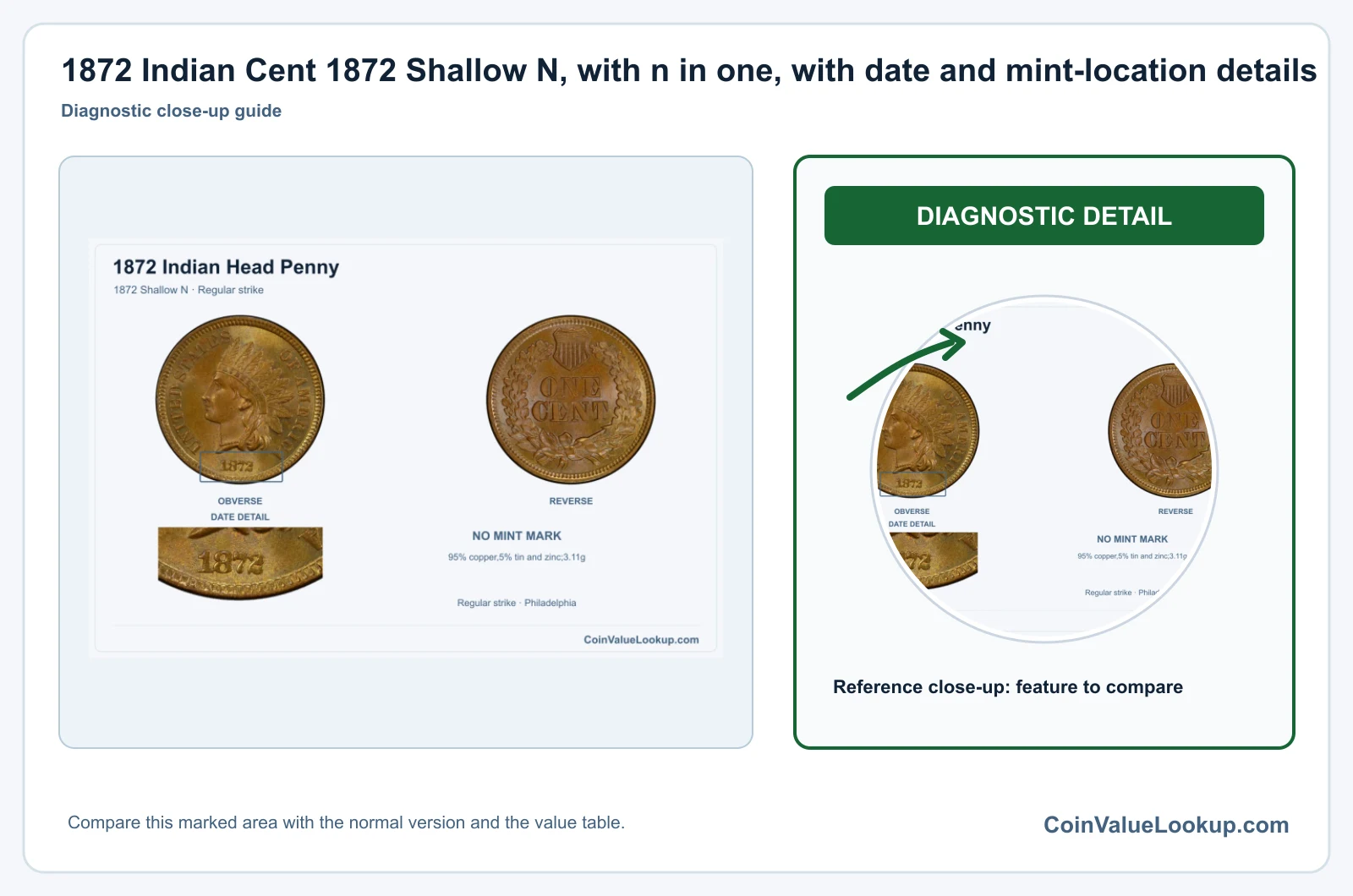
The Shallow N is the older reverse hub variety, carried over from before the Bold N hub was introduced. Look closely at the letter N in ONE: the relief is noticeably shallower and less crisply defined compared to a Bold N at similar wear levels.
This is a die hub difference, not a weak strike or a cud.
This version was also struck at Philadelphia on the standard 3.11-gram bronze planchet. Selected USA Coin Book guide anchors put it at roughly $162 in G4 and $1,390 in MS63, which edges slightly above the Bold N at both ends.
Compare carefully at the same grade before drawing conclusions about relative value, because wear can obscure the N relief difference.
Ordinary-issue reference: Ordinary-issue reference only: The table below shows prices for the 1872 Indian Cent (regular strike). It does not represent the value of the specific 1872 Shallow N variety or its variety premium. Year, mint, metal and strike type are matched; the specific variety is not priced by this table.
Range Grade
Price1872 Indian Cent — Ordinary-Issue Reference (Regular Strike) (BN) Price1872 Indian Cent — Ordinary-Issue Reference (Regular Strike) (RB) Price1872 Indian Cent — Ordinary-Issue Reference (Regular Strike) (RD) Auction Records Appraisal PO PO 1
—
Coin Identifier FR FR 2
Coin Identifier AG AG 3
Coin Identifier G G 4
Coin Identifier
G 6
Coin Identifier VG VG 8
Coin Identifier
VG 10
Coin Identifier F F 12
Coin Identifier
F 15
Coin Identifier VF VF 20
Coin Identifier
VF 25
Coin Identifier
VF 30
Coin Identifier
VF 35
Coin Identifier XF XF 40
Coin Identifier
XF 45
Coin Identifier AU AU 50
Coin Identifier
AU 53
Coin Identifier
AU 55
Coin Identifier
AU 58
Coin Identifier MS MS 60
—
Coin Identifier
MS 61
Coin Identifier
MS 62
Coin Identifier
MS 63
Coin Identifier
MS 64
Coin Identifier
MS 65
Coin Identifier
MS 66
Coin Identifier
MS 67
—
—
—
—
—
MS 68
—
—
—
—
—
MS 69
—
—
—
—
—
MS 70
—
—
—
—
—
1872 Indian Head Penny Error List
1. 1872 Indian Head Penny — Die Break / Cud
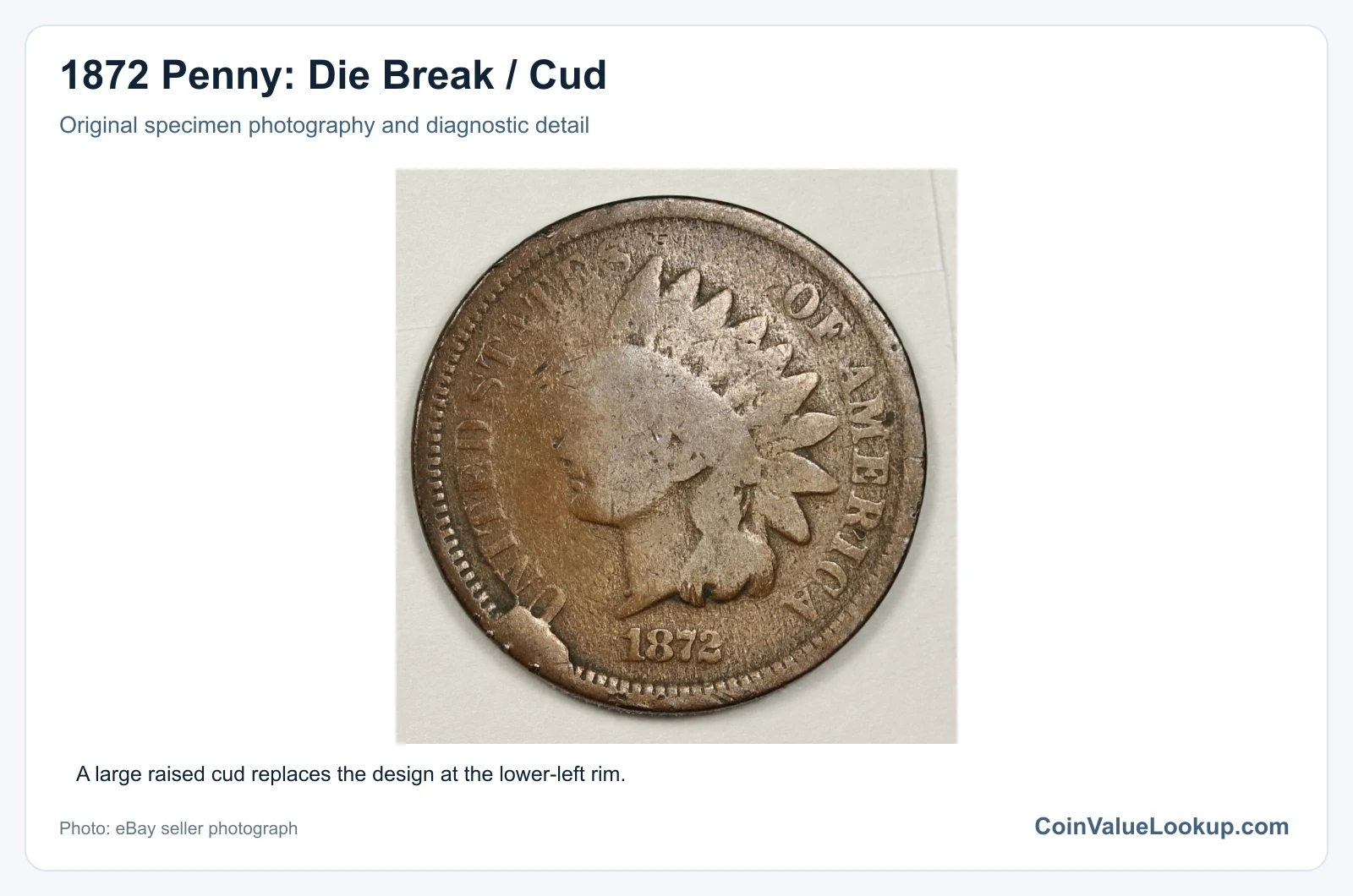
A cud on an 1872 Indian cent appears as a raised, featureless blob that connects to the rim. It happens when a piece of the die breaks away entirely, leaving a void that fills with metal during striking.
The result is an area where normal design detail is replaced by a smooth, raised lump.
To confirm a cud, check that the raised area actually touches the rim and displaces part of the design. A rim dent pushed inward, a patch of corrosion, or an interior die chip that does not reach the rim can all mimic the look.
The boundary between the cud and the remaining design should be relatively sharp and follow the shape of the missing die fragment.
Cuds on this date have been reported in published variety references. Pricing depends on the size, location, and overall condition of the coin, so individual assessment by an authenticated example is the way to go.
2. 1872 Indian Head Penny — Doubled Die Obverse
A doubled die obverse on an 1872 Indian cent shows consistent doubling of design elements on the front of the coin. You might see separation or notching on the date digits, LIBERTY letters, or other obverse features.
The key word is consistent: the doubling should repeat in the same direction across multiple elements.
Compare your coin against a normal example under matching lighting. Machine doubling, which is a far more common and less valuable occurrence, tends to produce a flat, shelf-like appearance on the raised elements rather than the distinct notched separation of a true doubled die.
This category has been reported in published variety references for the 1872 date. Value depends on the specific die pair, the strength of the doubling, and the coin's overall condition, so individual professional assessment matters here.
3. 1872 Indian Head Penny — Misplaced Date
A misplaced date occurs when part of a date digit appears somewhere it should not be, typically embedded in the denticles below the date or partially hidden near the portrait truncation. On an 1872 Indian cent, look for the ghost outline of a numeral in an unexpected location, separate from the correctly positioned 1872.
The partial digit will match the shape of one of the date numerals. This is what separates it from a random die chip, a scratch, or an arbitrary bump: it should look like part of a number, in the right scale, just in the wrong place.
This variety has been reported in published references for 1872. Pricing requires individual evaluation based on the clarity of the misplaced digit, the coin's grade, and authenticated identification.
Do not assume a stray mark is a misplaced date without careful comparison.
4. 1872 Indian Head Penny — Repunched Date
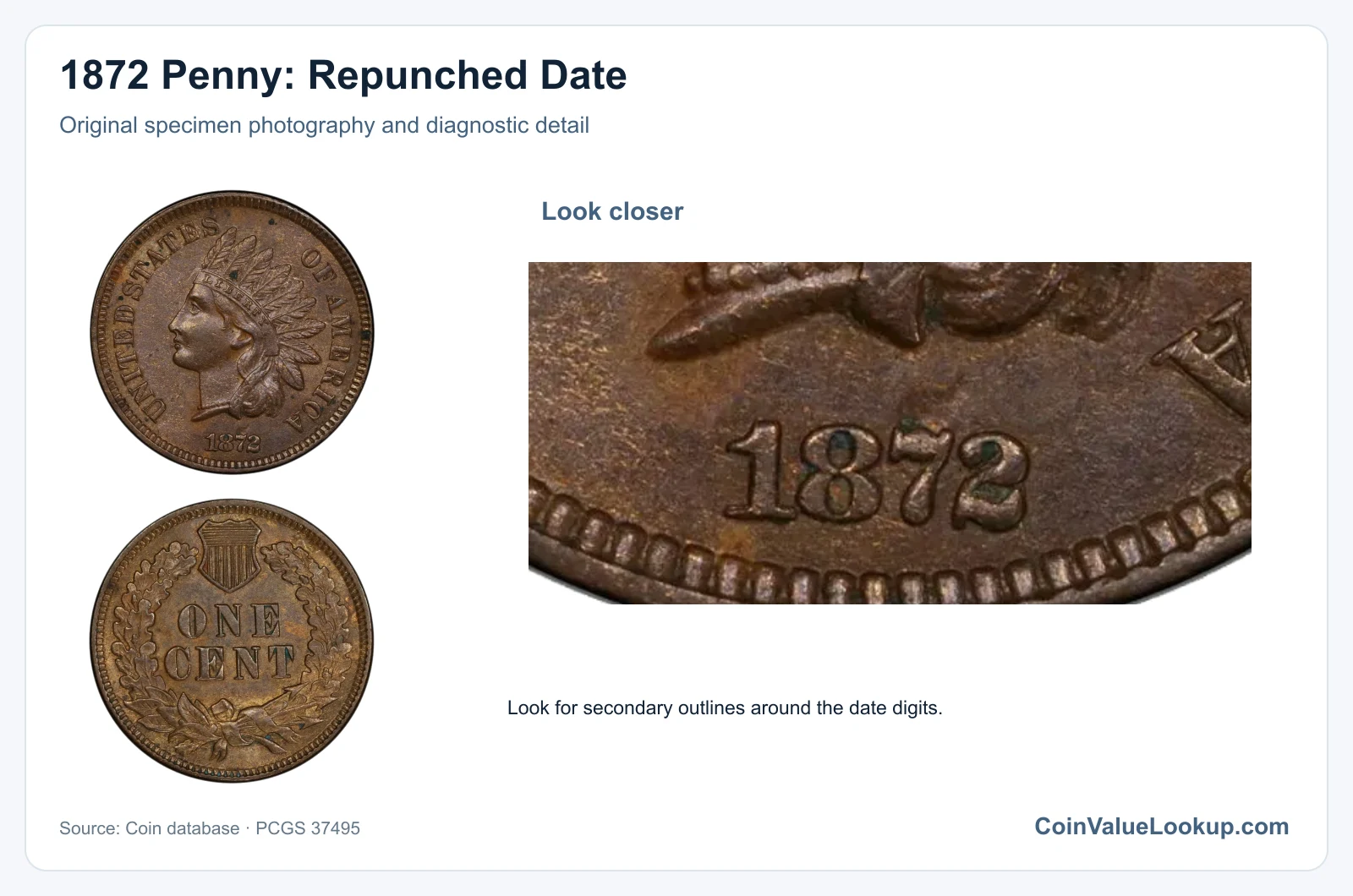
A repunched date on the 1872 Indian cent shows traces of an earlier position of one or more date numerals alongside the final, correctly placed digits. You are looking for remnants, not full extra numbers: a shadow of the top of an 8, a sliver of the 7, or an offset trace beside the 2.
This is mechanically different from a doubled die. Repunching happened when the date punch was applied more than once in slightly different positions.
Doubled dies involve the entire hub impression shifting.
Do not confuse repunching with damage or machine doubling. Damage tends to be irregular and incuse, while machine doubling produces flat shelves.
Repunching shows raised remnants in a position consistent with an earlier punch placement. Published variety references list this category for 1872, and value depends on the strength and clarity of the repunching plus overall coin condition.
5. 1872 Indian Head Penny — Die Crack
A die crack on an 1872 Indian cent shows up as a raised, thin line running across the surface. It can cross open fields, cut through letters, or trace along the rim.
The line is raised because the crack in the die creates a channel that fills with metal during striking.
To distinguish a die crack from a scratch, remember: die cracks are raised; scratches are incuse (cut into the surface). Corrosion lines and displaced-metal scrapes also sit differently from a genuine die crack.
Check both sides of the line; it should blend into the surrounding struck detail.
Die cracks have been reported for the 1872 date in published variety references. Most minor cracks add little premium, but dramatic examples that span the full coin or create interesting patterns can attract specialist interest.
Pricing depends on severity, location, and the coin's overall condition.
6. 1872 Indian Head Penny — Die Chip
A die chip on an 1872 Indian cent appears as a small, raised lump, usually inside or adjacent to a letter, numeral, or design element. When a tiny piece of the die surface flakes away, the resulting void fills with metal and produces this localized bump on the struck coin.
Look at how the surrounding design flows into the raised area. On a genuine die chip, the adjacent struck detail will transition smoothly into the lump.
A gouge or glued foreign material will usually show abrupt edges or sit on top of the existing surface rather than merging with it.
Die chips for this date are listed in published variety references. Small chips inside common letters rarely add significant value.
Larger or unusually placed chips can attract variety collectors, but pricing requires individual assessment based on the chip's size, position, and the coin's overall grade.