1887 Indian Head Penny Coin Value: How Much Is It Worth?
An 1887 Indian Head penny in well-worn condition carries a guide value around $4.96 at the G4 grade level, while a nicer uncirculated example at MS63 can reach roughly $144. Proofs were struck separately and are valued differently.
These are published retail guide estimates, not guaranteed offers, and actual results depend on the specific coin's condition, surfaces and authenticity.
Fast Way to Identify Your 1887 Indian Head Penny
Want a quick read on your 1887 Indian Head cent? Upload clear photos of both the front and back of your coin, and our identifier can offer a preliminary take on what you have.
This is not a substitute for professional authentication or grading, but it is a solid starting point to figure out the branch and general condition you are working with.
1887 Indian Head Penny Value
Upload both sides of your 1887 Indian Head Penny.
Front Obverse
Upload photo
Back Reverse
Upload photo
Which 1887 Indian Head Penny Versions Are Worth Money?
- The 1887 proof has a guide value of $313 at PR63, well above the business strike at any circulated grade listed.
- Business strikes grading MS63 carry a guide value around $144, a significant jump over worn examples.
- Coins retaining original red or red-brown color in uncirculated grades are more desirable than fully toned brown pieces.
- Confirmed die errors such as doubled die obverse, cuds or repunched dates require individual assessment and can add a premium.
Step 1: Identify Your 1887 Indian Head Penny Mint Mark and Version
Every regular 1887 Indian Head cent was struck at the Philadelphia Mint. There is no mintmark on this coin, and the small "L" you may spot on the ribbon behind the portrait is the designer's initial, not a mint identifier.
The obverse shows an idealized portrait wearing a feathered headdress, and the reverse features an oak wreath surrounding a shield. If your coin has wheat stalks on the back, it is a Lincoln cent, not an Indian Head.
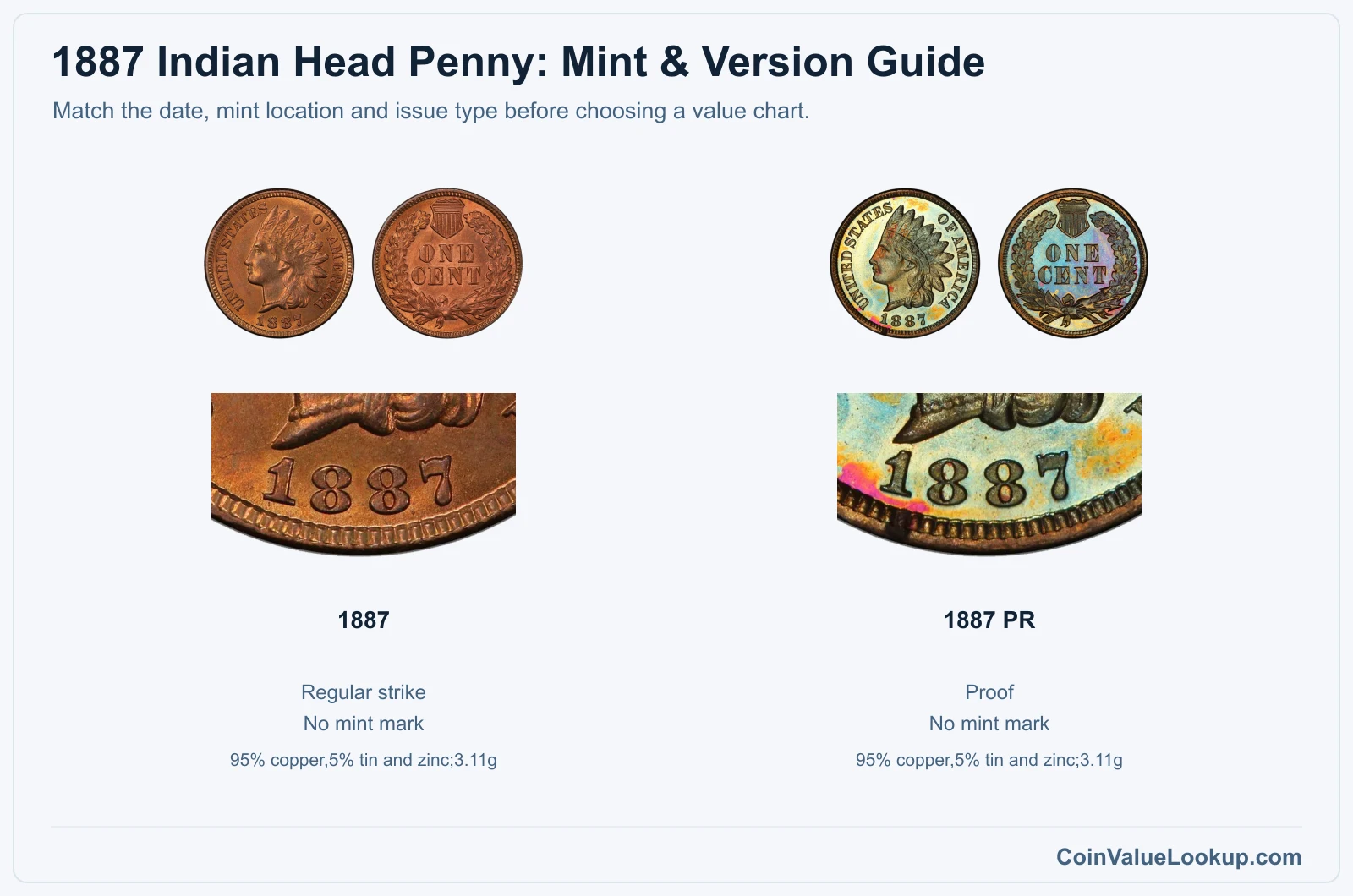
You need to separate two branches: the standard business strike and the proof. Both share the same design, composition and lack of mintmark.
Proof coins were made with specially prepared dies and planchets, producing mirrored fields and sharp detail. A polished or lightly circulated business strike is not a proof, no matter how shiny it looks.
Authentic proof identification usually requires close inspection of the rim geometry, field quality and overall manufacturing characteristics.
Step 2: Check Your 1887 Indian Head Penny Grade
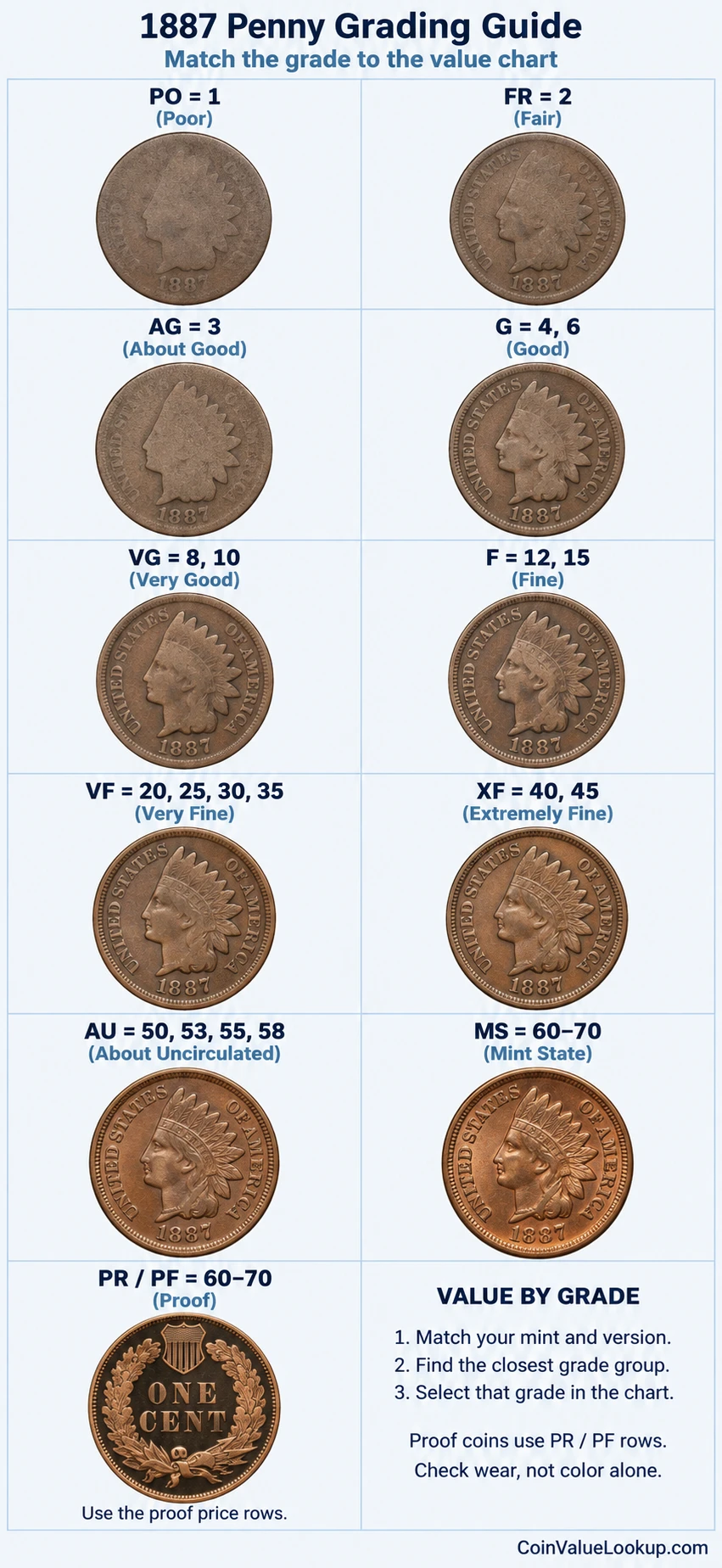
Start with the headband. On a well-preserved coin, LIBERTY is fully readable across the band.
As wear sets in, those letters soften and eventually disappear, starting with the tops of the letters.
Next, check the feather tips above and behind the portrait. These are high points and lose detail early.
The cheek and hair above the ear also flatten with circulation.
On the reverse, look at the wreath leaves and the shield. Wear shows first on the bow knot and the leaf tips closest to the rim.
Here is the catch: some 1887 cents came off the press with a soft strike, meaning feather and hair detail can look weak even on a coin that never circulated. Do not grade solely from one missing letter in LIBERTY or one mushy feather.
Compare your coin to the reference image and evaluate strike, remaining luster and surface problems together.
Bronze color designations like BN, RB and RD describe how much original copper-red color remains. These are color labels, not separate alloys.
A coin with full original red surfaces is more desirable than one that has toned brown, assuming equal technical grade.
Step 3: Check 1887 Indian Head Penny Value by Mint and Version
1887 Indian Head Penny
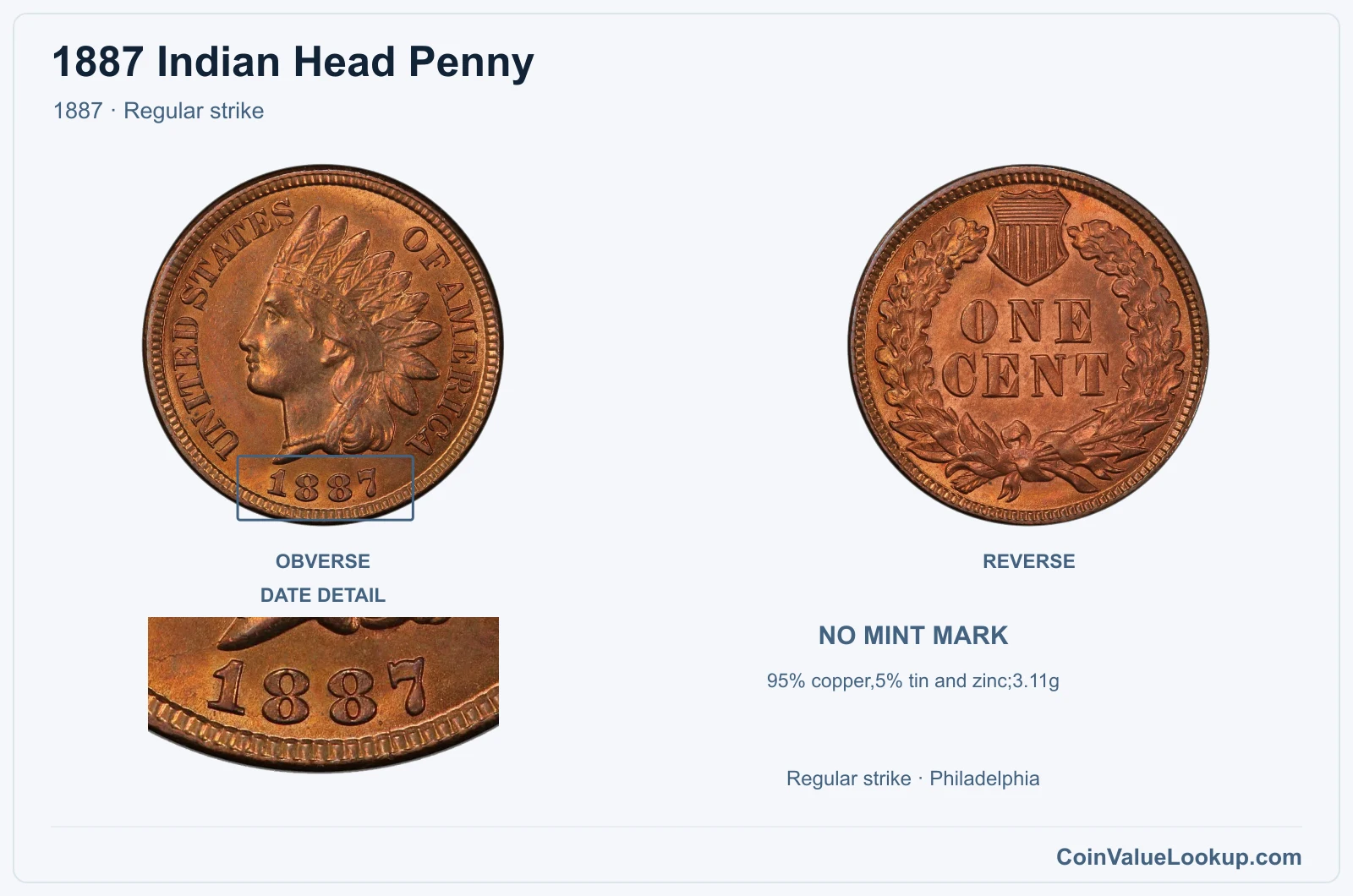
The standard 1887 Indian Head cent is a business strike from the Philadelphia Mint. It is composed of 95% copper with 5% tin and zinc, weighing about 3.11 grams.
No mintmark appears on any regular issue this year.
Guide values run from approximately $4.96 at G4, a grade where LIBERTY is mostly gone and the portrait is heavily worn, up to around $144 at MS63, where the coin retains strong detail and some luster. These are published retail estimates from USA Coin Book, not certified sale prices.
Surface quality matters a lot. A coin that has been cleaned, corroded or damaged will trade for less than a problem-free example of the same technical grade.
Original surfaces always command more confidence from buyers.
| Range | Grade | Price | Auction Records | Appraisal |
|---|---|---|---|---|
| PO | PO 1 | — | Coin Identifier | |
| FR | FR 2 | — | Coin Identifier | |
| AG | AG 3 | — | Coin Identifier | |
| G | G 4 | — | Coin Identifier | |
| G 6 | — | Coin Identifier | ||
| VG | VG 8 | — | Coin Identifier | |
| VG 10 | — | Coin Identifier | ||
| F | F 12 | — | Coin Identifier | |
| F 15 | — | Coin Identifier | ||
| VF | VF 20 | — | Coin Identifier | |
| VF 25 | — | Coin Identifier | ||
| VF 30 | Coin Identifier | |||
| VF 35 | — | Coin Identifier | ||
| XF | XF 40 | Coin Identifier | ||
| XF 45 | Coin Identifier | |||
| AU | AU 50 | — | Coin Identifier | |
| AU 53 | — | Coin Identifier | ||
| AU 55 | Coin Identifier | |||
| AU 58 | Coin Identifier | |||
| MS | MS 60 | — | Coin Identifier | |
| MS 61 | — | Coin Identifier | ||
| MS 62 | Coin Identifier | |||
| MS 63 | Coin Identifier | |||
| MS 64 | Coin Identifier | |||
| MS 65 | Coin Identifier | |||
| MS 66 | Coin Identifier | |||
| MS 67 | — | — | — | |
| MS 68 | — | — | — | |
| MS 69 | — | — | — | |
| MS 70 | — | — | — |
1887 Indian Head Penny — PR
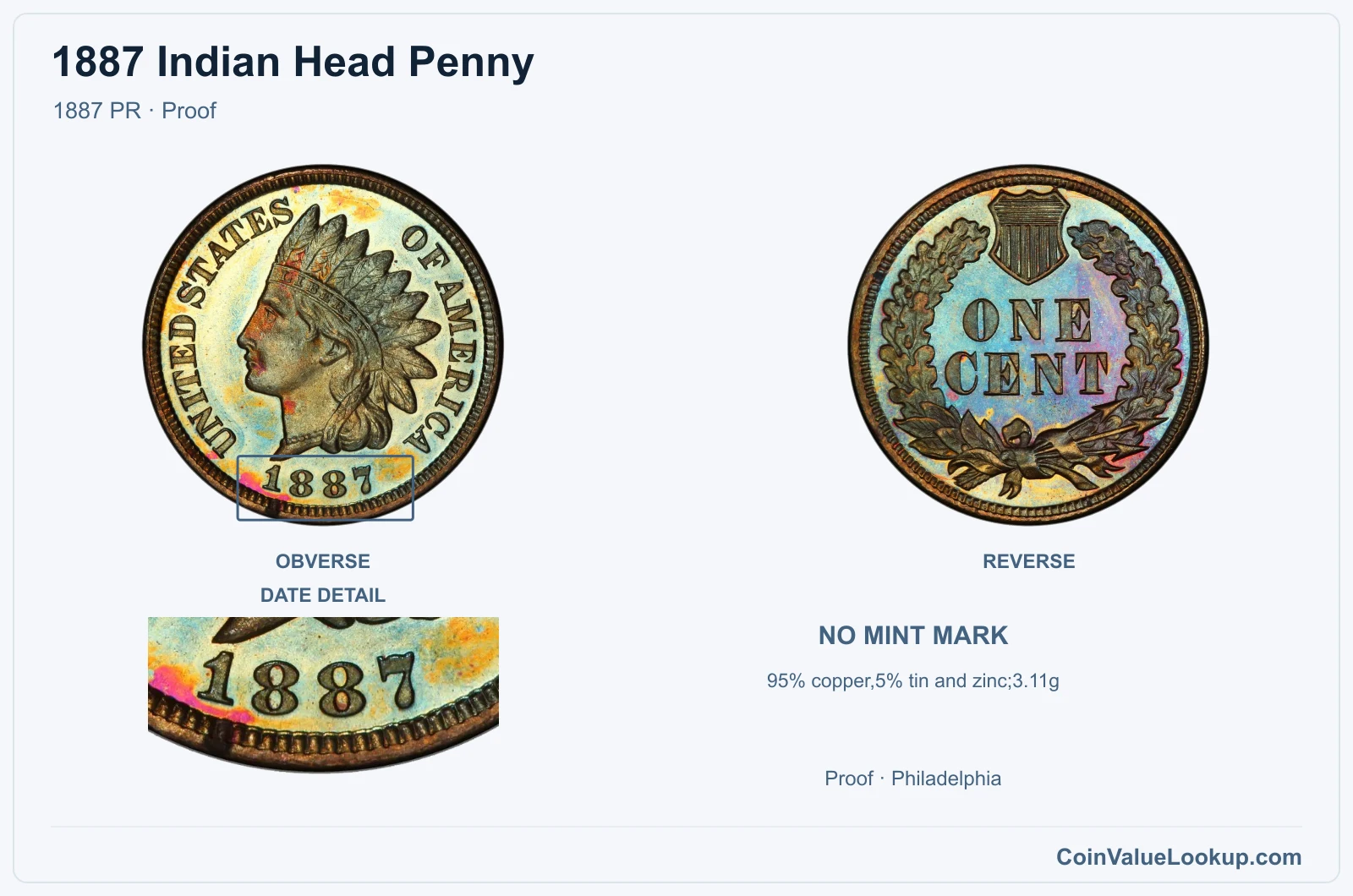
The 1887 proof Indian Head cent was a limited production intended for collectors, struck at Philadelphia with specially prepared dies. The composition and weight match the business strike: 95% copper, 5% tin and zinc, 3.11 grams.
At PR63, the guide value sits around $313, making it substantially more valuable than a typical circulated business strike. Proof surfaces should show mirrored fields and crisp design elements that a business strike simply does not replicate.
Do not assume a shiny coin is a proof. Polished, lightly circulated or well-preserved business strikes can fool you.
Look for the distinctive squared-off rim profile, deeply mirrored flat areas and consistent sharp detail. Professional authentication is the safest route if you believe you have a proof.
Coin Value Lookup is a useful starting point when you want to compare guide values across different years, denominations and branches before committing to a professional evaluation.
| Range | Grade | Price | Auction Records | Appraisal |
|---|---|---|---|---|
| PR | PR 1 | — | Coin Identifier | |
| PR 2 | — | Coin Identifier | ||
| PR 3 | — | Coin Identifier | ||
| PR 4 | — | Coin Identifier | ||
| PR 6 | — | Coin Identifier | ||
| PR 8 | — | Coin Identifier | ||
| PR 10 | — | Coin Identifier | ||
| PR 12 | — | Coin Identifier | ||
| PR 15 | — | Coin Identifier | ||
| PR 20 | — | Coin Identifier | ||
| PR 25 | — | Coin Identifier | ||
| PR 30 | — | Coin Identifier | ||
| PR 35 | — | Coin Identifier | ||
| PR 40 | — | Coin Identifier | ||
| PR 45 | — | Coin Identifier | ||
| PR 50 | — | Coin Identifier | ||
| PR 53 | — | Coin Identifier | ||
| PR 55 | — | Coin Identifier | ||
| PR 58 | — | Coin Identifier | ||
| PR 60 | — | Coin Identifier | ||
| PR 61 | — | Coin Identifier | ||
| PR 62 | Coin Identifier | |||
| PR 63 | Coin Identifier | |||
| PR 64 | Coin Identifier | |||
| PR 65 | Coin Identifier | |||
| PR 66 | Coin Identifier | |||
| PR 67 | Coin Identifier | |||
| PR 68 | — | — | — | |
| PR 69 | — | — | — | |
| PR 70 | — | — | — |
1887 Indian Head Penny Error List
1. 1887 Indian Head Penny — Die Break / Cud
A cud forms when a chunk of the die breaks away at the rim. The result is a raised, featureless blob on the coin that connects directly to the rim edge and displaces part of the normal design.
On an 1887 Indian Head cent, look for an area where lettering, denticles or design elements are replaced by a smooth, raised lump.
The boundary between the cud and the surviving design should be fairly sharp. If you see something similar in the interior of the coin that does not touch the rim, that is more likely an interior die chip, which is a different category.
Do not confuse a rim dent or corrosion pit with a cud. Damage is incuse, pushed into the coin; a genuine cud is raised above the surface.
No specific price range is established for this category on the 1887 cent, so value depends on the individual coin's authentication, condition and severity of the break.
2. 1887 Indian Head Penny — Doubled Die Obverse
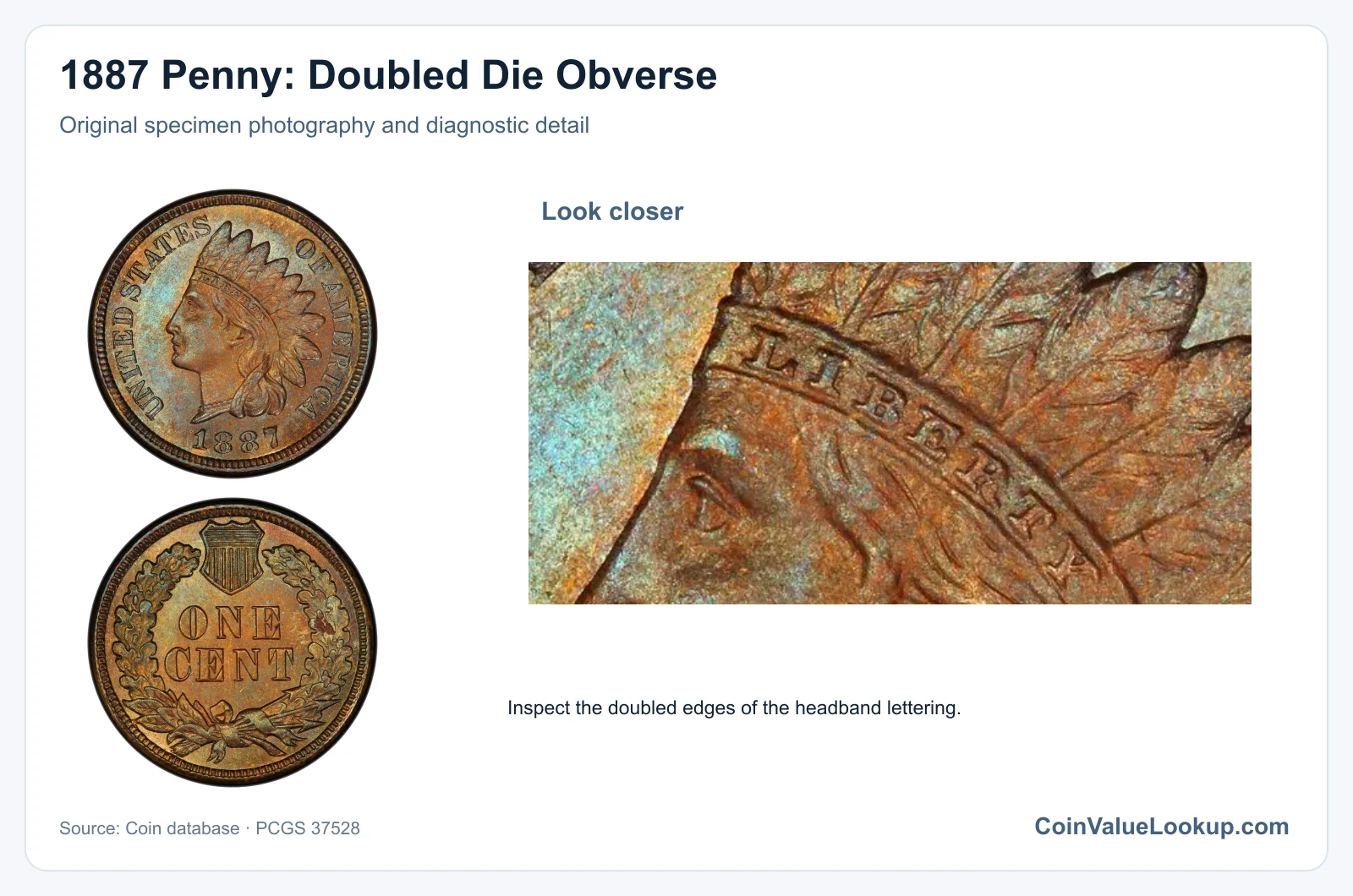
A doubled die obverse on an 1887 Indian Head cent shows a consistent secondary image on obverse design elements, typically visible on lettering, the date or portrait details. Under magnification, look for separation or notching on the edges of letters or numerals that repeats in the same direction across multiple features.
The key word is consistent. Machine doubling, a far more common artifact, tends to produce flat, shelf-like distortion rather than the rounded, raised secondary image of a true doubled die.
Reflections and worn die contours can also mimic doubling to the untrained eye.
Compare your coin against a known normal example under the same lighting. If the extra image appears only on one letter or seems to shift direction from one area to another, it is probably not a genuine doubled die.
No numeric value range is established here; each coin needs individual evaluation based on authenticated identity and condition.
3. 1887 Indian Head Penny — Misplaced Date
A misplaced date occurs when a date digit is punched into the wrong area of the die before being corrected. On an 1887 Indian Head cent, you might find partial remnants of a numeral embedded in the denticles below the date or intruding near the portrait, away from where the final date sits.
What you are looking for is a recognizable fragment of a number, such as the curve of an 8 or the top of a 7, in a location where no digit belongs. Compare the suspect area carefully against the shapes of the actual date digits on the same coin.
Die chips, scratches and random raised bumps can look vaguely like partial numerals, but they lack the consistent shape and font geometry of a real digit. No established price range exists for this variety on the 1887 cent; authenticated examples are assessed individually based on clarity and overall condition.
4. 1887 Indian Head Penny — Repunched Date
A repunched date happens when the date punch is applied more than once in slightly different positions, leaving visible remnants of the earlier impression beside the final numerals. On an 1887 Indian Head cent, check each digit for traces of a secondary image, especially along the tops or sides of the 1, 8 and 7.
This is a die variety, distinct from a doubled die, which involves the entire hub design rather than just the date. The remnants of a repunched date should follow the contour of the same numeral, shifted slightly in one direction.
A damaged date from post-strike contact or machine doubling can mimic a repunched date, but damage tends to be inconsistent and lacks the clean punch outline of an authentic repunch. Each confirmed example is valued individually based on its authentication, clarity and the coin's overall condition.
No specific price range is adopted for this category.
5. 1887 Indian Head Penny — Die Crack
Die cracks appear as raised, irregular lines on the coin's surface, caused by fractures in the steel die during striking. On an 1887 Indian Head cent, a die crack may cross the field, cut through lettering or run across the portrait.
The line is raised because metal fills the crack in the die.
Note where the line starts and ends. A crack that spans from rim to rim or from a design element to the rim is more significant than a tiny hairline fracture.
Multiple cracks on the same coin suggest a heavily worn die.
Do not mistake a scratch for a die crack. Scratches are incuse, meaning they are cut into the surface, while die cracks are raised above it.
Corrosion trails and displaced-metal scrapes can also look linear but lack the clean, raised profile of a genuine crack. Value depends on individual assessment of severity, location and overall coin condition.
6. 1887 Indian Head Penny — Clashed Dies
Clashed dies result when the obverse and reverse dies strike each other without a planchet between them. The impact transfers design elements from one die onto the other.
On a subsequent 1887 Indian Head cent struck from those clashed dies, you may see faint traces of the wreath or shield in the obverse field, or ghost outlines of the portrait on the reverse.
These ghost images should align with where the opposing design would sit during a normal strike. That alignment is the key diagnostic.
Random scratches or raised lines from other causes will not match the expected position of the opposing die's features.
A brockage, where a previously struck coin acts as the die, can leave similar-looking transferred design but involves a different mechanism. No specific price range is adopted for clashed die examples of this date; each coin is assessed individually based on the clarity of the clash, overall condition and professional authentication.