2003 Lincoln Penny Coin Value: How Much Is It Worth?
Most 2003 Lincoln pennies you find in pocket change are worth face value — one cent. A guide estimate places a well-preserved uncirculated example (MS65) around $0.36, while a San Francisco proof in PR65 condition is listed near $4.96.
Special varieties and striking errors occupy their own markets, where values depend on the specific type, severity, and authenticated condition of each coin.
Fast Way to Identify Your 2003 Lincoln Penny
The quickest way to start figuring out what you have is to upload clear photos of both sides of your 2003 penny. Front and back images let us provide a preliminary identification of the mint, version, and general condition.
This is not a substitute for professional authentication or exact grading, but it points you in the right direction fast.
2003 Penny Value
Upload both sides of your 2003 Lincoln Penny.
Front Obverse
Upload photo
Back Reverse
Upload photo
Which 2003 Lincoln Penny Versions Are Worth Money?
- Clean, original surfaces and strong preservation matter more than which mint struck a regular 2003 penny — an MS65 from either Philadelphia or Denver lists around $0.36.
- San Francisco proofs should be evaluated by proof grades and any cameo designation, not compared against circulation-strike values.
Step 1: Identify Your 2003 Lincoln Penny Mint Mark and Version
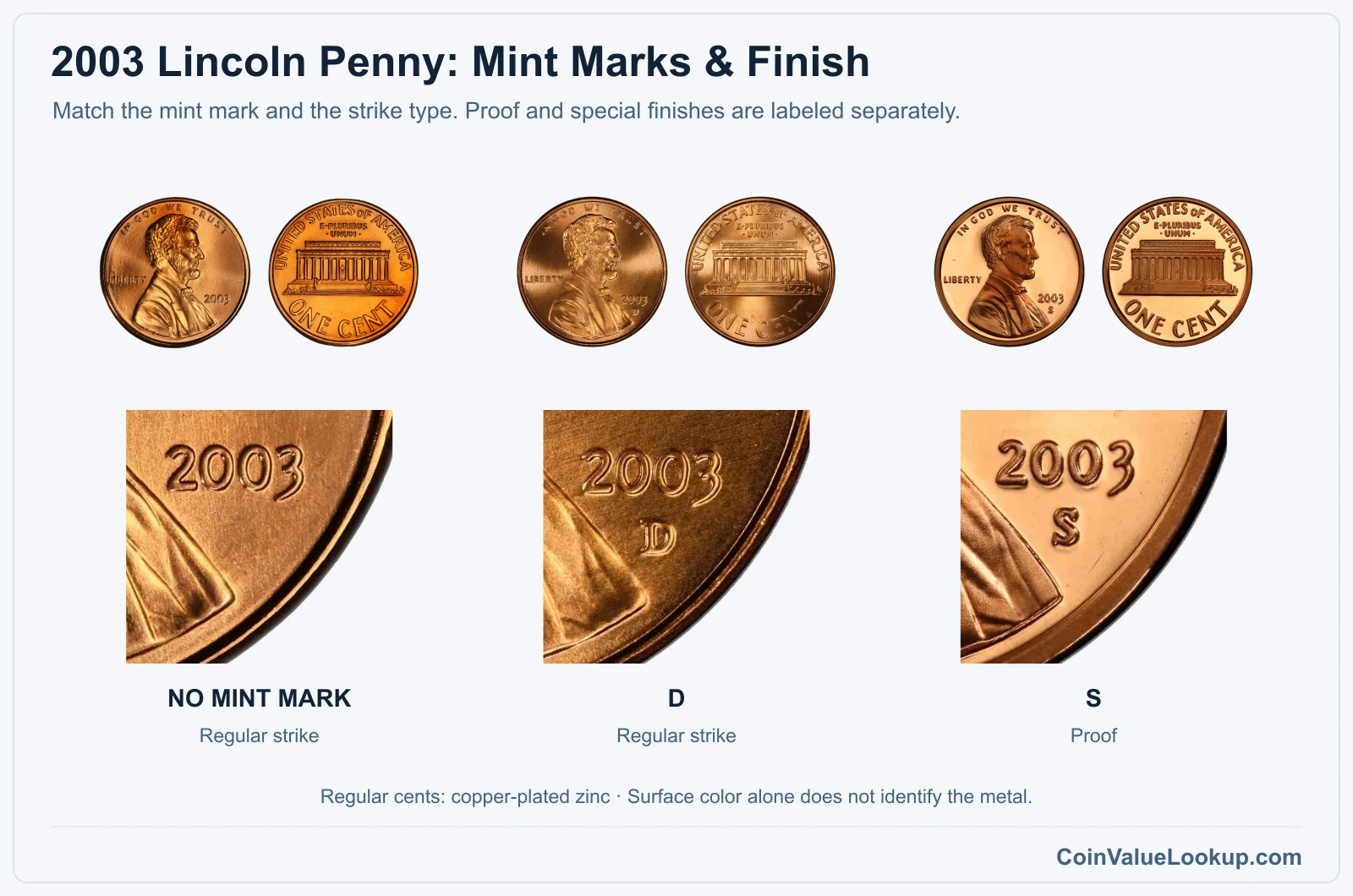
Flip the coin over first: the Lincoln Memorial on the back confirms you have the right series (used 1959–2008). Now check just below the date on the front.
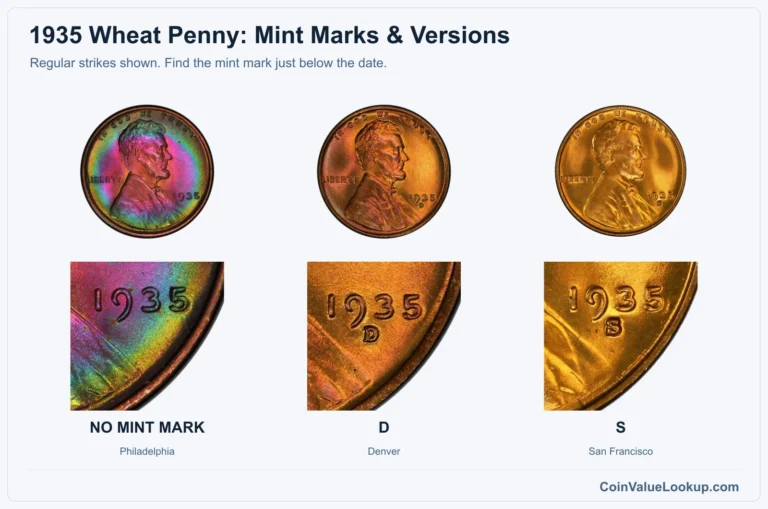
No letter means Philadelphia. A small "D" means Denver.
An "S" means San Francisco, and for 2003 that means a proof coin.
All three versions are copper-plated zinc, weighing about 2.50 grams with a plain edge. Color alone — whether it looks coppery, brown, or dark — cannot prove a different alloy.
Weight and diameter (19.05 mm) are more reliable identifiers if you suspect something unusual.
Proofs have mirror-like fields and sharply struck devices. They were sold in collector sets, not released into circulation, so finding a genuine 2003-S proof in your change jar would be very unusual.
Step 2: Check Your 2003 Lincoln Penny Grade
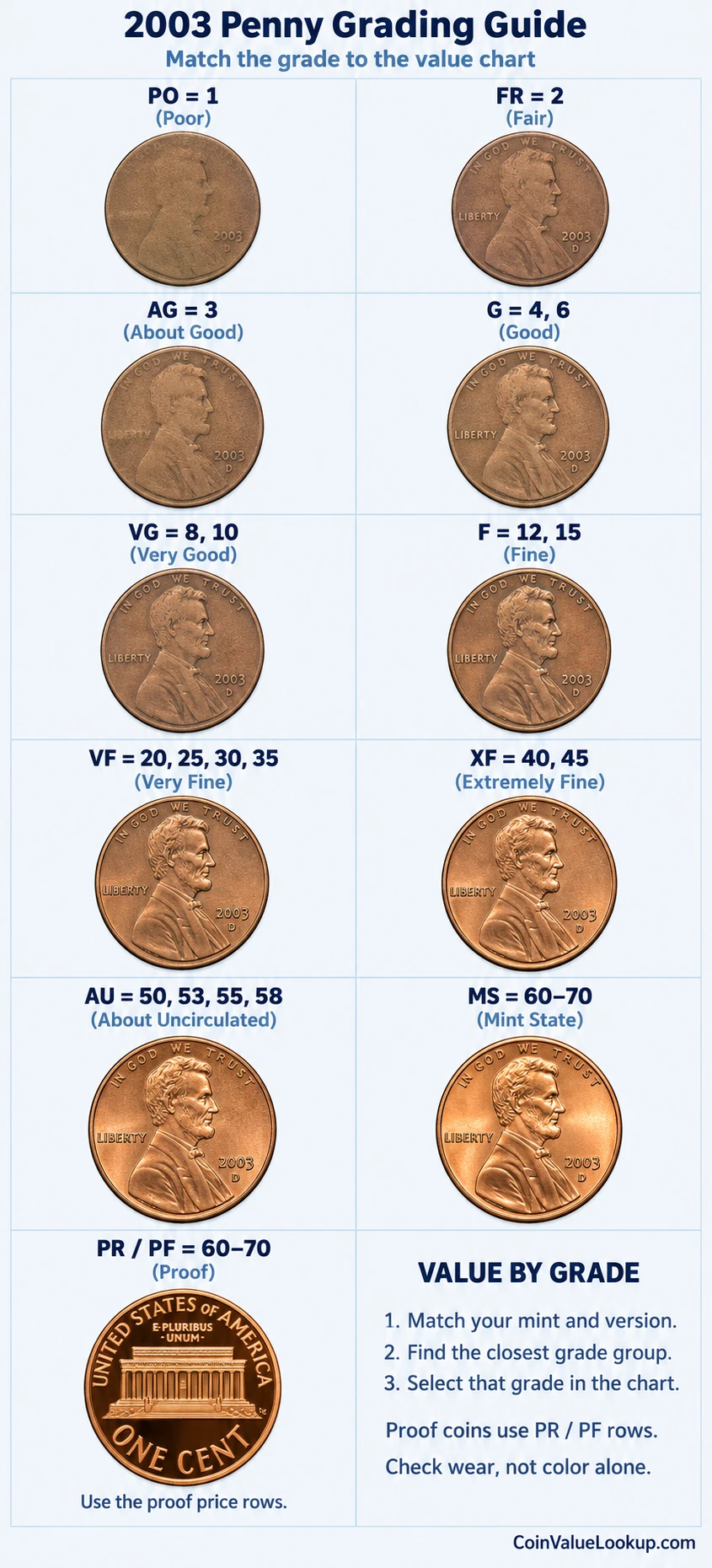
Start with Lincoln's cheek, jawline, and the hair detail above his ear — those are the first spots to show friction. On the reverse, check how crisp the Memorial columns and horizontal lines remain.
A coin can still look shiny from plating but have flat high points, so don't let surface gloss fool you.
Red, red-brown, and brown are color descriptions, not grades. A coin graded MS65 Red and one graded MS65 Brown share the same wear level but differ in how much original copper color remains.
Corrosion, spots, cleaning marks, and contact dings all reduce a coin's grade and appeal regardless of color.
Use the comparison image to match your coin's wear pattern against known grade examples. That side-by-side approach is more reliable than guessing.
Step 3: Check 2003 Lincoln Penny Value by Mint and Version
2003 Lincoln Penny
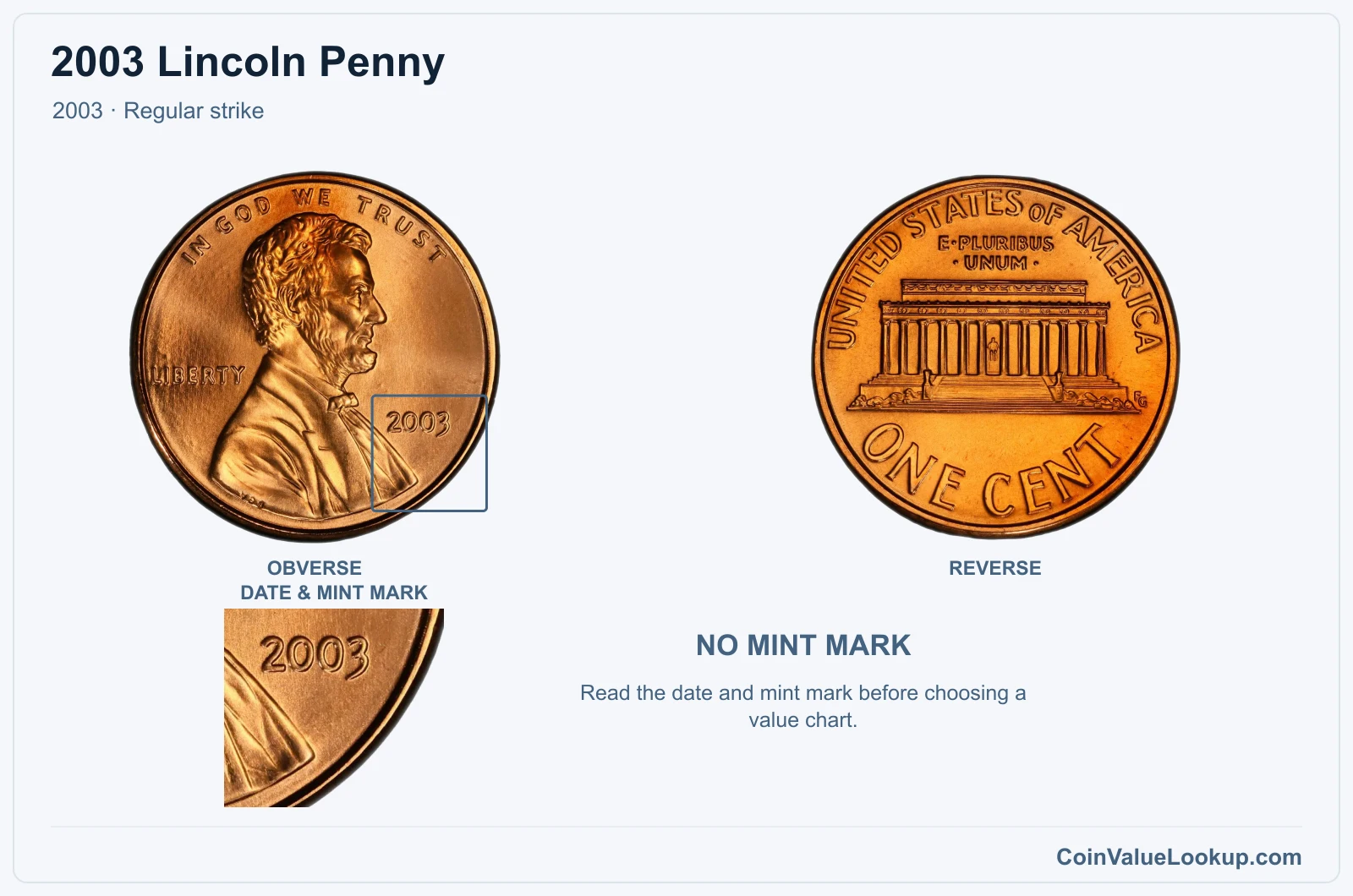
The 2003 Philadelphia cent has no mintmark below the date. Billions were struck, so circulated examples are worth face value.
In gem uncirculated condition (MS65), a guide estimate is about $0.36. What separates a quarter-dollar example from a one-cent example at this level is surface quality: look for full luster, no distracting contact marks, and original color.
A regular circulation strike in uncirculated condition is not a special finish — it simply avoided the wear that most pennies endure.
| Range | Grade | Price | Auction Records | Appraisal |
|---|---|---|---|---|
| PO | PO 1 | — | Coin Identifier | |
| FR | FR 2 | — | Coin Identifier | |
| AG | AG 3 | — | Coin Identifier | |
| G | G 4 | — | Coin Identifier | |
| G 6 | — | Coin Identifier | ||
| VG | VG 8 | — | Coin Identifier | |
| VG 10 | — | Coin Identifier | ||
| F | F 12 | — | Coin Identifier | |
| F 15 | — | Coin Identifier | ||
| VF | VF 20 | — | Coin Identifier | |
| VF 25 | — | Coin Identifier | ||
| VF 30 | — | Coin Identifier | ||
| VF 35 | — | Coin Identifier | ||
| XF | XF 40 | — | Coin Identifier | |
| XF 45 | — | Coin Identifier | ||
| AU | AU 50 | — | Coin Identifier | |
| AU 53 | — | Coin Identifier | ||
| AU 55 | — | Coin Identifier | ||
| AU 58 | — | Coin Identifier | ||
| MS | MS 60 | — | Coin Identifier | |
| MS 61 | — | Coin Identifier | ||
| MS 62 | — | Coin Identifier | ||
| MS 63 | — | Coin Identifier | ||
| MS 64 | — | Coin Identifier | ||
| MS 65 | — | Coin Identifier | ||
| MS 66 | — | Coin Identifier | ||
| MS 67 | Coin Identifier | |||
| MS 68 | Coin Identifier | |||
| MS 69 | Coin Identifier | |||
| MS 70 | — | — | — |
2003 Lincoln Penny — D
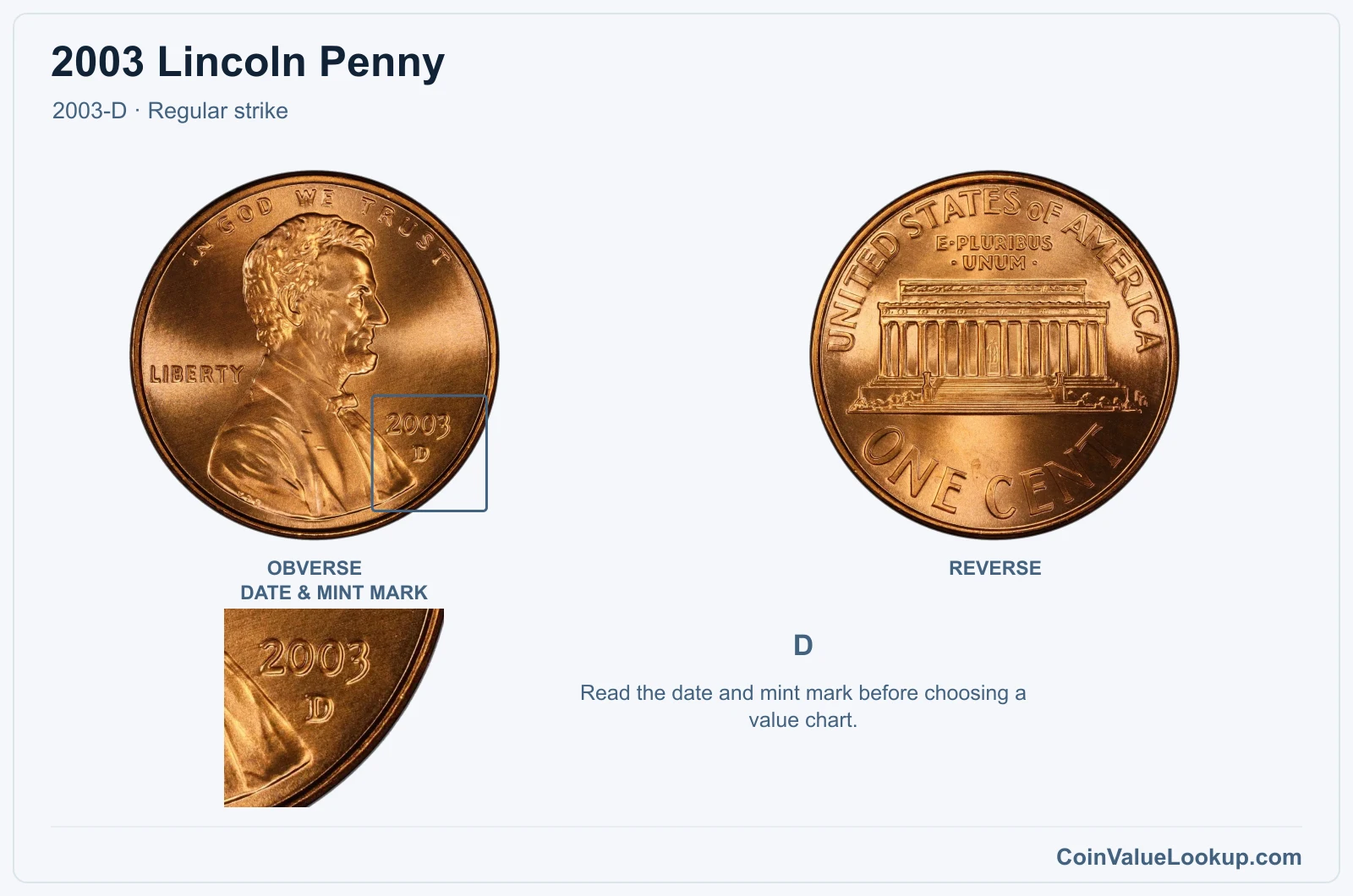
The 2003-D carries a small "D" mintmark below the date, confirming it was struck in Denver. Like its Philadelphia sibling, a circulated piece trades at face value.
The MS65 guide estimate is the same $0.36. Collectors sorting through rolls look for examples with strong strike detail on the Memorial columns and minimal bag marks.
Original red color pushes eye appeal, but remember that color designation is separate from the numerical grade.
If you are browsing coin guides online, Coin Value Lookup is a handy place to look up values for this and other dates in the Lincoln Memorial series.
| Range | Grade | Price | Auction Records | Appraisal |
|---|---|---|---|---|
| PO | PO 1 | — | Coin Identifier | |
| FR | FR 2 | — | Coin Identifier | |
| AG | AG 3 | — | Coin Identifier | |
| G | G 4 | — | Coin Identifier | |
| G 6 | — | Coin Identifier | ||
| VG | VG 8 | — | Coin Identifier | |
| VG 10 | — | Coin Identifier | ||
| F | F 12 | — | Coin Identifier | |
| F 15 | — | Coin Identifier | ||
| VF | VF 20 | — | Coin Identifier | |
| VF 25 | — | Coin Identifier | ||
| VF 30 | — | Coin Identifier | ||
| VF 35 | — | Coin Identifier | ||
| XF | XF 40 | — | Coin Identifier | |
| XF 45 | — | Coin Identifier | ||
| AU | AU 50 | — | Coin Identifier | |
| AU 53 | — | Coin Identifier | ||
| AU 55 | — | Coin Identifier | ||
| AU 58 | — | Coin Identifier | ||
| MS | MS 60 | — | Coin Identifier | |
| MS 61 | — | Coin Identifier | ||
| MS 62 | — | Coin Identifier | ||
| MS 63 | — | Coin Identifier | ||
| MS 64 | — | Coin Identifier | ||
| MS 65 | — | Coin Identifier | ||
| MS 66 | — | Coin Identifier | ||
| MS 67 | Coin Identifier | |||
| MS 68 | Coin Identifier | |||
| MS 69 | Coin Identifier | |||
| MS 70 | — | — | — |
2003 Lincoln Penny — S PR
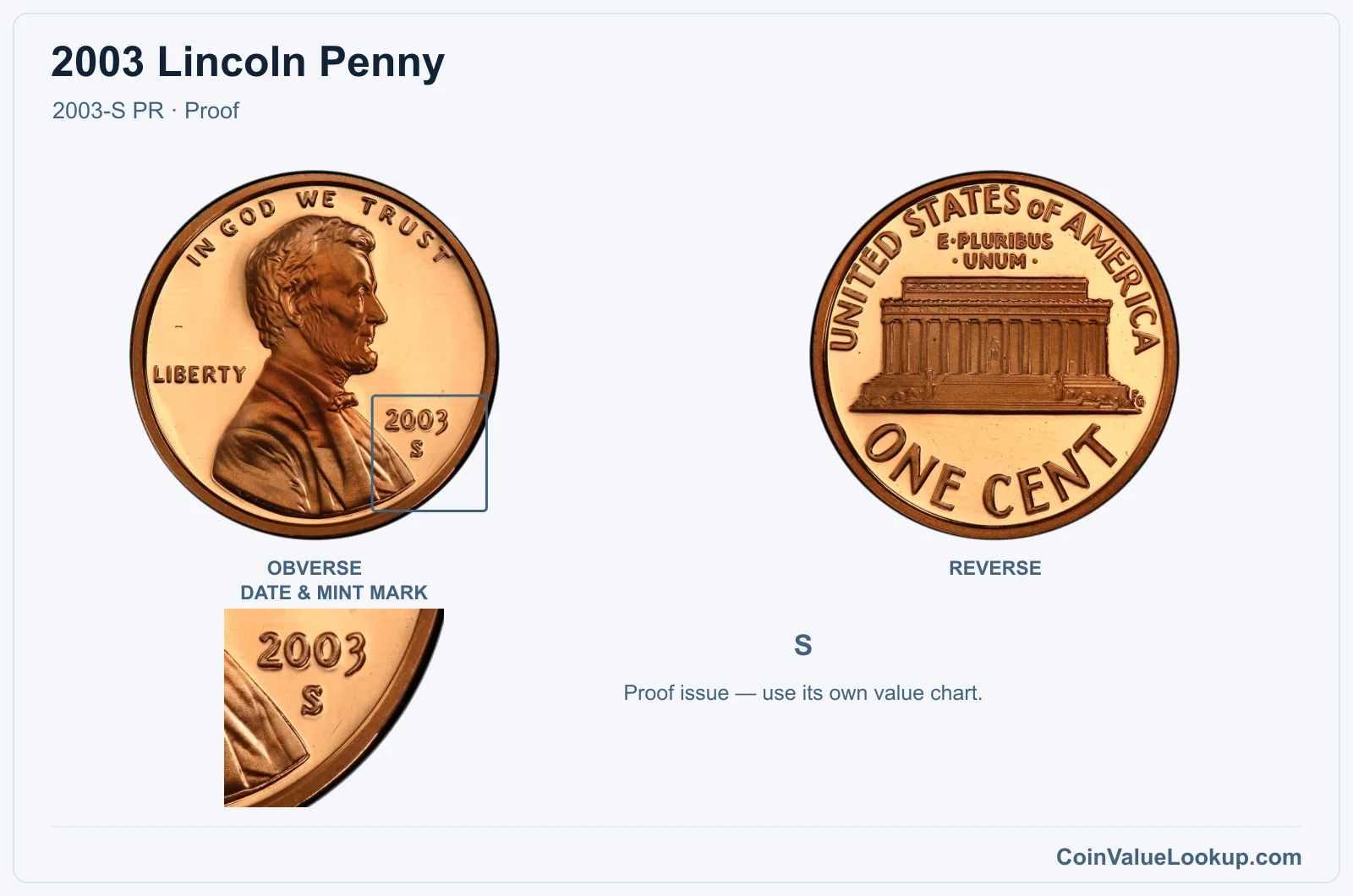
The 2003-S proof was produced at San Francisco exclusively for collector sets. It features mirror-like fields and finely detailed devices — the result of specially prepared dies and planchets.
A PR65 example carries a guide estimate around $4.96. Cameo and deep-cameo designations, which describe the contrast between frosted devices and reflective fields, are graded separately and can affect value.
Do not compare proof prices directly with circulation-strike grades; the manufacturing process and grading scales differ. Handling marks and haze on the mirrored surface are the main condition concerns for proofs that were removed from their original packaging.
| Range | Grade | Price | Auction Records | Appraisal |
|---|---|---|---|---|
| PR | PR 1 | — | Coin Identifier | |
| PR 2 | — | Coin Identifier | ||
| PR 3 | — | Coin Identifier | ||
| PR 4 | — | Coin Identifier | ||
| PR 6 | — | Coin Identifier | ||
| PR 8 | — | Coin Identifier | ||
| PR 10 | — | Coin Identifier | ||
| PR 12 | — | Coin Identifier | ||
| PR 15 | — | Coin Identifier | ||
| PR 20 | — | Coin Identifier | ||
| PR 25 | — | Coin Identifier | ||
| PR 30 | — | Coin Identifier | ||
| PR 35 | — | Coin Identifier | ||
| PR 40 | — | Coin Identifier | ||
| PR 45 | — | Coin Identifier | ||
| PR 50 | — | Coin Identifier | ||
| PR 53 | — | Coin Identifier | ||
| PR 55 | — | Coin Identifier | ||
| PR 58 | — | Coin Identifier | ||
| PR 60 | — | Coin Identifier | ||
| PR 61 | — | Coin Identifier | ||
| PR 62 | — | Coin Identifier | ||
| PR 63 | — | Coin Identifier | ||
| PR 64 | — | Coin Identifier | ||
| PR 65 | — | Coin Identifier | ||
| PR 66 | — | Coin Identifier | ||
| PR 67 | — | Coin Identifier | ||
| PR 68 | Coin Identifier | |||
| PR 69 | Coin Identifier | |||
| PR 70 | Coin Identifier |
2003 Lincoln Penny Error List
1. 2003 Lincoln Penny — Die Break / Cud
A die break happens when a chunk of the die surface cracks away, leaving a raised, featureless blob on the struck coin. When that blob connects to the rim, collectors call it a cud.
On a 2003 cent, look along the rim for an irregular raised area that displaces part of the normal design — letters, the date, or the portrait edge. Compare it carefully to rim dents, corrosion bumps, or small interior die chips, which are far more common and less valuable.
The size, location, and severity of a cud all affect what a collector will pay, so each piece needs individual assessment by an authenticated identity and condition.
2. 2003 Lincoln Penny — Struck-Through Error
A struck-through error occurs when foreign material — grease, a thread, a metal fragment — sits between the die and the planchet during striking. The result is a localized depression or an incomplete area of design where the obstruction blocked the metal flow.
On a 2003 Lincoln cent, look for a sharply defined impression or a smooth recessed patch that does not match normal wear. Grease fill-ins look different from a retained foreign object, so describe what you see carefully.
Ordinary weak detail from circulation, scratches, or cleaning can mimic a struck-through at first glance. Value depends on size, location, and what caused the obstruction, assessed individually on authenticated examples.
3. 2003 Lincoln Penny — Doubled Die Obverse
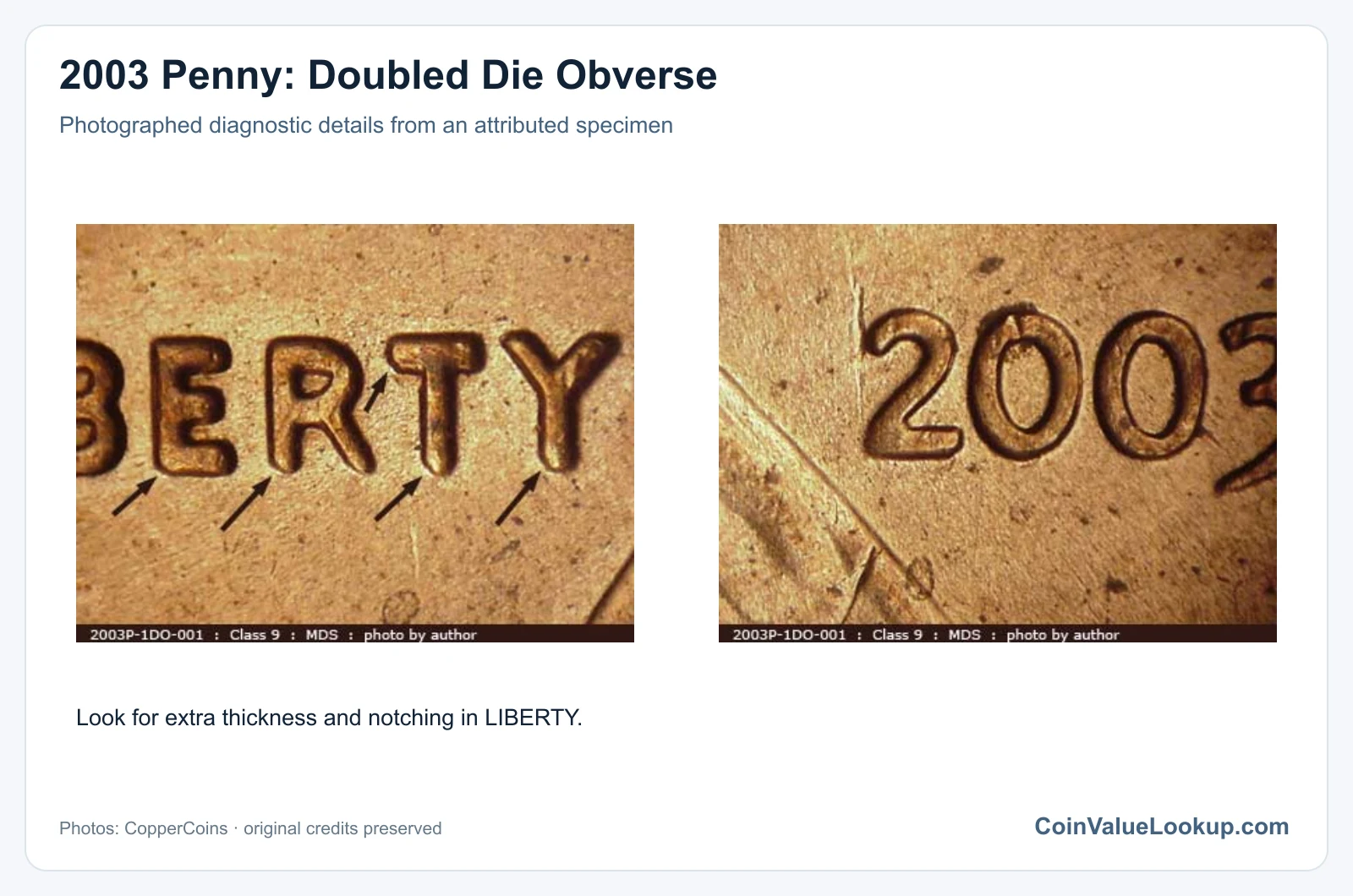
A doubled die obverse is created during die manufacturing, producing consistent doubling on every coin struck by that die. On a 2003 penny, compare the lettering in LIBERTY, IN GOD WE TRUST, and the date against a normal example under the same lighting.
Genuine doubling shows consistent separation or notching on the affected elements — it will appear in the same direction and magnitude across multiple letters. Machine doubling, by contrast, tends to produce a flat shelf to one side of the design and lacks the sharp, split serifs of a true doubled die.
Reflections and worn die contours also mimic doubling. Authentication is essential, and value depends on the strength and visibility of the doubling.
4. 2003 Lincoln Penny — Die-Adjustment / Low-Pressure Strike
A die-adjustment or low-pressure strike shows weak detail across both sides of the coin, even on areas that have not been worn by circulation. The entire design appears shallow and soft, as though the press did not deliver full force.
On a 2003 cent, check unworn high points — if Lincoln's hair and the Memorial columns are both mushy yet the surfaces show no friction, that is the hallmark. Distinguishing this from a grease-filled die, ordinary weak strike, or simple circulation wear requires comparing the overall impression rather than isolated spots.
These are reported for this date, but weak detail alone cannot prove a setup strike. Individual authentication and condition determine any premium.
5. 2003 Lincoln Penny — Off-Center Strike
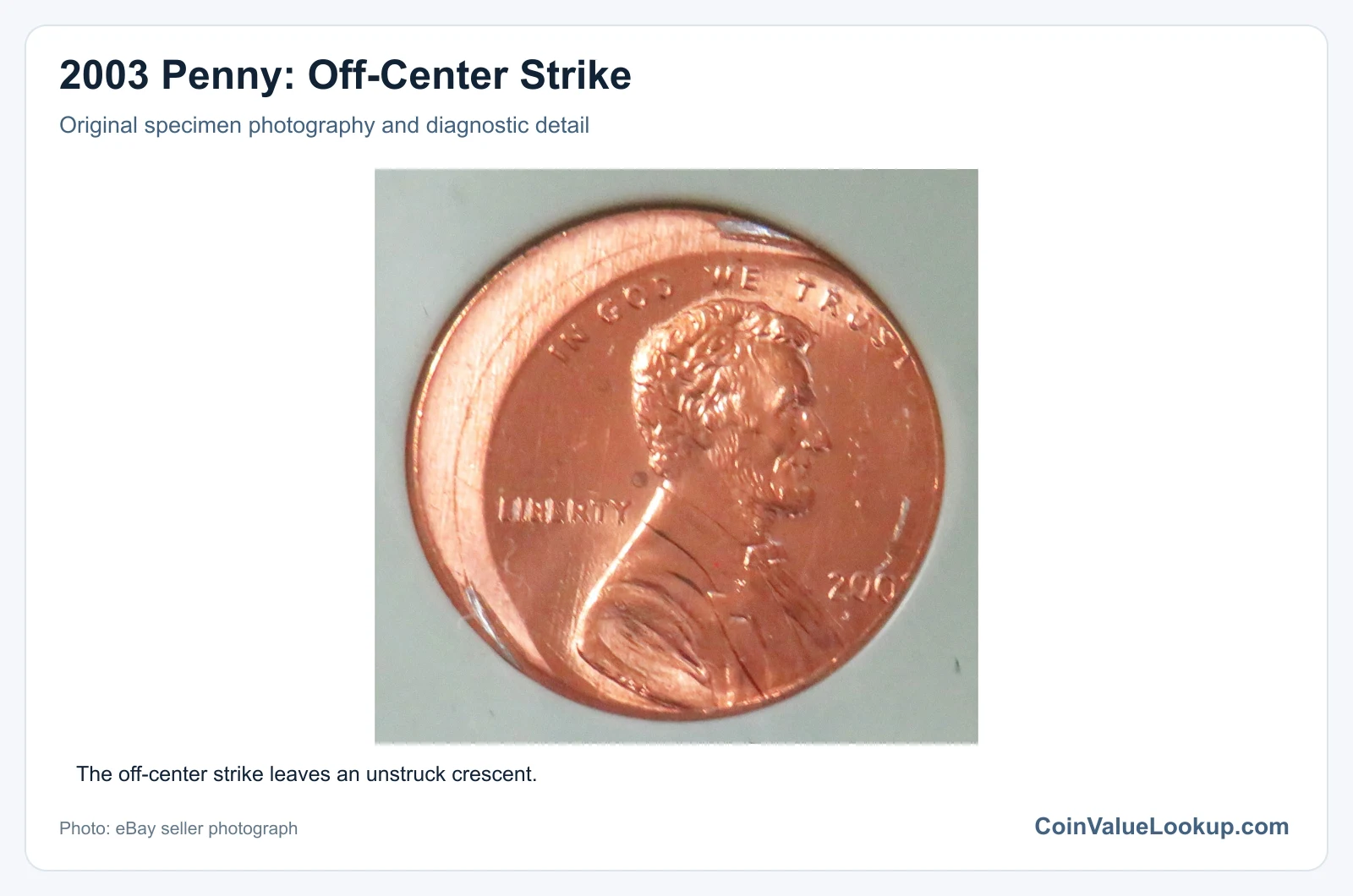
An off-center strike happens when the planchet is not properly seated between the dies, so part of the design is missing and a blank crescent appears on one side. The percentage of off-center displacement and whether the date remains visible are the two biggest factors collectors consider.
A 2003 cent struck 5% off-center is a minor curiosity; one struck 50% off-center with a full date is a different conversation entirely. Do not confuse an off-center strike with a clipped planchet (which removes a curved wedge of metal before striking) or post-mint flattening.
Each off-center coin is assessed individually based on its authenticated displacement and overall condition.
6. 2003 Lincoln Penny — Misaligned Die
A misaligned die shifts one face of the design off-center relative to the planchet, while the opposite face remains normally centered. On a 2003 penny, flip the coin and compare: if the obverse design is shifted but the reverse looks fine (or vice versa), that suggests a misaligned die rather than an off-center strike, where both sides shift together.
The displacement is usually slight — a millimeter or two — creating an uneven rim width on one side. A tilted photograph, post-mint rim damage, or a rotated die (where the alignment is angular, not lateral) can all look similar at first glance.
Value depends on the degree of displacement, assessed on an individual, authenticated basis.
7. 2003 Lincoln Penny — Broadstrike
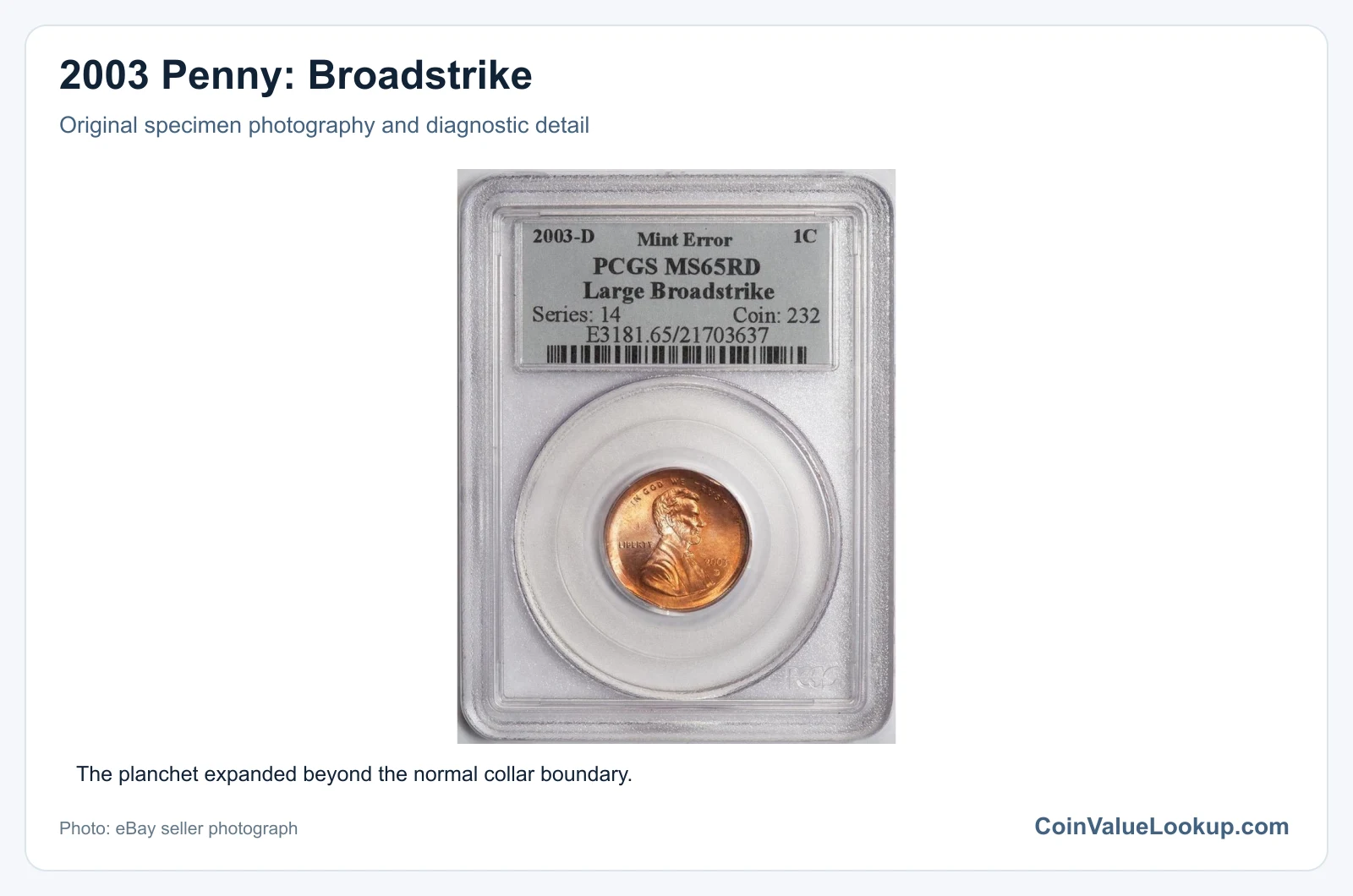
A broadstrike occurs when the collar that normally confines the planchet during striking is absent or retracted. The coin spreads outward under pressure, producing a larger-than-normal diameter with no reeded or raised rim edge.
On a 2003 cent, the design is still centered (unlike an off-center strike), but the rim looks flat or absent and the coin feels wider than usual. Check the edge profile — a broadstruck coin has a smooth, spread edge rather than the neat lip of a normal cent.
Post-mint flattening from a vise or hammer can imitate this, so authentication matters. Each broadstrike is valued individually by its severity and condition.
8. 2003 Lincoln Penny — Clashed Dies
Clashed dies result from the obverse and reverse dies striking each other without a planchet between them. The impact transfers ghost-like traces of each die's design onto the other.
On a 2003 Lincoln cent, look in the open fields — especially around Lincoln's portrait or in the Memorial area — for faint, raised outlines that mirror features from the opposite side. These impressions align with where the opposing design would sit during normal striking.
Random scratches, raised lines from die polish, or a brockage (where another coin acts as a die) can look similar but lack the consistent positional alignment of a true clash. Value is driven by the visibility and extent of the transferred design.
9. 2003 Lincoln Penny — Wrong Planchet / Off-Metal Strike
A wrong-planchet error means the 2003 Lincoln cent dies struck a blank intended for a different denomination or even a different country's coin. The result is a cent design on a planchet that differs in weight, diameter, edge, or metal from the standard copper-plated zinc blank.
To check, weigh the coin (normal is about 2.50 grams) and measure the diameter (19.05 mm). A significantly different weight or an unusual edge is a strong clue.
Plating loss, corrosion, acid damage, and deliberate alteration can all change a coin's appearance and weight enough to fool you, so professional authentication is critical. These are rare, and each example is valued on its own merits.
10. 2003 Lincoln Penny — BIE Die Break
The BIE error is a specific type of die break found between the letters B and E in LIBERTY on Lincoln cents. A small crack in the die surface produces a raised vertical line or blob that looks almost like a capital I wedged into the gap.
On a 2003 penny, inspect that exact space under magnification and good light. The raised feature should be consistent with the coin's surface — same color, same texture — not sitting on top like dirt or adhesive residue.
A scratch, a stray fiber impression, or an added piece of metal can mimic a BIE, so compare several examples if possible. These are a popular collecting niche, and value depends on the clarity and size of the break.
11. 2003 Lincoln Penny — Partial Collar Strike
A partial collar strike happens when the planchet is only partly seated in the collar during striking. One portion of the rim forms normally while another section spreads outward, creating a visible step or ledge in the edge profile.
On a 2003 cent, rotate the coin and look at the edge: you will see a transition from a normal raised rim to a flattened or expanded section. This differs from a full broadstrike (where the entire collar is absent) and from post-mint edge damage, which tends to show irregular dents rather than a smooth step.
The degree of misalignment and the overall condition of the coin determine its collectible value, assessed individually on authenticated pieces.