2004 Lincoln Penny Coin Value: How Much Is It Worth?
Most 2004 Lincoln pennies you pull from a jar are worth face value — one cent. A guide estimate for a well-preserved uncirculated Philadelphia or Denver coin in MS65 grade is about $0.36, while an S-mint proof in PR65 runs around $4.96.
Those are retail guide figures from USA Coin Book, not guaranteed offers. Special varieties and mint errors exist as separate markets with no universal ceiling, so the real question is always which version you have and what condition it is in.
Fast Way to Identify Your 2004 Lincoln Penny
The quickest way to start figuring out what your 2004 penny is worth is to upload clear photos of the front and back. Our identifier can give you a preliminary read on the mint, version, and general type based on those images.
Snap both sides in good light, and you will have a starting point before you dig deeper into condition and varieties.
2004 Penny Value
Upload both sides of your 2004 Lincoln Penny.
Front Obverse
Upload photo
Back Reverse
Upload photo
Which 2004 Lincoln Penny Versions Are Worth Money?
- Clean, original surfaces and strong preservation matter more than which mint struck your 2004 cent — the mintage was enormous at both Philadelphia and Denver.
- S-mint proofs should be evaluated using proof grades and any cameo designation, not compared against circulation-strike values.
Step 1: Identify Your 2004 Lincoln Penny Mint Mark and Version
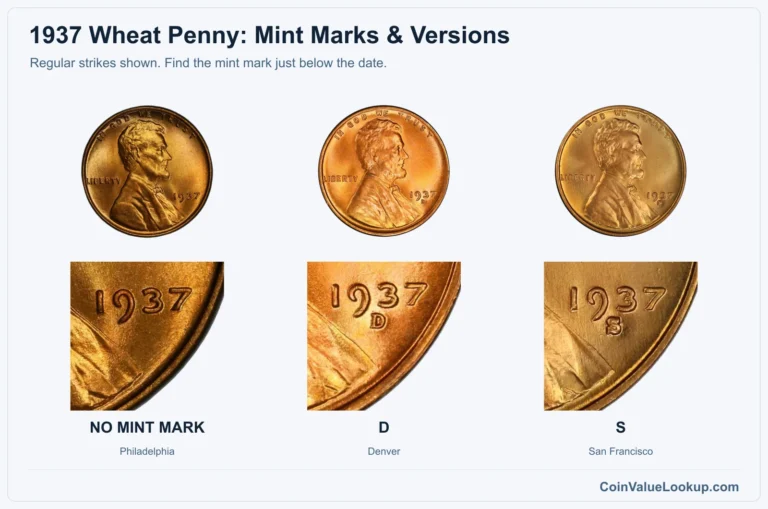
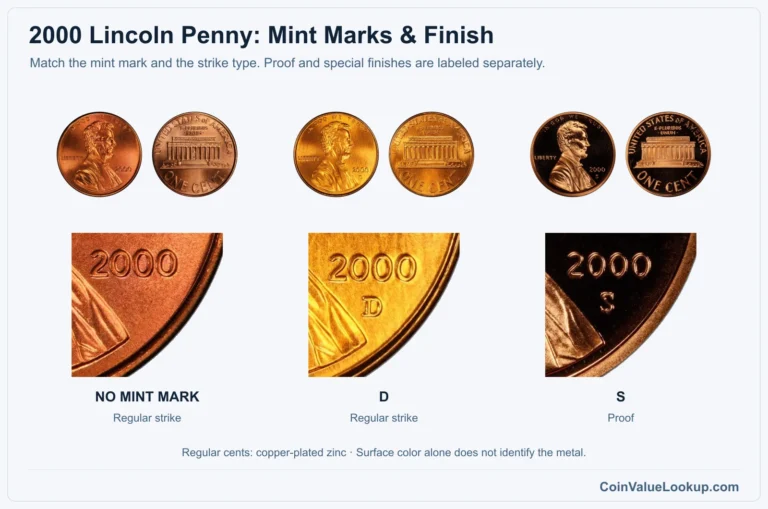
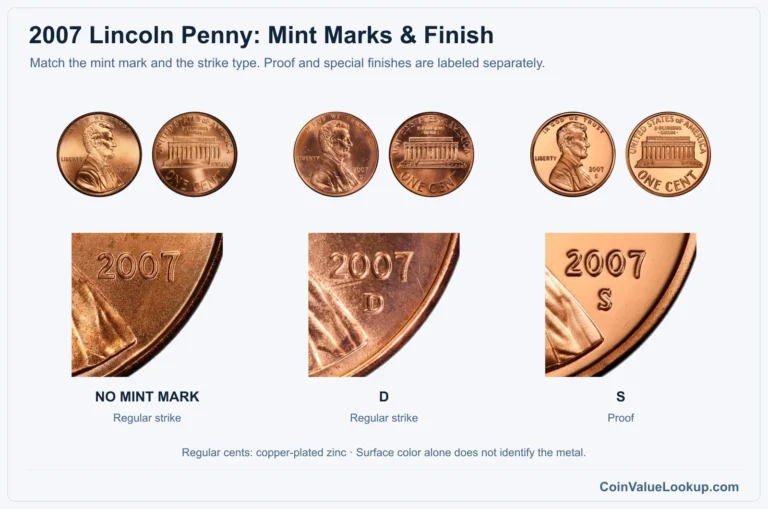
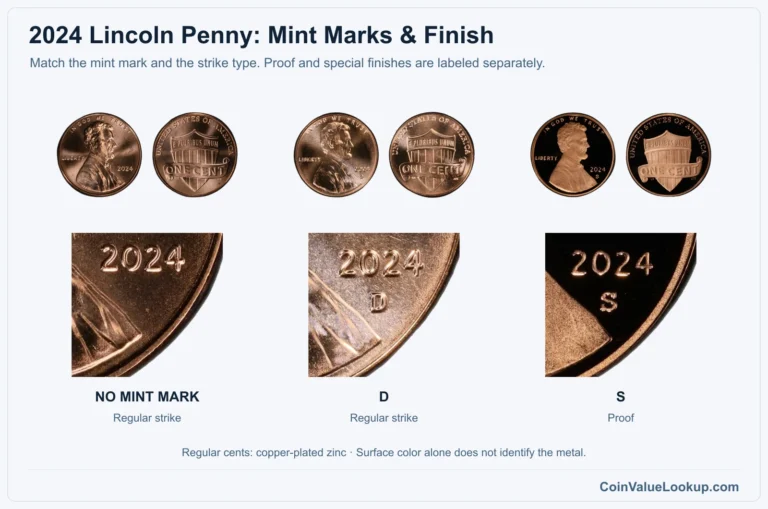
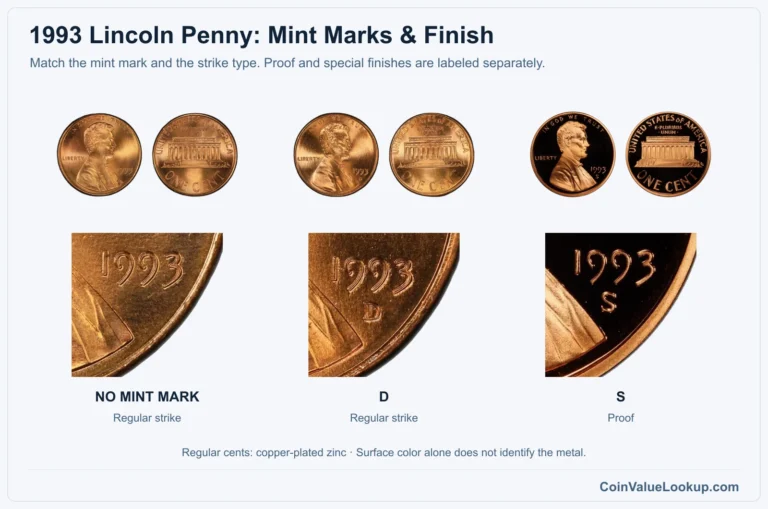
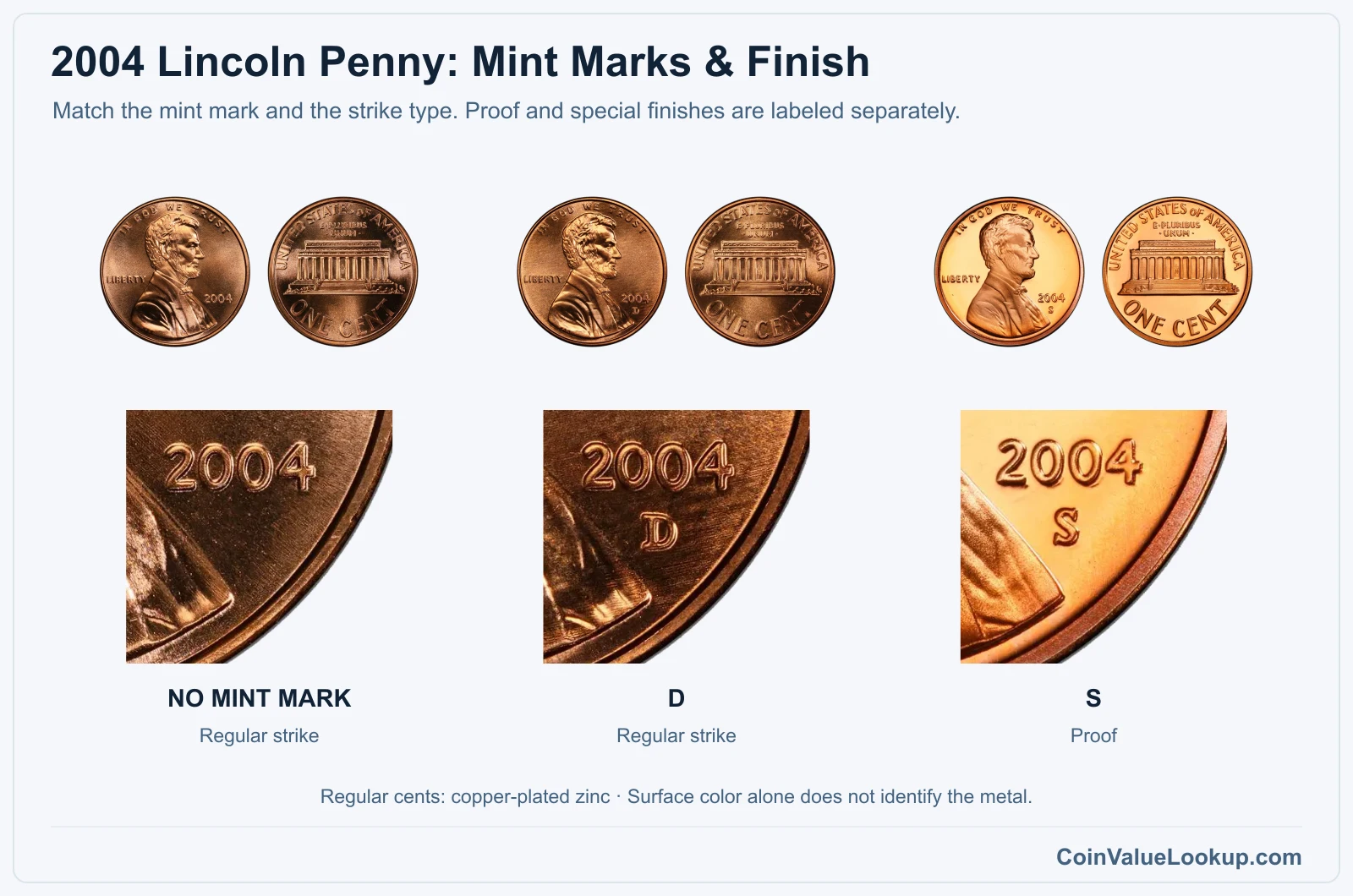
Flip your coin to the front and look just below the date. No letter at all means it was struck at Philadelphia.
A small "D" means Denver. An "S" means San Francisco, and for 2004 those are proof coins only.
The reverse shows the Lincoln Memorial, the design used from 1959 through 2008. These are copper-plated zinc cents — 97.5% zinc with a thin copper coating — weighing about 2.50 grams with a plain edge.
Color alone cannot prove a different alloy, so do not assume a shiny penny is solid copper.
Separate circulation strikes from proofs before comparing values. A proof has mirror-like fields and sharply detailed devices because it was made on specially prepared equipment.
It is a manufacturing method, not a condition grade above uncirculated.
Step 2: Check Your 2004 Lincoln Penny Grade
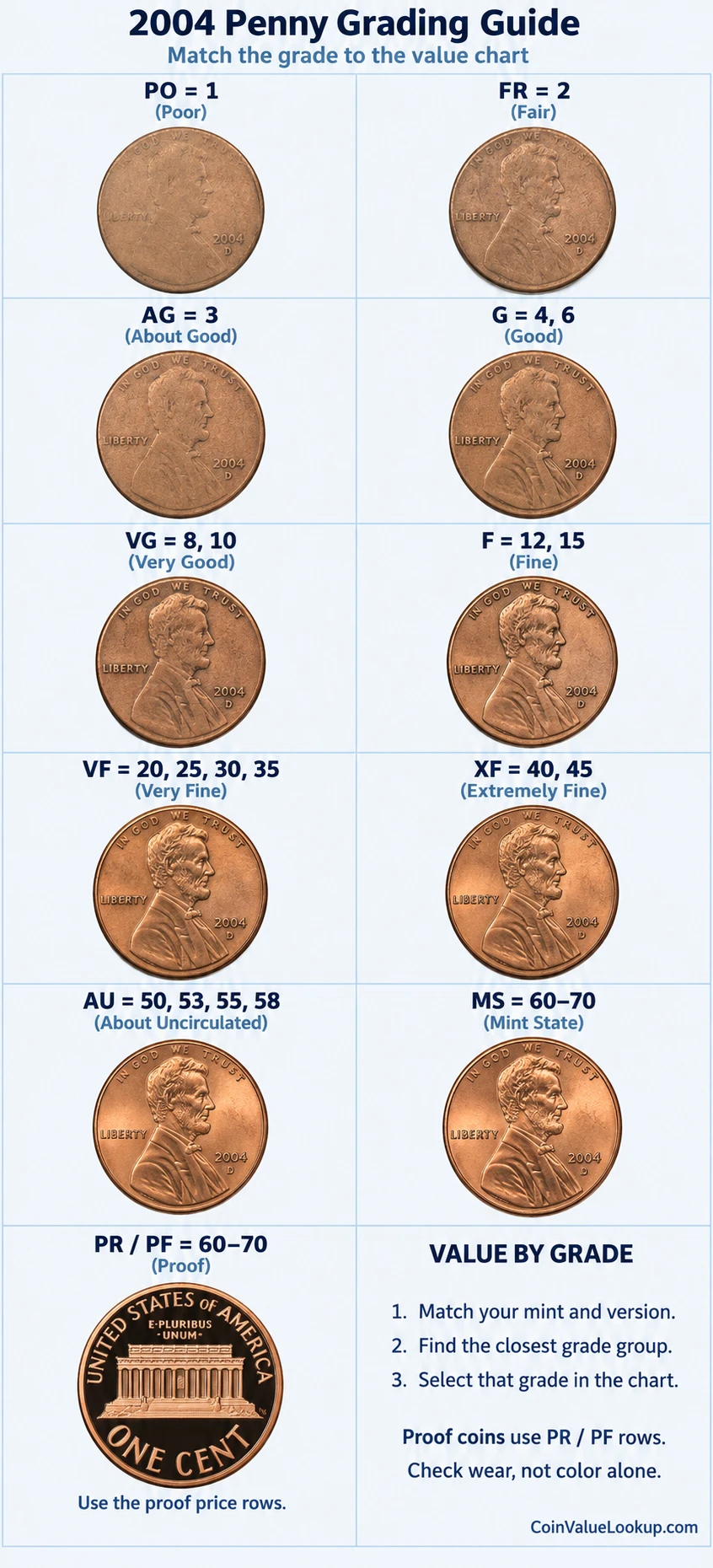
Start at Lincoln's cheekbone, jawline, and the hair detail above his ear. These are the highest points of the design and the first places to show friction.
On the reverse, check the columns and steps of the Memorial for softness.
An uncirculated coin will have full original luster with no wear on those high spots. As the grade drops, luster fades and details flatten — first subtly, then obviously.
The comparison image nearby can help you calibrate your eye.
Color matters but is graded separately from wear. "Red" means most of the original copper plating tone is intact; "red-brown" and "brown" describe progressive toning.
Neither adds nor subtracts from the wear grade itself.
Watch out for corrosion, dark spots, cleaning hairlines, and contact marks. Any of these will drag a coin's market appeal down regardless of its technical wear grade.
A lightly circulated penny with clean surfaces can be more desirable than an uncirculated one covered in green corrosion.
Step 3: Check 2004 Lincoln Penny Value by Mint and Version
2004 Lincoln Penny
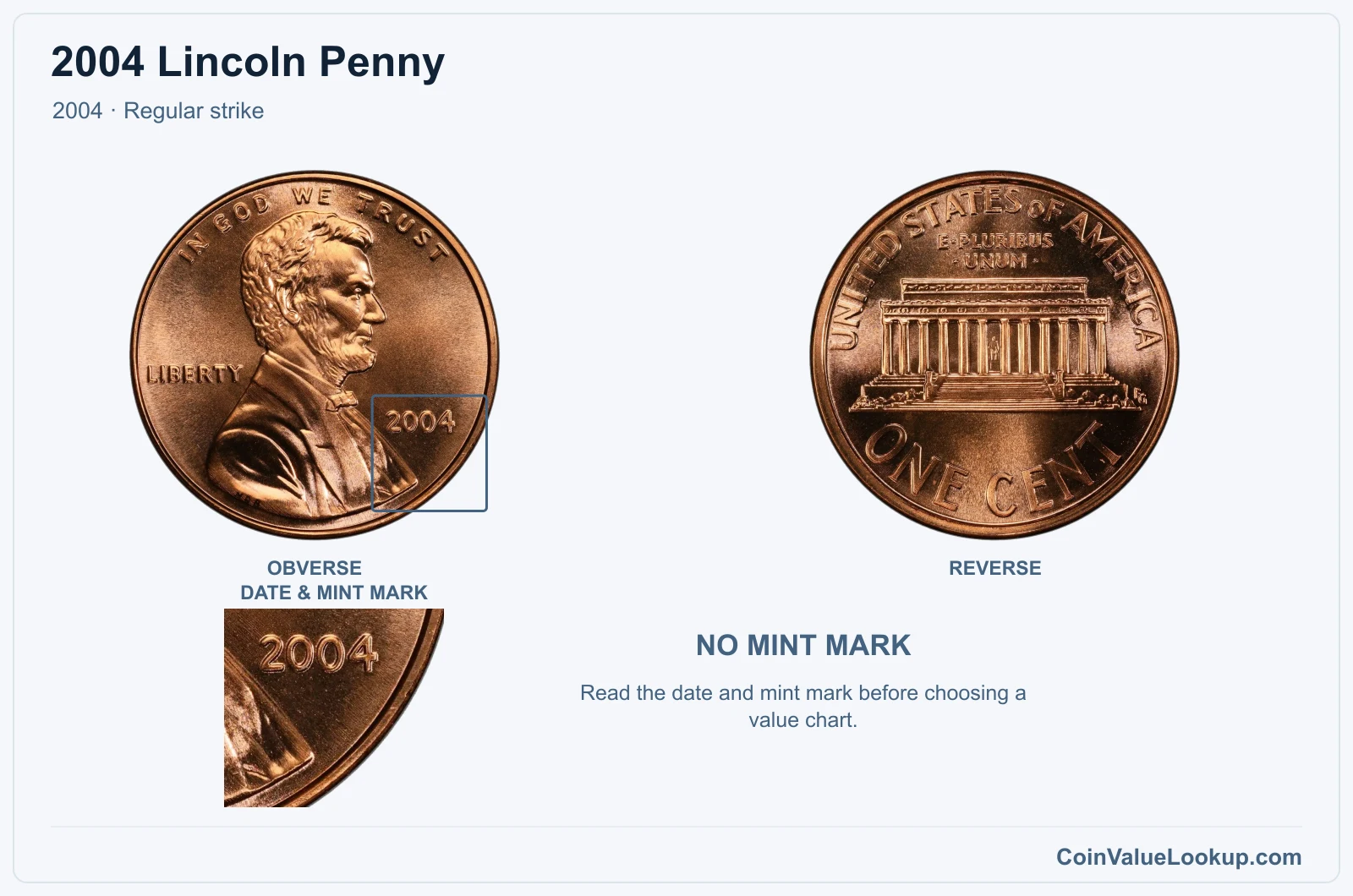
The 2004 Philadelphia cent has no mintmark below the date. Billions were struck, so finding one in your change is the norm, not the exception.
In circulated condition these are worth a penny. A USA Coin Book guide estimate for MS65 — a solidly uncirculated coin with minor contact marks at most — is $0.36.
What moves the needle is surface quality. Look for full original red luster, sharp hair detail, and clean fields free of spots or staining.
Being uncirculated alone does not make it a special finish; it just means it avoided pocket wear.
| Range | Grade | Price | Auction Records | Appraisal |
|---|---|---|---|---|
| PO | PO 1 | — | Coin Identifier | |
| FR | FR 2 | — | Coin Identifier | |
| AG | AG 3 | — | Coin Identifier | |
| G | G 4 | — | Coin Identifier | |
| G 6 | — | Coin Identifier | ||
| VG | VG 8 | — | Coin Identifier | |
| VG 10 | — | Coin Identifier | ||
| F | F 12 | — | Coin Identifier | |
| F 15 | — | Coin Identifier | ||
| VF | VF 20 | — | Coin Identifier | |
| VF 25 | — | Coin Identifier | ||
| VF 30 | — | Coin Identifier | ||
| VF 35 | — | Coin Identifier | ||
| XF | XF 40 | — | Coin Identifier | |
| XF 45 | — | Coin Identifier | ||
| AU | AU 50 | — | Coin Identifier | |
| AU 53 | — | Coin Identifier | ||
| AU 55 | — | Coin Identifier | ||
| AU 58 | — | Coin Identifier | ||
| MS | MS 60 | — | Coin Identifier | |
| MS 61 | — | Coin Identifier | ||
| MS 62 | — | Coin Identifier | ||
| MS 63 | — | Coin Identifier | ||
| MS 64 | — | Coin Identifier | ||
| MS 65 | — | Coin Identifier | ||
| MS 66 | Coin Identifier | |||
| MS 67 | Coin Identifier | |||
| MS 68 | Coin Identifier | |||
| MS 69 | Coin Identifier | |||
| MS 70 | — | — | — |
2004 Lincoln Penny — D
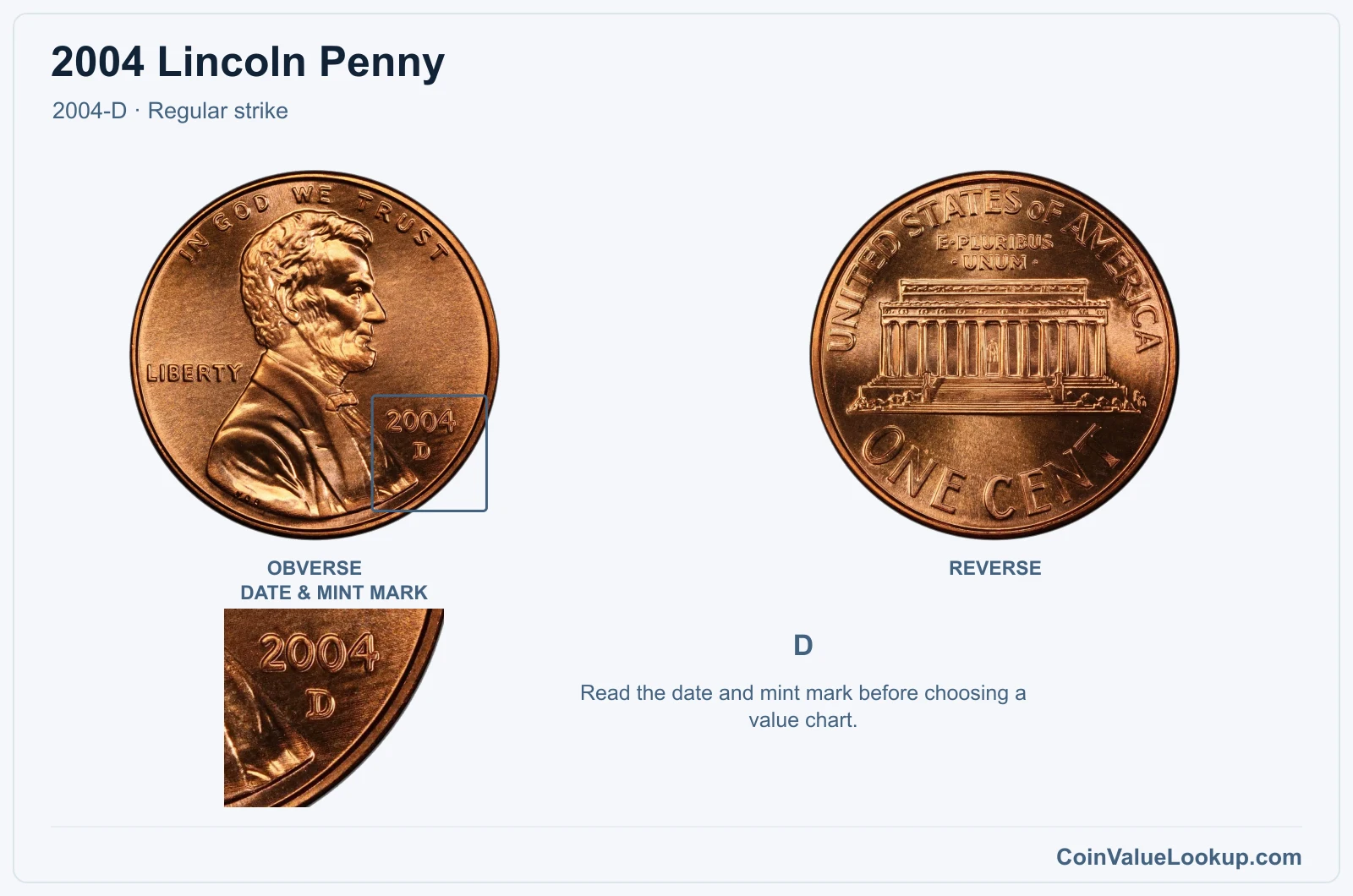
The 2004-D carries a small "D" mintmark below the date, confirming Denver production. Like its Philadelphia sibling, this is a common coin in all circulated grades.
The USA Coin Book guide places an MS65 example at about $0.36.
Coin Value Lookup can help you look up values for Lincoln cents and other series if you want to compare across years or mints.
Match your coin's color and surface condition carefully within this branch. A 2004-D with blazing original red color and no distracting marks will always outperform a dull, spotted example at the same technical grade.
| Range | Grade | Price | Auction Records | Appraisal |
|---|---|---|---|---|
| PO | PO 1 | — | Coin Identifier | |
| FR | FR 2 | — | Coin Identifier | |
| AG | AG 3 | — | Coin Identifier | |
| G | G 4 | — | Coin Identifier | |
| G 6 | — | Coin Identifier | ||
| VG | VG 8 | — | Coin Identifier | |
| VG 10 | — | Coin Identifier | ||
| F | F 12 | — | Coin Identifier | |
| F 15 | — | Coin Identifier | ||
| VF | VF 20 | — | Coin Identifier | |
| VF 25 | — | Coin Identifier | ||
| VF 30 | — | Coin Identifier | ||
| VF 35 | — | Coin Identifier | ||
| XF | XF 40 | — | Coin Identifier | |
| XF 45 | — | Coin Identifier | ||
| AU | AU 50 | — | Coin Identifier | |
| AU 53 | — | Coin Identifier | ||
| AU 55 | — | Coin Identifier | ||
| AU 58 | — | Coin Identifier | ||
| MS | MS 60 | — | Coin Identifier | |
| MS 61 | — | Coin Identifier | ||
| MS 62 | — | Coin Identifier | ||
| MS 63 | — | Coin Identifier | ||
| MS 64 | — | Coin Identifier | ||
| MS 65 | Coin Identifier | |||
| MS 66 | Coin Identifier | |||
| MS 67 | Coin Identifier | |||
| MS 68 | Coin Identifier | |||
| MS 69 | Coin Identifier | |||
| MS 70 | — | — | — |
2004 Lincoln Penny — S PR
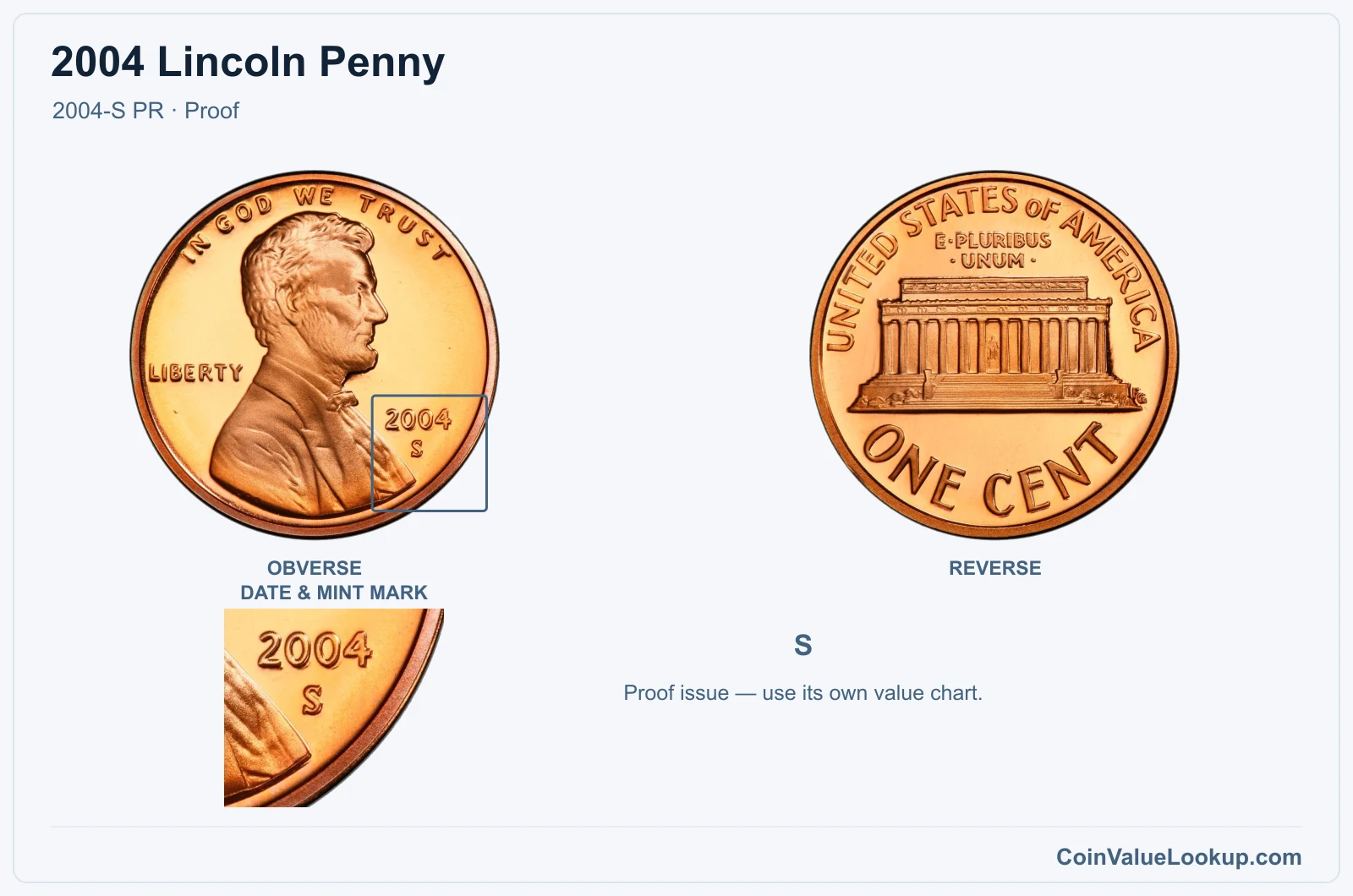
The 2004-S is a proof-only issue from San Francisco, sold in collector sets — you will not find one in pocket change. It features mirrored fields and crisply struck devices.
A USA Coin Book guide estimate for PR65 is $4.96.
Cameo and deep cameo designations reflect the contrast between frosted devices and reflective fields. Those grades are tracked separately and can carry different premiums, so check whether your coin shows that contrast before settling on a value.
Handle proofs by the edges; fingerprints on those mirror surfaces are nearly impossible to remove without damage.
| Range | Grade | Price | Auction Records | Appraisal |
|---|---|---|---|---|
| PR | PR 1 | — | Coin Identifier | |
| PR 2 | — | Coin Identifier | ||
| PR 3 | — | Coin Identifier | ||
| PR 4 | — | Coin Identifier | ||
| PR 6 | — | Coin Identifier | ||
| PR 8 | — | Coin Identifier | ||
| PR 10 | — | Coin Identifier | ||
| PR 12 | — | Coin Identifier | ||
| PR 15 | — | Coin Identifier | ||
| PR 20 | — | Coin Identifier | ||
| PR 25 | — | Coin Identifier | ||
| PR 30 | — | Coin Identifier | ||
| PR 35 | — | Coin Identifier | ||
| PR 40 | — | Coin Identifier | ||
| PR 45 | — | Coin Identifier | ||
| PR 50 | — | Coin Identifier | ||
| PR 53 | — | Coin Identifier | ||
| PR 55 | — | Coin Identifier | ||
| PR 58 | — | Coin Identifier | ||
| PR 60 | — | Coin Identifier | ||
| PR 61 | — | Coin Identifier | ||
| PR 62 | — | Coin Identifier | ||
| PR 63 | — | Coin Identifier | ||
| PR 64 | — | Coin Identifier | ||
| PR 65 | — | Coin Identifier | ||
| PR 66 | — | Coin Identifier | ||
| PR 67 | — | Coin Identifier | ||
| PR 68 | — | Coin Identifier | ||
| PR 69 | Coin Identifier | |||
| PR 70 | Coin Identifier |
2004 Lincoln Penny Error List
1. 2004 Lincoln Penny — Doubled Die Reverse
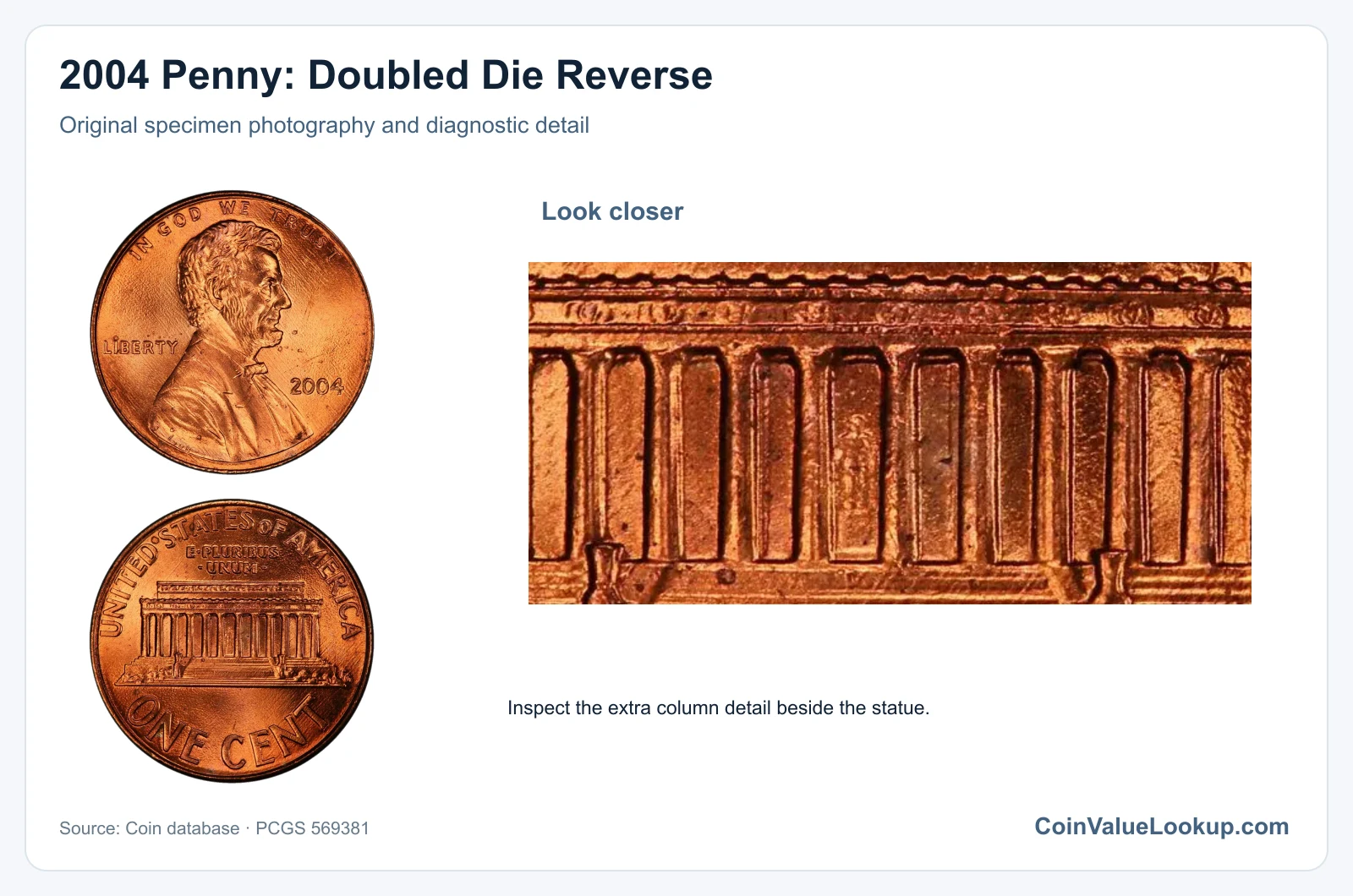
A doubled die reverse on a 2004 Lincoln cent shows consistent doubling on the reverse lettering or design elements. Compare your coin's legends — especially smaller text — against a normal example under magnification.
True die doubling produces separation or notching that repeats in the same direction across affected areas.
Machine doubling is the common lookalike. It tends to leave a flat, shelf-like shadow rather than distinct, rounded secondary lettering.
Random scratches and reflections can also mimic doubling under certain light angles.
No specific price range is supported for this variety. Value depends on the authenticated identity of the particular die, the severity of the doubling, and the coin's overall condition.
Professional authentication is the safest route if you believe you have a genuine doubled die.
2. 2004 Lincoln Penny — Broadstrike
A broadstrike happens when a coin is struck without the collar die that normally confines the blank and forms the rim. The result is a cent that spreads outward, appearing wider than normal while retaining a complete or nearly complete design.
Check the edge — it will lack the sharp, uniform rim of a properly struck coin.
Do not confuse a broadstrike with an off-center strike, which shifts the design and leaves a blank crescent. A coin that was simply flattened after leaving the mint — by a train track, for example — will show distorted details and surface damage that a genuine broadstrike does not.
No specific price is supported here. Each broadstrike is assessed individually based on how dramatic the spread is, whether the date remains visible, and the coin's preservation.
3. 2004 Lincoln Penny — Off-Center Strike
An off-center strike occurs when the blank is not properly seated between the dies, so part of the design is missing and a crescent of unstruck metal remains. The percentage off-center and whether the date is still visible are the two biggest factors collectors care about.
A coin that is 5% off-center looks like a minor curiosity. One that is 50% off-center with a readable date is a different conversation entirely.
The date is key — without it, identification becomes difficult and collector interest drops.
Look out for clipped planchets or post-mint damage that can mimic the appearance. A genuine off-center strike will show the design cleanly fading into the blank area, not a rough or torn edge.
No specific price range is adopted for this error; individual assessment based on severity and condition applies.
4. 2004 Lincoln Penny — Feeder-Finger Marks
Feeder-finger marks appear as parallel or repeated linear impressions on the coin's surface, attributed to contact with the planchet feeding mechanism before or during striking. They often run in a consistent direction and may cross over design elements in a way that normal handling scratches do not.
The tricky part is distinguishing genuine feeder-finger marks from ordinary scratches, cleaning hairlines, or die-polish lines. Genuine examples tend to show a consistent pattern and may be slightly raised or impressed into the design in a repeatable way across multiple coins from the same production run.
No price data is supported for this category on the 2004 cent. If you suspect feeder-finger marks, professional evaluation is the practical next step, since everyday scratches are far more common than legitimate mint-caused marks.
5. 2004 Lincoln Penny — Struck-Through Error
A struck-through error occurs when foreign material — grease, cloth fiber, a metal fragment, or other debris — gets between the die and the blank during striking. The result is a localized depression, an impression of the object, or an area of incomplete design detail.
Grease-filled dies produce soft, mushy areas where fine detail vanishes. A retained struck-through, where the object is still embedded in the coin, is a different animal and generally more collectible.
Look at the affected area under magnification; the depression should match the contour of the surrounding design rather than looking scratched or corroded.
Wear, cleaning, and ordinary weak strikes can all look similar to the untrained eye. No supported price exists for this error on the 2004 cent.
Each example is evaluated on the size, clarity, and nature of the obstruction impression, plus overall coin condition.
6. 2004 Lincoln Penny — Die Crack / Die Chip
Die cracks show up as thin raised lines on the coin's surface, running through or between design elements. They occur because the steel die itself cracked during use, and the metal from the blank fills that crack during striking.
A die chip is a small raised blob where a piece of the die broke away.
A large crack connecting to the rim — sometimes called a cud — produces a raised, featureless lump at the edge and is generally more sought after than a hairline interior crack. Minor die cracks are extremely common on high-mintage coins like 2004 cents and add little to no premium.
Do not confuse die cracks with incuse scratches, which are recessed into the surface rather than raised. Corrosion or foreign material can also mimic small raised areas.
No specific price data is supported here; value depends on prominence, location, and condition.
7. 2004 Lincoln Penny — Doubled Die Obverse
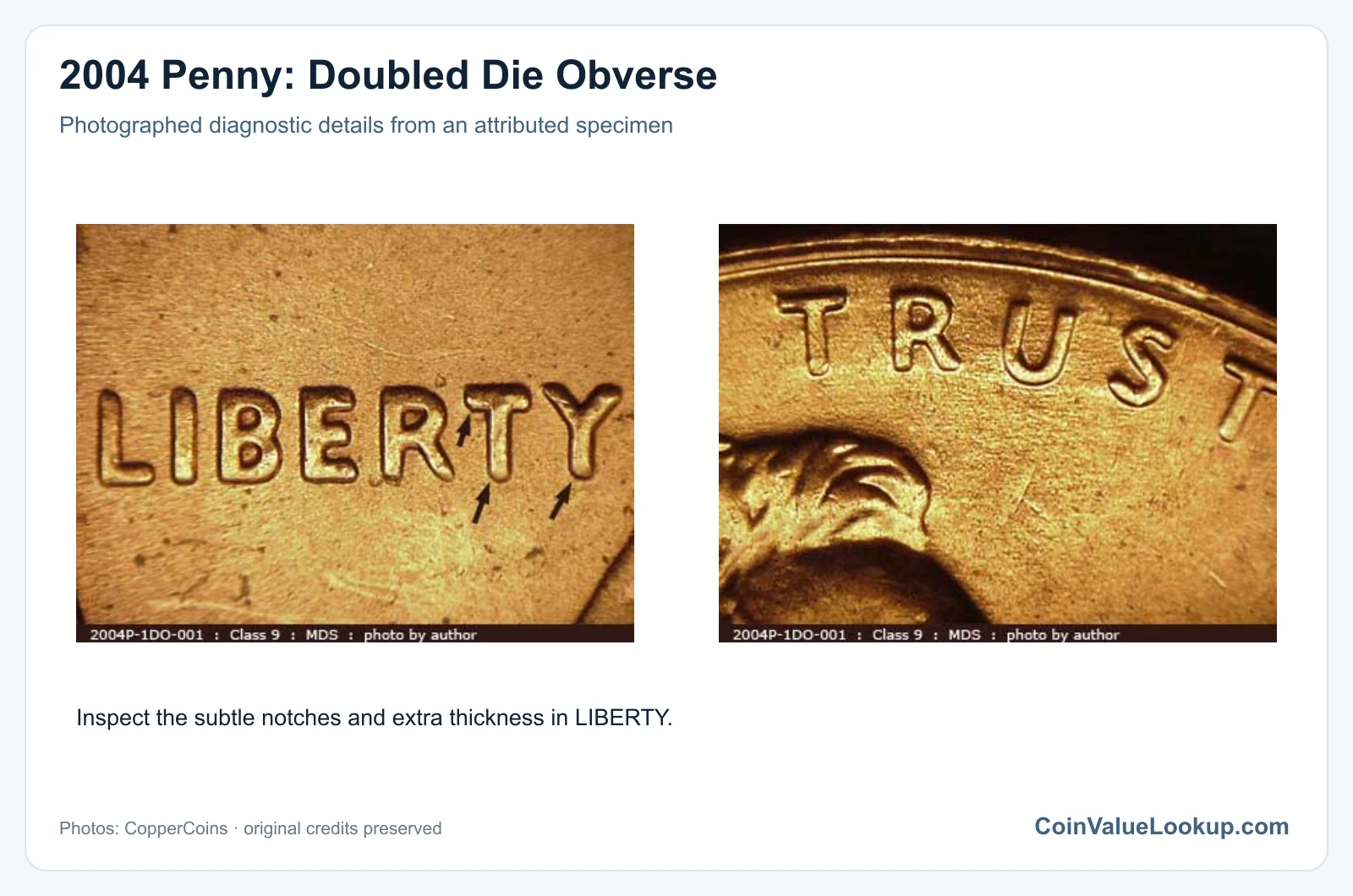
A doubled die obverse on a 2004 cent would show consistent doubling on the date, "LIBERTY," "IN GOD WE TRUST," or Lincoln's profile. Look for clear separation or notching on lettering rather than a flat, shelf-like shadow.
Consistent direction across multiple affected areas is the hallmark of a true doubled die.
Machine doubling is overwhelmingly more common and looks superficially similar. The difference: machine doubling produces flat, spread shelves of metal, while a genuine doubled die shows rounded, distinct secondary impressions.
Worn die contours or odd lighting can also trick the eye.
No supported price range exists for this error on the 2004 cent. If you spot what looks like genuine separation under magnification, professional authentication is the reliable way to confirm it.
Severity and the specific die involved dictate collector interest.
8. 2004 Lincoln Penny — Partial Collar Strike
A partial collar strike gives the coin a distinctive stepped or shelf-like edge on one side, while the opposite side looks normal. This happens when the blank sits slightly above or tilted in the collar die, so only part of the coin is confined during striking.
Check the edge profile carefully. One section will show the normal flat, reeded, or plain edge, and another section will appear thicker, angled, or stepped outward.
Compare it to a normal 2004 cent edge side by side.
Post-mint edge damage — from being hit, dropped, or run through a machine — can create uneven rims but usually leaves scrapes, gouges, or rough spots that a genuine partial collar does not. A complete broadstrike is also different because the entire coin lacks collar confinement.
No specific price is adopted for this variety; each coin is assessed individually based on the degree of the collar misalignment and overall preservation.