2005 Lincoln Penny Coin Value: How Much Is It Worth?
Most 2005 Lincoln pennies you pull from a jar are worth face value — one cent. In uncirculated condition, a guide estimate places a regular 2005 or 2005-D at about $0.36 in MS65, while a 2005-S proof runs around $4.96 in PR65.
Special varieties and minting errors occupy their own markets, with values that depend on the specific coin's identity, condition, and severity of any anomaly.
Fast Way to Identify Your 2005 Lincoln Penny
Snap a clear photo of the front and back of your 2005 penny and upload both images. Our identifier can give you a preliminary read on which version you have — Philadelphia, Denver, San Francisco proof, or satin finish — based on what the photos show.
It is not a substitute for professional authentication or grading, but it is a solid starting point.
2005 Penny Value
Upload both sides of your 2005 Lincoln Penny.
Front Obverse
Upload photo
Back Reverse
Upload photo
Which 2005 Lincoln Penny Versions Are Worth Money?
- Strong uncirculated examples (MS65 and above) with clean, original red surfaces bring more than average pocket change — guide estimates start at $0.36 at MS65 for regular strikes.
- 2005-S proofs in PR65 carry a guide estimate around $4.96; cameo and deep-cameo designations are graded separately and can affect value.
- Satin-finish specimens from 2005 mint sets are a distinct category — they are not ordinary business strikes, and value depends on authenticated identity and condition.
- Error coins such as doubled dies, off-center strikes, and unplated planchets trade in their own market, with prices driven by severity and authentication.
Step 1: Identify Your 2005 Lincoln Penny Mint Mark and Version
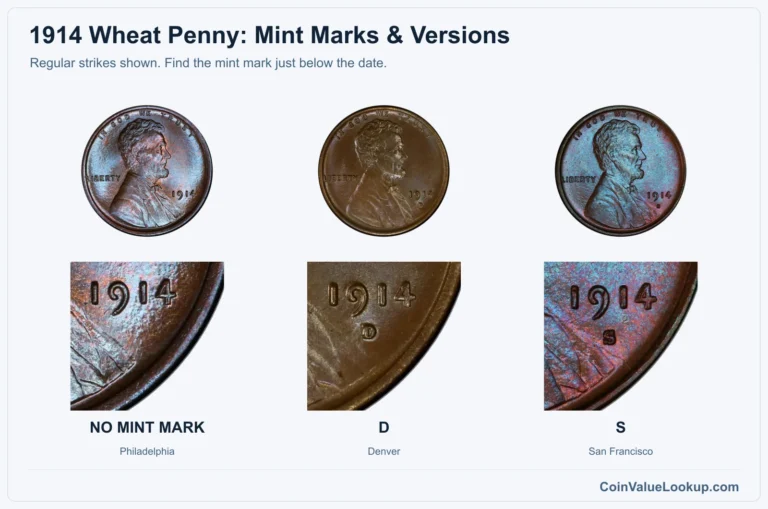
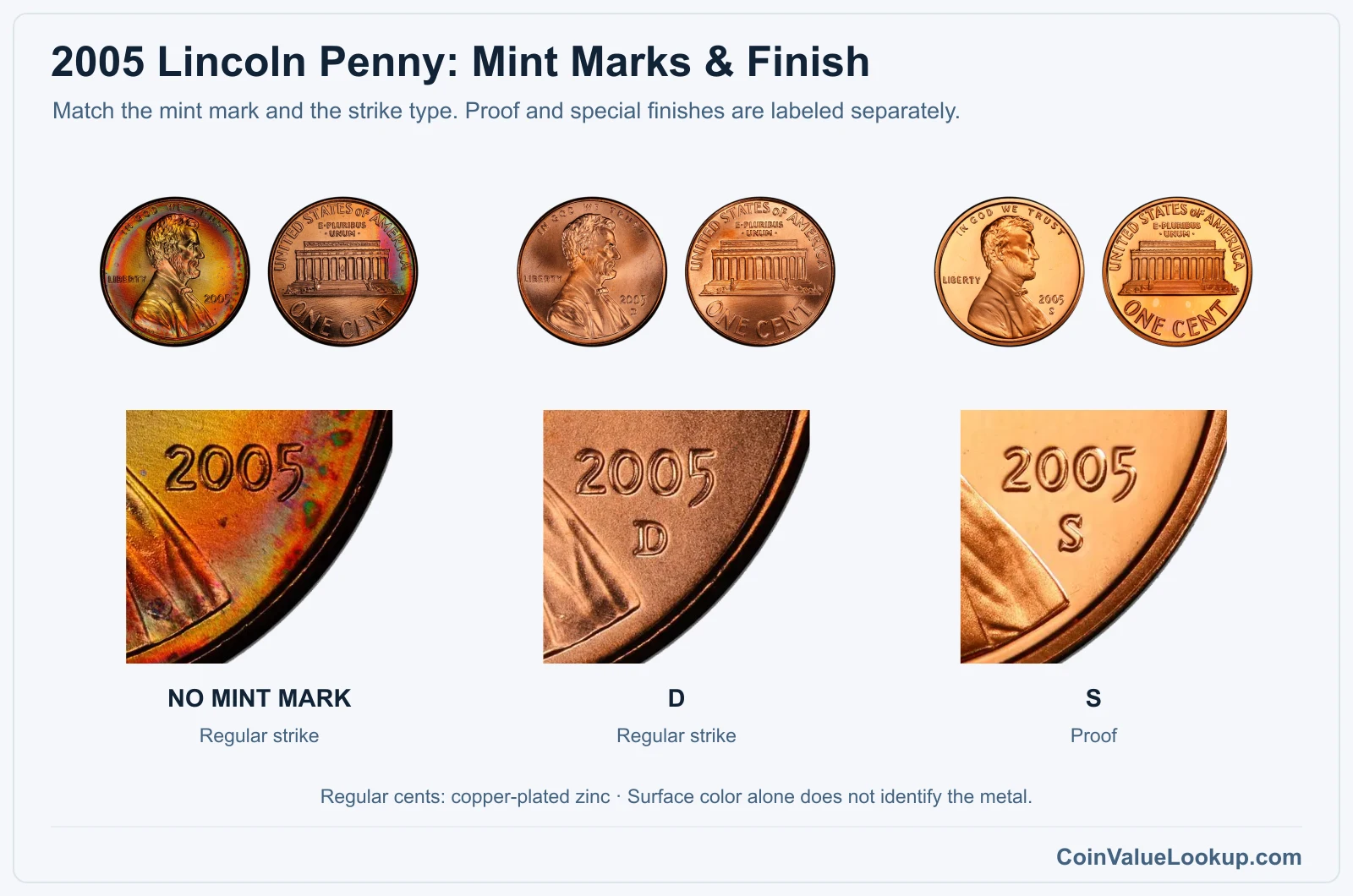
Flip your coin over so the date is facing you. Right below the date, look for a tiny letter.
No letter means Philadelphia. A "D" means Denver.
An "S" means San Francisco, and on a 2005 cent that almost certainly indicates a proof.
The reverse shows the Lincoln Memorial. All 2005 cents are copper-plated zinc, weighing a nominal 2.50 grams with a plain edge.
Color alone cannot prove a different alloy, so do not assume a silvery or dark coin is made of something unusual without further testing.
Finish matters. Regular circulation strikes have a standard luster.
Proofs display mirrored fields with sharply struck devices. Satin-finish coins, issued only in 2005–2010 uncirculated mint sets, have a distinctive soft, even sheen that is neither the cartwheel luster of a business strike nor the mirror of a proof.
Correctly identifying the finish is the first step toward knowing what you actually have.
Step 2: Check Your 2005 Lincoln Penny Grade
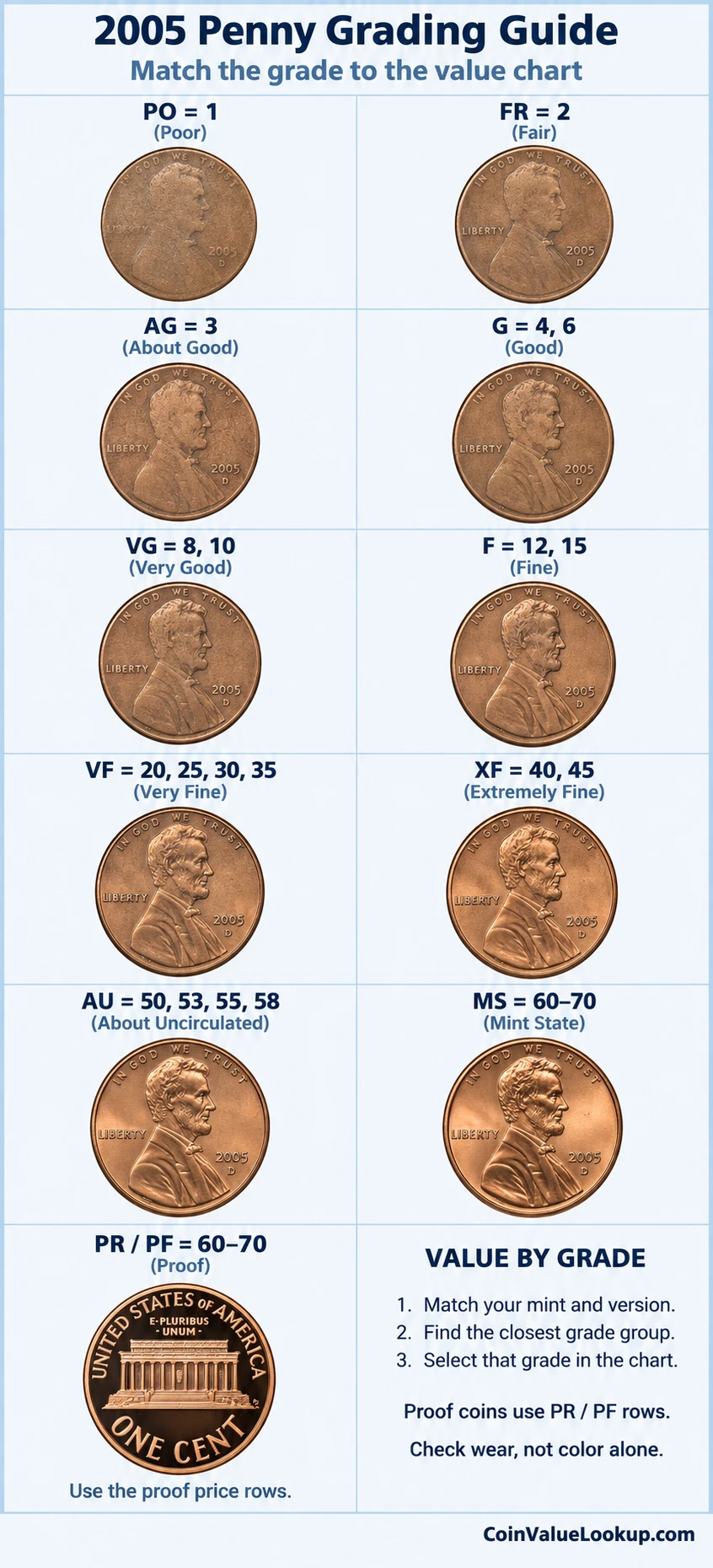
Start with Lincoln's cheek and jawline — that is where wear shows up first. Then check the hair detail above his ear.
On the reverse, look at the columns and horizontal lines of the Memorial. A coin with full, sharp detail and unbroken luster is uncirculated; one with slight flattening on those high points has started to circulate.
Color grading is separate from wear. Red means original copper plating is largely intact.
Red-brown is a mix, and brown means most of the original color has toned away. Spots, corrosion, cleaning marks, and bag contact all reduce a coin's appeal regardless of its wear grade.
Compare your coin to the reference image to see where it falls on the spectrum.
Step 3: Check 2005 Lincoln Penny Value by Mint and Version
2005 Lincoln Penny
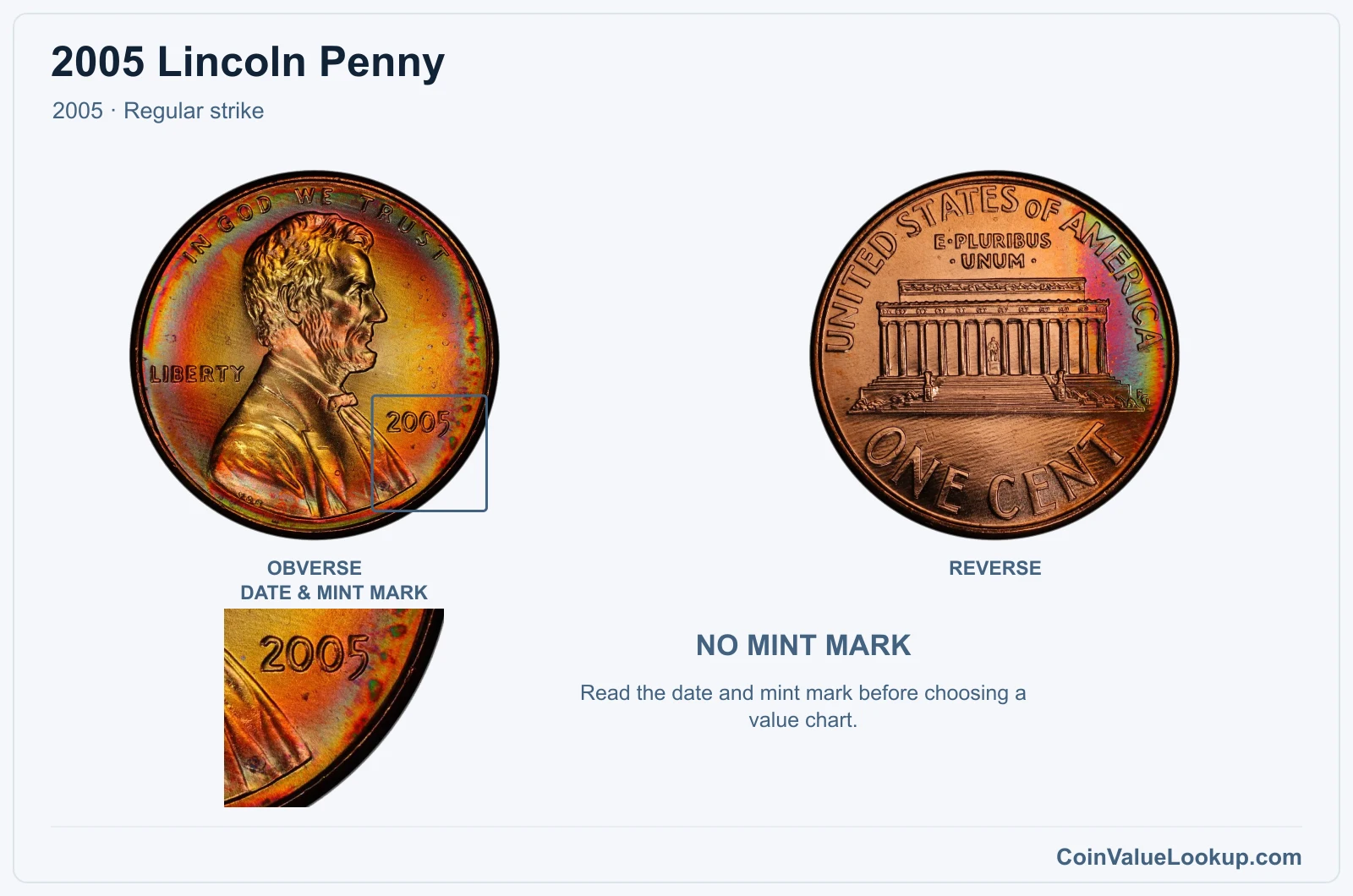
The 2005 Philadelphia cent has no mintmark below the date. It is a standard business-strike Lincoln Memorial cent made of copper-plated zinc.
Billions were struck, so circulated examples are worth face value.
In uncirculated condition at MS65, a guide estimate from USA Coin Book places this coin at about $0.36. To reach that level, the coin needs full luster, minimal contact marks, and strong detail across Lincoln's portrait and the Memorial columns.
Being uncirculated alone does not make it a special finish — satin specimens are a separate category.
| Range | Grade | Price | Auction Records | Appraisal |
|---|---|---|---|---|
| PO | PO 1 | — | Coin Identifier | |
| FR | FR 2 | — | Coin Identifier | |
| AG | AG 3 | — | Coin Identifier | |
| G | G 4 | — | Coin Identifier | |
| G 6 | — | Coin Identifier | ||
| VG | VG 8 | — | Coin Identifier | |
| VG 10 | — | Coin Identifier | ||
| F | F 12 | — | Coin Identifier | |
| F 15 | — | Coin Identifier | ||
| VF | VF 20 | — | Coin Identifier | |
| VF 25 | — | Coin Identifier | ||
| VF 30 | — | Coin Identifier | ||
| VF 35 | — | Coin Identifier | ||
| XF | XF 40 | — | Coin Identifier | |
| XF 45 | — | Coin Identifier | ||
| AU | AU 50 | — | Coin Identifier | |
| AU 53 | — | Coin Identifier | ||
| AU 55 | — | Coin Identifier | ||
| AU 58 | — | Coin Identifier | ||
| MS | MS 60 | — | Coin Identifier | |
| MS 61 | — | Coin Identifier | ||
| MS 62 | — | Coin Identifier | ||
| MS 63 | — | Coin Identifier | ||
| MS 64 | Coin Identifier | |||
| MS 65 | — | Coin Identifier | ||
| MS 66 | Coin Identifier | |||
| MS 67 | Coin Identifier | |||
| MS 68 | — | Coin Identifier | ||
| MS 69 | — | — | — | |
| MS 70 | — | — | — |
2005 Lincoln Penny — D
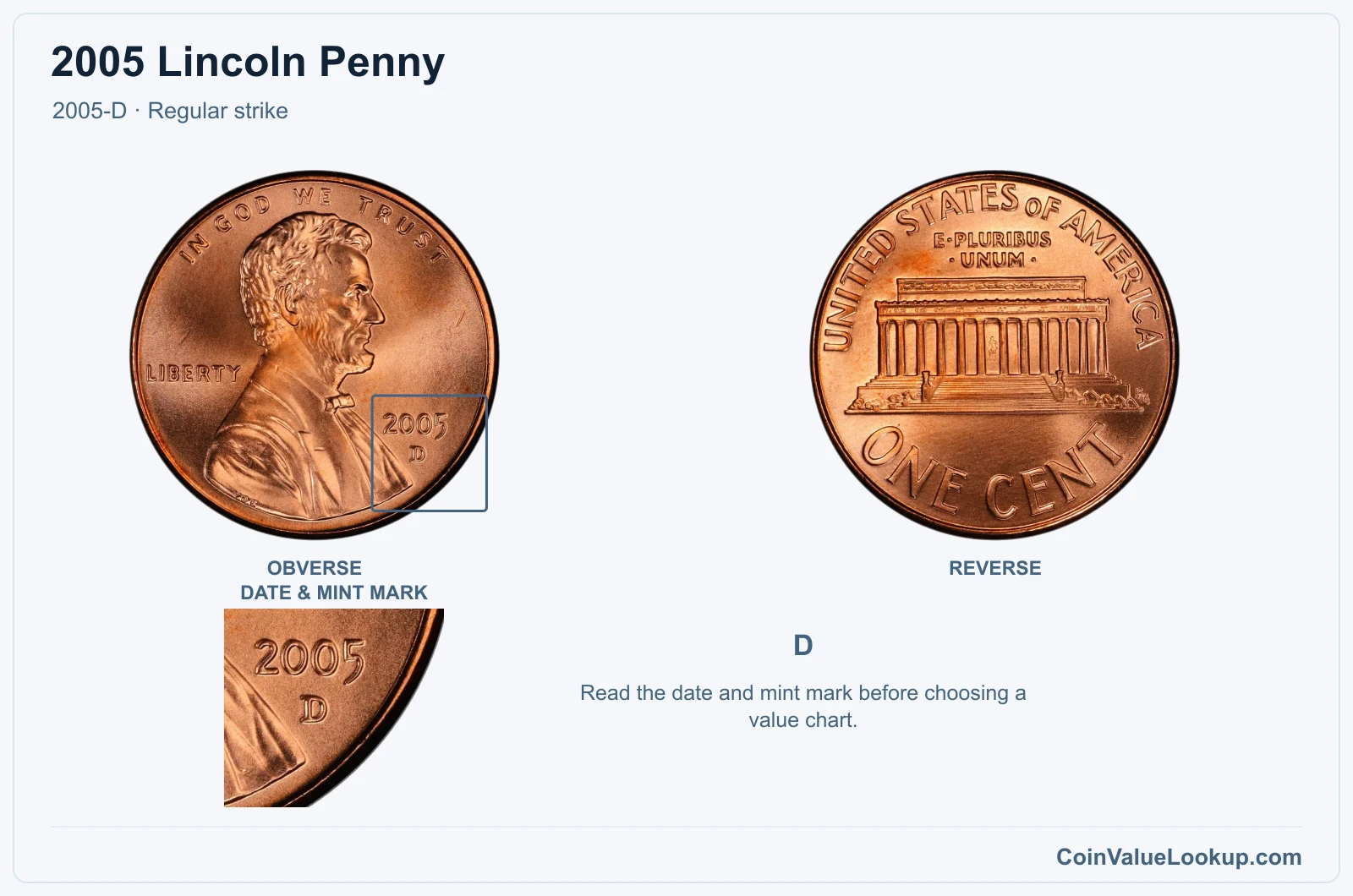
The 2005-D carries a small "D" mintmark below the date, indicating the Denver Mint. Same copper-plated zinc composition, same Memorial reverse, same enormous mintage territory.
A guide estimate puts an MS65 example at roughly $0.36. Like its Philadelphia sibling, condition and original surfaces are what separate a few-cents coin from one worth keeping.
Look for clean fields, sharp hair detail, and no distracting marks. Regular circulation strikes from Denver are common, so grade really is the main value driver here.
| Range | Grade | Price | Auction Records | Appraisal |
|---|---|---|---|---|
| PO | PO 1 | — | Coin Identifier | |
| FR | FR 2 | — | Coin Identifier | |
| AG | AG 3 | — | Coin Identifier | |
| G | G 4 | — | Coin Identifier | |
| G 6 | — | Coin Identifier | ||
| VG | VG 8 | — | Coin Identifier | |
| VG 10 | — | Coin Identifier | ||
| F | F 12 | — | Coin Identifier | |
| F 15 | — | Coin Identifier | ||
| VF | VF 20 | — | Coin Identifier | |
| VF 25 | — | Coin Identifier | ||
| VF 30 | — | Coin Identifier | ||
| VF 35 | — | Coin Identifier | ||
| XF | XF 40 | — | Coin Identifier | |
| XF 45 | — | Coin Identifier | ||
| AU | AU 50 | — | Coin Identifier | |
| AU 53 | — | Coin Identifier | ||
| AU 55 | — | Coin Identifier | ||
| AU 58 | — | Coin Identifier | ||
| MS | MS 60 | — | Coin Identifier | |
| MS 61 | — | Coin Identifier | ||
| MS 62 | — | Coin Identifier | ||
| MS 63 | — | Coin Identifier | ||
| MS 64 | — | Coin Identifier | ||
| MS 65 | Coin Identifier | |||
| MS 66 | Coin Identifier | |||
| MS 67 | Coin Identifier | |||
| MS 68 | Coin Identifier | |||
| MS 69 | — | — | — | |
| MS 70 | — | — | — |
2005 Lincoln Penny — S PR
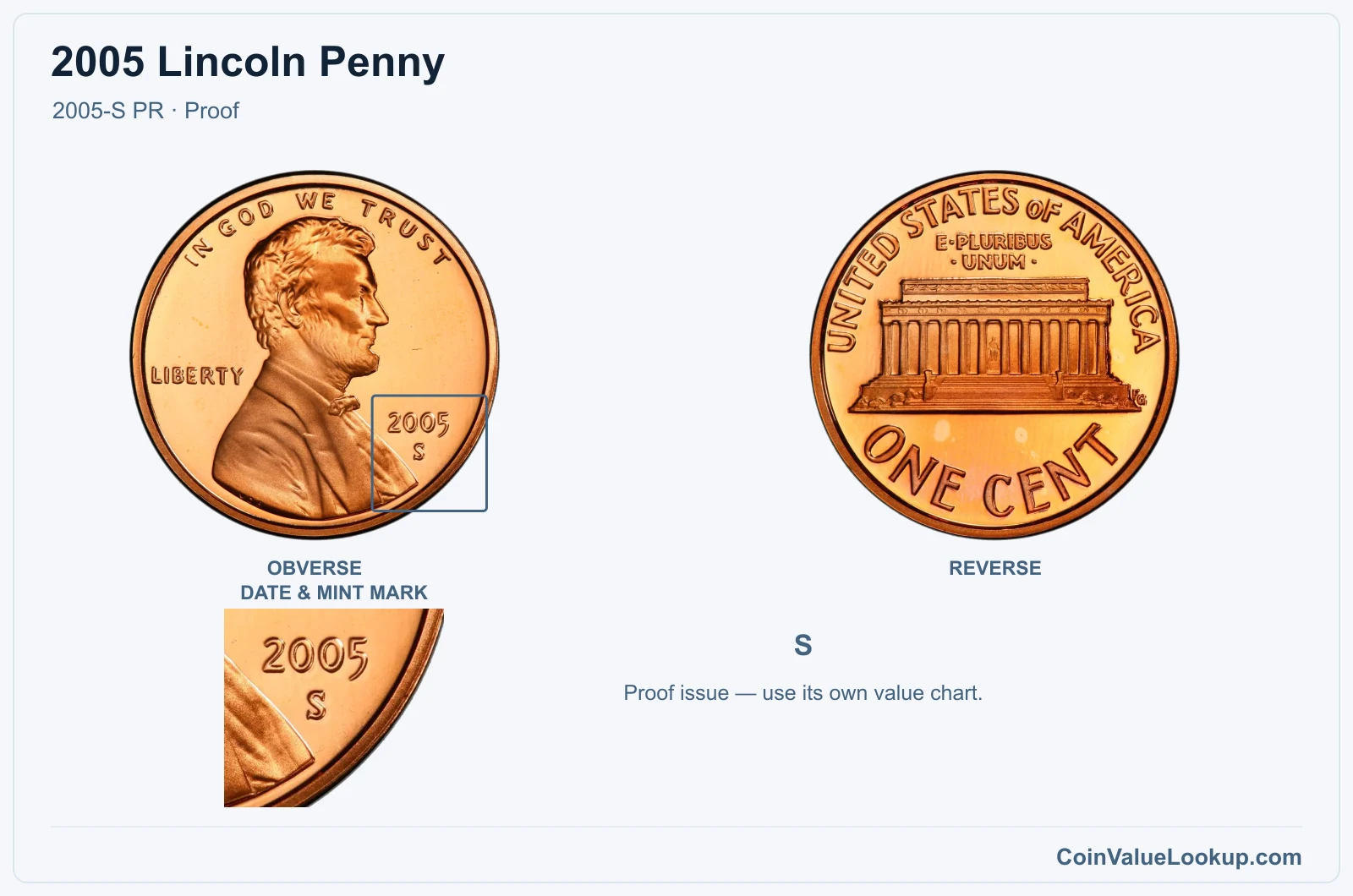
The 2005-S proof was struck at San Francisco exclusively for collector sets. You will see an "S" mintmark below the date.
Proof cents feature mirrored fields and crisply defined devices — they look nothing like a coin pulled from circulation.
A USA Coin Book guide estimate places the PR65 at about $4.96. Cameo and deep-cameo designations, which describe the contrast between frosted devices and mirror fields, are graded separately and can affect the price.
These coins were not released into circulation, so finding one loose and worn usually means it was removed from its original packaging.
Coin Value Lookup is a good place to start when you want to look up guide values for proof and business-strike cents across different years.
| Range | Grade | Price | Auction Records | Appraisal |
|---|---|---|---|---|
| PR | PR 1 | — | Coin Identifier | |
| PR 2 | — | Coin Identifier | ||
| PR 3 | — | Coin Identifier | ||
| PR 4 | — | Coin Identifier | ||
| PR 6 | — | Coin Identifier | ||
| PR 8 | — | Coin Identifier | ||
| PR 10 | — | Coin Identifier | ||
| PR 12 | — | Coin Identifier | ||
| PR 15 | — | Coin Identifier | ||
| PR 20 | — | Coin Identifier | ||
| PR 25 | — | Coin Identifier | ||
| PR 30 | — | Coin Identifier | ||
| PR 35 | — | Coin Identifier | ||
| PR 40 | — | Coin Identifier | ||
| PR 45 | — | Coin Identifier | ||
| PR 50 | — | Coin Identifier | ||
| PR 53 | — | Coin Identifier | ||
| PR 55 | — | Coin Identifier | ||
| PR 58 | — | Coin Identifier | ||
| PR 60 | Coin Identifier | |||
| PR 61 | — | Coin Identifier | ||
| PR 62 | — | Coin Identifier | ||
| PR 63 | — | Coin Identifier | ||
| PR 64 | — | Coin Identifier | ||
| PR 65 | — | Coin Identifier | ||
| PR 66 | — | Coin Identifier | ||
| PR 67 | — | Coin Identifier | ||
| PR 68 | Coin Identifier | |||
| PR 69 | Coin Identifier | |||
| PR 70 | Coin Identifier |
2005 Lincoln Penny — Satin Finish SP
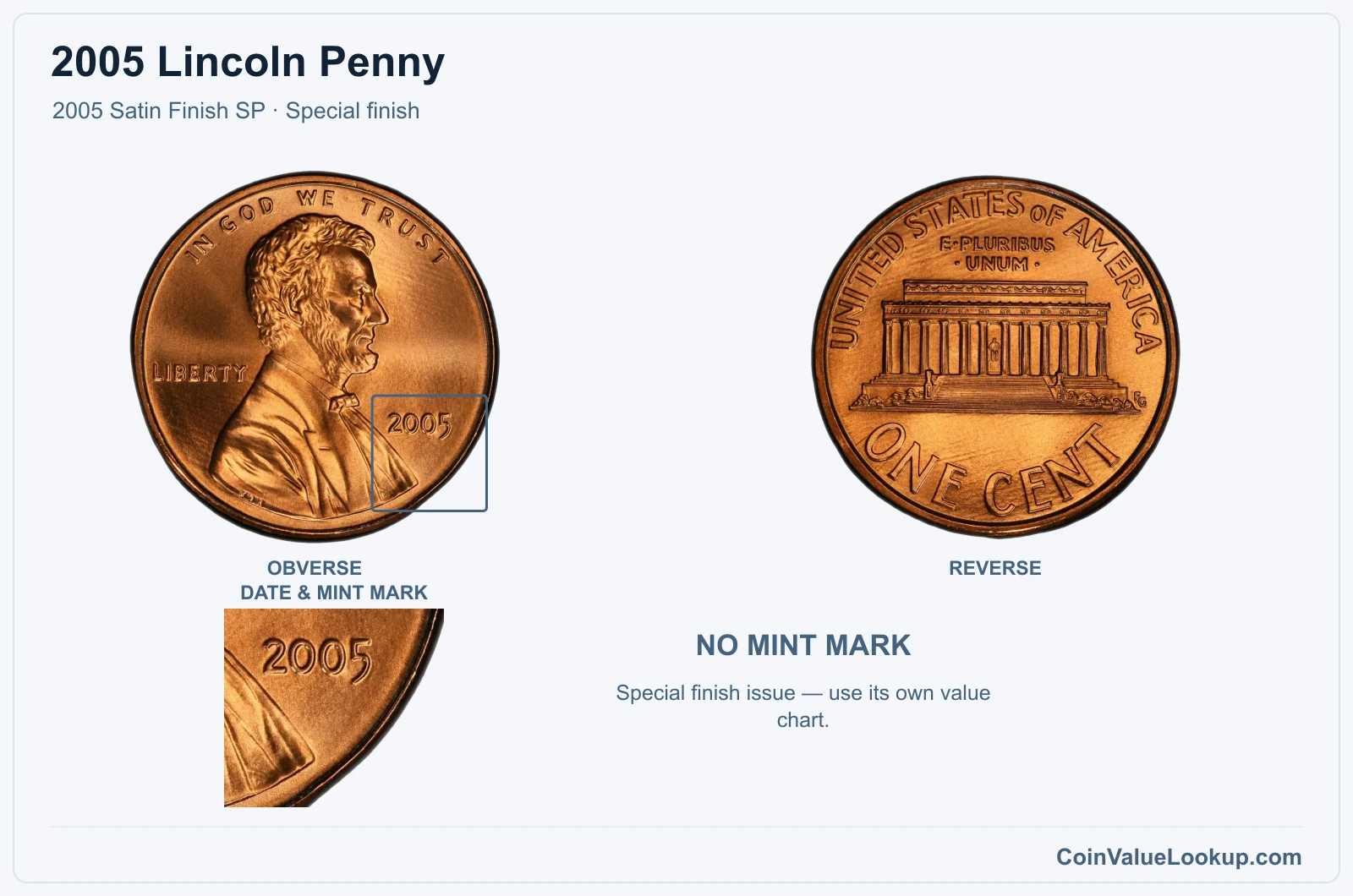
The 2005 satin-finish cent was produced at Philadelphia for inclusion in that year's uncirculated mint set. It carries no mintmark, just like the regular business strike, so finish is the distinguishing feature.
Satin coins have an even, soft luster without the cartwheel effect of a business strike or the mirror fields of a proof.
No specific guide price is adopted for this version. Value depends on authenticated identity, condition, and the coin's individual surfaces.
If you think you have one, professional authentication can confirm the finish — a loose satin cent looks deceptively similar to a lightly handled business strike without close inspection.
| Range | Grade | Price | Auction Records | Appraisal |
|---|---|---|---|---|
| SP | SP 1 | — | Coin Identifier | |
| SP 2 | — | Coin Identifier | ||
| SP 3 | — | Coin Identifier | ||
| SP 4 | — | Coin Identifier | ||
| SP 6 | — | Coin Identifier | ||
| SP 8 | — | Coin Identifier | ||
| SP 10 | — | Coin Identifier | ||
| SP 12 | — | Coin Identifier | ||
| SP 15 | — | Coin Identifier | ||
| SP 20 | — | Coin Identifier | ||
| SP 25 | — | Coin Identifier | ||
| SP 30 | — | Coin Identifier | ||
| SP 35 | — | Coin Identifier | ||
| SP 40 | — | Coin Identifier | ||
| SP 45 | — | Coin Identifier | ||
| SP 50 | — | Coin Identifier | ||
| SP 53 | — | Coin Identifier | ||
| SP 55 | — | Coin Identifier | ||
| SP 58 | — | Coin Identifier | ||
| SP 60 | — | Coin Identifier | ||
| SP 61 | — | Coin Identifier | ||
| SP 62 | — | Coin Identifier | ||
| SP 63 | — | Coin Identifier | ||
| SP 64 | — | Coin Identifier | ||
| SP 65 | — | Coin Identifier | ||
| SP 66 | Coin Identifier | |||
| SP 67 | Coin Identifier | |||
| SP 68 | Coin Identifier | |||
| SP 69 | Coin Identifier | |||
| SP 70 | Coin Identifier |
2005 Lincoln Penny — D Satin Finish SP
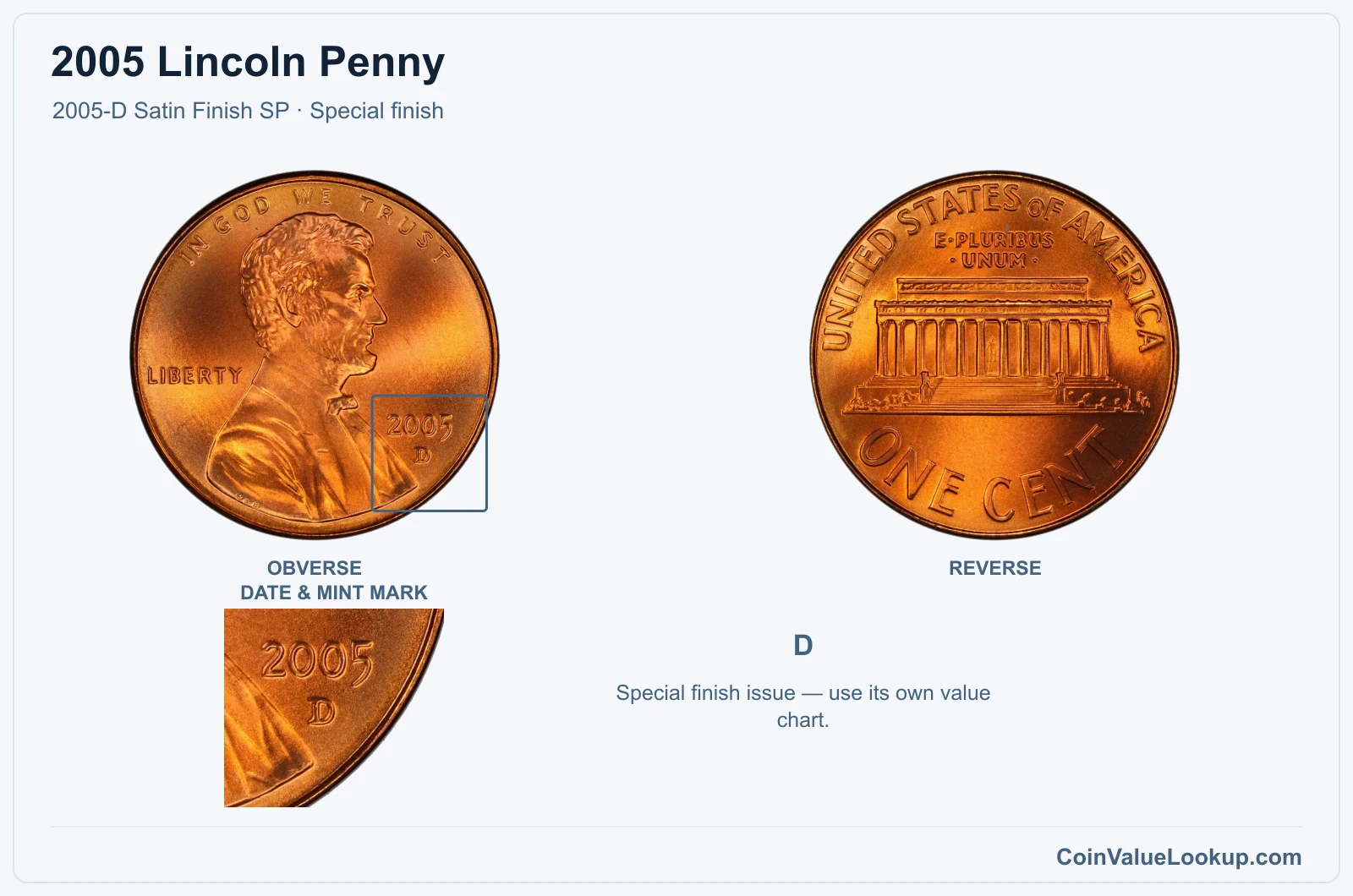
The 2005-D satin-finish cent came from Denver and was sold in the same uncirculated mint set packaging. It carries the "D" mintmark, but again, the finish is what sets it apart from a regular Denver business strike.
Satin specimens have a uniform, matte-like sheen across both sides. No specific guide price is adopted here.
Authenticated identity and surface preservation determine what a given coin is worth. These were produced in limited quantities relative to circulation strikes, so confirmed examples in top condition can carry collector interest beyond their face value.
| Range | Grade | Price | Auction Records | Appraisal |
|---|---|---|---|---|
| SP | SP 1 | — | Coin Identifier | |
| SP 2 | — | Coin Identifier | ||
| SP 3 | — | Coin Identifier | ||
| SP 4 | — | Coin Identifier | ||
| SP 6 | — | Coin Identifier | ||
| SP 8 | — | Coin Identifier | ||
| SP 10 | — | Coin Identifier | ||
| SP 12 | — | Coin Identifier | ||
| SP 15 | — | Coin Identifier | ||
| SP 20 | — | Coin Identifier | ||
| SP 25 | — | Coin Identifier | ||
| SP 30 | — | Coin Identifier | ||
| SP 35 | — | Coin Identifier | ||
| SP 40 | — | Coin Identifier | ||
| SP 45 | — | Coin Identifier | ||
| SP 50 | — | Coin Identifier | ||
| SP 53 | — | Coin Identifier | ||
| SP 55 | — | Coin Identifier | ||
| SP 58 | — | Coin Identifier | ||
| SP 60 | — | Coin Identifier | ||
| SP 61 | — | Coin Identifier | ||
| SP 62 | — | Coin Identifier | ||
| SP 63 | — | Coin Identifier | ||
| SP 64 | — | Coin Identifier | ||
| SP 65 | — | Coin Identifier | ||
| SP 66 | Coin Identifier | |||
| SP 67 | Coin Identifier | |||
| SP 68 | Coin Identifier | |||
| SP 69 | Coin Identifier | |||
| SP 70 | Coin Identifier |
2005 Lincoln Penny Error List
1. 2005 Lincoln Penny — Doubled Die Obverse
A doubled die obverse on a 2005 cent shows consistent doubling on obverse letters or design elements — typically visible as separation or notching when compared with a normal coin under the same lighting. The key word is consistent: the doubling repeats in the same direction across affected areas.
Do not confuse this with machine doubling, which produces a flat, shelf-like distortion without the raised, separated profiles of a true doubled die. Reflections and worn-die softness can also mimic doubling at first glance.
No specific price is adopted for this category; value depends on the individual coin's authentication, the strength of the doubling, and overall condition.
2. 2005 Lincoln Penny — Doubled Die Reverse
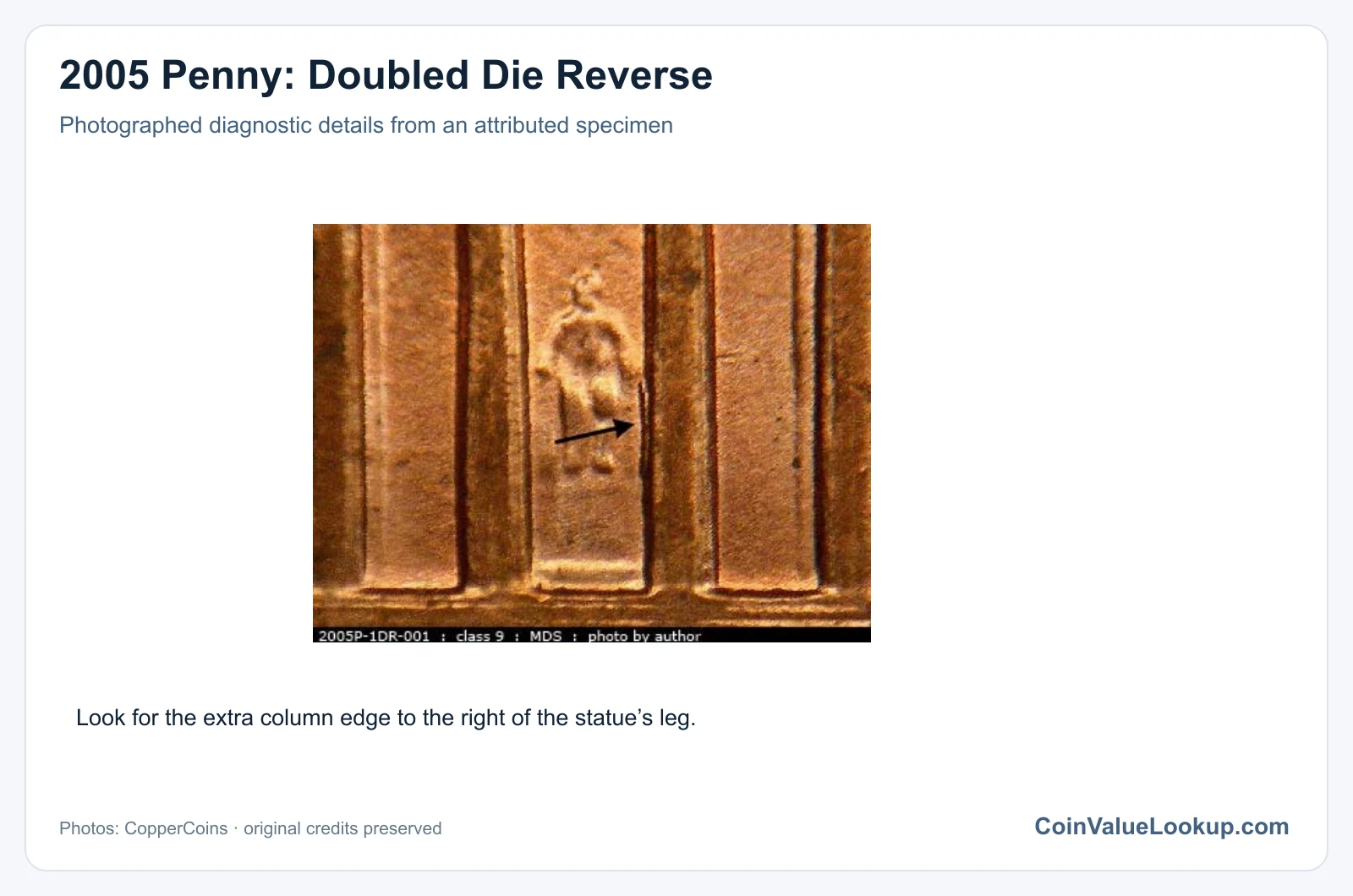
A doubled die reverse affects the back of the coin — look at the Memorial lettering, columns, or other reverse design details for consistent separation or notching compared to a normal example. Genuine doubled die reverses show doubling that is part of the die itself, not a striking anomaly.
Machine doubling on the reverse can look similar but tends to produce a flat shelf rather than distinctly raised, separated elements. Random post-mint damage and reflections are other common lookalikes.
No price is adopted for this error; each coin's value depends on authentication, the visibility and location of the doubling, and the coin's grade.
3. 2005 Lincoln Penny — BIE Die Break
A BIE die break shows up as a small raised vertical line or blob between the letters B and E in LIBERTY on the obverse. It is caused by a crack or chip in the die that fills with metal during striking, leaving a raised feature on the finished coin.
Do not mistake dirt, a scratch, or a piece of stuck debris for a BIE. The real thing is raised above the field and consistent in appearance — it will not scrape off.
No specific price is adopted for BIE errors on 2005 cents. Value depends on the size and clarity of the break, overall coin condition, and professional authentication.
4. 2005 Lincoln Penny — Struck-Through Error
A struck-through error occurs when foreign material — grease, a thread, a metal fragment — gets between the die and the planchet during striking. The result is a localized depression or incomplete design area on the finished coin.
Grease fill-ins tend to produce soft, rounded missing detail, while a retained foreign object can leave a sharper, more defined impression. Do not confuse struck-through areas with ordinary wear, scratches, cleaning, or weak strikes from a tired die.
No price is adopted for this category; value varies widely based on the size and type of obstruction, visibility, and the coin's overall condition and authentication.
5. 2005 Lincoln Penny — Flip-Over Double Strike
A flip-over double strike is a dramatic error. The coin is struck once, then flips and receives a second strike, placing overlapping obverse and reverse designs on the same face.
The result is unmistakable — you will see two distinct impressions crossing each other.
This is not a doubled die, which is a die-manufacturing issue. A flip-over double strike is a striking-process error, and the overlapping designs are from different sides of the coin.
Post-mint damage or vise marks pressed into a coin after it leaves the mint can sometimes mimic multiple strikes. No price is adopted; authenticated examples are evaluated individually based on the degree of overlap and overall condition.
6. 2005 Lincoln Penny — Unplated / Partly Unplated Planchet
An unplated or partly unplated 2005 cent is missing some or all of its copper plating, exposing the zinc core underneath. The result is a grayish or silvery appearance instead of the normal copper color.
Weight and edge examination help distinguish a genuine unplated planchet error from a coin that has been chemically stripped or corroded after minting. A stripped coin often shows uneven surface damage or residue, while a mint error tends to have cleaner, more uniform zinc exposure.
No price is adopted for this error. Value depends on authentication confirming the plating was absent before striking, the extent of missing coverage, and the coin's condition.
7. 2005 Lincoln Penny — Brockage
A brockage happens when a previously struck coin sticks to a die and impresses its design into the next coin struck. The result is an incuse (sunken), mirror-image version of one side's design appearing on the opposite side of the affected coin.
Look at the direction and depth of the transferred image. A genuine brockage shows a complete or partial reverse impression of the design, and the normal side of the coin is typically struck correctly.
Die clashes — where the dies contact each other without a planchet — leave weaker, partial impressions and are a different category. Coins pressed together outside the mint can also fake the look.
No price is adopted; individual assessment by a professional service is the path here.
8. 2005 Lincoln Penny — Broadstrike
A broadstrike occurs when the collar die — the ring that normally confines the planchet during striking — is missing or mispositioned. The coin spreads outward, producing a larger-than-normal diameter with a complete but slightly distorted design.
The edge of a broadstruck coin will look different from a normal plain-edge cent; it may appear rounded or irregular rather than sharply defined. Do not confuse a broadstrike with an off-center strike (where the design is displaced) or a coin that has been flattened by a train or press after leaving the mint.
No price is adopted for this error on 2005 cents. Value depends on the degree of spread, overall condition, and authentication.
9. 2005 Lincoln Penny — Die Crack / Die Chip
Die cracks appear as thin, raised lines on the coin's surface, running across fields or through design elements. Die chips show up as small raised blobs.
Both are caused by fractures in the steel die that fill with metal during striking.
A crack that connects to the rim and displaces a chunk of the design is called a cud — that is a more significant break. Smaller interior cracks and chips are common, especially late in a die's life.
Do not confuse incuse scratches, corrosion lines, or foreign material on the surface with raised die cracks. No price is adopted for die cracks on 2005 cents.
Value depends on size, location, and overall coin condition, confirmed through authentication.
10. 2005 Lincoln Penny — Off-Center Strike
An off-center strike happens when the planchet is not properly seated between the dies. The resulting coin shows a displaced design and an unstruck crescent of blank metal along one edge.
The percentage of off-center displacement matters — a 5% miss is minor, while 50% with a visible date is far more dramatic and collectible. The date must be readable for most collectors to have interest.
Do not confuse an off-center strike with a clipped planchet (which has a curved missing section with a normal strike) or one-sided die misalignment. Post-mint flattening can also mislead.
No price is adopted here; each coin is evaluated by authentication, the degree of displacement, and whether the date remains visible.