2010 Lincoln Penny Coin Value: How Much Is It Worth?
The 2010 Lincoln cent is the first year of the Union Shield reverse, replacing the four commemorative designs used in 2009. Most worn examples are worth face value — one cent.
A guide estimate places an uncirculated MS65 business strike around $0.36, while a San Francisco proof in PR65 is estimated near $4.96. Collector finishes, major varieties, and mint errors occupy their own pricing lanes entirely.
Fast Way to Identify Your 2010 Lincoln Penny
Snap clear photos of both sides of your 2010 penny and upload them for a preliminary identification. This can help sort out the mint, finish type, and whether any obvious variety or error is present.
It will not authenticate or certify your coin, but it is a solid first step before deciding whether professional grading is worthwhile.
2010 Penny Value
Upload both sides of your 2010 Lincoln Penny.
Front Obverse
Upload photo
Back Reverse
Upload photo
Which 2010 Lincoln Penny Versions Are Worth Money?
- Philadelphia and Denver business strikes in original bright red MS65 or higher condition can exceed face value, with a guide estimate around $0.36 at MS65.
- San Francisco proofs carry a separate premium; a PR65 example has a guide estimate near $4.96.
- Satin specimen finish coins from 2010 Mint Sets are distinct from circulation strikes and should be evaluated individually based on authenticated identity and condition.
- Doubled die obverse and doubled die reverse varieties, if authenticated, can command premiums well beyond ordinary examples.
- Off-center strikes, die caps, and broadstrikes are scarce error types that attract specialist collectors.
Step 1: Identify Your 2010 Lincoln Penny Mint Mark and Version
Flip the coin over first. You should see a Union Shield on the reverse — if you see the Lincoln Memorial or a scene from Lincoln's life, you have a different year or series.
The obverse carries Lincoln's portrait, the date 2010, and IN GOD WE TRUST.
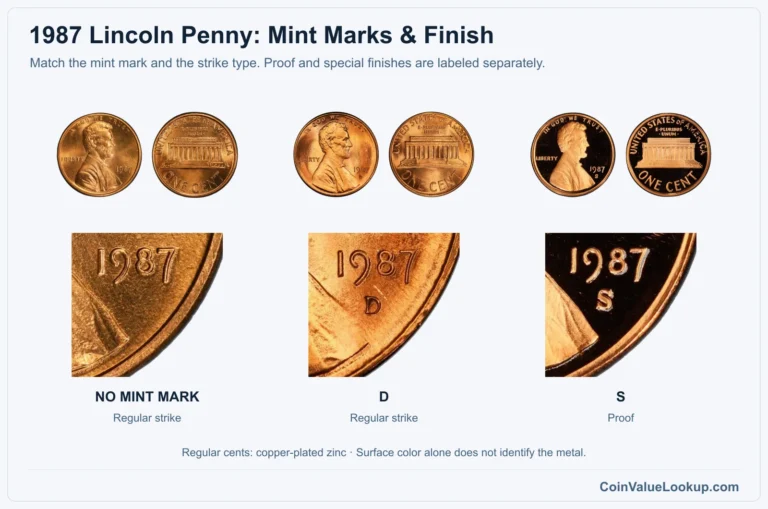
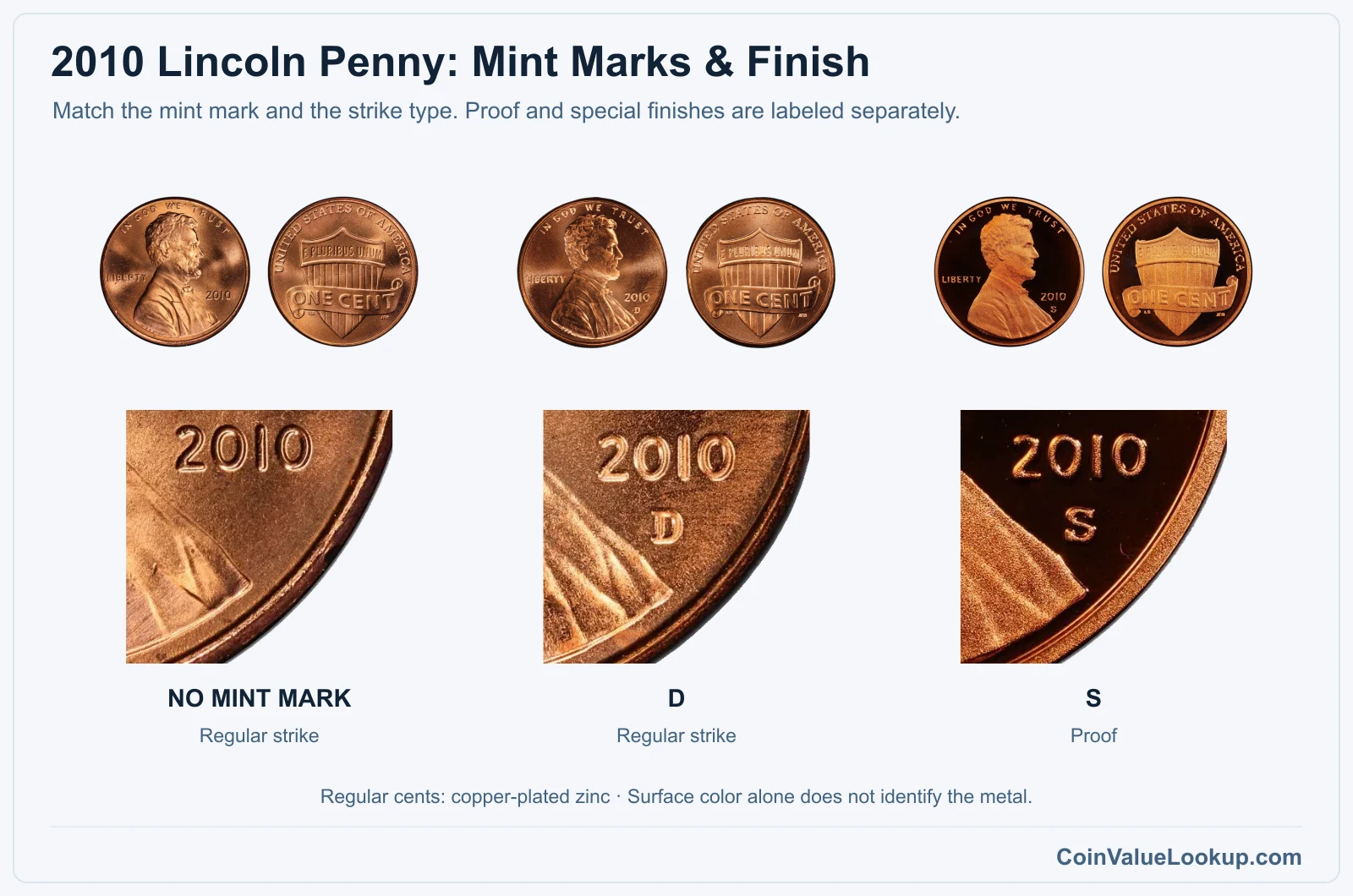
Now check for a mintmark just below the date. No letter means Philadelphia.
A small D means Denver. An S means San Francisco, and those are proof or satin specimen coins, not regular circulation strikes.
The 2010 cent is copper-plated zinc, weighing about 2.50 grams. A silvery or grayish appearance alone does not confirm an off-metal error; weight and professional examination matter more.
This year also saw satin-finish coins packaged in Mint Sets. Satin pieces have a distinctive soft, non-reflective luster that differs from both the slightly cartwheel sheen of business strikes and the mirror fields of proofs.
Keep these categories separate when comparing values.
Step 2: Check Your 2010 Lincoln Penny Grade
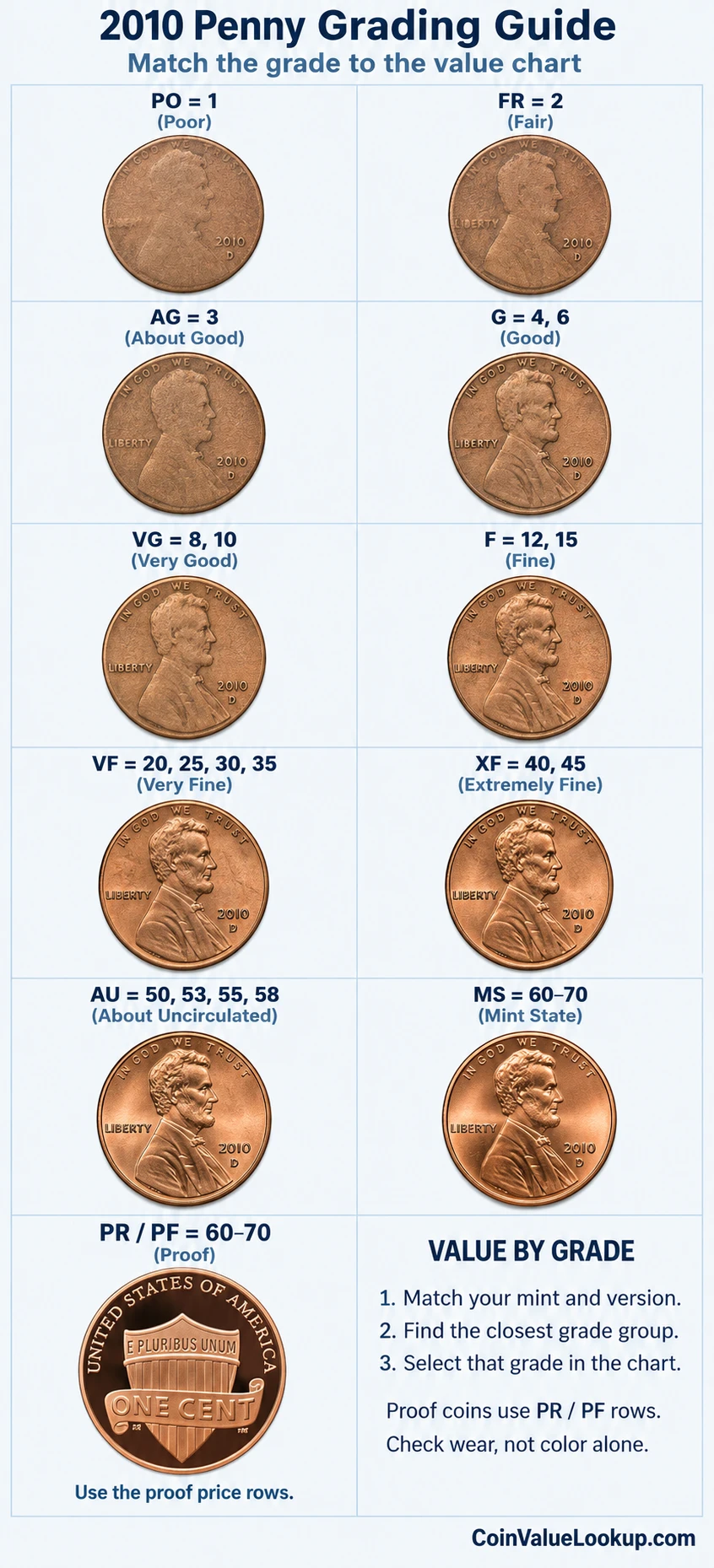
Start with Lincoln's cheek and jawline — these are the highest relief points and show friction first. On a lightly circulated coin you will see slight flattening there while the hair strands behind the ear still show separation.
A well-worn example loses nearly all hair detail and the jaw merges into the neck.
On the reverse, check the horizontal lines across the shield. They wear from the center outward.
Sharp, fully separated lines with complete luster suggest mint state.
Color designations — RD (red), RB (red-brown), and BN (brown) — describe the remaining original copper tone, not the amount of wear. A coin can be mint state and brown, or mint state and full red.
Red commands the biggest premium at a given grade.
Use the comparison image to match your coin's wear pattern. Proof and satin are manufacturing finishes, not grades above mint state, so do not line them up on the same scale as circulated coins.
Step 3: Check 2010 Lincoln Penny Value by Mint and Version
2010 Lincoln Penny — Shield
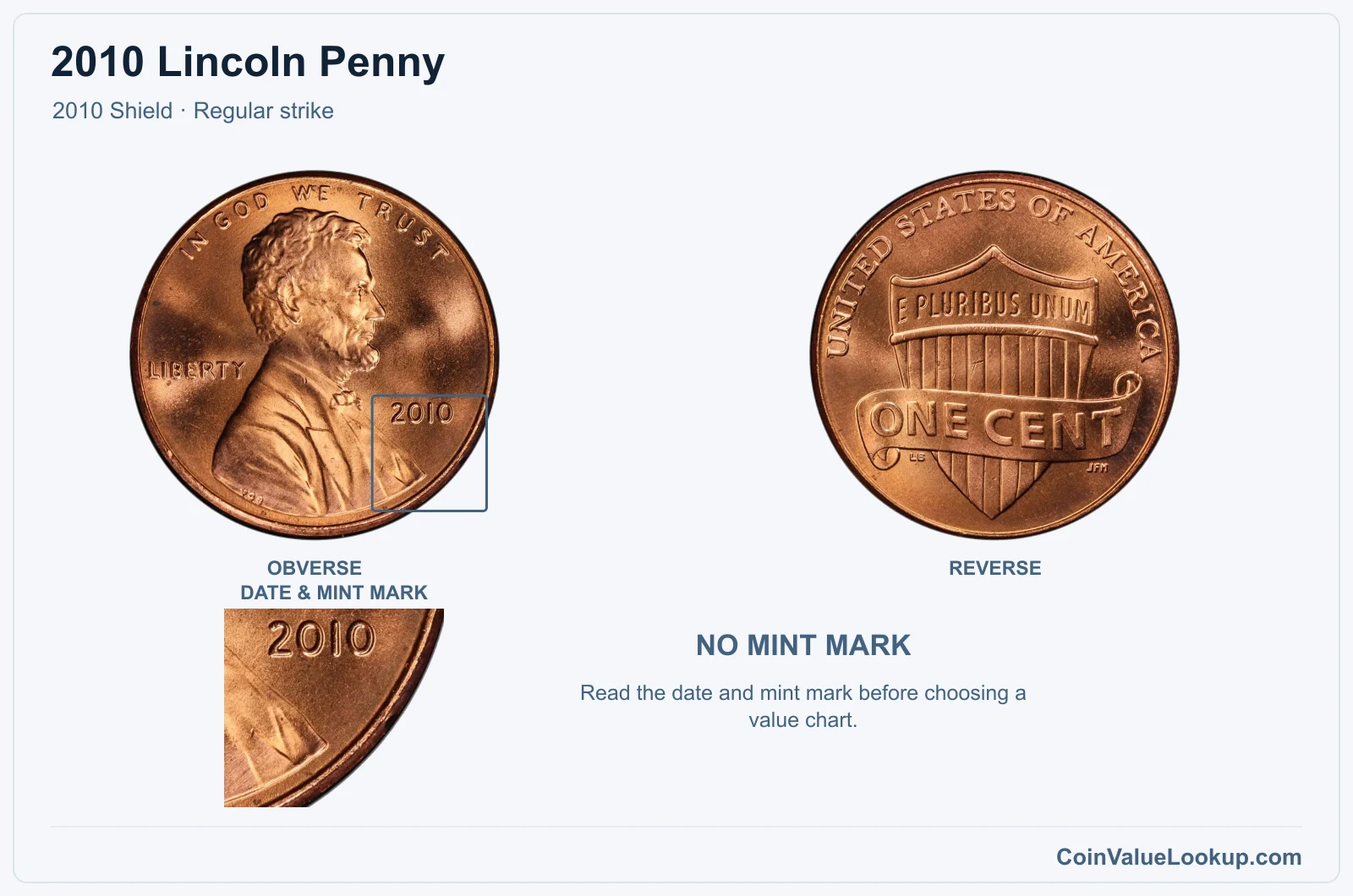
The 2010 Philadelphia Shield cent has no mintmark below the date. It is a standard business strike on a copper-plated zinc planchet weighing about 2.50 grams.
Billions were produced, so circulated examples are worth one cent.
Uncirculated coins with full original red luster are the ones worth a closer look. A guide estimate from USA Coin Book places an MS65 around $0.36.
That is not a fortune, but it is 36 times face value, and higher grades or especially pristine surfaces could do better. Check for bag marks, carbon spots, and fingerprints — any of those drag the grade down fast.
| Range | Grade | Price | Auction Records | Appraisal |
|---|---|---|---|---|
| PO | PO 1 | — | Coin Identifier | |
| FR | FR 2 | — | Coin Identifier | |
| AG | AG 3 | — | Coin Identifier | |
| G | G 4 | — | Coin Identifier | |
| G 6 | — | Coin Identifier | ||
| VG | VG 8 | — | Coin Identifier | |
| VG 10 | — | Coin Identifier | ||
| F | F 12 | — | Coin Identifier | |
| F 15 | — | Coin Identifier | ||
| VF | VF 20 | — | Coin Identifier | |
| VF 25 | — | Coin Identifier | ||
| VF 30 | — | Coin Identifier | ||
| VF 35 | — | Coin Identifier | ||
| XF | XF 40 | — | Coin Identifier | |
| XF 45 | — | Coin Identifier | ||
| AU | AU 50 | — | Coin Identifier | |
| AU 53 | — | Coin Identifier | ||
| AU 55 | — | Coin Identifier | ||
| AU 58 | — | Coin Identifier | ||
| MS | MS 60 | — | Coin Identifier | |
| MS 61 | — | Coin Identifier | ||
| MS 62 | — | Coin Identifier | ||
| MS 63 | — | Coin Identifier | ||
| MS 64 | — | Coin Identifier | ||
| MS 65 | Coin Identifier | |||
| MS 66 | Coin Identifier | |||
| MS 67 | Coin Identifier | |||
| MS 68 | — | — | — | |
| MS 69 | — | — | — | |
| MS 70 | — | — | — |
2010 Lincoln Penny — D Shield
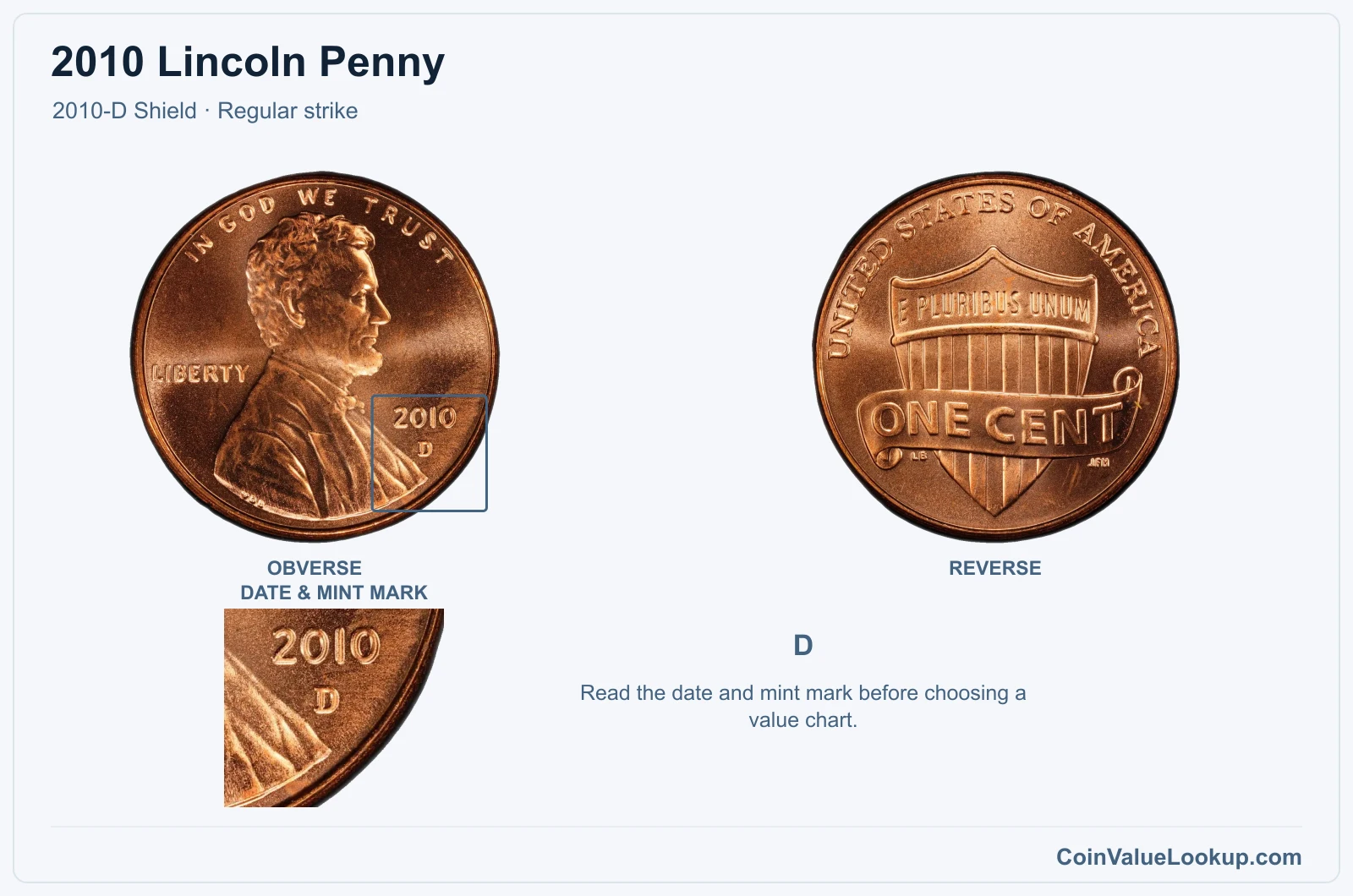
Look for a small D mintmark below the date to confirm Denver. Same copper-plated zinc composition, same 2.50-gram weight, same Union Shield reverse as the Philadelphia issue.
The 2010-D is equally common in pocket change and equally worth one cent when worn. At MS65 the USA Coin Book guide estimate is also about $0.36.
Full red color and clean surfaces matter here — a single dark spot or scratch across Lincoln's cheek can drop the grade noticeably. No special rarity attaches to Denver strikes this year, so condition is the whole game.
| Range | Grade | Price | Auction Records | Appraisal |
|---|---|---|---|---|
| PO | PO 1 | — | Coin Identifier | |
| FR | FR 2 | — | Coin Identifier | |
| AG | AG 3 | — | Coin Identifier | |
| G | G 4 | — | Coin Identifier | |
| G 6 | — | Coin Identifier | ||
| VG | VG 8 | — | Coin Identifier | |
| VG 10 | — | Coin Identifier | ||
| F | F 12 | — | Coin Identifier | |
| F 15 | — | Coin Identifier | ||
| VF | VF 20 | — | Coin Identifier | |
| VF 25 | — | Coin Identifier | ||
| VF 30 | — | Coin Identifier | ||
| VF 35 | — | Coin Identifier | ||
| XF | XF 40 | — | Coin Identifier | |
| XF 45 | — | Coin Identifier | ||
| AU | AU 50 | — | Coin Identifier | |
| AU 53 | — | Coin Identifier | ||
| AU 55 | — | Coin Identifier | ||
| AU 58 | — | Coin Identifier | ||
| MS | MS 60 | — | Coin Identifier | |
| MS 61 | — | Coin Identifier | ||
| MS 62 | — | Coin Identifier | ||
| MS 63 | — | Coin Identifier | ||
| MS 64 | — | Coin Identifier | ||
| MS 65 | Coin Identifier | |||
| MS 66 | Coin Identifier | |||
| MS 67 | Coin Identifier | |||
| MS 68 | — | — | — | |
| MS 69 | — | — | — | |
| MS 70 | — | — | — |
2010 Lincoln Penny — S Shield PR
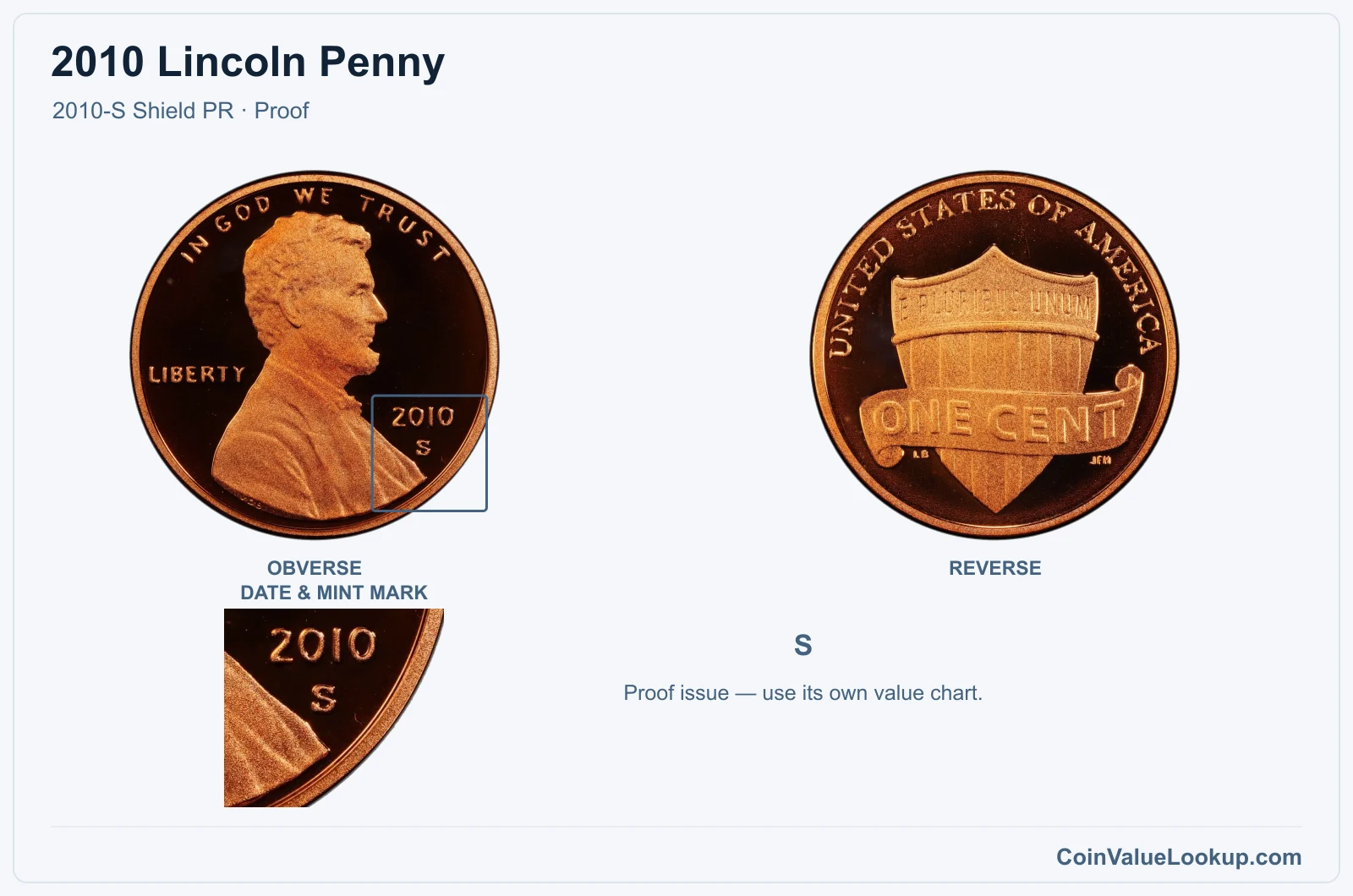
The 2010-S proof carries an S mintmark and was struck at San Francisco for collector sets. Proofs are made with specially prepared dies and polished planchets, producing mirror-like fields and sharp detail that you will never see on a business strike.
A PR65 example has a USA Coin Book guide estimate around $4.96. That is the baseline proof grade; higher grades and strong cameo contrast between frosted devices and reflective fields can push value upward.
Look for hairlines, haze, or fingerprints — proof surfaces are unforgiving and show every flaw. A proof is a finish, not a step above uncirculated, so grade it on its own scale.
| Range | Grade | Price | Auction Records | Appraisal |
|---|---|---|---|---|
| PR | PR 1 | — | Coin Identifier | |
| PR 2 | — | Coin Identifier | ||
| PR 3 | — | Coin Identifier | ||
| PR 4 | — | Coin Identifier | ||
| PR 6 | — | Coin Identifier | ||
| PR 8 | — | Coin Identifier | ||
| PR 10 | — | Coin Identifier | ||
| PR 12 | — | Coin Identifier | ||
| PR 15 | — | Coin Identifier | ||
| PR 20 | — | Coin Identifier | ||
| PR 25 | — | Coin Identifier | ||
| PR 30 | — | Coin Identifier | ||
| PR 35 | — | Coin Identifier | ||
| PR 40 | — | Coin Identifier | ||
| PR 45 | — | Coin Identifier | ||
| PR 50 | — | Coin Identifier | ||
| PR 53 | — | Coin Identifier | ||
| PR 55 | — | Coin Identifier | ||
| PR 58 | — | Coin Identifier | ||
| PR 60 | — | Coin Identifier | ||
| PR 61 | — | Coin Identifier | ||
| PR 62 | — | Coin Identifier | ||
| PR 63 | — | Coin Identifier | ||
| PR 64 | — | Coin Identifier | ||
| PR 65 | — | Coin Identifier | ||
| PR 66 | — | Coin Identifier | ||
| PR 67 | — | Coin Identifier | ||
| PR 68 | Coin Identifier | |||
| PR 69 | Coin Identifier | |||
| PR 70 | Coin Identifier |
2010 Lincoln Penny — Shield SP
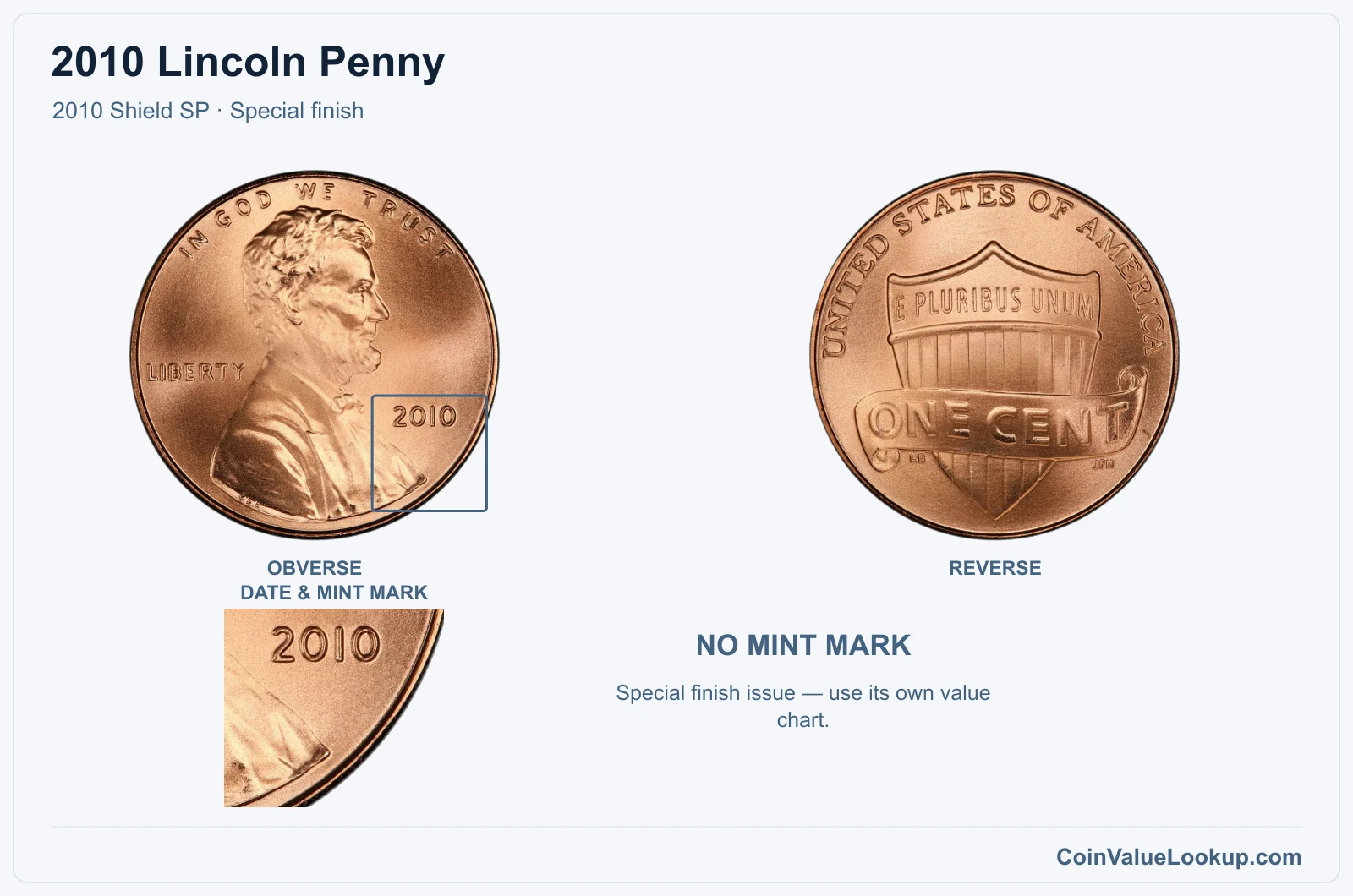
The 2010 Philadelphia satin specimen finish cent came packaged in that year's official Mint Set. It has no mintmark, just like the business strike, but the surface is distinctly different — a soft, even luster without the cartwheel effect of a regular uncirculated coin or the mirror fields of a proof.
Coin Value Lookup is a useful starting point if you want to compare your 2010 satin cent with other years and finishes across the Lincoln series.
2010 was the final year the Mint used the satin finish, making it a bookend piece for the 2005–2010 satin run. Value depends on authenticated identity, condition, and retained color.
No specific guide price is adopted here, so individual assessment by a grading service is the most reliable route to a number.
| Range | Grade | Price | Auction Records | Appraisal |
|---|---|---|---|---|
| SP | SP 1 | — | Coin Identifier | |
| SP 2 | — | Coin Identifier | ||
| SP 3 | — | Coin Identifier | ||
| SP 4 | — | Coin Identifier | ||
| SP 6 | — | Coin Identifier | ||
| SP 8 | — | Coin Identifier | ||
| SP 10 | — | Coin Identifier | ||
| SP 12 | — | Coin Identifier | ||
| SP 15 | — | Coin Identifier | ||
| SP 20 | — | Coin Identifier | ||
| SP 25 | — | Coin Identifier | ||
| SP 30 | — | Coin Identifier | ||
| SP 35 | — | Coin Identifier | ||
| SP 40 | — | Coin Identifier | ||
| SP 45 | — | Coin Identifier | ||
| SP 50 | — | Coin Identifier | ||
| SP 53 | — | Coin Identifier | ||
| SP 55 | — | Coin Identifier | ||
| SP 58 | — | Coin Identifier | ||
| SP 60 | — | Coin Identifier | ||
| SP 61 | — | Coin Identifier | ||
| SP 62 | — | Coin Identifier | ||
| SP 63 | — | Coin Identifier | ||
| SP 64 | — | Coin Identifier | ||
| SP 65 | — | Coin Identifier | ||
| SP 66 | Coin Identifier | |||
| SP 67 | Coin Identifier | |||
| SP 68 | Coin Identifier | |||
| SP 69 | — | Coin Identifier | ||
| SP 70 | — | — | — |
2010 Lincoln Penny — D Shield SP
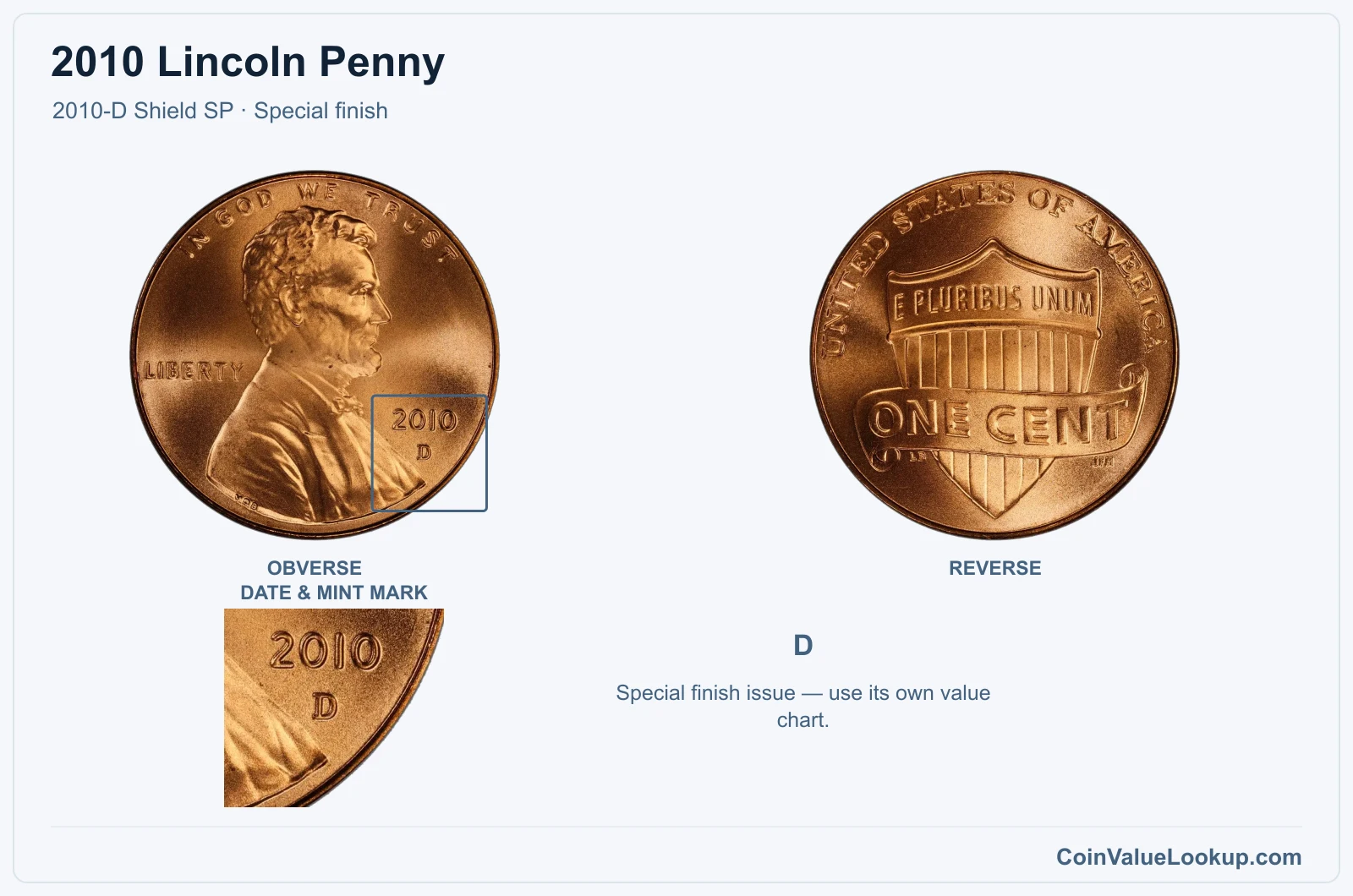
This is the Denver counterpart of the satin specimen finish, bearing a D mintmark. It was available only inside the 2010 Mint Set, not in circulation.
The satin surface has a muted, uniform sheen that is easy to confuse with a lightly cleaned business strike if you have never handled one before.
Because this is a distinct manufacturing finish, do not lump it with ordinary 2010-D cents when looking up values. No specific guide price is adopted for this version, so value depends on the coin's authenticated identity, preservation, and color.
Professional grading helps confirm the satin finish and provides a standardized grade that buyers trust.
| Range | Grade | Price | Auction Records | Appraisal |
|---|---|---|---|---|
| SP | SP 1 | — | Coin Identifier | |
| SP 2 | — | Coin Identifier | ||
| SP 3 | — | Coin Identifier | ||
| SP 4 | — | Coin Identifier | ||
| SP 6 | — | Coin Identifier | ||
| SP 8 | — | Coin Identifier | ||
| SP 10 | — | Coin Identifier | ||
| SP 12 | — | Coin Identifier | ||
| SP 15 | — | Coin Identifier | ||
| SP 20 | — | Coin Identifier | ||
| SP 25 | — | Coin Identifier | ||
| SP 30 | — | Coin Identifier | ||
| SP 35 | — | Coin Identifier | ||
| SP 40 | — | Coin Identifier | ||
| SP 45 | — | Coin Identifier | ||
| SP 50 | — | Coin Identifier | ||
| SP 53 | — | Coin Identifier | ||
| SP 55 | — | Coin Identifier | ||
| SP 58 | — | Coin Identifier | ||
| SP 60 | — | Coin Identifier | ||
| SP 61 | — | Coin Identifier | ||
| SP 62 | — | Coin Identifier | ||
| SP 63 | — | Coin Identifier | ||
| SP 64 | — | Coin Identifier | ||
| SP 65 | — | Coin Identifier | ||
| SP 66 | Coin Identifier | |||
| SP 67 | Coin Identifier | |||
| SP 68 | Coin Identifier | |||
| SP 69 | Coin Identifier | |||
| SP 70 | — | — | — |
2010 Lincoln Penny Error List
1. 2010 Lincoln Penny — Doubled Die Obverse
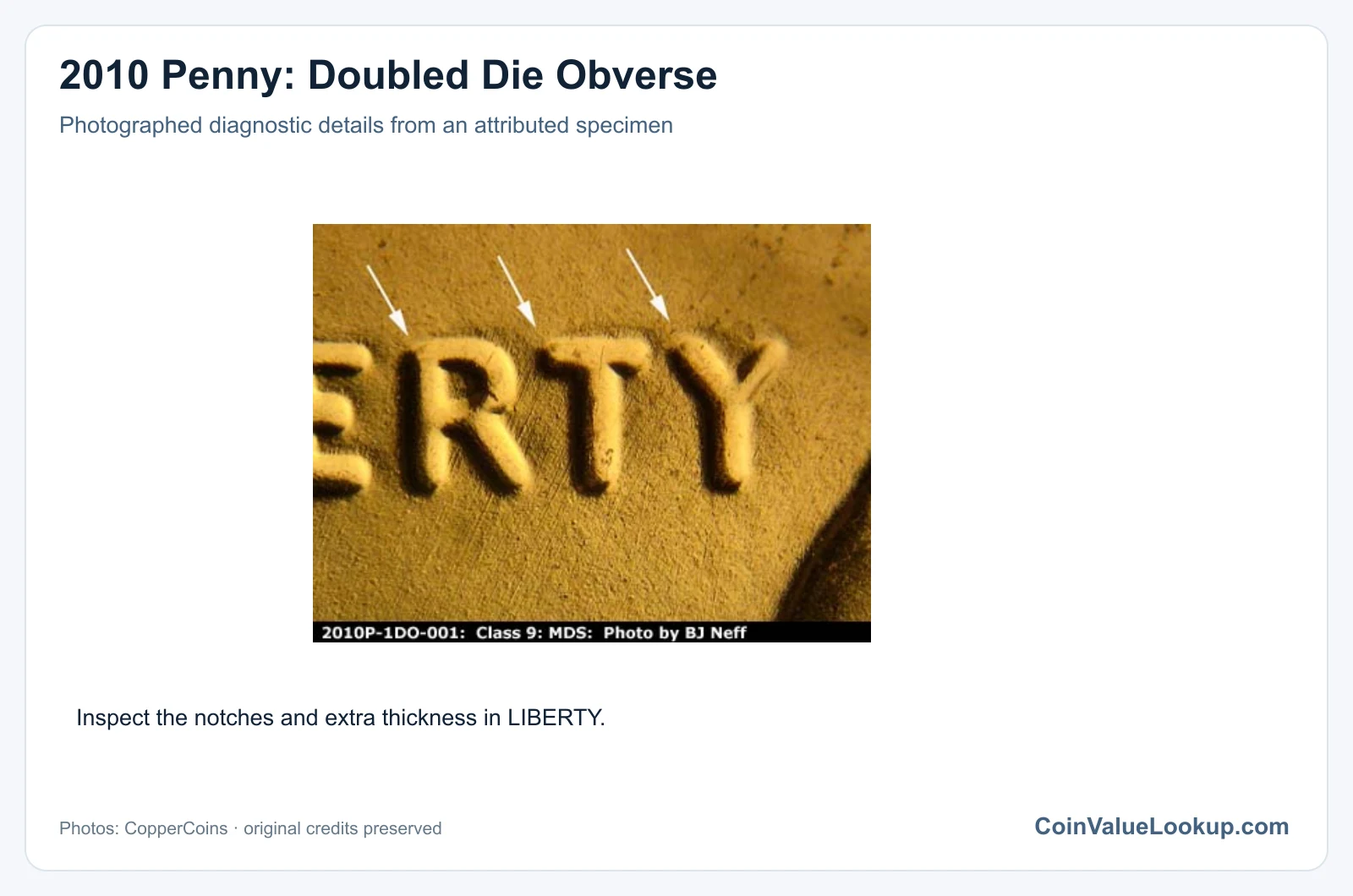
A doubled die obverse on a 2010 Lincoln cent shows consistent doubling — separation or notching — on obverse lettering or design elements. The key word is consistent: every affected letter shifts the same direction by the same amount.
Compare your coin to a normal 2010 cent under the same lighting. Genuine hub doubling produces raised, split serifs or shelf-like edges on letters such as LIBERTY or IN GOD WE TRUST.
Machine doubling, by contrast, tends to look flat and shelf-like in only one direction, often with a "mushy" appearance rather than crisp secondary lines.
No specific price is adopted for this variety. Value depends on the strength of the doubling, the coin's grade, and whether it has been authenticated by a recognized grading service.
2. 2010 Lincoln Penny — Doubled Die Reverse
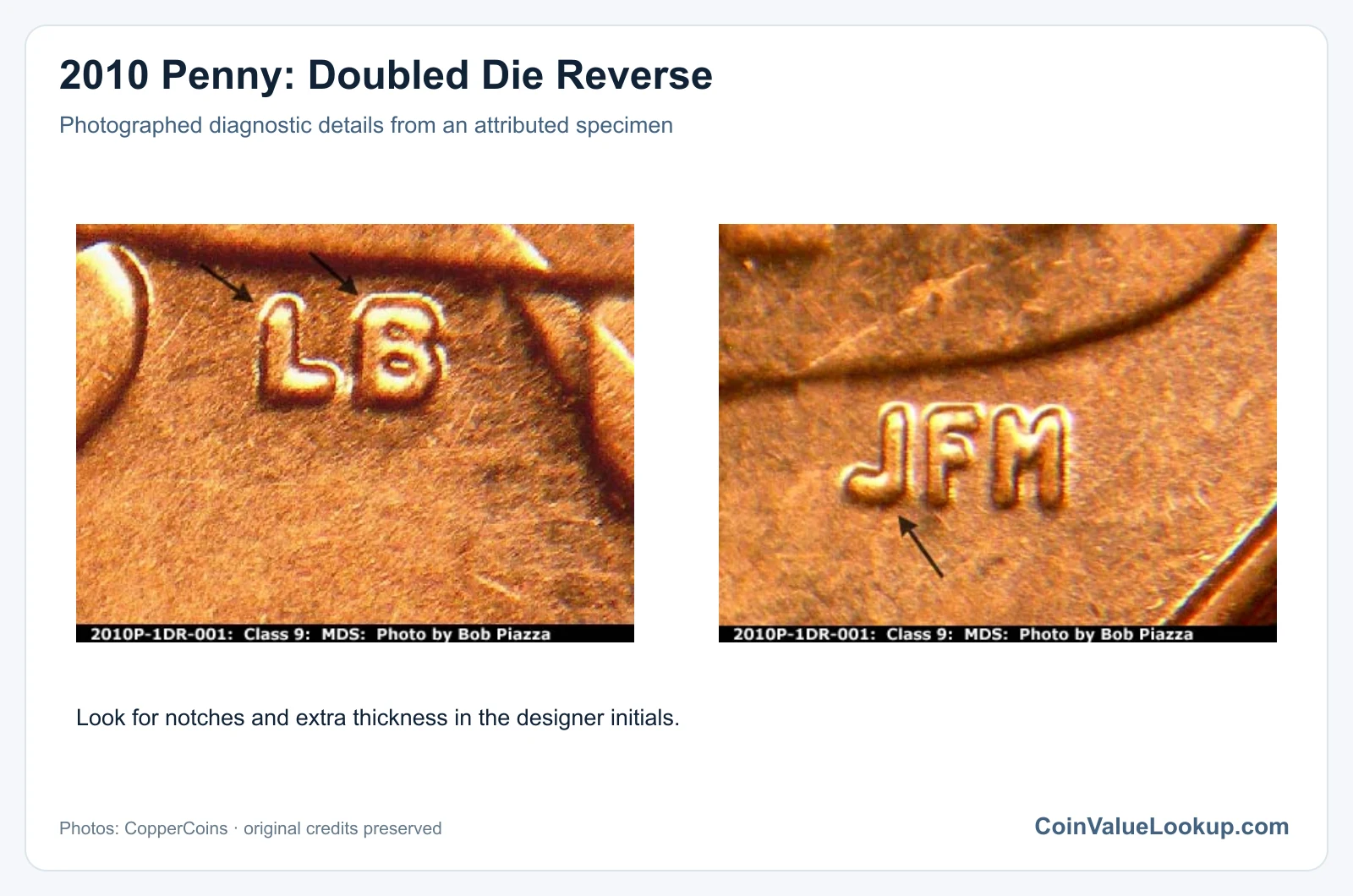
A doubled die reverse on the 2010 Shield cent is most readily checked in the E PLURIBUS UNUM lettering above the shield. Compare each letter against a known normal example from the same year.
Genuine doubling will appear as a consistent secondary image — notching on serifs, split crossbars, or separation in curved letters — and it repeats across multiple letters in the same zone. Machine doubling and die deterioration doubling are common lookalikes; both tend to show flat, directionless shelving rather than a crisp second impression.
No specific price is adopted here. The value of a confirmed doubled die reverse depends on how dramatic the doubling is, the coin's overall grade, and professional authentication.
3. 2010 Lincoln Penny — Off-Center Strike
An off-center strike happens when the planchet is not seated properly between the dies. The result is a crescent-shaped blank area on one side of the coin, with the design shifted in the opposite direction.
The most collectible off-center cents still show the full date and mintmark — without those, identification gets difficult and demand drops. A 5% shift is minor; 50% or more with a visible date is the sweet spot for collectors.
Do not confuse an off-center strike with a clipped planchet, which has a curved bite out of the edge, or with post-mint damage like a coin that was pressed flat on one side. No specific price is adopted for this error; value depends on the percentage of misalignment, date visibility, and authenticated condition.
4. 2010 Lincoln Penny — Broadstrike
A broadstrike occurs when the retaining collar fails to contain the planchet during striking. The coin spreads outward, so the design is complete but the diameter is larger than normal and the rim is weak or absent.
Pick up the coin and look at the edge. A genuine broadstrike has a thin, spreading edge profile rather than the normal raised rim.
The design elements near the border may look stretched or faded. If the design is also shifted off-center, it might be classified differently.
Post-mint flattening — a coin smashed by a train, for example — can mimic a broadstrike, but it usually shows distortion or tool marks on the surface. No specific price is adopted; value depends on how dramatic the spread is and the coin's authenticated condition.
5. 2010 Lincoln Penny — Die Crack / Die Chip
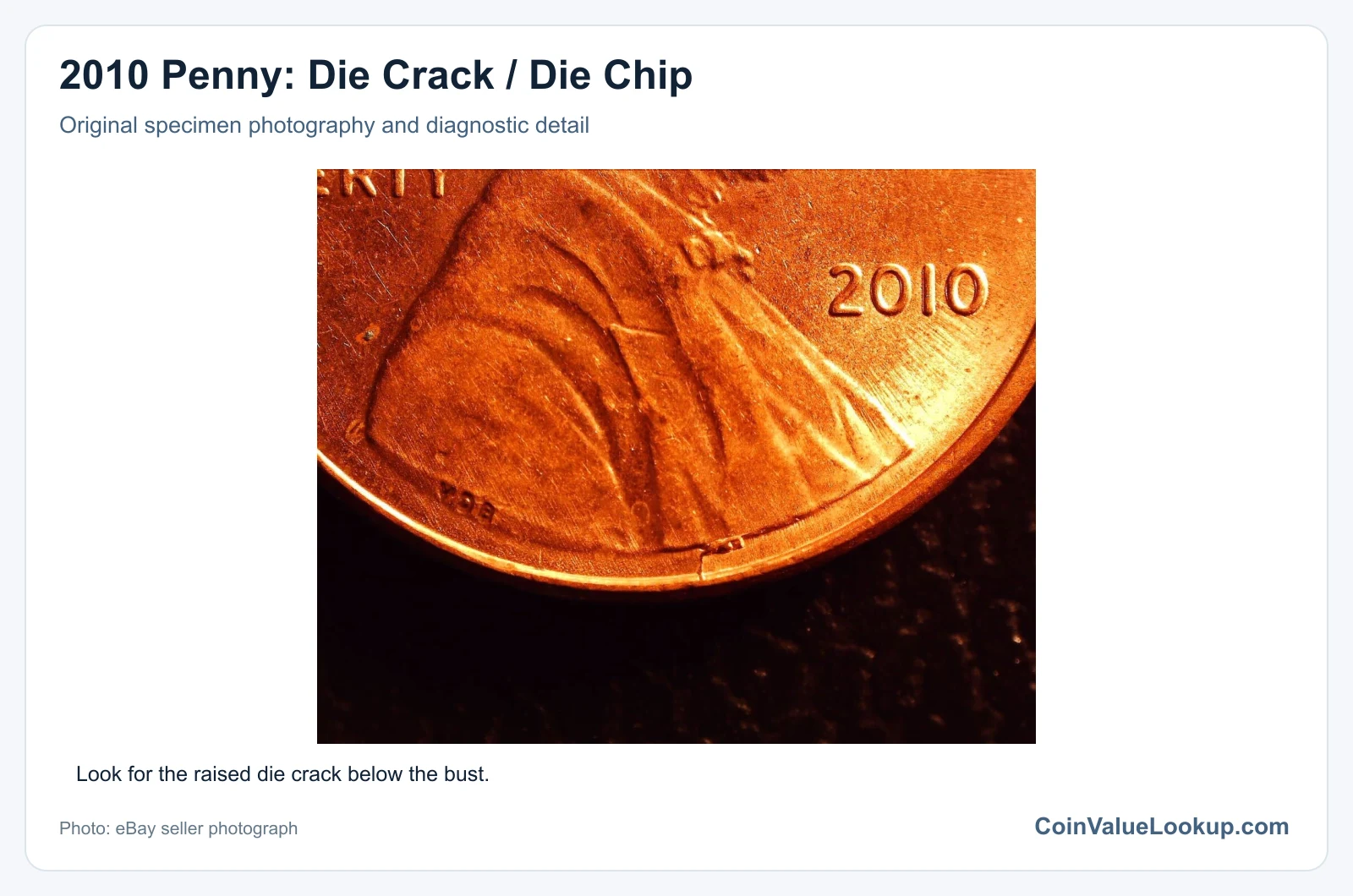
Die cracks appear as thin, raised lines on the coin's surface, tracing where the steel die fractured during use. Small raised blobs — die chips — come from tiny pieces of die breaking away, leaving a filled area that transfers as a raised lump.
These are among the most common minor errors on modern cents. A hairline crack across the field is interesting but not rare.
Larger cracks or chips that distort a letter or design element draw more attention from collectors.
The key diagnostic: the feature is raised above the coin's surface, not incised. Scratches, corrosion lines, and debris stuck to the die produce different textures.
No specific price is adopted; value varies with size, location, and visual impact of the crack or chip.
6. 2010 Lincoln Penny — BIE Die Break
The BIE error is a specific type of die break found on Lincoln cents where a raised vertical bar appears between the letters B and E in LIBERTY. It looks like an extra letter I wedged in there.
To check, examine LIBERTY under magnification. The bar should be raised metal — the same height as the surrounding letters — not a scratch or piece of debris.
It forms because the die cracked in that high-stress area between closely spaced letters.
Dirt lodged between the letters, fine scratches, or glue residue can mimic a BIE at first glance, so clean lighting and magnification matter. No specific price is adopted for this error on the 2010 cent.
Value depends on the prominence of the bar and the coin's overall condition.
7. 2010 Lincoln Penny — Die Break / Cud
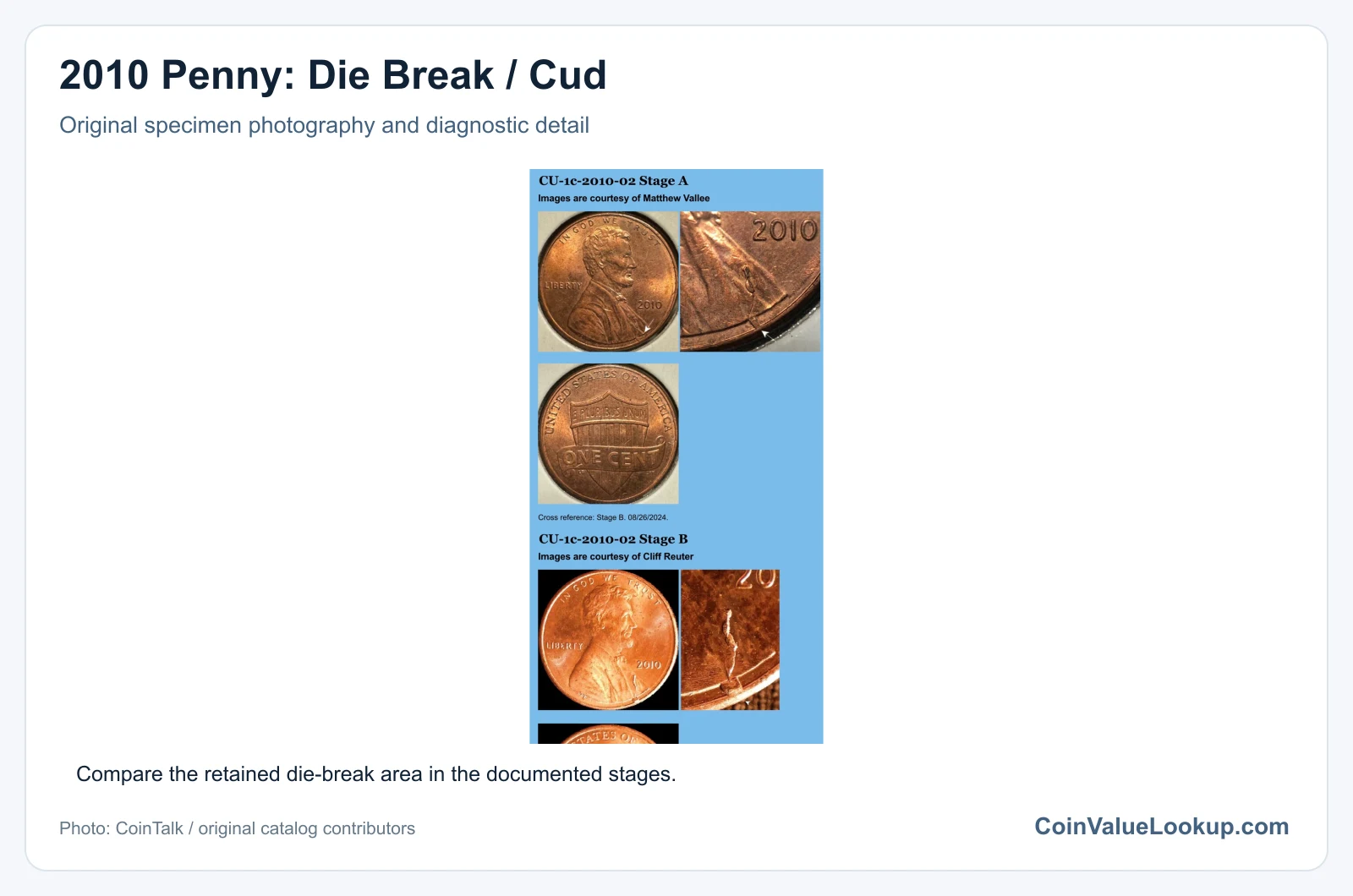
A cud is a major die break that connects to the rim. When a chunk of the die breaks away at the edge, the corresponding area on the coin is a raised, featureless blob merging into the rim.
Design details in that zone are obliterated.
Smaller interior die breaks that do not reach the rim are sometimes called retained cuds or simply die breaks — different animal. A true cud is rim-connected and unmistakable once you have seen one.
Do not confuse a cud with a rim ding, corrosion buildup, or an interior die chip. The boundary of a cud follows the shape of the missing die fragment and displaces the normal design.
No specific price is adopted for this error; a large, well-placed cud on a 2010 cent would be individually evaluated based on size, location, and authenticated condition.
8. 2010 Lincoln Penny — Die Cap / Capped-Die Strike
A die cap forms when a struck coin sticks to the upper die and keeps getting hit as new planchets feed in. The stuck coin gradually cups around the die like a bottle cap.
Coins struck beneath it receive a mirror-image impression of the cap's underside instead of the normal die design.
There are two collectibles here: the cap itself, which is deeply cupped and shows progressive distortion, and the coins struck through it, which display a mushy, brockage-like reverse of one side.
A bent coin or vise-damaged cent can look vaguely cap-like, but genuine caps show progressive metal flow and obverse-to-reverse design transfer that random damage does not replicate. No specific price is adopted; this is a dramatic error type and value depends entirely on authenticated condition and stage.
9. 2010 Lincoln Penny — Struck-Through Error
A struck-through error happens when foreign material — grease, wire, cloth, a fragment of another planchet — sits between the die and the planchet at the moment of striking. The result is a localized depression or impression in the coin's surface where the obstruction blocked the die.
Grease-filled dies are the most common version, leaving a smooth, flat blank area where design detail should be. A retained foreign object actually embedded in the coin's surface is much scarcer.
Ordinary wear, cleaning, and post-mint scratches can remove detail too, but they leave different surface textures. A struck-through area typically has sharp, well-defined borders matching the shape of the obstruction.
No specific price is adopted; value depends on what caused the obstruction, its size, and the coin's authenticated grade.
10. 2010 Lincoln Penny — Unplated / Partly Unplated Planchet
The 2010 cent is copper-plated zinc. An unplated or partly unplated error means the planchet entered the press without its full copper coating.
The exposed zinc surface appears silvery-gray, sometimes leading people to think they found a steel cent or an off-metal strike.
Check the weight — it should still be close to 2.50 grams. Fully unplated cents sometimes weigh slightly less because the copper layer is missing.
Look at the edge as well; a genuine unplated cent will show zinc all the way through, while a chemically stripped coin may show uneven removal or residual copper in protected areas.
Environmental corrosion can also strip copper plating over time, so professional authentication matters. No specific price is adopted for this error; value depends on the extent of missing plating and authenticated originality.
11. 2010 Lincoln Penny — Improper Annealing
Improper annealing refers to a planchet that was heated incorrectly during preparation. The result can be unusual surface discoloration — dark streaks, woodgrain patterns, or mottled toning — that looks different from ordinary environmental damage.
Compare the suspicious coin's surface to a normal 2010 cent. Annealing issues tend to produce colors and textures that follow the metal's flow lines rather than random splotches from moisture or chemicals.
The edge may also show the discoloration extending uniformly, which environmental damage rarely does.
That said, surface appearance alone is a screening clue, not proof. Heat damage from a house fire, chemical exposure, and prolonged soil burial can all create similar looks.
Professional authentication is the only reliable way to confirm this error. No specific price is adopted; value is determined individually based on the severity and authenticated cause.