2016 Lincoln Penny Coin Value: How Much Is It Worth?
Most 2016 Lincoln cents you find in pocket change are worth one cent, plain and simple. A well-preserved example graded MS65 carries a guide estimate around $0.36, while a San Francisco proof in PR65 is listed near $6.26.
These are guide figures, not guaranteed sale prices. Collector finishes, major varieties, and visible errors each occupy their own market and can shift values considerably.
Fast Way to Identify Your 2016 Lincoln Penny
The quickest way to start figuring out what you have is to upload clear photos of both the front and back of your coin. Our identifier can offer a preliminary read on the date, mintmark, and design type.
It is not a substitute for professional authentication or exact grading, but it gives you a solid starting point.
2016 Penny Value
Upload both sides of your 2016 Lincoln Penny.
Front Obverse
Upload photo
Back Reverse
Upload photo
Which 2016 Lincoln Penny Versions Are Worth Money?
- Uncirculated Philadelphia and Denver cents with full original red luster in MS65 or higher can bring a small premium over face value, with a guide estimate of $0.36 at MS65.
- San Francisco proof cents (S mintmark) are struck for collectors and carry a PR65 guide estimate around $6.26, well above a standard business strike.
Step 1: Identify Your 2016 Lincoln Penny Mint Mark and Version
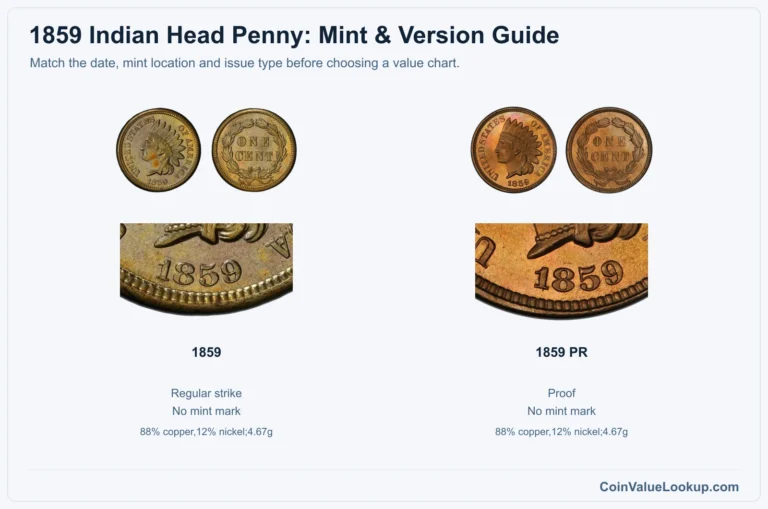
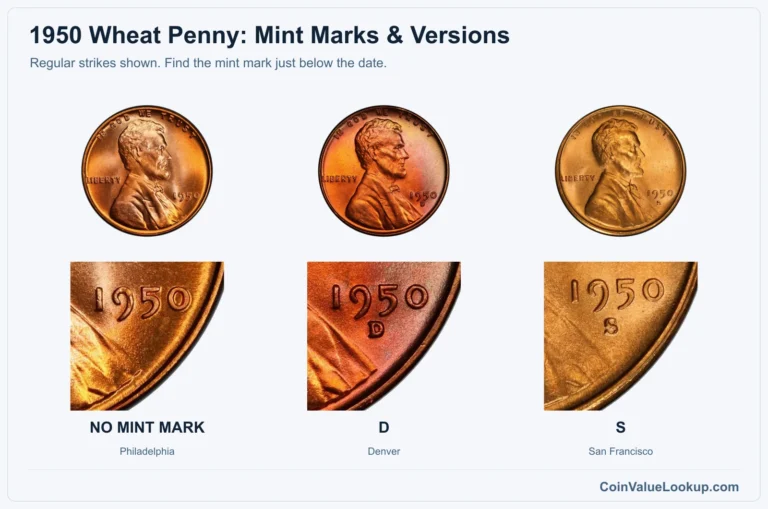
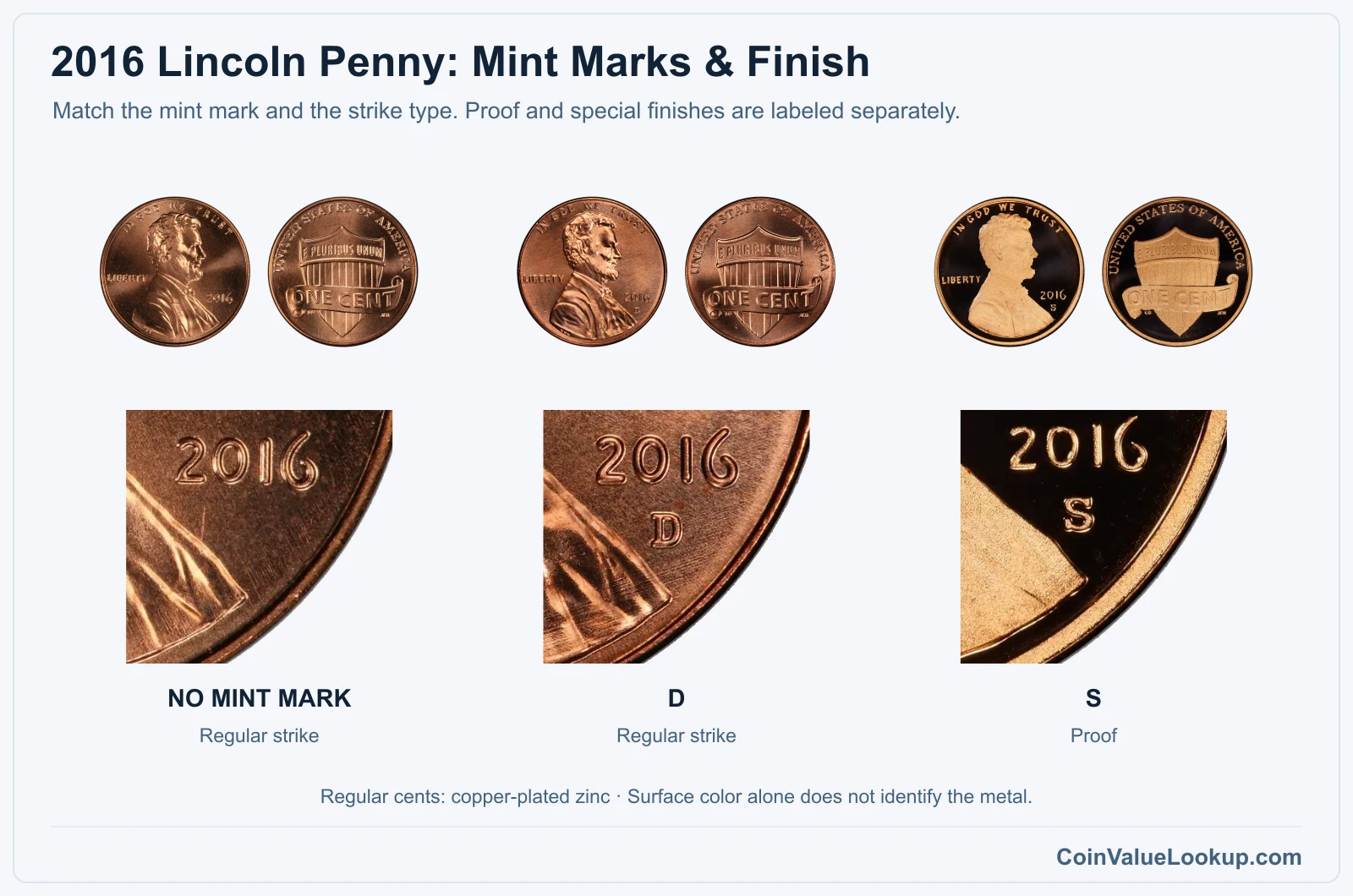
Flip your coin over and confirm the reverse shows the Union Shield design, which has been standard on Lincoln cents since 2010. On the obverse, look just below the date for a mintmark.
No letter means Philadelphia. A small D means Denver.
An S means San Francisco, and those are proof strikes sold in collector sets, not found in change.
All three versions share the same copper-plated zinc composition at a nominal 2.50 grams. The coin looks copper on the surface, but that is a thin plating over a zinc core.
You cannot identify an off-metal error by appearance alone, so weight matters if something looks unusual.
Coin Value Lookup is a handy place to look up guides for other dates and denominations in the Lincoln cent series, especially if you are sorting a whole jar of coins at once.
Step 2: Check Your 2016 Lincoln Penny Grade
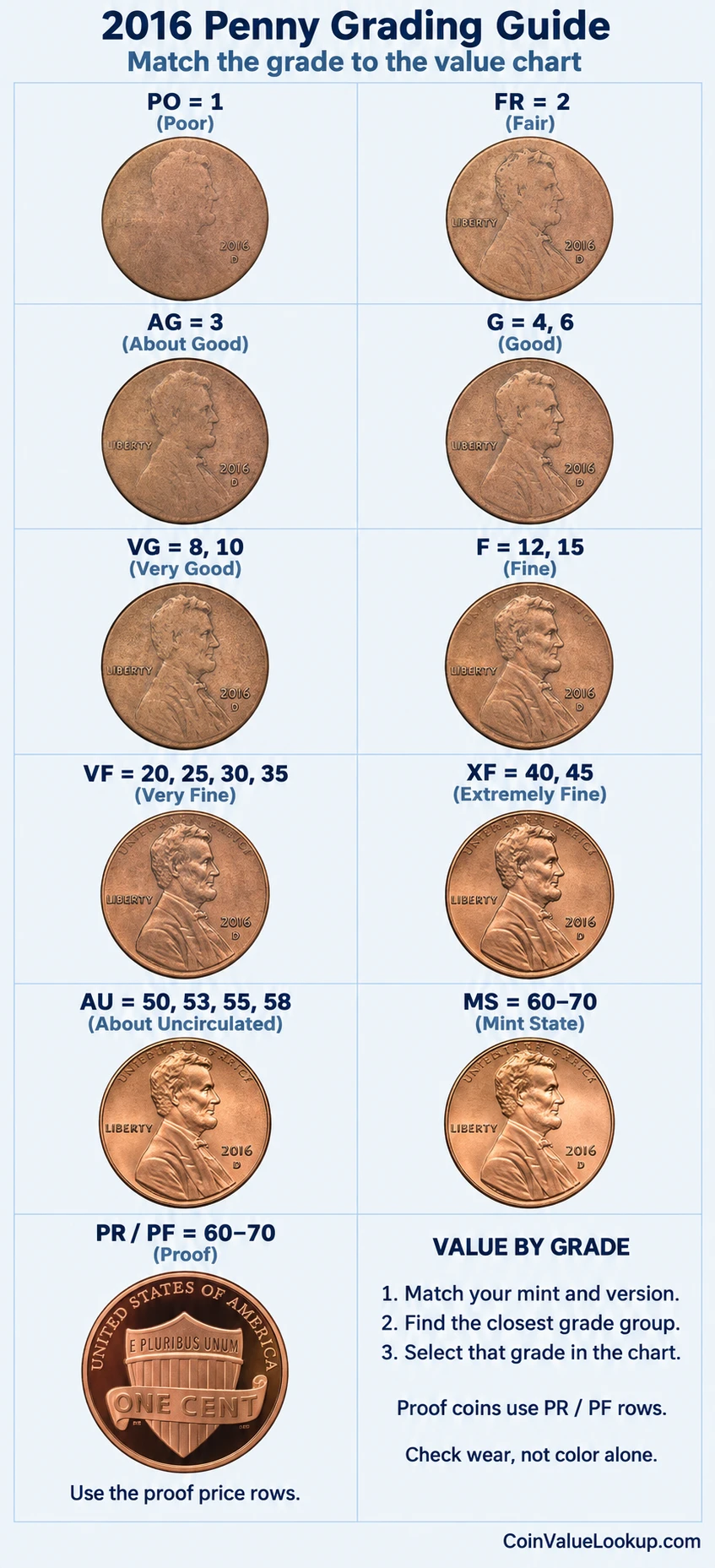
Start with Lincoln's cheek, jawline, and hair detail. On a lightly circulated coin, the cheek flattens first, followed by the hair above the ear.
A coin with full hair separation, strong jaw definition, and undisturbed luster across both sides is heading into Mint State territory. Compare yours to the reference image to gauge where it falls.
Color designations like RD (red), RB (red-brown), and BN (brown) describe how much original copper color remains. They are graded separately from wear.
A coin can be MS65 BN or MS65 RD, and the RD example will typically command more.
Proof coins have mirror-like fields and sharply struck devices. That is a manufacturing finish applied at San Francisco, not an indication that the coin grades higher than a business strike.
Evaluate proof surfaces for haze, hairlines, and contact marks just as you would any other coin.
Step 3: Check 2016 Lincoln Penny Value by Mint and Version
2016 Lincoln Penny — Shield
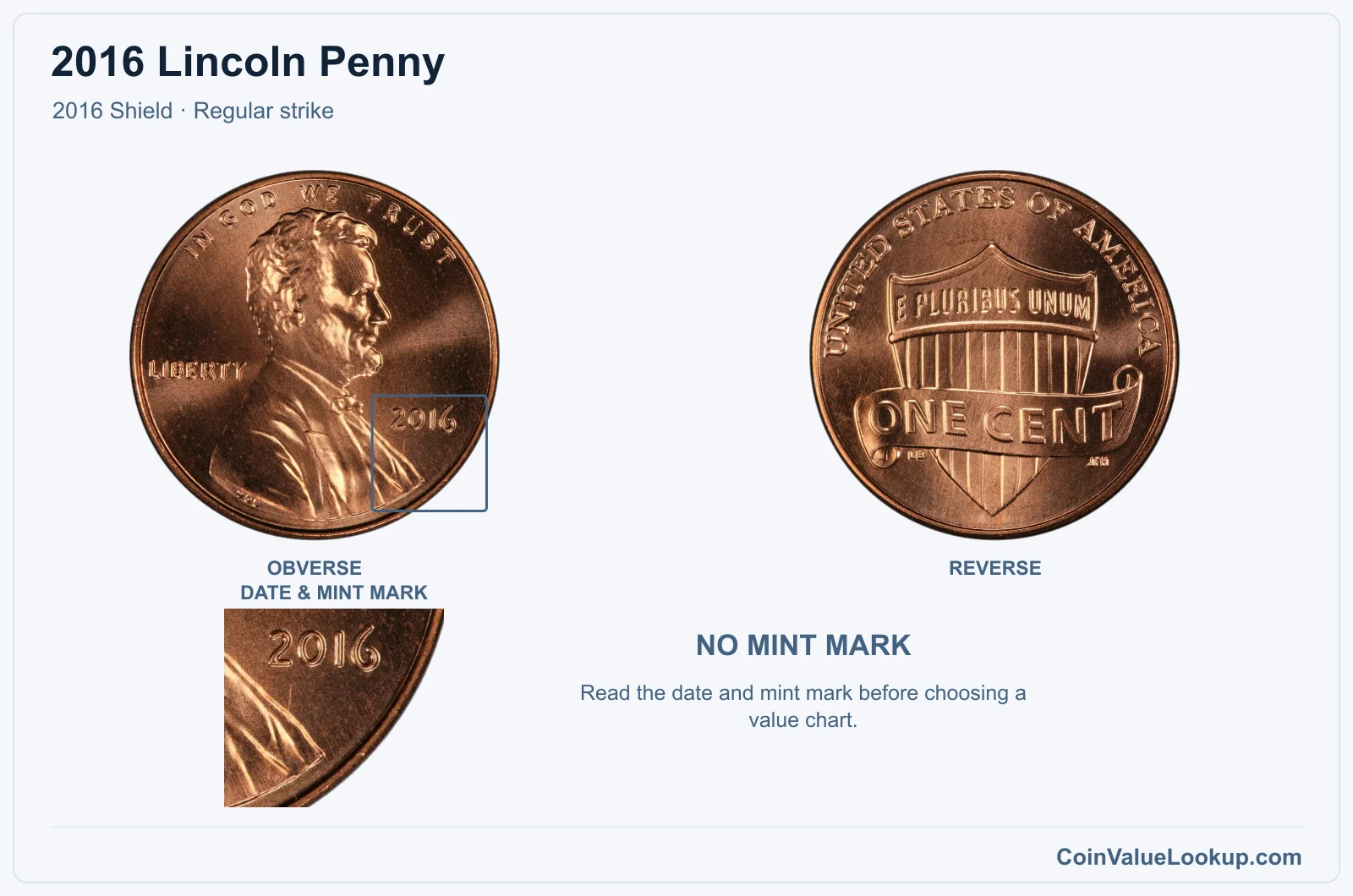
The 2016 Philadelphia cent has no mintmark below the date. Billions were struck, so circulated examples are worth face value.
The guide estimate at MS65 is $0.36. To reach that level, the coin needs full design detail, minimal contact marks, and strong remaining luster.
Original bright-red surfaces will add appeal over a toned or brown example. Check that the coin has not been cleaned, because artificial brightening destroys the natural surface and drops the grade sharply.
| Range | Grade | Price | Auction Records | Appraisal |
|---|---|---|---|---|
| PO | PO 1 | — | Coin Identifier | |
| FR | FR 2 | — | Coin Identifier | |
| AG | AG 3 | — | Coin Identifier | |
| G | G 4 | — | Coin Identifier | |
| G 6 | — | Coin Identifier | ||
| VG | VG 8 | — | Coin Identifier | |
| VG 10 | — | Coin Identifier | ||
| F | F 12 | — | Coin Identifier | |
| F 15 | — | Coin Identifier | ||
| VF | VF 20 | — | Coin Identifier | |
| VF 25 | — | Coin Identifier | ||
| VF 30 | — | Coin Identifier | ||
| VF 35 | — | Coin Identifier | ||
| XF | XF 40 | — | Coin Identifier | |
| XF 45 | — | Coin Identifier | ||
| AU | AU 50 | — | Coin Identifier | |
| AU 53 | — | Coin Identifier | ||
| AU 55 | — | Coin Identifier | ||
| AU 58 | — | Coin Identifier | ||
| MS | MS 60 | — | Coin Identifier | |
| MS 61 | — | Coin Identifier | ||
| MS 62 | — | Coin Identifier | ||
| MS 63 | — | Coin Identifier | ||
| MS 64 | — | Coin Identifier | ||
| MS 65 | — | Coin Identifier | ||
| MS 66 | Coin Identifier | |||
| MS 67 | Coin Identifier | |||
| MS 68 | — | Coin Identifier | ||
| MS 69 | — | — | — | |
| MS 70 | — | — | — |
2016 Lincoln Penny — D Shield
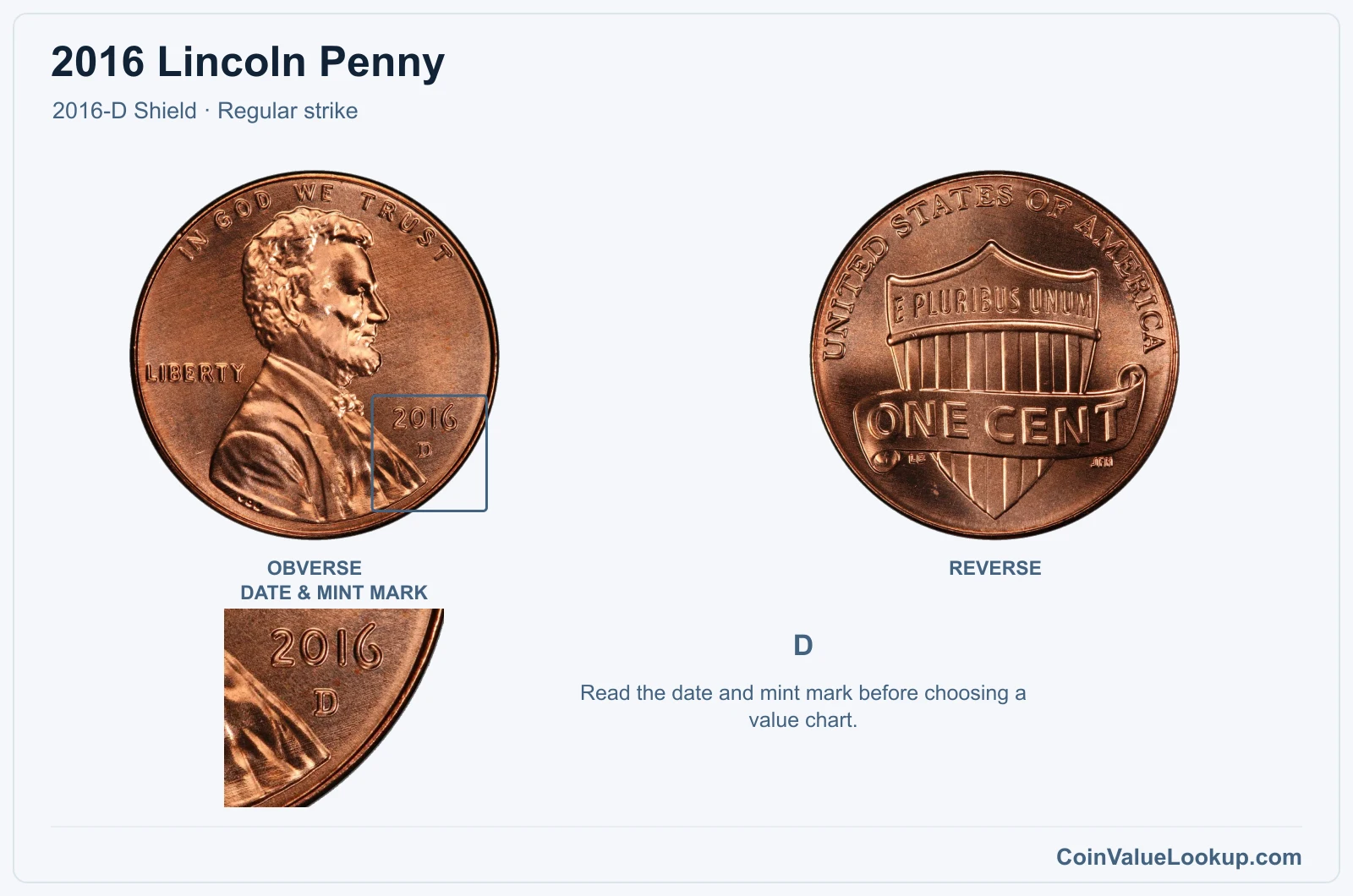
Look for the small D mintmark below the date. Denver produced these in similarly massive quantities, so worn pieces stay at one cent.
At MS65, the guide estimate matches the Philadelphia issue at $0.36. Grade and color make the difference here, not the mint.
Full luster with original red toning is what separates a common cent from one worth setting aside. As with all modern Lincoln cents, confirm the weight is close to 2.50 grams if anything about the planchet looks off.
| Range | Grade | Price | Auction Records | Appraisal |
|---|---|---|---|---|
| PO | PO 1 | — | Coin Identifier | |
| FR | FR 2 | — | Coin Identifier | |
| AG | AG 3 | — | Coin Identifier | |
| G | G 4 | — | Coin Identifier | |
| G 6 | — | Coin Identifier | ||
| VG | VG 8 | — | Coin Identifier | |
| VG 10 | — | Coin Identifier | ||
| F | F 12 | — | Coin Identifier | |
| F 15 | — | Coin Identifier | ||
| VF | VF 20 | — | Coin Identifier | |
| VF 25 | — | Coin Identifier | ||
| VF 30 | — | Coin Identifier | ||
| VF 35 | — | Coin Identifier | ||
| XF | XF 40 | — | Coin Identifier | |
| XF 45 | — | Coin Identifier | ||
| AU | AU 50 | — | Coin Identifier | |
| AU 53 | — | Coin Identifier | ||
| AU 55 | — | Coin Identifier | ||
| AU 58 | — | Coin Identifier | ||
| MS | MS 60 | — | Coin Identifier | |
| MS 61 | — | Coin Identifier | ||
| MS 62 | — | Coin Identifier | ||
| MS 63 | — | Coin Identifier | ||
| MS 64 | — | Coin Identifier | ||
| MS 65 | — | Coin Identifier | ||
| MS 66 | Coin Identifier | |||
| MS 67 | — | Coin Identifier | ||
| MS 68 | — | Coin Identifier | ||
| MS 69 | — | — | — | |
| MS 70 | — | — | — |
2016 Lincoln Penny — S Shield PR
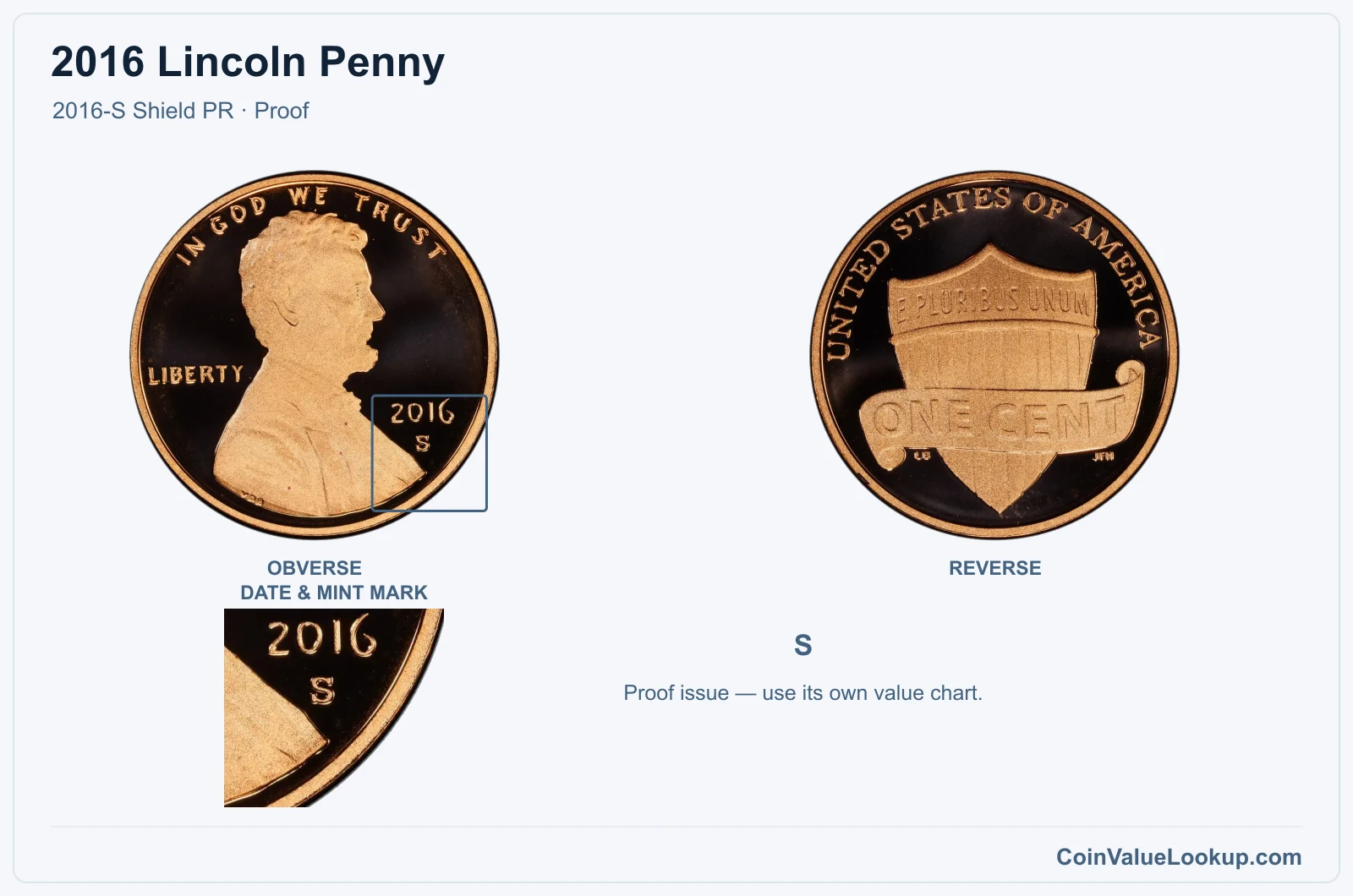
The 2016-S proof carries an S mintmark and was sold in San Francisco proof sets, not released into circulation. Mirror fields and frosted devices are the hallmarks of this finish.
A PR65 guide estimate sits at $6.26, making it the most accessible premium version in the 2016 Lincoln cent lineup at that grade level. Evaluate the fields for hairlines and haze under good lighting.
Cameo contrast, where the frosted design stands out crisply against the mirror background, is graded separately and can influence desirability. These are not rare coins, but they are purpose-built for collectors and priced accordingly above business strikes.
| Range | Grade | Price | Auction Records | Appraisal |
|---|---|---|---|---|
| PR | PR 1 | — | Coin Identifier | |
| PR 2 | — | Coin Identifier | ||
| PR 3 | — | Coin Identifier | ||
| PR 4 | — | Coin Identifier | ||
| PR 6 | — | Coin Identifier | ||
| PR 8 | — | Coin Identifier | ||
| PR 10 | — | Coin Identifier | ||
| PR 12 | — | Coin Identifier | ||
| PR 15 | — | Coin Identifier | ||
| PR 20 | — | Coin Identifier | ||
| PR 25 | — | Coin Identifier | ||
| PR 30 | — | Coin Identifier | ||
| PR 35 | — | Coin Identifier | ||
| PR 40 | — | Coin Identifier | ||
| PR 45 | — | Coin Identifier | ||
| PR 50 | — | Coin Identifier | ||
| PR 53 | — | Coin Identifier | ||
| PR 55 | — | Coin Identifier | ||
| PR 58 | — | Coin Identifier | ||
| PR 60 | — | Coin Identifier | ||
| PR 61 | — | Coin Identifier | ||
| PR 62 | — | Coin Identifier | ||
| PR 63 | — | Coin Identifier | ||
| PR 64 | — | Coin Identifier | ||
| PR 65 | — | Coin Identifier | ||
| PR 66 | — | Coin Identifier | ||
| PR 67 | — | Coin Identifier | ||
| PR 68 | — | Coin Identifier | ||
| PR 69 | — | Coin Identifier | ||
| PR 70 | — | Coin Identifier |
2016 Lincoln Penny Error List
1. 2016 Lincoln Penny — BIE Die Break
A BIE die break shows up as a small raised vertical bar or blob between the letters B and E in LIBERTY on the obverse. It is caused by a chip in the die face.
The result is a tiny extra element that looks almost like a capital I wedged between those two letters.
Do not confuse it with dirt, a scratch, or something stuck to the surface. A genuine BIE break is raised metal, part of the struck design, and appears in the same spot on every coin struck by that particular die.
No specific price range is adopted for this error on 2016 cents. Value depends on the clarity of the break, overall coin condition, and authentication by a recognized grading service.
2. 2016 Lincoln Penny — Struck-Through Error
A struck-through error occurs when foreign material sits between the die and the planchet during striking. The result is a localized depression or incomplete area in the design where the obstruction blocked the strike.
Grease fills create soft, mushy patches. A retained object, like a thread or metal fragment, leaves a sharper impression.
Do not confuse this with ordinary wear, cleaning damage, or weak strike from a worn die. A genuine struck-through has crisp boundaries matching the shape of whatever intervened.
No adopted price range exists for 2016 struck-through cents. Each piece is evaluated individually based on the size, location, and type of obstruction, plus the coin's overall condition and third-party authentication.
3. 2016 Lincoln Penny — Doubled Die
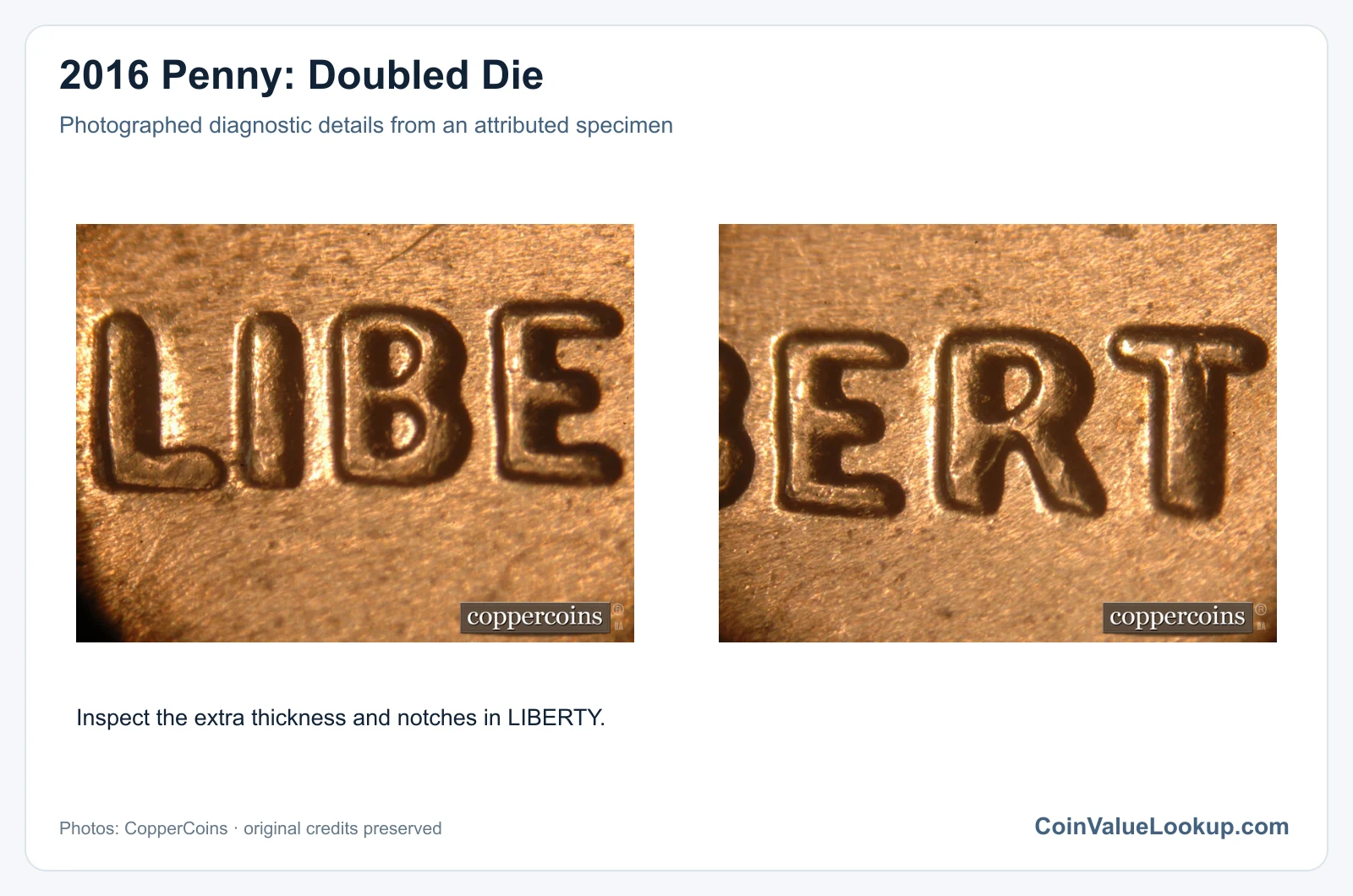
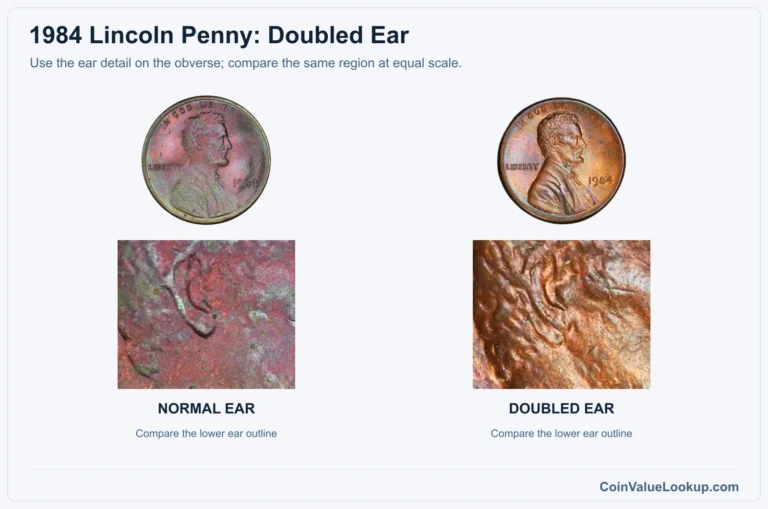
Doubled-die errors show consistent design separation or notching on affected elements of the coin. You might see a second outline on lettering, the date, or Lincoln's profile.
The doubling is part of the die itself, so every coin from that die shows the same shift in the same direction.
Machine doubling is the common lookalike. It produces flat, shelf-like distortion rather than the rounded, fully formed secondary image of a true doubled die.
Reflections and post-mint contact marks can also mimic doubling at first glance. No numerical price range is adopted for 2016 doubled-die cents.
Value hinges on the strength and location of the doubling, the coin's grade, and professional authentication.
4. 2016 Lincoln Penny — Die Break / Cud
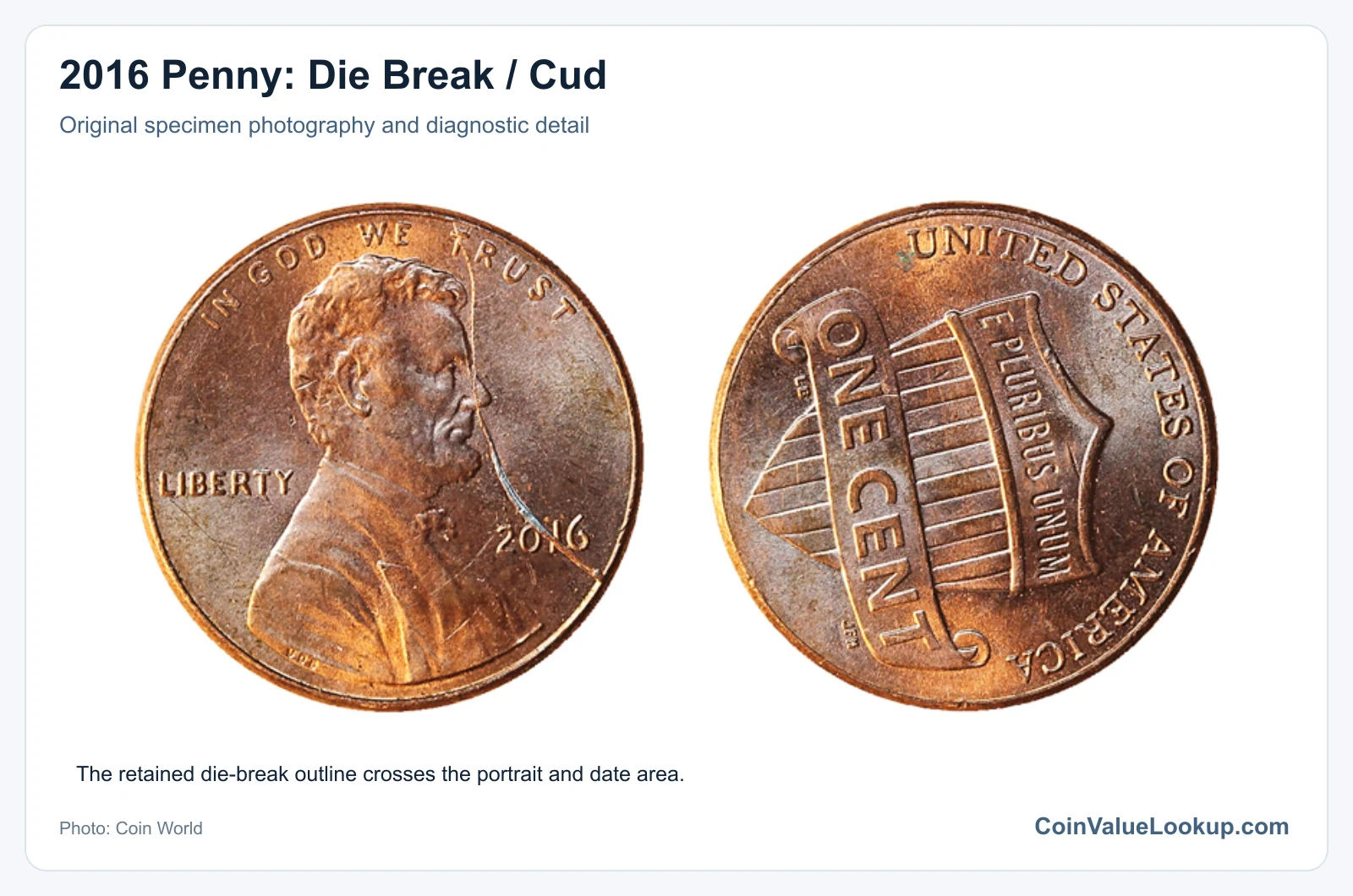
A cud is a specific type of die break where a piece of the die rim breaks away completely. The coin then shows a raised, featureless blob that connects directly to the rim, replacing whatever design was in that area.
Smaller interior die breaks that do not reach the rim are just die breaks, not cuds.
Do not mistake a rim dent, corrosion buildup, or interior die chip for a cud. A genuine cud has a smooth raised surface with a clear boundary where normal design resumes.
No specific price is adopted for 2016 cud errors. Larger cuds and those obscuring key design elements tend to be more desirable.
Authentication and condition determine individual value.
5. 2016 Lincoln Penny — Unplated / Partly Unplated Planchet
A 2016 cent struck on an unplated or partly unplated planchet will appear silvery-gray where the zinc core is exposed, instead of the usual copper color. The missing plating is a mint error that occurred before or during striking.
Partly unplated coins show patches of exposed zinc alongside normal copper-colored areas.
The big lookalike is a coin that had its plating chemically stripped or corroded away after leaving the mint. Genuine unplated errors usually have sharper strike detail in the bare zinc areas and consistent weight near 2.50 grams.
No adopted price range exists for this error on 2016 cents. Each coin is assessed individually based on the extent of missing plating, overall condition, and professional authentication.
6. 2016 Lincoln Penny — Off-Center Strike
An off-center strike happens when the planchet is not properly seated between the dies. The design shifts to one side and an unstruck crescent of blank metal appears opposite it.
The farther off center, the more dramatic the effect.
Coins that retain a full, readable date despite significant misalignment are generally the most sought after. Do not confuse this with a clipped planchet, one-sided die misalignment, or post-mint damage from being flattened.
A genuine off-center strike affects both sides symmetrically. No numerical price is adopted for 2016 off-center cents.
Value depends on the percentage of misalignment, date visibility, and authenticated condition.
7. 2016 Lincoln Penny — Die Crack / Die Chip
Die cracks appear as thin raised lines on the coin's surface, formed when the steel die develops a fracture. Die chips are small raised blobs from localized die damage.
Both are common on high-production modern cents because dies wear out fast under heavy use.
Raised is the key word. Scratches and incuse lines are cut into the surface, not above it.
Corrosion and foreign material can also mimic die cracks at a glance, so look carefully at the profile under magnification. An interior chip stays away from the rim, while a crack that reaches the rim might overlap with a cud.
No price range is adopted for 2016 die crack or die chip cents. Severity, location, and overall grade determine individual value.
8. 2016 Lincoln Penny — Clashed Dies
Clashed dies result from the obverse and reverse dies striking each other without a planchet in between. The impact transfers faint traces of each die's design onto the opposing die face.
On subsequent coins, you can spot ghost-like impressions of the reverse design in the obverse fields, or vice versa.
These transferred images align with where the opposite design would sit during a normal strike. Do not confuse clash marks with random scratches, raised lines from die cracks, or brockage errors.
No adopted price range exists for 2016 clashed-die cents. Value depends on the boldness and clarity of the transferred design, the coin's condition, and professional authentication confirming the error.
9. 2016 Lincoln Penny — Broadstrike
A broadstrike occurs when the collar die, which normally confines the planchet during striking, fails to engage. The metal spreads outward freely, producing a coin that is wider than normal with a missing or distorted rim.
The full design is present but stretched toward the edges.
Compare the edge profile to a normal cent. A broadstrike shows a smooth, rounded edge rather than the usual reeded or upset rim.
Do not confuse it with an off-center strike, where design is missing, or with a coin flattened by machinery after leaving the mint. No numerical price is adopted for 2016 broadstrike cents.
Each example is valued individually based on the degree of spread, overall condition, and third-party authentication.
10. 2016 Lincoln Penny — Partial Collar Strike
A partial collar strike produces a stepped or uneven edge where part of the planchet was inside the collar and part was not. One section of the rim looks normal while the rest flares outward or shows a visible ledge.
The effect is sometimes called a railroad rim because of that distinct step.
Compare the edge all the way around under magnification. A complete broadstrike lacks a rim entirely, while a partial collar has a clear transition between confined and unconfined areas.
Edge damage from circulation or post-mint contact can mimic the look but will not show that clean, consistent step. No adopted price exists for 2016 partial collar strikes.
Value depends on how pronounced the step is, overall coin condition, and professional authentication.