2018 Lincoln Penny Coin Value: How Much Is It Worth?
Most 2018 Lincoln pennies you pull from pocket change are worth one cent. An uncirculated example grading MS65 carries a guide estimate around $0.36, while a standard San Francisco proof at PR65 is estimated near $6.26.
Collector finishes like the S reverse proof, recognized error coins, and well-preserved high-grade pieces each occupy their own market and can be worth considerably more.
Fast Way to Identify Your 2018 Lincoln Penny
Snap a clear photo of the front and back of your 2018 penny and upload both images. Our identifier can give you a preliminary read on which version you have, whether it is a Philadelphia, Denver, or San Francisco issue, and what finish it appears to carry.
That is not a substitute for professional authentication, but it is a solid first step.
2018 Penny Value
Upload both sides of your 2018 Lincoln Penny.
Front Obverse
Upload photo
Back Reverse
Upload photo
Which 2018 Lincoln Penny Versions Are Worth Money?
- The 2018-S Reverse Proof penny has a PR65 guide estimate of $38, well above the standard proof, because of its limited distribution and distinctive frosted-field finish.
- Standard S proofs carry a PR65 guide estimate around $6.26 and came in San Francisco proof sets, not circulation.
- Philadelphia and Denver business strikes are common in circulation but can carry a small premium in original bright uncirculated condition.
- Error coins such as doubled dies, off-center strikes, or wrong-planchet pieces are assessed individually and can exceed typical values significantly.
Step 1: Identify Your 2018 Lincoln Penny Mint Mark and Version
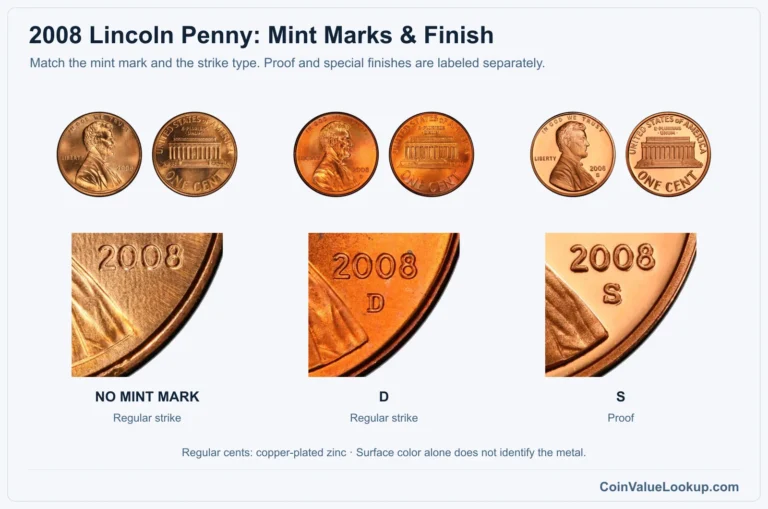
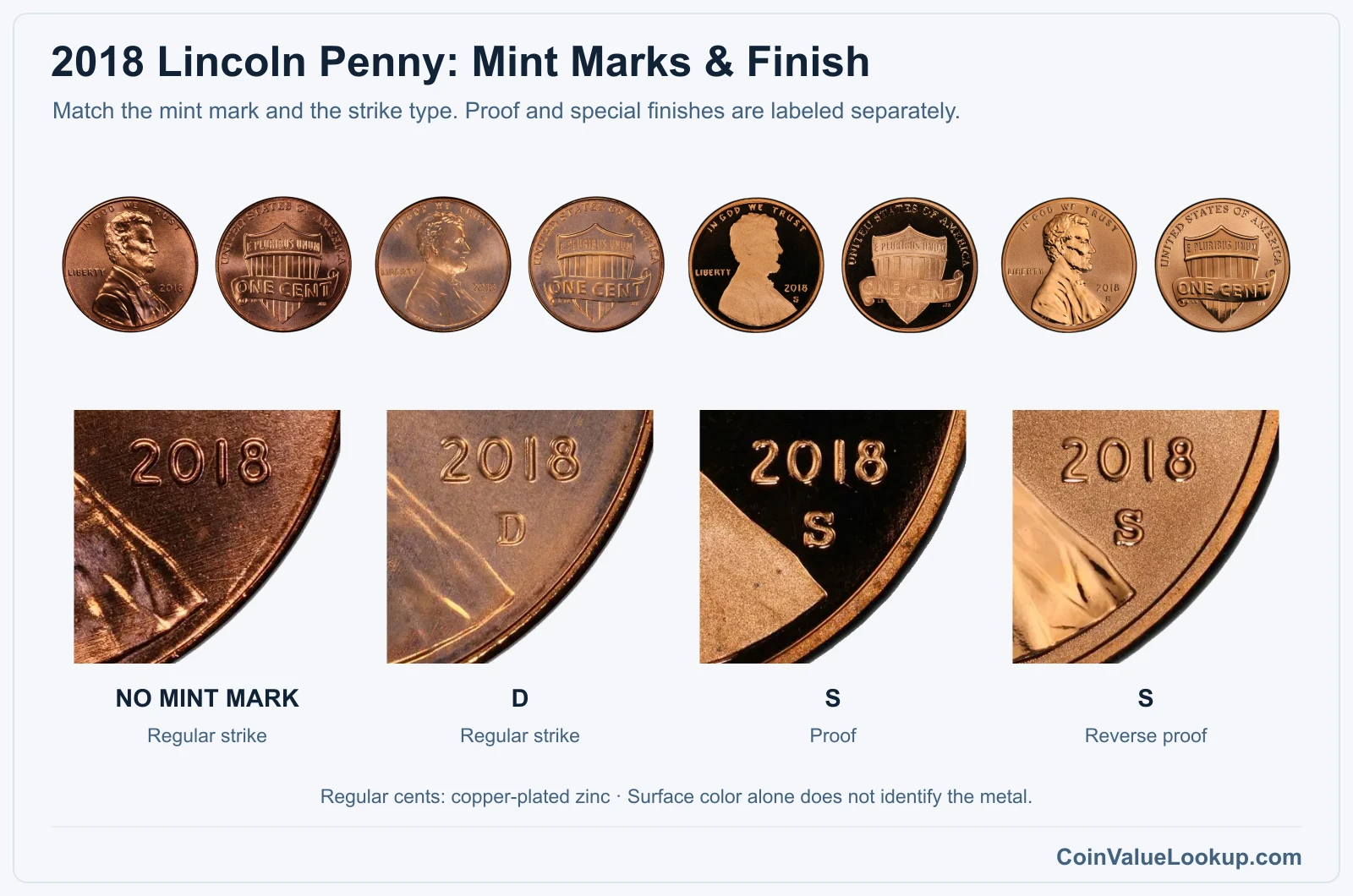
Flip your coin to the obverse and look just below the date. No letter at all means Philadelphia.
A small D means Denver. An S means San Francisco, but you still need to determine if it is a standard proof or a reverse proof.
The reverse should show the Union Shield design used on Lincoln cents since 2010. If your reverse has the Lincoln Memorial or any other design, you may have a different year entirely.
All standard 2018 cents are copper-plated zinc, weighing a nominal 2.50 grams. They look copper on the outside but are mostly zinc underneath.
A coin that appears silver or gray could be an error, or it could be damaged. Weight and diameter measurements help sort that out, and appearance alone is not enough to confirm an off-metal strike.
Step 2: Check Your 2018 Lincoln Penny Grade
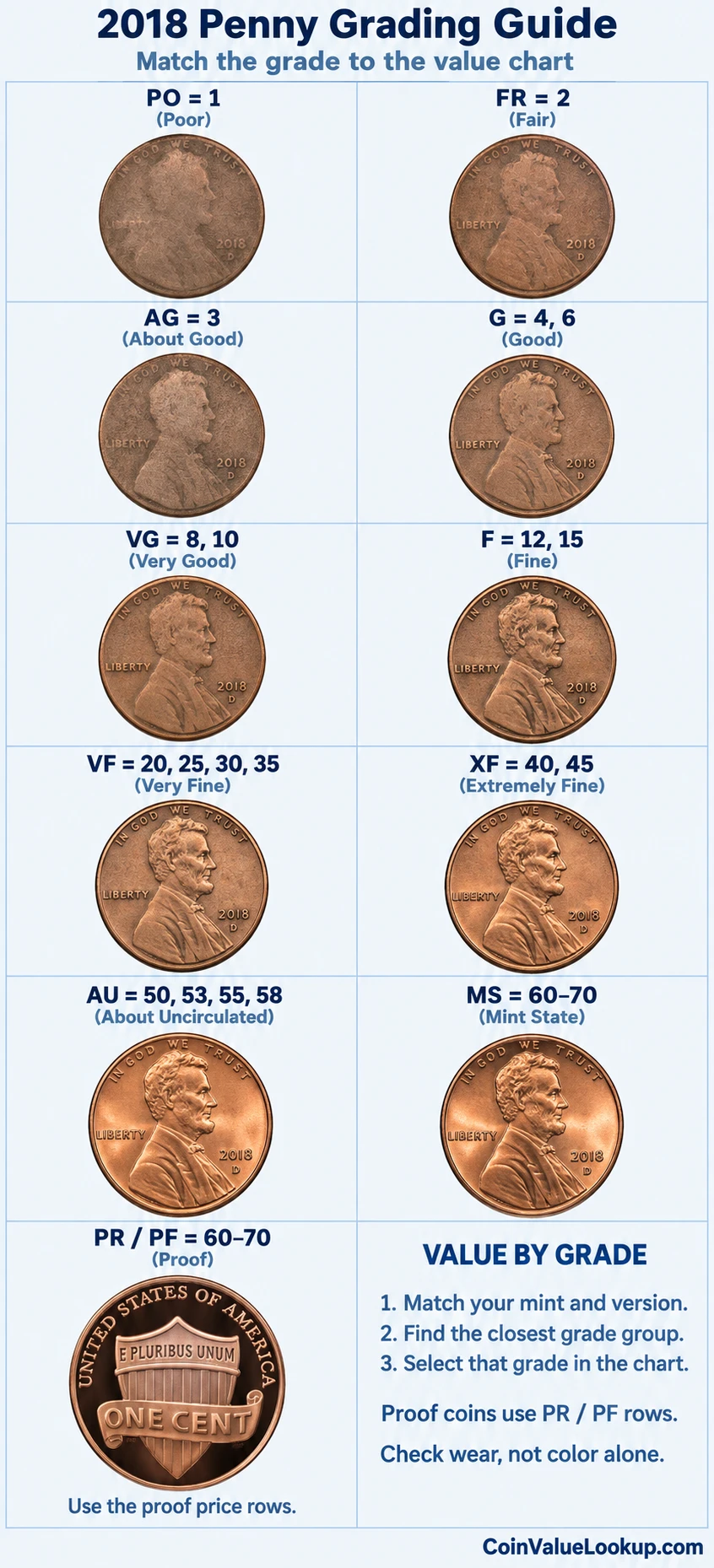
Start with Lincoln's cheek and jawline. On a well-preserved coin these areas show full detail and no flatness.
As the coin circulates, the cheek wears first, then the hair above his ear loses sharpness.
On the reverse, inspect the horizontal lines across the shield. Early wear softens these lines and reduces luster in the flat areas between them.
Color matters too. RD (red), RB (red-brown), and BN (brown) describe how much original copper color remains, and they are graded separately from the amount of wear.
A coin can be technically uncirculated but heavily toned to brown. Compare your coin to the reference image to gauge where it falls.
Proof and reverse proof are manufacturing finishes, not grades above Mint State. A proof coin can still have contact marks or haze that lower its assigned grade.
Step 3: Check 2018 Lincoln Penny Value by Mint and Version
2018 Lincoln Penny — Shield
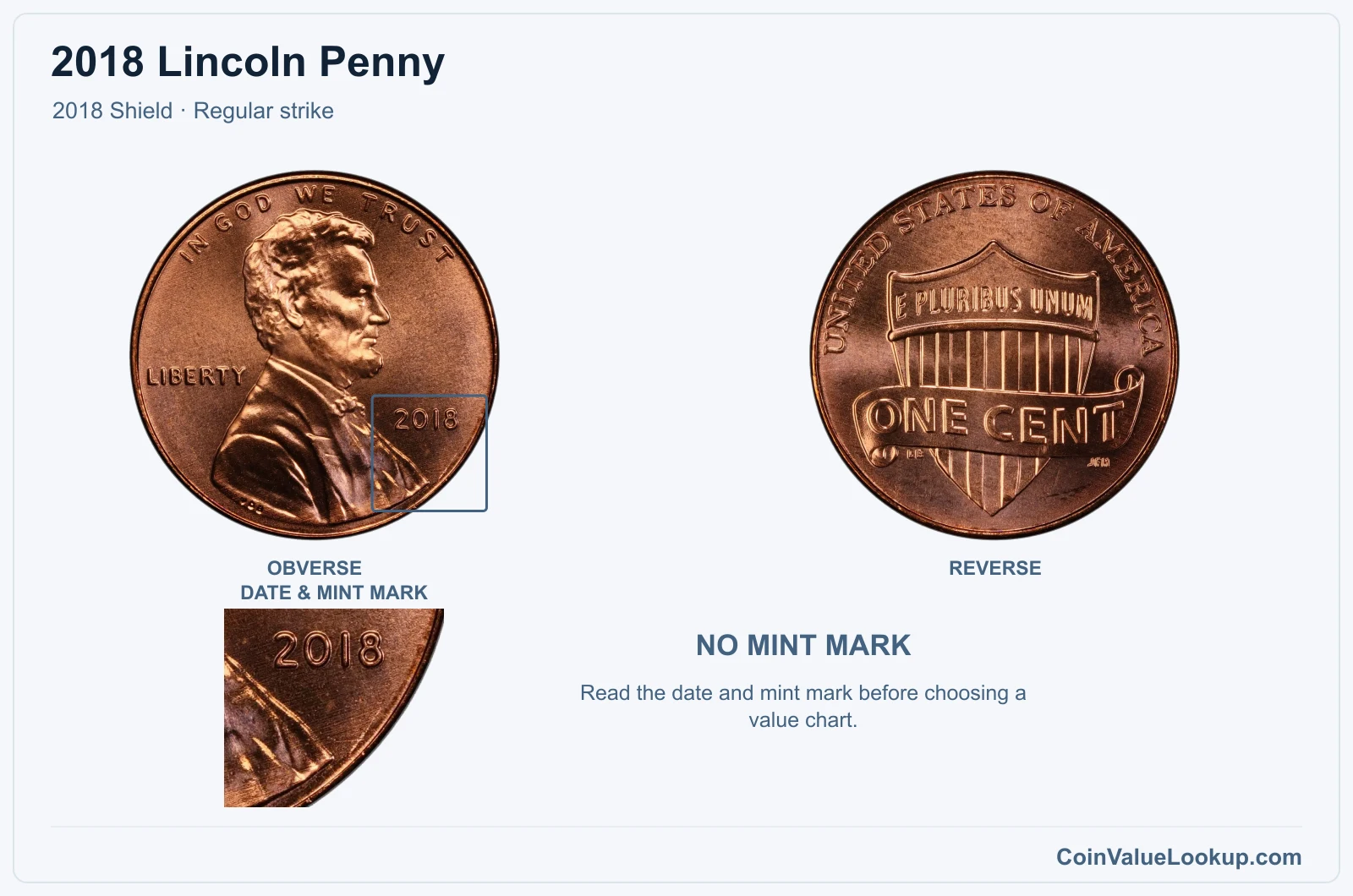
The 2018 Philadelphia cent has no mintmark below the date. Billions were struck, so circulated examples are worth face value.
In MS65 condition with full luster and minimal contact marks, a guide estimate sits around $0.36.
Look for original red surfaces. Coins that still show bright copper color (RD designation) tend to command the strongest premiums in uncirculated grades.
Any cleaning, re-coloring, or environmental damage drops the coin back toward face value quickly.
| Range | Grade | Price | Auction Records | Appraisal |
|---|---|---|---|---|
| PO | PO 1 | — | Coin Identifier | |
| FR | FR 2 | — | Coin Identifier | |
| AG | AG 3 | — | Coin Identifier | |
| G | G 4 | — | Coin Identifier | |
| G 6 | — | Coin Identifier | ||
| VG | VG 8 | — | Coin Identifier | |
| VG 10 | — | Coin Identifier | ||
| F | F 12 | — | Coin Identifier | |
| F 15 | — | Coin Identifier | ||
| VF | VF 20 | — | Coin Identifier | |
| VF 25 | — | Coin Identifier | ||
| VF 30 | — | Coin Identifier | ||
| VF 35 | — | Coin Identifier | ||
| XF | XF 40 | — | Coin Identifier | |
| XF 45 | — | Coin Identifier | ||
| AU | AU 50 | — | Coin Identifier | |
| AU 53 | — | Coin Identifier | ||
| AU 55 | — | Coin Identifier | ||
| AU 58 | — | Coin Identifier | ||
| MS | MS 60 | — | Coin Identifier | |
| MS 61 | — | Coin Identifier | ||
| MS 62 | — | Coin Identifier | ||
| MS 63 | — | Coin Identifier | ||
| MS 64 | — | Coin Identifier | ||
| MS 65 | — | Coin Identifier | ||
| MS 66 | — | Coin Identifier | ||
| MS 67 | — | Coin Identifier | ||
| MS 68 | Coin Identifier | |||
| MS 69 | — | — | — | |
| MS 70 | — | — | — |
2018 Lincoln Penny — D Shield
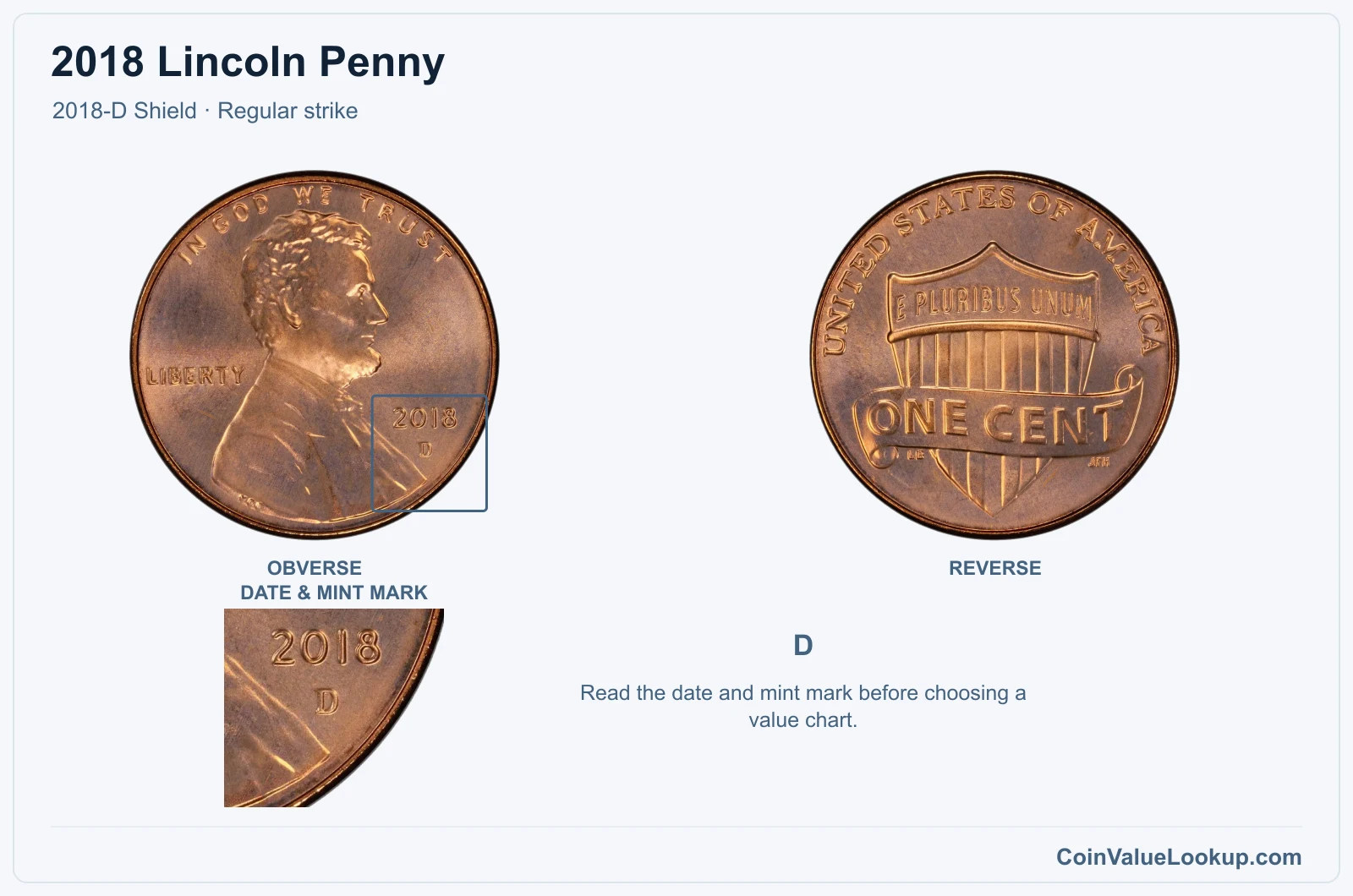
Look for a small D mintmark below the date. The Denver issue mirrors Philadelphia in composition and design, and it is equally common in change.
A guide estimate for this coin at MS65 is about $0.36. In worn condition it is a one-cent coin, full stop.
What you want to find is a bright, mark-free example straight from a fresh roll, ideally with full red color still intact.
Coin Value Lookup is a handy place to compare guide values across years and mints if you are sorting through a pile of modern cents.
| Range | Grade | Price | Auction Records | Appraisal |
|---|---|---|---|---|
| PO | PO 1 | — | Coin Identifier | |
| FR | FR 2 | — | Coin Identifier | |
| AG | AG 3 | — | Coin Identifier | |
| G | G 4 | — | Coin Identifier | |
| G 6 | — | Coin Identifier | ||
| VG | VG 8 | — | Coin Identifier | |
| VG 10 | — | Coin Identifier | ||
| F | F 12 | — | Coin Identifier | |
| F 15 | — | Coin Identifier | ||
| VF | VF 20 | — | Coin Identifier | |
| VF 25 | — | Coin Identifier | ||
| VF 30 | — | Coin Identifier | ||
| VF 35 | — | Coin Identifier | ||
| XF | XF 40 | — | Coin Identifier | |
| XF 45 | — | Coin Identifier | ||
| AU | AU 50 | — | Coin Identifier | |
| AU 53 | — | Coin Identifier | ||
| AU 55 | — | Coin Identifier | ||
| AU 58 | — | Coin Identifier | ||
| MS | MS 60 | — | Coin Identifier | |
| MS 61 | — | Coin Identifier | ||
| MS 62 | — | Coin Identifier | ||
| MS 63 | — | Coin Identifier | ||
| MS 64 | — | Coin Identifier | ||
| MS 65 | — | Coin Identifier | ||
| MS 66 | — | Coin Identifier | ||
| MS 67 | Coin Identifier | |||
| MS 68 | Coin Identifier | |||
| MS 69 | — | — | — | |
| MS 70 | — | — | — |
2018 Lincoln Penny — S Shield PR
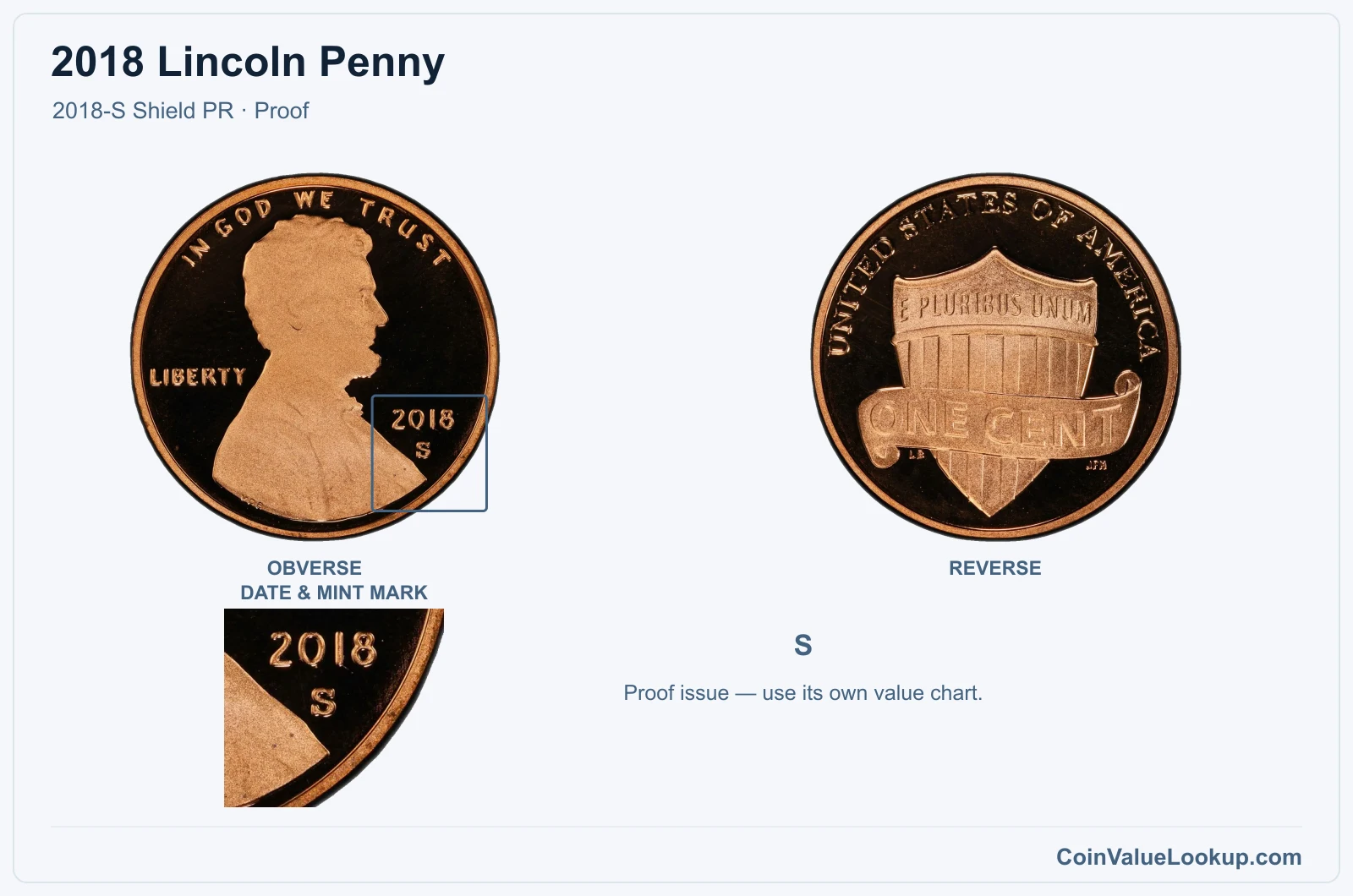
The 2018-S proof was struck at San Francisco and carries an S mintmark. It was sold in proof sets, not released into circulation.
Mirror-like fields and sharply struck devices distinguish a proof from a business strike.
At PR65, the guide estimate is approximately $6.26. Coins with strong contrast between frosted devices and reflective fields may grade higher and bring more.
Handle proofs by the edge only; fingerprints on those mirror surfaces are permanent problems.
| Range | Grade | Price | Auction Records | Appraisal |
|---|---|---|---|---|
| PR | PR 1 | — | Coin Identifier | |
| PR 2 | — | Coin Identifier | ||
| PR 3 | — | Coin Identifier | ||
| PR 4 | — | Coin Identifier | ||
| PR 6 | — | Coin Identifier | ||
| PR 8 | — | Coin Identifier | ||
| PR 10 | — | Coin Identifier | ||
| PR 12 | — | Coin Identifier | ||
| PR 15 | — | Coin Identifier | ||
| PR 20 | — | Coin Identifier | ||
| PR 25 | — | Coin Identifier | ||
| PR 30 | — | Coin Identifier | ||
| PR 35 | — | Coin Identifier | ||
| PR 40 | — | Coin Identifier | ||
| PR 45 | — | Coin Identifier | ||
| PR 50 | — | Coin Identifier | ||
| PR 53 | — | Coin Identifier | ||
| PR 55 | — | Coin Identifier | ||
| PR 58 | — | Coin Identifier | ||
| PR 60 | — | Coin Identifier | ||
| PR 61 | — | Coin Identifier | ||
| PR 62 | — | Coin Identifier | ||
| PR 63 | — | Coin Identifier | ||
| PR 64 | — | Coin Identifier | ||
| PR 65 | — | Coin Identifier | ||
| PR 66 | — | Coin Identifier | ||
| PR 67 | — | Coin Identifier | ||
| PR 68 | — | Coin Identifier | ||
| PR 69 | — | Coin Identifier | ||
| PR 70 | — | Coin Identifier |
2018 Lincoln Penny — S Reverse Proof
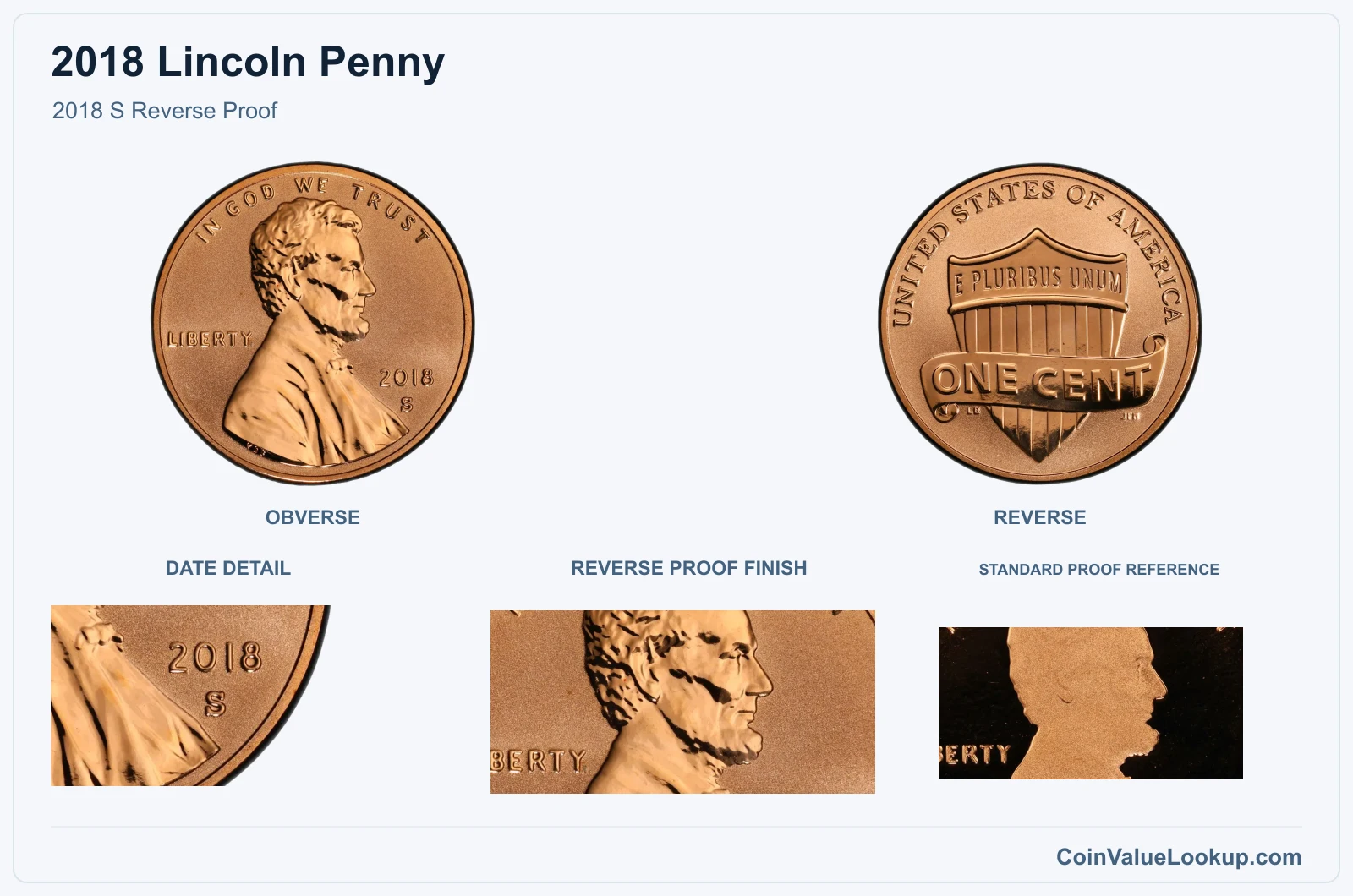
This is the one to watch. The 2018-S Reverse Proof Lincoln cent flips the usual proof contrast: the fields are frosted and the raised devices are brilliant.
It was included in the San Francisco Mint Silver Reverse Proof Set, which limits its availability compared to regular proofs.
The PR65 guide estimate is around $38, making it the standout among 2018 Lincoln cents. Confirming you have a genuine reverse proof requires examining the finish carefully.
Normal proofs have mirror fields; reverse proofs have mirror devices. If both the fields and devices look mirrored, you likely have a standard proof with strong cameo, not a reverse proof.
Preserve original surfaces. Any cleaning or improper storage will hurt the grade and the premium.
Range Grade
Price Auction Records Appraisal PR PR 1
—
Coin Identifier
PR 2
—
Coin Identifier
PR 3
—
Coin Identifier
PR 4
—
Coin Identifier
PR 6
—
Coin Identifier
PR 8
—
Coin Identifier
PR 10
—
Coin Identifier
PR 12
—
Coin Identifier
PR 15
—
Coin Identifier
PR 20
—
Coin Identifier
PR 25
—
Coin Identifier
PR 30
—
Coin Identifier
PR 35
—
Coin Identifier
PR 40
—
Coin Identifier
PR 45
—
Coin Identifier
PR 50
—
Coin Identifier
PR 53
—
Coin Identifier
PR 55
—
Coin Identifier
PR 58
—
Coin Identifier
PR 60
—
Coin Identifier
PR 61
—
Coin Identifier
PR 62
—
Coin Identifier
PR 63
—
Coin Identifier
PR 64
—
Coin Identifier
PR 65
—
Coin Identifier
PR 66
—
Coin Identifier
PR 67
—
Coin Identifier
PR 68
—
Coin Identifier
PR 69
—
Coin Identifier
PR 70
—
Coin Identifier
2018 Lincoln Penny Error List
1. 2018 Lincoln Penny — Doubled Die Obverse
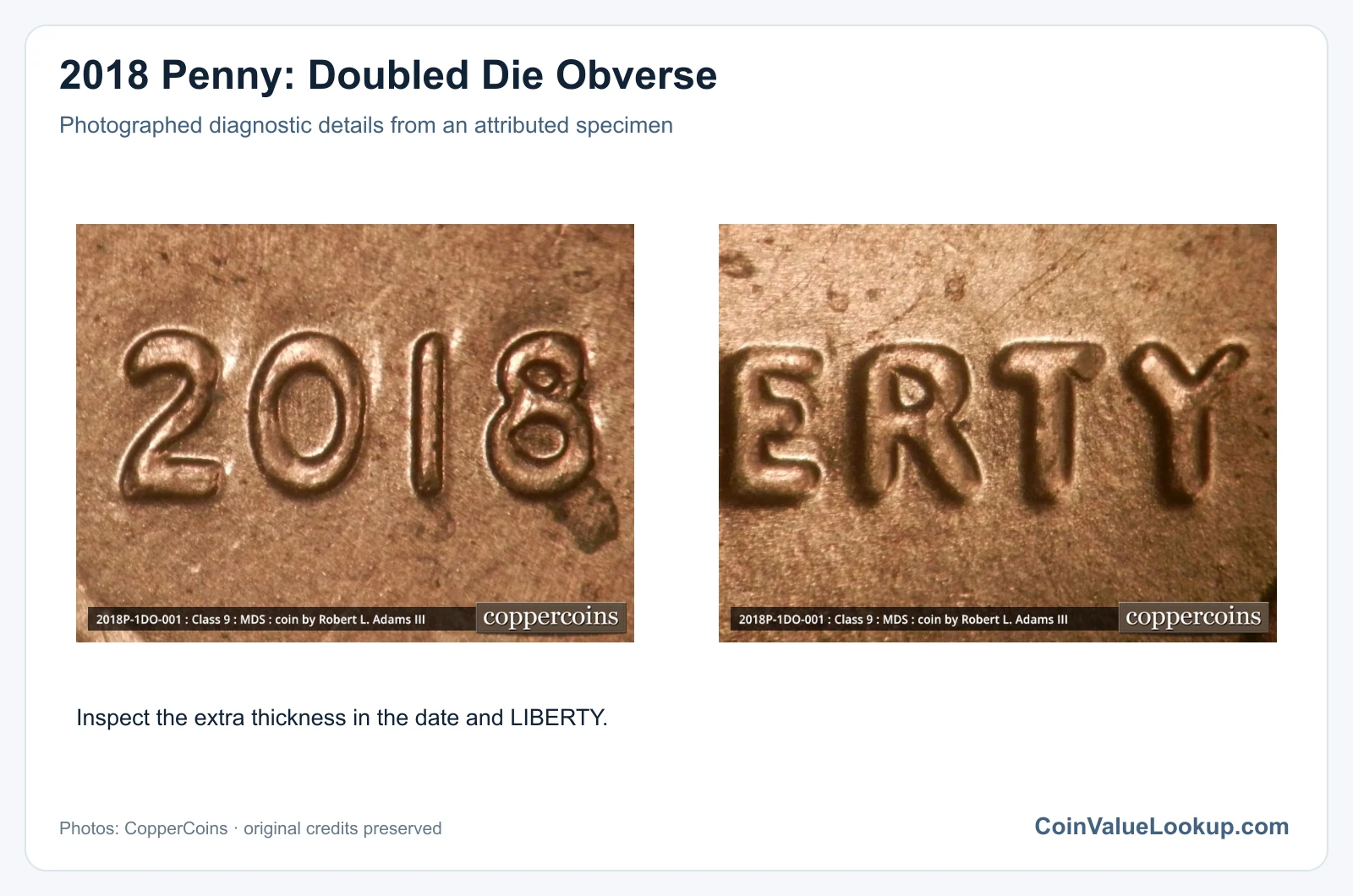
A doubled die obverse on a 2018 cent shows consistent doubling in the obverse lettering or design elements. Under magnification, look for separation or notching on letters like LIBERTY or IN GOD WE TRUST that repeats in the same direction on every affected letter.
The key distinction is consistency. Machine doubling produces a flat, shelf-like displacement that lacks the rounded, raised profile of a true doubled die.
Reflections from lighting or slight wear can also mimic doubling to the untrained eye.
No specific price range is adopted for this error. Value depends on the particular die, the severity of the doubling, the coin's grade, and whether it has been authenticated by a grading service.
Individual assessment is essential.
2. 2018 Lincoln Penny — Doubled Die Reverse
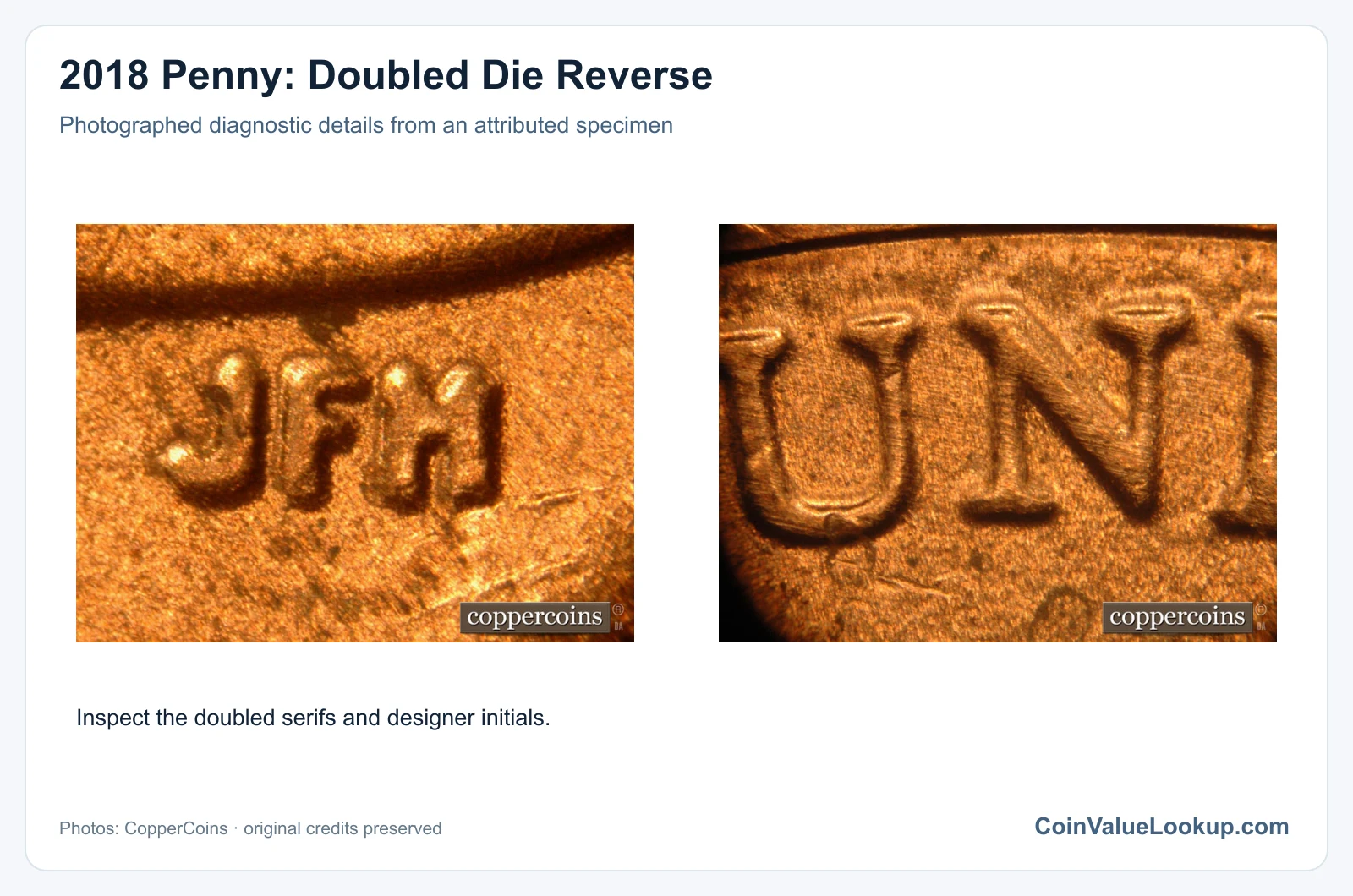
A doubled die reverse affects the shield design, lettering, or other reverse elements. Compare your coin's reverse legends and design contours against a normal 2018 cent under the same magnification and lighting.
Genuine doubled die reverses show crisp, directional separation in the affected areas. Machine doubling, by contrast, tends to look flat and washed out.
Random scratches or damage will not repeat in a consistent pattern across multiple design elements.
No supported price range exists for this category on the 2018 cent. The value of any individual doubled die reverse depends on its authenticated identity, the strength of the doubling, and the coin's overall condition.
3. 2018 Lincoln Penny — Off-Center Strike
An off-center strike happens when the planchet is not properly seated between the dies. The result is a displaced design with a blank crescent where the die did not reach.
The most collectible off-center errors still show the full date. Without the date, it is very difficult to attribute the coin to a specific year, and that limits demand.
Moderate off-center percentages with a visible date tend to attract the most interest.
Do not confuse a clipped planchet (a curved bite missing from the edge) with an off-center strike (the entire design shifted). Post-mint damage like flattening can also produce an odd appearance.
No specific price range is adopted; each piece is evaluated on its percentage of displacement, date visibility, and authenticated condition.
4. 2018 Lincoln Penny — BIE Die Break
BIE errors are a well-known Lincoln cent quirk. A small die crack develops between the letters B and E in LIBERTY, raising a vertical bar that looks roughly like the letter I.
Hence the name.
Inspect your 2018 cent under magnification. The raised bar should sit between B and E and have a slightly irregular, raised texture consistent with metal filling a die crack.
Dirt, scratches, or something stuck to the surface can mimic this. A genuine BIE is part of the coin's metal, struck into the surface.
Prices are not adopted for this variety. The value depends on the prominence of the die break, the coin's condition, and collector demand for that specific die stage.
5. 2018 Lincoln Penny — Struck-Through Error
A struck-through error occurs when foreign material sits between the die and the planchet during striking. The result is a localized depression or an incomplete area in the design where the obstruction blocked the die's impression.
Different materials leave different signatures. Grease fills produce soft, mushy detail in the affected area.
A retained foreign object may leave a clear impression of its shape. These are distinct categories worth describing accurately when seeking authentication.
Ordinary wear, cleaning scratches, and weak strikes from a worn die can all mimic a struck-through to the casual observer. True struck-throughs have sharp boundaries and do not match normal wear patterns.
No price range is adopted; assessment depends on the type and size of the obstruction, the coin's grade, and authentication.
6. 2018 Lincoln Penny — Clashed Dies
Die clashes occur when the obverse and reverse dies strike each other without a planchet between them. This transfers faint mirror-image traces of the opposing design onto each die.
Subsequent coins struck by those clashed dies carry ghostly outlines of the wrong side's design.
On a 2018 cent, look for faint traces of the shield or reverse lettering in the open fields around Lincoln's portrait, or traces of Lincoln's profile on the reverse. These marks will align with where the opposing design would contact the die.
Scratches, random raised lines, or damage will not align in this predictable way. No price range is adopted for clashed die errors on this date.
Individual evaluation by a grading service determines value based on clash severity and coin condition.
7. 2018 Lincoln Penny — Unplated / Partly Unplated Planchet
Standard 2018 cents have a thin copper plating over a zinc core. An unplated or partly unplated error means part or all of that copper layer was missing before the coin was struck.
The exposed zinc gives the coin a dull gray or silver appearance.
The key question is whether the plating was absent at the time of striking or removed afterward. A genuinely unplated cent shows full design detail on the exposed zinc, with no evidence of chemical stripping or abrasion at the plating edges.
Corrosion, acid damage, or deliberate stripping can mimic the look.
Weigh the coin. A fully unplated zinc cent weighs slightly less than 2.50 grams because the copper plating is missing.
No price range is adopted; authentication and condition determine value.
8. 2018 Lincoln Penny — Wrong Planchet / Off-Metal Strike
A wrong-planchet error means the 2018 Lincoln cent dies struck a blank intended for a different denomination or even a foreign coin. These are scarce and dramatic when genuine.
To evaluate a suspected wrong-planchet strike, measure the coin's weight, diameter, and edge characteristics and compare them to the normal 2.50 grams and 19.05 mm of a standard cent. The design may be incomplete if the blank was a different size.
Do not assume a specific wrong metal based on appearance alone.
Look-alikes include plating loss, corrosion, acid-treated coins, and deliberate alterations. A coin that weighs exactly 2.50 grams and measures 19.05 mm is almost certainly a normal cent with surface damage.
No price range is adopted; professional authentication is critical for any wrong-planchet claim.