2019 Lincoln Penny Coin Value: How Much Is It Worth?
Most 2019 Lincoln pennies you find in pocket change are worth one cent, plain and simple. A well-preserved uncirculated example with original bright surfaces carries a guide estimate around $0.36 at the MS65 level.
Standard San Francisco proofs sit near $6.26 at PR65. The real action starts with the three different West Point collector finishes and any legitimate minting errors, which occupy their own pricing tiers entirely.
Fast Way to Identify Your 2019 Lincoln Penny
Upload clear photos of your coin's front and back, and our identifier can give you a preliminary read on which version you have. It checks the mintmark location, overall design match, and finish type.
This is not a substitute for professional authentication or grading, but it is a solid first step before you dig deeper.
2019 Penny Value
Upload both sides of your 2019 Lincoln Penny.
Front Obverse
Upload photo
Back Reverse
Upload photo
Which 2019 Lincoln Penny Versions Are Worth Money?
- 2019-W uncirculated cents carry a guide estimate of $12 at MS65, far above ordinary Philadelphia or Denver strikes.
- 2019-W proof and reverse proof cents each carry a guide estimate of $12 at PR65, reflecting their limited collector-bonus distribution.
- San Francisco proof cents are worth checking at around $6.26 (PR65 guide estimate), well above face value.
- Coins with authenticated errors such as off-center strikes, doubled dies, or wrong-planchet strikes are assessed individually based on severity and condition.
Step 1: Identify Your 2019 Lincoln Penny Mint Mark and Version
Start by flipping the coin over. Every 2019 Lincoln cent carries the Union Shield reverse, so if yours shows the Lincoln Memorial, it is a different year entirely.
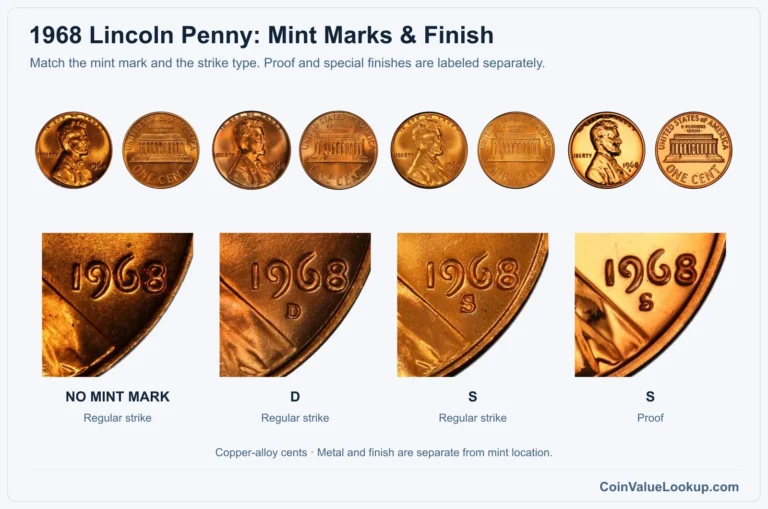
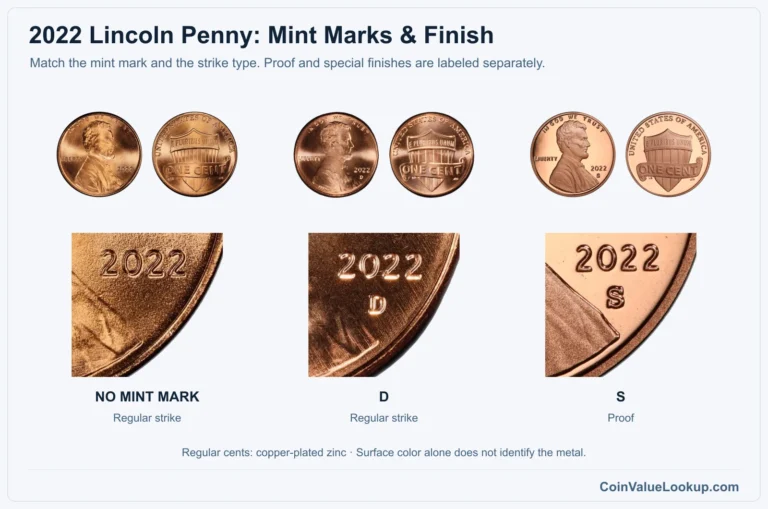
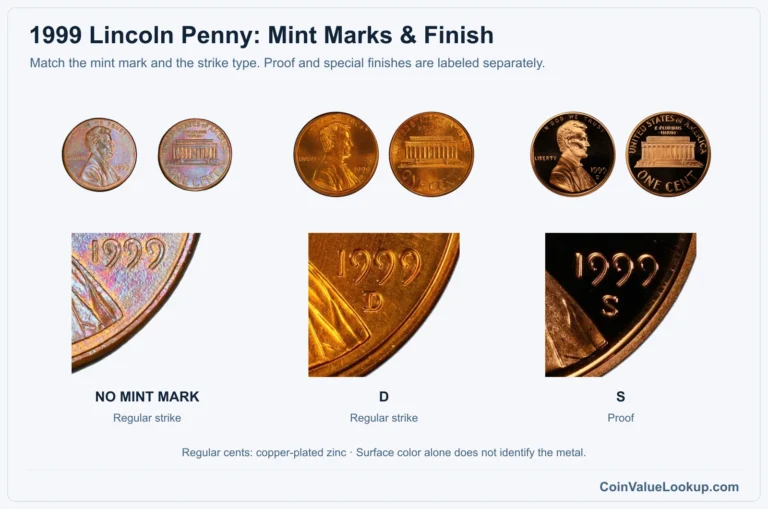
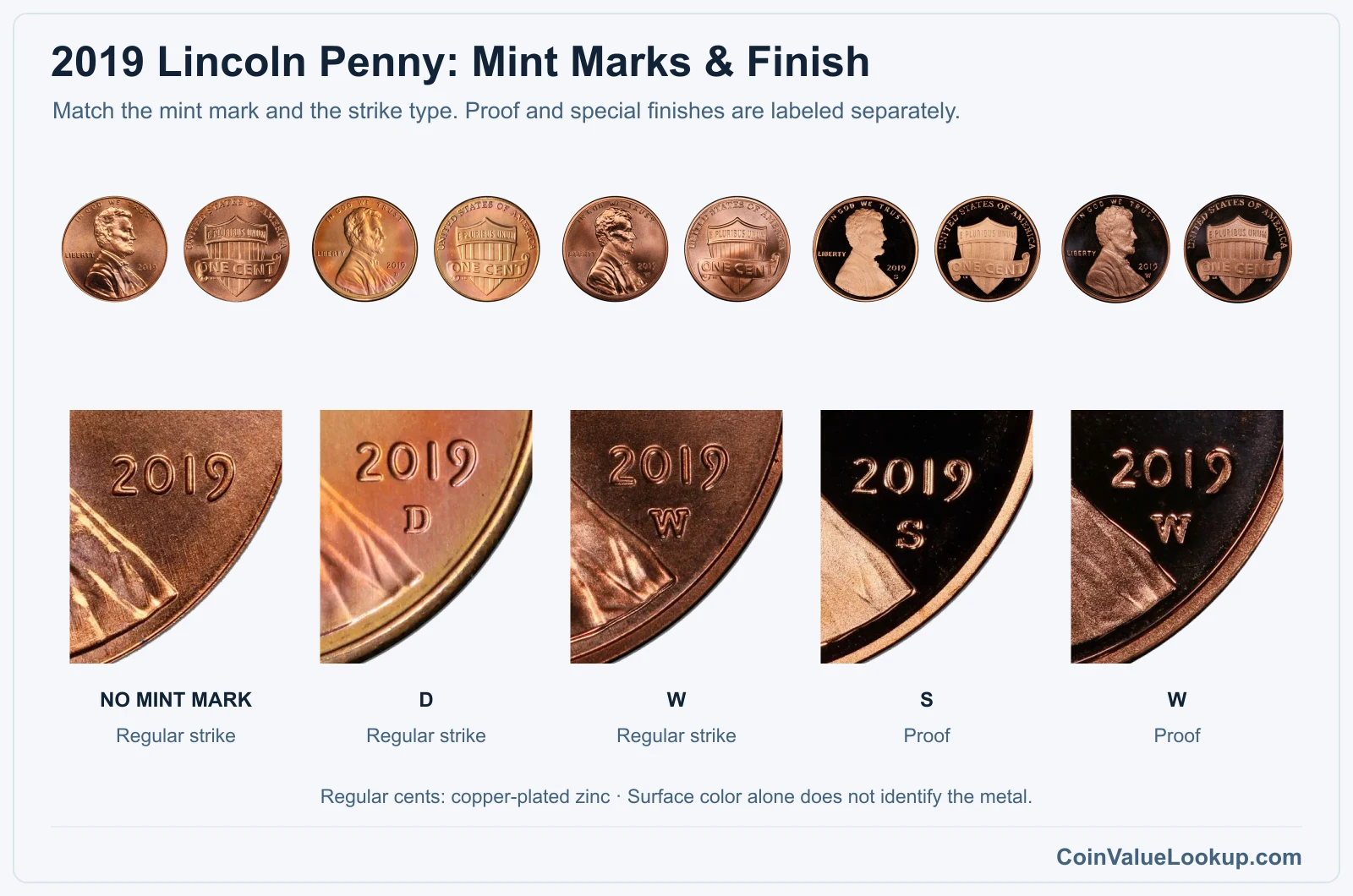
Now check below the date on the obverse for a tiny letter. No letter means Philadelphia.
A D means Denver. An S means San Francisco, and those are proof strikes sold in sets, not found in circulation.
A W mintmark means West Point, and that is where things get interesting. West Point produced 2019 cents in three separate finishes: uncirculated (business-strike appearance), proof (mirror fields), and reverse proof (frosted fields with mirror devices).
These were packaged as collector bonuses, not released into general circulation, so they will not turn up in your couch cushions.
All 2019 cents use the same copper-plated zinc composition at a nominal 2.50 grams. Appearance alone does not confirm an off-metal error; you need an accurate scale and sometimes professional evaluation.
A coin that simply looks odd could be corroded or chemically altered rather than struck on the wrong blank.
Step 2: Check Your 2019 Lincoln Penny Grade
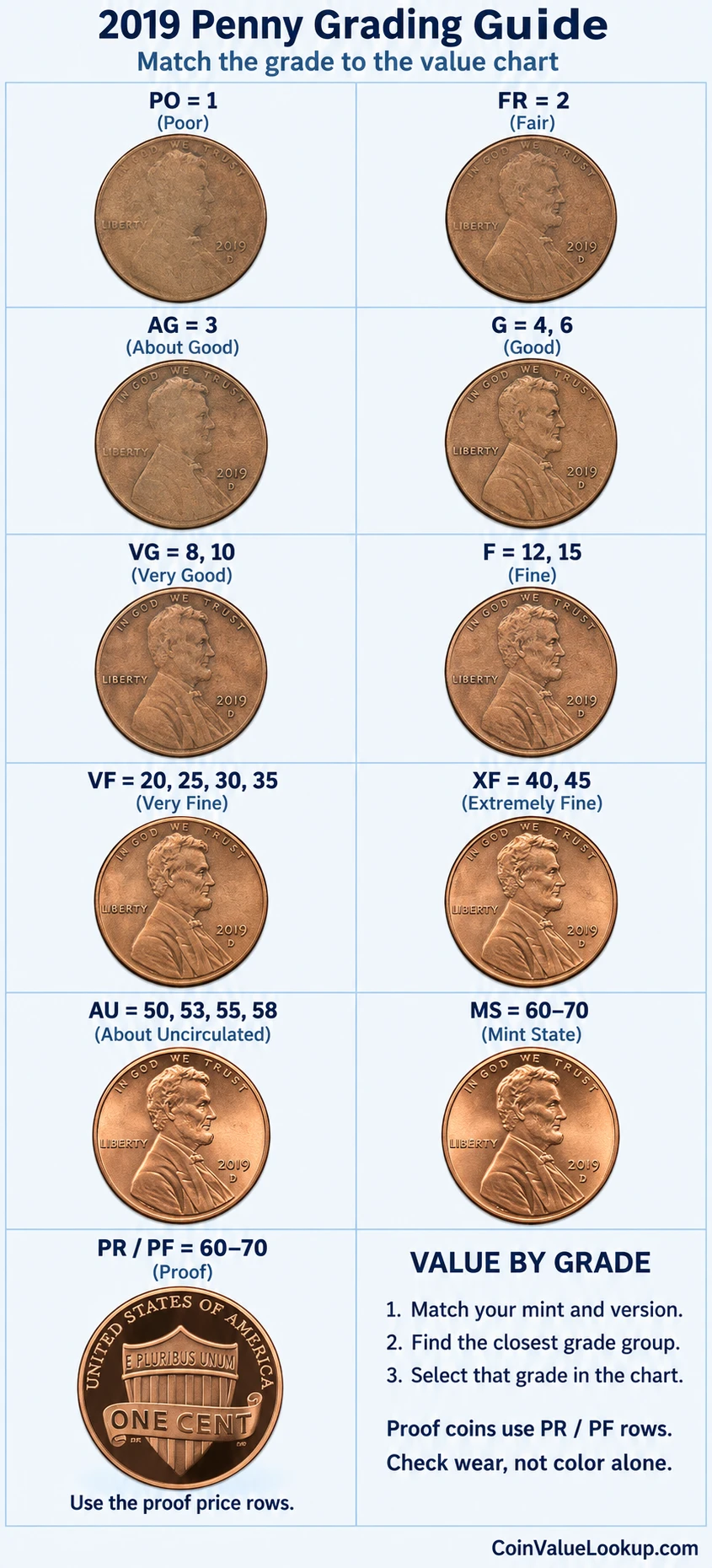
Look at Lincoln's cheek and jawline first. On a fresh uncirculated coin, these high points show full, unbroken luster with no dulling or flattening.
As wear begins, the cheek loses its sharpness, and the hair detail above the ear softens. On the reverse, the horizontal shield lines and the motto are good checkpoints.
Color designations matter separately from wear. RD (red), RB (red-brown), and BN (brown) describe how much original copper color remains.
A coin can be technically uncirculated but fully brown, and that affects its market appeal. Compare your coin to the grading reference image to get a baseline.
Proof and reverse proof are manufacturing finishes, not grades higher than Mint State. A proof coin in poor condition grades lower than a pristine business strike.
Keep that distinction clear when you are comparing values across different branches of the 2019 cent lineup.
Step 3: Check 2019 Lincoln Penny Value by Mint and Version
2019 Lincoln Penny — Shield
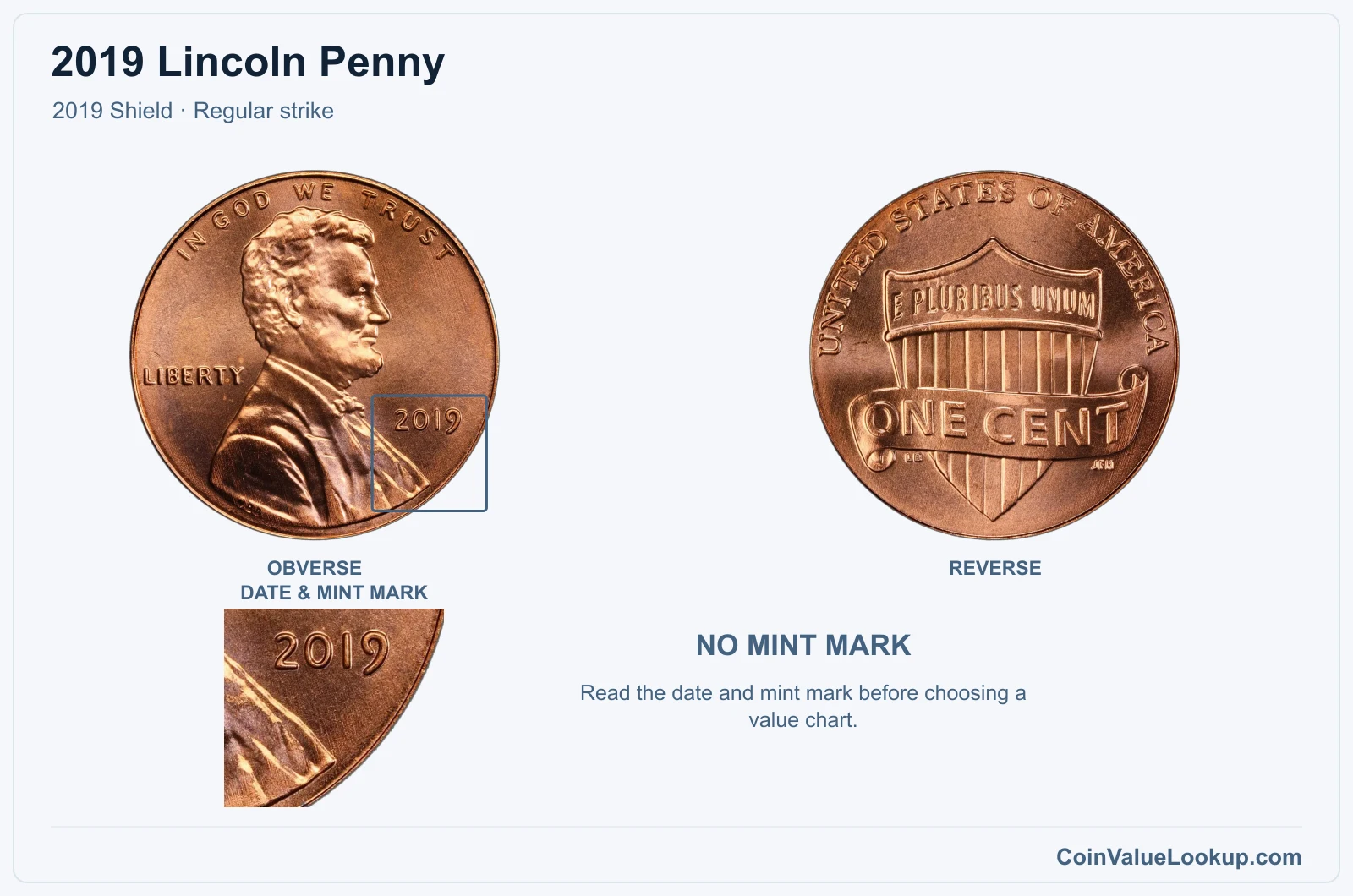
This is the standard 2019 penny with no mintmark, struck at Philadelphia. It is copper-plated zinc at 2.50 grams and carries the Union Shield reverse.
In circulated condition, it is worth one cent. A guide estimate places an MS65 example with original surfaces at about $0.36.
That is a modest premium, but most pocket-change specimens will not reach that grade. Look for full, undisturbed luster and no contact marks on Lincoln's cheek to identify a higher-grade candidate.
| Range | Grade | Price | Auction Records | Appraisal |
|---|---|---|---|---|
| PO | PO 1 | — | Coin Identifier | |
| FR | FR 2 | — | Coin Identifier | |
| AG | AG 3 | — | Coin Identifier | |
| G | G 4 | — | Coin Identifier | |
| G 6 | — | Coin Identifier | ||
| VG | VG 8 | — | Coin Identifier | |
| VG 10 | — | Coin Identifier | ||
| F | F 12 | — | Coin Identifier | |
| F 15 | — | Coin Identifier | ||
| VF | VF 20 | — | Coin Identifier | |
| VF 25 | — | Coin Identifier | ||
| VF 30 | — | Coin Identifier | ||
| VF 35 | — | Coin Identifier | ||
| XF | XF 40 | — | Coin Identifier | |
| XF 45 | — | Coin Identifier | ||
| AU | AU 50 | — | Coin Identifier | |
| AU 53 | — | Coin Identifier | ||
| AU 55 | — | Coin Identifier | ||
| AU 58 | — | Coin Identifier | ||
| MS | MS 60 | — | Coin Identifier | |
| MS 61 | — | Coin Identifier | ||
| MS 62 | — | Coin Identifier | ||
| MS 63 | — | Coin Identifier | ||
| MS 64 | — | Coin Identifier | ||
| MS 65 | — | Coin Identifier | ||
| MS 66 | — | Coin Identifier | ||
| MS 67 | — | Coin Identifier | ||
| MS 68 | — | Coin Identifier | ||
| MS 69 | — | — | — | |
| MS 70 | — | — | — |
2019 Lincoln Penny — D Shield
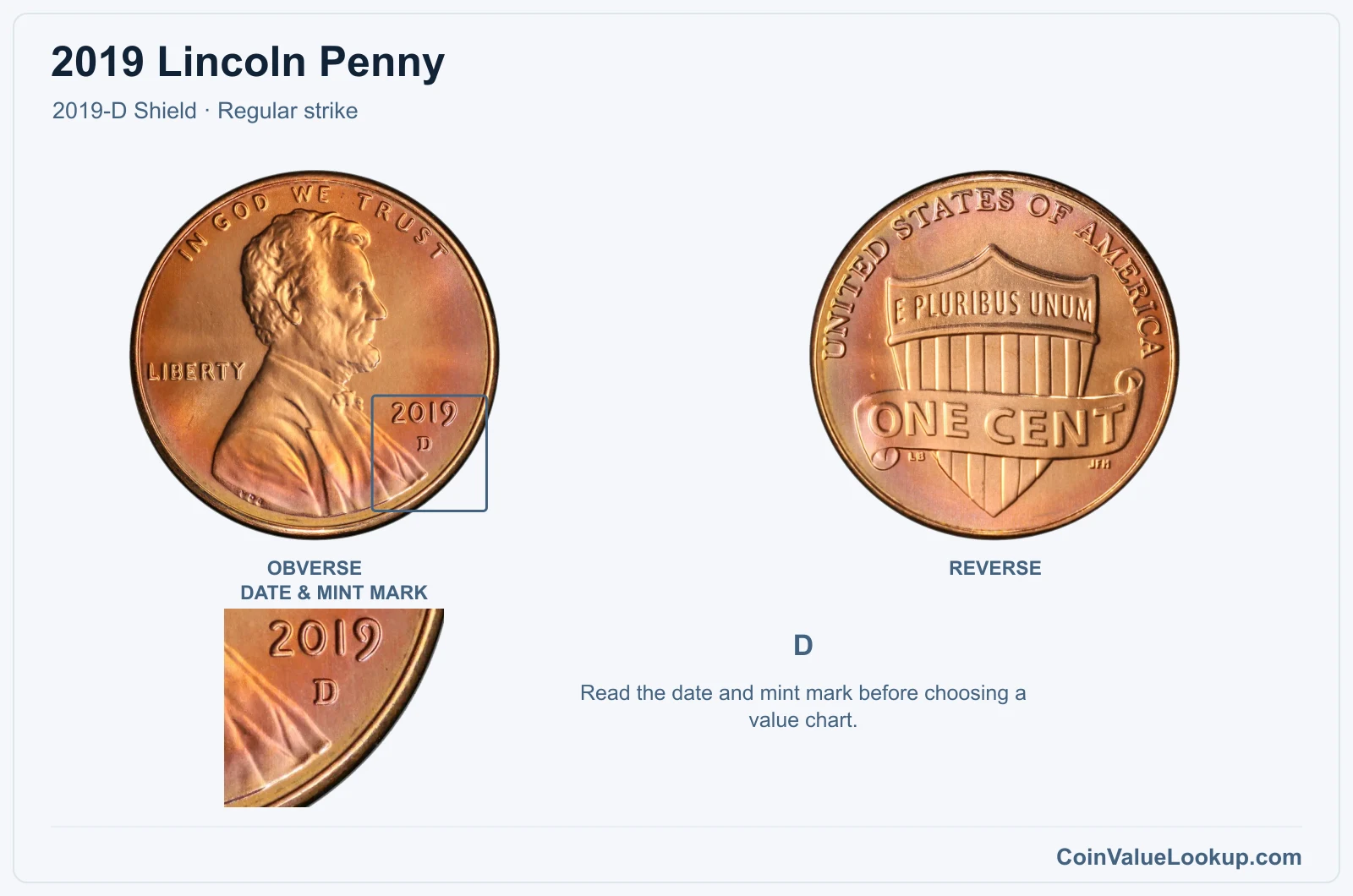
The Denver issue carries a small D below the date. Composition, weight, and design are identical to the Philadelphia version.
A circulated 2019-D cent is worth face value. At MS65, the guide estimate is also $0.36.
Billions were struck, so scarcity is not a factor here. Your best shot at a premium is finding one with blazing original red color and clean surfaces, which gets harder as these coins age and tone.
| Range | Grade | Price | Auction Records | Appraisal |
|---|---|---|---|---|
| PO | PO 1 | — | Coin Identifier | |
| FR | FR 2 | — | Coin Identifier | |
| AG | AG 3 | — | Coin Identifier | |
| G | G 4 | — | Coin Identifier | |
| G 6 | — | Coin Identifier | ||
| VG | VG 8 | — | Coin Identifier | |
| VG 10 | — | Coin Identifier | ||
| F | F 12 | — | Coin Identifier | |
| F 15 | — | Coin Identifier | ||
| VF | VF 20 | — | Coin Identifier | |
| VF 25 | — | Coin Identifier | ||
| VF 30 | — | Coin Identifier | ||
| VF 35 | — | Coin Identifier | ||
| XF | XF 40 | — | Coin Identifier | |
| XF 45 | — | Coin Identifier | ||
| AU | AU 50 | — | Coin Identifier | |
| AU 53 | — | Coin Identifier | ||
| AU 55 | — | Coin Identifier | ||
| AU 58 | — | Coin Identifier | ||
| MS | MS 60 | — | Coin Identifier | |
| MS 61 | — | Coin Identifier | ||
| MS 62 | — | Coin Identifier | ||
| MS 63 | — | Coin Identifier | ||
| MS 64 | — | Coin Identifier | ||
| MS 65 | — | Coin Identifier | ||
| MS 66 | — | Coin Identifier | ||
| MS 67 | Coin Identifier | |||
| MS 68 | — | Coin Identifier | ||
| MS 69 | — | Coin Identifier | ||
| MS 70 | — | — | — |
2019 Lincoln Penny — W Shield
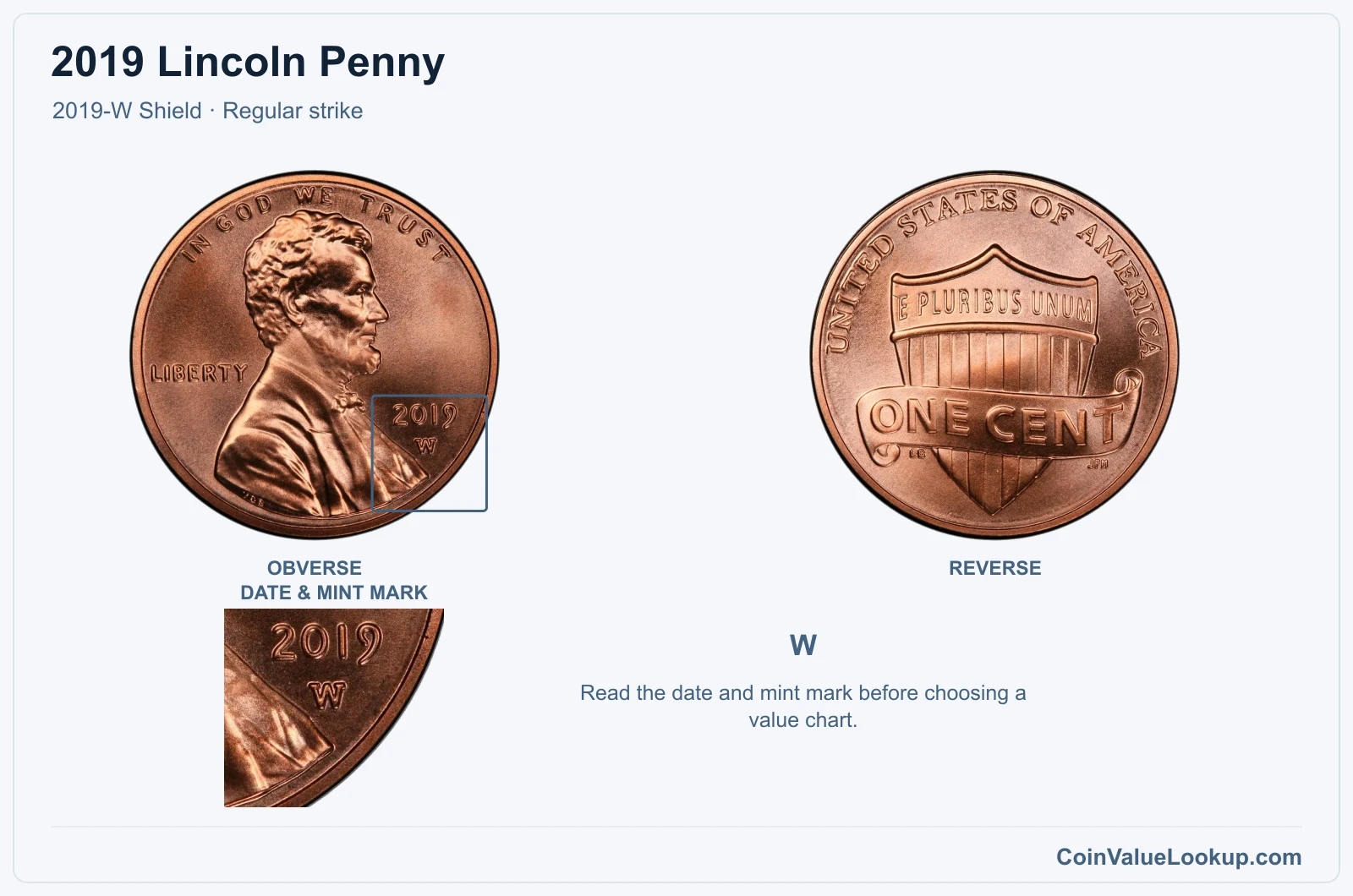
Here is where things shift. The 2019-W uncirculated cent was produced at West Point and distributed as a collector bonus, not through normal bank channels.
Look for the small W mintmark below the date. These were struck with a business-strike finish, so they look similar to a Philadelphia coin at first glance, but that W changes everything.
A guide estimate places the MS65 example at $12. That is a significant jump from the $0.36 Philadelphia and Denver coins in the same grade.
Because these were packaged for collectors, most surviving examples are in better condition than a typical circulation find. Confirm the mintmark carefully; a worn or dirty Philadelphia coin can fool you under poor lighting.
Coin Value Lookup is a good starting point if you want to compare this coin against other years and denominations in the Lincoln cent series.
| Range | Grade | Price | Auction Records | Appraisal |
|---|---|---|---|---|
| PO | PO 1 | — | Coin Identifier | |
| FR | FR 2 | — | Coin Identifier | |
| AG | AG 3 | — | Coin Identifier | |
| G | G 4 | — | Coin Identifier | |
| G 6 | — | Coin Identifier | ||
| VG | VG 8 | — | Coin Identifier | |
| VG 10 | — | Coin Identifier | ||
| F | F 12 | — | Coin Identifier | |
| F 15 | — | Coin Identifier | ||
| VF | VF 20 | — | Coin Identifier | |
| VF 25 | — | Coin Identifier | ||
| VF 30 | — | Coin Identifier | ||
| VF 35 | — | Coin Identifier | ||
| XF | XF 40 | — | Coin Identifier | |
| XF 45 | — | Coin Identifier | ||
| AU | AU 50 | — | Coin Identifier | |
| AU 53 | — | Coin Identifier | ||
| AU 55 | — | Coin Identifier | ||
| AU 58 | — | Coin Identifier | ||
| MS | MS 60 | — | Coin Identifier | |
| MS 61 | — | Coin Identifier | ||
| MS 62 | — | Coin Identifier | ||
| MS 63 | — | Coin Identifier | ||
| MS 64 | — | Coin Identifier | ||
| MS 65 | — | Coin Identifier | ||
| MS 66 | — | Coin Identifier | ||
| MS 67 | — | Coin Identifier | ||
| MS 68 | — | Coin Identifier | ||
| MS 69 | — | Coin Identifier | ||
| MS 70 | Coin Identifier |
2019 Lincoln Penny — S Shield PR
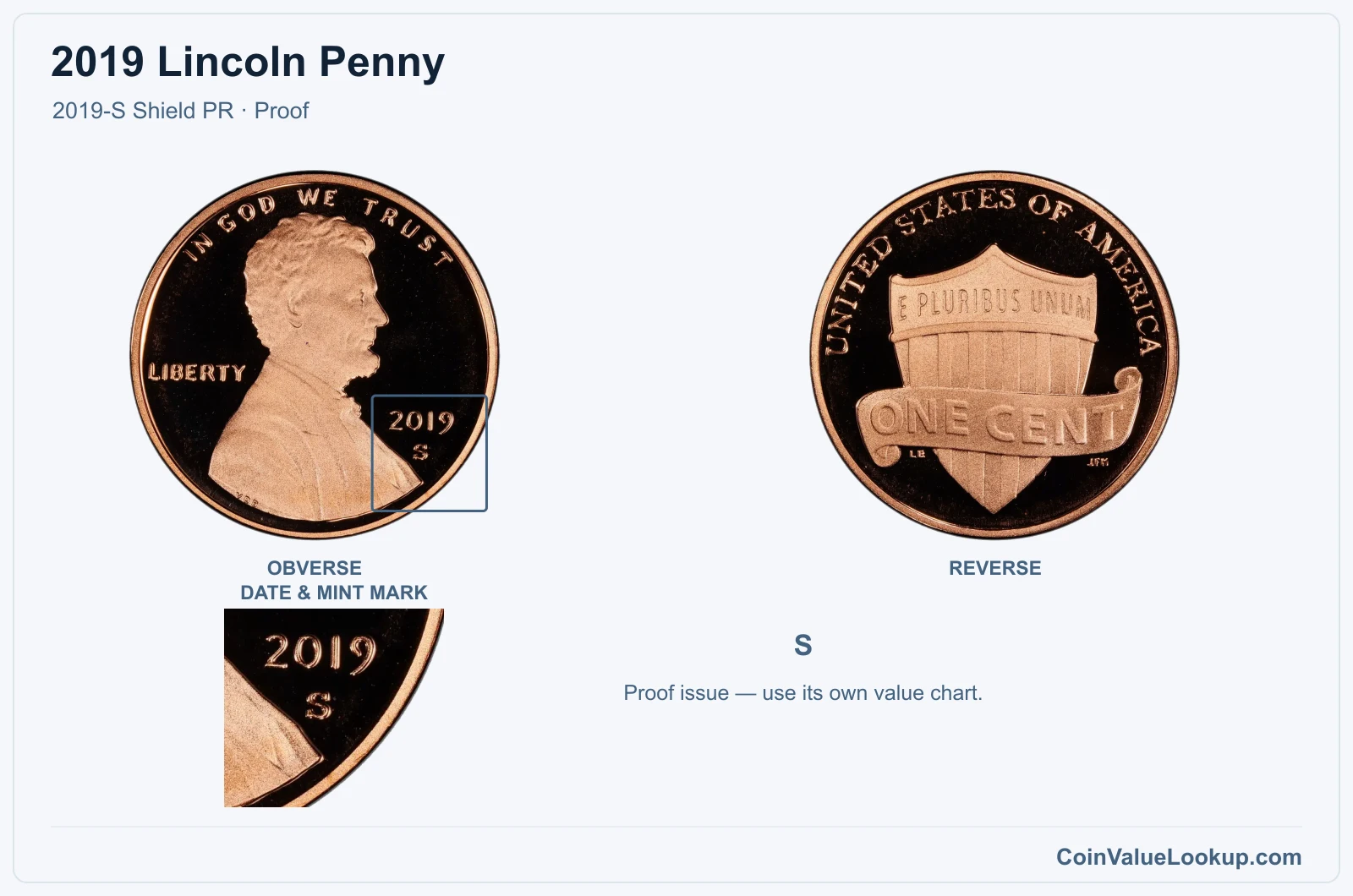
The 2019-S proof cent comes from San Francisco and was sold in proof sets. It features mirror-like fields with frosted design elements.
The S mintmark sits below the date. At PR65, the guide estimate is $6.26.
These were not released into circulation, so if you have one, it likely came from a set. Compare the mirror fields and cameo contrast when assessing condition; hazy or fingerprinted fields will drag the grade down quickly.
| Range | Grade | Price | Auction Records | Appraisal |
|---|---|---|---|---|
| PR | PR 1 | — | Coin Identifier | |
| PR 2 | — | Coin Identifier | ||
| PR 3 | — | Coin Identifier | ||
| PR 4 | — | Coin Identifier | ||
| PR 6 | — | Coin Identifier | ||
| PR 8 | — | Coin Identifier | ||
| PR 10 | — | Coin Identifier | ||
| PR 12 | — | Coin Identifier | ||
| PR 15 | — | Coin Identifier | ||
| PR 20 | — | Coin Identifier | ||
| PR 25 | — | Coin Identifier | ||
| PR 30 | — | Coin Identifier | ||
| PR 35 | — | Coin Identifier | ||
| PR 40 | — | Coin Identifier | ||
| PR 45 | — | Coin Identifier | ||
| PR 50 | — | Coin Identifier | ||
| PR 53 | — | Coin Identifier | ||
| PR 55 | — | Coin Identifier | ||
| PR 58 | — | Coin Identifier | ||
| PR 60 | — | Coin Identifier | ||
| PR 61 | — | Coin Identifier | ||
| PR 62 | — | Coin Identifier | ||
| PR 63 | — | Coin Identifier | ||
| PR 64 | — | Coin Identifier | ||
| PR 65 | — | Coin Identifier | ||
| PR 66 | — | Coin Identifier | ||
| PR 67 | — | Coin Identifier | ||
| PR 68 | — | Coin Identifier | ||
| PR 69 | — | Coin Identifier | ||
| PR 70 | — | Coin Identifier |
2019 Lincoln Penny — W Shield PR
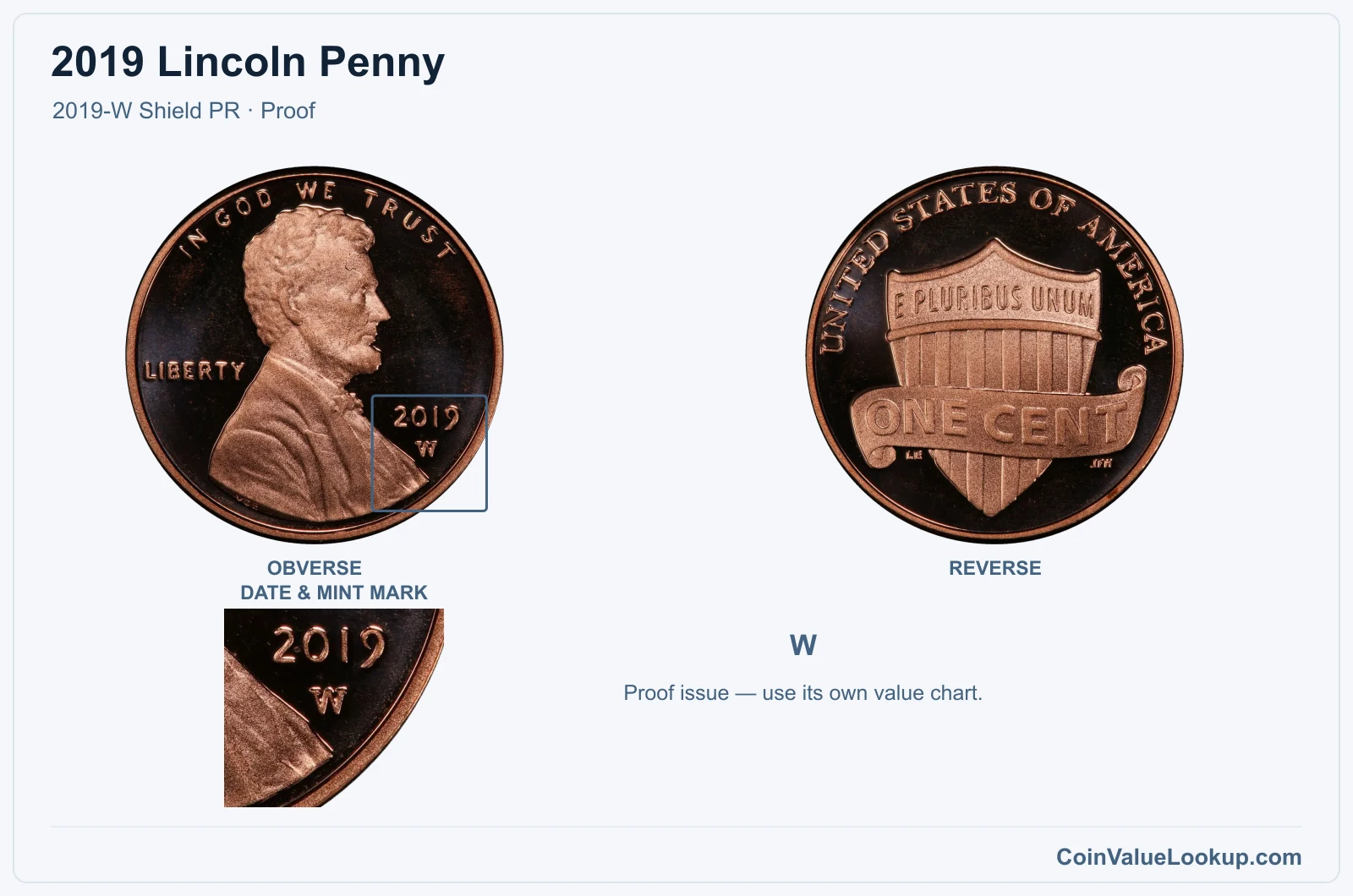
West Point also struck a proof-finish cent for 2019, carrying the W mintmark. This is a separate issue from the uncirculated W and the reverse proof W.
Mirror fields and frosted devices identify the proof finish. The PR65 guide estimate is $12.
Because all three W finishes share the same mintmark, you need to examine the surface characteristics carefully. A standard proof has reflective fields and frosted raised design; do not confuse it with the reverse proof, where that relationship is flipped.
| Range | Grade | Price | Auction Records | Appraisal |
|---|---|---|---|---|
| PR | PR 1 | — | Coin Identifier | |
| PR 2 | — | Coin Identifier | ||
| PR 3 | — | Coin Identifier | ||
| PR 4 | — | Coin Identifier | ||
| PR 6 | — | Coin Identifier | ||
| PR 8 | — | Coin Identifier | ||
| PR 10 | — | Coin Identifier | ||
| PR 12 | — | Coin Identifier | ||
| PR 15 | — | Coin Identifier | ||
| PR 20 | — | Coin Identifier | ||
| PR 25 | — | Coin Identifier | ||
| PR 30 | — | Coin Identifier | ||
| PR 35 | — | Coin Identifier | ||
| PR 40 | — | Coin Identifier | ||
| PR 45 | — | Coin Identifier | ||
| PR 50 | — | Coin Identifier | ||
| PR 53 | — | Coin Identifier | ||
| PR 55 | — | Coin Identifier | ||
| PR 58 | — | Coin Identifier | ||
| PR 60 | — | Coin Identifier | ||
| PR 61 | — | Coin Identifier | ||
| PR 62 | — | Coin Identifier | ||
| PR 63 | — | Coin Identifier | ||
| PR 64 | — | Coin Identifier | ||
| PR 65 | — | Coin Identifier | ||
| PR 66 | — | Coin Identifier | ||
| PR 67 | — | Coin Identifier | ||
| PR 68 | — | Coin Identifier | ||
| PR 69 | — | Coin Identifier | ||
| PR 70 | Coin Identifier |
2019 Lincoln Penny — W Reverse Proof
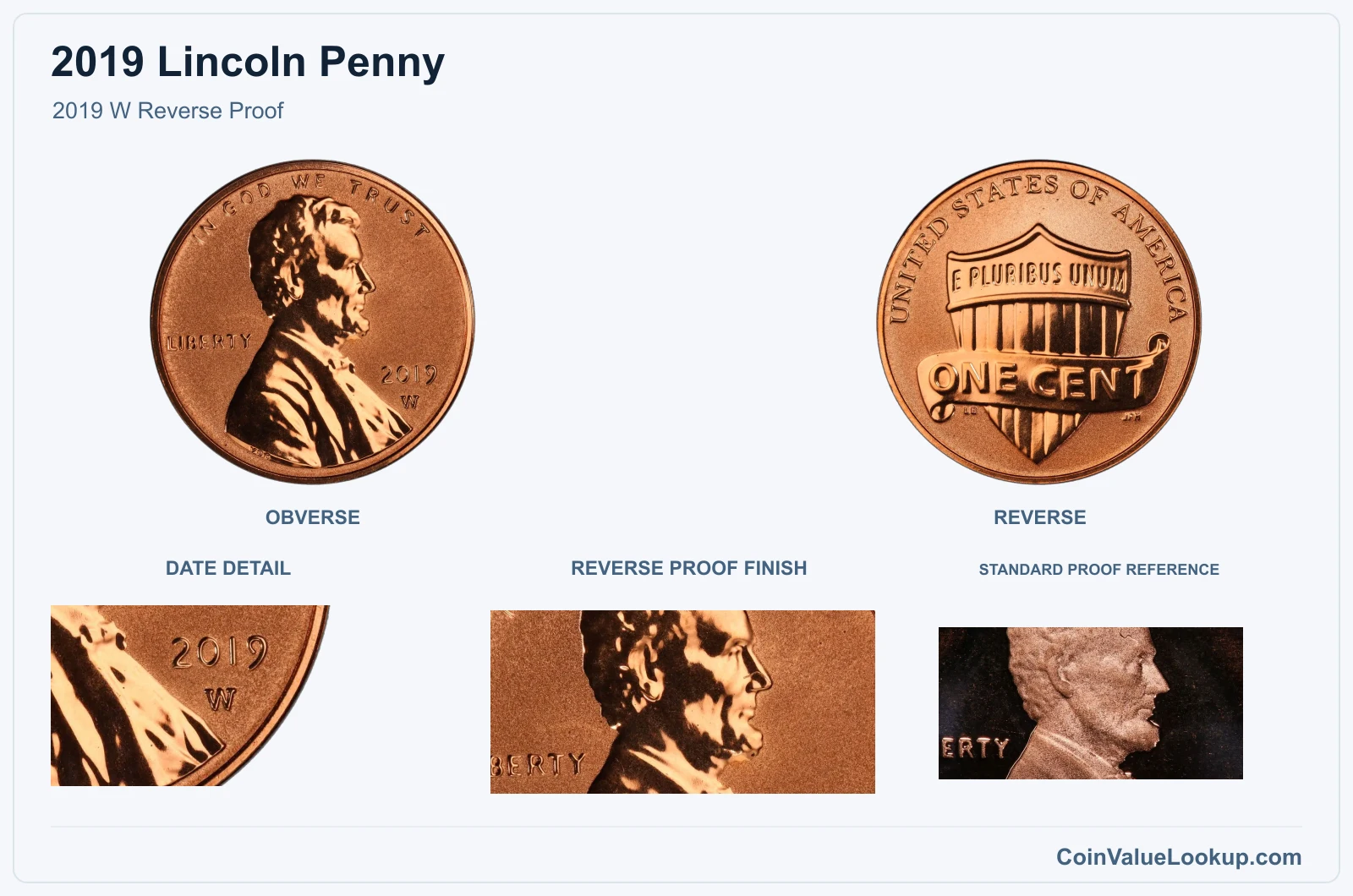
The 2019-W reverse proof cent inverts the usual proof look: the fields are frosted and the raised design elements are mirror-bright. It carries the W mintmark and was offered as a collector bonus packaged with certain silver proof sets.
The cent itself is still copper-plated zinc, not silver, regardless of the set it came in.
At PR65, the guide estimate is $12, identical to the other W finishes. Distinguishing it from the standard W proof requires checking which surfaces are mirrored and which are frosted.
On the reverse proof, Lincoln's portrait gleams against a matte-like background. Get the lighting right and the difference is obvious.
Range Grade
Price Auction Records Appraisal PR PR 1
—
Coin Identifier
PR 2
—
Coin Identifier
PR 3
—
Coin Identifier
PR 4
—
Coin Identifier
PR 6
—
Coin Identifier
PR 8
—
Coin Identifier
PR 10
—
Coin Identifier
PR 12
—
Coin Identifier
PR 15
—
Coin Identifier
PR 20
—
Coin Identifier
PR 25
—
Coin Identifier
PR 30
—
Coin Identifier
PR 35
—
Coin Identifier
PR 40
—
Coin Identifier
PR 45
—
Coin Identifier
PR 50
—
Coin Identifier
PR 53
—
Coin Identifier
PR 55
—
Coin Identifier
PR 58
—
Coin Identifier
PR 60
—
Coin Identifier
PR 61
—
Coin Identifier
PR 62
—
Coin Identifier
PR 63
—
Coin Identifier
PR 64
—
Coin Identifier
PR 65
—
Coin Identifier
PR 66
—
Coin Identifier
PR 67
—
Coin Identifier
PR 68
—
Coin Identifier
PR 69
—
Coin Identifier
PR 70
—
Coin Identifier
2019 Lincoln Penny Error List
1. 2019 Lincoln Penny — Die Crack / Die Chip
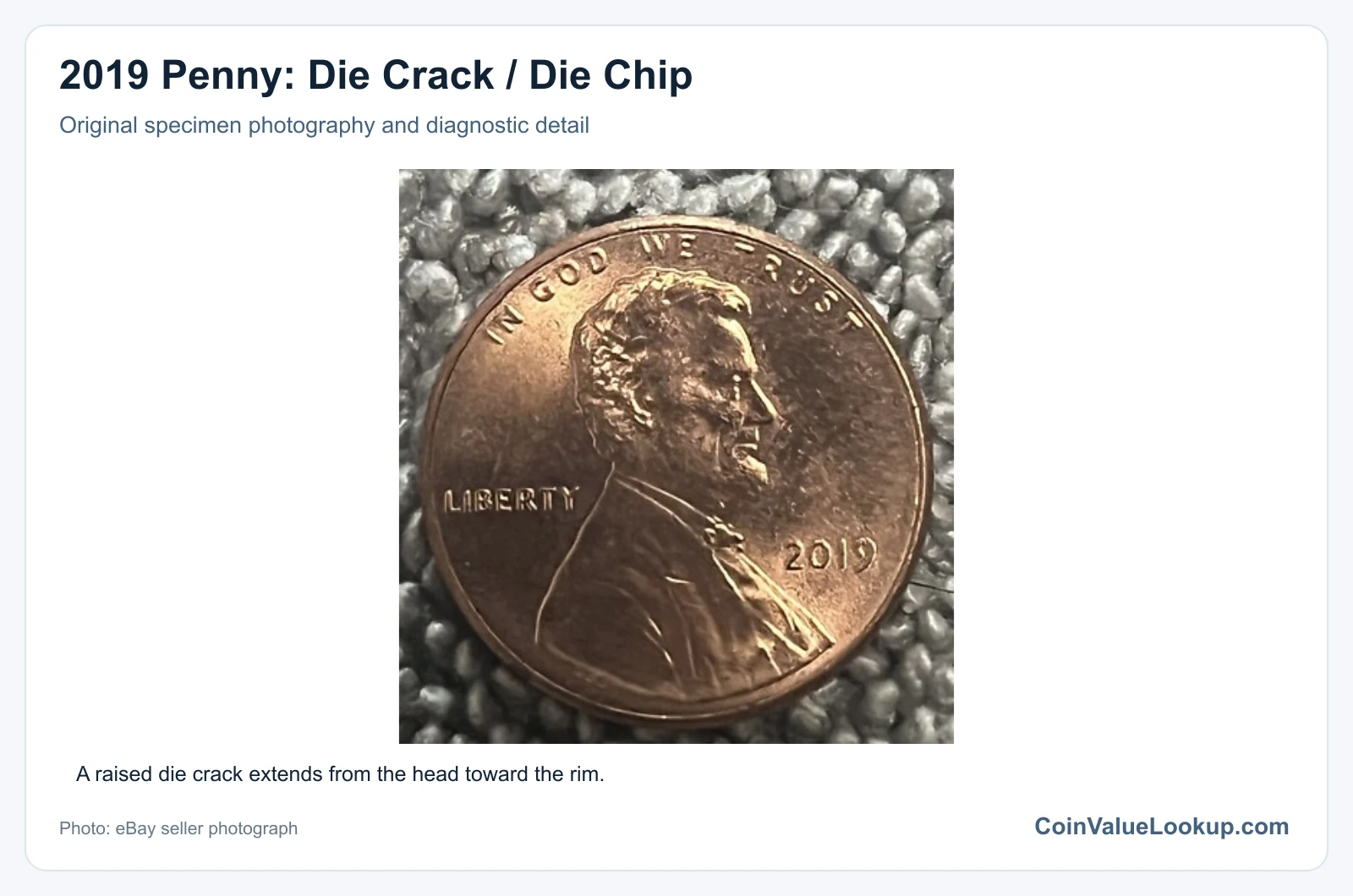
Die cracks show up as thin raised lines on the coin's surface, running across the design where the steel die fractured during use. On 2019 cents, one reported variety shows a raised line running through Lincoln's head.
A die chip is a small raised blob where a piece of the die broke away. Both are struck into the coin, so they feel raised and follow the coin's contour.
Do not confuse these with scratches, which are incuse (cut into the surface). Corrosion or foreign material stuck to a coin can also mimic a raised line.
Authentic die cracks are consistent and repeatable across multiple coins from the same die. Pricing depends on the crack's size, location, and visual impact, assessed individually by authenticated identity and condition.
2. 2019 Lincoln Penny — Die Break / Cud
A cud is a die break that connects to the rim, leaving a raised, featureless blob of metal where design detail should be. It happens when a chunk of the die edge breaks off entirely.
The result is unmistakable on a genuine example: a smooth raised area merging into the rim with a clear boundary against the normal design.
A rim dent pushed inward from damage after minting is the most common lookalike. Corrosion lumps and interior die chips can also be confused with cuds, but a true cud must touch the rim.
Value depends on size, location, and the coin's overall condition, evaluated on a case-by-case basis with professional authentication.
3. 2019 Lincoln Penny — Copper Plating Defects
Because 2019 cents are copper-plated zinc, the thin copper skin can fail during production. Look for blistered, bubbled, or split plating where the copper layer separated from the zinc core.
The surrounding design should be undisturbed, which helps confirm it happened at the mint rather than afterward.
Post-mint corrosion can produce similar bubbling, especially when moisture reaches the zinc through a tiny plating breach. Chemical stripping, where someone deliberately removes the copper layer, is another common lookalike.
Authentic plating errors typically show clean separation edges and unaltered adjacent surfaces. Each coin's value is assessed individually based on severity, visual appeal, and authenticated identity.
4. 2019 Lincoln Penny — Broadstrike
A broadstrike occurs when the coin is struck without the retaining collar that normally forms the rim and controls diameter. The result is a coin that spreads outward, appearing slightly larger than normal with a weak or missing rim.
The full design is usually present but may look stretched near the edges.
Look at the edge profile: a broadstruck coin will lack the sharp, defined rim of a normal cent. Do not confuse this with an off-center strike, which shifts the design to one side and leaves a blank crescent.
Post-mint flattening from machinery or deliberate squeezing can mimic a broadstrike, but those coins typically show disturbed surfaces. Pricing requires individual evaluation based on the degree of spread and overall condition.
5. 2019 Lincoln Penny — Reported Weak Strike
A weak strike shows incomplete design detail on both sides of the coin, yet the surfaces remain unworn. This distinguishes it from circulation wear, where high points flatten from contact over time.
On a weakly struck cent, you might see soft lettering, mushy hair detail, and shallow shield lines even though the coin was never spent.
The tricky part is separating a genuine weak strike from a coin that just circulated hard or got hit with grease during striking. Grease-filled dies produce a localized soft area, while a true weak strike tends to affect broader portions of the design.
Corrosion can also eat away detail. Value depends on severity and authentication.
6. 2019 Lincoln Penny — Struck-Through Error
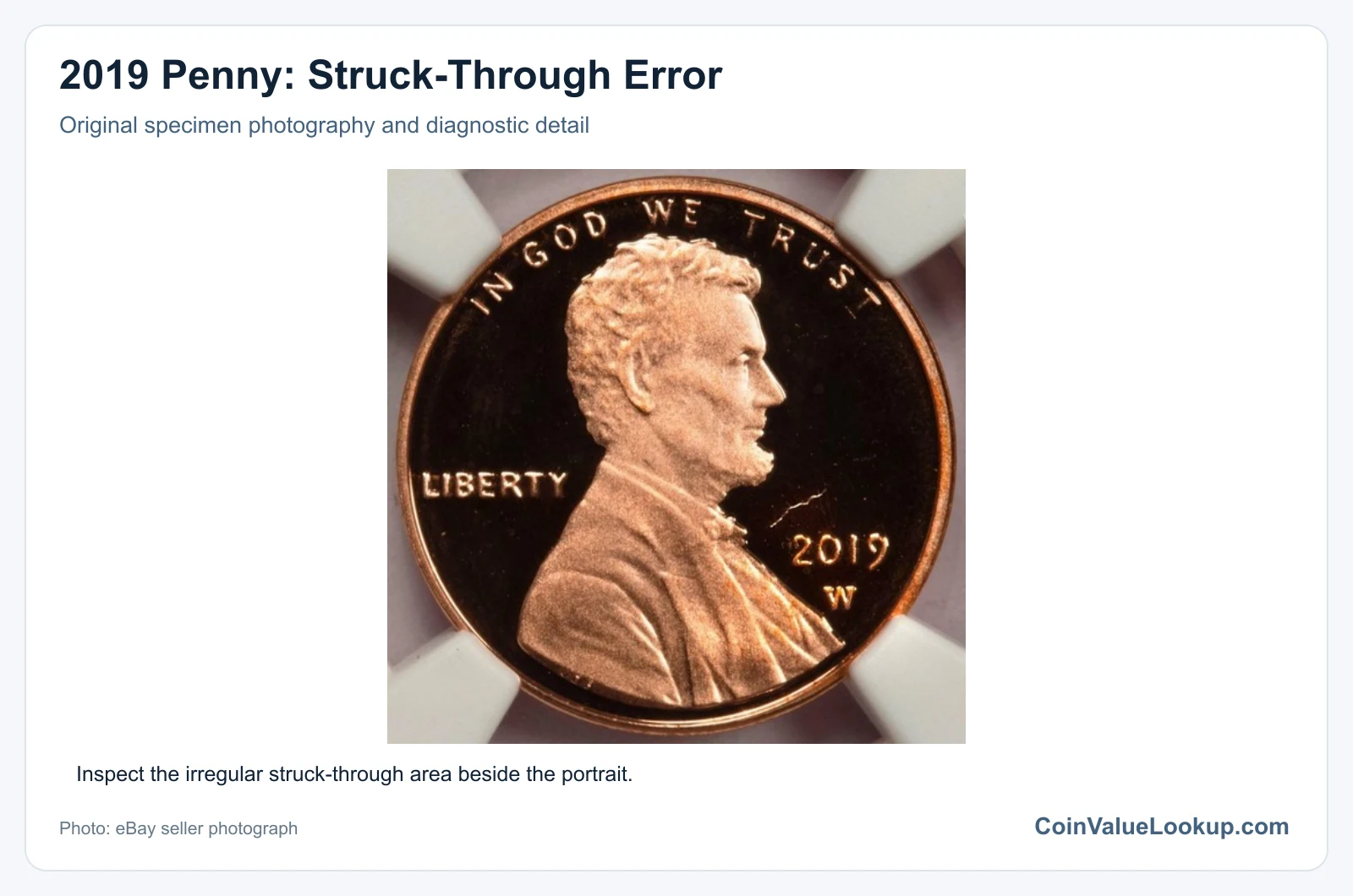
A struck-through error happens when foreign material sits between the die and the planchet during striking. The result is a depression or incomplete area in the design shaped like whatever got in the way: grease, a thread, a metal fragment, or even another coin's edge.
Grease fill-ins tend to produce smooth, shallow depressions, while a retained foreign object can leave a sharply defined impression.
Look for a localized area where the design fades or dips below normal level without any sign of wear or scratching around it. Post-mint damage, cleaning marks, and ordinary weak detail from a tired die are the usual lookalikes.
Each struck-through coin is priced individually based on the clarity and size of the obstruction impression and the coin's authenticated condition.
7. 2019 Lincoln Penny — Off-Center Strike
An off-center strike happens when the planchet is not seated correctly in the collar, causing the dies to impress the design shifted to one side. The telltale sign is a blank crescent of unstruck metal opposite the shifted design.
Minor off-center errors of a few percent are common; dramatic shifts of 20% or more with the date still visible are what collectors really want.
A clipped planchet can look similar at a glance, but clips show a curved missing section from the blank-cutting stage, not a displaced complete design. Post-mint flattening or a one-sided die misalignment can also fool you.
Pricing depends on how far off center the strike is, whether the date remains readable, and the coin's overall condition as confirmed by authentication.
8. 2019 Lincoln Penny — Doubled Die Reverse
A doubled die reverse shows consistent doubling in the design elements on the shield side of the coin. Look at the lettering in E PLURIBUS UNUM and ONE CENT, as well as the shield lines, under magnification.
True hub doubling produces a secondary image with defined separation or notching on the affected elements, and it appears on every coin struck by that die.
Machine doubling is the common lookalike. It produces a flat, shelf-like distortion rather than the distinct, rounded secondary image of a genuine doubled die.
Reflections under certain lighting angles can also create an illusion of doubling. No specific die marker is confirmed here; compare your coin carefully against a known normal example.
Value is assessed individually with professional authentication.
9. 2019 Lincoln Penny — Doubled Die Obverse
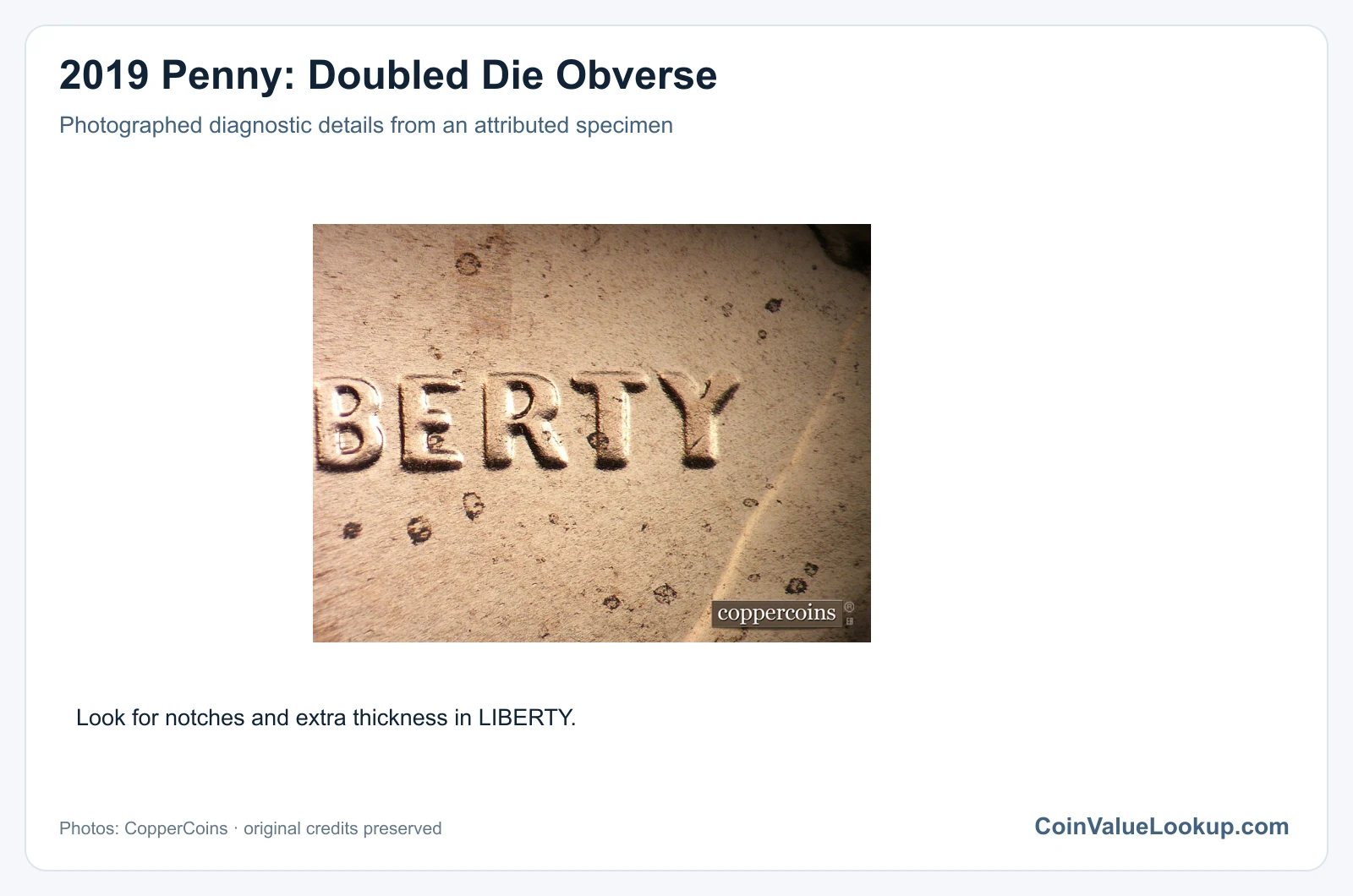
A doubled die obverse affects the portrait side. Under magnification, look for consistent separation or notching on IN GOD WE TRUST, LIBERTY, the date, or Lincoln's profile.
The doubling should repeat in the same direction on every affected element, which distinguishes it from random damage.
Machine doubling is by far the most common lookalike and produces a flat, shelf-like spread rather than a rounded secondary image. Worn die contours can also create the appearance of soft doubling under certain lighting.
Compare your coin to a known normal 2019 cent under matching light conditions. Pricing for a confirmed doubled die obverse depends on the strength of doubling and the coin's grade, evaluated on an individual basis with authentication.
10. 2019 Lincoln Penny — Wrong Planchet / Off-Metal Strike
A wrong-planchet error means the cent dies struck a blank intended for a different denomination or even a foreign coin. These are rare and dramatic.
The key diagnostic is weight, diameter, and edge that do not match the standard 2.50-gram, 19.05mm copper-plated zinc specification.
You need an accurate scale. A coin that merely looks different in color could be corroded, chemically stripped, or environmentally damaged rather than struck on the wrong metal.
Acid-treated cents lose weight and change color convincingly. Deliberate alterations are unfortunately common.
Professional authentication is essential for any suspected wrong-planchet error, and value is assessed individually based on the confirmed identity of the planchet and the coin's condition.