1894 Barber Dime Coin Value: How Much Is It Worth?
The 1894 Barber Dime spans a wide value range depending on which version you hold. Ordinary circulation strikes from Philadelphia and New Orleans run from roughly $46 at G4 up to about $4,074 at MS63 per USA Coin Book guide estimates.
Philadelphia Proofs sit around $616 at PR63. Then there is the legendary 1894-S Proof, a separate class entirely, with an individual specimen comparison near $1.7 million at PR63.
That last figure is not the typical experience for someone finding an 1894 dime in a cigar box.
Fast Way to Identify Your 1894 Barber Dime
The quickest way to start figuring out what you have is to upload clear photos of both sides of your coin. A well-lit front shot shows the date and Liberty's headband detail, while the back reveals the mintmark position below the wreath bow.
Submit those two images for a preliminary identification to help narrow down which version and condition range applies to your piece.
1894 Barber Dime Value
Upload both sides of your 1894 Barber Dime.
Front Obverse
Upload photo
Back Reverse
Upload photo
Which 1894 Barber Dime Versions Are Worth Money?
- Philadelphia business strikes range from about $46 at G4 to $501 at MS63 per guide estimates — the most commonly encountered 1894 Barber Dime.
- New Orleans (O mintmark) pieces carry a premium, running roughly $90 at G4 up to $4,074 at MS63, reflecting lower survival in higher grades.
- Philadelphia Proofs with mirrored fields are listed around $616 at PR63 — look for sharp rims and reflective surfaces distinct from circulation strikes.
- The 1894-S Proof is one of the most famous U.S. rarities, with only 24 struck; a PR63 specimen comparison stands near $1,714,917. Authentication by a major service is essential.
- Coins with original unworn surfaces and clear detail command the strongest premiums across all mints.
- Check for the distinct error types listed below; however, old damage and weak strikes are not automatically valuable.
Step 1: Identify Your 1894 Barber Dime Mint Mark and Version
The 1894 Barber Dime shows Charles Barber's right-facing Liberty head on the obverse, wearing a cap with a headband inscribed LIBERTY. The reverse reads ONE DIME surrounded by a laurel wreath.
Do not confuse this with the later Mercury (Winged Liberty) dime or earlier Seated Liberty designs.
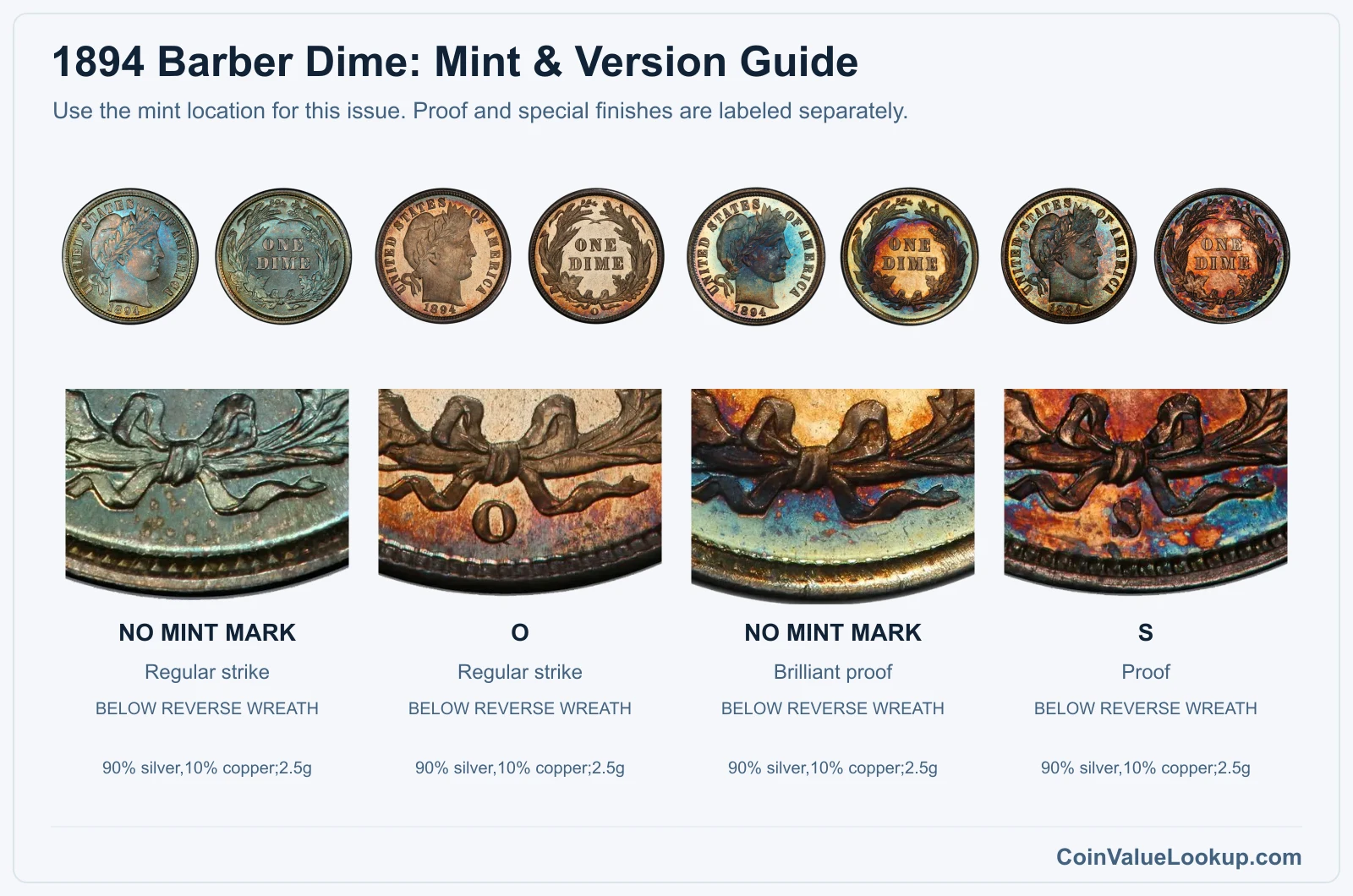
For 1894 business strikes, two mints produced coins: Philadelphia and New Orleans. The mintmark sits on the reverse, just below the wreath's bow knot.
No mintmark means Philadelphia. A small "O" means New Orleans.
All standard versions are 90% silver and 10% copper, weighing 2.5 grams with a 17.9 mm diameter and reeded edge. If your coin is magnetic or the wrong size, something is off.
The 1894-S is an extremely rare Proof issue with only 24 struck. Having an "S" mintmark alone does not confirm this rarity.
Specialist authentication from a major grading service is required, not just visual comparison to photos online.
Step 2: Check Your 1894 Barber Dime Grade
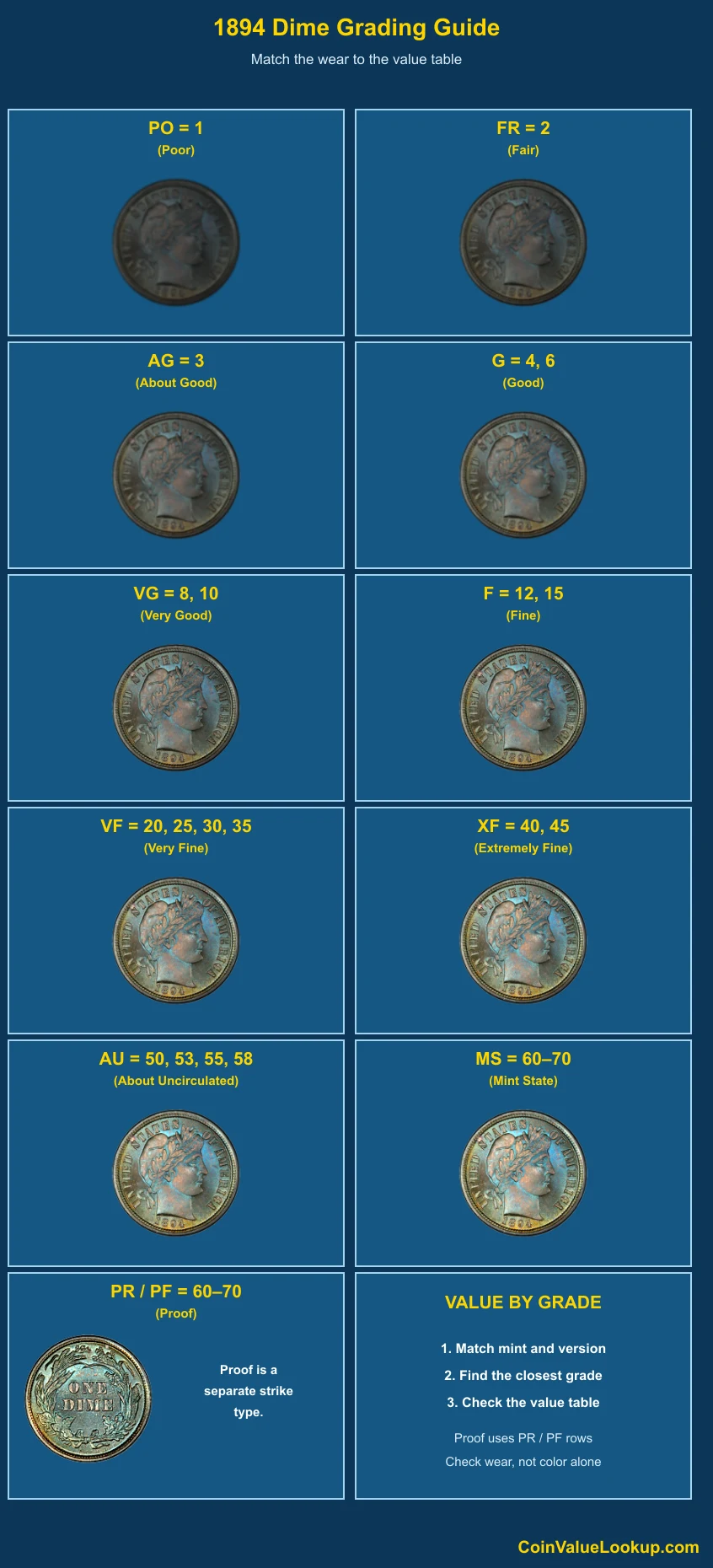
Start by looking at the LIBERTY headband on the obverse. On a well-worn coin (around Good-4), most or all letters will be gone, but the date and outline of Liberty's head remain clear.
As grade improves, individual letters become readable, and by About Uncirculated the full word should be visible with only slight friction on the high points.
Don't rely on the headband alone. Check the hair detail above Liberty's ear, the smoothness of the cheek, and the definition in the reverse wreath leaves.
All of these wear together and tell a more complete story than counting letters.
New Orleans coins are sometimes softly struck from the factory. A flat area on an O-mint coin might be a strike issue, not wear.
Compare your coin to the reference image to see how luster breaks and high-point wear differ from original softness.
Mint State means unbroken luster across the entire surface. Look carefully under good lighting for hairlines from old cleaning or contact marks from storage.
A cleaned coin that looks shiny is not the same as an original Mint State coin. Proof is a method of manufacture involving polished dies and planchets, producing mirrored fields.
It is not simply a grade above Mint State.
Step 3: Check 1894 Barber Dime Value by Mint and Version
1894 Barber Dime — No Mint Mark — Silver Circulation
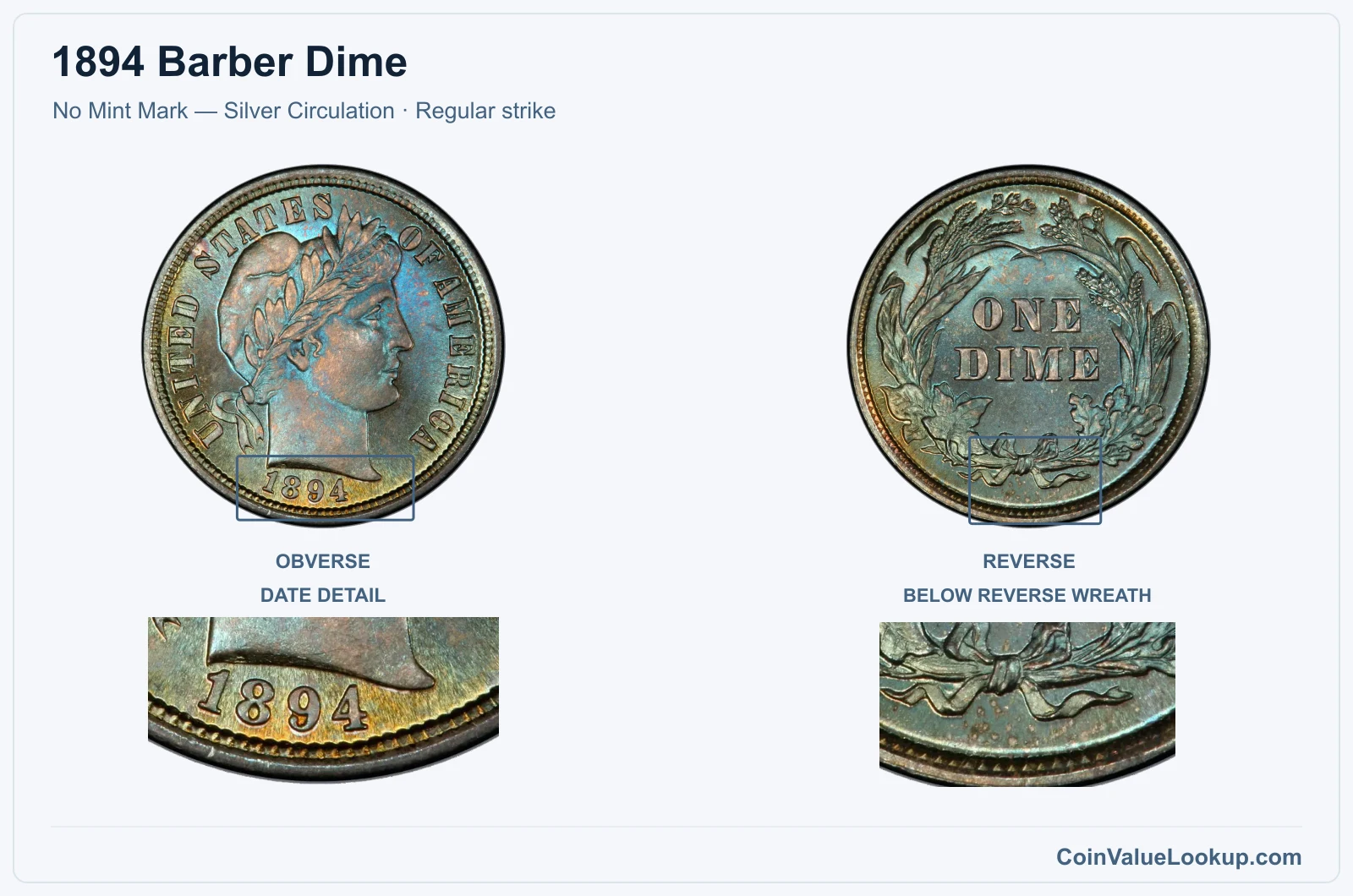
The Philadelphia business strike is the most available 1894 Barber Dime. It carries no mintmark — the space below the reverse wreath bow is blank.
USA Coin Book guide estimates place it at about $46 in G4 (a well-worn but fully readable coin) and around $501 in MS63 (light contact marks but full original luster).
Look for the date clarity, complete rim, and overall surface quality. These are 90% silver, 2.5 grams, with a reeded edge.
Guide values are retail snapshots, not guaranteed sale prices, and actual transactions depend on the specific coin's eye appeal and market timing.
Range Grade
Price Auction Records Appraisal PO PO 1
—
Coin Identifier FR FR 2
—
Coin Identifier AG AG 3
—
Coin Identifier G G 4
Coin Identifier
G 6
—
Coin Identifier VG VG 8
—
Coin Identifier
VG 10
Coin Identifier F F 12
Coin Identifier
F 15
Coin Identifier VF VF 20
Coin Identifier
VF 25
Coin Identifier
VF 30
Coin Identifier
VF 35
Coin Identifier XF XF 40
Coin Identifier
XF 45
Coin Identifier AU AU 50
Coin Identifier
AU 53
Coin Identifier
AU 55
Coin Identifier
AU 58
Coin Identifier MS MS 60
—
Coin Identifier
MS 61
Coin Identifier
MS 62
Coin Identifier
MS 63
Coin Identifier
MS 64
Coin Identifier
MS 65
Coin Identifier
MS 66
Coin Identifier
MS 67
Coin Identifier
MS 68
Coin Identifier
MS 69
—
—
—
MS 70
—
—
—
1894 Barber Dime — O — Silver Circulation
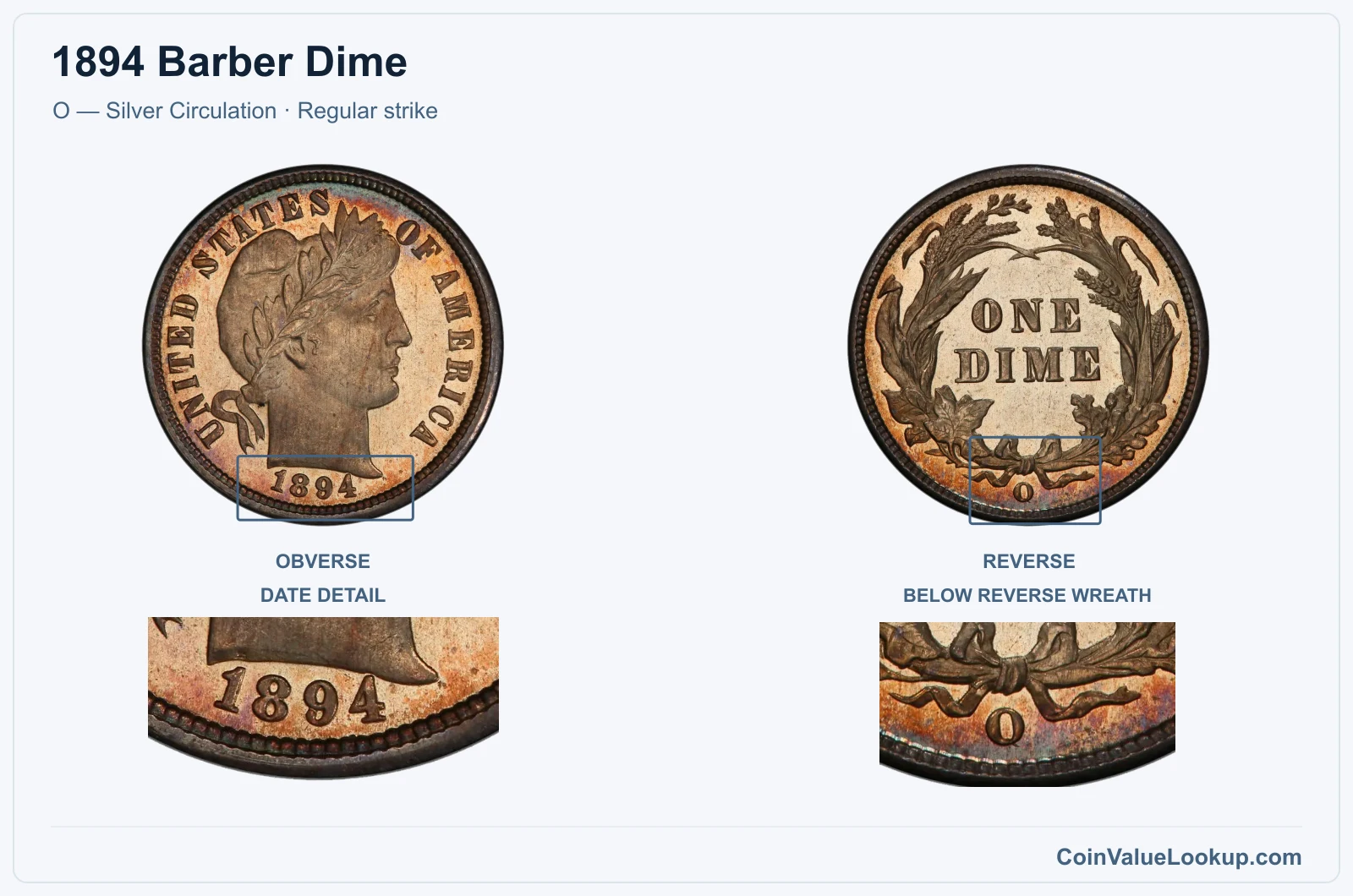
The New Orleans issue carries a small "O" mintmark below the wreath bow on the reverse. It trades at a noticeable premium over the Philadelphia strike.
USA Coin Book estimates put it around $90 at G4 and roughly $4,074 at MS63.
That MS63 jump reflects how few O-mint coins survived in upper grades. New Orleans Barber Dimes can show softer strikes from the factory, so a mushy headband or flat wreath leaf does not always mean heavy wear.
Compare luster patterns and high-point surfaces rather than relying on one design element.
Coin Value Lookup is a useful starting point when you want to look up guide values for Barber Dimes and other series across different dates and mints.
Range Grade
Price Auction Records Appraisal PO PO 1
—
Coin Identifier FR FR 2
—
Coin Identifier AG AG 3
—
Coin Identifier G G 4
Coin Identifier
G 6
Coin Identifier VG VG 8
Coin Identifier
VG 10
Coin Identifier F F 12
Coin Identifier
F 15
Coin Identifier VF VF 20
Coin Identifier
VF 25
Coin Identifier
VF 30
Coin Identifier
VF 35
Coin Identifier XF XF 40
Coin Identifier
XF 45
Coin Identifier AU AU 50
Coin Identifier
AU 53
Coin Identifier
AU 55
Coin Identifier
AU 58
Coin Identifier MS MS 60
Coin Identifier
MS 61
Coin Identifier
MS 62
Coin Identifier
MS 63
Coin Identifier
MS 64
Coin Identifier
MS 65
Coin Identifier
MS 66
Coin Identifier
MS 67
Coin Identifier
MS 68
—
—
—
MS 69
—
—
—
MS 70
—
—
—
1894 Barber Dime — No Mint Mark — Brilliant Silver Proof
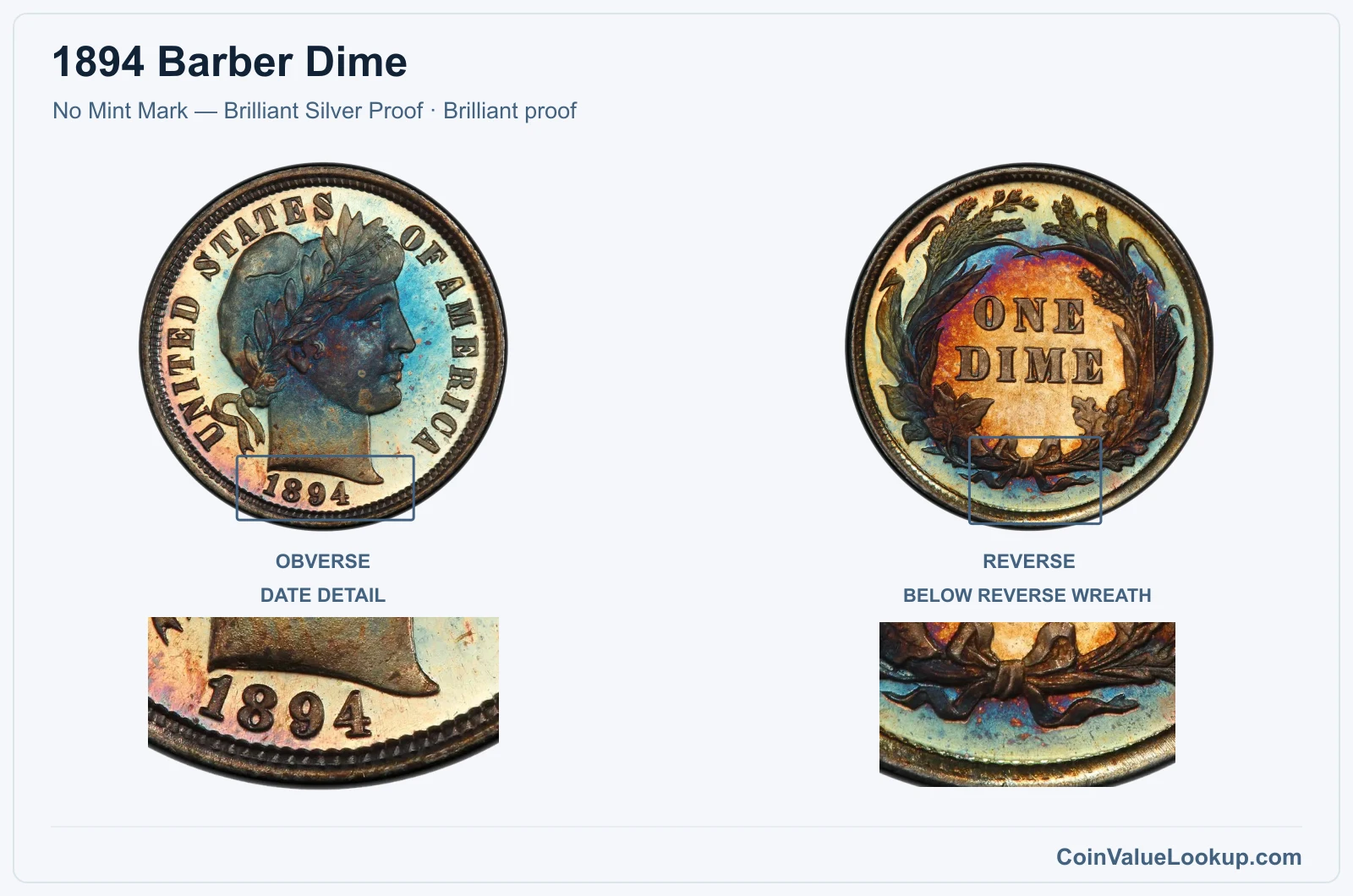
Philadelphia produced Proof Barber Dimes for collectors throughout the series run. These coins were struck on polished planchets with polished dies, producing deeply mirrored fields and crisp design edges.
There is no mintmark.
At PR63, USA Coin Book lists a guide estimate of about $616. Cameo and Deep Cameo designations describe the degree of contrast between frosted devices and reflective fields.
Do not assume an ordinary PR63 price applies to a coin with a Cameo or Deep Cameo designation, as those carry their own market.
Sharp rims, squared-off letter edges, and undisturbed mirror surfaces are what you are looking for. Hairlines from mishandling are the most common flaw on surviving Proofs.
Range Grade
Price Auction Records Appraisal PR PR 1
—
Coin Identifier
PR 2
—
Coin Identifier
PR 3
—
Coin Identifier
PR 4
—
Coin Identifier
PR 6
—
Coin Identifier
PR 8
—
Coin Identifier
PR 10
—
Coin Identifier
PR 12
—
Coin Identifier
PR 15
—
Coin Identifier
PR 20
—
Coin Identifier
PR 25
—
Coin Identifier
PR 30
—
Coin Identifier
PR 35
—
Coin Identifier
PR 40
—
Coin Identifier
PR 45
—
Coin Identifier
PR 50
—
Coin Identifier
PR 53
—
Coin Identifier
PR 55
—
Coin Identifier
PR 58
—
Coin Identifier
PR 60
Coin Identifier
PR 61
Coin Identifier
PR 62
Coin Identifier
PR 63
Coin Identifier
PR 64
Coin Identifier
PR 65
Coin Identifier
PR 66
Coin Identifier
PR 67
Coin Identifier
PR 68
Coin Identifier
PR 69
—
—
—
PR 70
—
—
—
1894 Barber Dime — S — 1894-S Proof Rarity
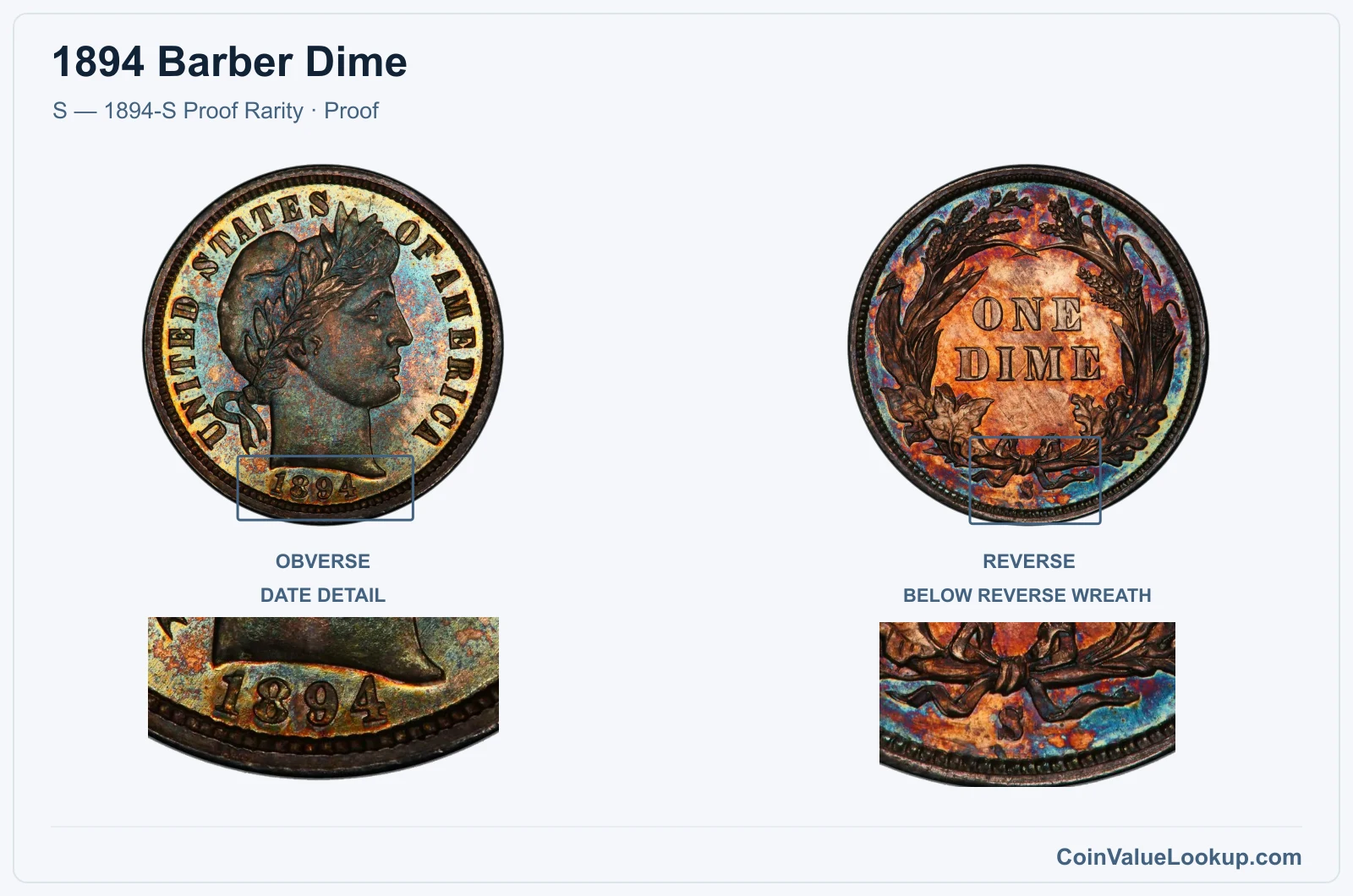
The 1894-S is one of the great American coin rarities. Only 24 Proof dimes were struck at the San Francisco Mint, and fewer than ten are confirmed to survive today.
These are not ordinary circulation strikes — they are purpose-made Proofs bearing the "S" mintmark.
A PR63 specimen comparison sits near $1,714,917 per available records. Each surviving coin has its own pedigree and auction history, so individual results vary considerably.
Simply finding an "S" below the wreath bow on an 1894 dime does not confirm this issue. The coin requires specialist authentication from a major third-party grading service.
Counterfeit and altered examples exist, including coins with added or tooled mintmarks. Do not buy, sell, or represent one of these without professional certification.
If you believe you have one, handle it carefully and seek expert evaluation before any cleaning or further contact.
Range Grade
Price Auction Records Appraisal PR PR 1
—
Coin Identifier
PR 2
—
Coin Identifier
PR 3
—
Coin Identifier
PR 4
—
Coin Identifier
PR 6
—
Coin Identifier
PR 8
—
Coin Identifier
PR 10
—
Coin Identifier
PR 12
—
Coin Identifier
PR 15
—
Coin Identifier
PR 20
—
Coin Identifier
PR 25
—
Coin Identifier
PR 30
—
Coin Identifier
PR 35
—
Coin Identifier
PR 40
—
Coin Identifier
PR 45
—
Coin Identifier
PR 50
—
Coin Identifier
PR 53
—
Coin Identifier
PR 55
—
Coin Identifier
PR 58
—
Coin Identifier
PR 60
—
Coin Identifier
PR 61
—
Coin Identifier
PR 62
—
Coin Identifier
PR 63
Coin Identifier
PR 64
Coin Identifier
PR 65
Coin Identifier
PR 66
Coin Identifier
PR 67
—
—
—
PR 68
—
—
—
PR 69
—
—
—
PR 70
—
—
—
1894 Barber Dime Error List
1. 1894 Barber Dime — Die Crack / Die Chip
Die cracks appear as thin raised lines running across the coin's surface, caused by fractures in the steel die during production. A die chip is a small raised blob where a piece of the die broke away.
Both are mint-made and can appear on either side of ordinary 1894 Philadelphia or New Orleans business strikes.
To identify one, look for a line or lump that sits above the coin's surface rather than being incised into it. An interior chip looks like a small bump, while a crack connecting to the rim is sometimes called a cud if enough metal is displaced.
Don't confuse these with scratches, corrosion lines, or foreign material stuck to the surface — those are incuse or sit on top rather than being part of the struck design. Condition, size, and location all affect how collectors value a die crack, so no single price applies.
2. 1894 Barber Dime — Struck-Through Error
A struck-through error happens when foreign material — grease, wire, thread, or a metal fragment — gets between the die and the planchet during striking. The result is a localized depression or incomplete area in the design where the obstruction blocked the die's impression.
On an 1894 business-strike dime, look for an area where the design seems pressed in or muffled rather than simply worn flat. Grease fill-ins tend to produce smooth, rounded depressions, while a retained foreign object may leave a distinct shape or texture.
These can be confused with ordinary wear, cleaning damage, or a weak strike. The key difference is that a struck-through affects a specific localized area while surrounding detail remains normal.
Value depends on the size, visibility, and nature of the obstruction impression, so a blanket price range does not apply.
3. 1894 Barber Dime — Lamination / Split Planchet
Lamination errors occur when the planchet metal separates internally, usually due to impurities or gas trapped in the alloy during preparation. On an 1894 Barber Dime business strike, this shows up as peeling metal, a retained flap, or a visible split within the coin's thickness.
Photograph both the affected face and the edge together — the edge view often shows the separation layer most clearly. A retained flap that is still attached is generally more collectible than a missing chunk.
This is not the same as surface scraping, corrosion pitting, or a deliberately altered coin. Lamination follows the metal's internal structure and typically has a natural, layered appearance at the edges of the flaw.
The value of a lamination error depends on how dramatic the separation is and the overall condition of the coin.
4. 1894 Barber Dime — Clipped Planchet
A clipped planchet error means the coin blank was incompletely punched from the metal strip before striking. The result is a missing curved, straight, or irregular section along the edge.
On an 1894 business-strike dime, look at the rim area for an absent portion and check whether the opposite side of the coin shows design weakness — metal flow during striking often creates a soft zone across from the clip.
The edge texture at a genuine clip differs from a filed or cut edge. A real clip shows the natural shear of the punching process rather than tool marks.
Do not confuse clips with post-mint damage such as filing, deliberate cutting, or heavy corrosion eating away the rim. The specific size, shape, and effect on the design all influence collector interest, so there is no fixed price for this category.
5. 1894 Barber Dime — Broadstrike
A broadstrike occurs when a coin is struck without the normal collar die that constrains the planchet's edge. The metal spreads outward, producing a coin that is wider than normal with a missing or malformed rim, while the full design is still centered and visible.
On an 1894 business-strike dime, look for a coin that appears slightly oversized with the design spreading toward the edges. The edge profile will lack the standard reeded pattern or show distorted reeding.
This is different from an off-center strike, where the design shifts to one side and part is missing. It also differs from a coin that was flattened after leaving the mint — post-strike damage typically shows unnatural surface distortion and tool marks.
The degree of spread and the coin's overall condition determine how collectors assess a broadstrike, so no single price range applies here.