1896 Barber Dime Coin Value: How Much Is It Worth?
The 1896 Barber Dime spans a wide value range depending on mint and condition. A Philadelphia piece in well-worn G4 grade runs about $21, while a New Orleans coin in MS63 reaches around $2,905 according to USA Coin Book guide estimates.
Proofs, scarce mints, and recognized errors each carry their own premium, so knowing exactly what you have matters.
Fast Way to Identify Your 1896 Barber Dime
The quickest way to start figuring out your 1896 Barber Dime's value is to upload clear photos of the front and back. Our identifier can give you a preliminary read on mint, version, and general condition from those images alone.
Snap both sides in good light, keep the coin flat, and let the tool do its initial work.
1896 Barber Dime Value
Upload both sides of your 1896 Barber Dime.
Front Obverse
Upload photo
Back Reverse
Upload photo
Which 1896 Barber Dime Versions Are Worth Money?
- New Orleans (O) coins in higher grades are scarce and guide at $2,905 in MS63 versus $106 in G4, reflecting sharp grade-driven premiums.
- San Francisco (S) coins command $147 at G4 and $1,678 at MS63, making them the priciest mint in low grades.
- Philadelphia Proof dimes in PR63 guide at $616 and were produced in limited quantities for collectors.
- The O/S overmintmark variety carries a substantial premium over a regular O-mint coin and is worth checking with a loupe.
- Recognized errors like off-center strikes and misplaced dates can add value depending on severity and condition.
Step 1: Identify Your 1896 Barber Dime Mint Mark and Version
The obverse shows a right-facing Liberty wearing a cap and headband inscribed LIBERTY. The reverse reads ONE DIME inside an open wreath tied with a bow at the bottom.
Do not confuse this design with the later Mercury (Winged Liberty) dime or earlier Seated Liberty types.
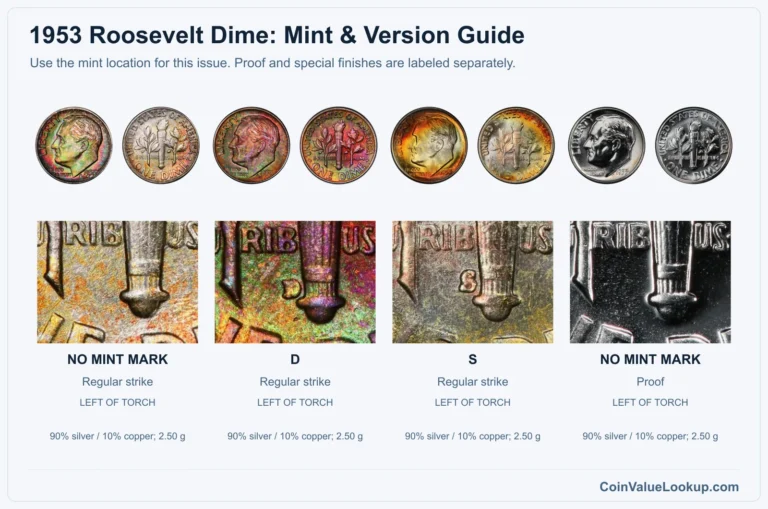
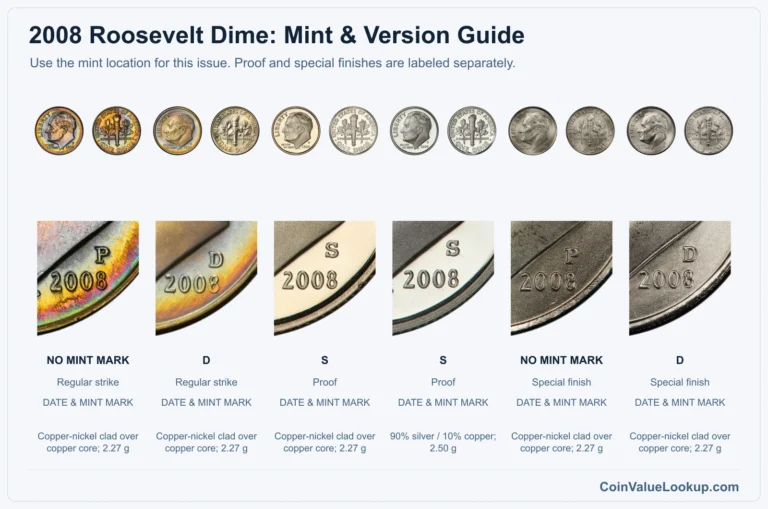
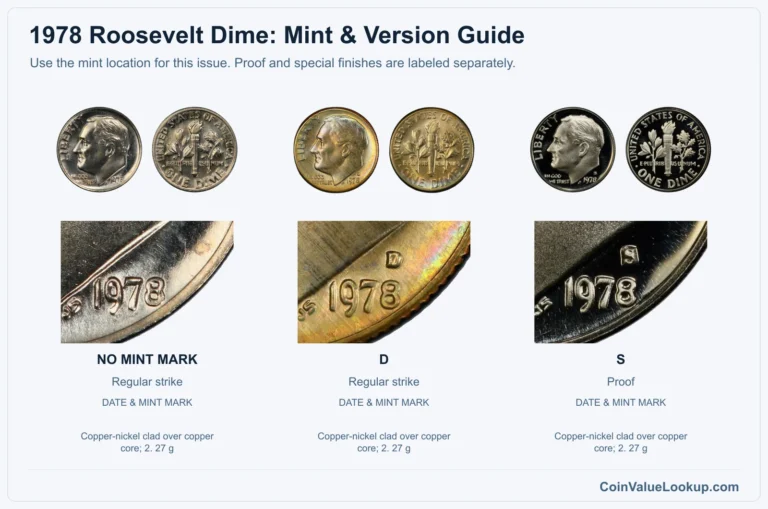
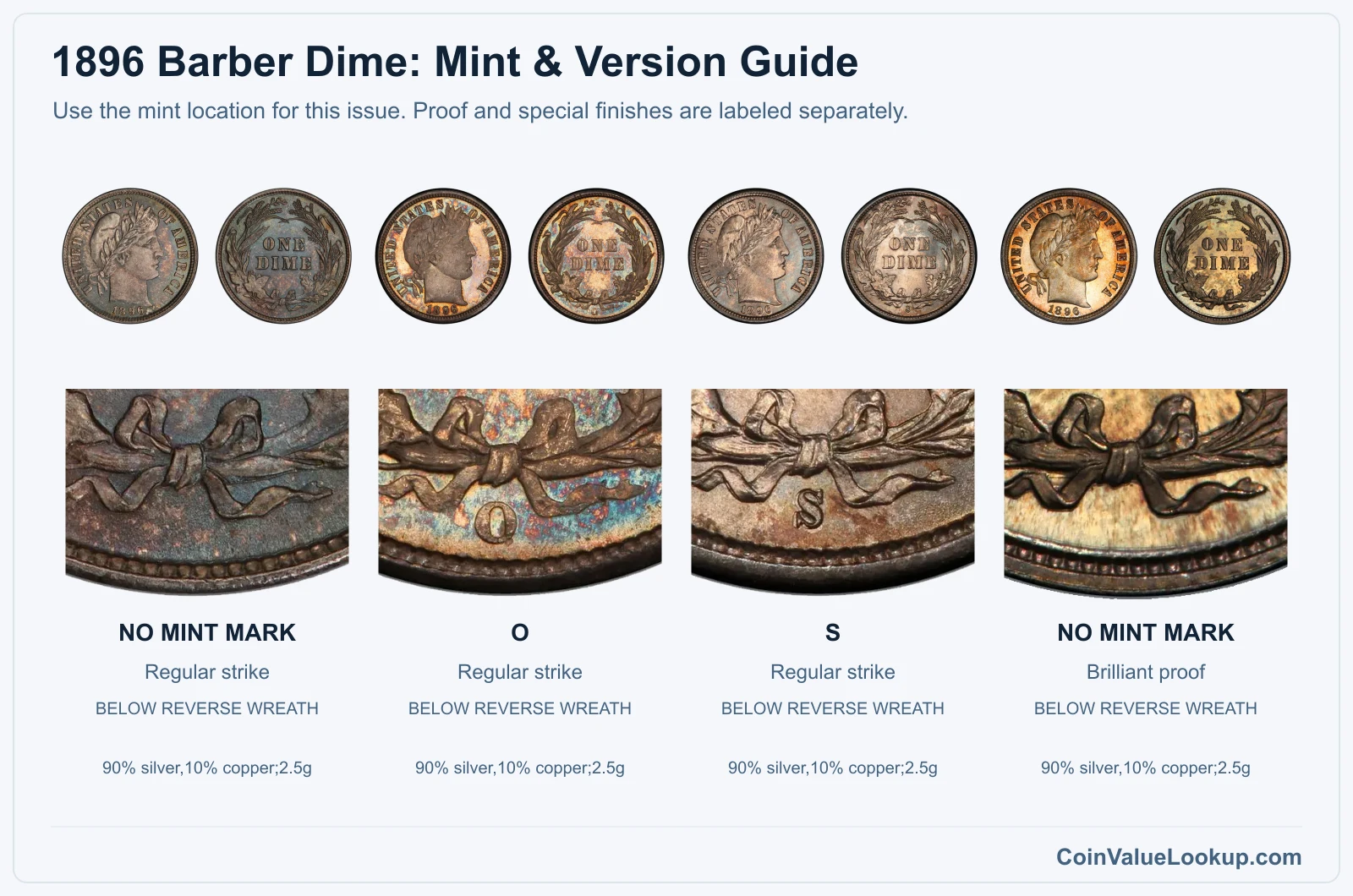
Mintmarks sit just below the wreath bow on the reverse. No mintmark means Philadelphia.
An "O" means New Orleans, and an "S" means San Francisco. You may need a loupe to see the small letter clearly, especially on worn coins.
All normal 1896 Barber Dimes are struck in 90% silver and 10% copper, weigh 2.5 grams, measure 17.9 mm across, and have a reeded edge. If the weight or edge seems off, you may be looking at a counterfeit or damaged piece.
The O-mintmark coins from New Orleans sometimes feature an overmintmark (O/S), where an earlier "S" mintmark is visible beneath the "O." That is a recognized variety carrying a substantial premium over a normal O-mint coin, so inspect the mintmark carefully under magnification.
Step 2: Check Your 1896 Barber Dime Grade
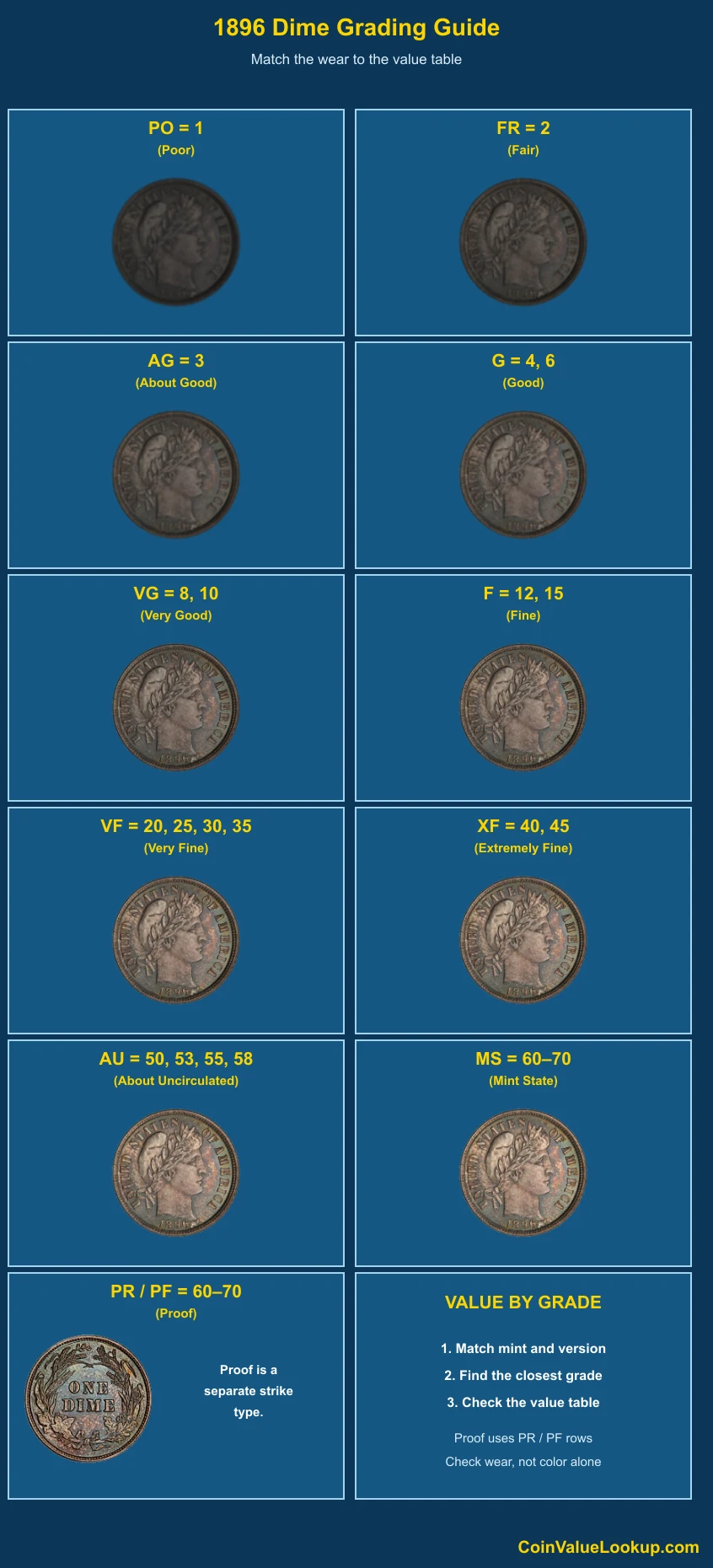
Grading a Barber Dime means evaluating actual wear across several areas, not just counting how many letters of LIBERTY you can read. Check the headband detail, the hair above the ear, the smoothness of the cheek, the wreath leaves on the reverse, and the sharpness of the rim.
At G4 (Good), the design outline is visible but most fine detail is gone. LIBERTY on the headband is typically worn away or barely legible.
At MS63 (Mint State), the coin retains full original luster with no wear, though minor bag marks or contact marks are acceptable.
New Orleans coins are often softly struck from the factory, which can mimic wear. A soft strike shows mushy detail but retains luster in protected areas; true wear removes luster entirely.
Use the comparison image to see how genuine wear differs from strike weakness.
Proof is a special manufacturing method with mirrored fields and crisp rims, not simply a grade above Mint State. Proof coins were struck at Philadelphia only.
Cleaned coins, even if otherwise unworn, lose much of their value, so look for unnatural brightness or hairlines under magnification.
Step 3: Check 1896 Barber Dime Value by Mint and Version
1896 Barber Dime — No Mint Mark — Silver Circulation
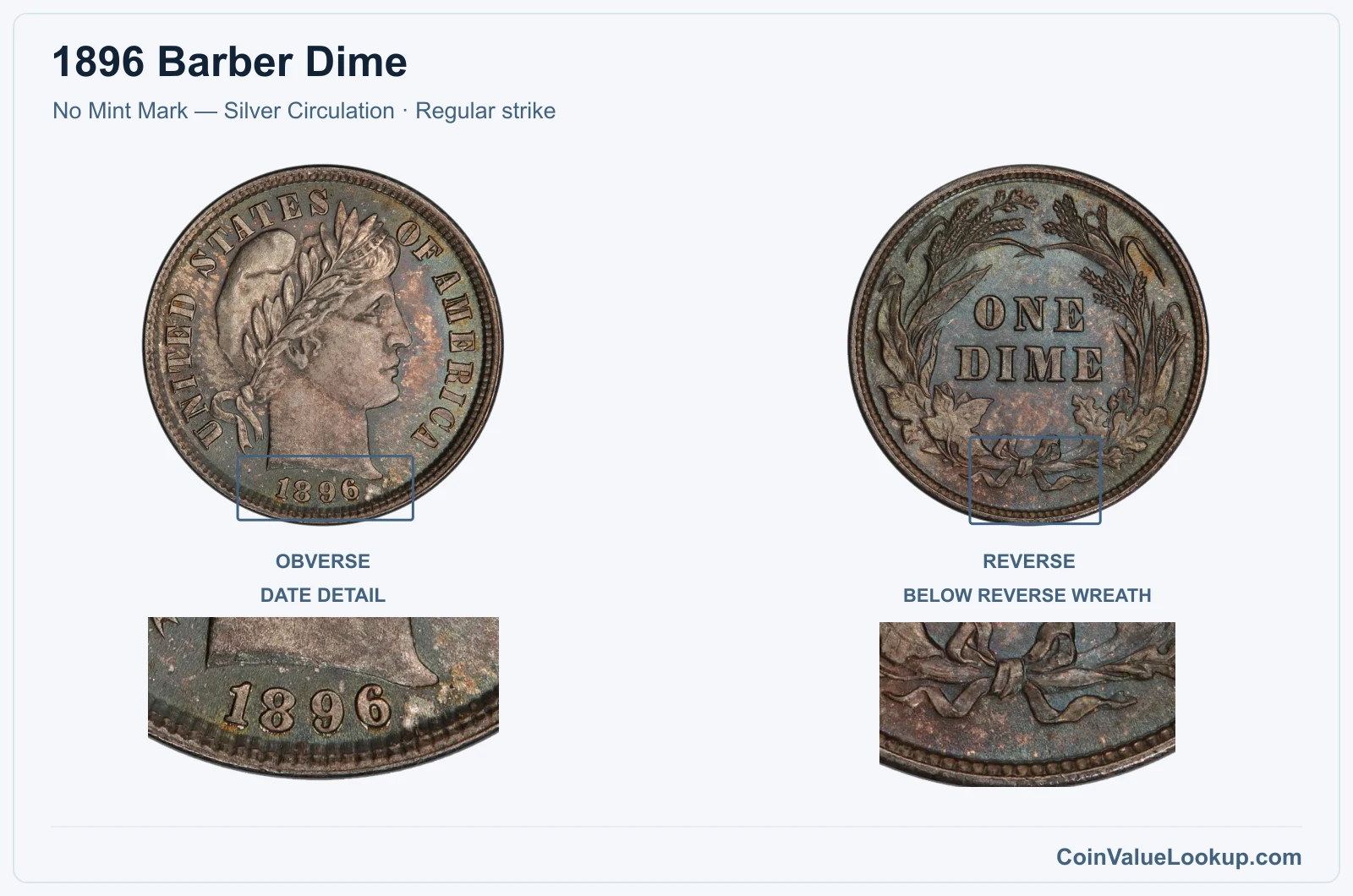
The Philadelphia issue carries no mintmark. In G4, a guide estimate puts it near $21, climbing to about $501 at MS63.
That is a big jump, so condition matters.
Look for full detail on Liberty's headband and sharp wreath leaves to push into higher grades. These are the most common 1896 Barber Dimes, which keeps lower-grade prices modest.
Still, an original, uncleaned example with strong luster in Mint State is a genuinely attractive coin.
Range Grade
Price Auction Records Appraisal PO PO 1
—
Coin Identifier FR FR 2
—
Coin Identifier AG AG 3
—
Coin Identifier G G 4
—
Coin Identifier
G 6
—
Coin Identifier VG VG 8
—
Coin Identifier
VG 10
Coin Identifier F F 12
—
Coin Identifier
F 15
—
Coin Identifier VF VF 20
Coin Identifier
VF 25
Coin Identifier
VF 30
—
Coin Identifier
VF 35
—
Coin Identifier XF XF 40
Coin Identifier
XF 45
Coin Identifier AU AU 50
Coin Identifier
AU 53
Coin Identifier
AU 55
Coin Identifier
AU 58
Coin Identifier MS MS 60
—
Coin Identifier
MS 61
—
Coin Identifier
MS 62
Coin Identifier
MS 63
Coin Identifier
MS 64
Coin Identifier
MS 65
Coin Identifier
MS 66
Coin Identifier
MS 67
Coin Identifier
MS 68
—
—
—
MS 69
—
—
—
MS 70
—
—
—
1896 Barber Dime — O — Silver Circulation
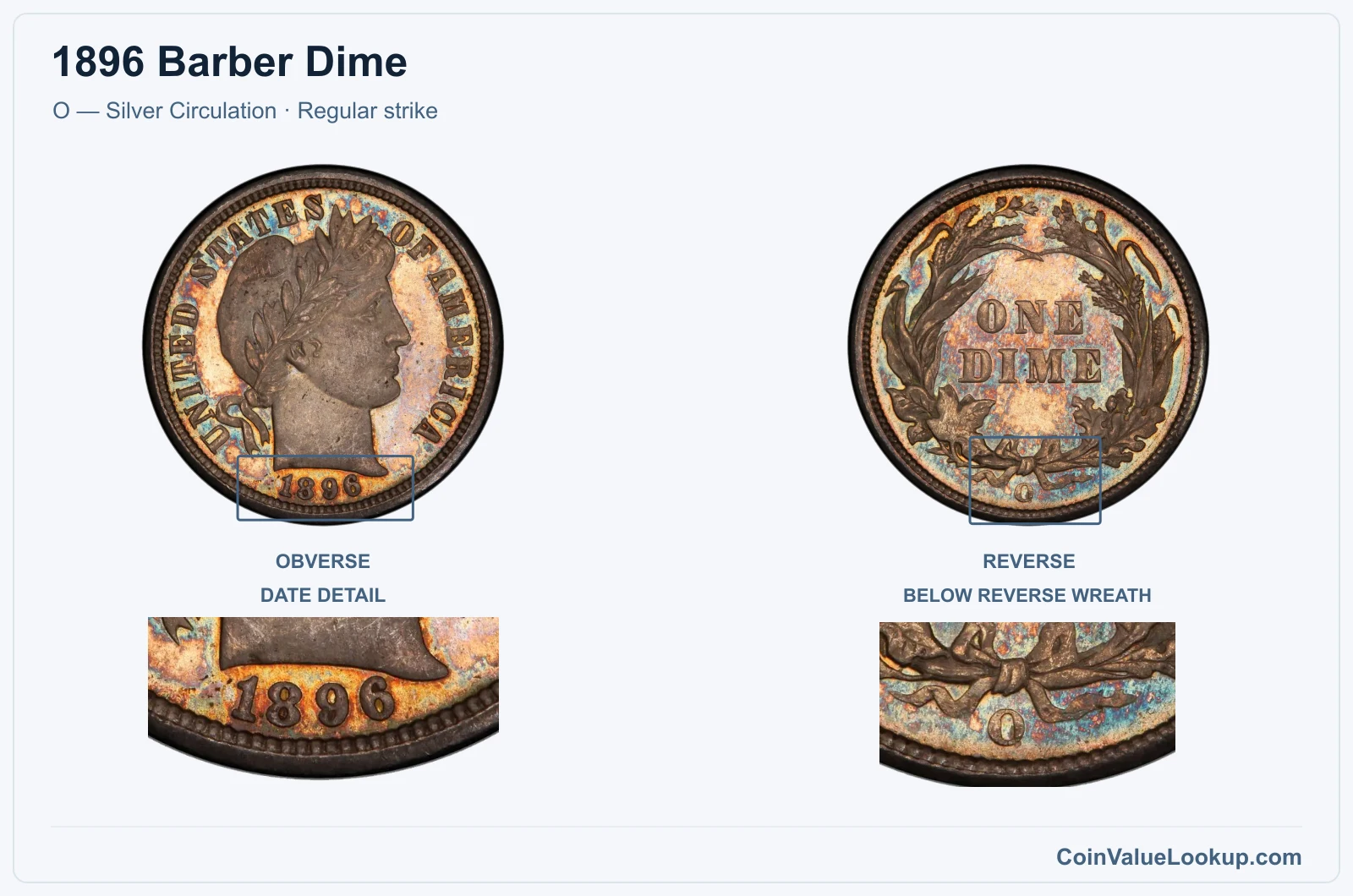
The New Orleans mint placed an "O" below the wreath bow. This is the key semi-scarce issue for the year, guiding at about $106 in G4 and roughly $2,905 in MS63 per USA Coin Book estimates.
Before you celebrate, check the mintmark carefully. Some 1896-O dimes show traces of an earlier "S" beneath the "O," indicating an overmintmark variety that commands a substantial premium beyond even these already elevated figures.
A loupe at 10x or better helps.
New Orleans strikes are often soft, so do not mistake factory weakness for heavy circulation wear. If luster remains in the recessed areas around the ear and wreath, the coin may grade higher than it first appears.
Coin Value Lookup is a good starting point if you want to compare values across different Barber Dime dates and mints before deciding on your next step.
Range Grade
Price Auction Records Appraisal PO PO 1
—
Coin Identifier FR FR 2
Coin Identifier AG AG 3
Coin Identifier G G 4
Coin Identifier
G 6
Coin Identifier VG VG 8
Coin Identifier
VG 10
Coin Identifier F F 12
Coin Identifier
F 15
Coin Identifier VF VF 20
Coin Identifier
VF 25
Coin Identifier
VF 30
Coin Identifier
VF 35
Coin Identifier XF XF 40
Coin Identifier
XF 45
Coin Identifier AU AU 50
Coin Identifier
AU 53
Coin Identifier
AU 55
Coin Identifier
AU 58
Coin Identifier MS MS 60
—
Coin Identifier
MS 61
—
Coin Identifier
MS 62
Coin Identifier
MS 63
Coin Identifier
MS 64
Coin Identifier
MS 65
Coin Identifier
MS 66
Coin Identifier
MS 67
Coin Identifier
MS 68
—
—
—
MS 69
—
—
—
MS 70
—
—
—
1896 Barber Dime — S — Silver Circulation
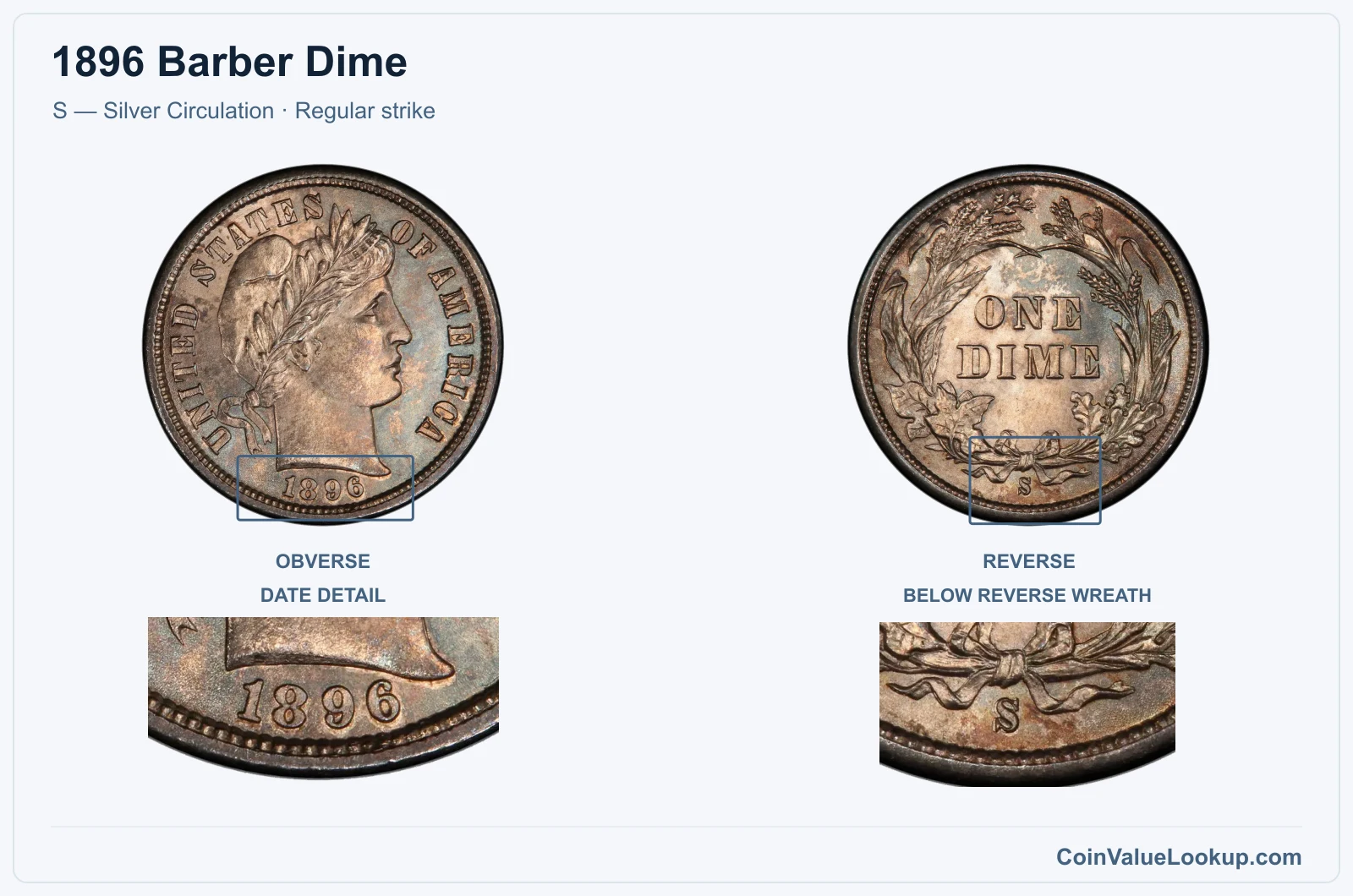
San Francisco coins bear an "S" mintmark below the wreath bow. At G4, the guide estimate is about $147, making this the most expensive mint in heavily worn condition.
In MS63, the figure is roughly $1,678.
The high low-grade price reflects genuine scarcity in surviving populations. Many were circulated hard in Western commerce and few survived with any detail.
Finding one with a readable LIBERTY headband already puts you well above the floor value.
As with all Barber Dimes, check for cleaning. A harshly cleaned S-mint coin loses much of its premium, even if the underlying detail is decent.
Range Grade
Price Auction Records Appraisal PO PO 1
—
Coin Identifier FR FR 2
—
Coin Identifier AG AG 3
Coin Identifier G G 4
Coin Identifier
G 6
Coin Identifier VG VG 8
Coin Identifier
VG 10
Coin Identifier F F 12
Coin Identifier
F 15
Coin Identifier VF VF 20
Coin Identifier
VF 25
Coin Identifier
VF 30
Coin Identifier
VF 35
Coin Identifier XF XF 40
Coin Identifier
XF 45
Coin Identifier AU AU 50
Coin Identifier
AU 53
Coin Identifier
AU 55
Coin Identifier
AU 58
Coin Identifier MS MS 60
Coin Identifier
MS 61
Coin Identifier
MS 62
Coin Identifier
MS 63
Coin Identifier
MS 64
Coin Identifier
MS 65
Coin Identifier
MS 66
Coin Identifier
MS 67
—
—
—
MS 68
—
—
—
MS 69
—
—
—
MS 70
—
—
—
1896 Barber Dime — No Mint Mark — Brilliant Silver Proof
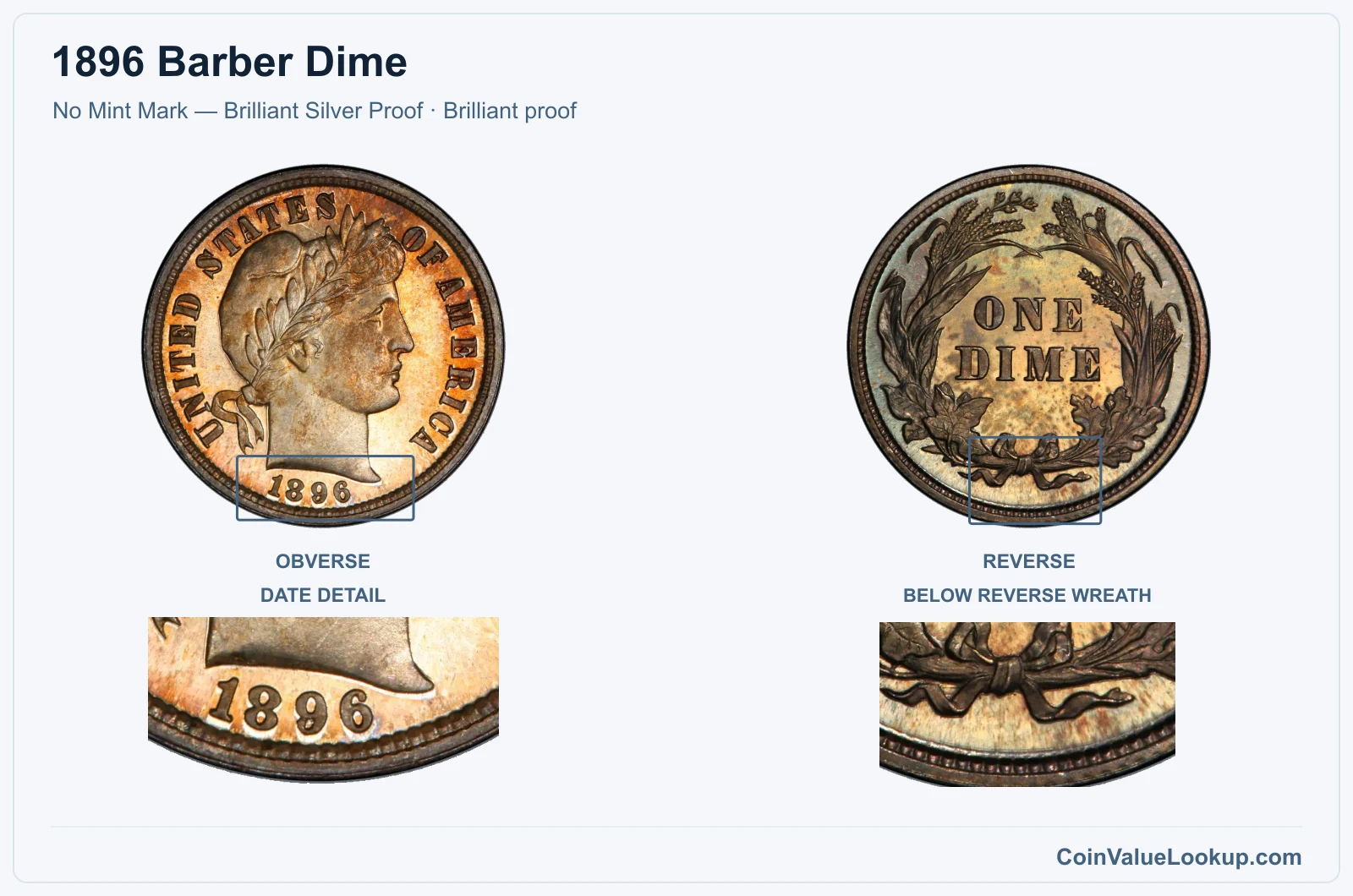
Proof 1896 Barber Dimes were struck only at Philadelphia and carry no mintmark, just like business strikes. The difference is in the manufacturing: mirrored fields, razor-sharp rims, and fully defined design elements.
A PR63 example guides at approximately $616 according to USA Coin Book. Cameo and Deep Cameo designations reflect contrast between frosted devices and mirrored fields, but those are separate tiers with their own pricing.
Do not assume a standard PR63 price applies to a contrast-designated coin.
Look for hairlines under angled light. Even light cleaning or mishandling can drop a proof below the PR63 threshold.
Original surfaces with minimal marks are what you want to see.
Range Grade
Price Auction Records Appraisal PR PR 1
—
Coin Identifier
PR 2
—
Coin Identifier
PR 3
—
Coin Identifier
PR 4
—
Coin Identifier
PR 6
—
Coin Identifier
PR 8
—
Coin Identifier
PR 10
—
Coin Identifier
PR 12
—
Coin Identifier
PR 15
—
Coin Identifier
PR 20
—
Coin Identifier
PR 25
—
Coin Identifier
PR 30
—
Coin Identifier
PR 35
—
Coin Identifier
PR 40
—
Coin Identifier
PR 45
—
Coin Identifier
PR 50
—
Coin Identifier
PR 53
—
Coin Identifier
PR 55
—
Coin Identifier
PR 58
Coin Identifier
PR 60
Coin Identifier
PR 61
Coin Identifier
PR 62
Coin Identifier
PR 63
Coin Identifier
PR 64
Coin Identifier
PR 65
Coin Identifier
PR 66
Coin Identifier
PR 67
Coin Identifier
PR 68
—
—
—
PR 69
—
—
—
PR 70
—
—
—
1896 Barber Dime Error List
1. 1896 Barber Dime — Off-Center Strike
An off-center strike happens when the planchet is not properly seated in the collar during striking. The result is a displaced design with an unstruck crescent of blank metal along one edge.
On a 1896 Dime, retain enough of the design to see the date, or the coin loses most of its error premium.
Off-center errors are reported for the 1896 Dime as a category. The degree of displacement, the visibility of the date, and overall condition all affect how much premium the error commands.
No standard price range applies because each example varies.
Do not confuse an off-center strike with a clipped planchet, which shows a curved bite out of one edge, or with post-mint damage like a coin that was flattened or bent after leaving the press. A genuine off-center piece shifts the entire design uniformly in one direction.
2. 1896 Barber Dime — Misplaced Date
A misplaced date occurs when a digit fragment appears outside its normal position, typically punched into the denticles below the date during die preparation. On the reported 1896 Dime example, look for the top of a "6" visible in the denticles beneath the "9" of the date.
You will need magnification to spot it.
This is different from a repunched date, where the secondary image sits beside or overlapping the normal numerals. A misplaced date shows a stray fragment clearly displaced into an area where no numeral belongs.
Damaged dates or machine doubling can mimic this effect to an untrained eye. Machine doubling produces flat, shelf-like secondary images rather than a rounded digit fragment.
Condition, clarity of the displaced digit, and overall surface quality all influence value, but no specific price range is established for this variety in the supplied data.