1905 Barber Dime Coin Value: How Much Is It Worth?
A 1905 Barber Dime in circulated condition starts around $12–$15 at the G4 grade level depending on the mint, while uncirculated examples can reach roughly $253 to $531 at MS63. The New Orleans Micro O variety is the one to watch — guide estimates place that coin at about $90 in G4 and $6,834 at MS63.
Proofs, error coins, and specific mint issues each carry their own pricing, so sorting out exactly what you have matters.
Fast Way to Identify Your 1905 Barber Dime
The quickest way to start figuring out your 1905 Barber Dime is to snap clear photos of both sides and upload them here. That gives you a preliminary identification based on the design, mintmark, and overall condition.
It won't replace professional grading or authentication, but it can point you in the right direction before you go further.
1905 Barber Dime Value
Upload both sides of your 1905 Barber Dime.
Front Obverse
Upload photo
Back Reverse
Upload photo
Which 1905 Barber Dime Versions Are Worth Money?
- The 1905-O Micro O variety commands a significant premium — guide estimates run about $90 at G4 and roughly $6,834 at MS63, far above the regular O mintmark version.
- Uncirculated 1905-O dimes with the regular O mintmark carry higher guide values at MS63 (about $531) compared to Philadelphia ($253) or San Francisco ($348) examples.
- Philadelphia proof strikes are listed around $616 at PR63; contrast designations like Cameo or Deep Cameo carry different pricing and should not be confused with a standard proof.
- Error coins such as broadstrikes, clipped planchets, off-center strikes, and repunched mintmarks are reported for this date — condition and visibility of the error affect value individually.
Step 1: Identify Your 1905 Barber Dime Mint Mark and Version
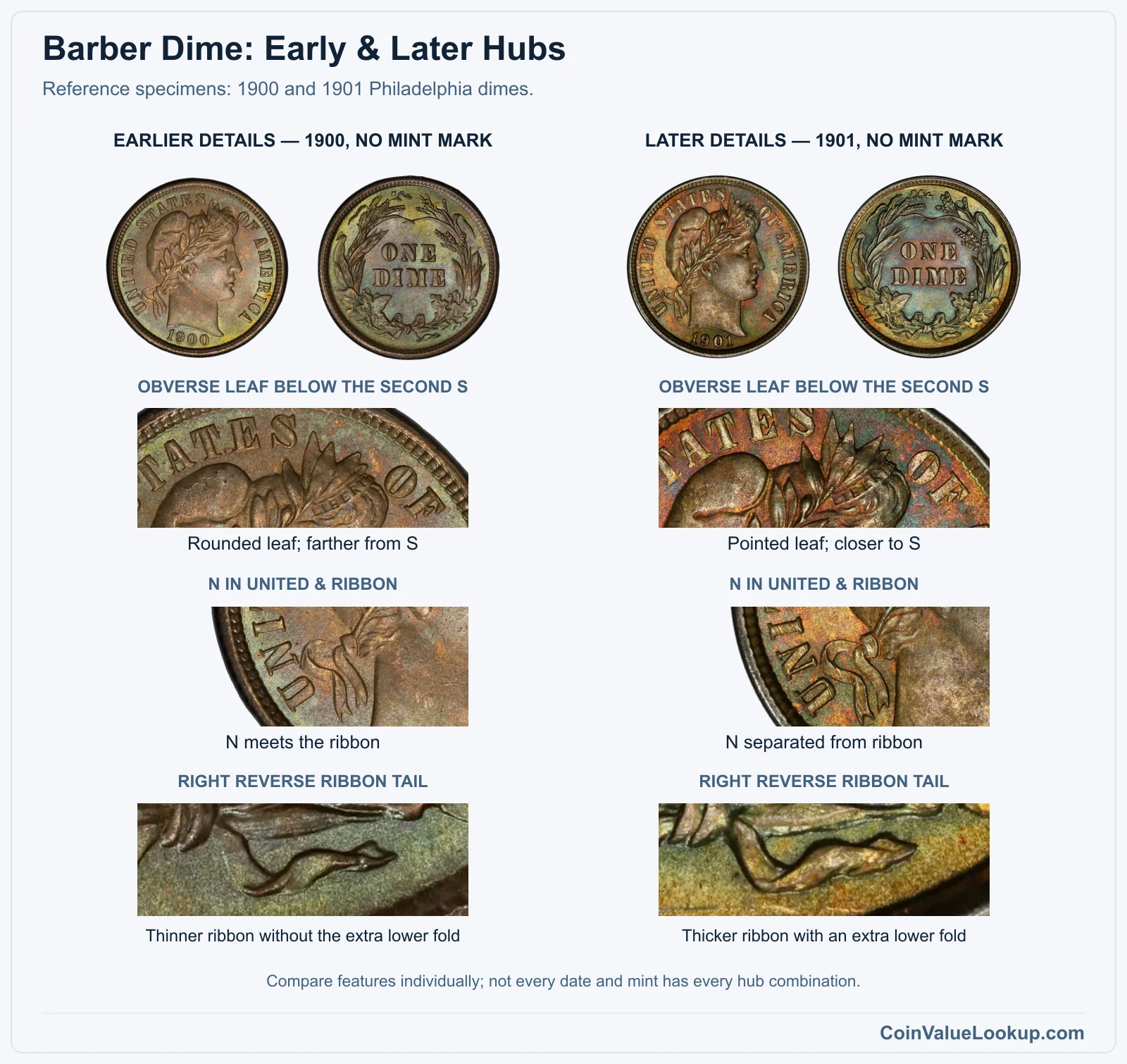
The 1905 Barber Dime shows Liberty facing right on the obverse, wearing a Phrygian cap and headband inscribed LIBERTY. The reverse features ONE DIME inside an open wreath tied with a bow at the bottom.
Flip the coin over and look below that wreath bow. If there is no letter, your coin is from Philadelphia.
An "O" means New Orleans, and an "S" means San Francisco.
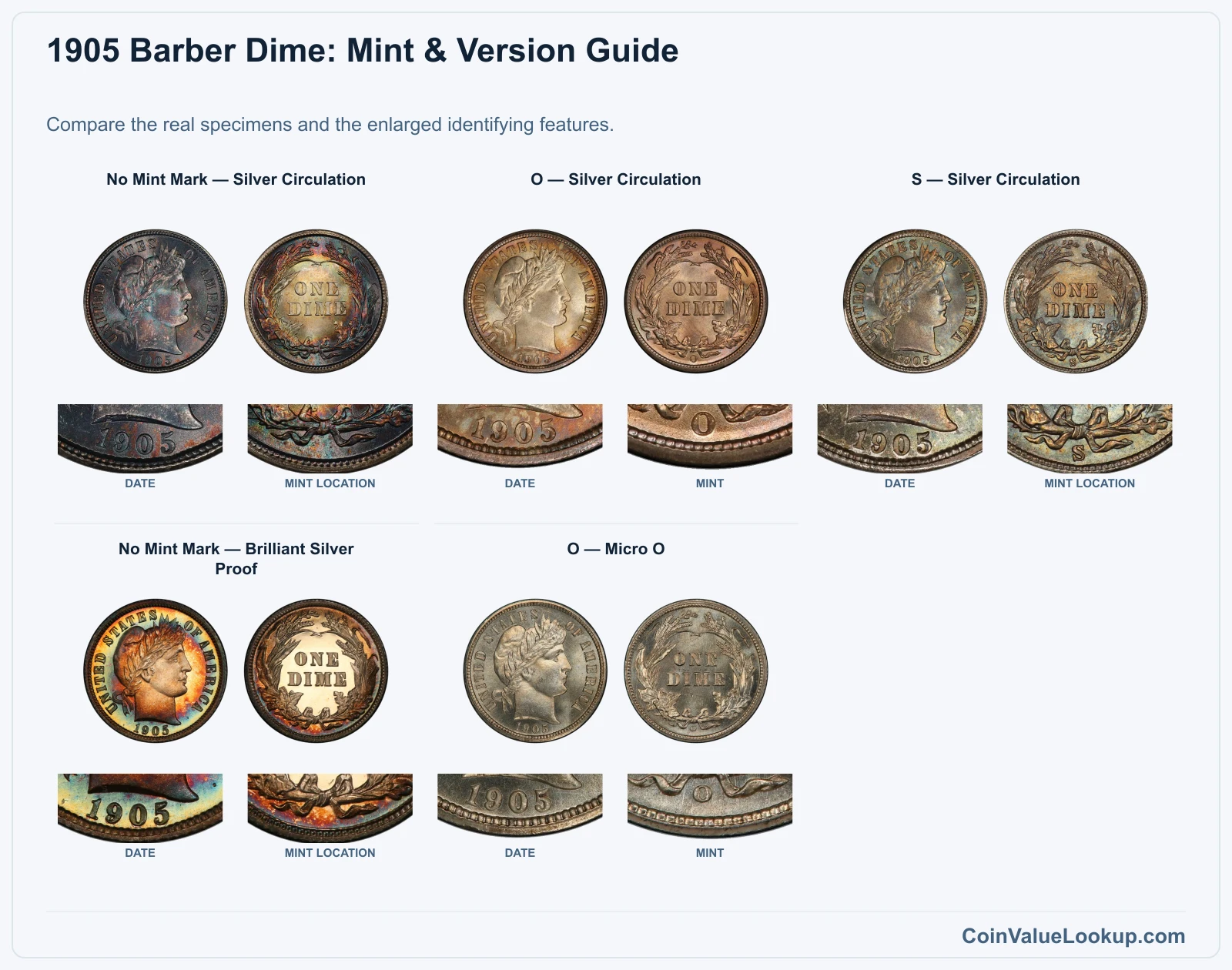
Here is where it gets a little tricky. The 1905-O comes in two varieties: a regular-size O mintmark and a distinctly smaller Micro O.
The Micro O is not a repunched mintmark or a doubled letter — it is simply a physically smaller punch used to stamp the mintmark. Compare your O to known examples at the same magnification to tell the difference.
All standard 1905 Barber Dimes are struck in 90% silver and 10% copper, weigh 2.5 grams, measure 17.9 mm across, and have a reeded edge. If your coin is smooth-edged, magnetic, or the wrong weight, something else is going on.
Step 2: Check Your 1905 Barber Dime Grade
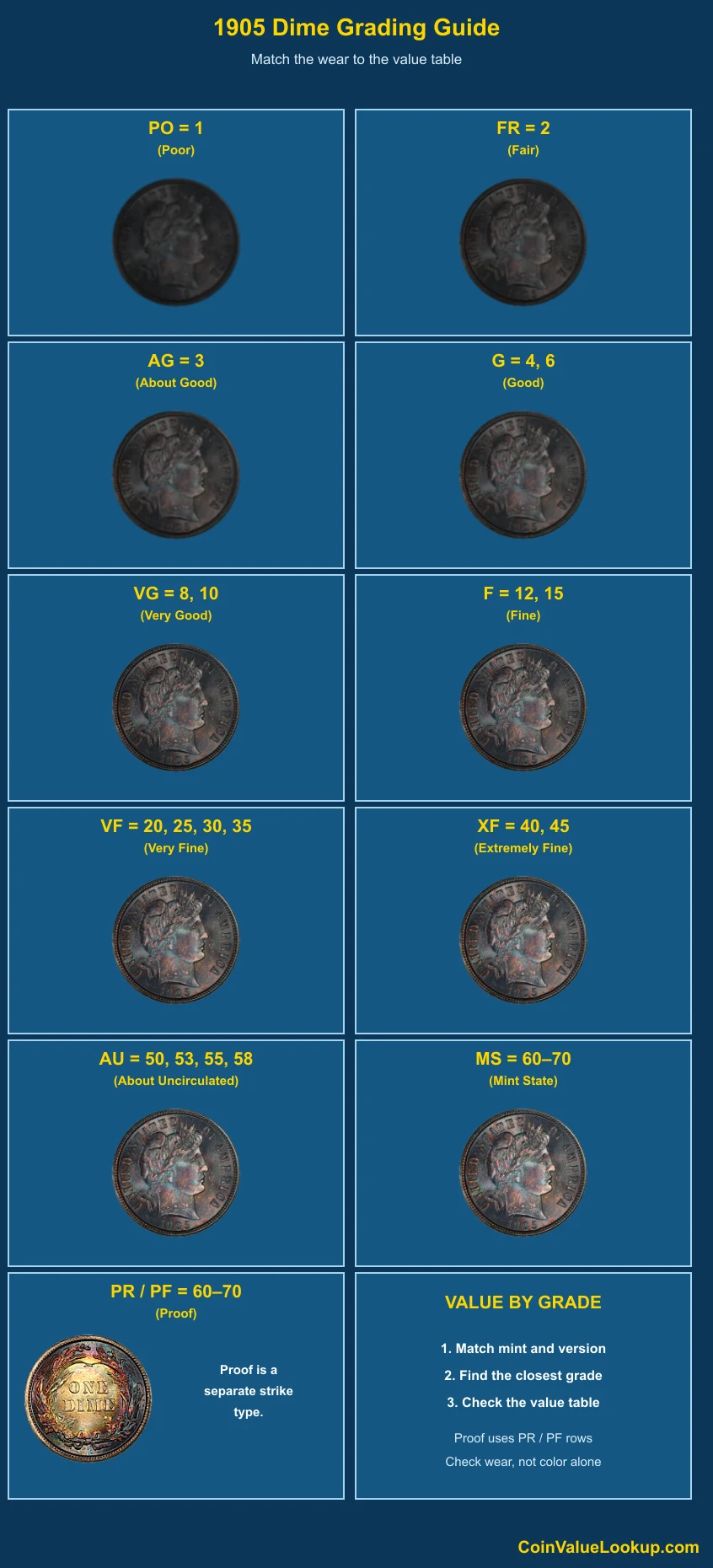
Start with the LIBERTY headband on the obverse. On a well-worn coin (around G4), most or all letters will be gone, but you should still see the head outline and date clearly.
As condition improves, individual letters in LIBERTY become readable — that is a key milestone collectors use.
Do not rely on the headband alone, though. Check the hair detail above Liberty's ear, the smoothness of the cheek, and the crispness of the wreath leaves and ribbon on the reverse.
Worn rims also tell a story.
New Orleans coins deserve extra patience. They were sometimes softly struck at the mint, meaning a coin can look more worn than it actually is.
A soft strike is not the same as circulation wear — luster and surface quality help you separate the two.
For Mint State, you need unbroken luster across the entire coin. Hairlines from cleaning, dull spots, or obvious scratches disqualify a coin from that grade even if the design looks sharp.
Use the comparison image to match your coin's wear pattern against known grade examples.
Proof is a manufacturing method, not a grade above Mint State. Proof coins were struck with specially prepared dies on polished planchets at Philadelphia.
They have mirrored fields and sharp rims by design.
Step 3: Check 1905 Barber Dime Value by Mint and Version
1905 Barber Dime — No Mint Mark — Silver Circulation
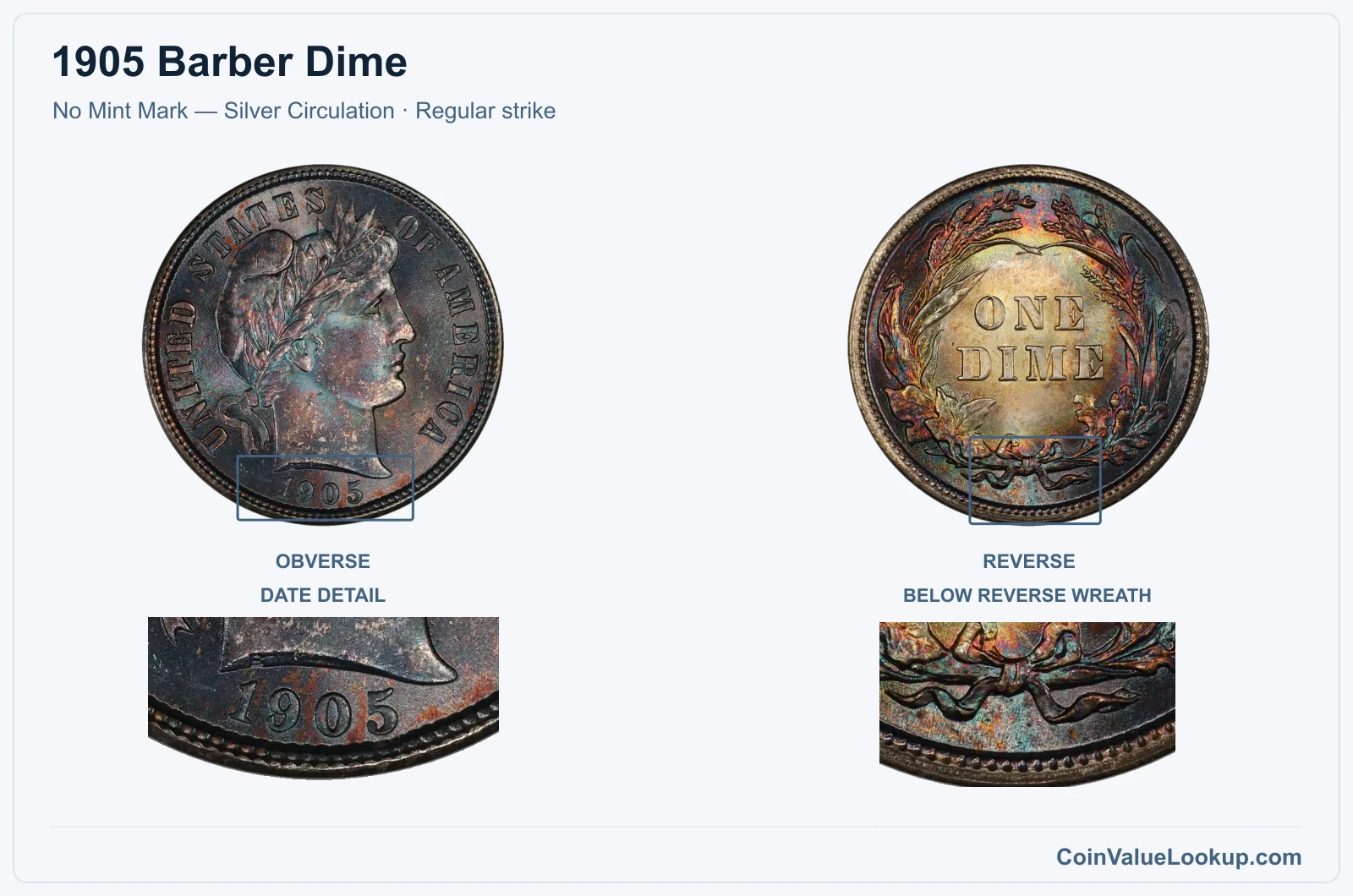
The Philadelphia 1905 Barber Dime carries no mintmark. Look below the wreath bow on the reverse — if the space is empty, you have the Philly issue.
USA Coin Book guide estimates place this coin at about $12.26 in G4 and around $253 at MS63. These are retail guide snapshots, not guaranteed sale prices.
Most circulated examples trade near the lower end, so condition is everything.
The coin is 90% silver and 10% copper, weighing 2.5 grams with a reeded edge. Even a beat-up example has a small amount of silver content behind it.
Range Grade
Price Auction Records Appraisal PO PO 1
—
Coin Identifier FR FR 2
—
Coin Identifier AG AG 3
—
Coin Identifier G G 4
—
Coin Identifier
G 6
—
Coin Identifier VG VG 8
—
Coin Identifier
VG 10
—
Coin Identifier F F 12
—
Coin Identifier
F 15
—
Coin Identifier VF VF 20
—
Coin Identifier
VF 25
—
Coin Identifier
VF 30
—
Coin Identifier
VF 35
—
Coin Identifier XF XF 40
Coin Identifier
XF 45
—
Coin Identifier AU AU 50
Coin Identifier
AU 53
—
Coin Identifier
AU 55
Coin Identifier
AU 58
Coin Identifier MS MS 60
Coin Identifier
MS 61
Coin Identifier
MS 62
Coin Identifier
MS 63
Coin Identifier
MS 64
Coin Identifier
MS 65
Coin Identifier
MS 66
Coin Identifier
MS 67
Coin Identifier
MS 68
—
—
—
MS 69
—
—
—
MS 70
—
—
—
1905 Barber Dime — O — Silver Circulation
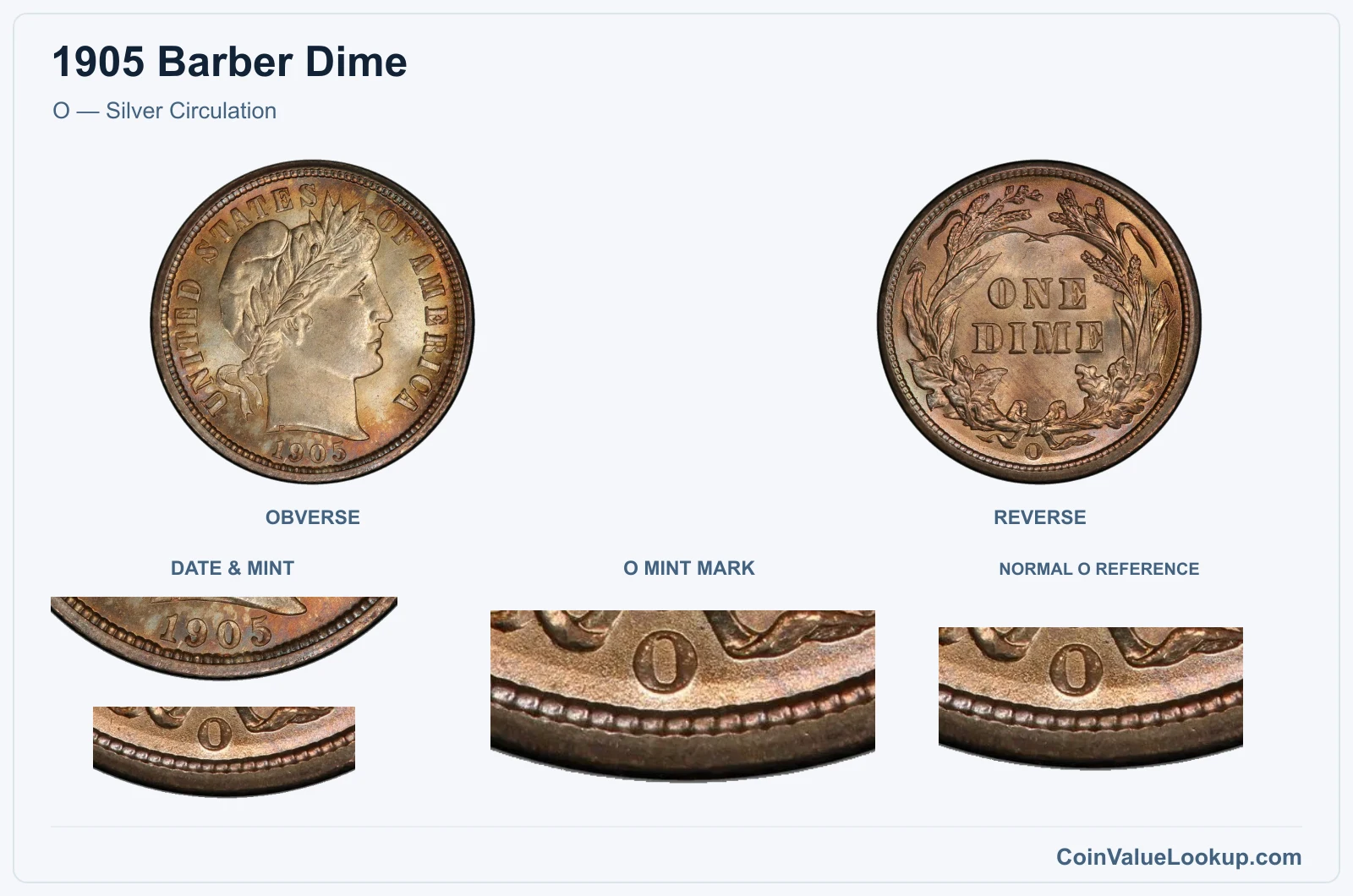
The 1905-O with a regular-size O mintmark was struck in New Orleans. You will find the O centered below the wreath bow on the reverse.
Guide estimates from USA Coin Book put this version at roughly $15 in G4 and about $531 at MS63 — a meaningful jump over the Philadelphia issue in higher grades. New Orleans Barber Dimes are known for sometimes having softer strikes, so do not confuse a weak impression with heavy wear.
Make sure you compare the size of your O mintmark against known Micro O examples. The regular O is noticeably larger.
If yours looks unusually small and compact, you may be holding the much more valuable Micro O variety instead.
Range Grade
Price Auction Records Appraisal PO PO 1
—
Coin Identifier FR FR 2
—
Coin Identifier AG AG 3
—
Coin Identifier G G 4
Coin Identifier
G 6
—
Coin Identifier VG VG 8
—
Coin Identifier
VG 10
—
Coin Identifier F F 12
Coin Identifier
F 15
Coin Identifier VF VF 20
Coin Identifier
VF 25
Coin Identifier
VF 30
Coin Identifier
VF 35
Coin Identifier XF XF 40
Coin Identifier
XF 45
Coin Identifier AU AU 50
Coin Identifier
AU 53
Coin Identifier
AU 55
Coin Identifier
AU 58
Coin Identifier MS MS 60
—
Coin Identifier
MS 61
Coin Identifier
MS 62
Coin Identifier
MS 63
Coin Identifier
MS 64
Coin Identifier
MS 65
Coin Identifier
MS 66
Coin Identifier
MS 67
Coin Identifier
MS 68
—
—
—
MS 69
—
—
—
MS 70
—
—
—
1905 Barber Dime — S — Silver Circulation
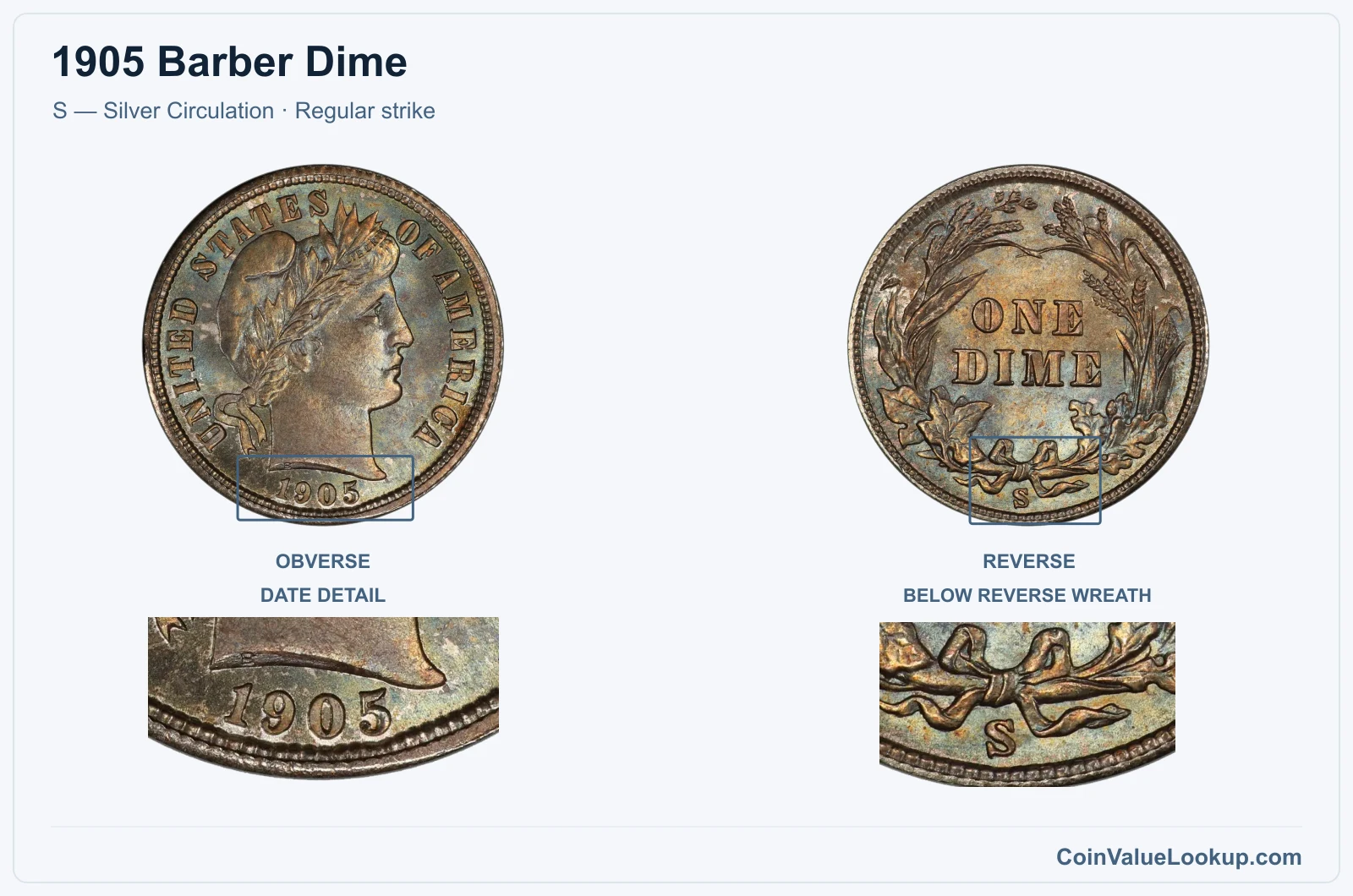
A small "S" below the reverse wreath bow identifies the San Francisco issue. USA Coin Book lists guide estimates of about $15 at G4 and roughly $348 at MS63.
In lower circulated grades the San Francisco and New Orleans issues sit close together in value. The gap widens as you move into uncirculated territory, with the S-mint trailing the O-mint at MS63.
Coin Value Lookup is a good starting point if you are sorting through a batch of Barber Dimes across multiple years and mints. You can look up each date individually without digging through a dozen different sites.
Range Grade
Price Auction Records Appraisal PO PO 1
—
Coin Identifier FR FR 2
—
Coin Identifier AG AG 3
—
Coin Identifier G G 4
—
Coin Identifier
G 6
—
Coin Identifier VG VG 8
—
Coin Identifier
VG 10
—
Coin Identifier F F 12
—
Coin Identifier
F 15
—
Coin Identifier VF VF 20
—
Coin Identifier
VF 25
—
Coin Identifier
VF 30
Coin Identifier
VF 35
Coin Identifier XF XF 40
Coin Identifier
XF 45
Coin Identifier AU AU 50
Coin Identifier
AU 53
Coin Identifier
AU 55
Coin Identifier
AU 58
Coin Identifier MS MS 60
Coin Identifier
MS 61
Coin Identifier
MS 62
Coin Identifier
MS 63
Coin Identifier
MS 64
Coin Identifier
MS 65
Coin Identifier
MS 66
Coin Identifier
MS 67
Coin Identifier
MS 68
—
—
—
MS 69
—
—
—
MS 70
—
—
—
1905 Barber Dime — No Mint Mark — Brilliant Silver Proof
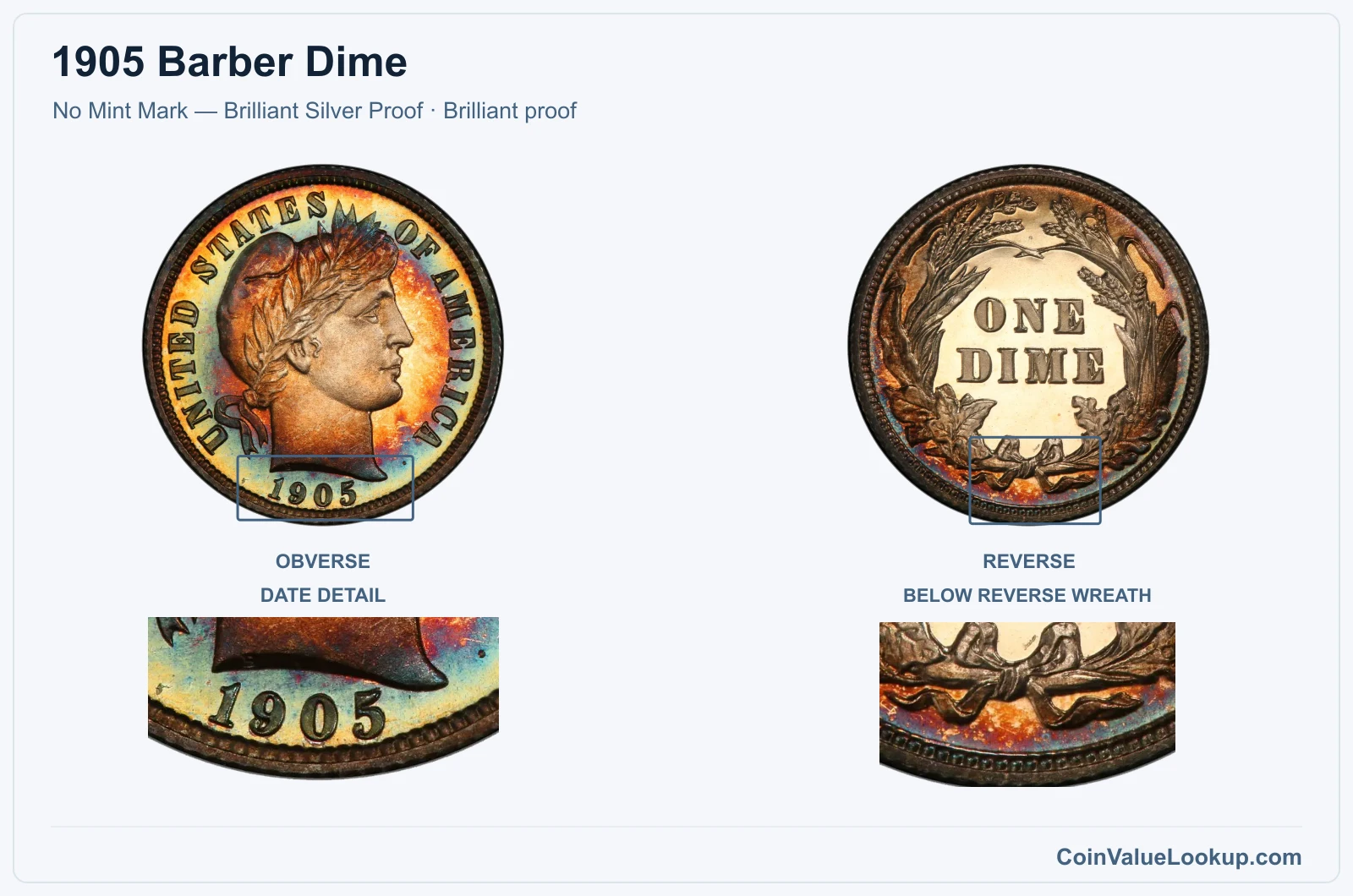
Philadelphia struck proof Barber Dimes for collectors throughout the series run, and 1905 is no exception. These coins show mirrored fields and sharply defined rims — they were made on polished planchets with specially prepared dies.
USA Coin Book lists a guide estimate of about $616 at PR63. That price applies to a standard brilliant proof.
Cameo and Deep Cameo designations reflect the degree of contrast between frosted devices and mirror fields, and those carry different values. Do not assume a bright-looking proof automatically qualifies for a contrast designation, and do not apply the PR63 price to a Deep Cameo coin or vice versa.
All 1905 proofs were struck in Philadelphia. If your coin has a mintmark, it is not a proof.
Range Grade
Price Auction Records Appraisal PR PR 1
—
Coin Identifier
PR 2
—
Coin Identifier
PR 3
—
Coin Identifier
PR 4
—
Coin Identifier
PR 6
—
Coin Identifier
PR 8
—
Coin Identifier
PR 10
—
Coin Identifier
PR 12
—
Coin Identifier
PR 15
—
Coin Identifier
PR 20
—
Coin Identifier
PR 25
—
Coin Identifier
PR 30
—
Coin Identifier
PR 35
—
Coin Identifier
PR 40
—
Coin Identifier
PR 45
—
Coin Identifier
PR 50
—
Coin Identifier
PR 53
—
Coin Identifier
PR 55
—
Coin Identifier
PR 58
—
Coin Identifier
PR 60
Coin Identifier
PR 61
Coin Identifier
PR 62
Coin Identifier
PR 63
Coin Identifier
PR 64
Coin Identifier
PR 65
Coin Identifier
PR 66
Coin Identifier
PR 67
Coin Identifier
PR 68
Coin Identifier
PR 69
—
—
—
PR 70
—
—
—
1905 Barber Dime — O — Micro O
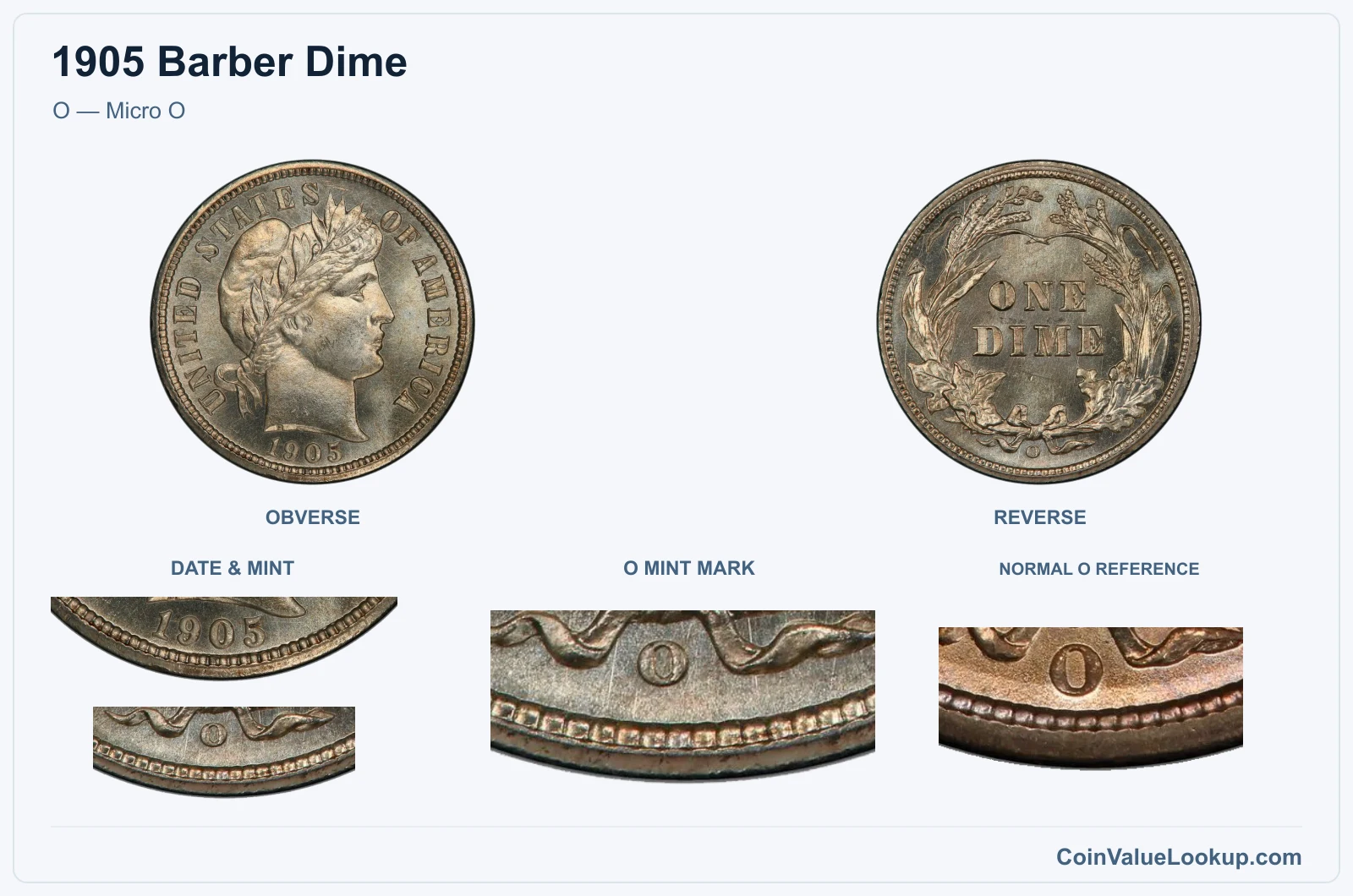
This is the variety that makes 1905-O collectors sit up straight. The Micro O is a physically smaller mintmark punch than the one used on the regular 1905-O.
It is not a repunched mintmark or a doubled impression — it is a different-size tool entirely.
To identify it, compare the O below the wreath bow against a regular 1905-O at the same magnification. The Micro O is compact and proportionally smaller relative to the surrounding design elements.
If you only look at your coin in isolation, you can easily miss it.
USA Coin Book guide estimates reflect the rarity: about $90 at G4 and approximately $6,834 at MS63. That is a massive gap compared to the regular O, which lists around $15 and $531 at the same grades.
Even a well-worn Micro O carries a real premium over its regular counterpart.
Range Grade
Price Auction Records Appraisal PO PO 1
—
Coin Identifier FR FR 2
—
Coin Identifier AG AG 3
Coin Identifier G G 4
Coin Identifier
G 6
Coin Identifier VG VG 8
Coin Identifier
VG 10
Coin Identifier F F 12
Coin Identifier
F 15
Coin Identifier VF VF 20
Coin Identifier
VF 25
Coin Identifier
VF 30
Coin Identifier
VF 35
Coin Identifier XF XF 40
Coin Identifier
XF 45
Coin Identifier AU AU 50
Coin Identifier
AU 53
Coin Identifier
AU 55
Coin Identifier
AU 58
Coin Identifier MS MS 60
—
Coin Identifier
MS 61
Coin Identifier
MS 62
Coin Identifier
MS 63
Coin Identifier
MS 64
Coin Identifier
MS 65
Coin Identifier
MS 66
—
Coin Identifier
MS 67
—
—
—
MS 68
—
—
—
MS 69
—
—
—
MS 70
—
—
—
1905 Barber Dime Error List
1. 1905 Barber Dime — Broadstrike
A broadstrike happens when the coin is struck without the normal collar die that constrains the planchet's edge. The result is a coin that spreads outward, appearing slightly wider than normal with a distorted or missing reeded edge.
The design is still centered, but it extends closer to or beyond the usual rim.
Look at the edge first. A normal 1905 dime has tight, even reeding.
A broadstrike will show a smooth or irregular edge with the design elements pushed outward. The rim may be weak or absent in places.
Do not confuse this with an off-center strike, which shifts the entire design to one side and leaves a blank crescent. Also rule out post-mint damage — a coin that was flattened after leaving the mint can mimic the spread but will show damage marks rather than proper metal flow.
The value of a broadstrike depends on the coin's condition and how dramatic the spread is.
2. 1905 Barber Dime — Clipped Planchet
A clipped planchet error means a portion of the coin blank was missing before the coin was struck. The clip can be curved, straight, or ragged depending on how the blank was cut from the metal strip.
Look for a section of the coin's edge where metal is simply absent, often with a smooth or slightly irregular boundary. A useful secondary diagnostic is weakness in the design opposite the clip — metal did not flow fully into the die on that side during striking.
Do not mistake post-mint damage for a clip. Filed edges, cut notches, and corrosion can all remove metal after the coin was made.
Genuine clips show consistent edge texture and often produce a telltale area of design weakness directly across from the missing section. The value of a clipped 1905 dime depends on the size and type of the clip, as well as overall coin condition.
3. 1905 Barber Dime — Off-Center Strike
An off-center strike occurs when the planchet is not properly seated between the dies at the moment of striking. The result is a design that is shifted to one side, with an unstruck crescent of blank metal on the opposite side.
The key diagnostic is that crescent of flat, featureless metal alongside a partial but otherwise sharp design impression. The percentage off-center and whether the date remains visible both affect desirability — a coin with a readable date is generally worth more to collectors.
Do not confuse this with a clipped planchet, which removes metal from the blank before striking, or with a misaligned die, which shifts only one side of the design. Post-mint flattening can also create misleading shapes.
Genuine off-center errors show clean, consistent displacement of the entire obverse and reverse design. Condition and the degree of the error determine value for any individual coin.
4. 1905 Barber Dime — Repunched Mintmark
A repunched mintmark occurs when the mintmark punch was applied more than once in slightly different positions, leaving traces of the earlier impression. On a 1905 dime, this would be visible at the O or S mintmark below the reverse wreath bow.
Look closely at the mintmark under magnification. You may see a shadow, partial outline, or serif remnant from a second punch slightly offset from the primary letter.
Compare your mintmark against a normal example at the same magnification to spot the difference.
This is easy to confuse with machine doubling, which produces flat, shelf-like doubling without the depth of a true repunched mark. Die chips and corrosion near the mintmark can also create misleading shapes.
The value of a repunched mintmark depends on how visible and dramatic the repunching is, plus the coin's overall condition.