1911 Barber Dime Coin Value: How Much Is It Worth?
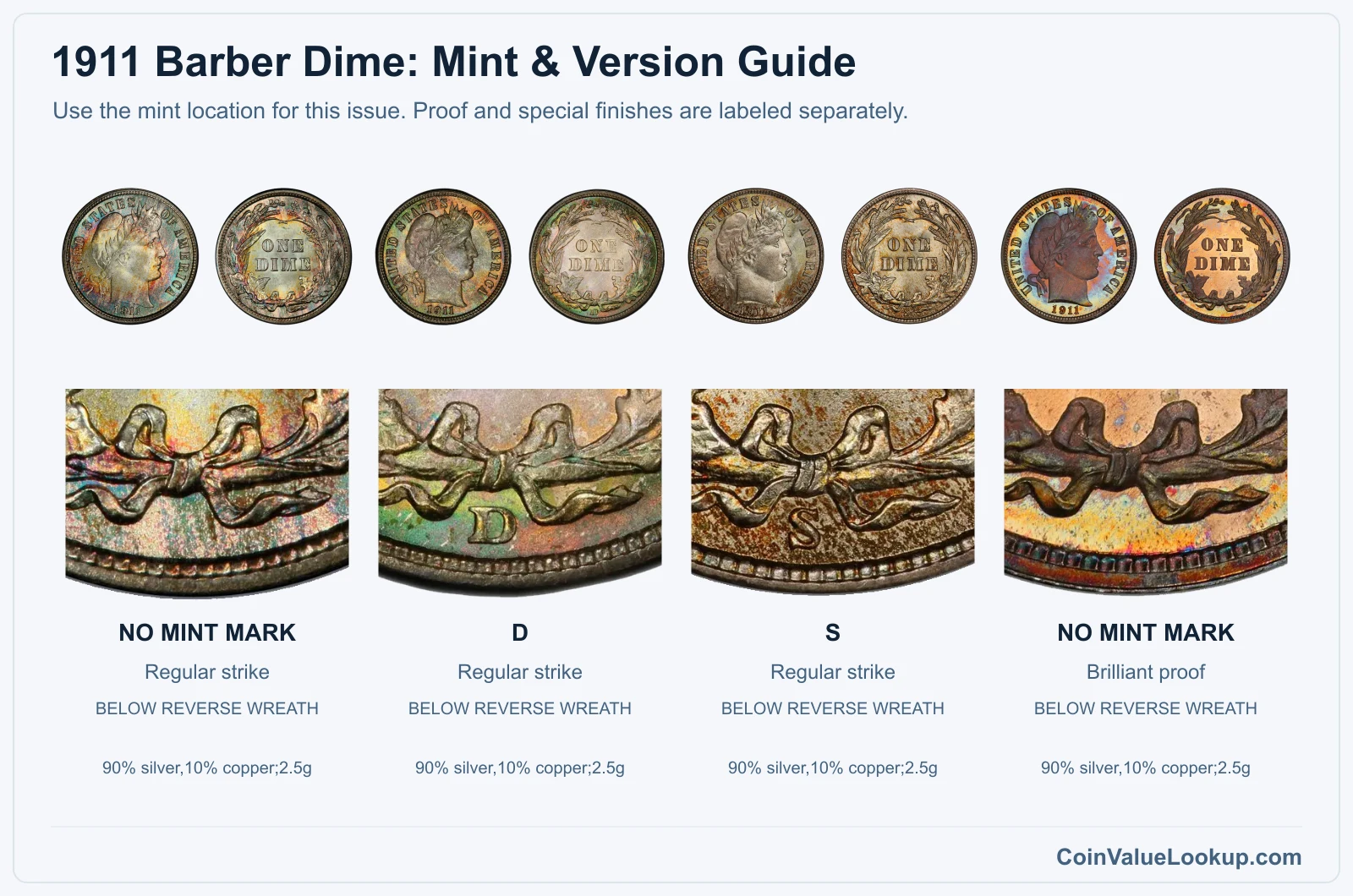
The 1911 Barber Dime was struck at three mints — Philadelphia, Denver, and San Francisco — plus a limited Philadelphia proof issue. Guide estimates for ordinary business strikes range from about $10.42 at G4 to $472 at MS63, depending on the mint.
Proofs carry their own separate pricing. Condition, mintmark, and any genuine errors all matter when figuring out what yours is worth.
Fast Way to Identify Your 1911 Barber Dime
The quickest way to start figuring out your 1911 Barber Dime's value is to upload clear photos of the front and back. This gives a preliminary identification of the mint, general condition, and whether anything unusual stands out.
Good lighting and a sharp focus on the mintmark area help the most.
1911 Barber Dime Value
Upload both sides of your 1911 Barber Dime.
Front Obverse
Upload photo
Back Reverse
Upload photo
Which 1911 Barber Dime Versions Are Worth Money?
- The San Francisco (S) mint issue carries the highest guide estimate among business strikes, listed at about $472 in MS63 — noticeably above the Philadelphia and Denver issues at that grade.
- Philadelphia proof strikes in PR63 are estimated around $616, reflecting their limited production as special collector issues.
- Coins with fully original, unworn surfaces command the strongest premiums regardless of mint; even common-mint examples jump dramatically from circulated to Mint State values.
- Genuine error coins — such as a doubled die obverse or repunched mintmark — can add value beyond normal guide figures, though individual assessment of each coin is necessary.
Step 1: Identify Your 1911 Barber Dime Mint Mark and Version
The 1911 Barber Dime shows Charles Barber's right-facing Liberty head on the obverse, wearing a cap and headband inscribed LIBERTY. The reverse displays ONE DIME inside a cereal wreath tied with a bow at the bottom.
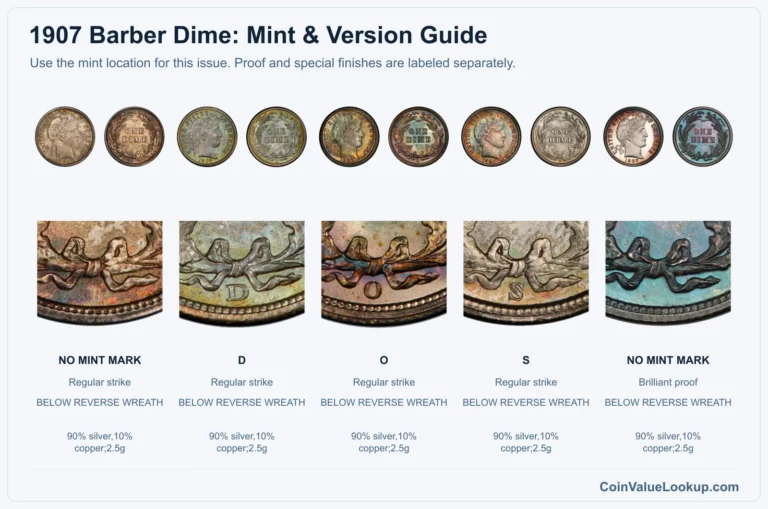
Three business-strike mints produced this date: Philadelphia (no mintmark), Denver (D), and San Francisco (S). Philadelphia also struck proofs.
The mintmark sits on the reverse, just below the wreath's bow — if there is no letter there, you have a Philadelphia coin.
All standard 1911 Barber Dimes are 90% silver and 10% copper, weighing 2.5 grams with a 17.9 mm diameter and a reeded edge. Those specs help you spot fakes: a coin that is noticeably too light, too large, or has a smooth edge is not a genuine Barber Dime.
Be aware that the Barber Dime's obverse hub was modified around 1900–1901, affecting leaf-tip and ribbon details. Your coin's exact hub combination should be confirmed by examining the actual piece, not assumed.
Step 2: Check Your 1911 Barber Dime Grade
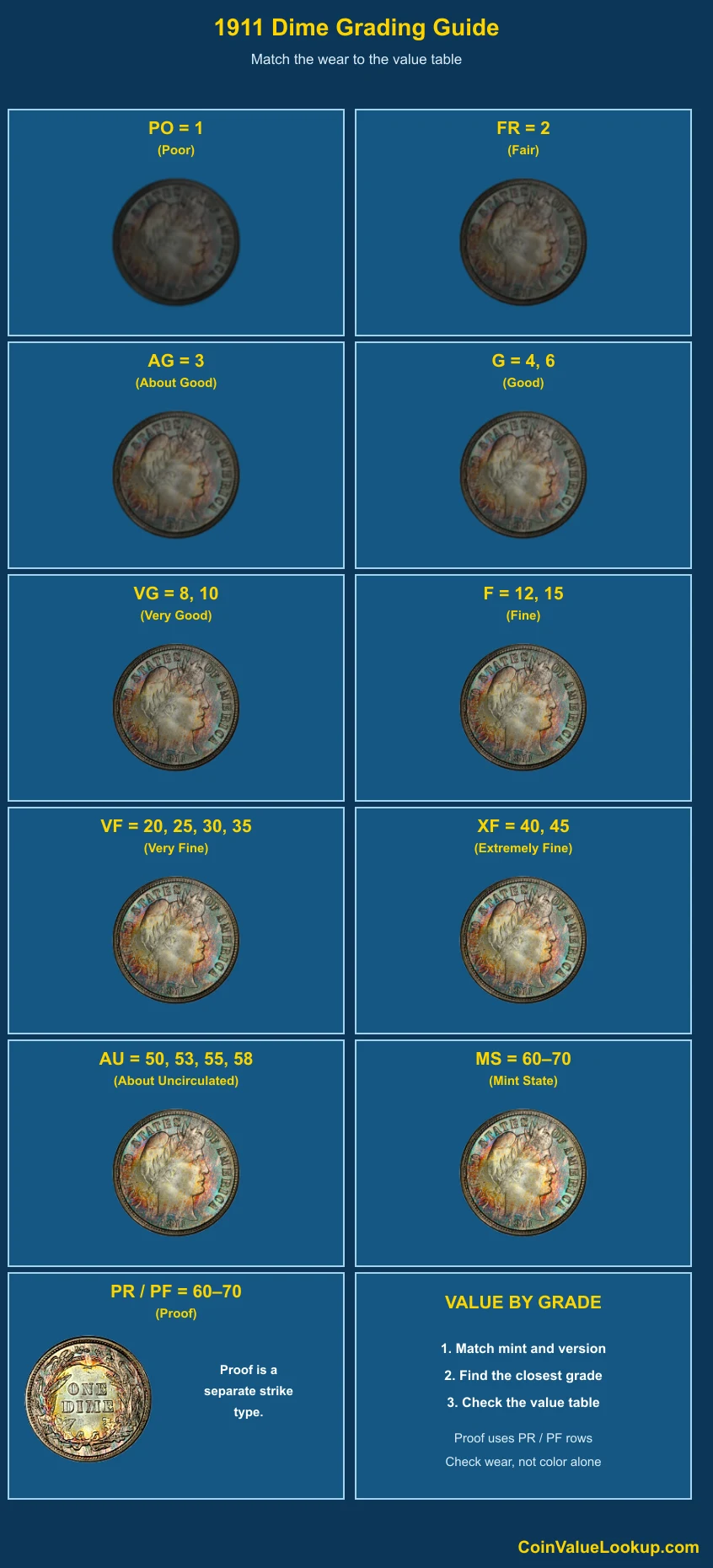
Grading a Barber Dime means checking wear across several areas together, not just counting visible letters in LIBERTY. Start with the headband — on a well-worn coin, the letters fade progressively, but a softly struck coin can also show weak letters even without wear.
Look at the hair above the ear and the cheek below the eye. These are the first spots to lose detail.
On the reverse, check the wreath leaves and the ribbon bow for flatness.
Mint State requires unbroken original luster across both sides. Tilt the coin under a single light source and watch for breaks in the cartwheel effect.
Hairlines from cleaning or wiping will show up as fine parallel scratches under magnification — a cleaned coin is worth less than an honestly worn one at the same apparent grade.
Proof is a manufacturing method, not a grade above Mint State. Proofs were struck on polished planchets with polished dies, producing mirrored fields.
Use the comparison image to gauge where your coin's wear falls on the spectrum.
Step 3: Check 1911 Barber Dime Value by Mint and Version
1911 Barber Dime — No Mint Mark — Silver Circulation
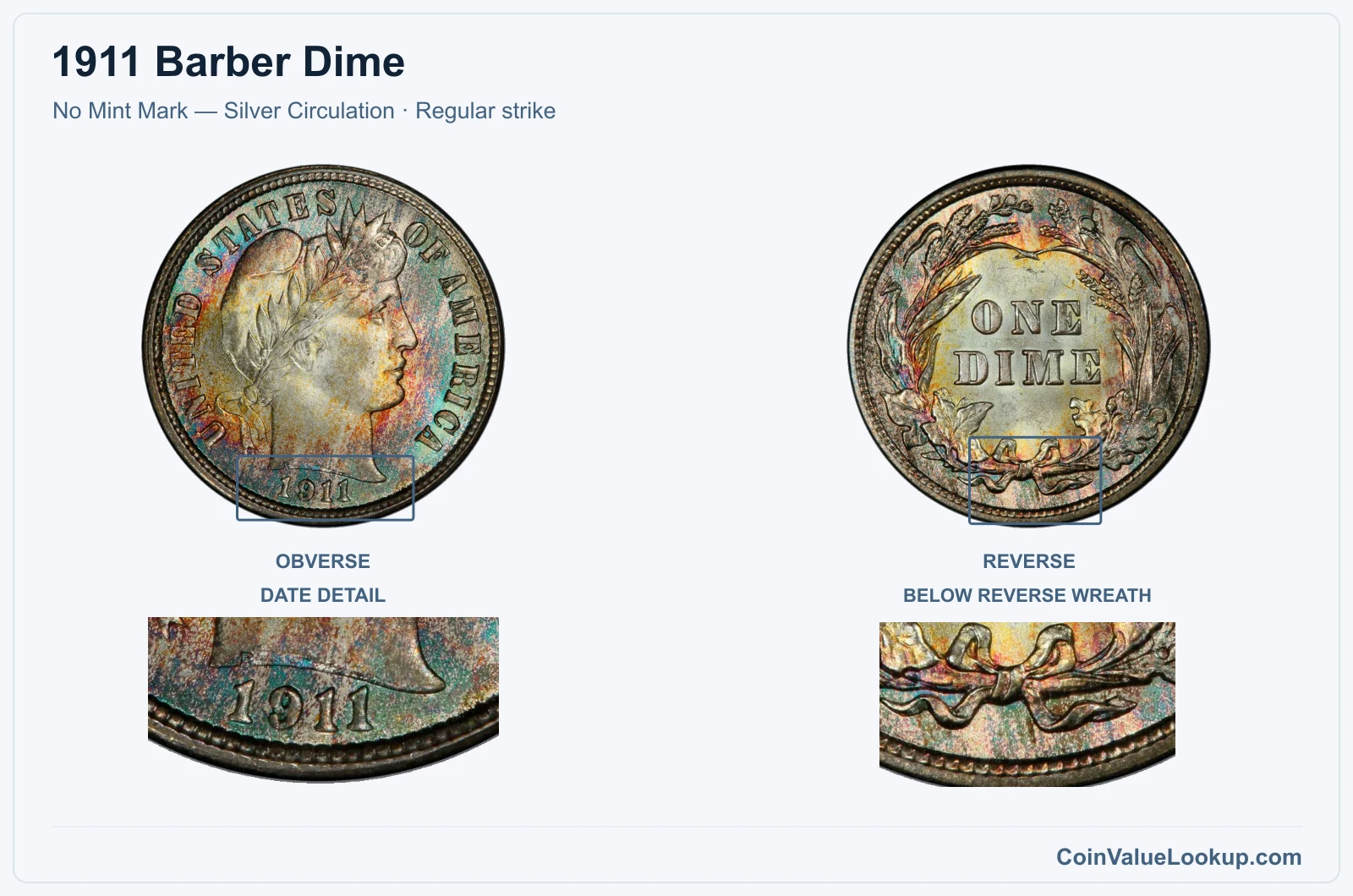
The Philadelphia business strike carries no mintmark. Look at the reverse below the wreath bow — a blank space confirms this mint.
In well-circulated condition around G4, guide estimates place this coin near $10.91. At MS63, the same guide lists roughly $253.
Philadelphia issues are generally available in lower grades, but finding one with full original surfaces at the Mint State level is a different story. Check both sides for cleaning or tooling.
The actual surface quality and sharpness of the design details drive value more than the date alone.
Range Grade
Price Auction Records Appraisal PO PO 1
—
Coin Identifier FR FR 2
—
Coin Identifier AG AG 3
—
Coin Identifier G G 4
—
Coin Identifier
G 6
—
Coin Identifier VG VG 8
—
Coin Identifier
VG 10
—
Coin Identifier F F 12
—
Coin Identifier
F 15
—
Coin Identifier VF VF 20
Coin Identifier
VF 25
—
Coin Identifier
VF 30
Coin Identifier
VF 35
—
Coin Identifier XF XF 40
—
Coin Identifier
XF 45
Coin Identifier AU AU 50
Coin Identifier
AU 53
Coin Identifier
AU 55
Coin Identifier
AU 58
Coin Identifier MS MS 60
—
Coin Identifier
MS 61
Coin Identifier
MS 62
Coin Identifier
MS 63
Coin Identifier
MS 64
Coin Identifier
MS 65
Coin Identifier
MS 66
Coin Identifier
MS 67
Coin Identifier
MS 68
Coin Identifier
MS 69
—
—
—
MS 70
—
—
—
1911 Barber Dime — D — Silver Circulation
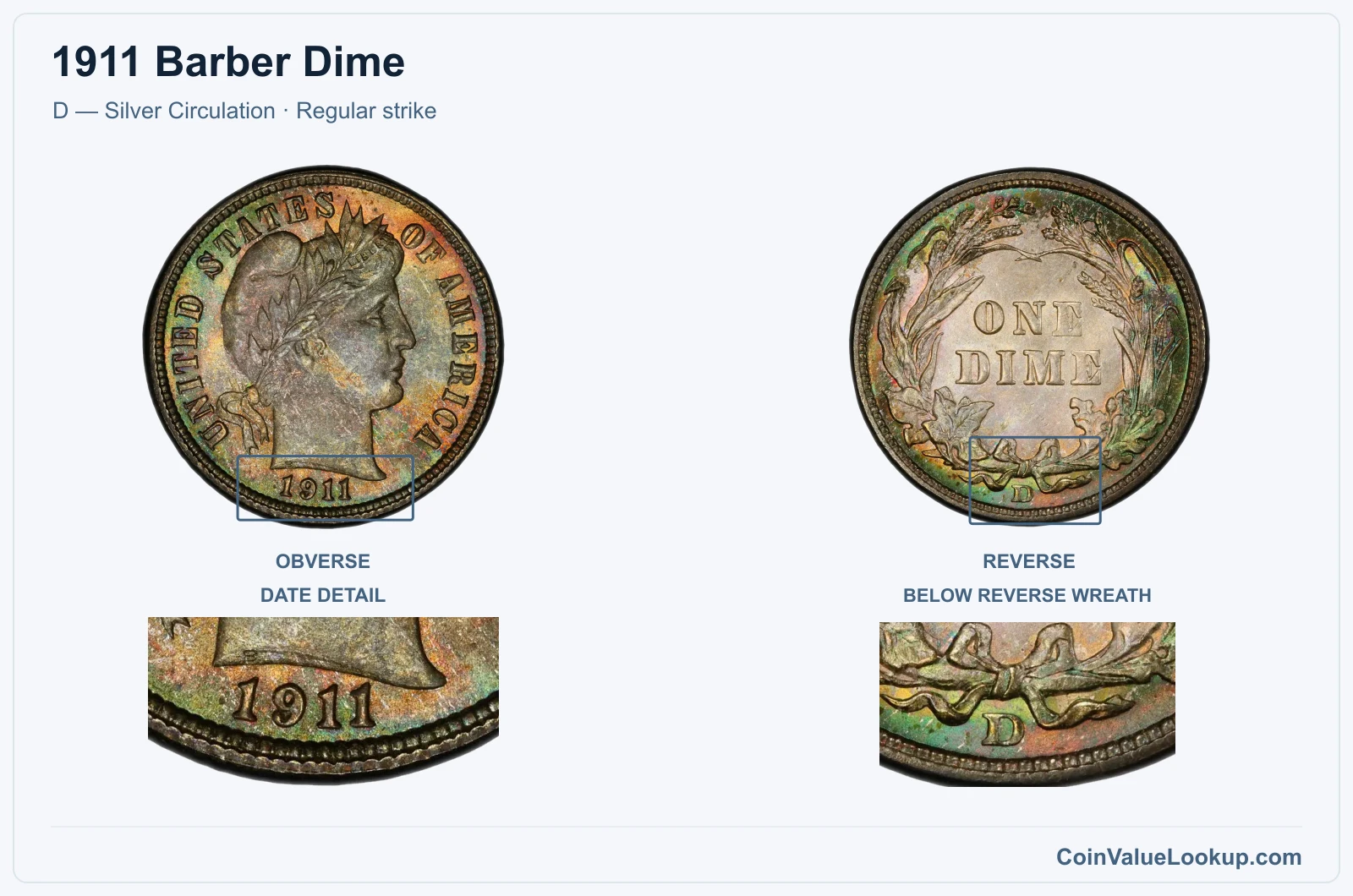
Denver coins carry a small D mintmark below the wreath bow on the reverse. A loupe helps — sometimes the letter is weakly impressed.
Guide estimates start around $10.42 at G4 and reach about $253 at MS63.
Denver Barber Dimes from this era can show softer strikes than Philadelphia issues, so do not confuse a mushy mintmark or slightly blurred wreath detail with heavy wear. Compare hair and cheek detail against a known-grade reference before deciding.
Range Grade
Price Auction Records Appraisal PO PO 1
—
Coin Identifier FR FR 2
—
Coin Identifier AG AG 3
—
Coin Identifier G G 4
—
Coin Identifier
G 6
—
Coin Identifier VG VG 8
—
Coin Identifier
VG 10
Coin Identifier F F 12
—
Coin Identifier
F 15
—
Coin Identifier VF VF 20
Coin Identifier
VF 25
—
Coin Identifier
VF 30
Coin Identifier
VF 35
—
Coin Identifier XF XF 40
—
Coin Identifier
XF 45
Coin Identifier AU AU 50
Coin Identifier
AU 53
Coin Identifier
AU 55
Coin Identifier
AU 58
Coin Identifier MS MS 60
—
Coin Identifier
MS 61
Coin Identifier
MS 62
Coin Identifier
MS 63
Coin Identifier
MS 64
Coin Identifier
MS 65
Coin Identifier
MS 66
Coin Identifier
MS 67
Coin Identifier
MS 68
—
—
—
MS 69
—
—
—
MS 70
—
—
—
1911 Barber Dime — S — Silver Circulation
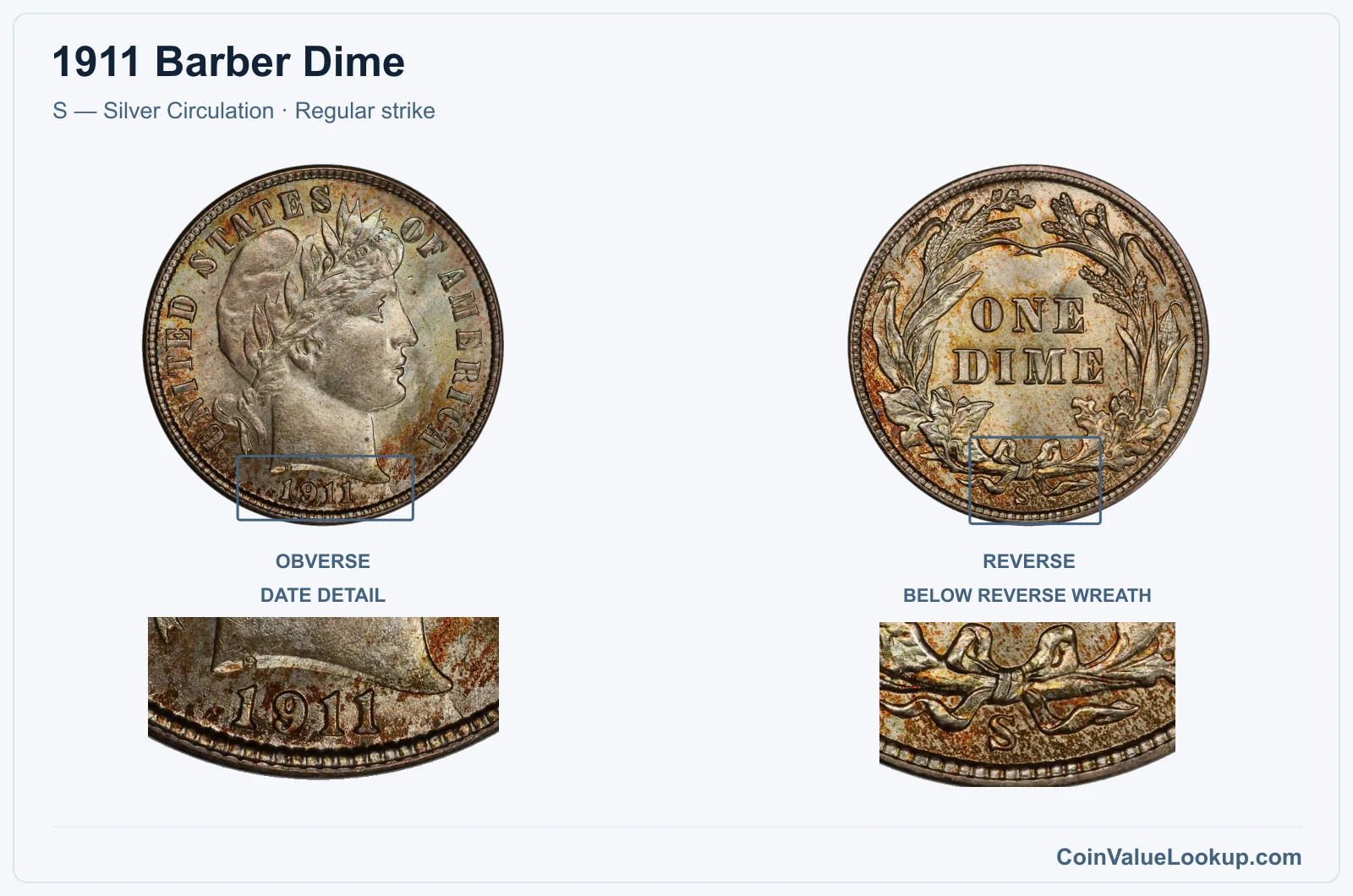
San Francisco strikes bear an S mintmark below the reverse wreath bow. This is the mint issue to watch among 1911 business strikes.
Guide estimates run about $15 at G4 and climb to roughly $472 at MS63 — a clear premium over the Philadelphia and Denver counterparts at that grade level.
Coin Value Lookup is a useful starting point if you want to compare values across different Barber Dime dates and mints. It can help you zero in on the specific guide information for your coin.
As with all Barber Dimes, confirm that the luster is original and unbroken before calling any example Mint State. A lightly cleaned S-mint coin in an MS holder can still disappoint experienced buyers.
Range Grade
Price Auction Records Appraisal PO PO 1
—
Coin Identifier FR FR 2
—
Coin Identifier AG AG 3
—
Coin Identifier G G 4
—
Coin Identifier
G 6
—
Coin Identifier VG VG 8
—
Coin Identifier
VG 10
Coin Identifier F F 12
—
Coin Identifier
F 15
—
Coin Identifier VF VF 20
Coin Identifier
VF 25
—
Coin Identifier
VF 30
—
Coin Identifier
VF 35
—
Coin Identifier XF XF 40
—
Coin Identifier
XF 45
Coin Identifier AU AU 50
Coin Identifier
AU 53
Coin Identifier
AU 55
Coin Identifier
AU 58
Coin Identifier MS MS 60
—
Coin Identifier
MS 61
Coin Identifier
MS 62
Coin Identifier
MS 63
Coin Identifier
MS 64
Coin Identifier
MS 65
Coin Identifier
MS 66
Coin Identifier
MS 67
Coin Identifier
MS 68
Coin Identifier
MS 69
—
—
—
MS 70
—
—
—
1911 Barber Dime — No Mint Mark — Brilliant Silver Proof
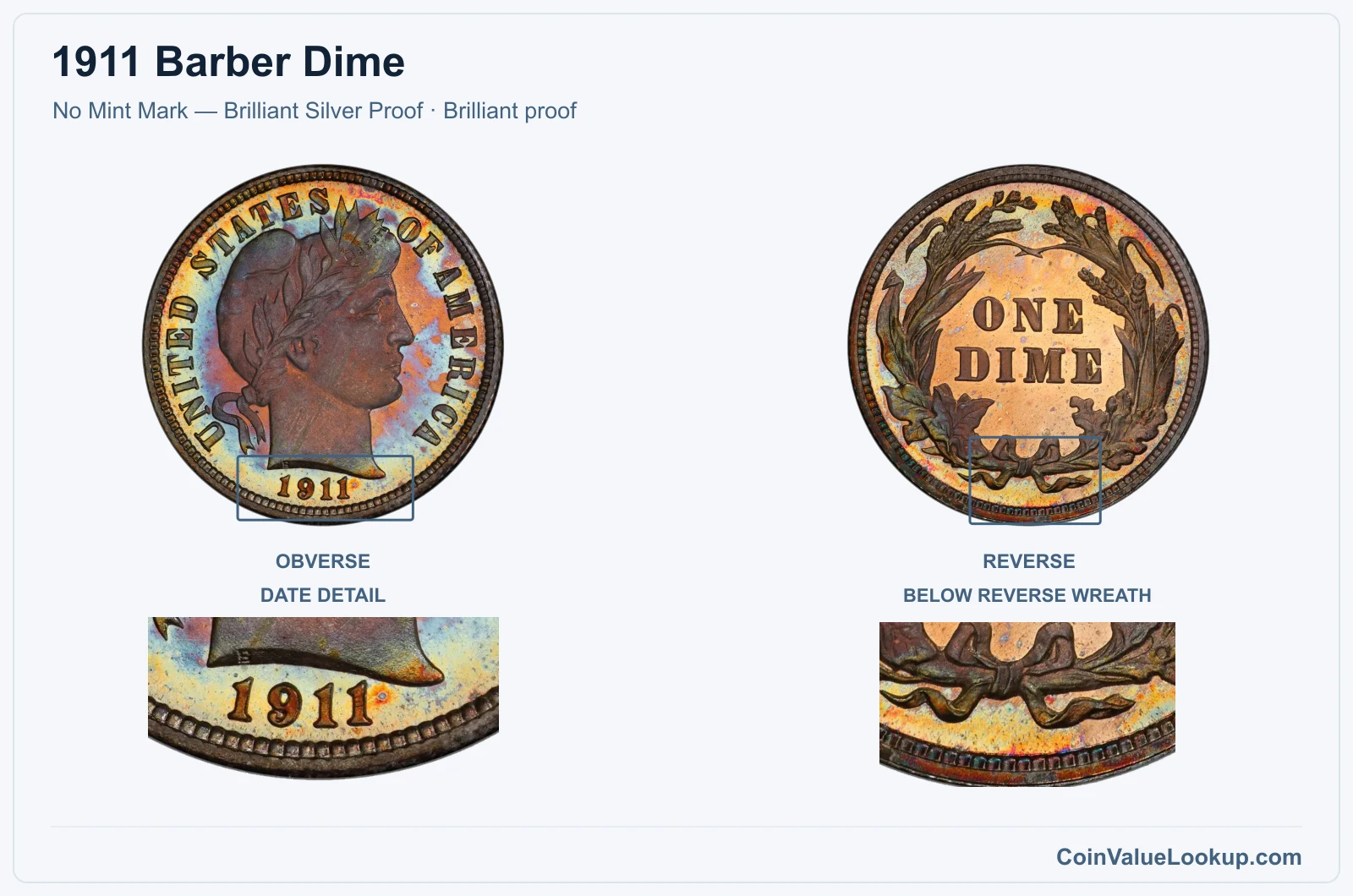
Philadelphia proof Barber Dimes have mirrored fields and sharply defined rims, struck from specially prepared dies on polished planchets. There is no mintmark.
The PR63 guide estimate sits at about $616.
Do not confuse a well-preserved business strike with a proof. Genuine proofs show a distinctly reflective, glass-like field that business strikes simply cannot replicate, even in high Mint State grades.
Cameo and Deep Cameo designations describe the degree of contrast between frosted devices and mirrored fields — they are not the same as a standard PR63, and their values differ. Examine the coin's actual surfaces rather than relying on brightness alone.
Range Grade
Price Auction Records Appraisal PR PR 1
—
Coin Identifier
PR 2
—
Coin Identifier
PR 3
—
Coin Identifier
PR 4
—
Coin Identifier
PR 6
—
Coin Identifier
PR 8
—
Coin Identifier
PR 10
—
Coin Identifier
PR 12
—
Coin Identifier
PR 15
—
Coin Identifier
PR 20
—
Coin Identifier
PR 25
—
Coin Identifier
PR 30
—
Coin Identifier
PR 35
—
Coin Identifier
PR 40
—
Coin Identifier
PR 45
—
Coin Identifier
PR 50
—
Coin Identifier
PR 53
—
Coin Identifier
PR 55
—
Coin Identifier
PR 58
—
Coin Identifier
PR 60
Coin Identifier
PR 61
Coin Identifier
PR 62
Coin Identifier
PR 63
Coin Identifier
PR 64
Coin Identifier
PR 65
Coin Identifier
PR 66
Coin Identifier
PR 67
Coin Identifier
PR 68
Coin Identifier
PR 69
Coin Identifier
PR 70
—
—
—
1911 Barber Dime Error List
1. 1911 Barber Dime — Doubled Die Obverse
A Doubled Die Obverse on a 1911 Barber Dime shows consistent doubling on the obverse design elements — letters, the date, or parts of Liberty's portrait. The key word is consistent: the separation or notching should repeat in the same direction across multiple features.
Compare the obverse lettering and design to a normal 1911 dime under the same lighting and magnification. True hub doubling produces a clear, raised secondary image or shelf.
Machine doubling, by contrast, tends to look flat and shelf-like with a different spread pattern, and it adds little or no premium.
Reflections, worn die contours, and strike weakness can also mimic doubling to the untrained eye. No specific price range is established for this variety; the coin's condition, the visibility of the doubling, and confirmation of the error all affect what it might bring.
2. 1911 Barber Dime — Off-Center Strike
An off-center strike happens when the planchet is not properly seated in the collar before the dies come together. The result is a displaced design with an unstruck crescent of blank metal along part of the rim.
On a 1911 Barber Dime, the critical factor for collectibility is whether the date remains fully visible. A 5% off-center with a full date is mildly interesting.
A 10–20% off-center with a readable date starts getting serious attention.
Do not confuse a clipped planchet — which removes a curved bite from the edge — with an off-center strike. Post-mint damage that flattens one side of the coin can also look similar at first glance.
No specific price is established for this error on the 1911 date; value depends on the percentage of offset, date visibility, and overall condition.
3. 1911 Barber Dime — Repunched Mintmark
A repunched mintmark occurs when the mintmark punch was applied more than once in slightly different positions, leaving traces of the earlier impression alongside the final one. On a 1911 Barber Dime, this would appear on the D or S mintmark below the reverse wreath bow.
Use at least 5x magnification and compare your mintmark directly against a normal example at the same angle. Look for a secondary outline, a notch, or a partial letter remnant near the primary mintmark.
The remnant should be raised — not recessed or pitted.
Machine doubling on the mintmark, die chips, and corrosion can all create confusing artifacts near the letter. None of those are the same thing as a repunched mintmark.
No specific price is available for this variety on the 1911 date; value will depend on the clarity of the repunching and the coin's overall grade.
4. 1911 Barber Dime — Partial Collar Strike
A partial collar strike produces a distinctive stepped or ridged edge on part of the coin. It happens when the planchet sits slightly above or tilted relative to the collar die, so only a portion of the blank is confined during striking.
The result is a coin that looks normal on one side of the rim but shows an expanded, unfinished edge on the other.
To identify it on a 1911 Barber Dime, roll the coin slowly along its edge and compare the profile to a normal piece. You should see reeding on part of the edge and a smooth, slightly flared section where the collar did not reach.
Do not mistake post-mint rim damage, a flattened edge from a coin counter, or a complete broadstrike for a partial collar. No numerical price is available for this error; value hinges on how dramatic the collar misalignment is and the coin's condition.