1914 Barber Dime Coin Value: How Much Is It Worth?
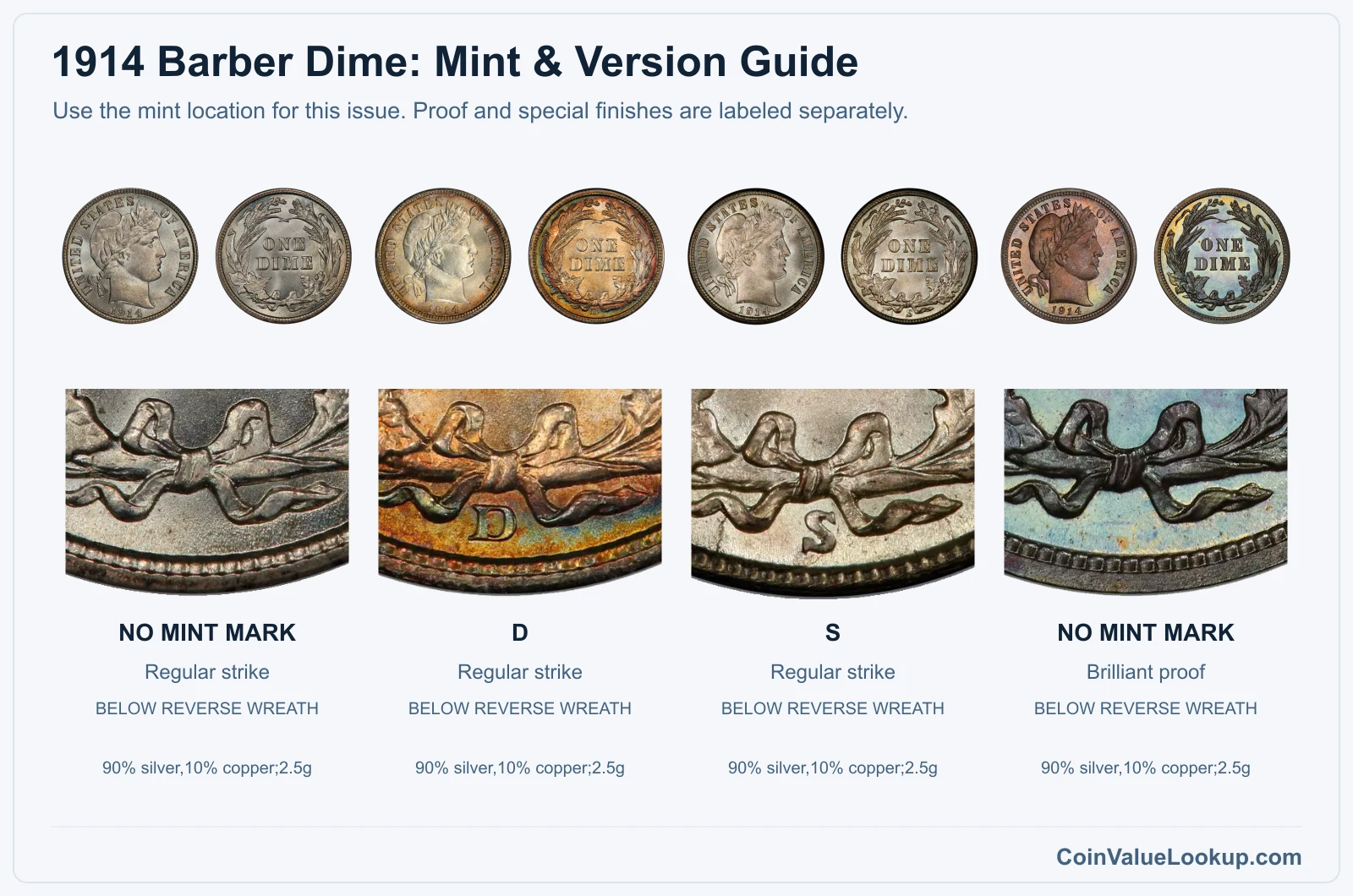
The 1914 Barber dime was struck at three mints — Philadelphia, Denver, and San Francisco — plus a tiny Philadelphia proof run of just 425 pieces. Guide estimates for ordinary business strikes range from about $10.42 at G4 to $379 at MS63, depending on the mint.
Proofs carry their own premium and deserve separate evaluation.
Fast Way to Identify Your 1914 Barber Dime
The quickest way to start figuring out what your 1914 Barber dime is worth is to upload clear photos of both sides. A sharp image of the obverse shows the date and surface condition, while the reverse reveals the mintmark (or lack of one) below the wreath bow.
Upload your photos for a preliminary identification to narrow things down.
1914 Barber Dime Value
Upload both sides of your 1914 Barber Dime.
Front Obverse
Upload photo
Back Reverse
Upload photo
Which 1914 Barber Dime Versions Are Worth Money?
- The 1914-S dime carries the highest guide values among the three business-strike mints, listed at about $14 in G4 and $379 in MS63.
- Philadelphia proof 1914 dimes had a mintage of only 425 pieces — the smallest annual proof run in the Barber dime series — and are listed around $616 at PR63.
- Unworn, original-surface examples from any mint command the strongest premiums; cleaned or damaged coins lose much of that advantage.
- Several error types, including off-center strikes and repunched mintmarks, have been reported for 1914 dimes and are worth checking for.
Step 1: Identify Your 1914 Barber Dime Mint Mark and Version
The 1914 Barber dime shows Liberty facing right on the obverse, wearing a cap and headband inscribed LIBERTY. The reverse features ONE DIME inside a wreath.
Do not confuse it with the Mercury dime or a half dime — totally different designs.
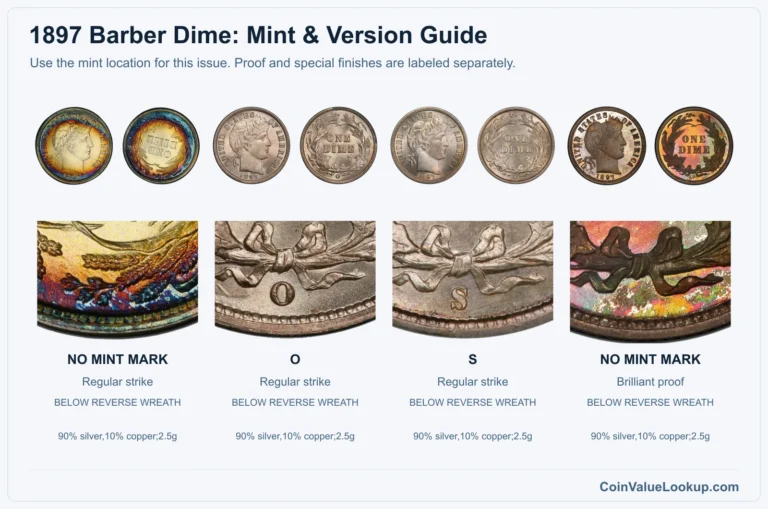
Three business-strike mints produced 1914 dimes: Philadelphia (no mintmark), Denver (D), and San Francisco (S). The mintmark sits on the reverse, just below the bow that ties the wreath together.
No letter means Philadelphia.
All regular 1914 Barber dimes are 90% silver and 10% copper, weighing 2.5 grams with a diameter of 17.9 mm and a reeded edge. Philadelphia also struck a proof version that year with a mintage of only 425 — the smallest regular annual proof run for the series.
When checking your coin, confirm the date is legible and look closely at the reverse mintmark area. A loupe helps, especially on well-worn pieces where the mark can nearly vanish.
Step 2: Check Your 1914 Barber Dime Grade
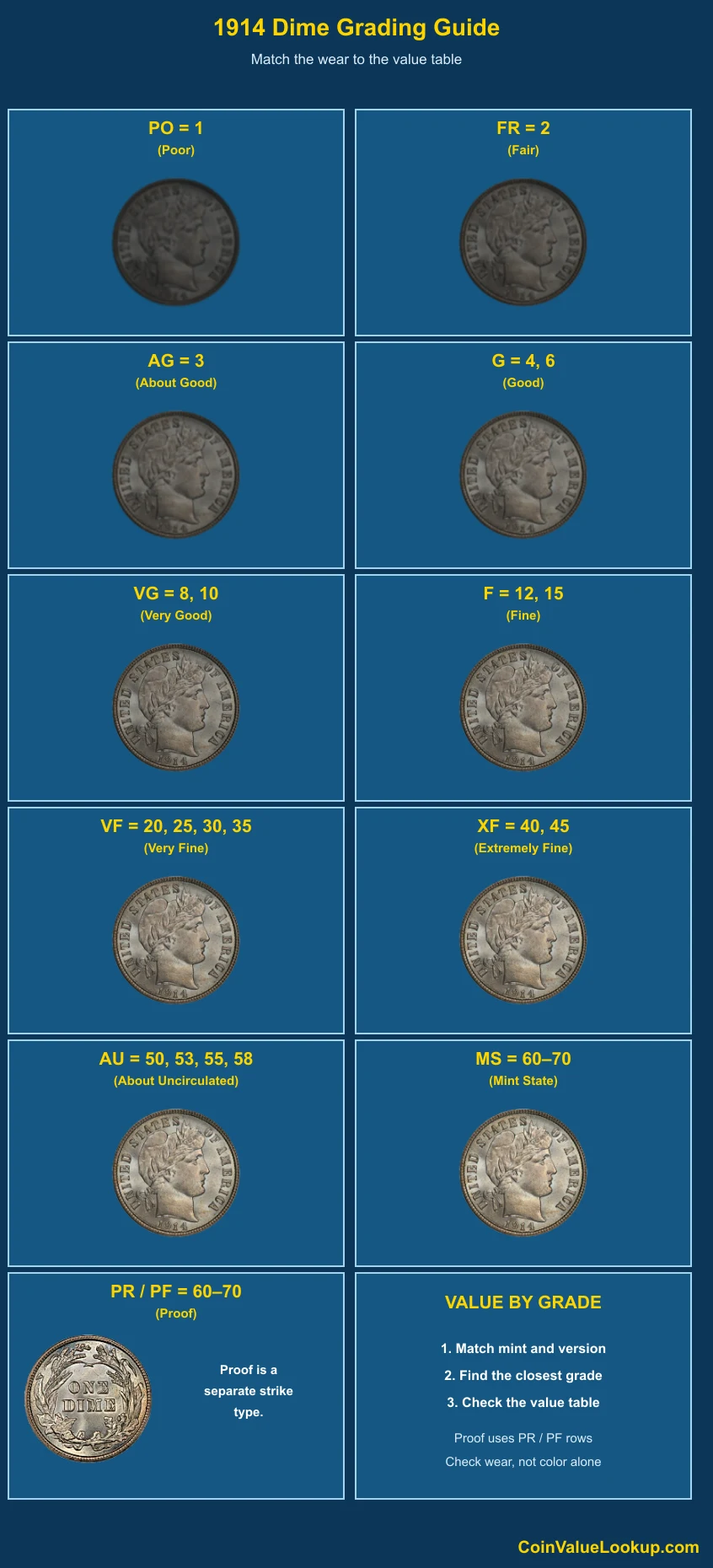
Grading a Barber dime means looking at real wear across several areas at once — the LIBERTY headband, the hair above the ear, the cheek, the wreath detail, and the rim sharpness. Do not grade by counting headband letters alone; that shortcut misses a lot.
At lower grades like G4, LIBERTY is mostly gone, the hair is flat, and the wreath is smooth. A coin grading around VF will show partial LIBERTY with visible hair strands and crisp wreath leaves.
Mint State requires unbroken luster across both sides. Check carefully for hairlines and signs of past cleaning, which reduce value.
Use the comparison image to gauge where your coin falls.
Proof is a manufacturing method, not a grade above Mint State. A proof that has been mishandled can grade lower than a well-preserved business strike.
Keep that distinction in mind when evaluating any brilliant, mirror-surfaced piece.
Step 3: Check 1914 Barber Dime Value by Mint and Version
1914 Barber Dime — No Mint Mark — Silver Circulation
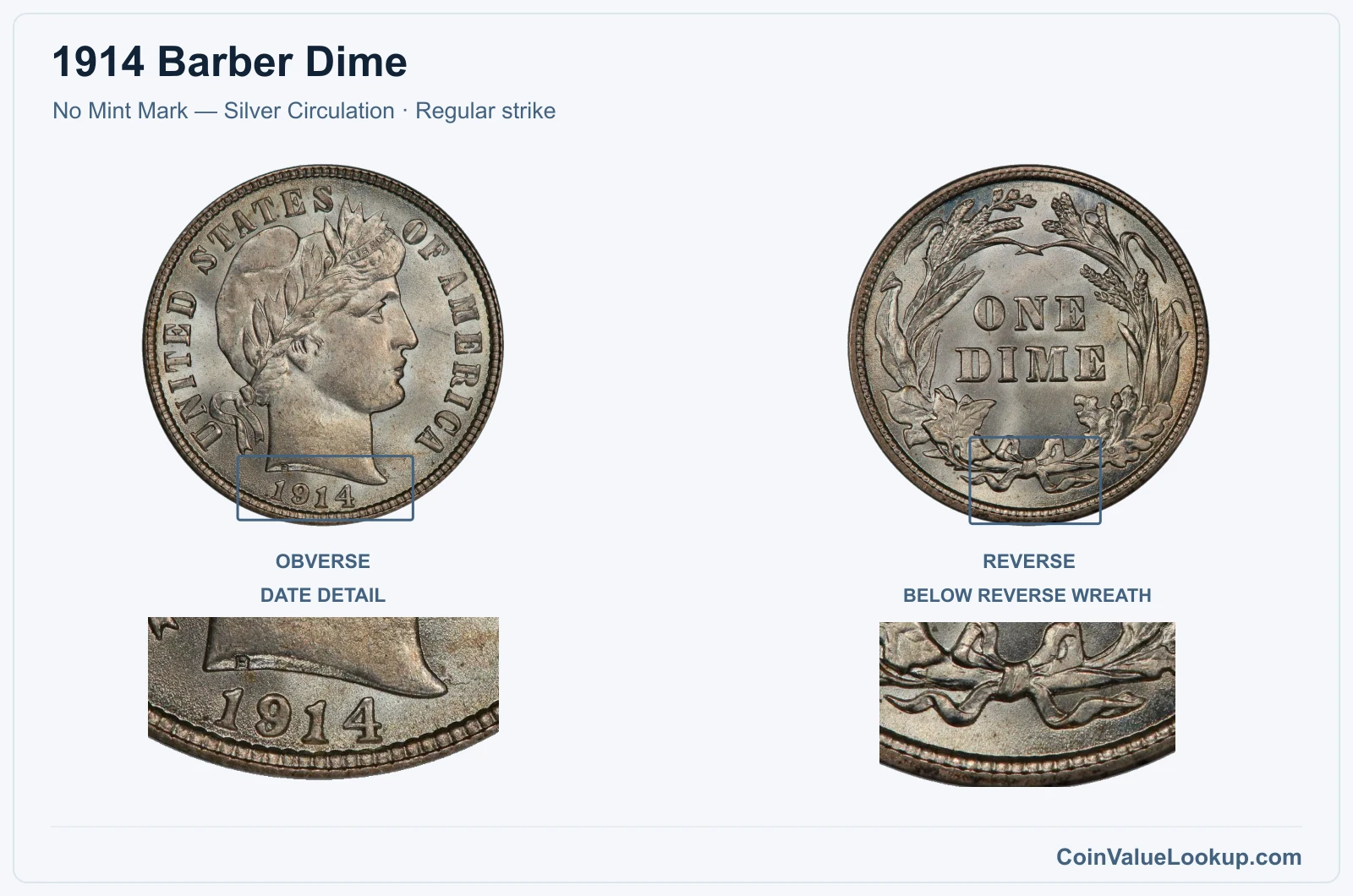
The 1914 Philadelphia dime carries no mintmark on the reverse. It is a 90% silver, 2.5-gram coin with a reeded edge, like every standard Barber dime.
Guide estimates place this issue at about $10.42 in G4 and around $253 in MS63 (USA Coin Book). Most surviving examples are well circulated, so finding one with full luster takes patience.
Confirm the reverse below the wreath bow is clean — no letter means Philly.
Range Grade
Price Auction Records Appraisal PO PO 1
—
Coin Identifier FR FR 2
—
Coin Identifier AG AG 3
—
Coin Identifier G G 4
—
Coin Identifier
G 6
—
Coin Identifier VG VG 8
—
Coin Identifier
VG 10
Coin Identifier F F 12
—
Coin Identifier
F 15
—
Coin Identifier VF VF 20
—
Coin Identifier
VF 25
—
Coin Identifier
VF 30
Coin Identifier
VF 35
Coin Identifier XF XF 40
Coin Identifier
XF 45
Coin Identifier AU AU 50
Coin Identifier
AU 53
Coin Identifier
AU 55
Coin Identifier
AU 58
Coin Identifier MS MS 60
—
Coin Identifier
MS 61
Coin Identifier
MS 62
Coin Identifier
MS 63
Coin Identifier
MS 64
Coin Identifier
MS 65
Coin Identifier
MS 66
Coin Identifier
MS 67
Coin Identifier
MS 68
—
—
—
MS 69
—
—
—
MS 70
—
—
—
1914 Barber Dime — D — Silver Circulation
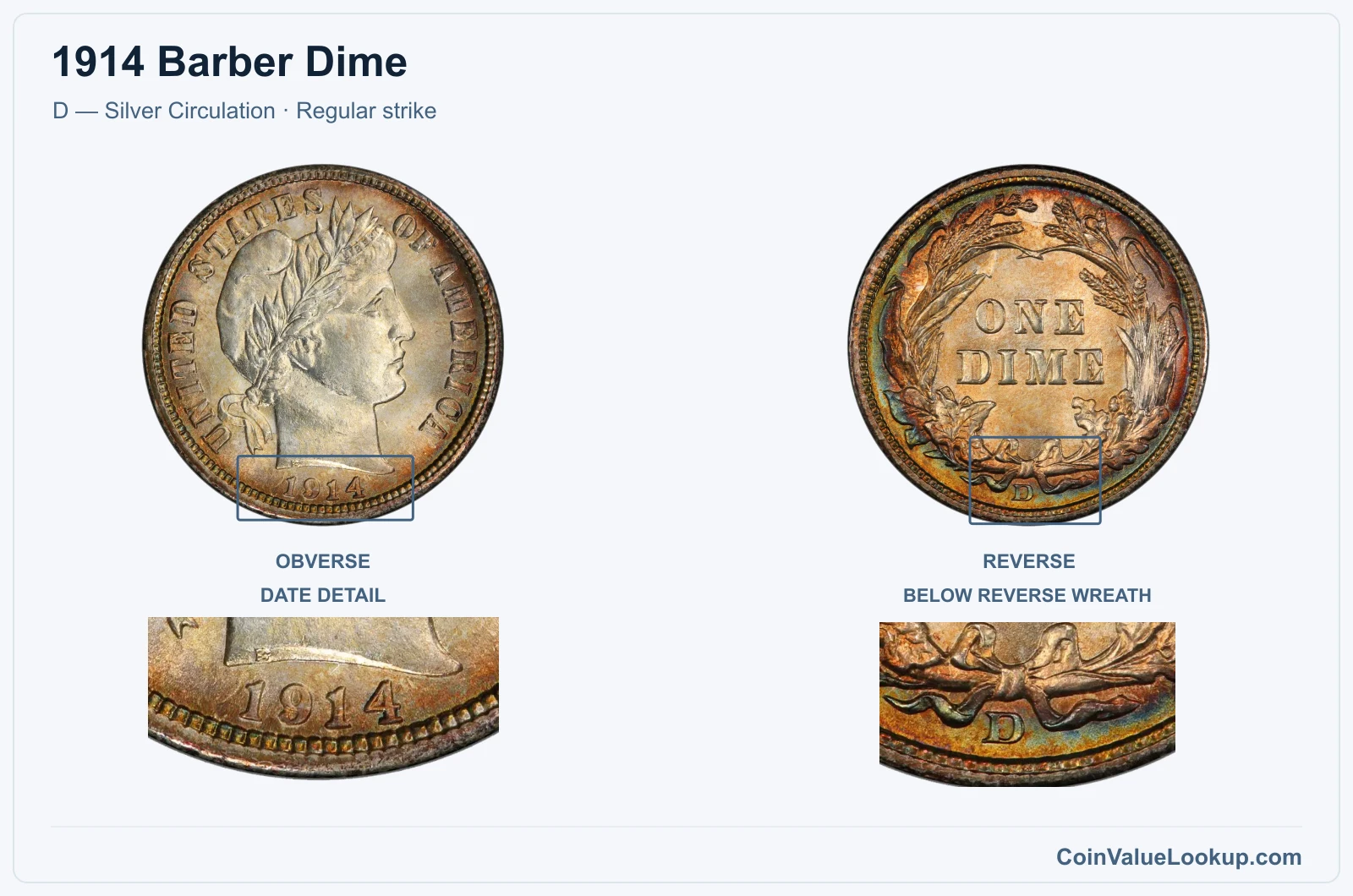
Look for the small "D" mintmark below the wreath bow on the reverse. The 1914-D is a Denver issue struck in 90% silver at 2.5 grams.
Guide estimates from USA Coin Book put it at roughly $10.42 in G4 and $253 in MS63, matching the Philadelphia issue at those benchmarks. Denver Barber dimes from this period often show up in lower grades, so an uncirculated survivor is a solid find.
Verify the mintmark with magnification — worn D marks can look like a smudge.
Range Grade
Price Auction Records Appraisal PO PO 1
—
Coin Identifier FR FR 2
—
Coin Identifier AG AG 3
—
Coin Identifier G G 4
—
Coin Identifier
G 6
—
Coin Identifier VG VG 8
Coin Identifier
VG 10
—
Coin Identifier F F 12
—
Coin Identifier
F 15
—
Coin Identifier VF VF 20
—
Coin Identifier
VF 25
—
Coin Identifier
VF 30
—
Coin Identifier
VF 35
—
Coin Identifier XF XF 40
Coin Identifier
XF 45
Coin Identifier AU AU 50
Coin Identifier
AU 53
—
Coin Identifier
AU 55
Coin Identifier
AU 58
Coin Identifier MS MS 60
Coin Identifier
MS 61
Coin Identifier
MS 62
Coin Identifier
MS 63
Coin Identifier
MS 64
Coin Identifier
MS 65
Coin Identifier
MS 66
Coin Identifier
MS 67
Coin Identifier
MS 68
—
—
—
MS 69
—
—
—
MS 70
—
—
—
1914 Barber Dime — S — Silver Circulation
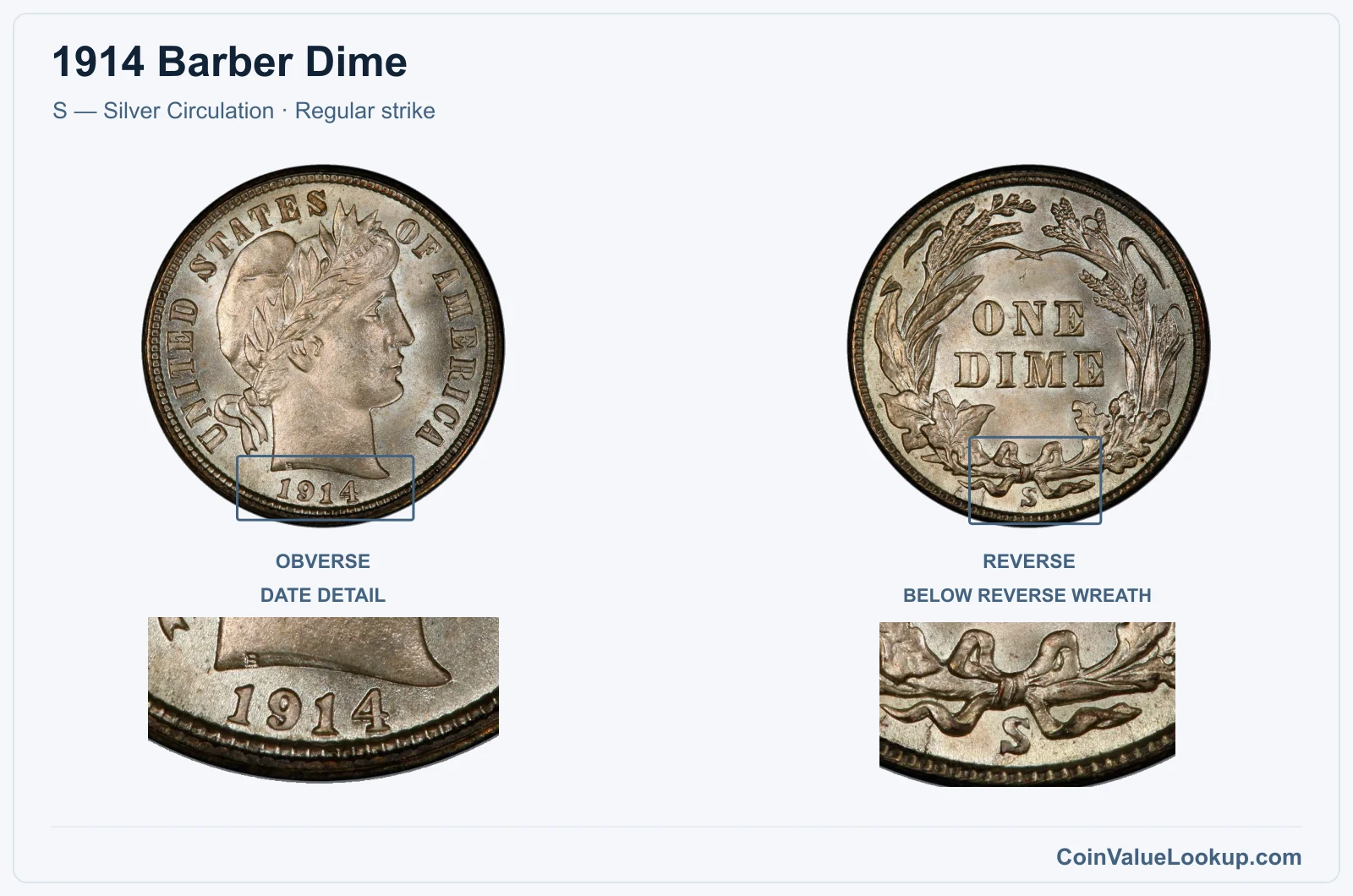
The San Francisco mint's "S" mintmark sits below the wreath bow on the reverse. Same 90% silver composition, 2.5 grams, reeded edge.
This is the priciest of the three business strikes at the guide levels supplied: about $14 at G4 and $379 at MS63 per USA Coin Book. That premium over the P and D issues makes the mintmark confirmation especially important.
A tiny S can hide in grime or wear, so clean magnification is your friend.
Coin Value Lookup is a good starting point if you want to compare this dime against other dates and mints in the Barber series. It offers quick access to coin value guides across many U.S. denominations.
Range Grade
Price Auction Records Appraisal PO PO 1
—
Coin Identifier FR FR 2
—
Coin Identifier AG AG 3
—
Coin Identifier G G 4
—
Coin Identifier
G 6
—
Coin Identifier VG VG 8
—
Coin Identifier
VG 10
—
Coin Identifier F F 12
—
Coin Identifier
F 15
—
Coin Identifier VF VF 20
—
Coin Identifier
VF 25
—
Coin Identifier
VF 30
—
Coin Identifier
VF 35
—
Coin Identifier XF XF 40
—
Coin Identifier
XF 45
—
Coin Identifier AU AU 50
Coin Identifier
AU 53
Coin Identifier
AU 55
Coin Identifier
AU 58
Coin Identifier MS MS 60
Coin Identifier
MS 61
Coin Identifier
MS 62
Coin Identifier
MS 63
Coin Identifier
MS 64
Coin Identifier
MS 65
Coin Identifier
MS 66
Coin Identifier
MS 67
Coin Identifier
MS 68
—
—
—
MS 69
—
—
—
MS 70
—
—
—
1914 Barber Dime — No Mint Mark — Brilliant Silver Proof
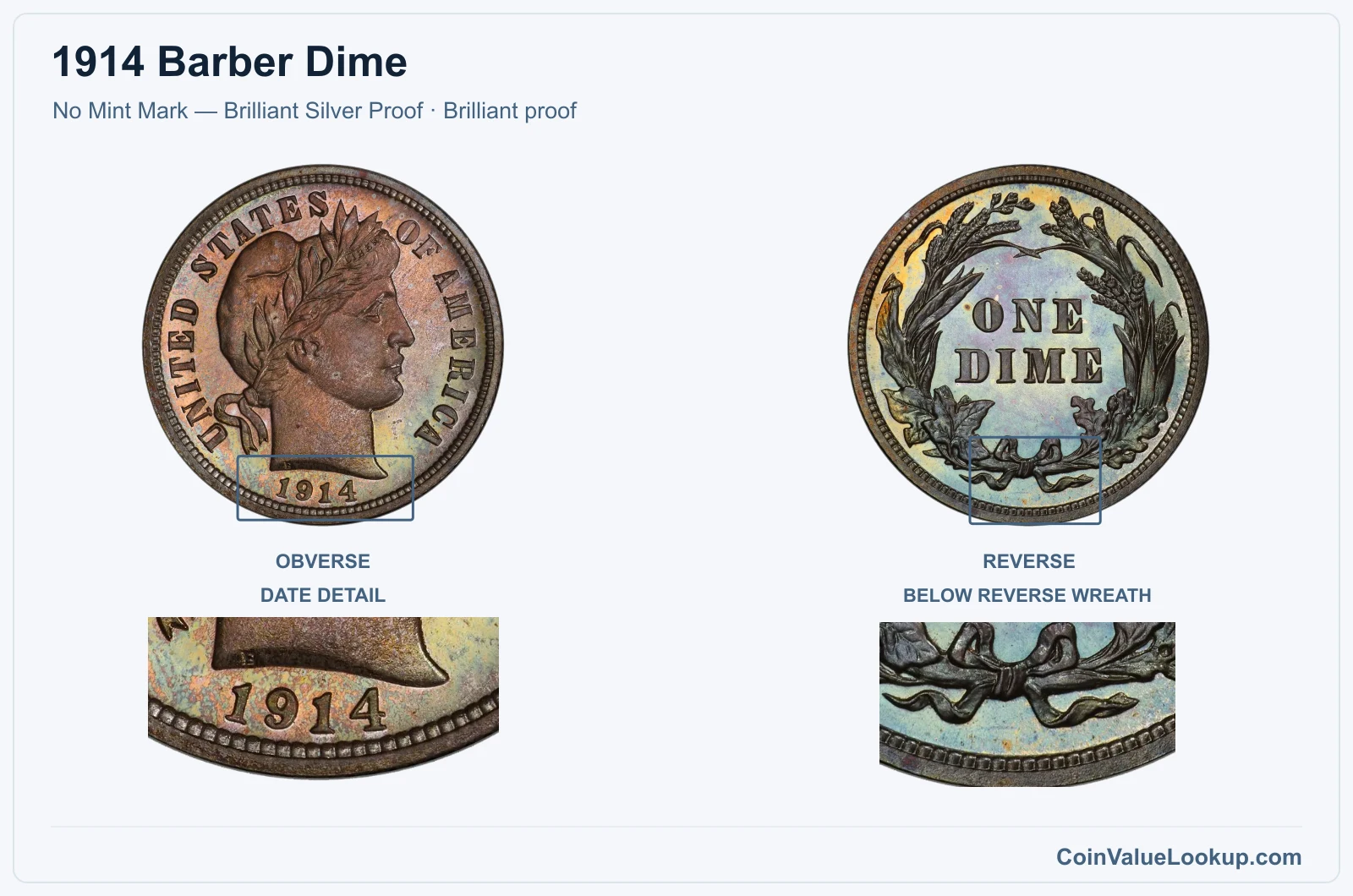
Philadelphia struck just 425 proof Barber dimes in 1914 — the smallest regular annual proof mintage in the entire series. These coins have mirrored fields and sharply defined rims that distinguish them from even the best business strikes.
USA Coin Book lists the 1914 proof at approximately $616 in PR63. Cameo and Deep Cameo designations reflect contrast between frosted devices and mirrored fields; do not assume an ordinary PR63 price applies to those contrast varieties.
Brilliant proofs from later years in the series sometimes show weaker contrast than earlier issues, so judge the actual coin in hand rather than relying on expectations.
Range Grade
Price Auction Records Appraisal PR PR 1
—
Coin Identifier
PR 2
—
Coin Identifier
PR 3
—
Coin Identifier
PR 4
—
Coin Identifier
PR 6
—
Coin Identifier
PR 8
—
Coin Identifier
PR 10
—
Coin Identifier
PR 12
—
Coin Identifier
PR 15
—
Coin Identifier
PR 20
—
Coin Identifier
PR 25
—
Coin Identifier
PR 30
—
Coin Identifier
PR 35
—
Coin Identifier
PR 40
—
Coin Identifier
PR 45
—
Coin Identifier
PR 50
—
Coin Identifier
PR 53
—
Coin Identifier
PR 55
—
Coin Identifier
PR 58
—
Coin Identifier
PR 60
Coin Identifier
PR 61
Coin Identifier
PR 62
Coin Identifier
PR 63
Coin Identifier
PR 64
Coin Identifier
PR 65
Coin Identifier
PR 66
Coin Identifier
PR 67
Coin Identifier
PR 68
Coin Identifier
PR 69
—
—
—
PR 70
—
—
—
1914 Barber Dime Error List
1. 1914 Barber Dime — Off-Center Strike
An off-center strike happens when the planchet is not properly seated between the dies. The result is a displaced design with a blank crescent where metal was never struck.
On a 1914 Barber dime, the degree of off-center shift and whether the full date remains visible are the two biggest factors affecting desirability.
Condition and the specific percentage of misalignment also matter — a 5% shift is common and modest, while a 20%+ shift with a readable date is far scarcer. Watch out for lookalikes: a clipped planchet, one-sided die misalignment, or post-mint flattening can mimic an off-center appearance.
True off-center coins show the design consistently displaced in one direction, with an unstruck crescent that follows the planchet edge.
2. 1914 Barber Dime — Broadstrike
A broadstrike occurs when a coin is struck without the normal collar die that constrains the blank. The metal spreads outward, making the coin slightly wider than standard, and the reeded edge is absent or distorted.
On a 1914 Barber dime, you will see the full design present but expanded, often with a slightly wavy or smooth rim.
Do not confuse a broadstrike with an off-center error — a broadstrike keeps the design roughly centered. Also rule out post-mint damage, where someone flattened the coin after it left the press.
Check the edge profile carefully; a genuine broadstrike should show uniform metal flow outward. Value depends on condition, the severity of the spread, and overall eye appeal, but no specific price range is established here.
3. 1914 Barber Dime — Struck-Through Error
A struck-through error appears as a localized depression or incomplete area on the coin's surface where foreign material — grease, a fragment of metal, even a thread — sat between the die and the planchet during striking. On a 1914 dime, look for a smooth, sunken patch or an impression that does not match the surrounding design.
Grease-filled strikes tend to produce soft, rounded depressions, while retained-object strikes may leave a sharper outline. Do not mistake ordinary wear, cleaning marks, or a weak strike for a struck-through.
Wear gradually removes high points across the coin; a struck-through creates an isolated disruption. The size, location, and clarity of the obstruction impression all influence how collectors value the piece.
4. 1914 Barber Dime — Lamination / Split Planchet
A lamination error shows up as peeling metal, a retained flap, or a visible separation within the coin's alloy. On a 1914 Barber dime, the 90% silver and 10% copper composition can develop internal weaknesses during planchet preparation, leading to layers that split apart.
Photograph both the affected face and the edge together — edge views help confirm the split runs through the metal rather than sitting on the surface. A genuine lamination flap often curls slightly and reveals a different texture underneath.
Lookalikes include deliberate cuts, heavy corrosion, and scraping damage. Those tend to leave sharp, irregular tool marks rather than the smooth, natural separations of a true lamination.
Value depends on how dramatic the separation is and the coin's overall condition.
5. 1914 Barber Dime — Repunched Mintmark
A repunched mintmark (RPM) happens when the mintmark punch was applied more than once in slightly different positions, leaving traces of the earlier impression. On 1914 D or S Barber dimes, inspect the mintmark below the wreath bow at moderate magnification.
You may see a faint second outline or a shadow beside the primary letter.
Compare your coin against a normal mintmark at the same magnification — the extra impression should be consistent and die-raised, not incuse. Machine doubling produces flat, shelf-like doubling that lacks the rounded profile of a true RPM.
Die chips and corrosion near the mark can also mimic doubling. Value depends on the clarity of the remnant punch and the coin's grade, but no specific price range is available here.
6. 1914 Barber Dime — Die Crack / Die Chip
Die cracks and die chips are raised features on the coin that result from fractures in the steel die. A die crack appears as a thin raised line, often running from the rim inward across the design.
A die chip is a small raised blob where a piece of the die face broke away, leaving a void that fills with metal during striking.
On a 1914 Barber dime, check both sides carefully. A rim-connected break that produces a larger raised lump is sometimes called a cud — that is the extreme version.
Do not confuse these raised features with incuse scratches or surface corrosion, which are sunken or rough rather than raised above the field. Value depends on the size, location, and visual impact of the crack or chip, along with the coin's overall condition.