1828 Capped Bust Dime Coin Value: How Much Is It Worth?
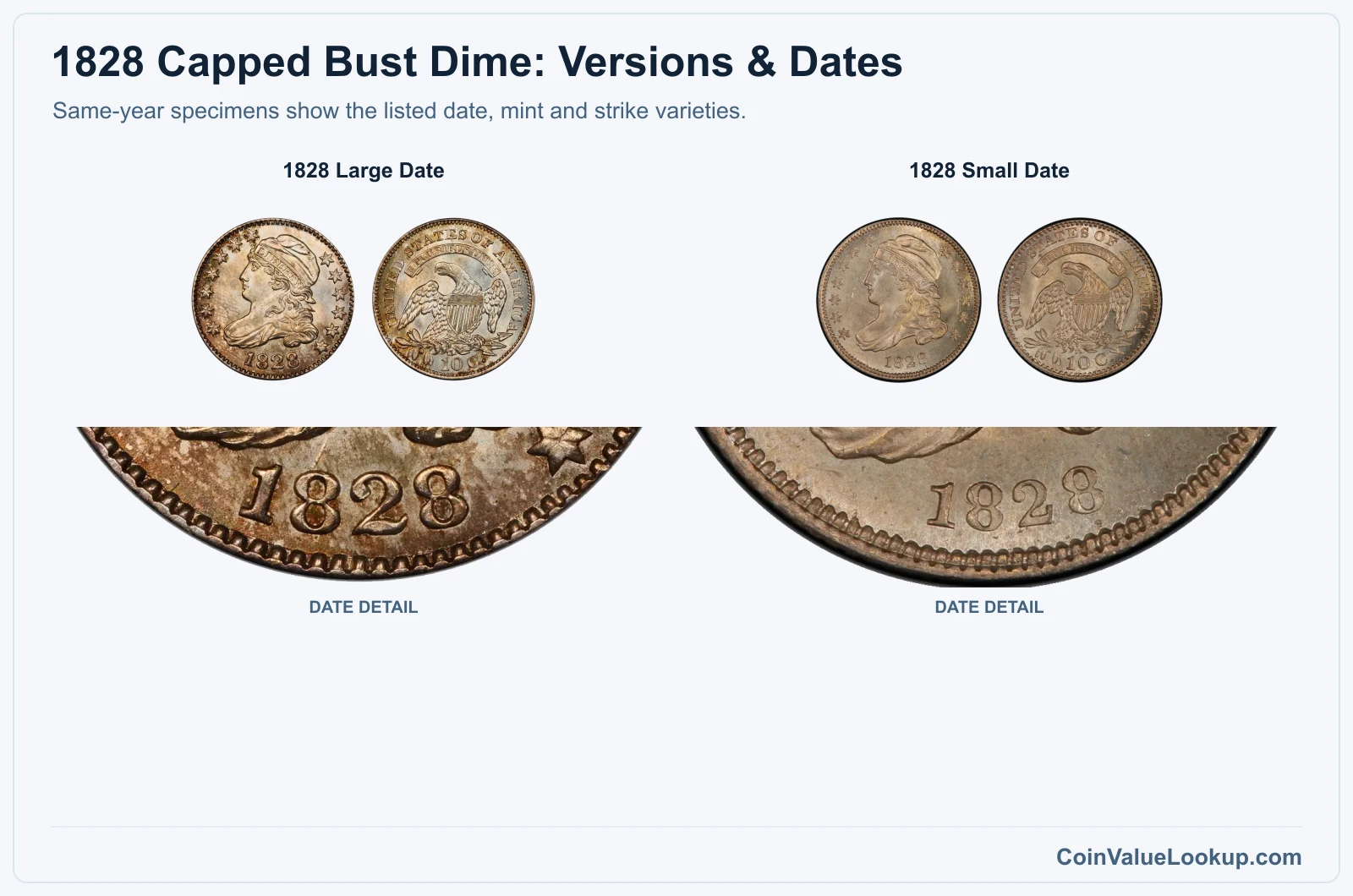
The 1828 Capped Bust Dime is an early American silver collectible struck at the Philadelphia Mint. Guide estimates from USA Coin Book range from roughly $85.00 in well-worn condition up to about $8,586.00 for higher-grade examples, depending on the specific date variety and grade.
Actual value depends on your coin's version, wear and original surfaces — those figures are not guaranteed offers.
Fast Way to Identify Your 1828 Capped Bust Dime
The quickest way to start identifying your 1828 dime is to upload clear photos of both the front and back. Our preliminary identification tool can help you match the design and narrow down which variety you may have.
Sharp, well-lit images showing the date and dentils make a big difference.
1828 Capped Bust Dime Value
Upload both sides of your 1828 Capped Bust Dime.
Front Obverse
Upload photo
Back Reverse
Upload photo
Which 1828 Capped Bust Dime Versions Are Worth Money?
- The 1828 Large Date variety carries higher guide estimates, with USA Coin Book listing around $158 in G4 and about $8,586 in MS63.
- The 1828 Small Date variety is listed at roughly $85 in G4 and around $3,321 in MS63 by the same guide — still a meaningful coin in better grades.
- A mirror brockage error has been reported on an 1828 Large Date dime, which is a scarce mint-made anomaly worth investigating if your coin shows unusual incuse impressions.
- Confirming the correct variety and preserving original surfaces are the two most important steps before comparing your coin to any published estimate.
Step 1: Identify Your 1828 Capped Bust Dime Mint Mark and Version
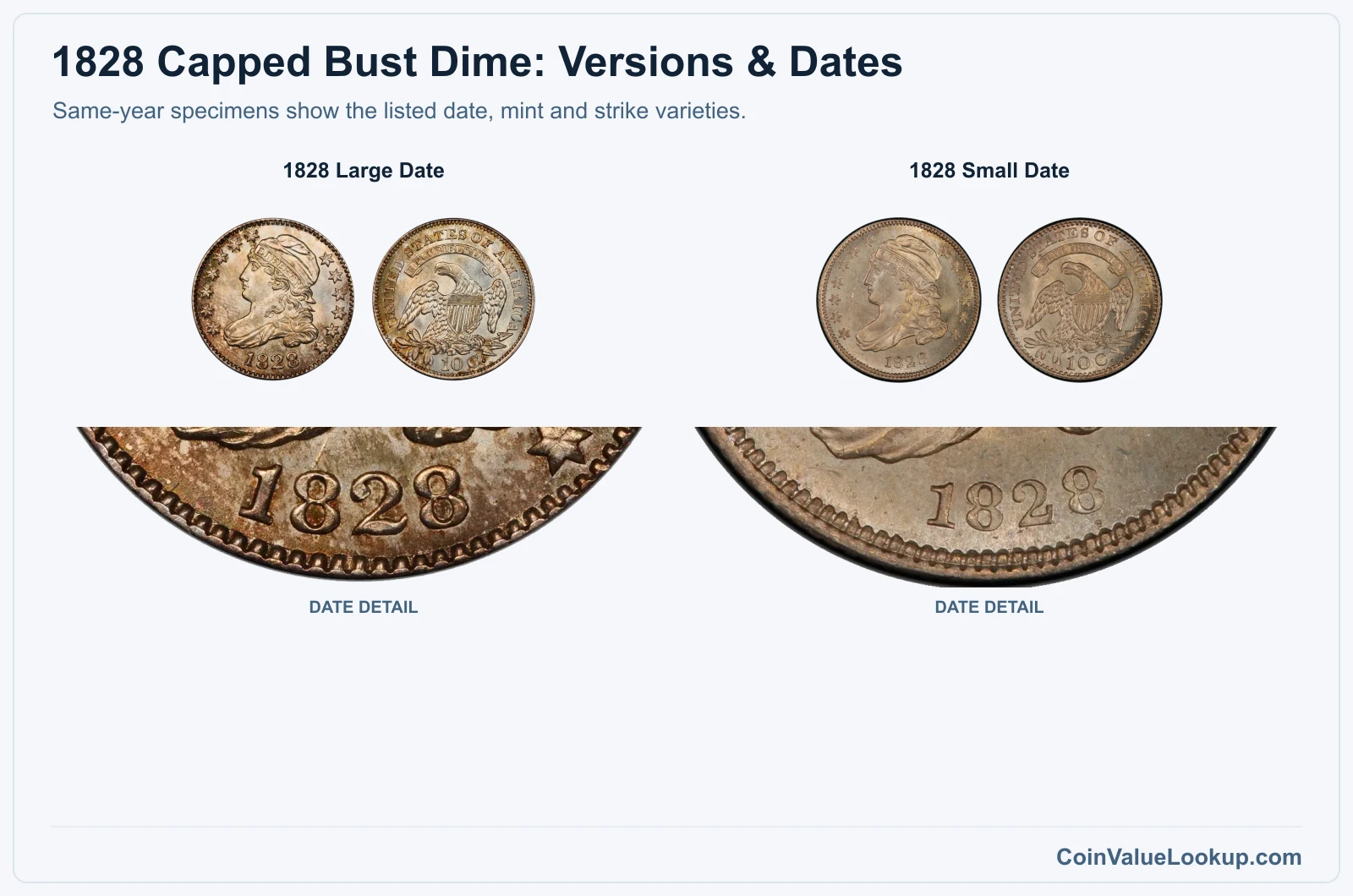
Every 1828 Capped Bust Dime was struck at the Philadelphia Mint, so there is no mintmark to look for. The coin is a silver-copper alloy, roughly 89.24% silver.
Two main branches exist for this date: the Large Date and the Small Date. The Large Date version uses the wider Capped Bust format with large dentils around the rim.
The Small Date version pairs smaller numerals with small dentils and a closed-collar edge, giving the coin a slightly different overall look.
To separate them, compare the size of the date numerals and the tooth-like dentils around the border. Don't rely on magnification or image zoom alone — use a correctly labeled reference image of each variety side by side.
A half dime is a completely different, smaller denomination, so make sure you're working with an actual dime before going further.
Step 2: Check Your 1828 Capped Bust Dime Grade
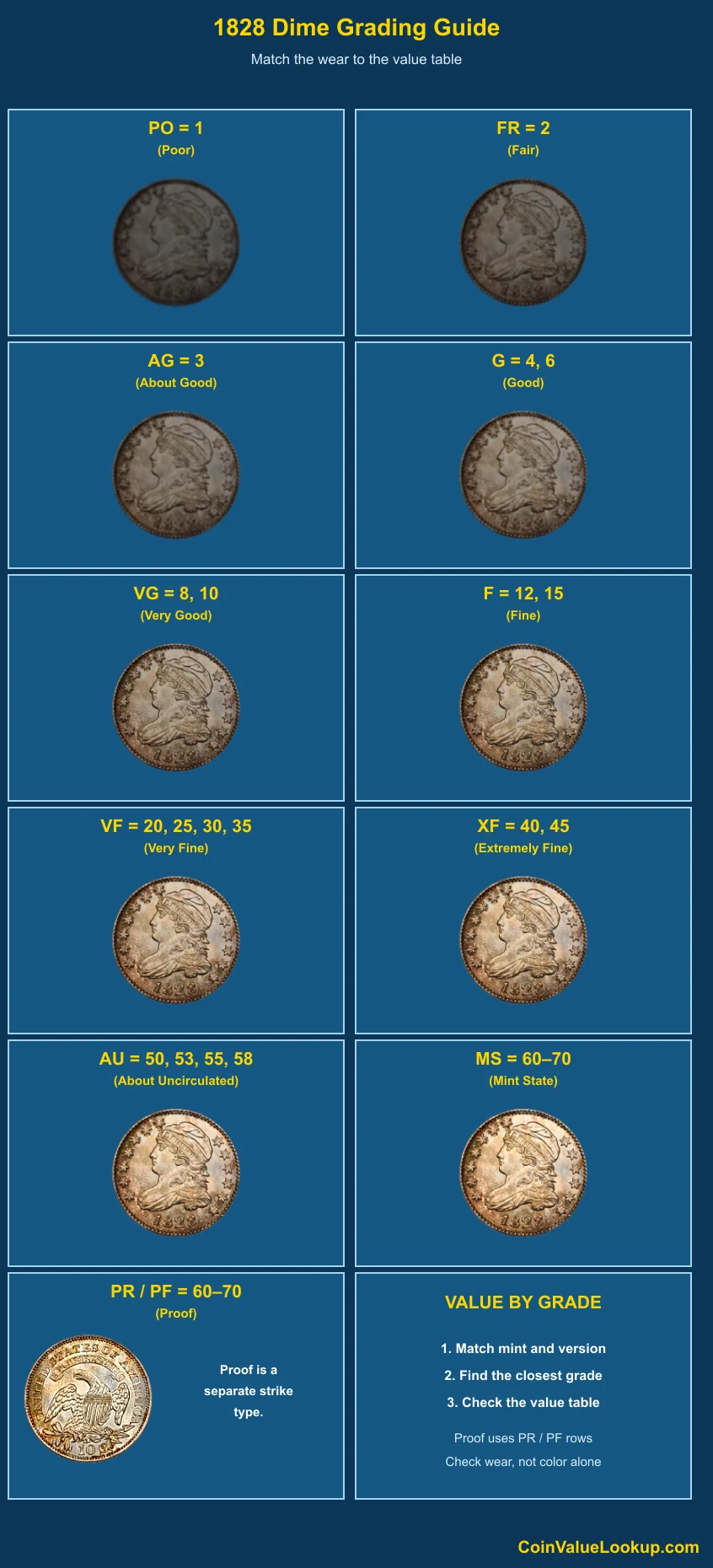
On the obverse, check the high points first: Liberty's hair curls above her forehead, the cheek, and the drapery folds near the cap. These are the first areas to show friction.
On the reverse, the eagle's breast feathers and upper wing tips wear earliest.
Early 1800s coins were struck on hand-operated presses, so even uncirculated pieces can show uneven detail or soft strikes in spots. That is not the same as wear.
Look at the overall luster and surface quality rather than isolated soft areas.
Compare your coin to the same-type grading image to gauge where it falls. Contact marks and original surfaces matter — a coin with honest wear and no cleaning will almost always be more desirable than one that has been scrubbed bright.
Resist the urge to polish or dip these old silver pieces.
Step 3: Check 1828 Capped Bust Dime Value by Mint and Version
1828 Capped Bust Dime — Large Date
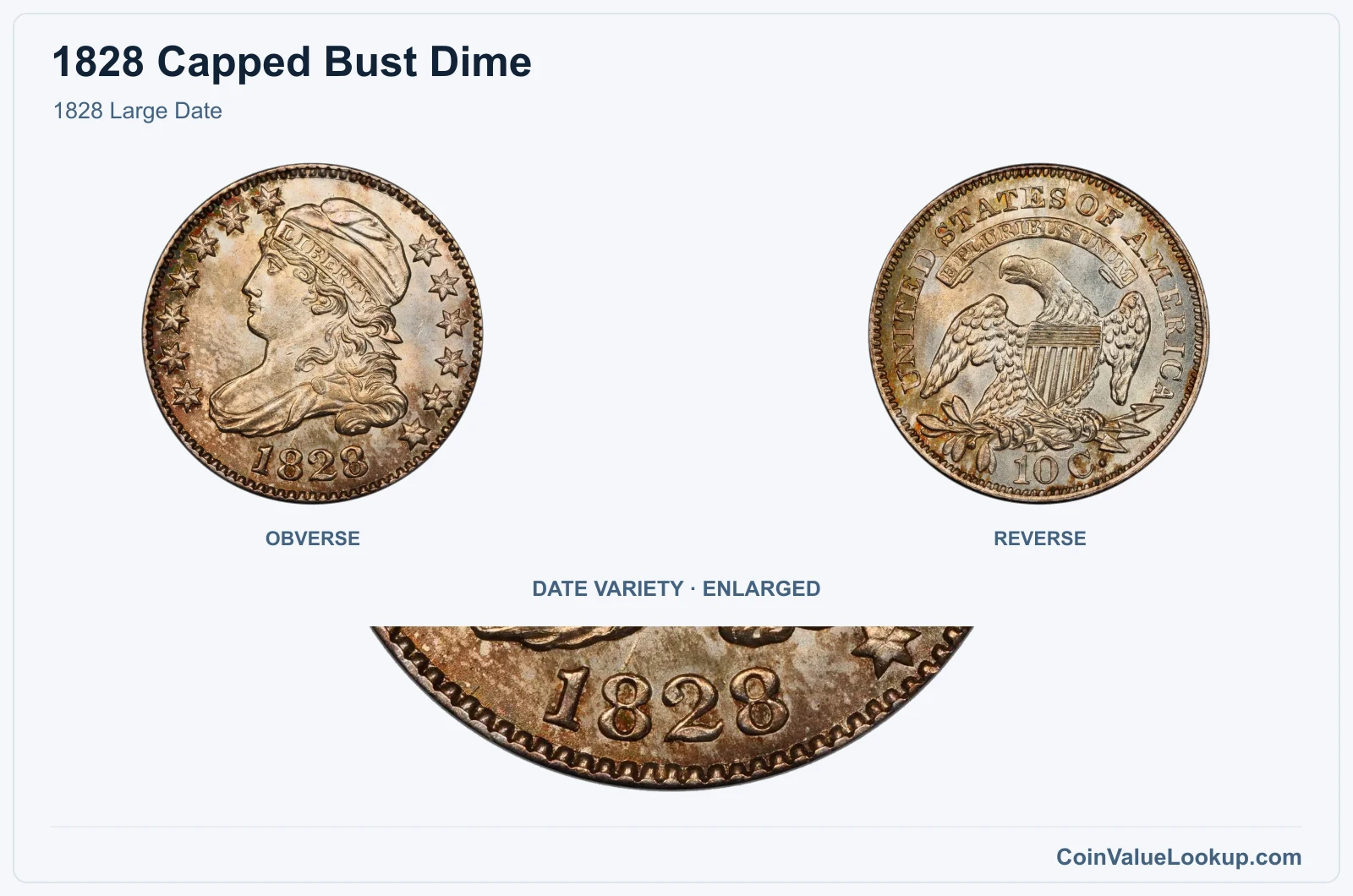
The 1828 Large Date Capped Bust Dime features noticeably larger numerals in the date and large dentils around the rim, consistent with the wider-format Capped Bust design. It was struck at Philadelphia with no mintmark.
The base of the numeral 2 in the date has a curved or "curl" form, which helps confirm you have this branch rather than the Small Date.
USA Coin Book lists guide estimates of about $158 at G4 and around $8,586 at MS63. These are reference anchors, not guaranteed sale prices.
Original, uncleaned surfaces and accurate grade assessment matter far more than surface brightness when comparing your coin to published figures.
Coin Value Lookup is a good starting point if you want to look up other early dime dates or different denominations from the same era. Bookmark it for future reference when sorting through old silver.
Range Grade
Price Auction Records Appraisal PO PO 1
—
Coin Identifier FR FR 2
—
Coin Identifier AG AG 3
—
Coin Identifier G G 4
—
Coin Identifier
G 6
Coin Identifier VG VG 8
Coin Identifier
VG 10
—
Coin Identifier F F 12
Coin Identifier
F 15
Coin Identifier VF VF 20
Coin Identifier
VF 25
Coin Identifier
VF 30
Coin Identifier
VF 35
Coin Identifier XF XF 40
Coin Identifier
XF 45
Coin Identifier AU AU 50
Coin Identifier
AU 53
Coin Identifier
AU 55
Coin Identifier
AU 58
Coin Identifier MS MS 60
—
Coin Identifier
MS 61
—
Coin Identifier
MS 62
Coin Identifier
MS 63
Coin Identifier
MS 64
Coin Identifier
MS 65
—
Coin Identifier
MS 66
—
Coin Identifier
MS 67
—
—
—
MS 68
—
—
—
MS 69
—
—
—
MS 70
—
—
—
1828 Capped Bust Dime — Small Date
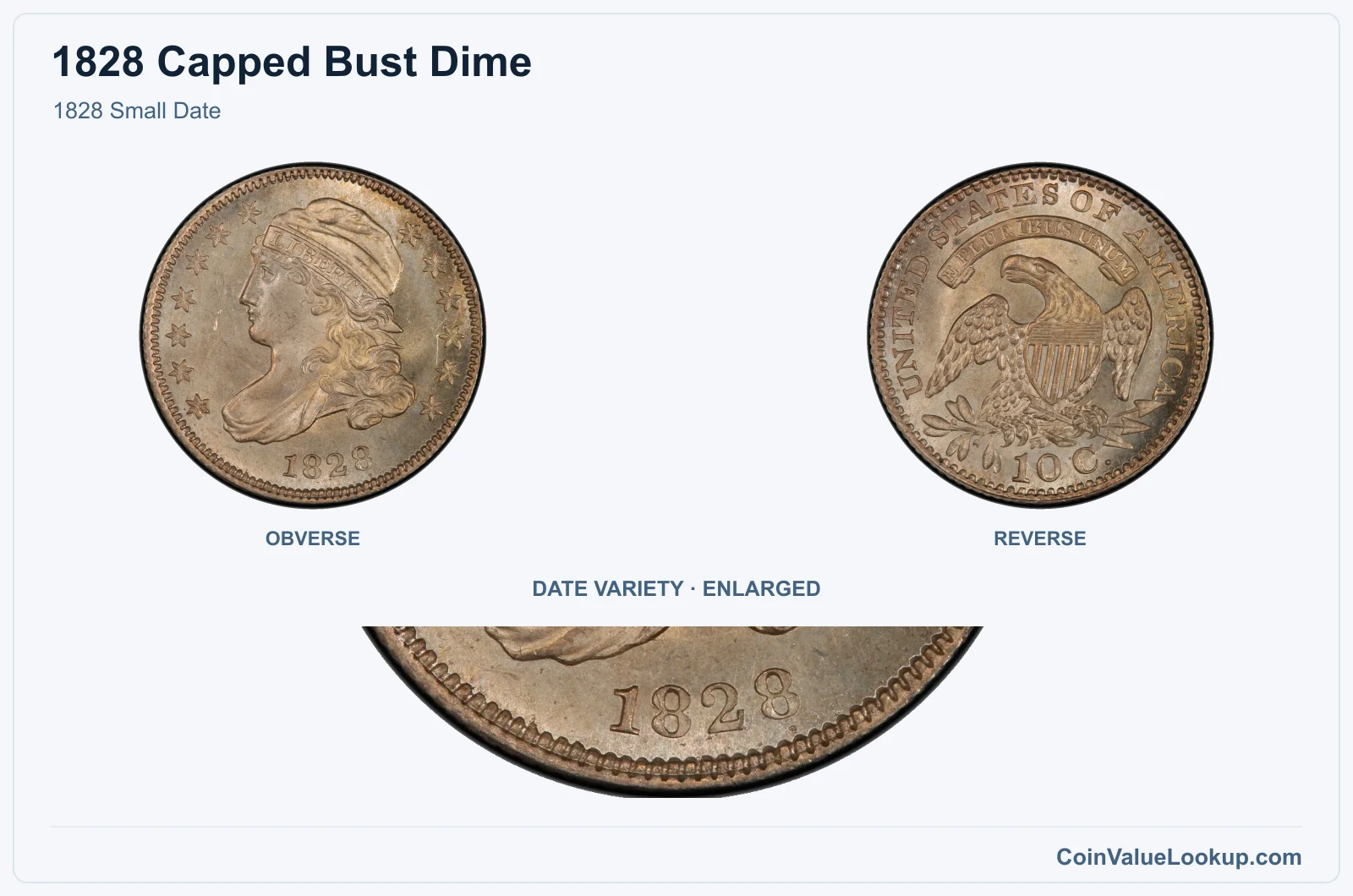
The 1828 Small Date variety is distinguished by its smaller date numerals and small dentils around the rim. This version is associated with closed-collar production, which gives the coin a more uniform edge compared to the Large Date.
The numeral 2 in the date has a square or flat base — a key diagnostic when comparing the two varieties side by side.
Philadelphia struck this version as well, so again, no mintmark. USA Coin Book guide estimates place this branch at roughly $85 in G4 and about $3,321 in MS63.
That is lower than the Large Date across comparable grades, but a well-preserved Small Date example in original condition is still a serious early American silver coin. Always match the actual design details before applying any price reference.
Range Grade
Price Auction Records Appraisal PO PO 1
—
Coin Identifier FR FR 2
—
Coin Identifier AG AG 3
—
Coin Identifier G G 4
Coin Identifier
G 6
Coin Identifier VG VG 8
Coin Identifier
VG 10
Coin Identifier F F 12
Coin Identifier
F 15
Coin Identifier VF VF 20
Coin Identifier
VF 25
Coin Identifier
VF 30
Coin Identifier
VF 35
Coin Identifier XF XF 40
Coin Identifier
XF 45
Coin Identifier AU AU 50
Coin Identifier
AU 53
Coin Identifier
AU 55
Coin Identifier
AU 58
Coin Identifier MS MS 60
—
Coin Identifier
MS 61
Coin Identifier
MS 62
Coin Identifier
MS 63
Coin Identifier
MS 64
Coin Identifier
MS 65
Coin Identifier
MS 66
—
Coin Identifier
MS 67
—
Coin Identifier
MS 68
—
—
—
MS 69
—
—
—
MS 70
—
—
—
1828 Capped Bust Dime Error List
1. 1828 Capped Bust Dime — Brockage
A brockage occurs when a previously struck coin sticks to a die and impresses its design into the next blank in mirror-image, incuse form. On the reported 1828 Large Date Dime, the reverse shows a mirror brockage — an incuse, reversed impression of the design transferred through a stuck coin.
Heritage Auctions listed one example graded AG3 by NGC.
To check for this, look at the reverse for any sunken, backward lettering or eagle design that appears pressed into the surface rather than raised. The impression should be a true mirror image, reading backward and recessed.
Don't confuse this with a die clash, which leaves faint ghost outlines from the opposing die but no deep incuse impression. Post-mint damage from two coins being squeezed together can also mimic a brockage, but those lack the uniform depth and centering of a genuine mint-produced error.
Condition, visibility of the brockage and overall coin grade all affect what such a piece might bring.