1831 Capped Bust Dime Coin Value: How Much Is It Worth?
The 1831 Capped Bust Dime is one of the earlier collectible silver dimes struck at the Philadelphia Mint. Guide estimates for this date range from roughly $54.00 in Good-4 condition to around $2,344.00 at the MS63 level for regular strikes, though proof examples require individual assessment.
Your coin's actual worth depends on its specific branch, condition, and whether surfaces remain original and uncleaned.
Fast Way to Identify Your 1831 Capped Bust Dime
Snap clear photos of both the front and back of your 1831 dime and upload them for a preliminary identification. This step helps sort out whether you have a regular business strike or a proof, and gives a starting point for evaluating condition.
Good lighting and a steady hand go a long way.
1831 Capped Bust Dime Value
Upload both sides of your 1831 Capped Bust Dime.
Front Obverse
Upload photo
Back Reverse
Upload photo
Which 1831 Capped Bust Dime Versions Are Worth Money?
- The regular 1831 business strike ranges from about $54.00 in G4 to $2,344.00 in MS63 per guide estimates, making higher-grade survivors the ones to watch.
- The 1831 proof is extremely scarce early proof coinage; no standard guide range applies, and each authenticated example is assessed individually.
- Original, uncleaned surfaces on any branch add appeal and preserve full comparability to guide values.
Step 1: Identify Your 1831 Capped Bust Dime Mint Mark and Version
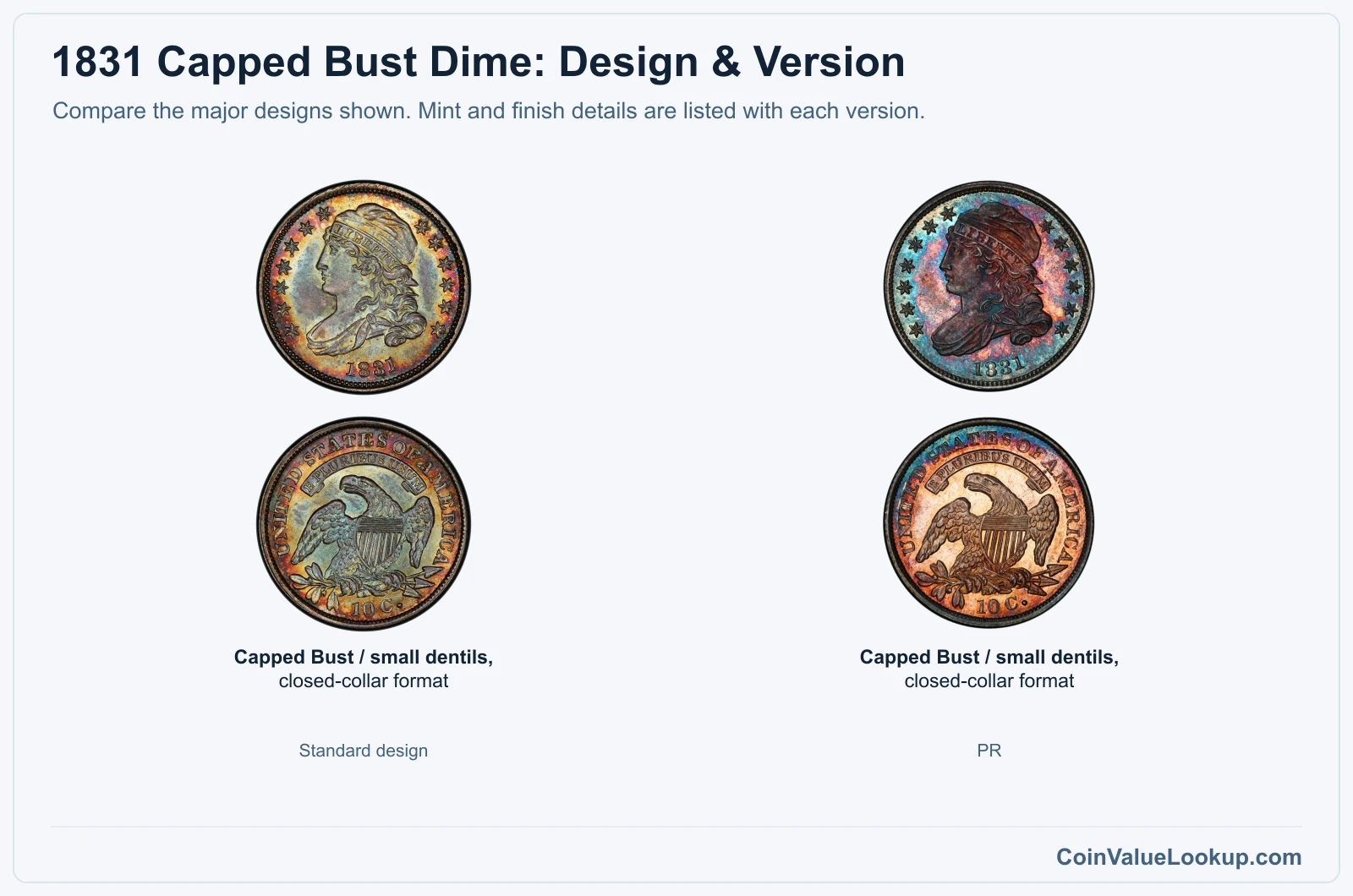
Every 1831 dime was struck at the Philadelphia Mint, so there is no mintmark to hunt for. The coin is made from a silver-copper alloy that is approximately 89.24% silver.
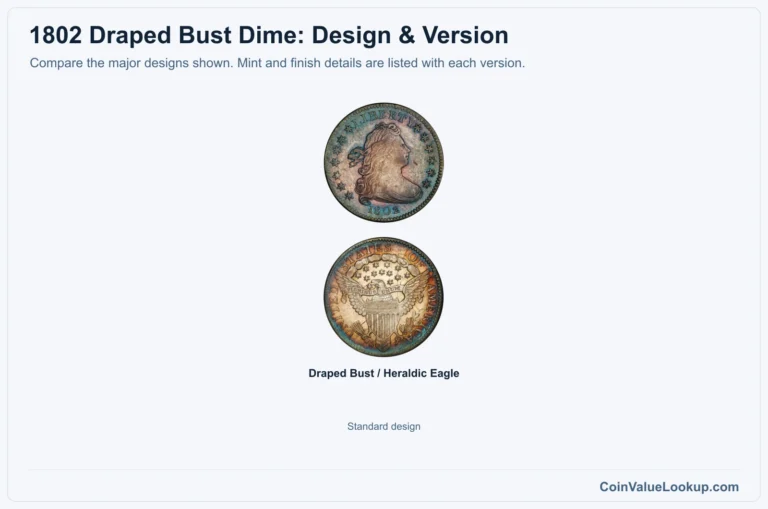
The design features Liberty wearing a cap on the obverse with small dentils around the rim, produced in the closed-collar format. On the reverse, a heraldic eagle dominates the field.
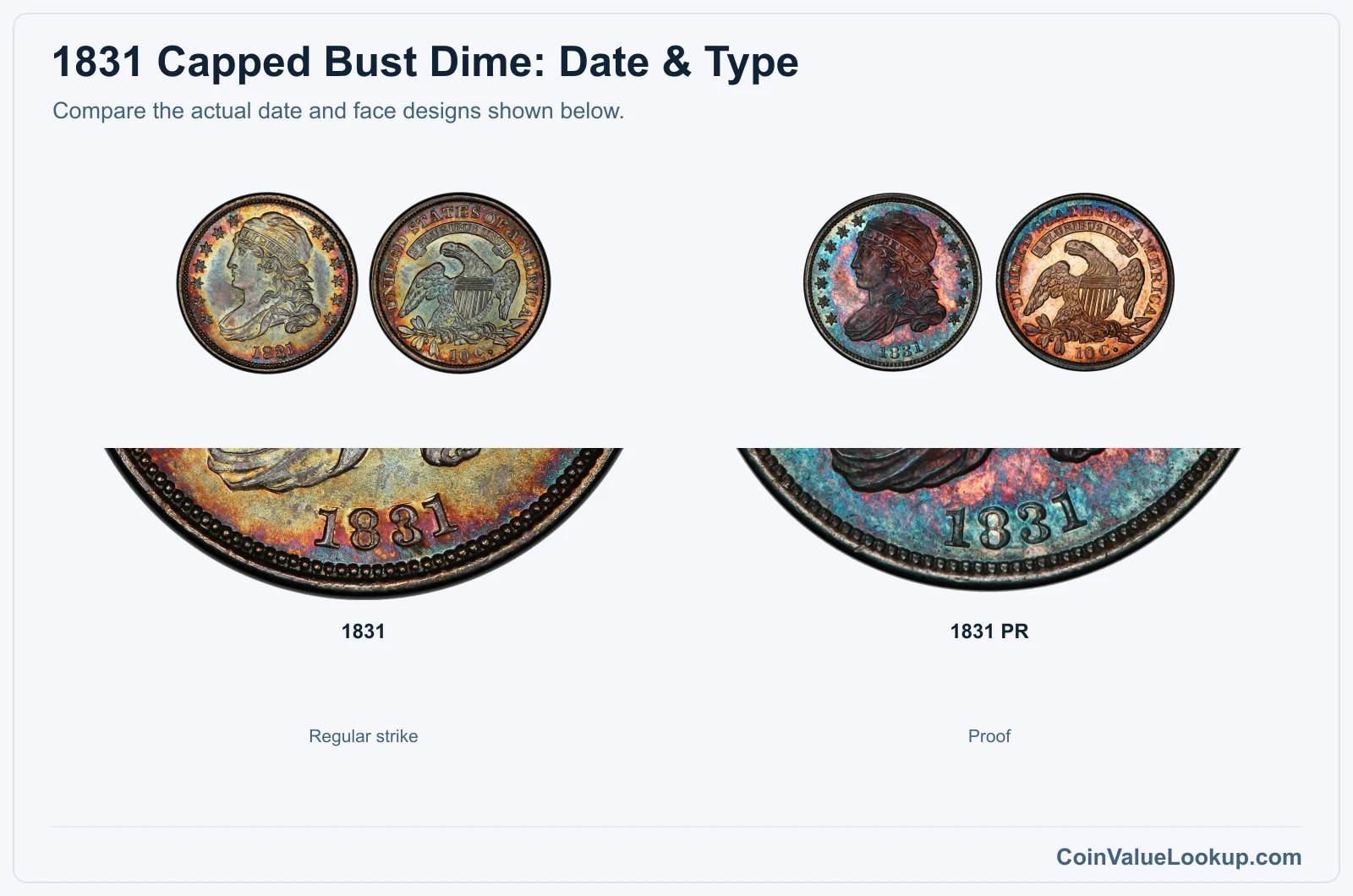
Two branches exist for this date: the regular 1831 business strike and the 1831 proof. Do not confuse a dime with a half dime, which is a separate, smaller denomination entirely.
Separating a proof from a business strike matters here. A coin that simply looks shiny or well-struck is not automatically a proof.
Proof status on an 1831 dime should be confirmed through professional attribution, since early proofs were made by a different manufacturing process and are extremely scarce.
Step 2: Check Your 1831 Capped Bust Dime Grade
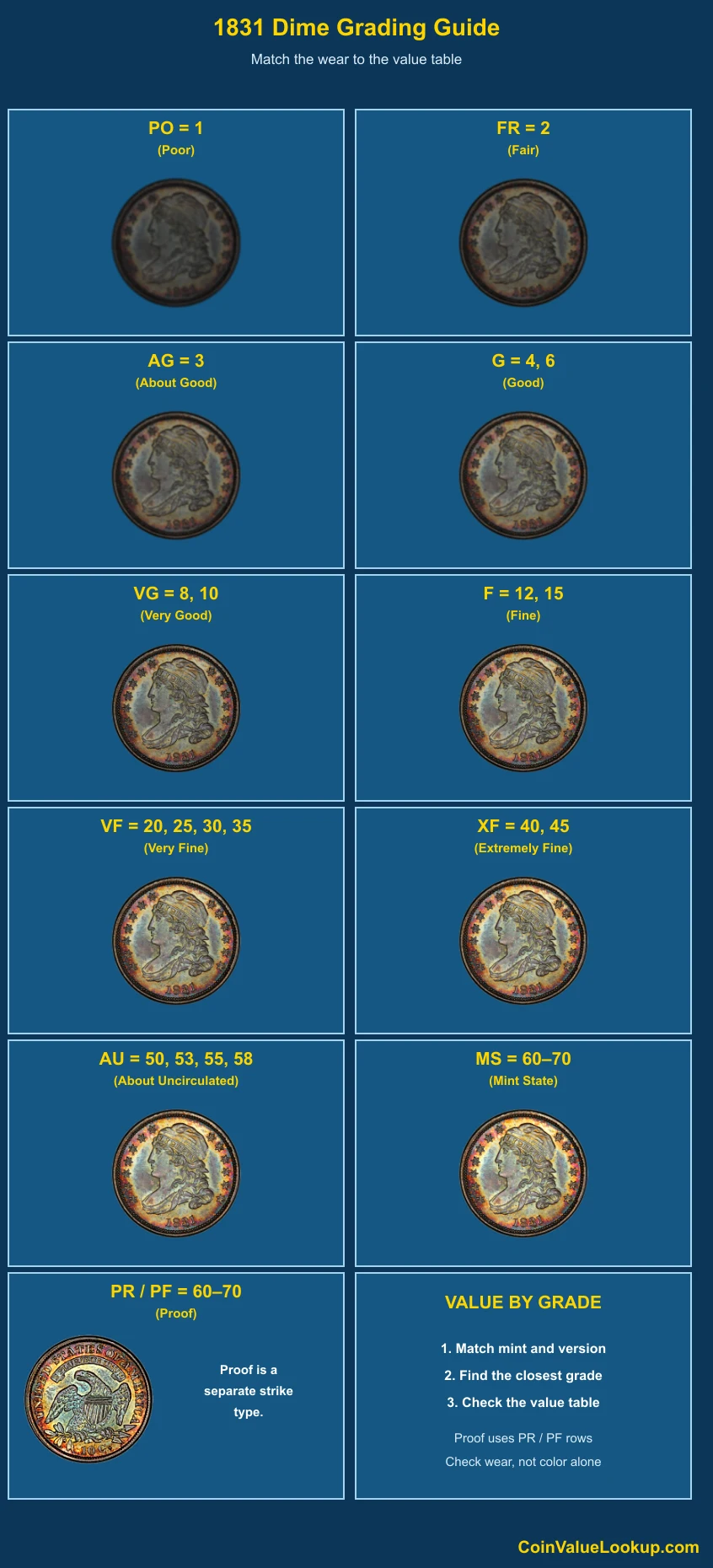
Focus on the high points first. On the obverse, check Liberty's hair curls, cheekbone, and the cap and drapery for smoothness caused by circulation wear.
On the reverse, the eagle's breast feathers and wing tips lose detail earliest.
These coins were struck on hand-operated presses, so some areas may appear soft or unevenly detailed even on coins that never circulated. That is a strike characteristic, not wear.
Look at overall luster and surface quality alongside the high points to get the full picture.
Contact marks, bag scratches, and light friction are normal signs of handling. Cleaning, polishing, or artificial brightening will lower a coin's desirability and value significantly.
Use the comparison image to match your coin's wear pattern against known grade benchmarks for this type.
Step 3: Check 1831 Capped Bust Dime Value by Mint and Version
1831 Capped Bust Dime
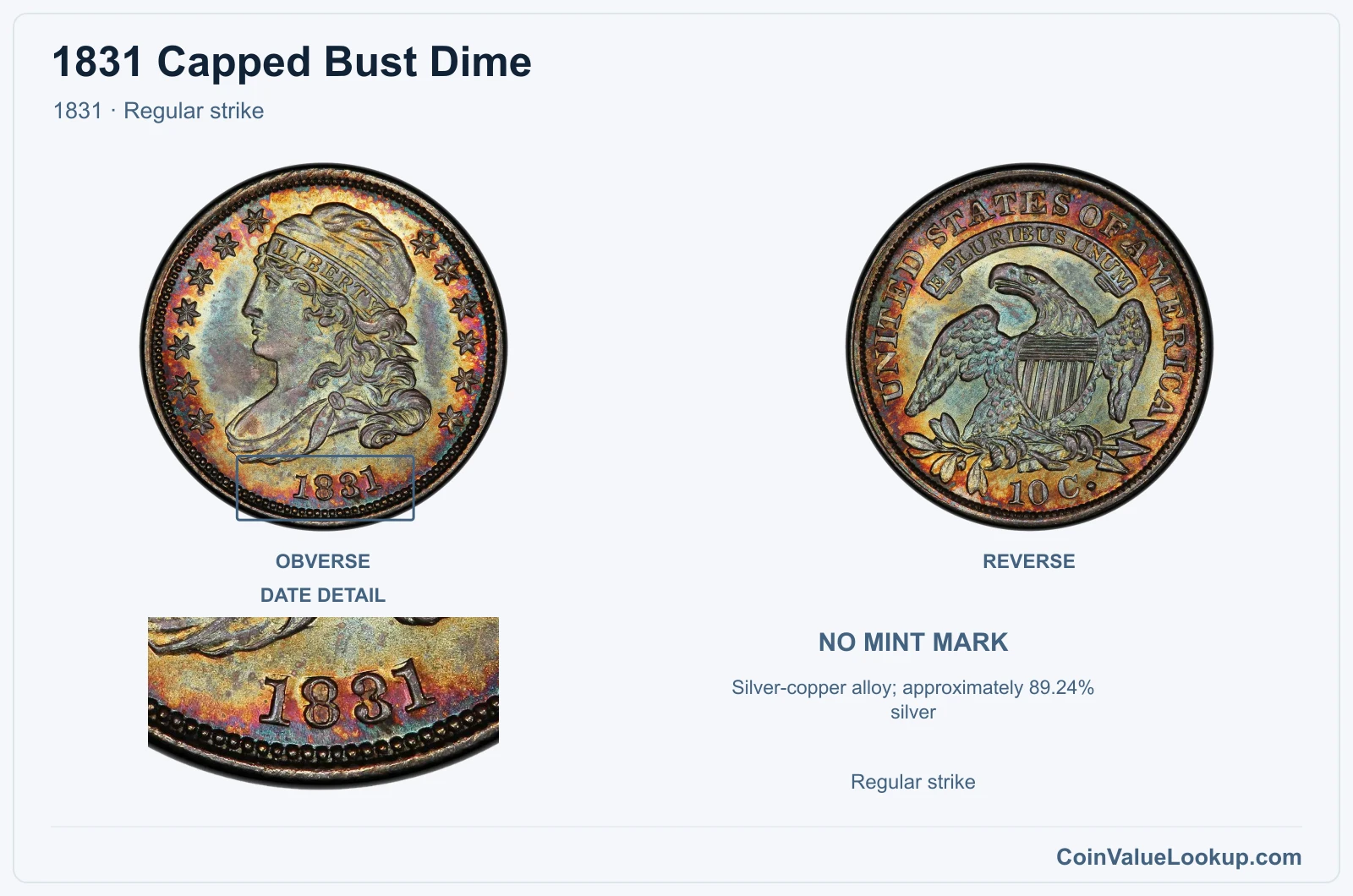
The regular 1831 Capped Bust Dime is a Philadelphia business strike on a silver-copper alloy planchet, roughly 89.24% silver. It carries no mintmark.
Guide estimates place this coin at about $54.00 in Good-4 and around $2,344.00 in MS63. Those anchors are guide figures, not guaranteed purchase offers, and they assume original, problem-free surfaces.
Match the date and the closed-collar, small-dentil design before comparing grade. Actual wear and surface quality matter far more than how bright the coin looks.
Cleaned or damaged pieces will fall below these reference points.
Coin Value Lookup is a useful starting point if you want to look up guides for other dates or denominations in this series.
Range Grade
Price Auction Records Appraisal PO PO 1
—
Coin Identifier FR FR 2
—
Coin Identifier AG AG 3
—
Coin Identifier G G 4
Coin Identifier
G 6
Coin Identifier VG VG 8
Coin Identifier
VG 10
—
Coin Identifier F F 12
Coin Identifier
F 15
Coin Identifier VF VF 20
Coin Identifier
VF 25
—
Coin Identifier
VF 30
Coin Identifier
VF 35
Coin Identifier XF XF 40
Coin Identifier
XF 45
Coin Identifier AU AU 50
Coin Identifier
AU 53
Coin Identifier
AU 55
Coin Identifier
AU 58
Coin Identifier MS MS 60
Coin Identifier
MS 61
Coin Identifier
MS 62
Coin Identifier
MS 63
Coin Identifier
MS 64
Coin Identifier
MS 65
Coin Identifier
MS 66
Coin Identifier
MS 67
Coin Identifier
MS 68
Coin Identifier
MS 69
—
—
—
MS 70
—
—
—
1831 Capped Bust Dime — PR
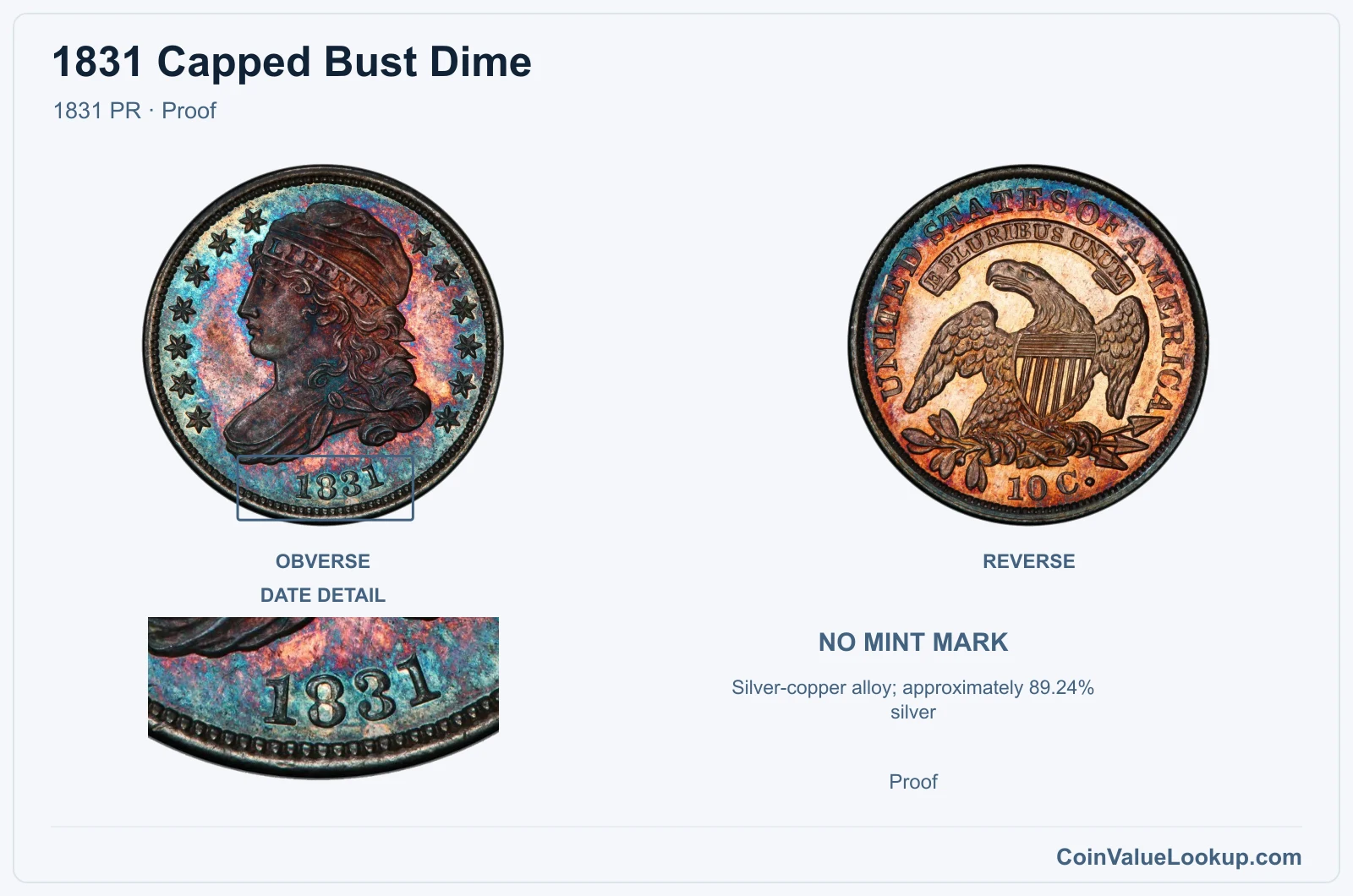
The 1831 proof Capped Bust Dime is an extremely scarce product of early proof manufacturing at Philadelphia. These were made in tiny numbers, likely for presentation or collector purposes, using specially prepared dies and planchets.
There is no adopted numeric guide range for this branch. Each authenticated proof is valued individually based on its confirmed identity, condition, and surface preservation.
Do not assume a reflective or well-struck circulation piece qualifies; proof status on coins this old requires professional attribution.
If you think you have one, the responsible next step is third-party certification. The difference between a proof and a nice business strike on an 1831 dime is significant, and it is not a call most collectors should make at the kitchen table.
Range Grade
Price Auction Records Appraisal PR PR 1
—
Coin Identifier
PR 2
—
Coin Identifier
PR 3
—
Coin Identifier
PR 4
—
Coin Identifier
PR 6
—
Coin Identifier
PR 8
—
Coin Identifier
PR 10
—
Coin Identifier
PR 12
—
Coin Identifier
PR 15
—
Coin Identifier
PR 20
—
Coin Identifier
PR 25
—
Coin Identifier
PR 30
—
Coin Identifier
PR 35
—
Coin Identifier
PR 40
—
Coin Identifier
PR 45
—
Coin Identifier
PR 50
—
Coin Identifier
PR 53
—
Coin Identifier
PR 55
—
Coin Identifier
PR 58
—
Coin Identifier
PR 60
—
Coin Identifier
PR 61
—
Coin Identifier
PR 62
—
Coin Identifier
PR 63
Coin Identifier
PR 64
Coin Identifier
PR 65
Coin Identifier
PR 66
Coin Identifier
PR 67
Coin Identifier
PR 68
—
—
—
PR 69
—
—
—
PR 70
—
—
—