1833 Capped Bust Dime Coin Value: How Much Is It Worth?
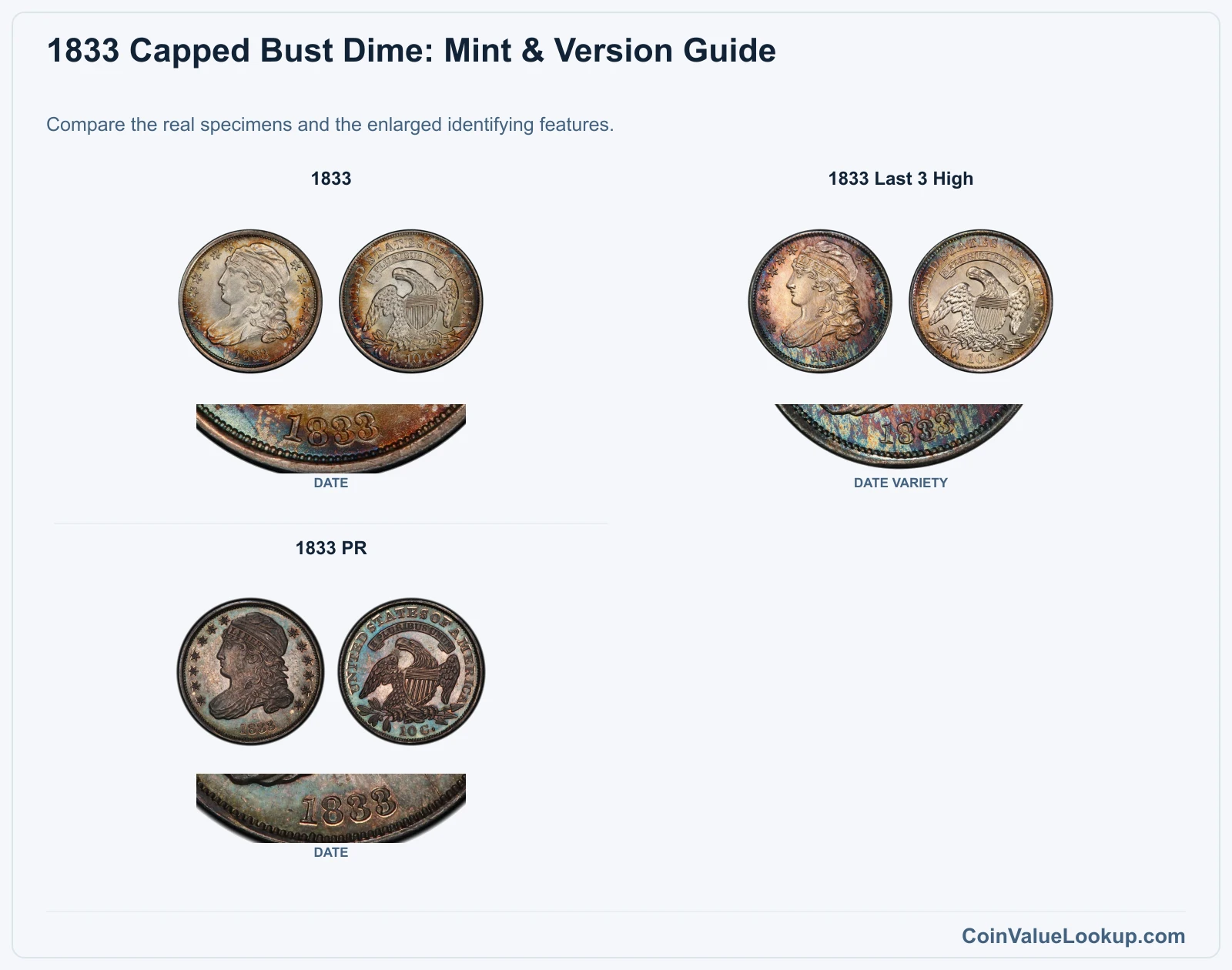
The 1833 Capped Bust Dime is an early American silver dime struck at the Philadelphia Mint, made from a silver-copper alloy of roughly 89.24% silver. Guide estimates for this date range from about $54.00 in well-worn Good-4 condition to around $2,344.00 at the MS63 level, depending on the specific variety and grade.
These anchors are guide figures, not guaranteed offers. Your coin's actual value hinges on its exact date variety, surface condition and honest wear.
Fast Way to Identify Your 1833 Capped Bust Dime
If you have an 1833 Capped Bust Dime and want a quick starting point, upload clear photos of the front and back. Our identifier can help with preliminary identification of the design, date and basic branch.
Good lighting and a steady shot make a real difference, so avoid glare and try to capture the full rim on both sides.
1833 Capped Bust Dime Value
Upload both sides of your 1833 Capped Bust Dime.
Front Obverse
Upload photo
Back Reverse
Upload photo
Which 1833 Capped Bust Dime Versions Are Worth Money?
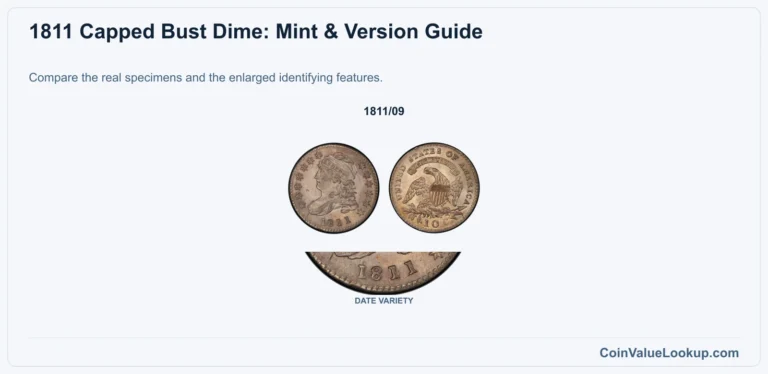
- The 1833 Last 3 High variety shows the final 3 sitting higher than adjacent digits, a detail worth checking under magnification before pricing.
- The 1833 PR (proof) is an extremely scarce early proof striking that requires professional authentication and commands individual-assessment pricing.
Step 1: Identify Your 1833 Capped Bust Dime Mint Mark and Version
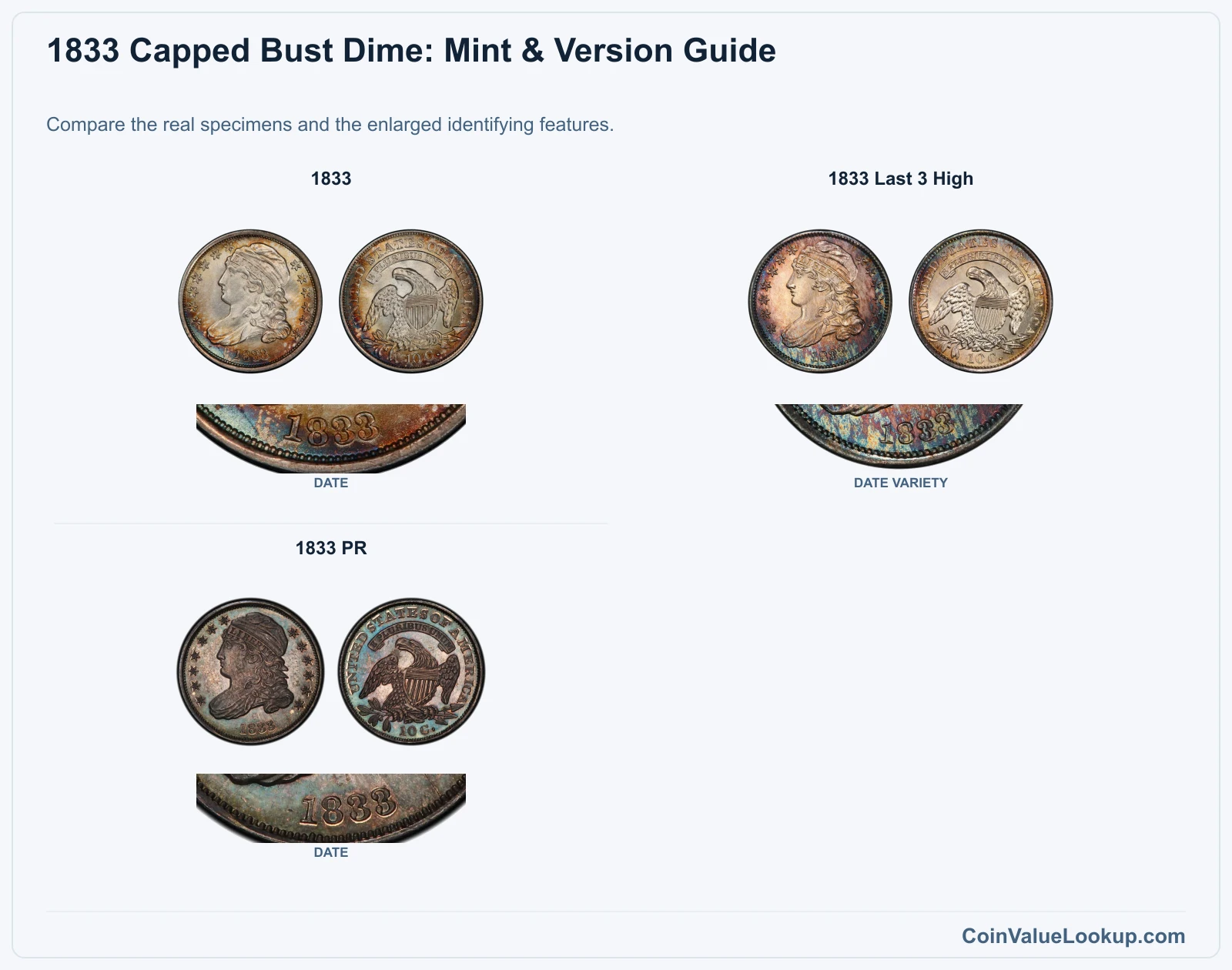
Every 1833 Capped Bust Dime was struck in Philadelphia. There is no mintmark to look for on this date.
The design uses the small-dentils, closed-collar format with a capped Liberty on the obverse and an eagle on the reverse. Be careful not to confuse this coin with a half dime, which is a smaller denomination entirely and has a different diameter and weight.
Three branches exist for this year. The standard 1833 is the baseline variety.
The 1833 Last 3 High shows the final digit of the date sitting noticeably higher than the adjacent numerals relative to their shared baseline. The 1833 PR is an extremely scarce proof issue with a mirror-like finish.
A shiny or well-struck circulation coin is not automatically a proof, so that distinction matters.
Step 2: Check Your 1833 Capped Bust Dime Grade
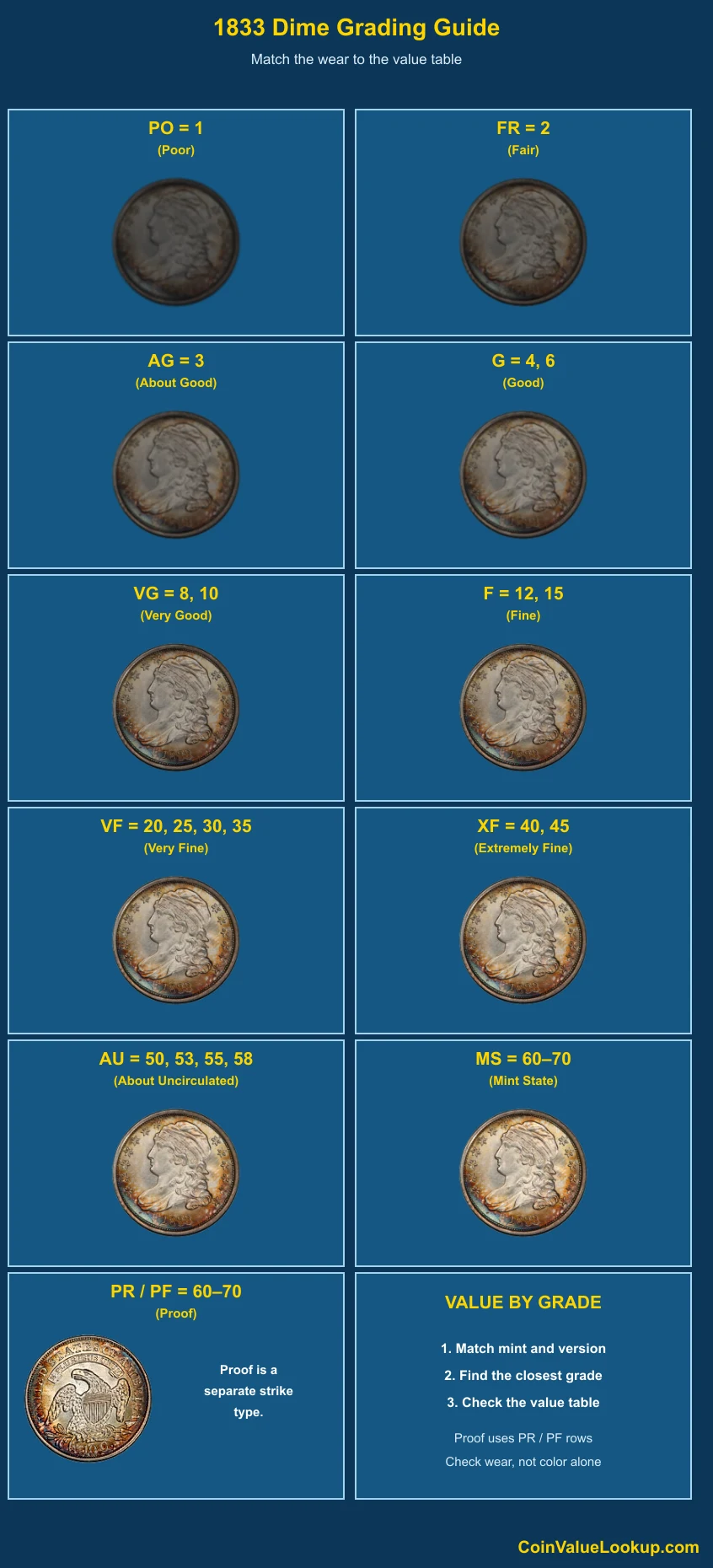
Start with Liberty's hair above the forehead and ear. On a lightly circulated coin, the individual strands begin to merge.
The cheek and the drapery at Liberty's shoulder lose definition early, so those are your first checkpoints.
Flip it over and examine the eagle's breast feathers and wing tips. Flat, mushy feathers usually mean moderate to heavy wear.
Here is the tricky part with early dimes: hand-operated presses sometimes left uneven or weakly impressed details even on brand-new coins. So a soft area does not always mean wear.
Look at the overall luster and contact marks together before drawing conclusions. The comparison image beside this section shows the progression from worn to mint-state for this type.
Do not clean or polish the coin. Original toned surfaces, even dark ones, are strongly preferred by collectors over a bright, scrubbed piece.
Step 3: Check 1833 Capped Bust Dime Value by Mint and Version
1833 Capped Bust Dime
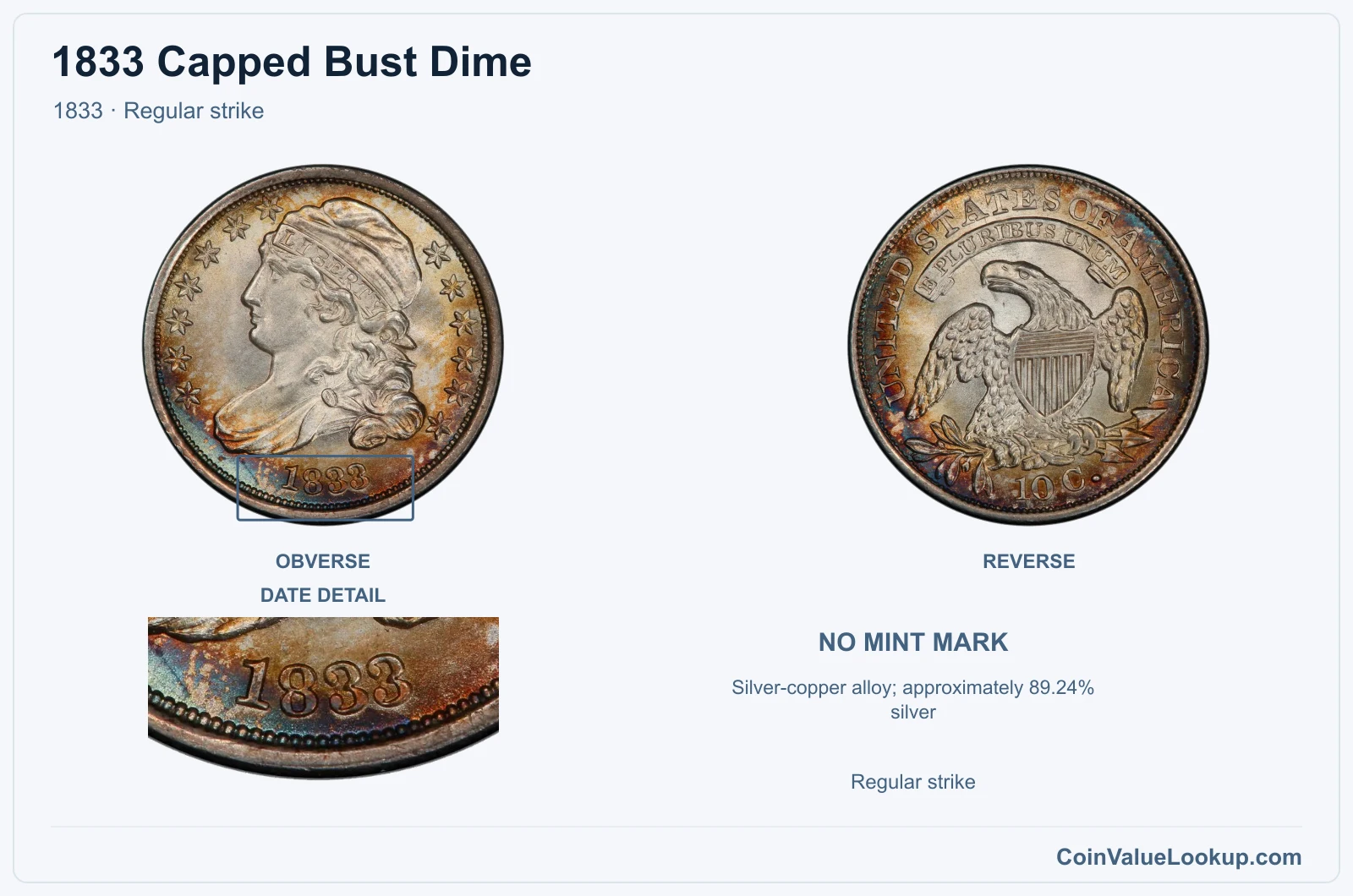
The standard 1833 Capped Bust Dime is the most commonly encountered branch for this date. Philadelphia struck it in a silver-copper alloy with no mintmark.
Guide estimates place it at roughly $54.00 in Good-4 and around $2,344.00 at MS63. These are reference anchors, not offers.
Actual value depends on wear, originality of surfaces and the absence of damage. Cleaning, scratches or corrosion will reduce what a buyer is willing to pay compared to a coin with honest, original toning.
Coin Value Lookup is a good starting point if you are exploring values across other dates or denominations in the Capped Bust Dime series. You can look up guides for related coins to compare what different years and varieties typically bring.
Range Grade
Price Auction Records Appraisal PO PO 1
—
Coin Identifier FR FR 2
—
Coin Identifier AG AG 3
Coin Identifier G G 4
Coin Identifier
G 6
—
Coin Identifier VG VG 8
Coin Identifier
VG 10
Coin Identifier F F 12
Coin Identifier
F 15
Coin Identifier VF VF 20
Coin Identifier
VF 25
Coin Identifier
VF 30
Coin Identifier
VF 35
Coin Identifier XF XF 40
Coin Identifier
XF 45
Coin Identifier AU AU 50
Coin Identifier
AU 53
Coin Identifier
AU 55
Coin Identifier
AU 58
Coin Identifier MS MS 60
Coin Identifier
MS 61
Coin Identifier
MS 62
Coin Identifier
MS 63
Coin Identifier
MS 64
Coin Identifier
MS 65
Coin Identifier
MS 66
Coin Identifier
MS 67
—
Coin Identifier
MS 68
—
Coin Identifier
MS 69
—
—
—
MS 70
—
—
—
1833 Capped Bust Dime — Last 3 High
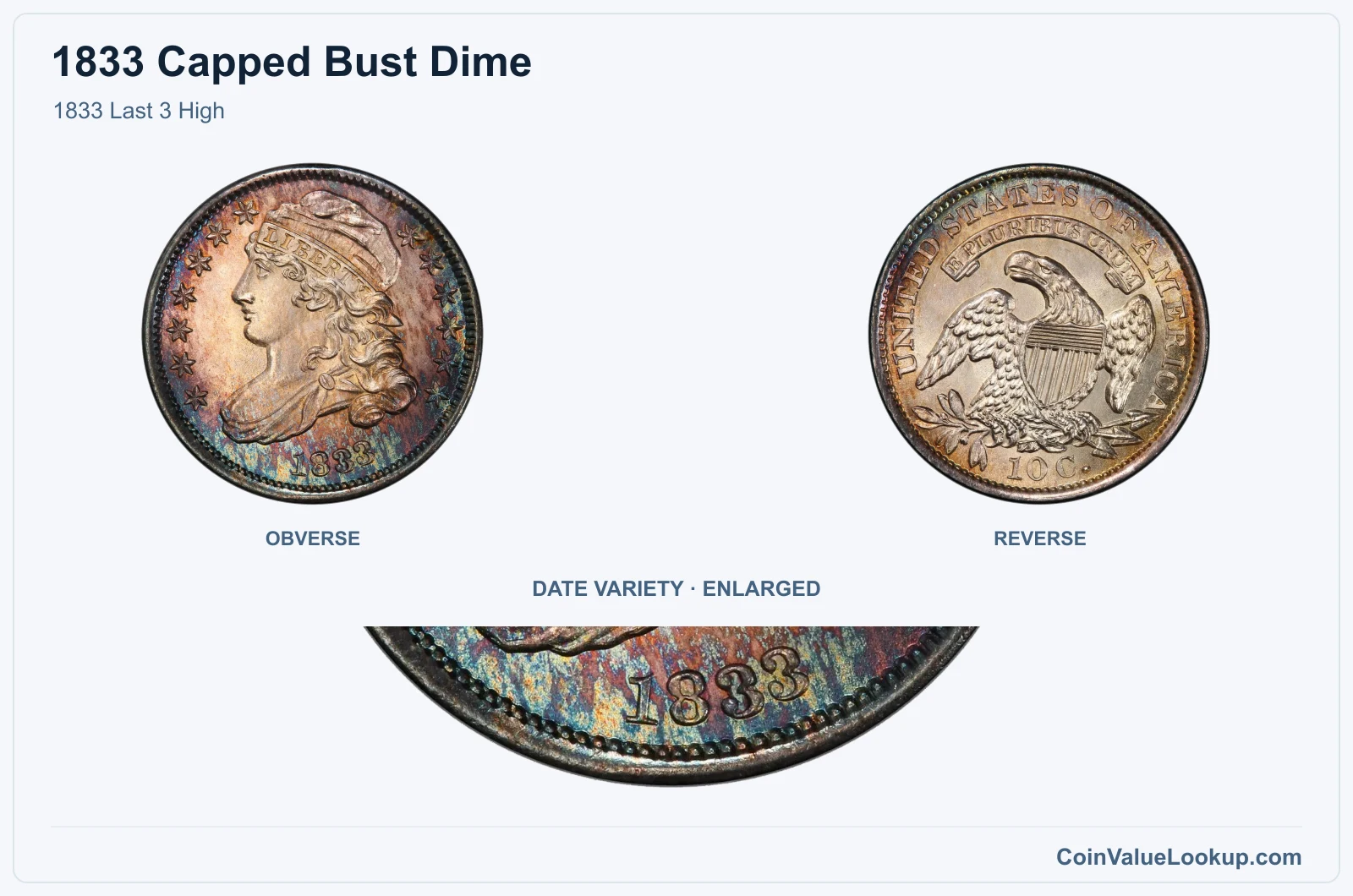
The 1833 Last 3 High variety is identified by comparing the final 3 in the date to its neighboring digits. That last 3 sits visibly higher relative to the baseline shared by the other numerals.
You will want magnification and good light to confirm this, since the difference can be subtle on worn examples.
Guide estimates for this variety match the standard 1833 at roughly $54.00 in Good-4 and approximately $2,344.00 at MS63, though the distinct die variety may attract specialist interest. Original surfaces matter more than brightness.
Confirm the variety before assuming any premium, and keep in mind these guide figures are not guaranteed offers.
Range Grade
Price Auction Records Appraisal PO PO 1
—
Coin Identifier FR FR 2
—
Coin Identifier AG AG 3
—
Coin Identifier G G 4
Coin Identifier
G 6
Coin Identifier VG VG 8
—
Coin Identifier
VG 10
Coin Identifier F F 12
Coin Identifier
F 15
—
Coin Identifier VF VF 20
Coin Identifier
VF 25
Coin Identifier
VF 30
Coin Identifier
VF 35
Coin Identifier XF XF 40
Coin Identifier
XF 45
Coin Identifier AU AU 50
Coin Identifier
AU 53
Coin Identifier
AU 55
Coin Identifier
AU 58
Coin Identifier MS MS 60
—
Coin Identifier
MS 61
Coin Identifier
MS 62
Coin Identifier
MS 63
Coin Identifier
MS 64
Coin Identifier
MS 65
Coin Identifier
MS 66
Coin Identifier
MS 67
Coin Identifier
MS 68
—
—
—
MS 69
—
—
—
MS 70
—
—
—
1833 Capped Bust Dime — PR
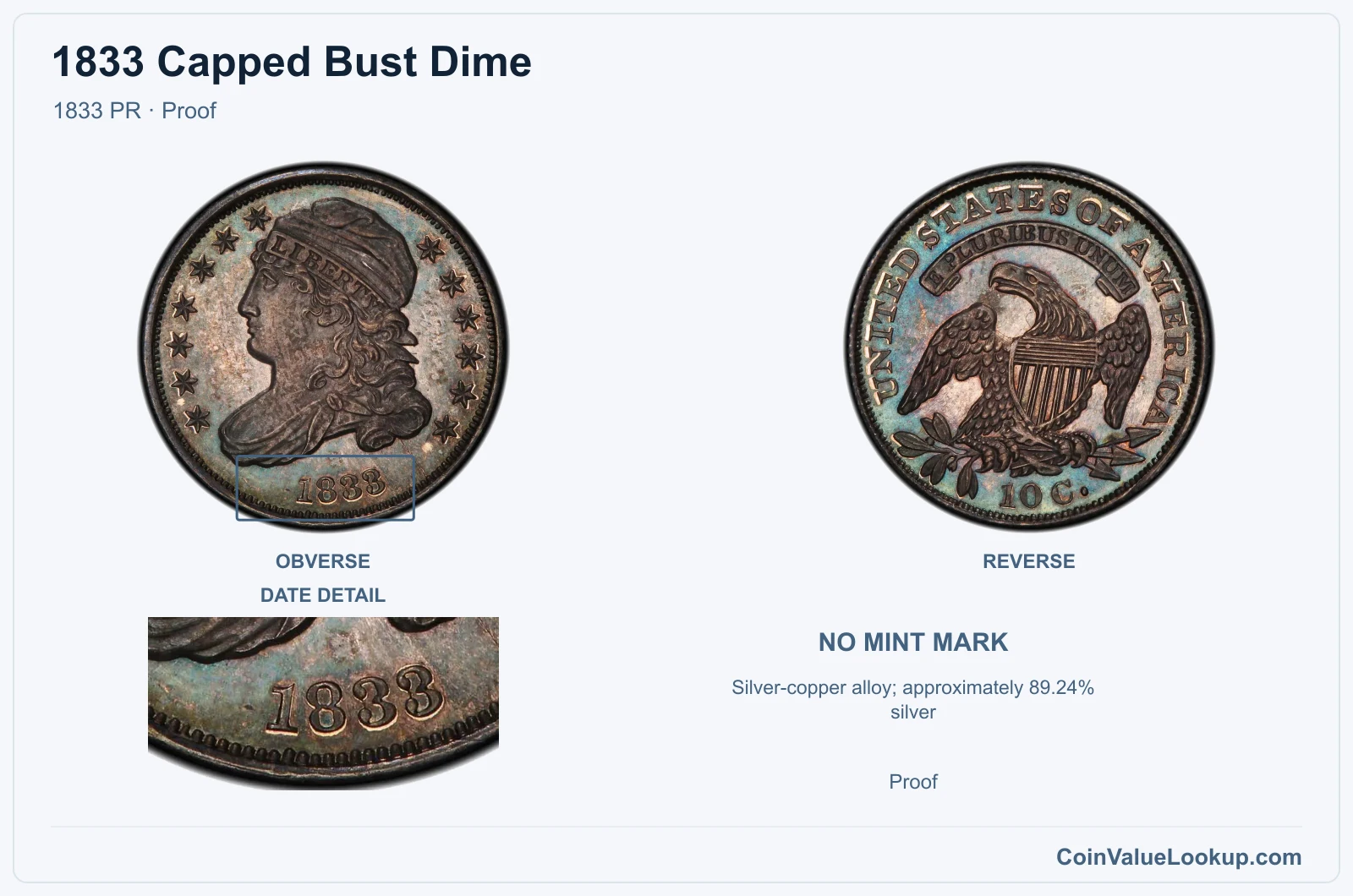
The 1833 PR is an extremely scarce proof striking from the Philadelphia Mint. Early proof dimes were produced in tiny numbers for presentation or collector purposes, and surviving examples are seldom offered.
Identifying a genuine proof requires more than surface shine. A strongly struck or lightly circulated business strike can look reflective, but that does not make it a proof.
Genuine proofs show specific die characteristics and surface qualities that professional authentication services evaluate. No supported numeric price range is available for this branch.
Each example is assessed individually based on its authenticated identity, overall condition and any notable features. If you believe you have one, third-party certification is the essential first step.
Range Grade
Price Auction Records Appraisal PR PR 1
—
Coin Identifier
PR 2
—
Coin Identifier
PR 3
—
Coin Identifier
PR 4
—
Coin Identifier
PR 6
—
Coin Identifier
PR 8
—
Coin Identifier
PR 10
—
Coin Identifier
PR 12
—
Coin Identifier
PR 15
—
Coin Identifier
PR 20
—
Coin Identifier
PR 25
—
Coin Identifier
PR 30
—
Coin Identifier
PR 35
—
Coin Identifier
PR 40
—
Coin Identifier
PR 45
—
Coin Identifier
PR 50
—
Coin Identifier
PR 53
—
Coin Identifier
PR 55
—
Coin Identifier
PR 58
—
Coin Identifier
PR 60
—
Coin Identifier
PR 61
—
Coin Identifier
PR 62
—
Coin Identifier
PR 63
—
Coin Identifier
PR 64
—
Coin Identifier
PR 65
—
Coin Identifier
PR 66
Coin Identifier
PR 67
—
—
—
PR 68
—
—
—
PR 69
—
—
—
PR 70
—
—
—
1833 Capped Bust Dime Error List
1. 1833 Capped Bust Dime — Die Crack / Die Chip
Die cracks on the 1833 Capped Bust Dime appear as thin, raised lines on the coin's surface. They form when the steel die develops a fracture during use, and the crack transfers as a raised ridge onto every coin struck afterward.
A die chip is a related feature: a small raised blob where a tiny piece of the die broke away.
To spot these, tilt the coin under a single light source and look for lines that cross over design elements or fields. They follow no part of the intended design.
Do not confuse them with incuse scratches, which are pressed into the surface, or with corrosion deposits and foreign material sitting on top. A crack is raised and metallic, part of the coin itself.
Not every 1833 dime shows this feature. Value depends on the crack's size, location and the coin's overall condition.
2. 1833 Capped Bust Dime — Die Break / Cud
A cud on the 1833 Capped Bust Dime is a specific type of die break where a piece of the die edge actually separated. The result is a raised, featureless lump of metal that connects to the rim, replacing part of the normal design.
It is literally a chunk of missing die.
The key diagnostic is that a cud always touches the rim. An interior die chip or raised blob that sits away from the rim is a different category.
Also distinguish a cud from a rim dent or ding, which is damage to the coin after striking and will appear as a depression rather than a raised area. Corrosion near the rim can sometimes mimic the look, but it lacks the sharp boundary a true cud shows.
Not all 1833 dimes carry this feature. Pricing depends on the cud's size, prominence and the coin's overall preservation.