1798 Draped Bust Dime Coin Value: How Much Is It Worth?
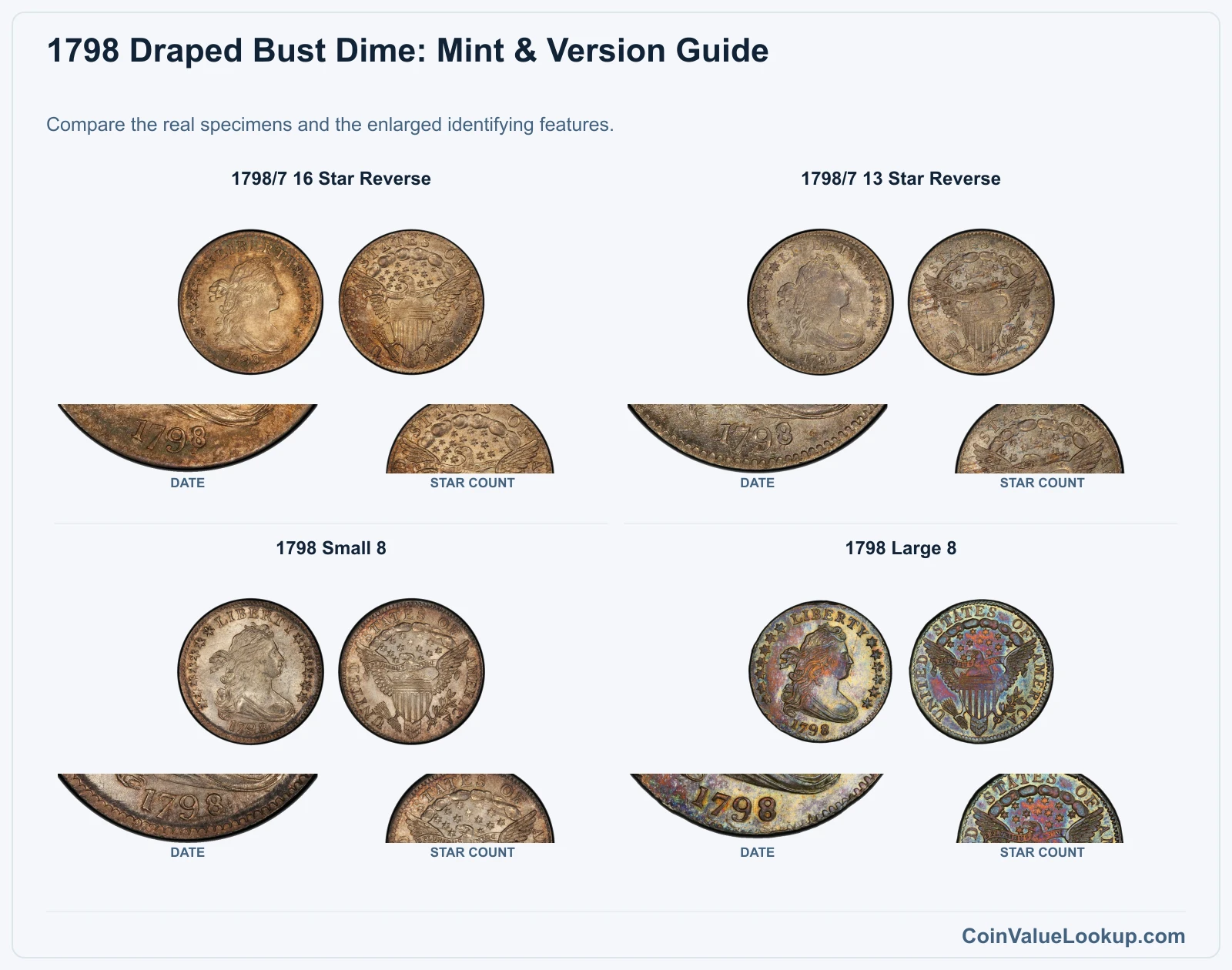
The 1798 Draped Bust Dime is one of the earliest dimes struck by the United States Mint, produced in Philadelphia from a silver-copper alloy of approximately 89.24% silver. Guide estimates for this date range from about $1,247 in well-worn condition (G4) up to $92,651 at the MS63 level, depending on the specific variety.
These anchors reflect particular branches and grades — they are not guaranteed offers, and your coin's actual value depends on its exact variety, wear, and surface condition.
Fast Way to Identify Your 1798 Draped Bust Dime
Want a quick starting point? Upload clear photos of both the front and back of your 1798 Draped Bust Dime, and our identifier can offer a preliminary identification of which variety you may have.
This is not authentication or exact grading — just a helpful first step before deeper research or professional evaluation.
1798 Draped Bust Dime Value
Upload both sides of your 1798 Draped Bust Dime.
Front Obverse
Upload photo
Back Reverse
Upload photo
Which 1798 Draped Bust Dime Versions Are Worth Money?
- The 1798/7 13 Star Reverse variety carries the highest guide anchor at $92,651 in MS63 and $3,087 even in G4, reflecting its scarcity among the overdate branches.
- The 1798 Small 8 variety follows closely with a guide estimate of $90,736 at MS63, making it another branch well worth confirming.
- The 1798 Large 8 reaches $42,828 at MS63, while the 1798/7 16 Star Reverse lists at $27,084 at that grade — both still significant for a coin over two centuries old.
- Original, uncleaned surfaces with natural toning strongly affect desirability; cleaned or damaged examples fall well below these guide anchors regardless of variety.
Step 1: Identify Your 1798 Draped Bust Dime Mint Mark and Version
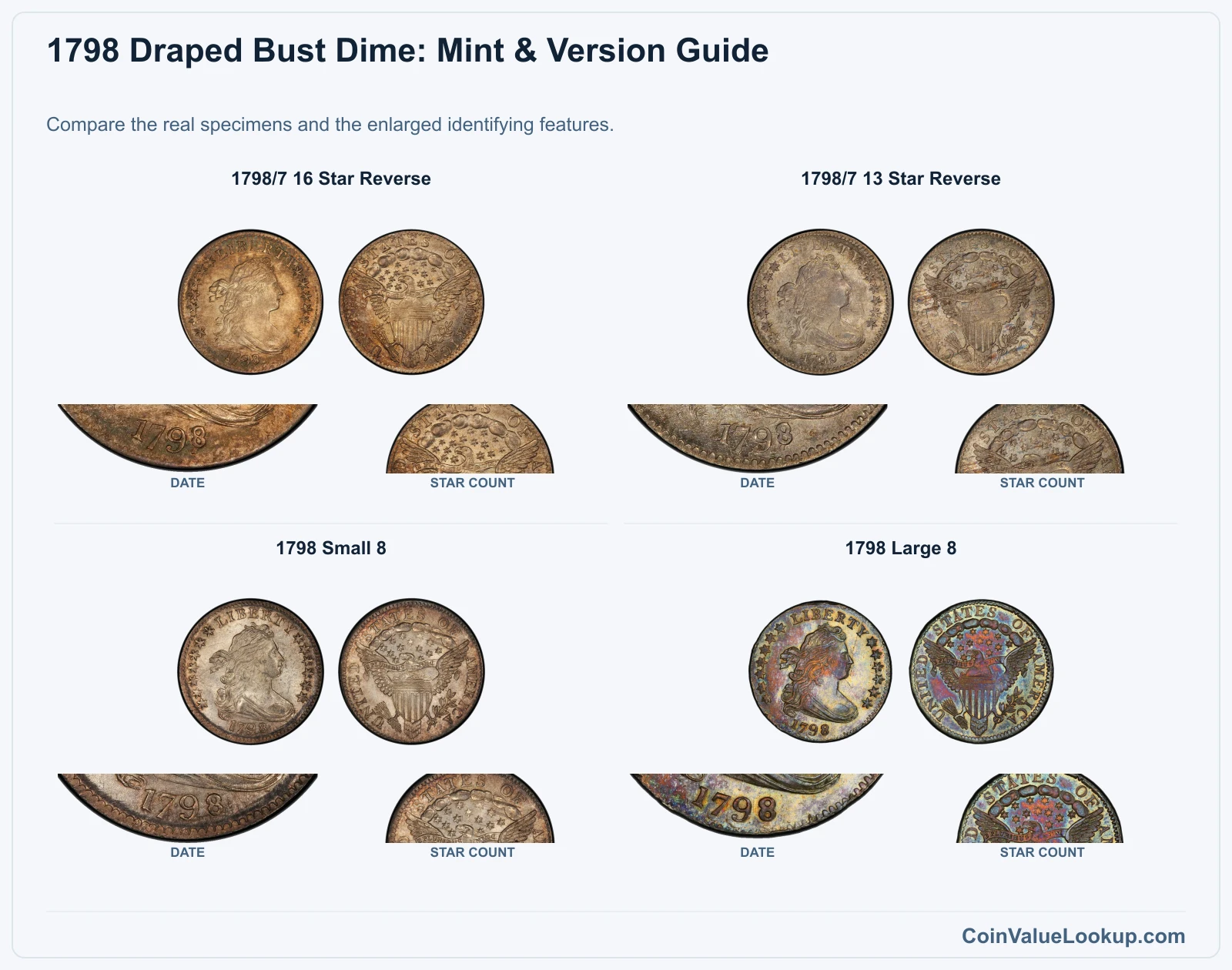
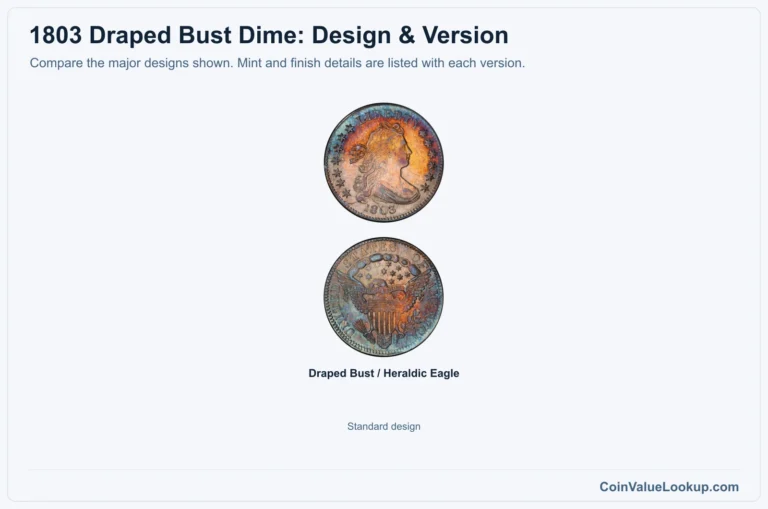
All 1798 Draped Bust Dimes were struck at the Philadelphia Mint, so there is no mintmark to look for. The design pairs the Draped Bust of Liberty on the obverse with a Heraldic Eagle on the reverse.
Four distinct branches exist for this date: the 1798/7 with 16 Stars on the reverse, the 1798/7 with 13 Stars on the reverse, the 1798 Small 8, and the 1798 Large 8. Getting the right branch is essential before comparing values.
For the two overdate varieties, you need magnification to spot remnants of a 7 beneath the final 8 in the date. Then count the stars above the eagle on the reverse — either 13 or 16 — to separate those two branches.
For the Small 8 versus Large 8 varieties, compare your coin's date digits against a correctly labeled reference image. Magnification alone will not settle it; you need a side-by-side comparison with known examples.
One important note: these dimes do not display a "10C" denomination anywhere on the coin. The Draped Bust design was also used on half dimes, which are physically smaller.
Confirm you actually have a dime-sized coin before proceeding.
Step 2: Check Your 1798 Draped Bust Dime Grade
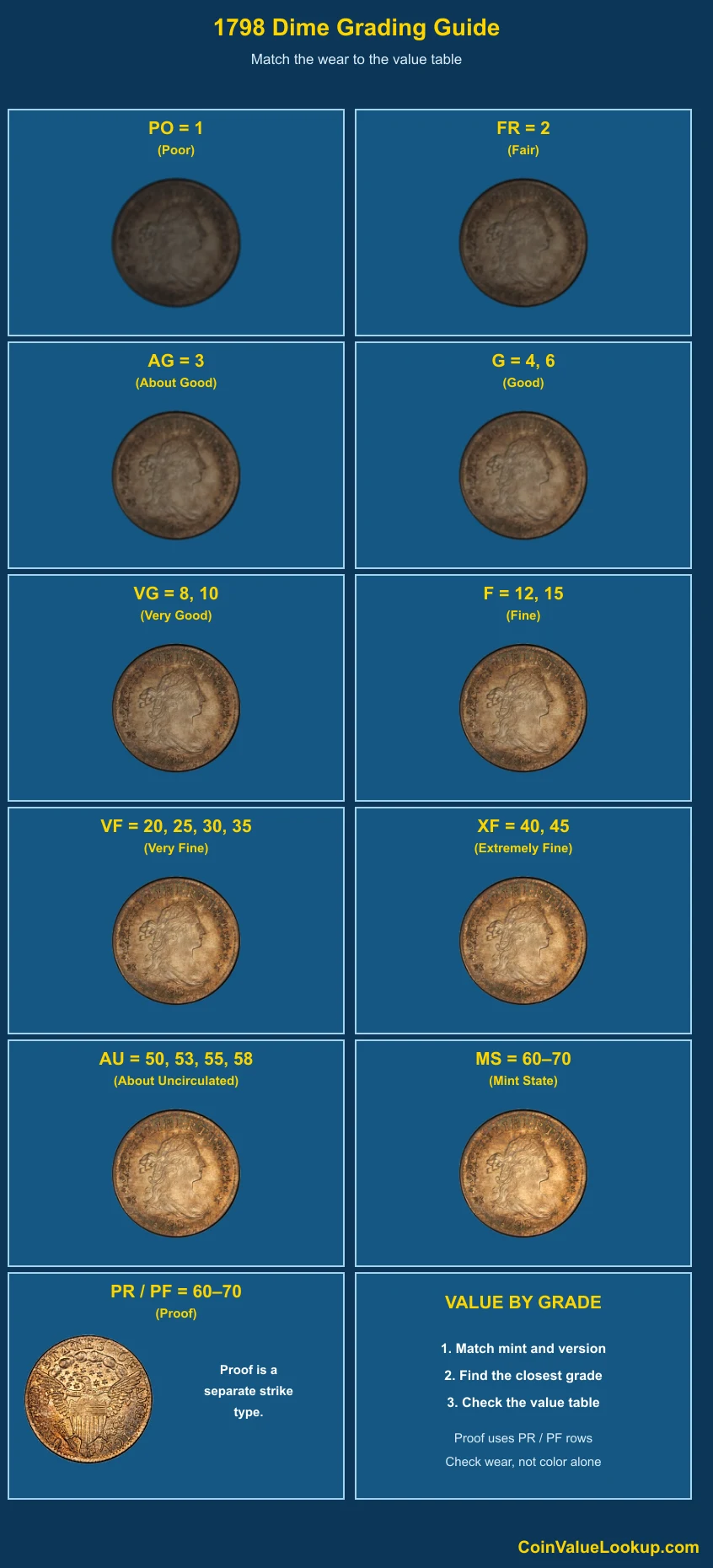
Start by examining Liberty's hair detail, the high point of her cheek, and the drapery lines near her bust. On well-preserved coins, individual hair strands remain sharp and the fabric folds show depth.
As wear increases, these areas flatten first.
Flip the coin over and check the eagle's breast feathers and wing tips. These are the reverse high points and will show smoothing before the rest of the design.
Here is the tricky part with early coinage: the hand-operated presses of the 1790s produced uneven strikes. A coin can be technically unworn yet still show soft detail in spots simply because the die did not fully impress the planchet.
Use the comparison image to distinguish genuine circulation wear from strike weakness.
Luster matters. An original, uncleaned coin has a certain natural tone and surface quality that a cleaned coin loses permanently.
Contact marks, scratches, and corrosion all reduce a coin's comparability to published guide estimates, regardless of how much design detail survives. Do not attempt to clean or brighten the surface.
Step 3: Check 1798 Draped Bust Dime Value by Mint and Version
1798 Draped Bust Dime — /7 16 Star Reverse
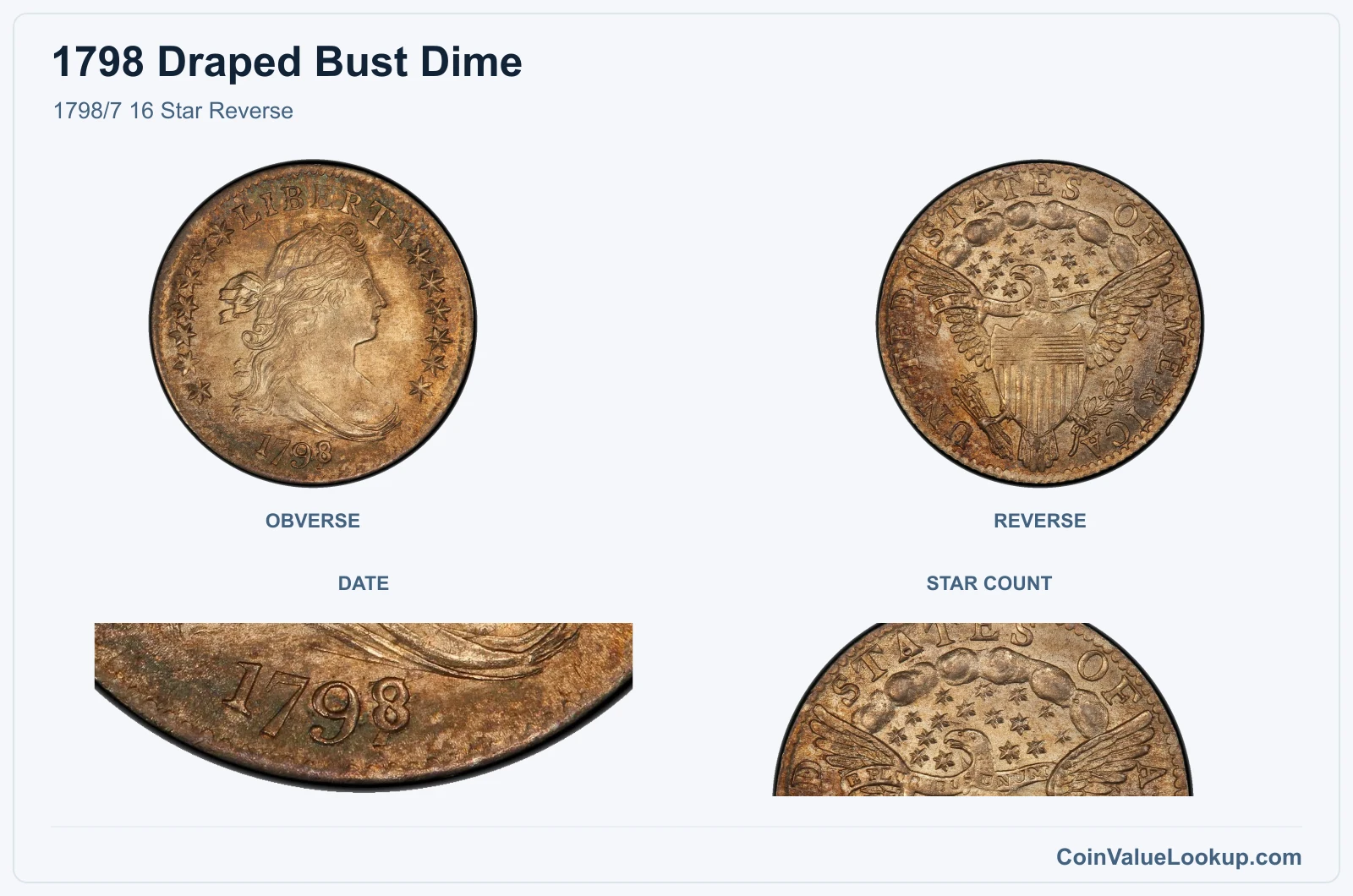
The 1798/7 16 Star Reverse is an overdate variety. Under magnification, you can see the outline of a 7 hiding beneath the 8 in the date — evidence that the Mint reused a 1797-dated die and punched a new 8 over the old 7.
To confirm this specific branch, flip the coin over and count the small stars arranged above the Heraldic Eagle. This version has 16 stars on the reverse, an intentional die design choice, not a mistake.
Guide estimates place this variety at roughly $1,247 in G4 and $27,084 in MS63. These are reference anchors from a published guide, not guaranteed sale prices.
Condition and originality of surfaces matter enormously. A coin with honest wear and natural toning will always be more desirable than one that has been cleaned to look brighter.
Range Grade
Price Auction Records Appraisal PO PO 1
—
Coin Identifier FR FR 2
—
Coin Identifier AG AG 3
Coin Identifier G G 4
Coin Identifier
G 6
Coin Identifier VG VG 8
Coin Identifier
VG 10
Coin Identifier F F 12
Coin Identifier
F 15
Coin Identifier VF VF 20
Coin Identifier
VF 25
Coin Identifier
VF 30
Coin Identifier
VF 35
Coin Identifier XF XF 40
Coin Identifier
XF 45
Coin Identifier AU AU 50
Coin Identifier
AU 53
Coin Identifier
AU 55
Coin Identifier
AU 58
Coin Identifier MS MS 60
—
Coin Identifier
MS 61
Coin Identifier
MS 62
Coin Identifier
MS 63
Coin Identifier
MS 64
Coin Identifier
MS 65
Coin Identifier
MS 66
Coin Identifier
MS 67
—
—
—
MS 68
—
—
—
MS 69
—
—
—
MS 70
—
—
—
1798 Draped Bust Dime — /7 13 Star Reverse
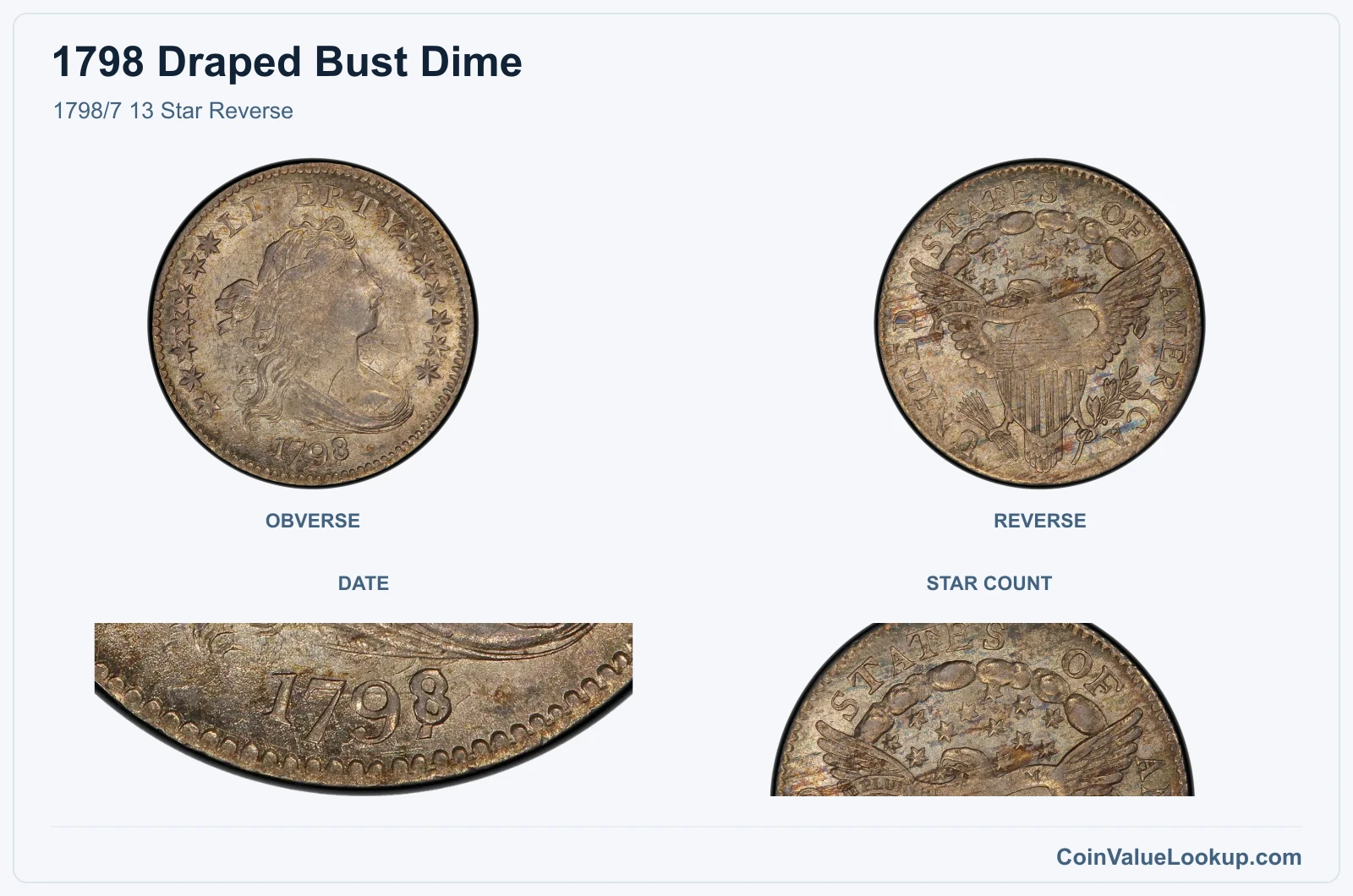
The 1798/7 13 Star Reverse shares the same overdate characteristic as the 16-star version — remnants of a 7 are visible beneath the 8 in the date. The critical difference is on the reverse: count the stars above the eagle, and you will find 13 instead of 16.
This distinction is what separates two otherwise similar-looking overdates and dramatically affects value.
Guide estimates run from about $3,087 in G4 to $92,651 in MS63, making this the most aggressively priced branch for this date at both ends of the grading spectrum. The 13-star reverse die was used less frequently, which accounts for the premium.
As always, these are guide-level anchors — actual market results depend on the coin's surfaces, strike quality, and overall eye appeal.
Coin Value Lookup is a useful starting point if you want to look up guide values for other early American coins while you research this one.
Range Grade
Price Auction Records Appraisal PO PO 1
—
Coin Identifier FR FR 2
—
Coin Identifier AG AG 3
—
Coin Identifier G G 4
—
Coin Identifier
G 6
Coin Identifier VG VG 8
Coin Identifier
VG 10
—
Coin Identifier F F 12
Coin Identifier
F 15
Coin Identifier VF VF 20
—
Coin Identifier
VF 25
—
Coin Identifier
VF 30
—
Coin Identifier
VF 35
—
Coin Identifier XF XF 40
Coin Identifier
XF 45
Coin Identifier AU AU 50
Coin Identifier
AU 53
—
Coin Identifier
AU 55
—
Coin Identifier
AU 58
Coin Identifier MS MS 60
—
Coin Identifier
MS 61
—
Coin Identifier
MS 62
Coin Identifier
MS 63
—
Coin Identifier
MS 64
—
—
—
MS 65
—
—
—
MS 66
—
—
—
MS 67
—
—
—
MS 68
—
—
—
MS 69
—
—
—
MS 70
—
—
—
1798 Draped Bust Dime — Small 8
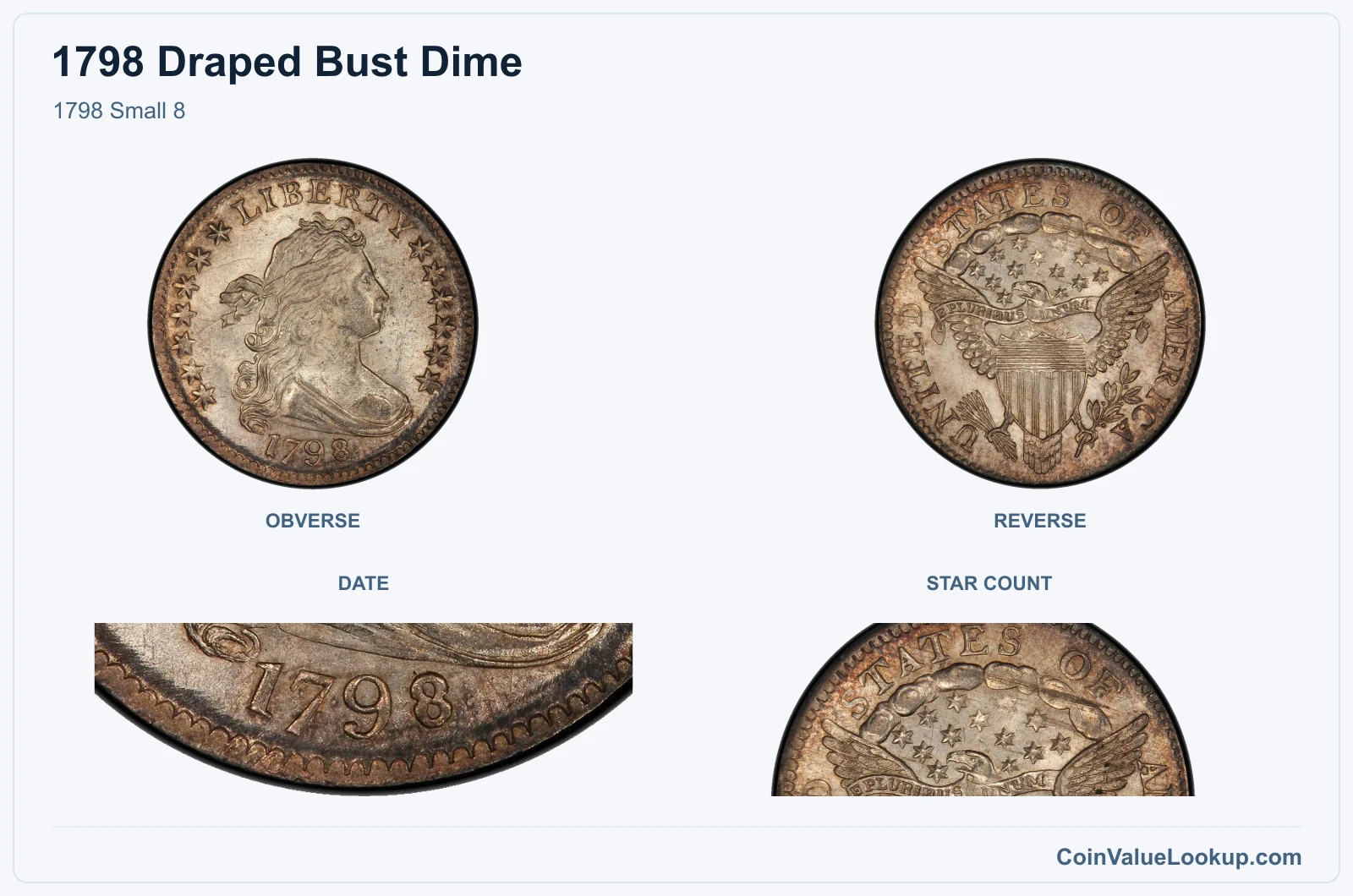
The 1798 Small 8 does not have an overdate. The date reads plainly as 1798, but the size of the numeral 8 is noticeably smaller compared to the Large 8 variety.
You cannot determine this by simply zooming in on your own coin — you need a side-by-side comparison with a correctly labeled reference showing both the Small 8 and Large 8 next to each other.
Guide estimates for this variety sit at approximately $2,500 in G4 and $90,736 in MS63. That upper figure reflects serious rarity in high grades.
Original surfaces with natural patina carry significant weight at this level. Cleaning, tooling, or environmental damage will sharply reduce a coin's standing relative to these published anchors.
Range Grade
Price Auction Records Appraisal PO PO 1
—
Coin Identifier FR FR 2
—
Coin Identifier AG AG 3
—
Coin Identifier G G 4
Coin Identifier
G 6
—
Coin Identifier VG VG 8
Coin Identifier
VG 10
Coin Identifier F F 12
Coin Identifier
F 15
—
Coin Identifier VF VF 20
Coin Identifier
VF 25
Coin Identifier
VF 30
—
Coin Identifier
VF 35
Coin Identifier XF XF 40
Coin Identifier
XF 45
Coin Identifier AU AU 50
—
Coin Identifier
AU 53
—
Coin Identifier
AU 55
Coin Identifier
AU 58
—
Coin Identifier MS MS 60
—
Coin Identifier
MS 61
—
Coin Identifier
MS 62
Coin Identifier
MS 63
Coin Identifier
MS 64
Coin Identifier
MS 65
Coin Identifier
MS 66
—
—
—
MS 67
—
—
—
MS 68
—
—
—
MS 69
—
—
—
MS 70
—
—
—
1798 Draped Bust Dime — Large 8
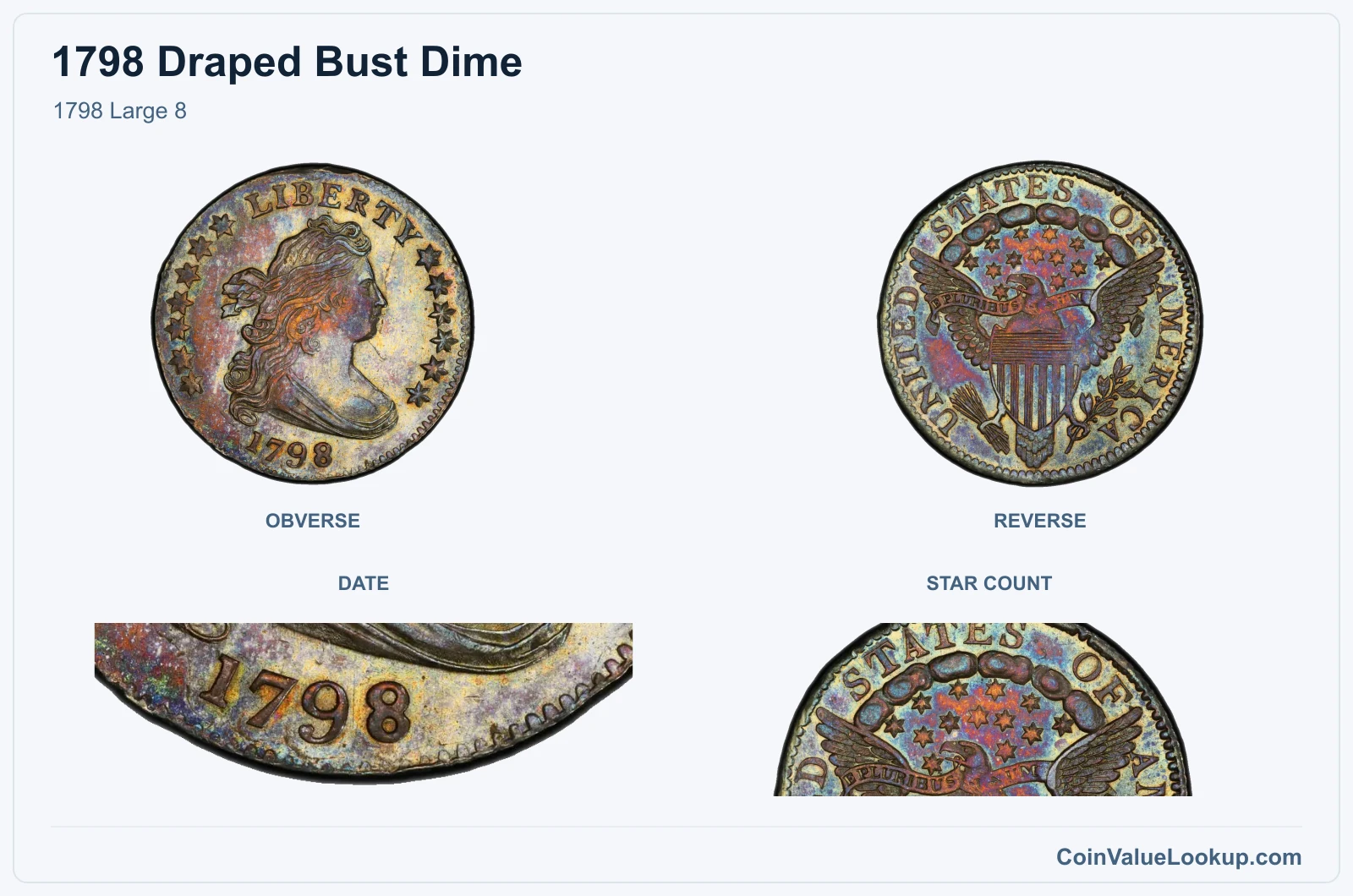
The 1798 Large 8 is the most straightforward variety of this date — a plain 1798 with a visibly larger numeral 8 compared to the Small 8 branch. Again, establishing this requires a direct comparison against a labeled reference image of both varieties, not just a guess based on how big the 8 looks to your eye.
Guide estimates range from about $1,247 in G4 to $42,828 in MS63. While those figures sit below the Small 8 and the 13-star overdate, they are still substantial for a coin struck in the final years of the eighteenth century.
Match the date style carefully, confirm there is no overdate lurking beneath the 8, and assess original surface quality before drawing any value conclusions.
Range Grade
Price Auction Records Appraisal PO PO 1
—
Coin Identifier FR FR 2
Coin Identifier AG AG 3
Coin Identifier G G 4
Coin Identifier
G 6
Coin Identifier VG VG 8
Coin Identifier
VG 10
Coin Identifier F F 12
Coin Identifier
F 15
Coin Identifier VF VF 20
Coin Identifier
VF 25
Coin Identifier
VF 30
Coin Identifier
VF 35
Coin Identifier XF XF 40
Coin Identifier
XF 45
Coin Identifier AU AU 50
Coin Identifier
AU 53
Coin Identifier
AU 55
Coin Identifier
AU 58
Coin Identifier MS MS 60
—
Coin Identifier
MS 61
Coin Identifier
MS 62
Coin Identifier
MS 63
Coin Identifier
MS 64
Coin Identifier
MS 65
Coin Identifier
MS 66
—
Coin Identifier
MS 67
—
—
—
MS 68
—
—
—
MS 69
—
—
—
MS 70
—
—
—
1798 Draped Bust Dime Error List
1. 1798 Draped Bust Dime — Overdate
The 1798/7 overdate is a die variety where the Mint punched a new 8 over the previous year's 7 in the date. Under magnification, you can see the curved remnants of the 7 peeking out from behind the 8 — particularly at the top and bottom of the numeral.
The specific branch reported here pairs this overdate with 13 stars on the reverse above the eagle.
Do not confuse this with simple date damage or ordinary machine doubling. A damaged date tends to show irregular distortion without a coherent second numeral underneath.
Machine doubling produces flat, shelf-like displacement rather than the distinct outline of a different digit.
No specific price range has been adopted for this feature as a standalone error listing. The overdate's value depends on overall condition, the clarity of the underlying 7, and the coin's surface quality.
If you suspect you have an overdate, professional attribution is worth pursuing.