1839 Liberty Seated Dime Coin Value: How Much Is It Worth?
The 1839 Liberty Seated Dime spans a wide value range depending on mint, variety and condition. USA Coin Book guide estimates place normal business strikes from roughly $29 at G4 to around $10,019 at MS63 for the scarce Reverse of 1838-O variety.
Proof examples are in a different league entirely, with a PR63 guide figure near $30,000. Original surfaces and the correct branch identification matter far more than shine.
Fast Way to Identify Your 1839 Liberty Seated Dime
Snap clear photos of both the front and back of your 1839 dime and upload them for a preliminary identification. The identifier can help you sort out which mint and design variety you have based on the images.
Make sure the date, any mintmark below the wreath, and the overall reverse layout are visible and in focus.
1839 Liberty Seated Dime Value
Upload both sides of your 1839 Liberty Seated Dime.
Front Obverse
Upload photo
Back Reverse
Upload photo
Which 1839 Liberty Seated Dime Versions Are Worth Money?
- The 1839-O Reverse of 1838-O (Huge O) carries guide values from about $502 at G4 to $10,019 at MS63, far above the standard O-mint issue, because it uses an earlier reverse hub with a distinctly larger mintmark.
- Philadelphia Proofs are extremely rare early-date issues, not routine collector products; the PR63 guide figure is around $30,000.
- Standard 1839-O dimes guide from about $34 at G4 to $2,425 at MS63, making higher-grade survivors worthwhile to identify carefully.
- Repunched dates and repunched mintmarks are documented for 1839 dimes and can carry premiums depending on visibility and condition.
Step 1: Identify Your 1839 Liberty Seated Dime Mint Mark and Version
Start by confirming you have a seated Liberty obverse paired with a ONE DIME reverse inside a wreath. That rules out the smaller half dime, which can look similar at a glance.
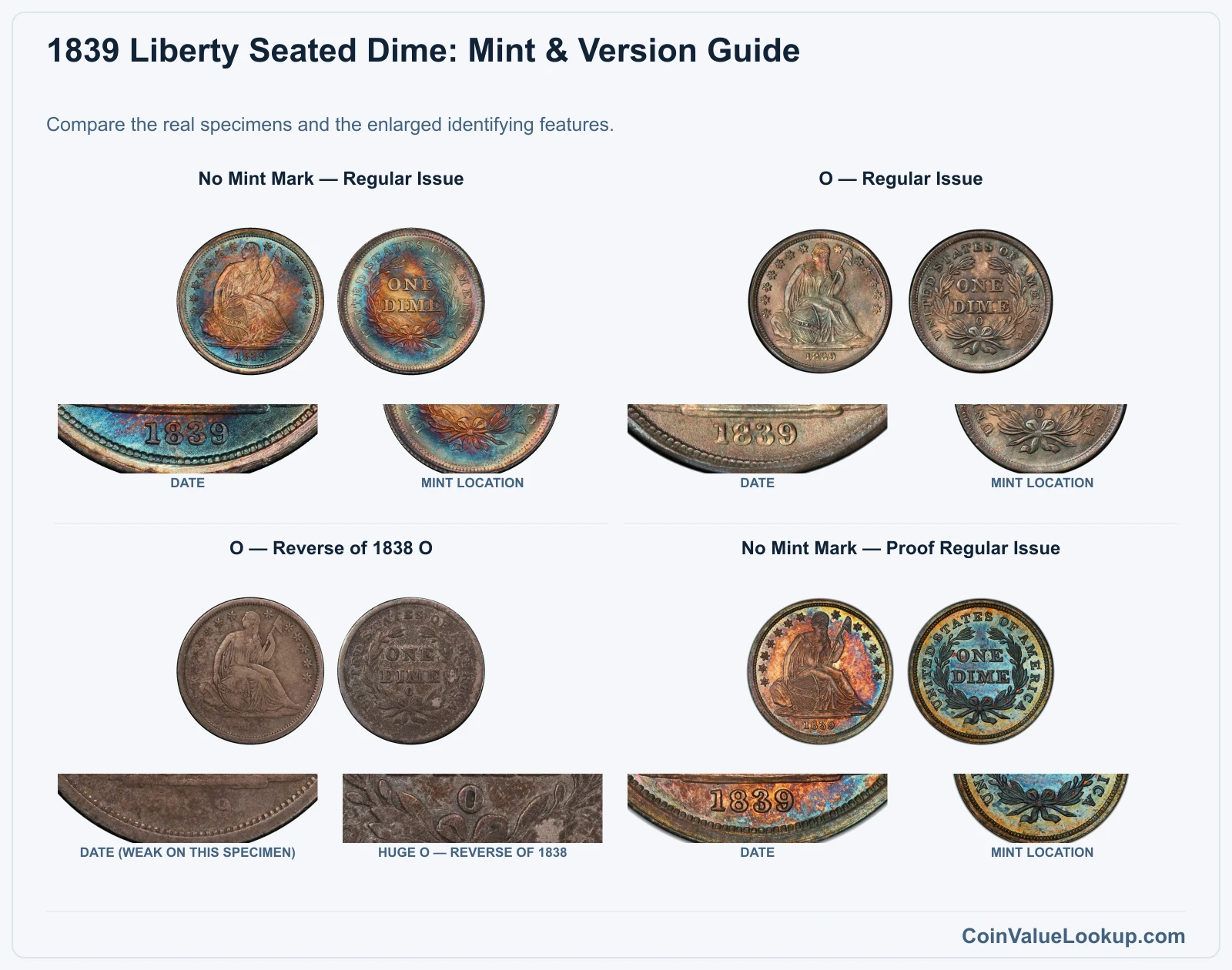
Flip the coin over and check below the wreath for a mintmark. Philadelphia pieces have no letter at all.
A small "O" means New Orleans.
All 1839 dimes are the No Drapery subtype, struck in 90% silver and 10% copper, with a reeded edge and a diameter of 17.9 mm. The nominal weight is 2.67 grams.
The critical fork for New Orleans coins is the reverse hub. The Reverse of 1838-O, sometimes called the "Huge O" variety, uses an earlier reverse die with a noticeably larger mintmark and slightly different wreath details compared to the standard 1839 reverse.
Do not assume a weakly struck coin is automatically the 1838 reverse. Compare the mintmark size and shape carefully against known examples of each type.
A genuinely large, blocky O paired with the older hub is the expensive variety; a mushy but normal-sized O on the regular reverse hub is just a tired die.
Step 2: Check Your 1839 Liberty Seated Dime Grade
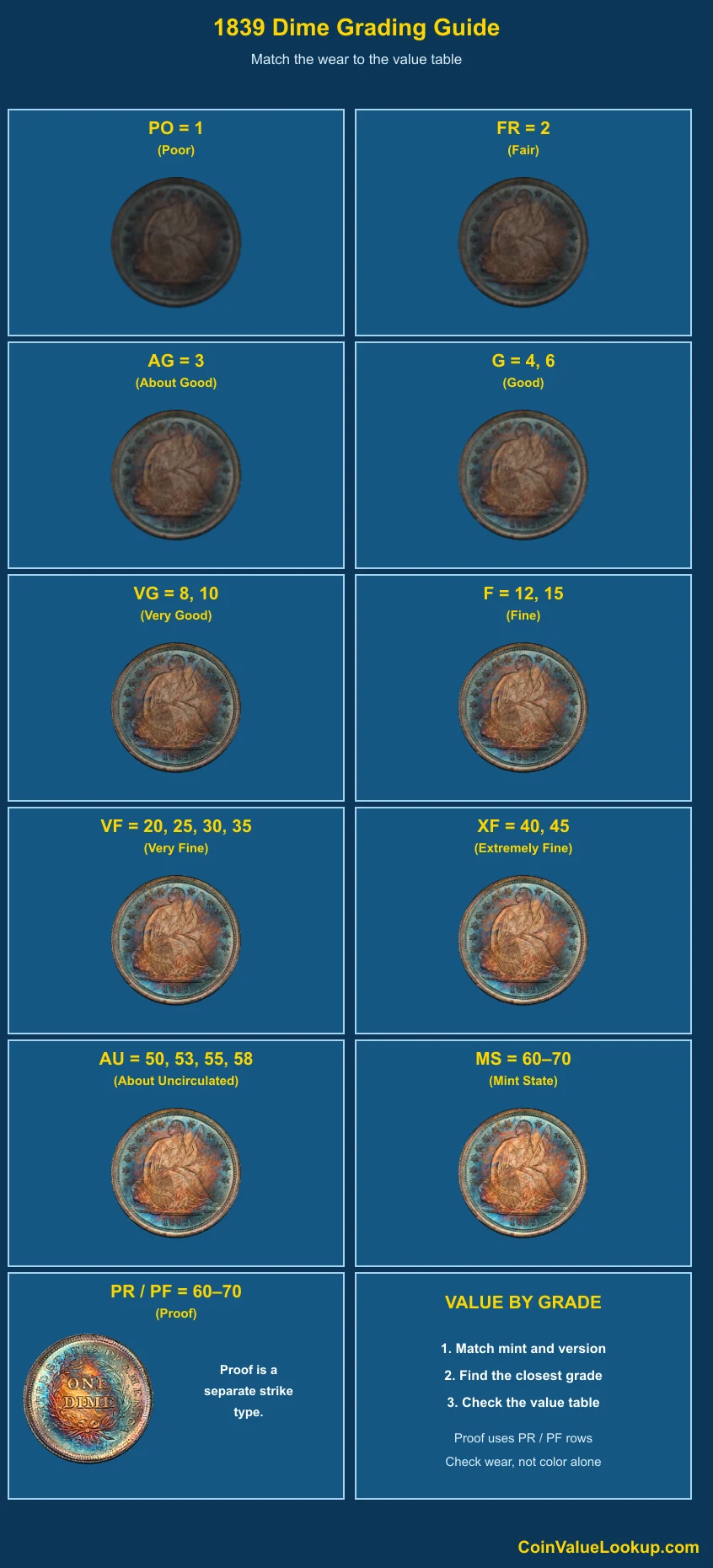
Use the comparison image to check key wear points on your 1839 dime. On the obverse, look at Liberty's head, the shield on her arm, and her gown folds at the knee and feet.
These are the first spots to lose detail.
On the reverse, the wreath leaves near the bow at the base wear quickest. A coin grading G4 will show a smooth Liberty outline with the shield mostly flat, while an MS63 example retains full luster and sharp detail with only minor contact marks.
Separate actual circulation wear from original strike weakness. Some 1839 dimes, especially New Orleans issues, came off the press soft in spots.
A weakly struck but uncirculated coin still shows cartwheel luster in protected areas.
Polished coins are not Proofs. Genuine Proofs display deeply mirrored fields from specially prepared dies, and hairlines from cleaning are a condition issue, not a sign of Proof manufacture.
Keep Proof grading on its own track entirely.
Step 3: Check 1839 Liberty Seated Dime Value by Mint and Version
1839 Liberty Seated Dime — No Mint Mark — Regular Issue
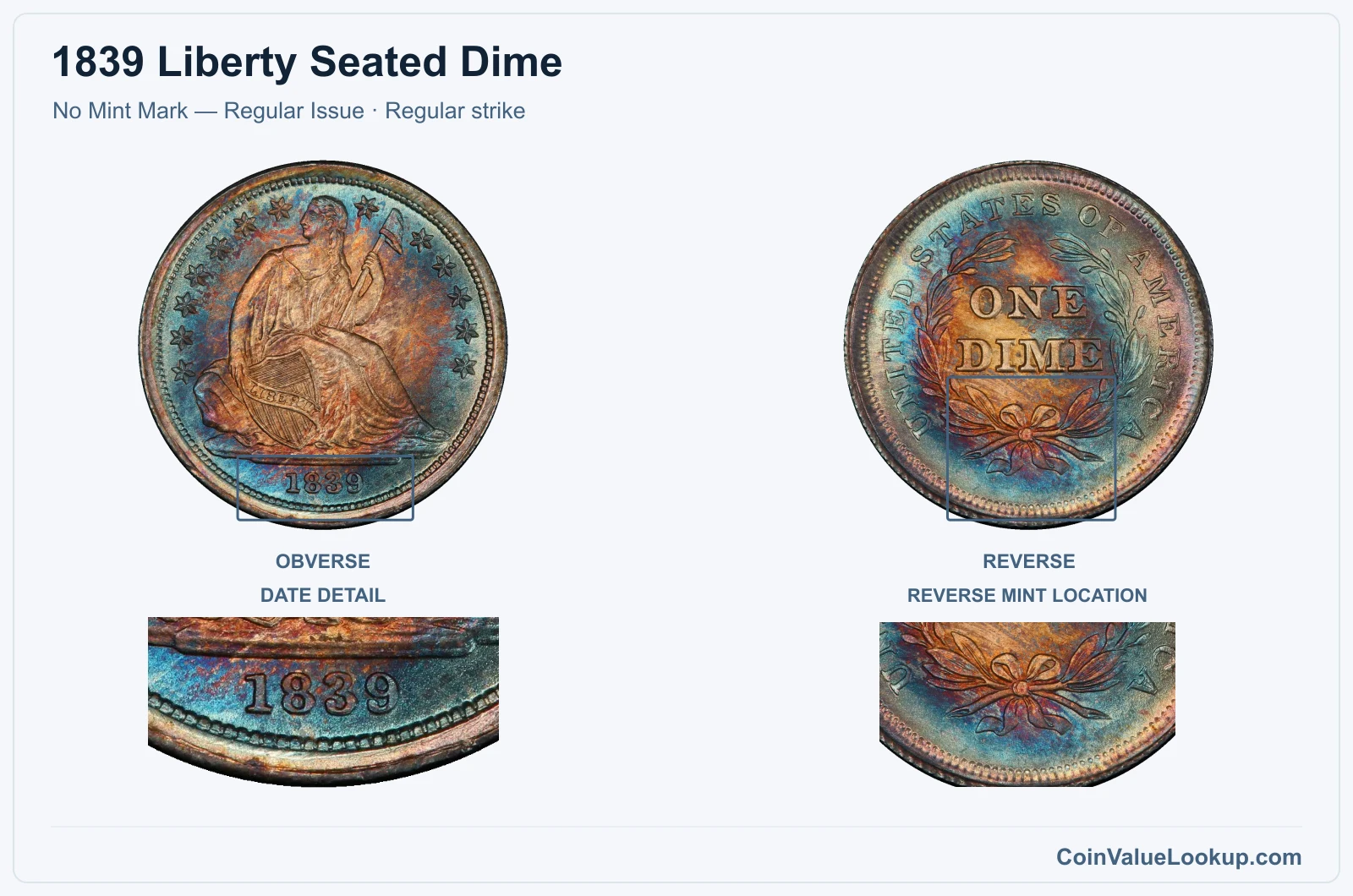
The Philadelphia regular issue has no mintmark anywhere on the coin. It is the No Drapery subtype, struck in 90% silver and 10% copper at a nominal weight of 2.67 grams.
USA Coin Book guide estimates place this version at about $29 in G4 and around $1,067 in MS63. Most surviving examples are well circulated, so a coin with original surfaces in the VF to AU range is a solid find.
Check the area below Liberty's elbow to confirm no extra drapery fold appears; 1839 Philadelphia dimes should lack it entirely.
Range Grade
Price Auction Records Appraisal PO PO 1
—
Coin Identifier FR FR 2
—
Coin Identifier AG AG 3
—
Coin Identifier G G 4
—
Coin Identifier
G 6
—
Coin Identifier VG VG 8
—
Coin Identifier
VG 10
—
Coin Identifier F F 12
Coin Identifier
F 15
—
Coin Identifier VF VF 20
Coin Identifier
VF 25
—
Coin Identifier
VF 30
Coin Identifier
VF 35
Coin Identifier XF XF 40
Coin Identifier
XF 45
Coin Identifier AU AU 50
Coin Identifier
AU 53
Coin Identifier
AU 55
Coin Identifier
AU 58
Coin Identifier MS MS 60
—
Coin Identifier
MS 61
Coin Identifier
MS 62
Coin Identifier
MS 63
Coin Identifier
MS 64
Coin Identifier
MS 65
Coin Identifier
MS 66
Coin Identifier
MS 67
Coin Identifier
MS 68
Coin Identifier
MS 69
—
—
—
MS 70
—
—
—
1839 Liberty Seated Dime — O — Regular Issue
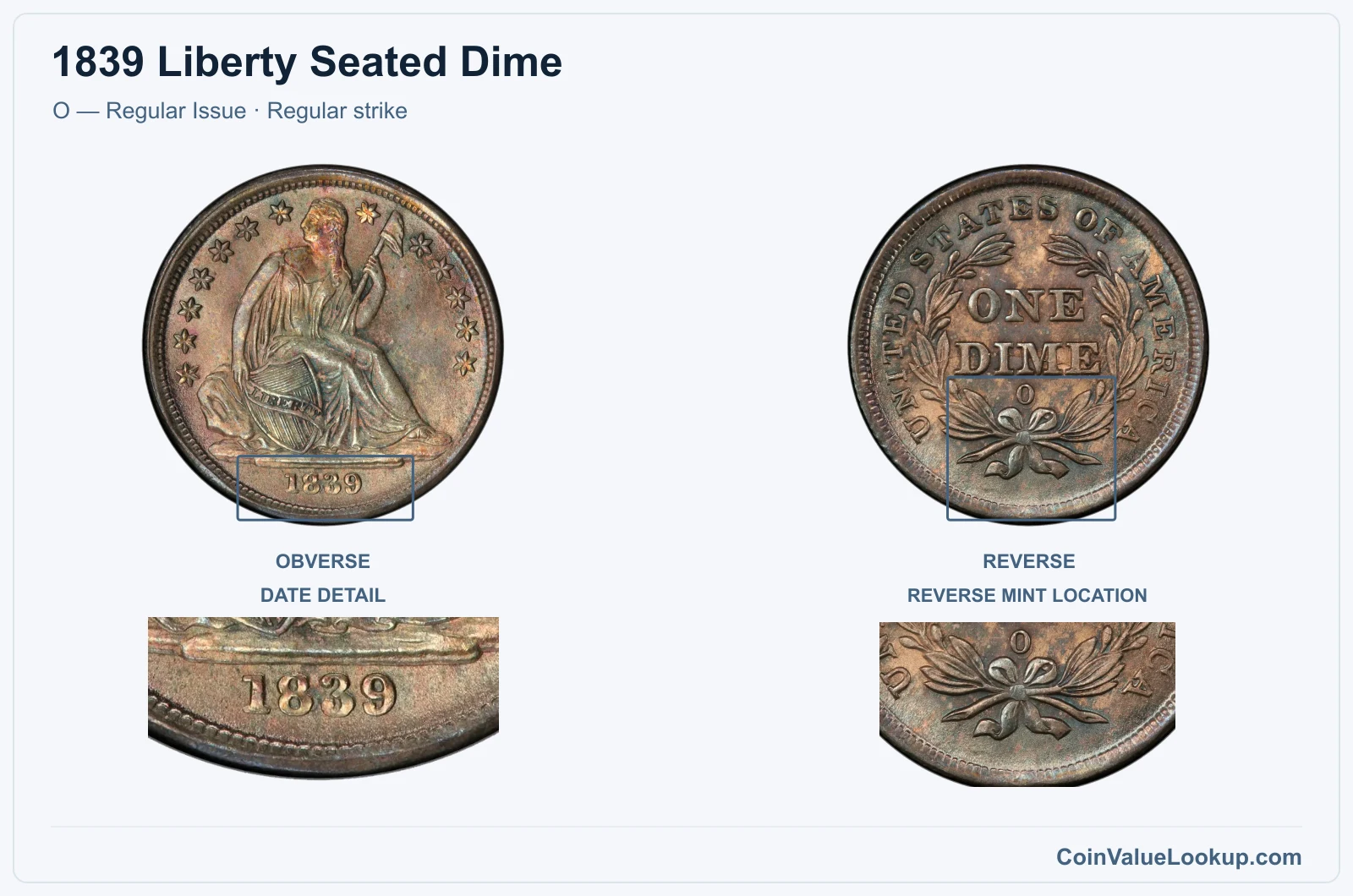
Look for a small "O" mintmark on the reverse below the wreath. This is the standard 1839 New Orleans issue using the regular 1839 reverse hub.
Guide values run about $34 at G4 up to roughly $2,425 at MS63 per USA Coin Book. The key distinction here is separating this coin from the much scarcer Reverse of 1838-O.
On the regular issue, the mintmark is a normal-sized O consistent with other 1839 reverse dies. If your O looks proportionally small and sits on a standard wreath layout, you have this version.
Coin Value Lookup is a handy starting point when you need to look up guide values for other dates and denominations in the Seated Dime series.
Range Grade
Price Auction Records Appraisal PO PO 1
—
Coin Identifier FR FR 2
Coin Identifier AG AG 3
Coin Identifier G G 4
—
Coin Identifier
G 6
—
Coin Identifier VG VG 8
Coin Identifier
VG 10
—
Coin Identifier F F 12
—
Coin Identifier
F 15
Coin Identifier VF VF 20
Coin Identifier
VF 25
Coin Identifier
VF 30
Coin Identifier
VF 35
Coin Identifier XF XF 40
Coin Identifier
XF 45
Coin Identifier AU AU 50
Coin Identifier
AU 53
Coin Identifier
AU 55
Coin Identifier
AU 58
Coin Identifier MS MS 60
—
Coin Identifier
MS 61
—
Coin Identifier
MS 62
Coin Identifier
MS 63
Coin Identifier
MS 64
Coin Identifier
MS 65
Coin Identifier
MS 66
Coin Identifier
MS 67
Coin Identifier
MS 68
Coin Identifier
MS 69
—
—
—
MS 70
—
—
—
1839 Liberty Seated Dime — O — Reverse of 1838 O
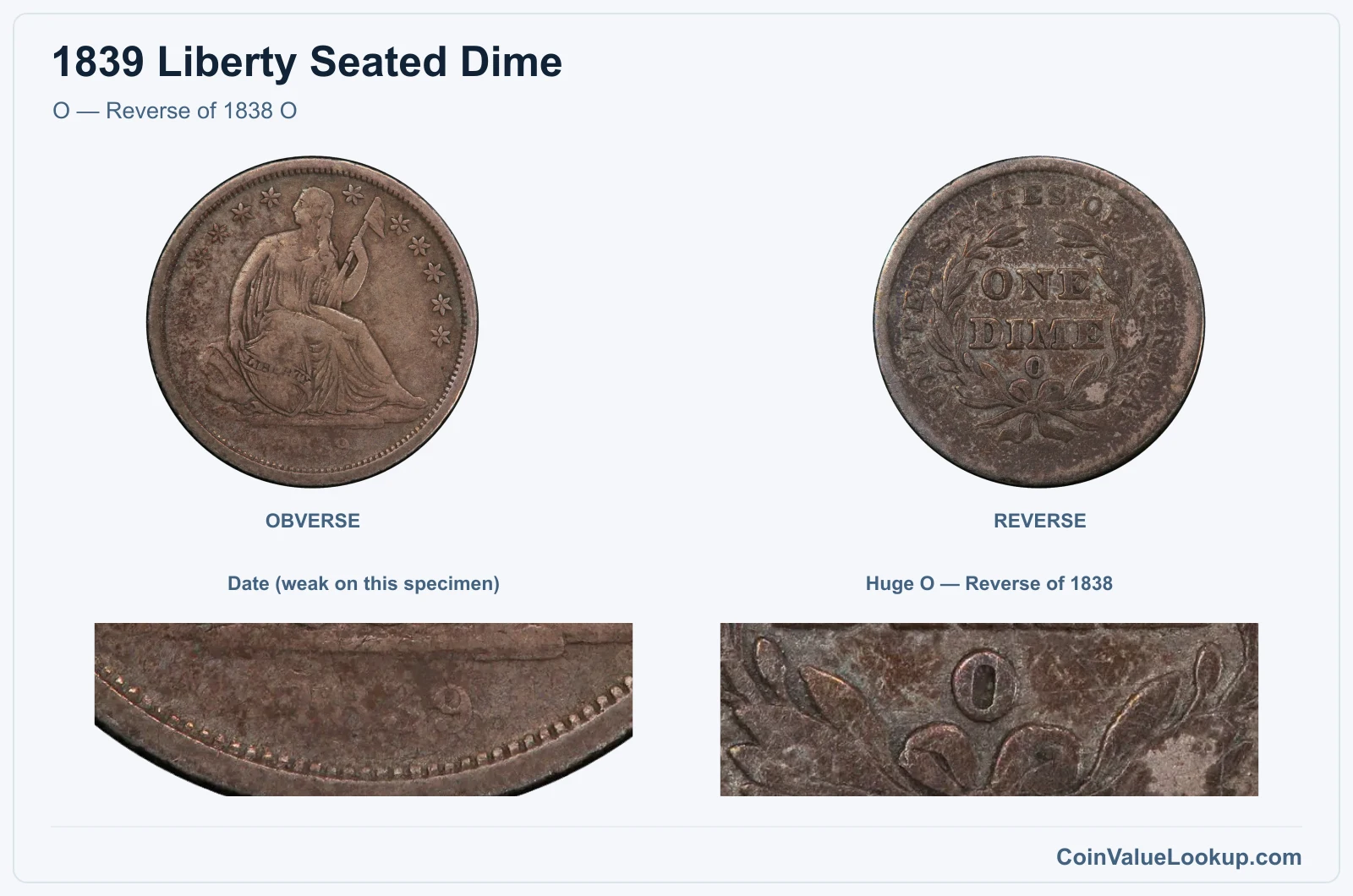
This is the one that gets collectors excited, and for good reason. The 1839-O Reverse of 1838-O uses a leftover reverse die from 1838 with a distinctly larger, blockier "O" mintmark, often called the "Huge O." The wreath details differ subtly from the regular 1839 reverse hub as well.
USA Coin Book guide estimates start at about $502 in G4 and reach approximately $10,019 in MS63. That is a dramatic jump over the standard O-mint coin.
Do not rely on weak strike alone to identify this variety. Compare your mintmark directly to reference images of each reverse type.
The size difference in the O is the primary tell, but the overall reverse hub layout should also match the 1838 style. Authentication by a grading service is worth considering at these values.
Ordinary-issue reference: Ordinary-issue reference only: The table below shows prices for the 1839-O Liberty Seated Dime (regular strike). It does not represent the value of the specific O — Reverse of 1838 O variety or its variety premium. Year, mint, metal and strike type are matched; the specific variety is not priced by this table.
Range Grade
Price Auction Records Appraisal PO PO 1
—
Coin Identifier FR FR 2
Coin Identifier AG AG 3
Coin Identifier G G 4
—
Coin Identifier
G 6
—
Coin Identifier VG VG 8
Coin Identifier
VG 10
—
Coin Identifier F F 12
—
Coin Identifier
F 15
Coin Identifier VF VF 20
Coin Identifier
VF 25
Coin Identifier
VF 30
Coin Identifier
VF 35
Coin Identifier XF XF 40
Coin Identifier
XF 45
Coin Identifier AU AU 50
Coin Identifier
AU 53
Coin Identifier
AU 55
Coin Identifier
AU 58
Coin Identifier MS MS 60
—
Coin Identifier
MS 61
—
Coin Identifier
MS 62
Coin Identifier
MS 63
Coin Identifier
MS 64
Coin Identifier
MS 65
Coin Identifier
MS 66
Coin Identifier
MS 67
Coin Identifier
MS 68
Coin Identifier
MS 69
—
—
—
MS 70
—
—
—
1839 Liberty Seated Dime — No Mint Mark — Proof Regular Issue
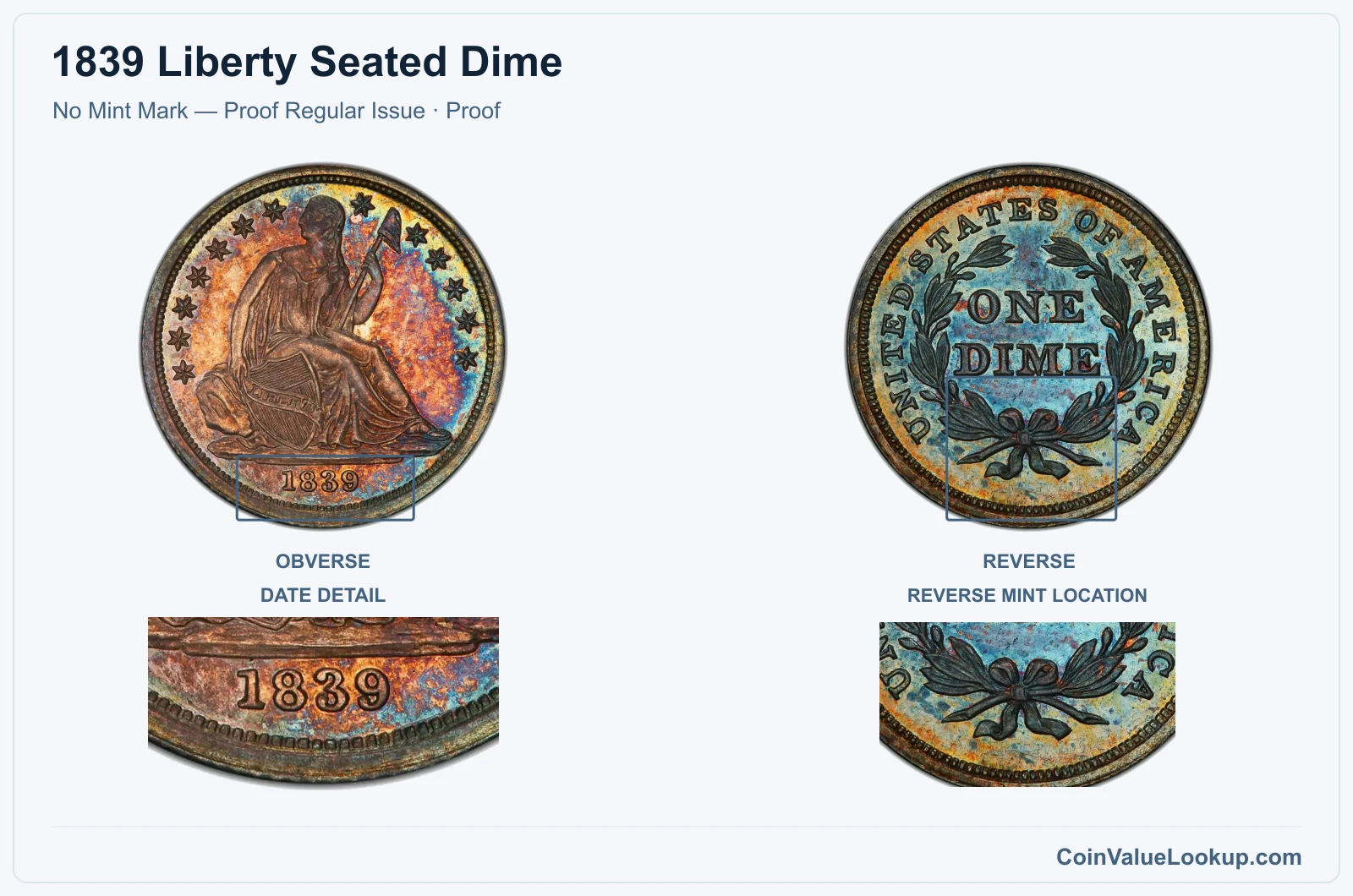
Philadelphia Proof 1839 dimes are genuinely rare. These are not annual collector sets produced in quantity.
Early Seated Dime Proofs were made in tiny numbers, and survivors are scarce.
The PCGS guide lists a PR63 figure near $30,000. Genuine Proofs show deeply mirrored fields and sharp design details from specially prepared dies.
A polished or lightly circulated business strike is not a Proof, no matter how shiny it looks. Hairlines on a real Proof are a condition issue that affects the grade, not evidence supporting the attribution.
If you suspect you have one, professional authentication is essential before assuming Proof status.
Range Grade
Price Auction Records Appraisal PR PR 1
—
Coin Identifier
PR 2
—
Coin Identifier
PR 3
—
Coin Identifier
PR 4
—
Coin Identifier
PR 6
—
Coin Identifier
PR 8
—
Coin Identifier
PR 10
—
Coin Identifier
PR 12
—
Coin Identifier
PR 15
—
Coin Identifier
PR 20
—
Coin Identifier
PR 25
—
Coin Identifier
PR 30
—
Coin Identifier
PR 35
—
Coin Identifier
PR 40
—
Coin Identifier
PR 45
—
Coin Identifier
PR 50
—
Coin Identifier
PR 53
—
Coin Identifier
PR 55
—
Coin Identifier
PR 58
—
Coin Identifier
PR 60
—
Coin Identifier
PR 61
—
Coin Identifier
PR 62
Coin Identifier
PR 63
—
Coin Identifier
PR 64
Coin Identifier
PR 65
—
—
—
PR 66
—
—
—
PR 67
—
—
—
PR 68
—
—
—
PR 69
—
—
—
PR 70
—
—
—
1839 Liberty Seated Dime Error List
1. 1839 Liberty Seated Dime — Repunched Date
A repunched date on an 1839 dime shows remnants of an earlier position of one or more date numerals beside the final placement. You are looking for faint shadows or partial digit outlines near the base or tops of the numbers in the date.
This is a die variety, not a striking error. The die was punched more than once during its preparation, and each impression left a trace.
Do not confuse this with machine doubling, which produces flat, shelf-like doubling across the whole design rather than isolated remnants near specific digits. Damage from contact or corrosion can also mimic a repunched date at first glance.
Condition, the clarity of the repunching, and the specific variety all affect any premium. No fixed price range applies across the board.
2. 1839 Liberty Seated Dime — Repunched Mintmark
A repunched mintmark appears when the mintmark punch was applied more than once in slightly different positions on the working die. On 1839-O dimes, inspect the O below the wreath for traces of a second impression, often visible as a partial outline offset from the primary letter.
Compare your coin to a normal mintmark at the same magnification. Die chips or corrosion around the letter can look like extra metal, but a true repunched mintmark shows a recognizable duplicate letter form, not a random blob.
Machine doubling creates a different effect: flat, spread outlines rather than a distinct second punch position.
Value depends on the visibility of the repunching and the coin's overall condition. No single price range covers every instance.
3. 1839 Liberty Seated Dime — Die Crack / Die Chip
Die cracks show up as thin raised lines on the coin's surface, running from one design element to another or from the rim inward. Die chips appear as small raised lumps where a piece of the die face broke away.
Both are caused by die deterioration during the press run.
On 1839 dimes, look for raised lines crossing Liberty or the wreath that were not part of the original design. A crack that reaches the rim and produces a raised blob of extra metal is sometimes called a cud.
Interior chips tend to be smaller and more localized.
Do not confuse die cracks with incuse scratches, which are recessed into the surface rather than raised. Corrosion or debris stuck to the coin can also mimic a chip.
Value depends on the size, location, and visual impact of the crack, as well as the coin's grade.