1860 Liberty Seated Dime Coin Value: How Much Is It Worth?
The 1860 Liberty Seated Dime is a genuine transition year, with three mints producing coins in two different design types. Retail guide estimates for normal business strikes range from about $23 at G4 up through $22,514 at select Mint State grades, depending heavily on which mint and design subtype you hold.
The scarce New Orleans issue and the Philadelphia Proof each require their own pricing, so identifying your exact coin matters before anything else.
Fast Way to Identify Your 1860 Liberty Seated Dime
Snap a clear photo of both the front and back of your coin and upload them here for a preliminary identification. This helps narrow down which of the three mints and two design types your dime belongs to.
Keep in mind this is a visual starting point, not a certification or exact grade assignment, but it will point you in the right direction fast.
1860 Liberty Seated Dime Value
Upload both sides of your 1860 Liberty Seated Dime.
Front Obverse
Upload photo
Back Reverse
Upload photo
Which 1860 Liberty Seated Dime Versions Are Worth Money?
- The 1860-O (New Orleans) dime is scarce by nature, with guide values starting around $933 at G4 and climbing steeply in higher grades.
- Philadelphia Proofs from 1860 are rare early-date Proofs, not routine collector products; a PR63 example is guided near $863.
- The 1860-S uses the older Stars obverse and smaller wreath, making it visually distinct and valued around $85 at G4 up to about $10,072 at MS63.
- The Philadelphia business strike is the most affordable entry point at roughly $23 in G4, but clean Mint State examples still carry respectable value.
- Doubled Die Obverse and Repunched Date varieties have been reported for 1860 dimes and can carry premiums depending on visibility and condition.
Step 1: Identify Your 1860 Liberty Seated Dime Mint Mark and Version
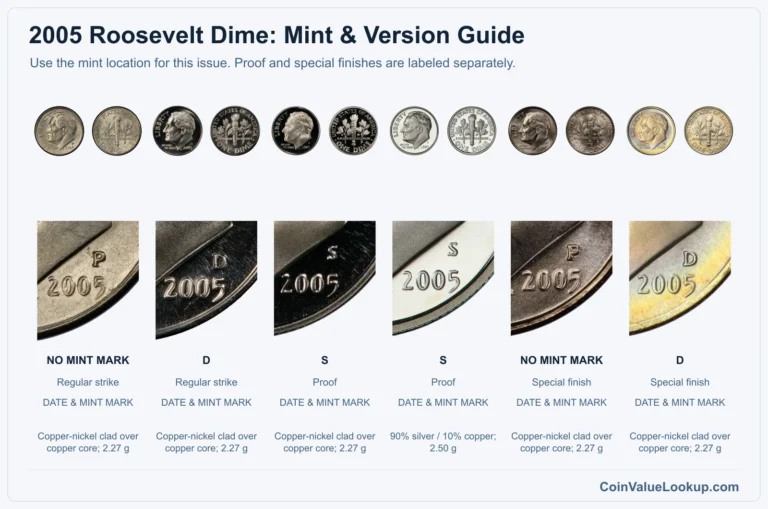
Start by confirming you have a seated Liberty on the obverse and the words ONE DIME on the reverse. Half dimes exist for this date too, so check the diameter: a dime measures 17.9 mm with a reeded edge, struck in 90% silver and 10% copper at a nominal weight of 2.49 grams.
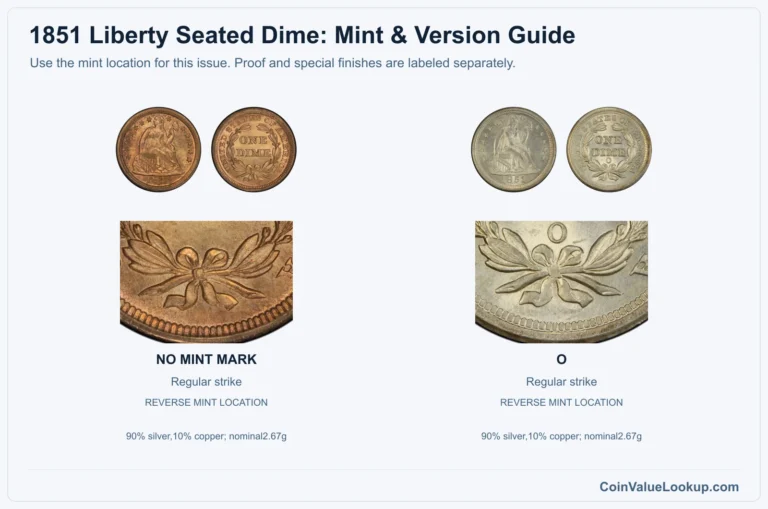
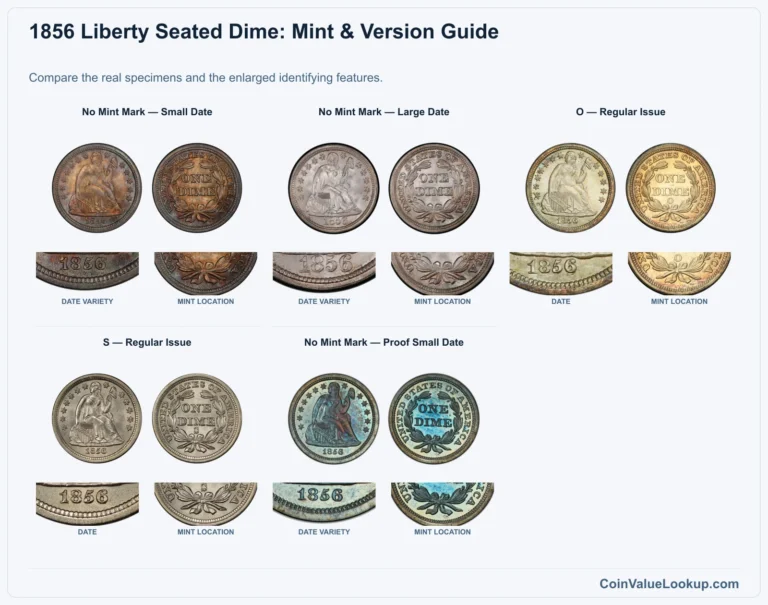
Next, read the date. Then flip the coin over and look below the wreath for a mintmark letter.
Philadelphia coins carry no mintmark. An "O" means New Orleans, and an "S" means San Francisco.
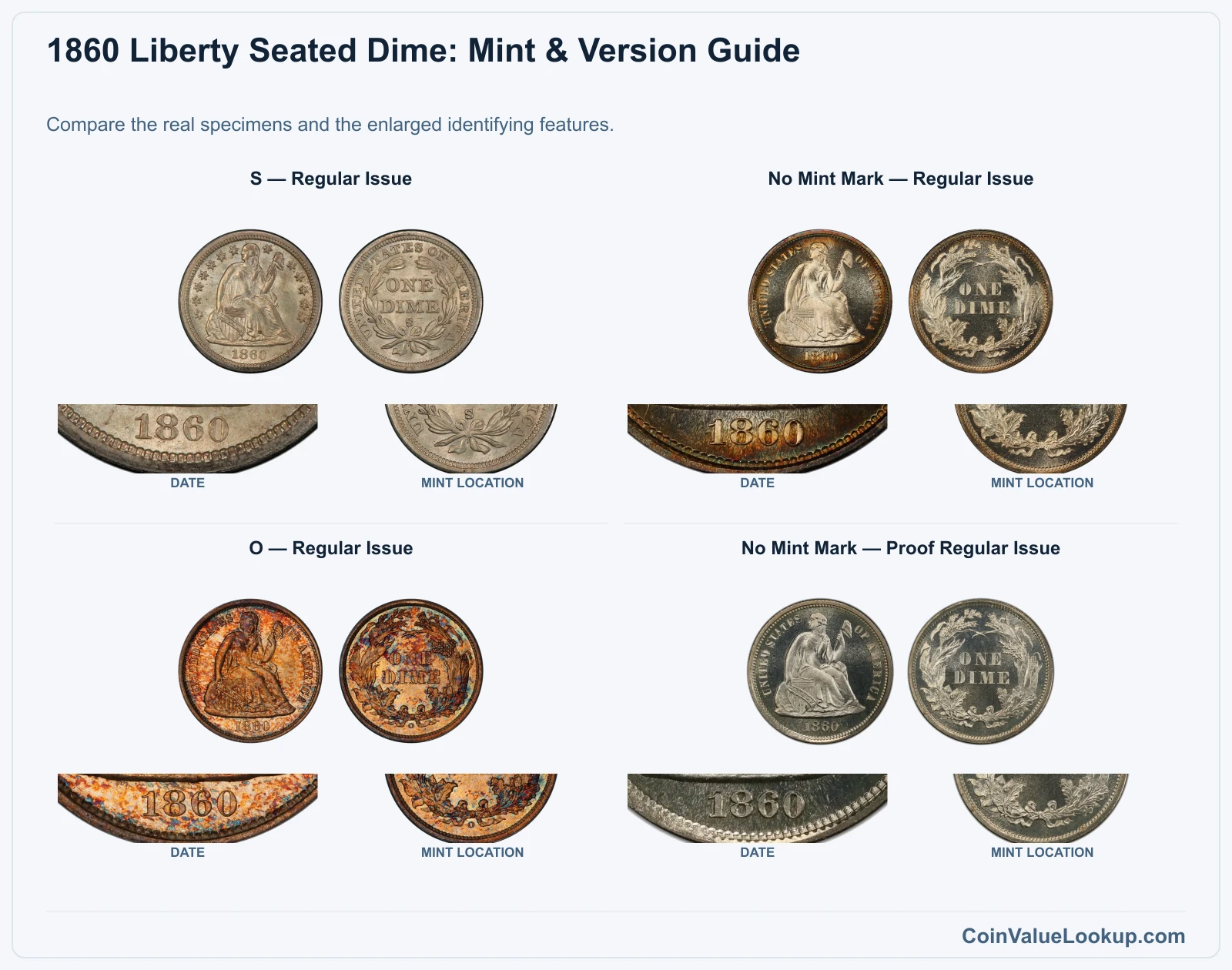
Here is where it gets interesting for 1860. Philadelphia and New Orleans dimes use the new Legend Obverse, which replaced the surrounding stars with the inscription UNITED STATES OF AMERICA on the obverse, paired with a large agricultural wreath on the reverse.
San Francisco, however, kept the older Stars obverse with drapery and the smaller wreath with the legend on the reverse. So the design on your coin and the mintmark must agree.
The O-mint issue is genuinely scarce. That scarcity is a function of low mintage, not a minting error, so do not confuse it with a variety or mistake.
Original surfaces and the correct mint-and-design match matter far more than a shiny appearance.
Step 2: Check Your 1860 Liberty Seated Dime Grade
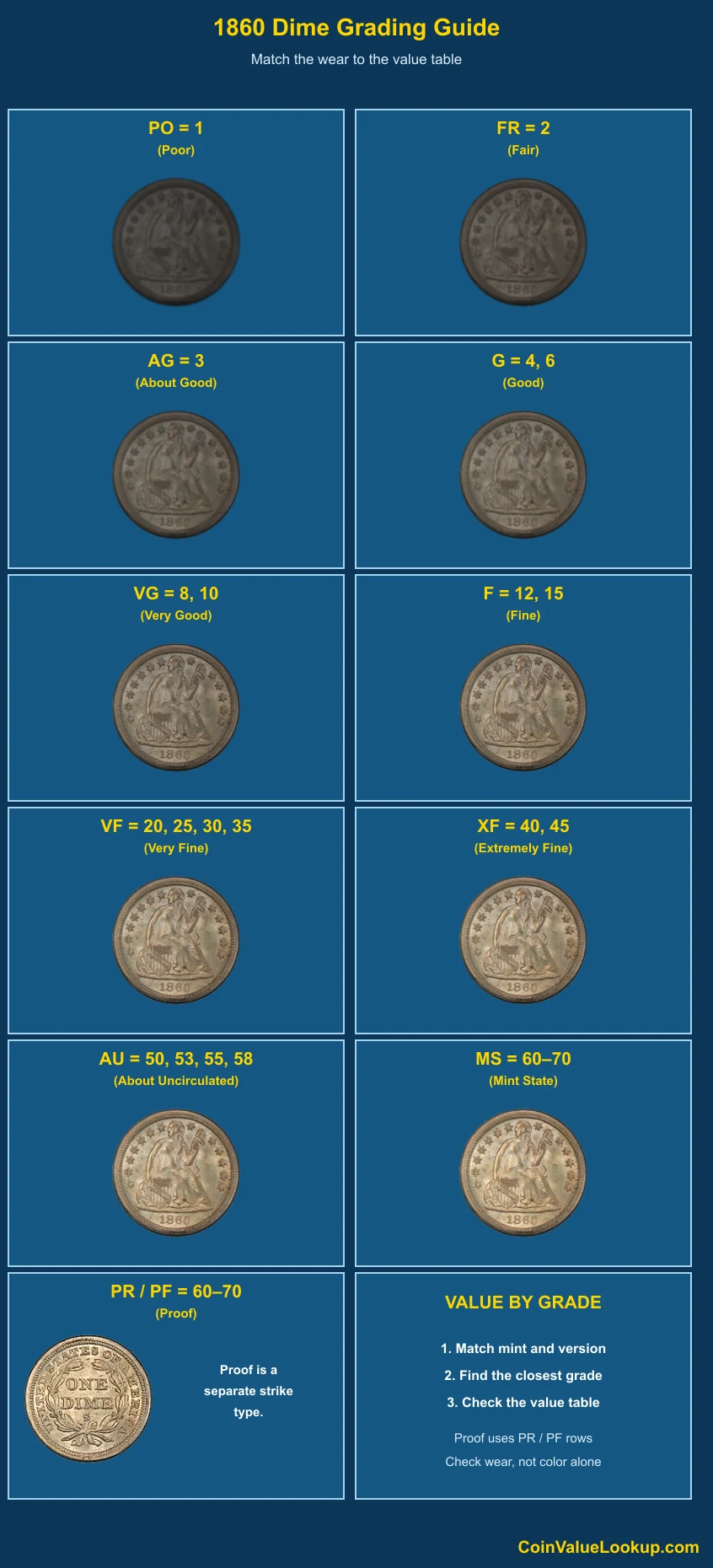
When judging wear, compare Liberty's shield detail, the folds of her gown, her head, and her feet against the correct subtype in the grading comparison image. The Stars obverse (S-mint) and the Legend Obverse (P and O) wear differently, so use the right reference.
Separate actual circulation friction from strike weakness or worn dies. A soft head or flat foot on Liberty might be a weak strike from the original production, not decades of pocket wear.
Look at the luster in protected areas versus exposed high points to tell the difference.
Proof coins are a separate category from Mint State. A polished circulated dime is not a Proof, no matter how shiny someone made it.
Proof fields have a distinctive mirror-like finish from specially prepared dies, and hairlines from cleaning will be visible under magnification.
Step 3: Check 1860 Liberty Seated Dime Value by Mint and Version
1860 Liberty Seated Dime — S — Regular Issue
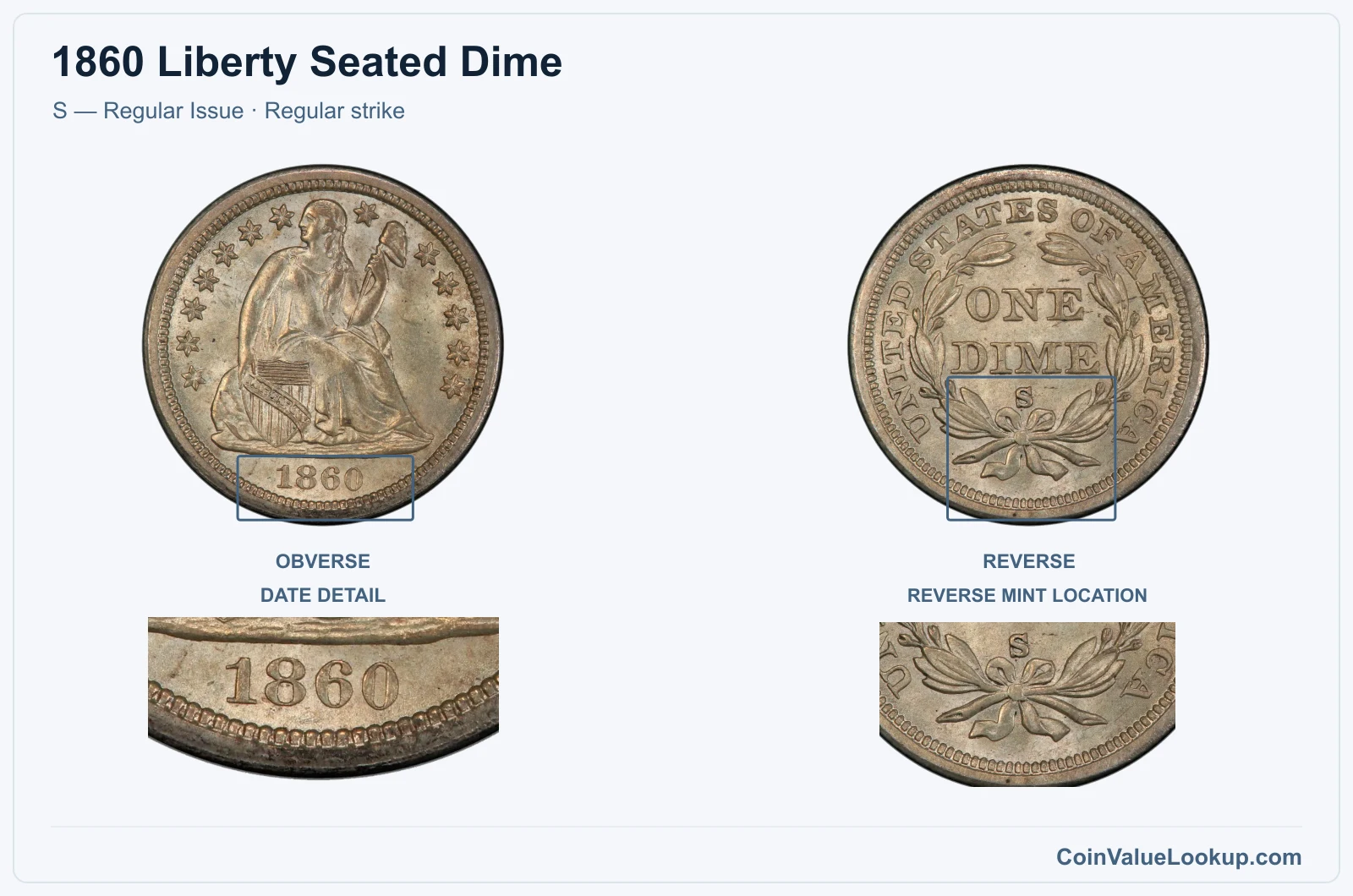
The 1860-S dime is the oddball of the year. While Philadelphia and New Orleans switched to the new Legend Obverse, San Francisco kept the older Stars obverse with drapery and the smaller cereal-wreath reverse carrying the country's name.
Look for thirteen stars surrounding Liberty on the front and an "S" mintmark below the wreath on the back.
This design mismatch makes the S-mint visually easy to separate from its siblings. USA Coin Book guides the 1860-S at about $85 in G4 and around $10,072 in MS63.
Struck in 90% silver and 10% copper at a nominal 2.49 grams, these saw real circulation in the West, so most survivors show honest wear.
Range Grade
Price Auction Records Appraisal PO PO 1
—
Coin Identifier FR FR 2
—
Coin Identifier AG AG 3
—
Coin Identifier G G 4
Coin Identifier
G 6
—
Coin Identifier VG VG 8
Coin Identifier
VG 10
Coin Identifier F F 12
Coin Identifier
F 15
Coin Identifier VF VF 20
Coin Identifier
VF 25
Coin Identifier
VF 30
Coin Identifier
VF 35
Coin Identifier XF XF 40
Coin Identifier
XF 45
Coin Identifier AU AU 50
Coin Identifier
AU 53
Coin Identifier
AU 55
Coin Identifier
AU 58
Coin Identifier MS MS 60
—
Coin Identifier
MS 61
Coin Identifier
MS 62
Coin Identifier
MS 63
Coin Identifier
MS 64
Coin Identifier
MS 65
Coin Identifier
MS 66
—
—
—
MS 67
—
—
—
MS 68
—
—
—
MS 69
—
—
—
MS 70
—
—
—
1860 Liberty Seated Dime — No Mint Mark — Regular Issue
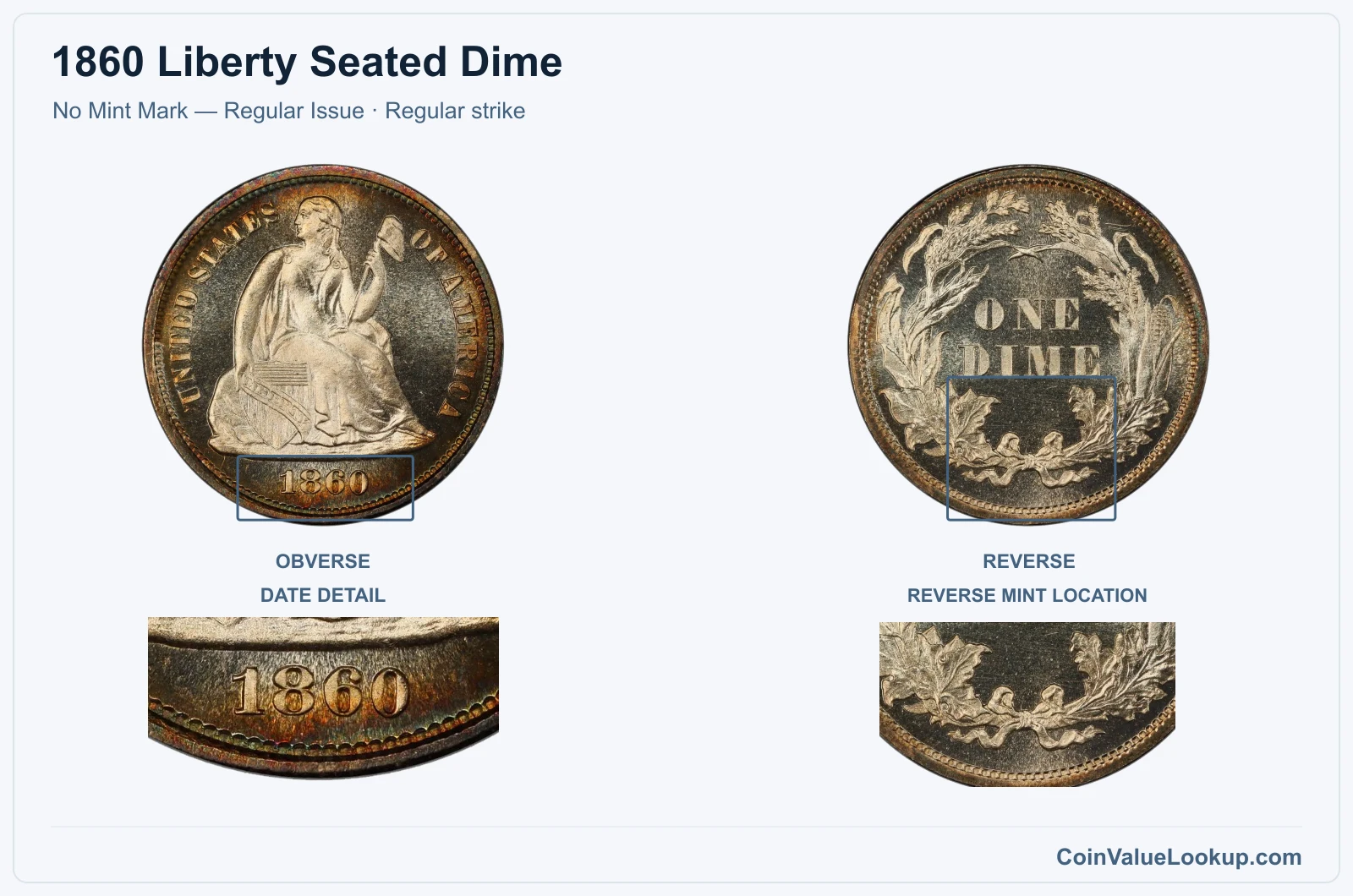
The 1860 Philadelphia dime carries no mintmark and debuts the Legend Obverse design, with UNITED STATES OF AMERICA moved to the obverse and a large agricultural wreath on the reverse. This is the new look that would continue for years.
Guide values from USA Coin Book place this issue at roughly $23 in G4 and about $410 in MS63. It is the most common 1860 dime, so finding one in lower grades is not difficult.
The challenge is locating examples with original surfaces and strong detail, since many were cleaned long ago.
Coin Value Lookup is a handy starting point if you want to check guide values for other dates and denominations in the Liberty Seated Dime series.
Range Grade
Price Auction Records Appraisal PO PO 1
—
Coin Identifier FR FR 2
—
Coin Identifier AG AG 3
—
Coin Identifier G G 4
—
Coin Identifier
G 6
—
Coin Identifier VG VG 8
—
Coin Identifier
VG 10
—
Coin Identifier F F 12
—
Coin Identifier
F 15
—
Coin Identifier VF VF 20
Coin Identifier
VF 25
—
Coin Identifier
VF 30
—
Coin Identifier
VF 35
—
Coin Identifier XF XF 40
—
Coin Identifier
XF 45
Coin Identifier AU AU 50
Coin Identifier
AU 53
—
Coin Identifier
AU 55
Coin Identifier
AU 58
Coin Identifier MS MS 60
Coin Identifier
MS 61
Coin Identifier
MS 62
Coin Identifier
MS 63
Coin Identifier
MS 64
Coin Identifier
MS 65
Coin Identifier
MS 66
Coin Identifier
MS 67
Coin Identifier
MS 68
Coin Identifier
MS 69
—
—
—
MS 70
—
—
—
1860 Liberty Seated Dime — O — Regular Issue
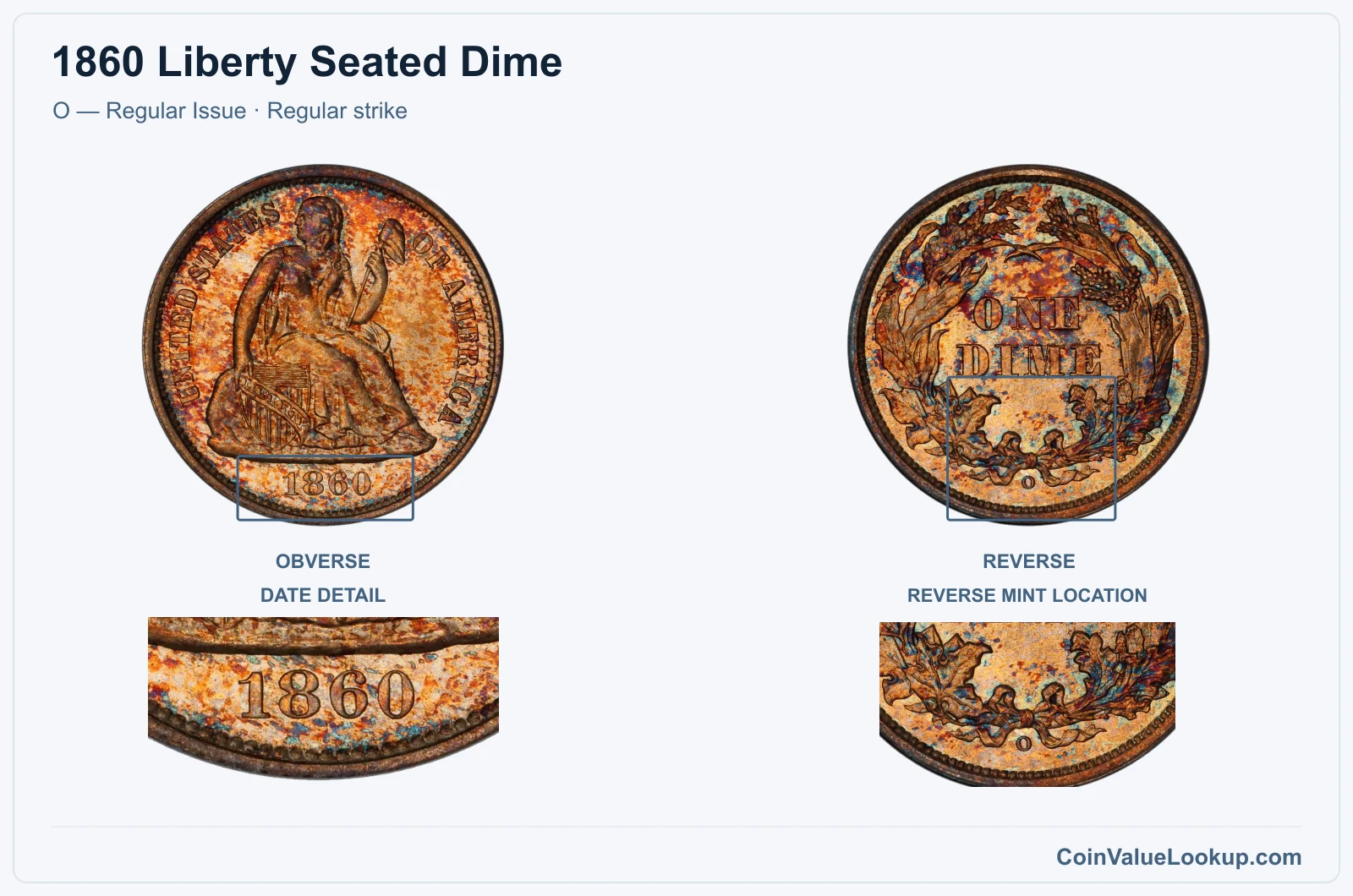
The 1860-O is the coin to watch. New Orleans used the same Legend Obverse and large agricultural wreath as Philadelphia, but produced far fewer dimes.
Look for the "O" mintmark below the wreath on the reverse.
This scarcity is baked into the mintage, not a minting error, so do not confuse it with a variety. USA Coin Book guides the 1860-O at approximately $933 even in G4, jumping to around $22,514 at MS60.
That steep climb reflects how few survived in any condition, let alone with original luster intact. The 90% silver, 10% copper composition and 2.49-gram weight match the Philadelphia issue exactly; only the mintmark and the survival rate differ.
If you find an "O" under that wreath, take a very careful second look at condition.
Range Grade
Price Auction Records Appraisal PO PO 1
—
Coin Identifier FR FR 2
Coin Identifier AG AG 3
Coin Identifier G G 4
Coin Identifier
G 6
Coin Identifier VG VG 8
Coin Identifier
VG 10
Coin Identifier F F 12
Coin Identifier
F 15
Coin Identifier VF VF 20
Coin Identifier
VF 25
Coin Identifier
VF 30
Coin Identifier
VF 35
Coin Identifier XF XF 40
Coin Identifier
XF 45
Coin Identifier AU AU 50
Coin Identifier
AU 53
Coin Identifier
AU 55
Coin Identifier
AU 58
Coin Identifier MS MS 60
—
—
—
MS 61
—
—
—
MS 62
—
—
—
MS 63
—
—
—
MS 64
Coin Identifier
MS 65
—
—
—
MS 66
—
—
—
MS 67
Coin Identifier
MS 68
—
—
—
MS 69
—
—
—
MS 70
—
—
—
1860 Liberty Seated Dime — No Mint Mark — Proof Regular Issue
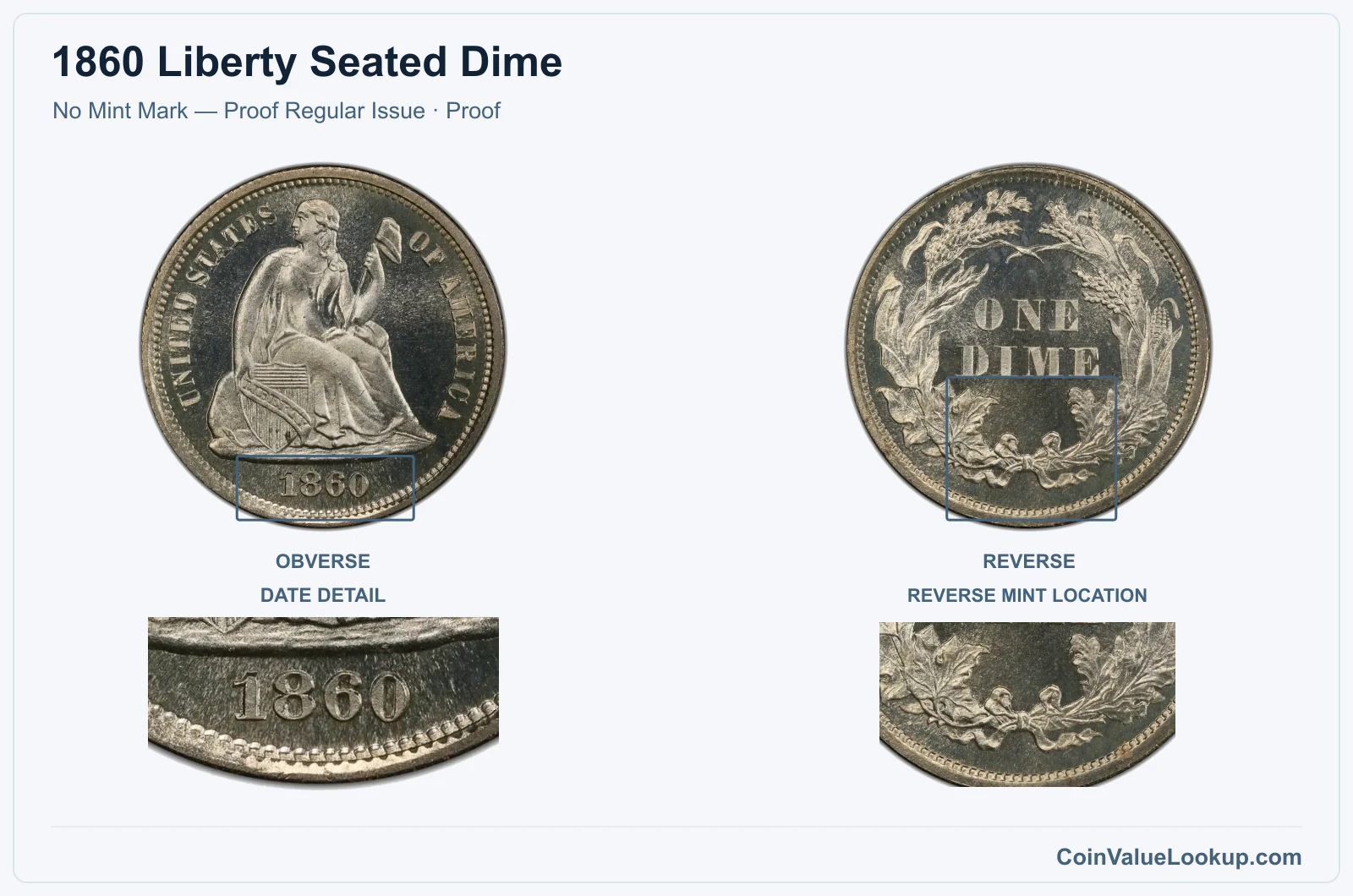
Philadelphia also struck Proof dimes in 1860 using the new Legend Obverse design and large agricultural wreath. These are rare early-date Proofs, not the mass-produced collector sets of later decades.
PCGS guide data places a PR63 example near $863.
Proof identification requires mirrored fields produced by specially prepared dies. A polished circulation coin is not a Proof, no matter how reflective someone made it.
Under magnification, genuine Proofs show squared, knife-like rim edges and a distinctive surface quality. Hairlines from past cleaning will be visible and affect grade.
Keep Proof assessment entirely separate from Mint State grading; they are different manufacturing finishes, not a quality ladder where Proof sits above MS.
Range Grade
Price Auction Records Appraisal PR PR 1
—
Coin Identifier
PR 2
—
Coin Identifier
PR 3
—
Coin Identifier
PR 4
—
Coin Identifier
PR 6
—
Coin Identifier
PR 8
—
Coin Identifier
PR 10
—
Coin Identifier
PR 12
—
Coin Identifier
PR 15
—
Coin Identifier
PR 20
—
Coin Identifier
PR 25
—
Coin Identifier
PR 30
—
Coin Identifier
PR 35
—
Coin Identifier
PR 40
—
Coin Identifier
PR 45
—
Coin Identifier
PR 50
—
Coin Identifier
PR 53
—
Coin Identifier
PR 55
—
Coin Identifier
PR 58
—
Coin Identifier
PR 60
—
Coin Identifier
PR 61
Coin Identifier
PR 62
Coin Identifier
PR 63
Coin Identifier
PR 64
Coin Identifier
PR 65
Coin Identifier
PR 66
Coin Identifier
PR 67
Coin Identifier
PR 68
Coin Identifier
PR 69
—
—
—
PR 70
—
—
—
1860 Liberty Seated Dime Error List
1. 1860 Liberty Seated Dime — Doubled Die Obverse
A Doubled Die Obverse has been reported for the 1860 dime. This variety originates from a misalignment during the hub-to-die impression process, leaving a second, slightly offset image on the obverse die that transfers to every coin struck from it.
To check, examine the obverse lettering and design elements under good magnification and consistent lighting. Look for uniform separation, notching, or a secondary outline on letters or features.
The doubling should appear in the same direction and strength across multiple elements, not random.
Do not confuse this with machine doubling, which tends to produce flat, shelf-like distortions without the raised, rounded profile of a true doubled die. Reflections and worn die contours can also mimic doubling at a glance.
No specific price range is established here; value depends on the visibility of the doubling, overall coin condition, and the particular die involved.
2. 1860 Liberty Seated Dime — Repunched Date
A Repunched Date variety is also reported for the 1860 dime. This occurred when the date numerals were hand-punched into the working die and the mintworker struck the punch a second time in a slightly different position, leaving traces of the first impression beside the final digits.
Look closely at each numeral in the date for remnants of an earlier punch position, such as a ghost outline, a thickened serif, or a secondary foot visible next to or beneath the accepted digit. The remnants should be consistent with a shifted punch, not random damage.
Do not confuse this with a damaged date caused by contact marks or post-strike hits, and keep it separate from Doubled Die Obverse, which affects the entire obverse design rather than just the date area. Machine doubling can also create confusing flat shelves near the numerals.
No adopted price range exists here; the premium depends on how dramatic the repunching is and the coin's overall condition.