1871 Liberty Seated Dime Coin Value: How Much Is It Worth?
The 1871 Liberty Seated Dime spans a wide range of retail guide values depending on mint and condition — from about $23 at G4 for a Philadelphia issue up to roughly $175,513 at MS63 for the Carson City strike. This was the first year Carson City produced dimes, making the CC mintmark a major rarity.
The San Francisco issue also commands strong premiums in higher grades.
Fast Way to Identify Your 1871 Liberty Seated Dime
Want a quick read on what you have? Upload clear photos of the front and back of your 1871 dime, and our identifier can offer a preliminary take on which mint version you're holding.
It won't authenticate or certify the coin, but it's a solid first step before deciding whether professional grading is worthwhile.
1871 Liberty Seated Dime Value
Upload both sides of your 1871 Liberty Seated Dime.
Front Obverse
Upload photo
Back Reverse
Upload photo
Which 1871 Liberty Seated Dime Versions Are Worth Money?
- The 1871-CC dime is the first Carson City dime ever struck and a genuine rarity, with guide values from about $3,432 at G4 to roughly $175,513 at MS63.
- The 1871-S dime lists around $34 at G4 but climbs to about $4,675 at MS63, making higher-grade survivors worth careful inspection.
- Philadelphia proofs from 1871 carry a guide value near $725 at PR63 — look for mirror fields and sharp rims, not just a shiny surface.
- Repunched dates, doubled die obverses, and die cracks have been reported for 1871 dimes and can add collector interest depending on visibility and condition.
Step 1: Identify Your 1871 Liberty Seated Dime Mint Mark and Version
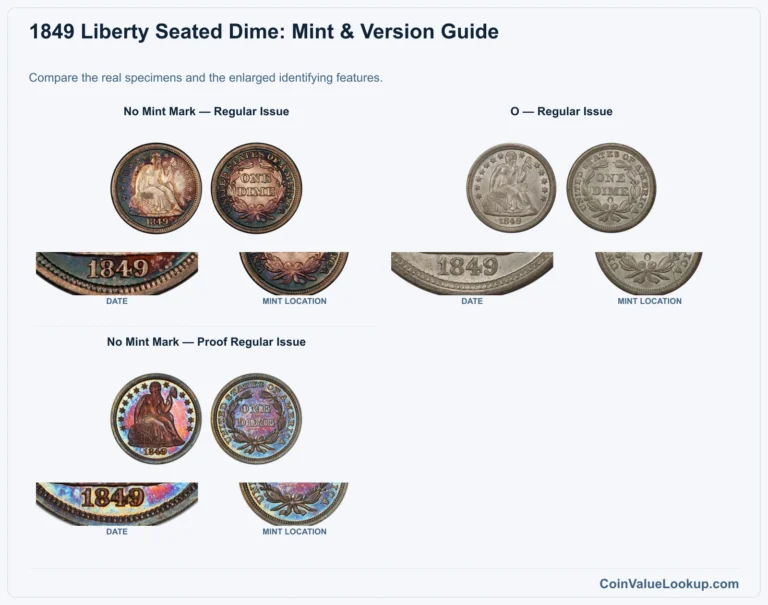
Start by confirming you're looking at a Liberty Seated dime — the obverse shows a seated Liberty figure, and the reverse reads ONE DIME inside an agricultural wreath. Half dimes are smaller and say HALF DIME, so don't mix them up.
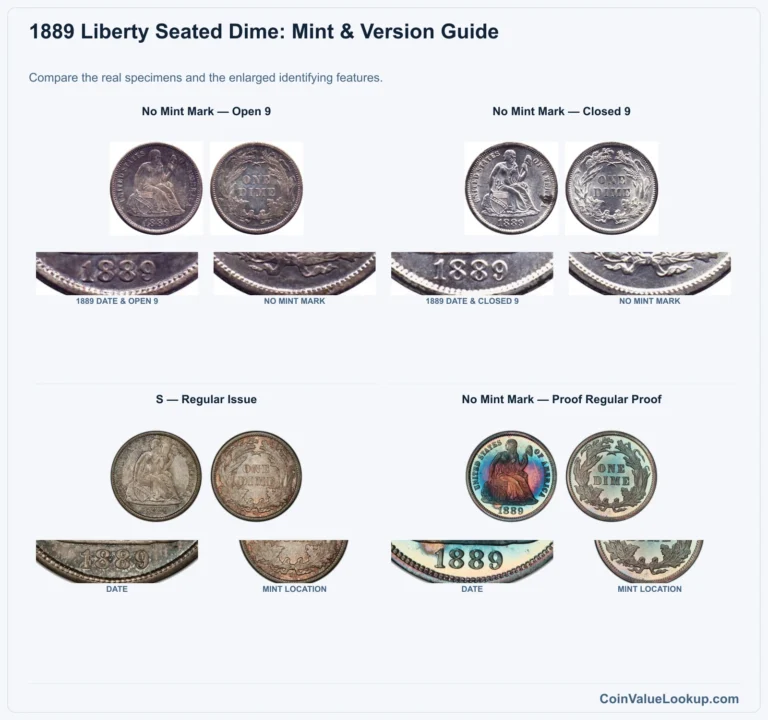
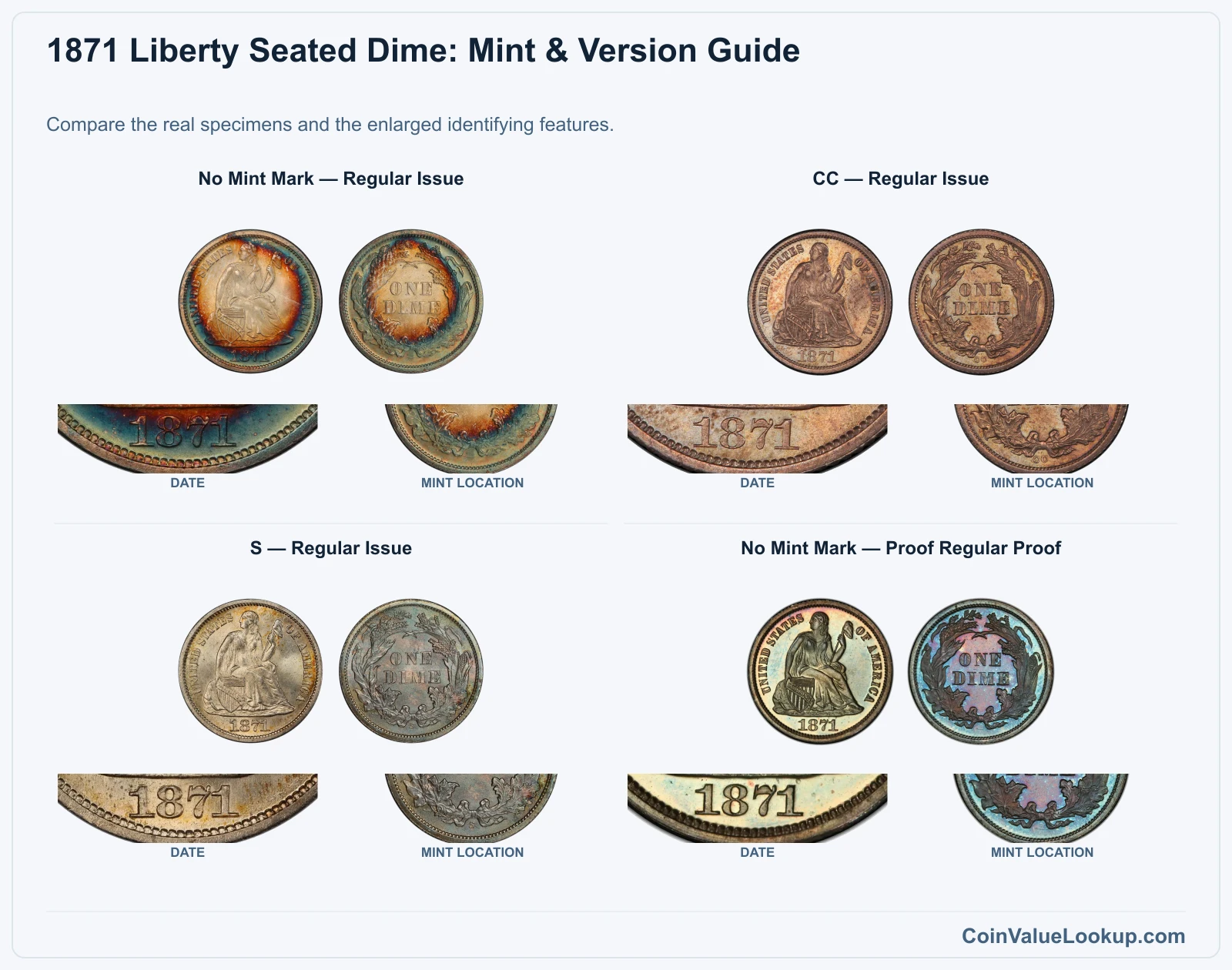
The mintmark sits on the reverse, near the bottom of the wreath. Philadelphia coins carry no mintmark at all.
A tiny "S" means San Francisco, while "CC" indicates Carson City — and that CC is the one everyone wants to find.
All 1871 regular-issue dimes are struck in 90% silver and 10% copper, measure 17.9mm across, and have a reeded edge. The nominal weight is 2.49 grams (the standard before the 1873 arrows redesign increased it slightly to 2.50g).
Philadelphia also produced proof strikes this year, which are a different manufacturing finish — not a higher grade. A polished coin is not a proof.
Mirror-like fields from deliberate die preparation are what distinguish a genuine proof from a shiny circulated coin.
Step 2: Check Your 1871 Liberty Seated Dime Grade
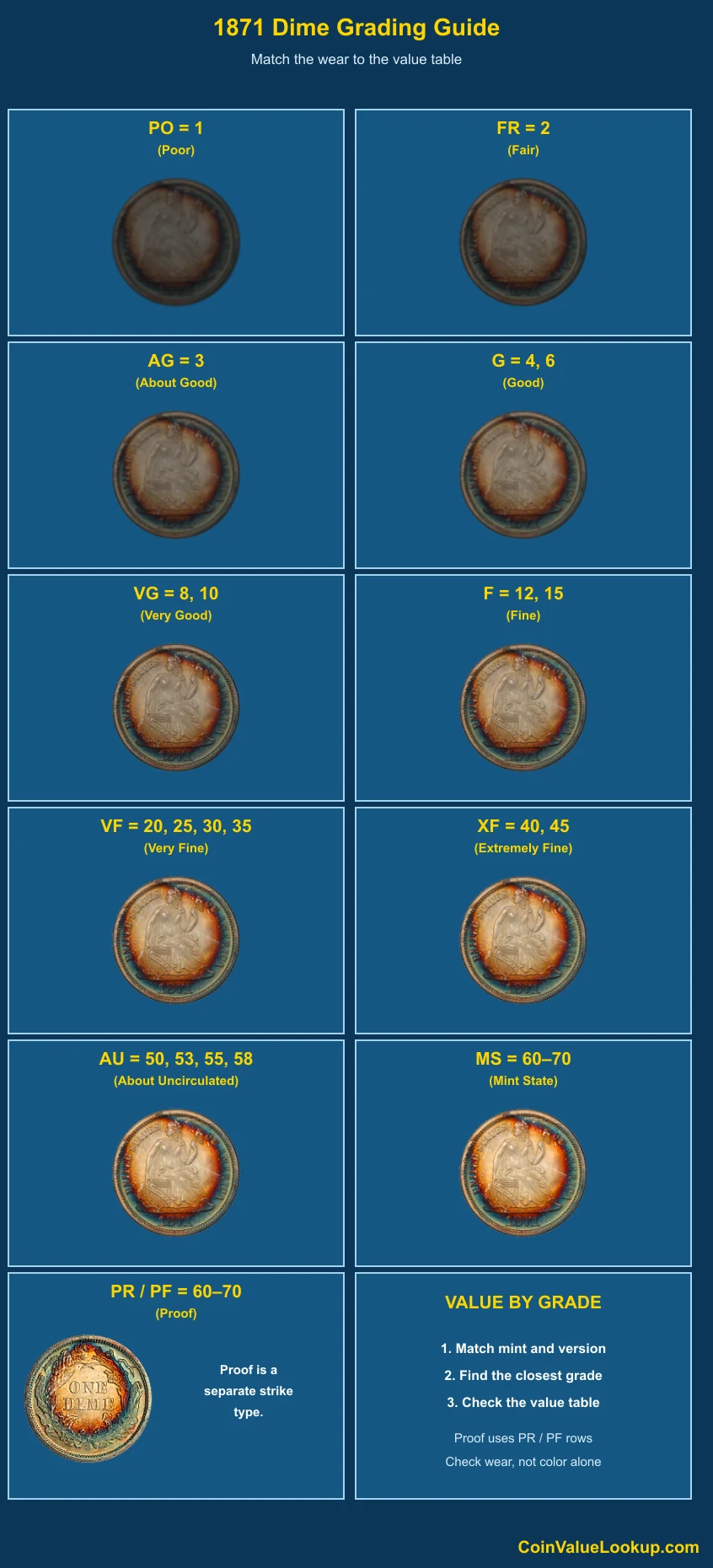
Focus on Liberty's head, the breast and knee area, and the shield on the obverse. These spots show friction first.
On the reverse, check the highest wreath leaves for wear.
Surviving mint luster matters as much as design detail. A coin with full hair curls but no luster may grade lower than one with slightly softer detail but original surfaces still intact.
Compare your coin side-by-side with the reference image to gauge where it falls.
Weak strikes and worn dies can soften details without any circulation wear. If the stars look mushy but Liberty's knee is sharp, that's likely a strike issue, not a grade problem.
This distinction is especially common on branch-mint coins of this era.
Keep proof strikes, business strikes and cleaned or polished coins in separate mental categories. A coin that's been buffed to look shiny does not become a proof — it becomes a problem coin.
Step 3: Check 1871 Liberty Seated Dime Value by Mint and Version
1871 Liberty Seated Dime — No Mint Mark — Regular Issue
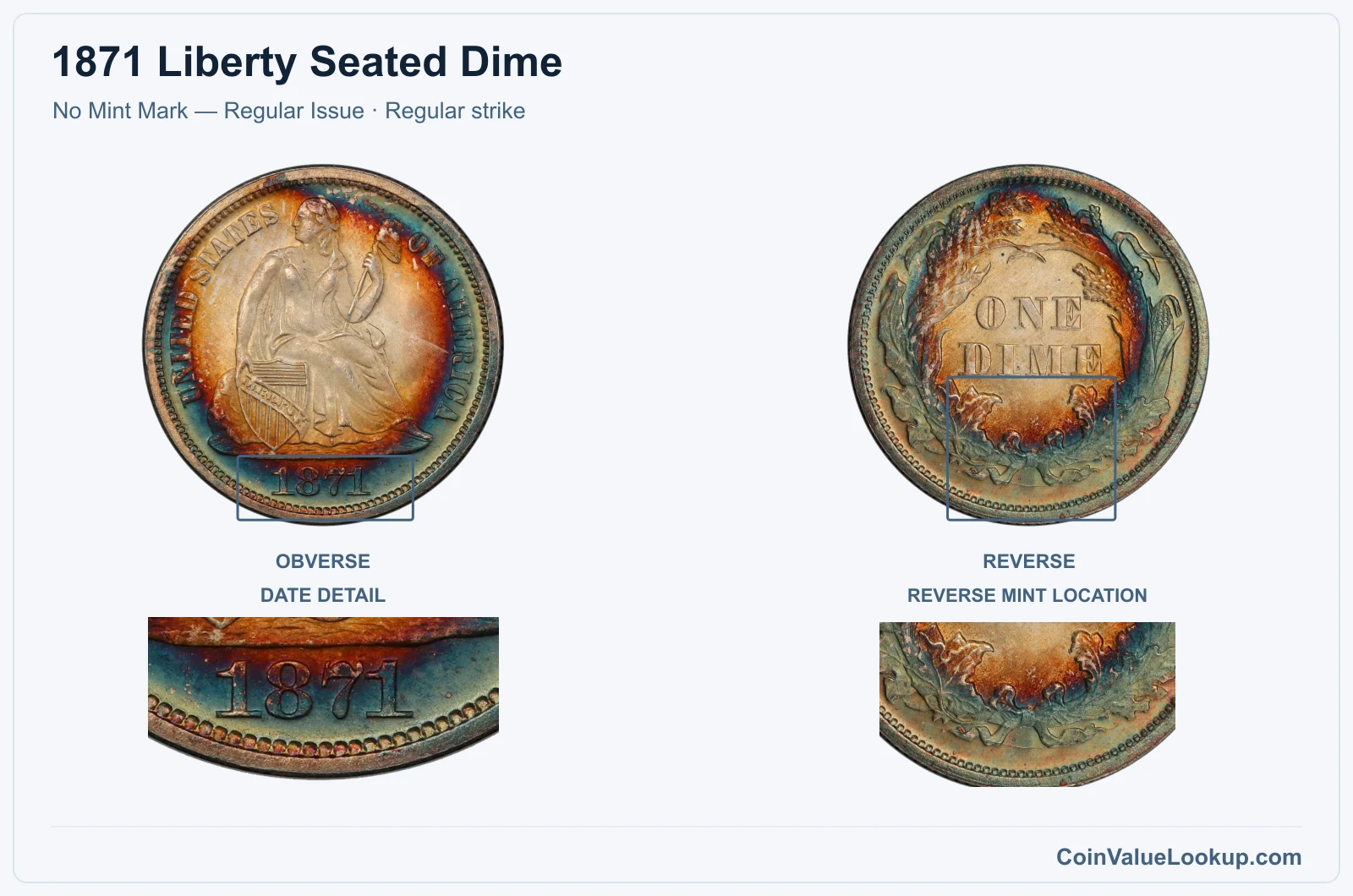
The 1871 Philadelphia dime has no mintmark on the reverse. It's the most common issue this year, with retail guide values running about $23 at G4 and around $531 at MS63 according to USA Coin Book estimates.
Look for a Legend Obverse design paired with the agricultural wreath reverse. The composition is 90% silver, 10% copper, at a nominal weight of 2.49 grams with a reeded edge.
Philadelphia produced both business strikes and proofs this year, so check which category your coin fits before comparing prices.
Range Grade
Price Auction Records Appraisal PO PO 1
—
Coin Identifier FR FR 2
—
Coin Identifier AG AG 3
—
Coin Identifier G G 4
—
Coin Identifier
G 6
—
Coin Identifier VG VG 8
—
Coin Identifier
VG 10
—
Coin Identifier F F 12
—
Coin Identifier
F 15
—
Coin Identifier VF VF 20
—
Coin Identifier
VF 25
—
Coin Identifier
VF 30
—
Coin Identifier
VF 35
Coin Identifier XF XF 40
Coin Identifier
XF 45
Coin Identifier AU AU 50
Coin Identifier
AU 53
Coin Identifier
AU 55
Coin Identifier
AU 58
Coin Identifier MS MS 60
Coin Identifier
MS 61
Coin Identifier
MS 62
Coin Identifier
MS 63
Coin Identifier
MS 64
Coin Identifier
MS 65
Coin Identifier
MS 66
Coin Identifier
MS 67
Coin Identifier
MS 68
—
Coin Identifier
MS 69
—
—
—
MS 70
—
—
—
1871 Liberty Seated Dime — CC — Regular Issue
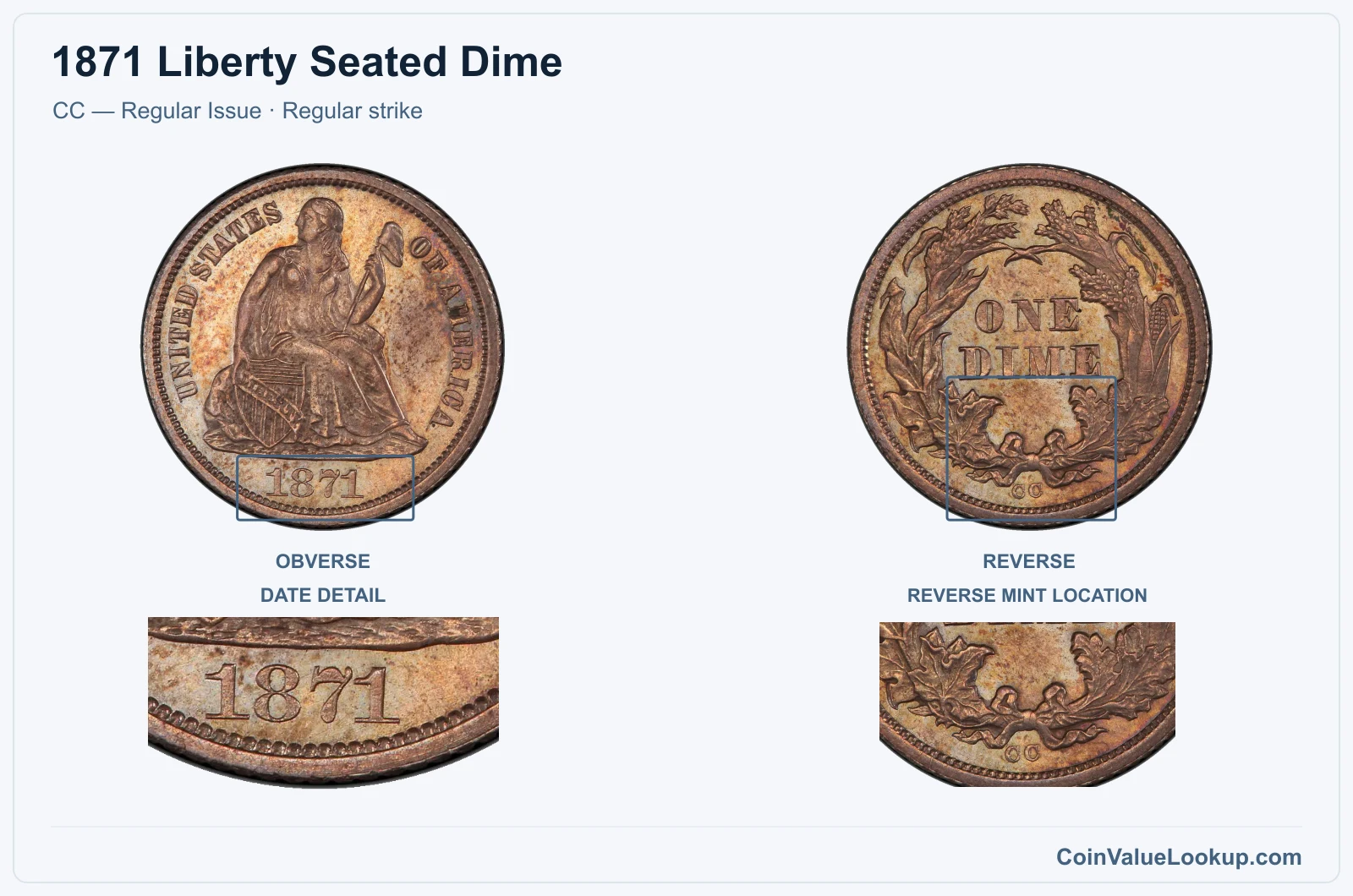
This is the one that gets people excited — and for good reason. The 1871-CC is the very first dime struck at the Carson City Mint, and survival rates are tiny.
Guide values start around $3,432 even in well-worn G4 condition and reach approximately $175,513 at MS63.
The "CC" mintmark appears on the reverse, below the wreath. Confirm it carefully; a scratched or damaged coin can sometimes fool hopeful eyes into seeing letters that aren't there.
Same silver composition as the Philadelphia issue: 90% silver, 10% copper, 2.49 grams, reeded edge. If you genuinely have one, professional authentication is worth the investment.
Coin Value Lookup is a good starting point if you want to compare this coin against other Liberty Seated Dime dates and mints before pursuing certification.
Range Grade
Price Auction Records Appraisal PO PO 1
—
Coin Identifier FR FR 2
Coin Identifier AG AG 3
Coin Identifier G G 4
Coin Identifier
G 6
Coin Identifier VG VG 8
Coin Identifier
VG 10
Coin Identifier F F 12
Coin Identifier
F 15
Coin Identifier VF VF 20
Coin Identifier
VF 25
—
Coin Identifier
VF 30
—
Coin Identifier
VF 35
Coin Identifier XF XF 40
Coin Identifier
XF 45
Coin Identifier AU AU 50
Coin Identifier
AU 53
Coin Identifier
AU 55
Coin Identifier
AU 58
—
Coin Identifier MS MS 60
—
Coin Identifier
MS 61
Coin Identifier
MS 62
Coin Identifier
MS 63
Coin Identifier
MS 64
—
Coin Identifier
MS 65
—
—
—
MS 66
—
—
—
MS 67
—
—
—
MS 68
—
—
—
MS 69
—
—
—
MS 70
—
—
—
1871 Liberty Seated Dime — S — Regular Issue
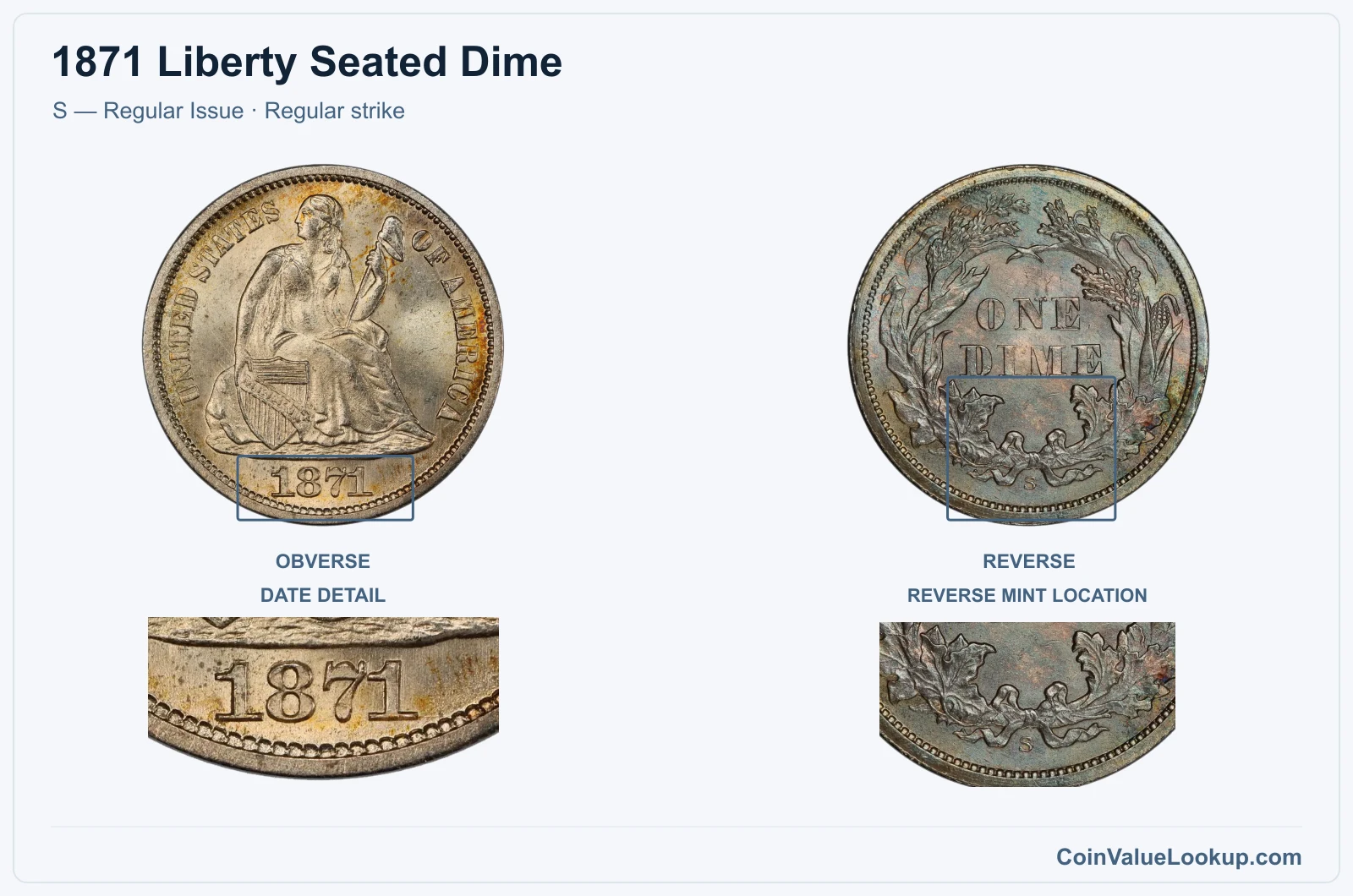
The San Francisco issue carries a small "S" mintmark on the reverse below the wreath. It's not as rare as the CC, but it's no slouch in higher grades.
USA Coin Book guide estimates place it at about $34 in G4 and roughly $4,675 at MS63.
The jump from low-grade to mint-state values tells the story — most of these saw heavy use out West. Same 90% silver, 10% copper composition, 2.49 grams, reeded edge.
Finding one with original surfaces and strong detail is the real challenge.
Range Grade
Price Auction Records Appraisal PO PO 1
—
Coin Identifier FR FR 2
—
Coin Identifier AG AG 3
—
Coin Identifier G G 4
—
Coin Identifier
G 6
—
Coin Identifier VG VG 8
—
Coin Identifier
VG 10
Coin Identifier F F 12
—
Coin Identifier
F 15
—
Coin Identifier VF VF 20
Coin Identifier
VF 25
Coin Identifier
VF 30
Coin Identifier
VF 35
—
Coin Identifier XF XF 40
Coin Identifier
XF 45
Coin Identifier AU AU 50
Coin Identifier
AU 53
—
Coin Identifier
AU 55
Coin Identifier
AU 58
Coin Identifier MS MS 60
—
Coin Identifier
MS 61
Coin Identifier
MS 62
Coin Identifier
MS 63
Coin Identifier
MS 64
Coin Identifier
MS 65
Coin Identifier
MS 66
Coin Identifier
MS 67
—
—
—
MS 68
—
—
—
MS 69
—
—
—
MS 70
—
—
—
1871 Liberty Seated Dime — No Mint Mark — Proof Regular Proof
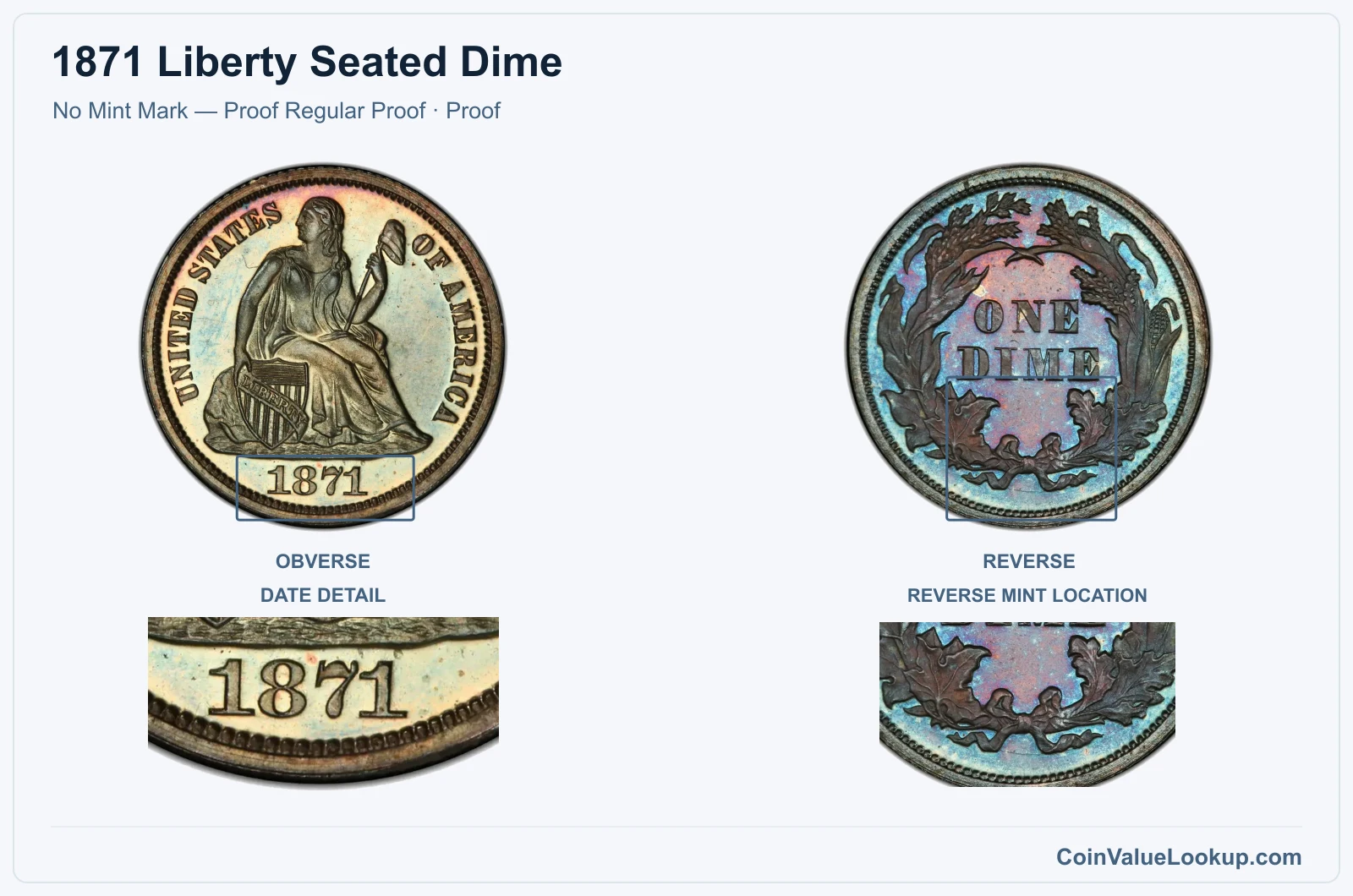
Philadelphia produced proof dimes in 1871 using specially prepared dies and planchets. A genuine proof shows deeply mirrored fields — the flat surfaces around Liberty and inside the wreath reflect like glass.
Rims tend to be sharper and more squared-off than business strikes.
The guide value from USA Coin Book is about $725 at PR63. Hairlines from handling or cleaning can drag the grade down quickly.
Brilliance alone does not make a proof; the mirror finish comes from polished dies, not polished coins. If your dime is shiny but the fields look grainy or show circular polishing marks, it's almost certainly a cleaned business strike, not a proof.
Range Grade
Price Auction Records Appraisal PR PR 1
—
Coin Identifier
PR 2
—
Coin Identifier
PR 3
—
Coin Identifier
PR 4
—
Coin Identifier
PR 6
—
Coin Identifier
PR 8
—
Coin Identifier
PR 10
—
Coin Identifier
PR 12
—
Coin Identifier
PR 15
—
Coin Identifier
PR 20
—
Coin Identifier
PR 25
—
Coin Identifier
PR 30
—
Coin Identifier
PR 35
—
Coin Identifier
PR 40
—
Coin Identifier
PR 45
—
Coin Identifier
PR 50
—
Coin Identifier
PR 53
—
Coin Identifier
PR 55
—
Coin Identifier
PR 58
—
Coin Identifier
PR 60
Coin Identifier
PR 61
—
Coin Identifier
PR 62
Coin Identifier
PR 63
Coin Identifier
PR 64
Coin Identifier
PR 65
Coin Identifier
PR 66
Coin Identifier
PR 67
Coin Identifier
PR 68
—
Coin Identifier
PR 69
—
—
—
PR 70
—
—
—
1871 Liberty Seated Dime Error List
1. 1871 Liberty Seated Dime — Repunched Date
A repunched date on an 1871 dime shows remnants of an earlier date-punch position next to the final numerals. You're looking for traces — partial ghost digits slightly offset from the accepted date, visible under magnification near the base or tops of the numbers.
This is a die variety, not design doubling of the entire coin. The difference matters: a repunched date involves the date punch being entered into the die more than once at slightly different positions, while machine doubling affects the whole design with a flat shelf-like appearance.
Don't confuse a damaged or corroded date with a repunched one. Post-mint scratches or environmental damage can mimic offset digits.
Condition, clarity of the remnant, and overall coin grade all factor into how much a collector might pay, but no reliable numerical premium can be stated here.
2. 1871 Liberty Seated Dime — Die Crack / Die Chip
Die cracks appear as raised lines running across the coin's surface, formed when the steel die develops fractures from repeated striking. On 1871 Philadelphia dimes, specialists have documented die-state progressions that include cracks.
A die chip looks like a small raised blob rather than a line.
A crack that connects to the rim is sometimes called a cud — a larger, more dramatic break. Interior cracks tend to be thinner and can run through lettering or design elements.
Don't confuse die cracks with incuse scratches, which are recessed into the surface rather than raised. Corrosion deposits or foreign material stuck to the coin can also mimic a raised line.
Run a fingernail across the mark — a genuine die crack is part of the metal, raised and smooth. The value impact depends on visibility, location, and the coin's overall condition.
3. 1871 Liberty Seated Dime — Doubled Die Obverse
A doubled die obverse on the 1871 dime involves genuine separation of design elements created during the die-making process. Specialists have described obverse doubling visible in the lettering — particularly around the word AMERICA — and in the positioning of the date numerals.
True doubled die varieties show clear, rounded separation between the doubled contours. Machine doubling, by contrast, produces a flat, shelf-like distortion that lacks distinct secondary outlines.
The two look different under magnification once you know what to compare.
Reflections from proof-like surfaces or worn die contours can also mimic doubling at first glance. Check multiple design elements: if only one letter looks doubled but nothing else does, you may be seeing localized die wear rather than a true doubled die.
The premium depends on the strength and visibility of the doubling plus the coin's overall grade, but no specific price range can be stated.