1888 Liberty Seated Dime Coin Value: How Much Is It Worth?
The 1888 Liberty Seated Dime was struck at Philadelphia and San Francisco, with Philadelphia also producing Proofs. USA Coin Book retail guide estimates range from about $22 at G4 to $1,067 at MS63 across the regular circulation issues, depending on mint and condition.
Several die varieties and mint errors have been documented for this date, so a close look at your coin is worthwhile.
Fast Way to Identify Your 1888 Liberty Seated Dime
Snap clear photos of both the front and back of your 1888 dime and upload them to our identifier. It can provide a preliminary identification of your coin's mint and version based on design details and mintmark placement.
This is not a substitute for professional authentication, but it is a solid starting point for figuring out what you have.
1888 Liberty Seated Dime Value
Upload both sides of your 1888 Liberty Seated Dime.
Front Obverse
Upload photo
Back Reverse
Upload photo
Which 1888 Liberty Seated Dime Versions Are Worth Money?
- Philadelphia business strikes range from about $22 at G4 to $316 at MS63 per USA Coin Book; higher grades command more.
- San Francisco (S mintmark) pieces carry a wider spread, from about $22 at G4 up to $1,067 at MS63, reflecting lower survival rates in top condition.
- Philadelphia Proofs list around $725 at PR63 and require mirror fields and deliberate preparation to qualify.
- Die varieties such as doubled die obverse, repunched date and misplaced date have been documented for this year and can add a premium depending on visibility and condition.
Step 1: Identify Your 1888 Liberty Seated Dime Mint Mark and Version
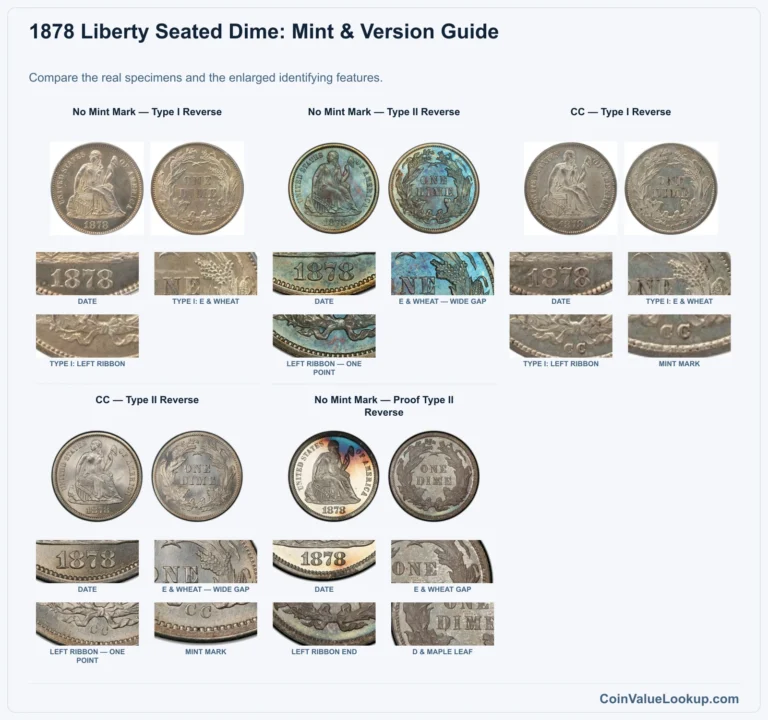
The 1888 Seated Dime shows the Legend Obverse design with UNITED STATES OF AMERICA around a seated Liberty, paired with an agricultural wreath reverse reading ONE DIME. All regular issues are 90% silver and 10% copper, weigh 2.50 grams and measure 17.9mm with a reeded edge.
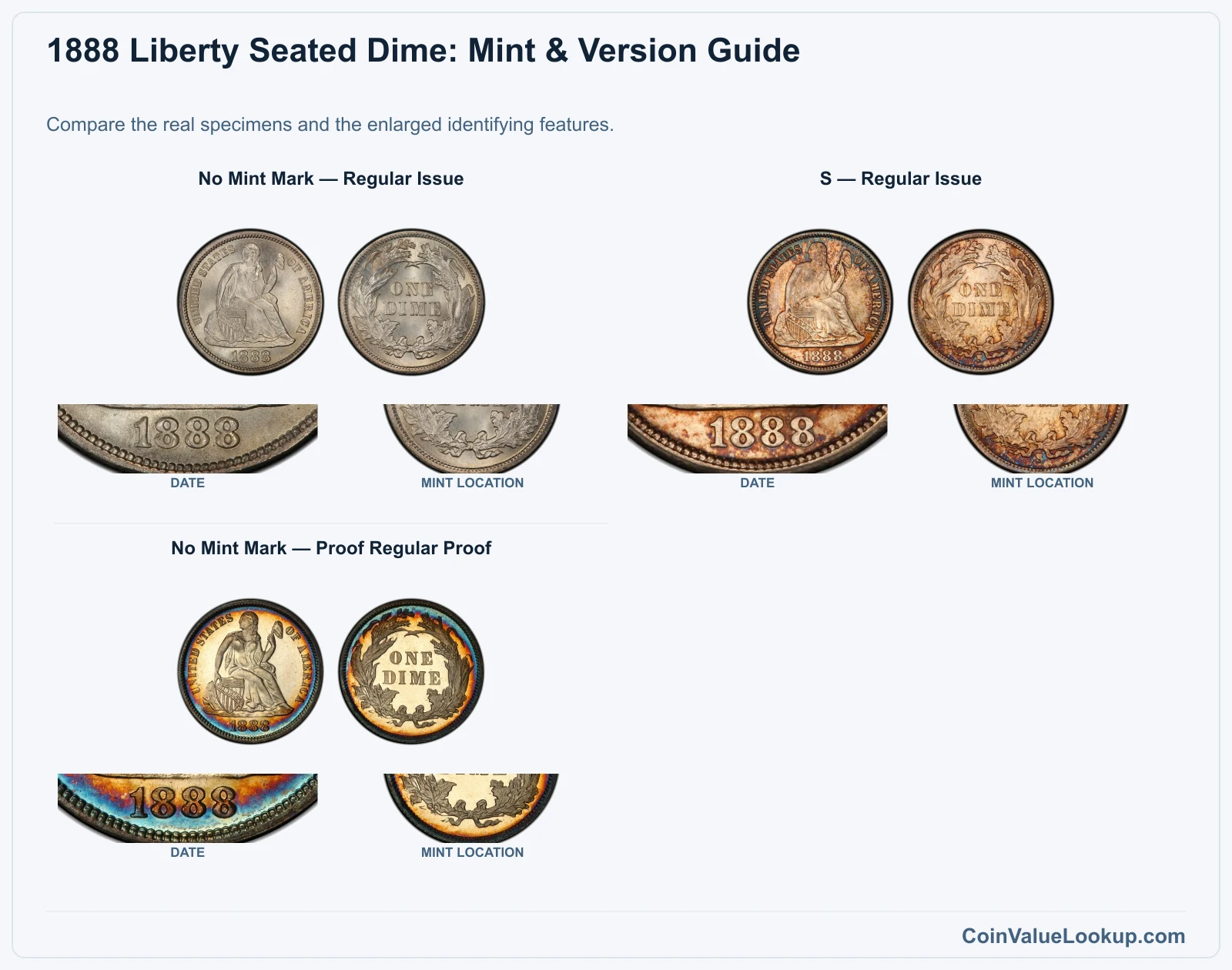
To determine the mint, flip the coin to the reverse and look inside the wreath, near the bottom. Philadelphia coins carry no mintmark at all.
San Francisco coins show a small "S" in that same spot.
There is no normal 1888-O issue, so if you see what looks like an "O" mintmark, examine it very carefully under magnification before drawing conclusions. Confirm you are looking at a dime and not a half dime by checking the size and the ONE DIME denomination on the reverse.
Original surfaces matter. A coin that has been cleaned, polished, or harshly wiped will not command the same value as one with natural toning and undisturbed luster, even at the same technical grade.
Step 2: Check Your 1888 Liberty Seated Dime Grade
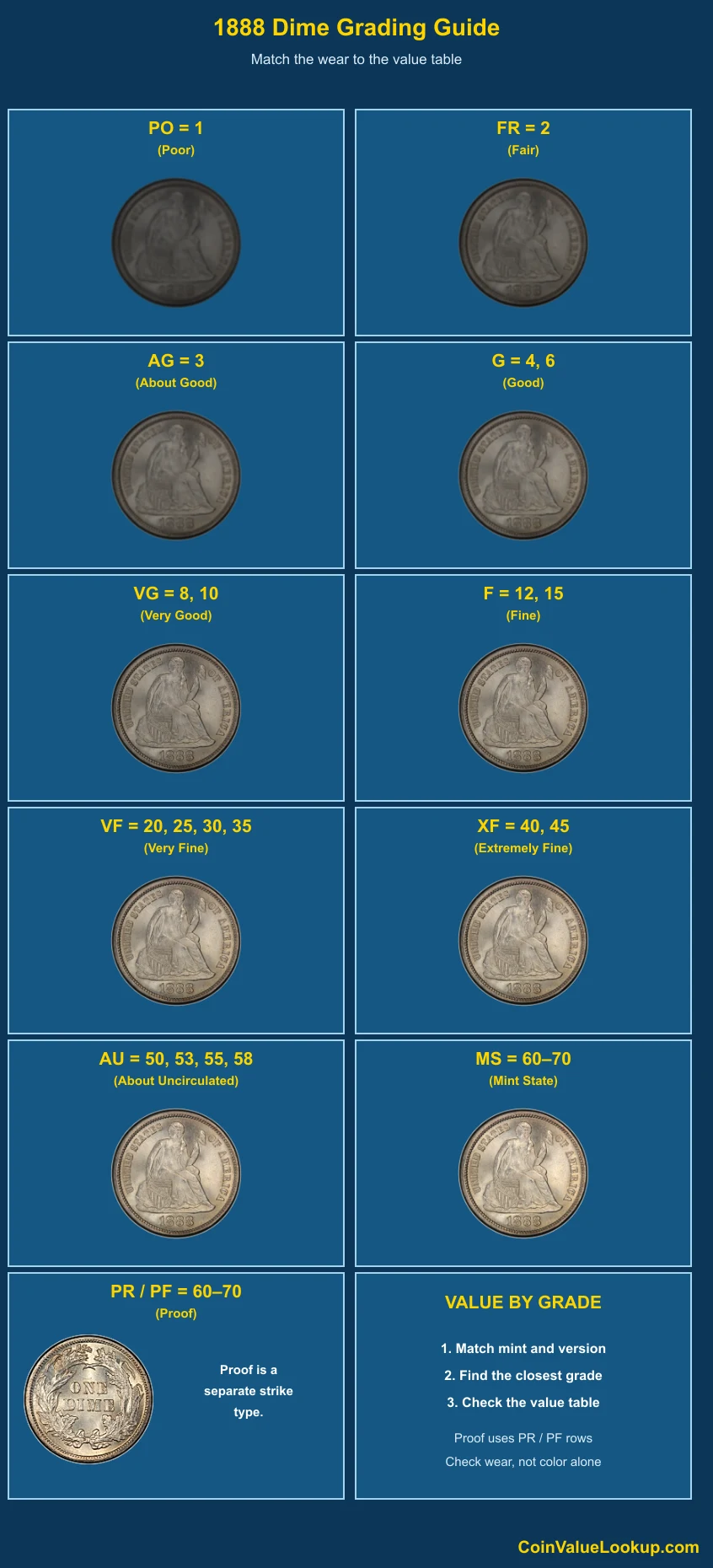
Start with Liberty's head on the obverse. In lower grades the hair detail above the ear vanishes first, followed by the breast and knee areas of the seated figure.
The shield lines and the highest wreath leaves on the reverse also flatten early.
Compare your coin to the reference image and look at both sides together. A coin can show weak detail from a tired die or a soft strike without ever circulating, so do not assume every mushy feature means wear.
Luster is your friend here. On a genuinely uncirculated piece the original mint sheen covers both faces evenly.
Any break in luster across high points signals friction from handling or brief circulation.
Proofs are a finish, not a grade above Mint State. A polished coin is not a Proof.
Genuine Proofs were deliberately struck on specially prepared planchets and exhibit mirror-like fields that ordinary business strikes lack. Keep that distinction clear when evaluating your piece.
Step 3: Check 1888 Liberty Seated Dime Value by Mint and Version
1888 Liberty Seated Dime — No Mint Mark — Regular Issue
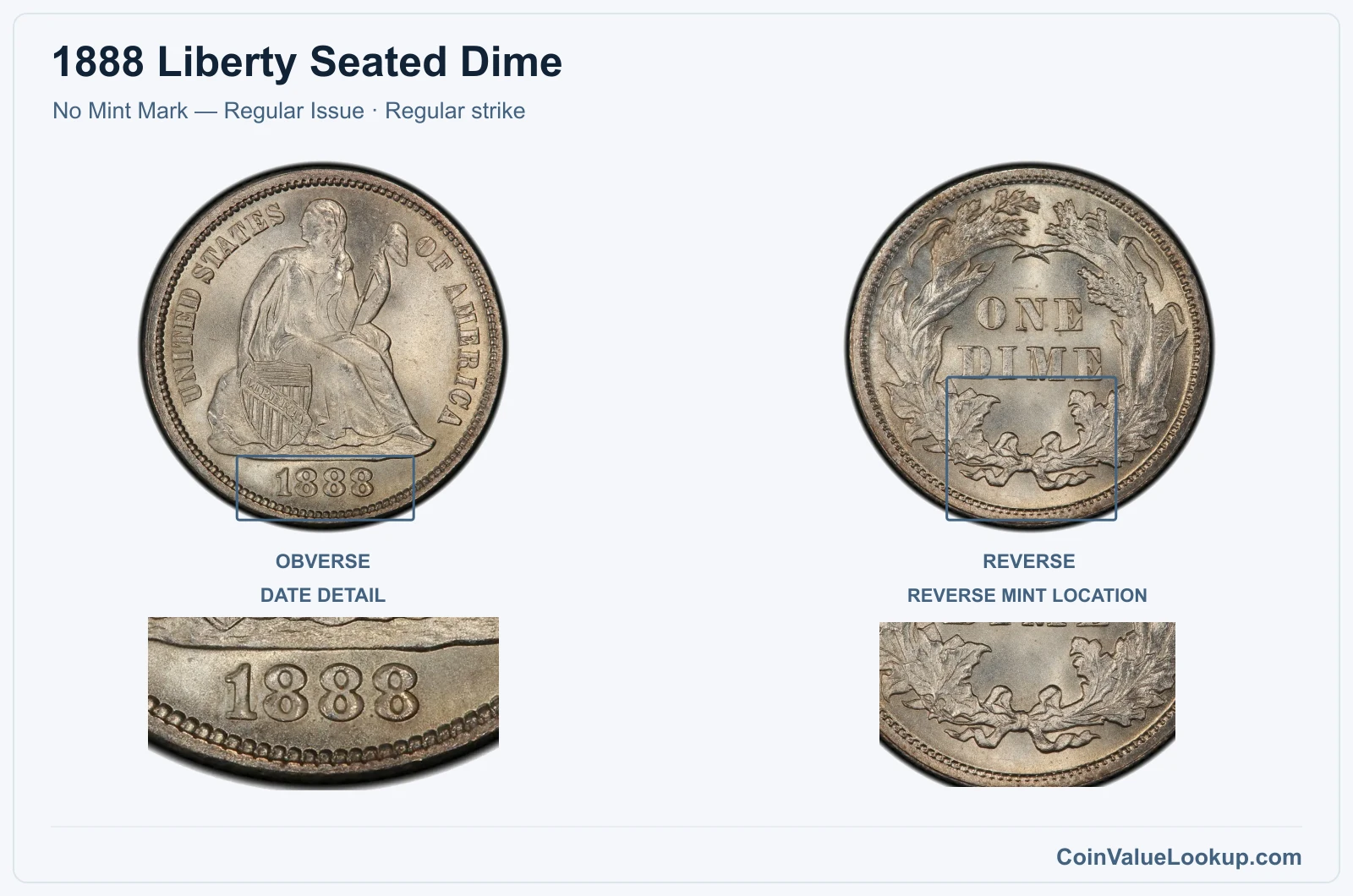
The Philadelphia regular issue has no mintmark anywhere on the coin. Look at the reverse below the wreath bow and you should see only open field.
USA Coin Book lists this version at about $22 in G4 and around $316 in MS63.
This is the more commonly encountered mint for the date. Even so, original problem-free survivors in higher Mint State grades are genuinely scarce.
Check for natural toning and undisturbed surfaces, which add appeal beyond the raw grade number.
Range Grade
Price Auction Records Appraisal PO PO 1
—
Coin Identifier FR FR 2
—
Coin Identifier AG AG 3
—
Coin Identifier G G 4
—
Coin Identifier
G 6
—
Coin Identifier VG VG 8
—
Coin Identifier
VG 10
—
Coin Identifier F F 12
—
Coin Identifier
F 15
—
Coin Identifier VF VF 20
—
Coin Identifier
VF 25
—
Coin Identifier
VF 30
—
Coin Identifier
VF 35
Coin Identifier XF XF 40
Coin Identifier
XF 45
—
Coin Identifier AU AU 50
Coin Identifier
AU 53
—
Coin Identifier
AU 55
Coin Identifier
AU 58
Coin Identifier MS MS 60
Coin Identifier
MS 61
Coin Identifier
MS 62
Coin Identifier
MS 63
Coin Identifier
MS 64
Coin Identifier
MS 65
Coin Identifier
MS 66
Coin Identifier
MS 67
Coin Identifier
MS 68
—
—
—
MS 69
—
—
—
MS 70
—
—
—
1888 Liberty Seated Dime — S — Regular Issue
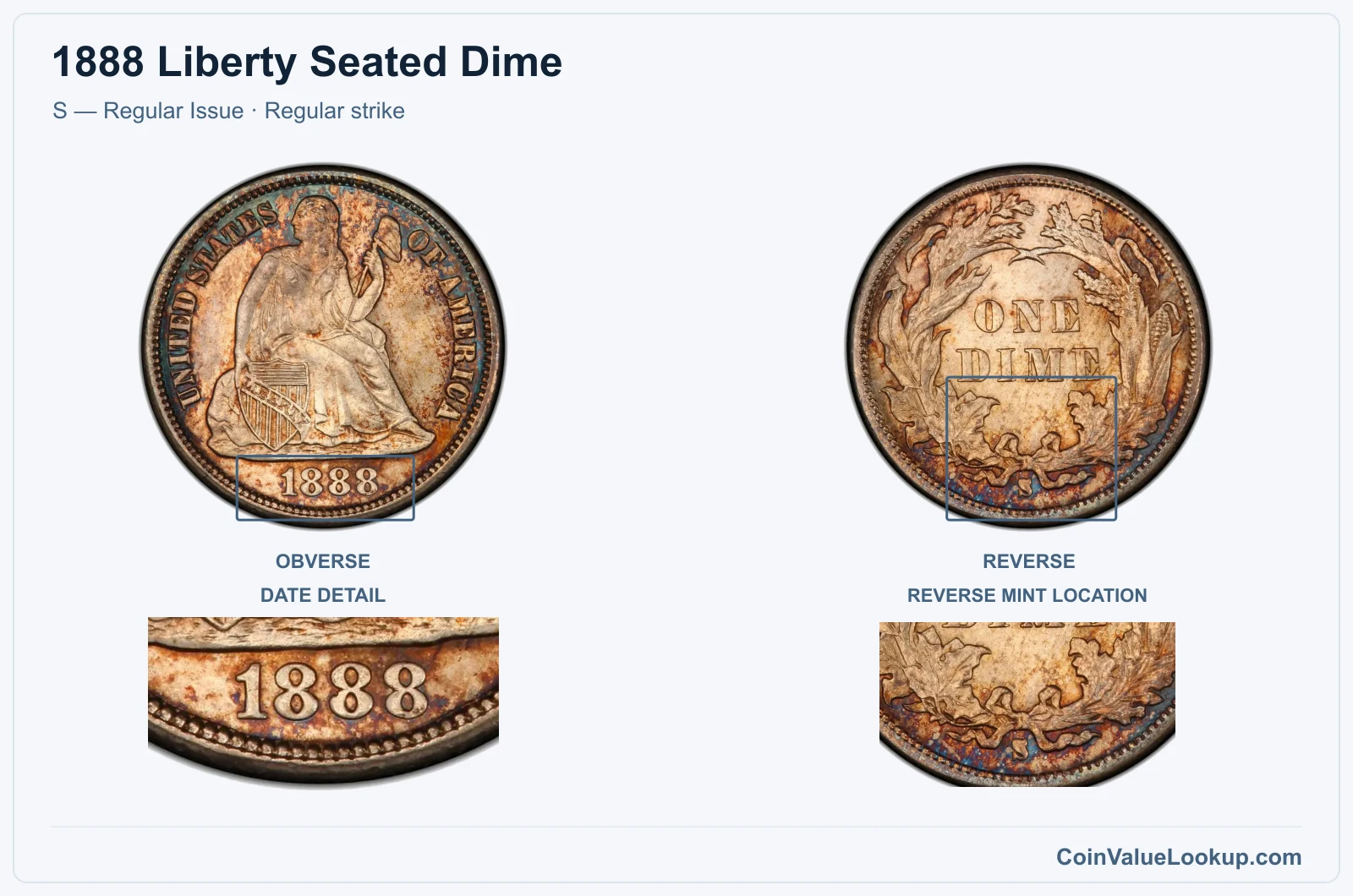
The San Francisco issue carries a small "S" mintmark on the reverse, positioned inside the lower portion of the wreath. USA Coin Book lists it at roughly $22 in G4 but jumps to about $1,067 at MS63, a much steeper climb than the Philadelphia version.
That spread tells you something: plenty of these circulated hard in the West, but survivors with full luster and sharp detail are tough. If yours shows the S mintmark and looks like it was barely handled, pay close attention to the high points of Liberty's knee and the shield lines.
A properly graded upper-end example could be a strong coin.
Coin Value Lookup is a useful starting point if you want to look up other dates and mints in the Liberty Seated Dime series or explore different denominations entirely.
Range Grade
Price Auction Records Appraisal PO PO 1
—
Coin Identifier FR FR 2
—
Coin Identifier AG AG 3
—
Coin Identifier G G 4
Coin Identifier
G 6
—
Coin Identifier VG VG 8
—
Coin Identifier
VG 10
—
Coin Identifier F F 12
—
Coin Identifier
F 15
—
Coin Identifier VF VF 20
—
Coin Identifier
VF 25
—
Coin Identifier
VF 30
—
Coin Identifier
VF 35
—
Coin Identifier XF XF 40
Coin Identifier
XF 45
Coin Identifier AU AU 50
Coin Identifier
AU 53
Coin Identifier
AU 55
Coin Identifier
AU 58
Coin Identifier MS MS 60
—
Coin Identifier
MS 61
Coin Identifier
MS 62
Coin Identifier
MS 63
Coin Identifier
MS 64
Coin Identifier
MS 65
Coin Identifier
MS 66
Coin Identifier
MS 67
Coin Identifier
MS 68
—
—
—
MS 69
—
—
—
MS 70
—
—
—
1888 Liberty Seated Dime — No Mint Mark — Proof Regular Proof
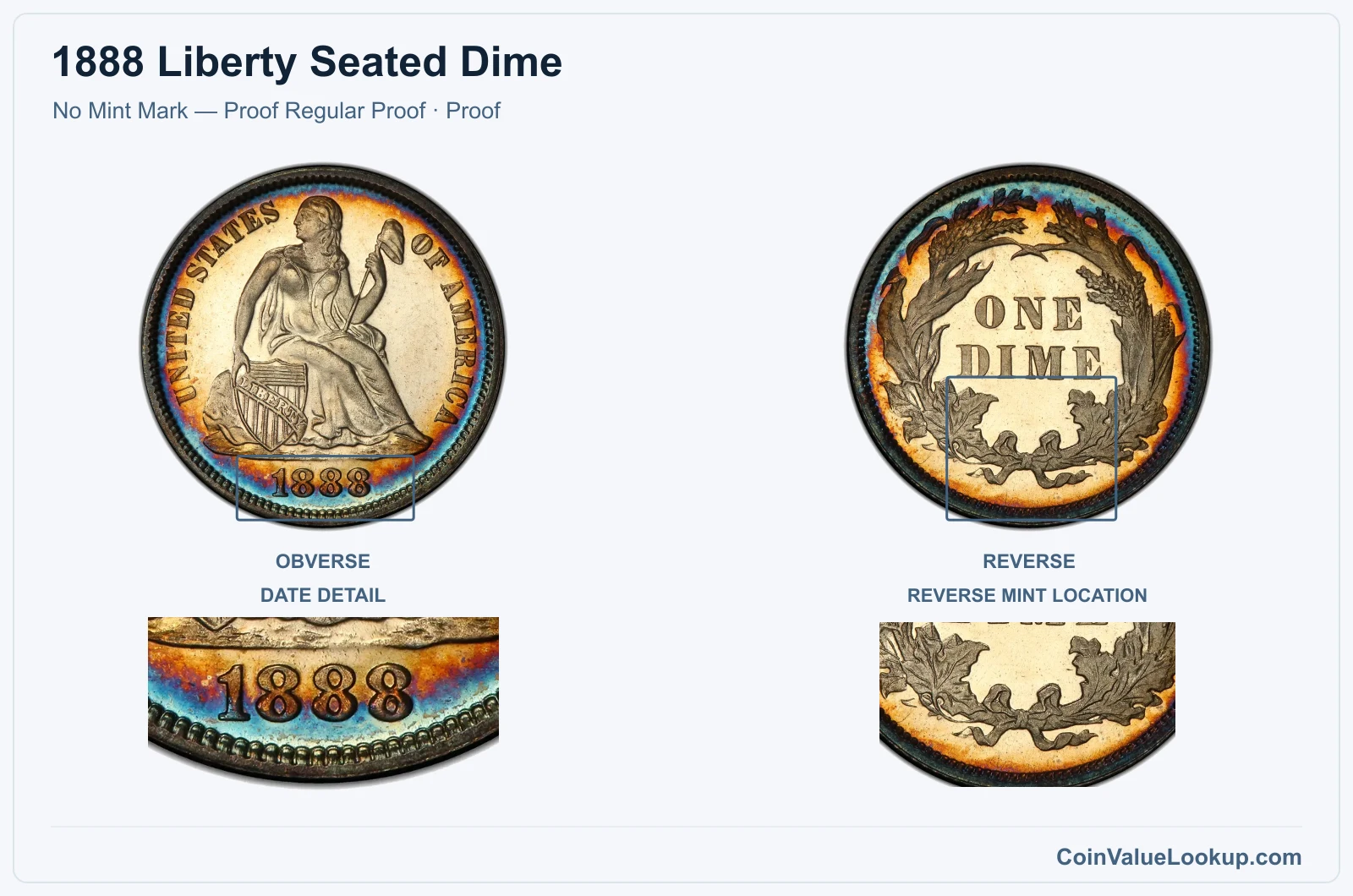
Philadelphia Proofs were struck with polished dies on carefully prepared planchets, producing deeply mirrored fields that reflect like glass. USA Coin Book lists this at about $725 in PR63.
Genuine Proofs show sharp, squared-off rims and fully detailed devices that stand in contrast to the flat mirror surface. Hairlines from old cleaning or mishandling are the most common issue that drags down a Proof's grade.
Brilliance alone does not make a Proof; many circulating coins have been polished by well-meaning owners, and those are not the same thing at all. If you suspect you have one, compare the fields carefully to a known example before celebrating.
Range Grade
Price Auction Records Appraisal PR PR 1
—
Coin Identifier
PR 2
—
Coin Identifier
PR 3
—
Coin Identifier
PR 4
—
Coin Identifier
PR 6
—
Coin Identifier
PR 8
—
Coin Identifier
PR 10
—
Coin Identifier
PR 12
—
Coin Identifier
PR 15
—
Coin Identifier
PR 20
—
Coin Identifier
PR 25
—
Coin Identifier
PR 30
—
Coin Identifier
PR 35
—
Coin Identifier
PR 40
—
Coin Identifier
PR 45
—
Coin Identifier
PR 50
—
Coin Identifier
PR 53
—
Coin Identifier
PR 55
—
Coin Identifier
PR 58
—
Coin Identifier
PR 60
—
Coin Identifier
PR 61
—
Coin Identifier
PR 62
Coin Identifier
PR 63
Coin Identifier
PR 64
Coin Identifier
PR 65
Coin Identifier
PR 66
Coin Identifier
PR 67
Coin Identifier
PR 68
—
—
—
PR 69
—
—
—
PR 70
—
—
—
1888 Liberty Seated Dime Error List
1. 1888 Liberty Seated Dime — Repunched Date
A repunched date on an 1888 Seated Dime shows remnants of an earlier date-punch impression next to the final numerals. You are looking for traces of misaligned digits, often appearing as partial outlines or thickened serifs on one or more of the 1-8-8-8 figures.
This is a die variety, not a strike error, meaning it was baked into the die before any coins were struck. Every coin from that die pair carries the same feature.
Do not confuse this with machine doubling, which produces flat shelf-like distortions rather than the rounded, separated contours of a genuine repunched date. Damage to the date area from contact or corrosion can also mimic a repunch at first glance.
The value depends on the visibility of the extra impression and the coin's overall condition.
2. 1888 Liberty Seated Dime — Misplaced Date
A misplaced date appears when a digit from the date punch was accidentally impressed into an unintended area of the die, such as Liberty's gown, the shield, or the base below the seated figure. On an 1888 dime, look for recognizable numeral fragments in those zones.
The key is matching the shape to one of the date digits. A genuine misplaced date shows raised contours that mirror the profile of a "1" or an "8," not random scratches or die polishing lines.
These are collectible die varieties, and their premium depends heavily on how visible the displaced digit is without magnification and on the coin's grade. Faint examples under a loupe are less desirable than bold ones you can spot at arm's length.
3. 1888 Liberty Seated Dime — Rotated Dies
A rotated die error means the obverse and reverse are not aligned in the standard 180-degree coin orientation. To check, hold your 1888 dime so Liberty faces upright, then flip the coin top to bottom.
The reverse wreath should appear upright as well. If it tilts to one side, you have a rotation.
Small rotations of a few degrees are relatively minor. Larger rotations, say 45 degrees or more, attract more collector interest.
Be careful not to confuse this with a photograph taken at an angle or your own hand position when flipping the coin. Lay it flat, rotate it mechanically, and verify.
The premium depends on the degree of rotation and the coin's condition.
4. 1888 Liberty Seated Dime — Repunched Mintmark
A repunched mintmark on an 1888 dime would apply to the San Francisco issue, since Philadelphia coins carry no mintmark. Look at the "S" on the reverse for traces of a second punch impression offset from the final position.
Genuine repunched mintmarks show rounded remnants of the extra letter, often visible as a partial serif or shadow beside the primary "S." Machine doubling, by contrast, produces flat shelf-like distortion. Die chips or corrosion near the mintmark can also create confusing lumps that look like a repunch under low magnification.
Compare your coin's mintmark against a normal example at the same magnification. The value depends on the visibility of the repunch and the coin's overall condition.
5. 1888 Liberty Seated Dime — Die Crack / Die Chip
Die cracks appear as thin raised lines on the coin's surface, tracing the path of a fracture in the steel die. On 1888 Philadelphia dimes, die cracks have been documented.
They can run across fields, through letters, or from the rim inward.
A die chip is a small raised blob rather than a line, caused by a tiny piece of the die surface breaking away. Both are signs of die deterioration and are legitimate collectible varieties.
Do not confuse these with incuse scratches, which are recessed into the surface rather than raised above it. Corrosion or foreign material sitting on a coin can also mimic a die chip.
The premium depends on the crack's size, location, and the coin's grade.
6. 1888 Liberty Seated Dime — Clashed Dies
Clashed dies result from the obverse and reverse dies striking each other without a planchet between them. The impact transfers faint design elements from one die onto the other.
On an 1888 Philadelphia dime, look for ghostly traces of the wreath on the obverse fields, or outlines of Liberty's figure appearing on the reverse.
These impressions should align with where the opposing design would naturally contact the die. Random raised lines, scratches, or a brockage impression from a struck coin stuck to the die are different phenomena entirely.
Clash marks are usually subtle and require good lighting at an angle. Their collectibility depends on how bold the transferred design elements are and on the coin's condition overall.
7. 1888 Liberty Seated Dime — Die Break / Cud
A cud is a specific type of die break where a piece of the die along the rim breaks away completely. The result is a raised, featureless blob of metal on the coin that connects to the rim, often obliterating part of the design or lettering beneath it.
On 1888 Philadelphia dimes, cuds have been documented. To confirm one, look for a smooth raised area at the rim edge with a clear boundary where the normal design resumes.
Do not confuse a cud with a rim dent, which is damage to the coin after striking, or with an interior die chip that does not touch the rim. Corrosion buildup near the edge can also look suspicious.
The premium depends on the cud's size, location, and the coin's overall condition.
8. 1888 Liberty Seated Dime — Doubled Die Obverse
A doubled die obverse on the 1888 dime involves hub doubling during die creation, producing separated design contours visible on the obverse. One documented variety for this date shows doubling along the right shield edge, paired with a medium date that slopes slightly downward.
Look for split or offset contours on the shield's right side. Genuine hub doubling shows rounded, separated outlines, whereas machine doubling, which happens during striking, creates flat shelf-like distortions with no real depth.
Reflections from toning or lighting can also trick you into seeing doubling that is not there. Use consistent low-angle light and compare directly against a normal 1888 dime.
The premium depends on the strength of the doubling and the coin's grade.
9. 1888 Liberty Seated Dime — Off-Center Strike
An off-center strike happens when the planchet is not properly seated between the dies, causing the design to shift to one side. The result is a crescent-shaped blank area on the coin where the die never made contact.
For an 1888 Seated Dime, the key is whether the date remains fully visible. Off-center errors that retain a readable date are significantly more collectible than those where the year is lost.
Do not confuse this with a clipped planchet, which shows a curved bite out of the blank before striking, or with post-mint flattening that squishes the design to one side. A genuine off-center strike shows a clean unstruck crescent.
Value depends on the percentage of misalignment and the coin's condition.
10. 1888 Liberty Seated Dime — Lamination / Split Planchet
Lamination errors occur when layers of the planchet separate, creating peeling metal, a retained flap, or a visible split within the coin's thickness. On an 1888 Seated Dime, which is struck in 90% silver, these are uncommon but documented.
Look for a flap of metal lifting away from the surface, or a visible seam along the coin's edge where the layers have begun to part. Photographing the edge alongside the affected face helps document the defect.
Scraping, corrosion, or a deliberately shaved coin can mimic a lamination at first glance. Genuine laminations follow the natural contour of the planchet rather than showing tool marks or irregular pitting.
The premium depends on the size and visibility of the separation and on the coin's overall condition.
11. 1888 Liberty Seated Dime — Broadstrike
A broadstrike occurs when a coin is struck without the retaining collar that normally forms the reeded edge and constrains the planchet's diameter. The result is a coin that spreads outward, appearing slightly wider than normal with a distorted or missing edge reeding.
On an 1888 Seated Dime, look for metal that has flowed beyond the normal 17.9mm diameter while still showing a mostly centered, complete design. The edge profile will look different from a standard piece.
Do not confuse a broadstrike with an off-center strike, which shifts the design to one side, or with a coin that has been flattened by machinery after leaving the mint. A genuine broadstrike retains a roughly centered design with outward metal spread.
Value depends on how dramatic the spread is and on the coin's condition.