1921 Mercury Dime Coin Value: How Much Is It Worth?
The 1921 Mercury dime is a genuine key date — both the Philadelphia and Denver issues are scarce and command real money even in low grades. USA Coin Book guide estimates place ordinary circulated-to-mint-state examples from about $64 in G4 up to around $4,251 in MS65, depending on the mint.
Full Bands strikes and identified error varieties each need their own separate evaluation.
Fast Way to Identify Your 1921 Mercury Dime
Want a quick read on your 1921 dime? Upload clear photos of the front and back, and our identifier can give you a preliminary take on which mint and version you have.
That first look covers basic identification from your images — it does not substitute for professional grading, authentication, or Full Bands assessment.
1921 Mercury Dime Value
Upload both sides of your 1921 Mercury Dime.
Front Obverse
Upload photo
Back Reverse
Upload photo
Which 1921 Mercury Dime Versions Are Worth Money?
- Both the Philadelphia (no mintmark) and Denver (D) 1921 Mercury dimes are recognized key dates, making even low-grade examples worth checking carefully.
- Original mint-state surfaces with fully separated fasces bands (Full Bands) can command significant premiums beyond standard guide prices for the same grade.
- Reported error categories for 1921 dimes include die cracks, off-center strikes, repunched mintmarks, and clashed dies — each affects value differently based on visibility and condition.
Step 1: Identify Your 1921 Mercury Dime Mint Mark and Version
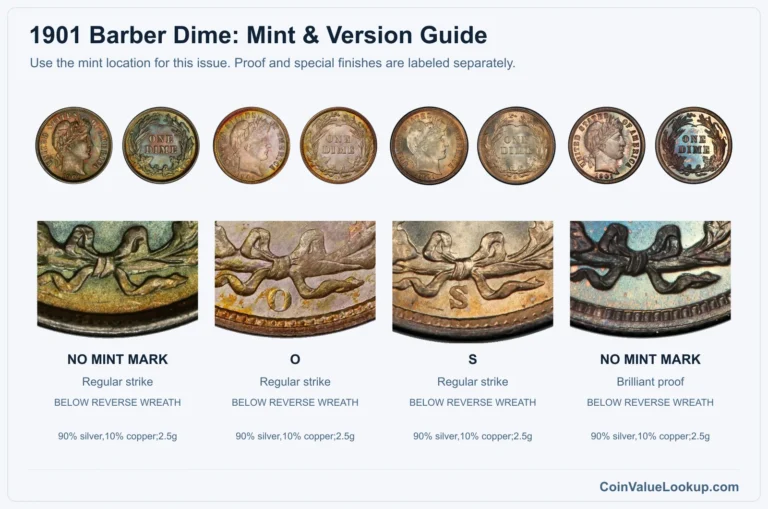
Only two mints produced Mercury dimes in 1921: Philadelphia and Denver. There was no 1921-S and no 1922 Mercury dime at all, so the field is narrow.
Philadelphia coins carry no mintmark. Denver coins show a small "D" on the lower-left reverse, just to the left of the word ONE between the fasces and olive branch.
Do not confuse the "AW" monogram on the obverse near the neck cutoff — that is designer Adolph Weinman's initials, not a mintmark or West Point identifier.
All 1921 Mercury dimes are struck in 90% silver and 10% copper, weigh about 2.5 grams, measure 17.9 mm across, and have a reeded edge. There is no clad or alternate-alloy version for this year.
If you are checking for Full Bands designation, that refers to clearly separated horizontal bands on the fasces on the reverse. It is a strike characteristic, not an error.
Different grading services may apply slightly different criteria for that designation.
Step 2: Check Your 1921 Mercury Dime Grade
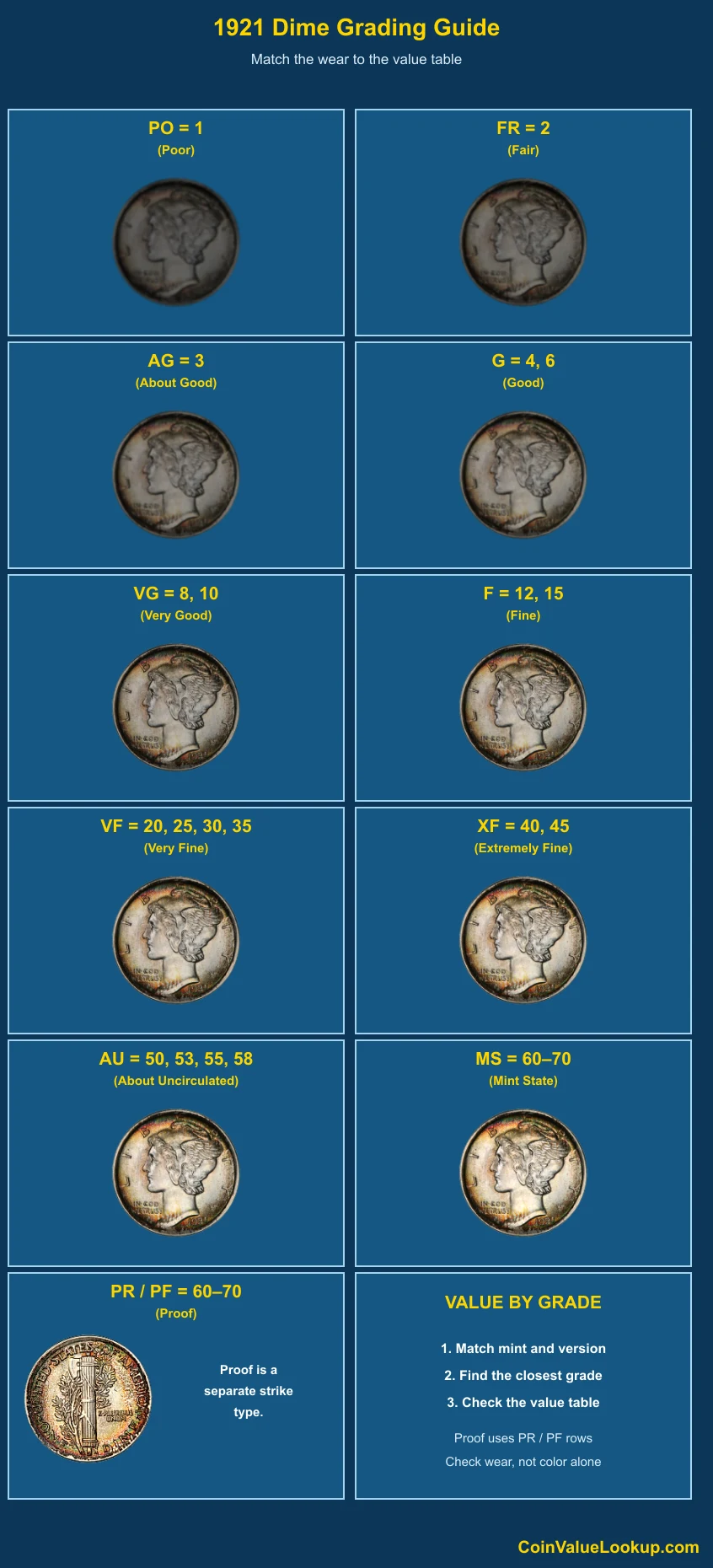
Start by examining the hair detail above and just in front of Liberty's ear on the obverse. In higher grades, individual strands are sharp and distinct; as the coin wears, that area flattens first into a smooth, featureless patch.
Next, check the wing feathers on Liberty's cap. These lose definition progressively, and heavy wear turns the wing into a rounded lump.
The reverse fasces bands are another key checkpoint, though weak bands on a 1921 dime are not automatically proof of heavy circulation — branch-mint strikes from this era were often soft to begin with.
Look at overall luster and surface quality. A coin with original mint luster but contact marks from bag storage grades differently from one that has been cleaned or polished.
Cleaning often leaves hairline scratches visible under a light.
Use the comparison image to match your coin against known grade examples of the same type. When checking for Full Bands, NGC evaluates central and outer band separation, but different services may set their own bar.
A coin can be high-grade MS without qualifying for FB, and vice versa — they measure different things.
Step 3: Check 1921 Mercury Dime Value by Mint and Version
1921 Mercury Dime — No Mint Mark — Silver Circulation
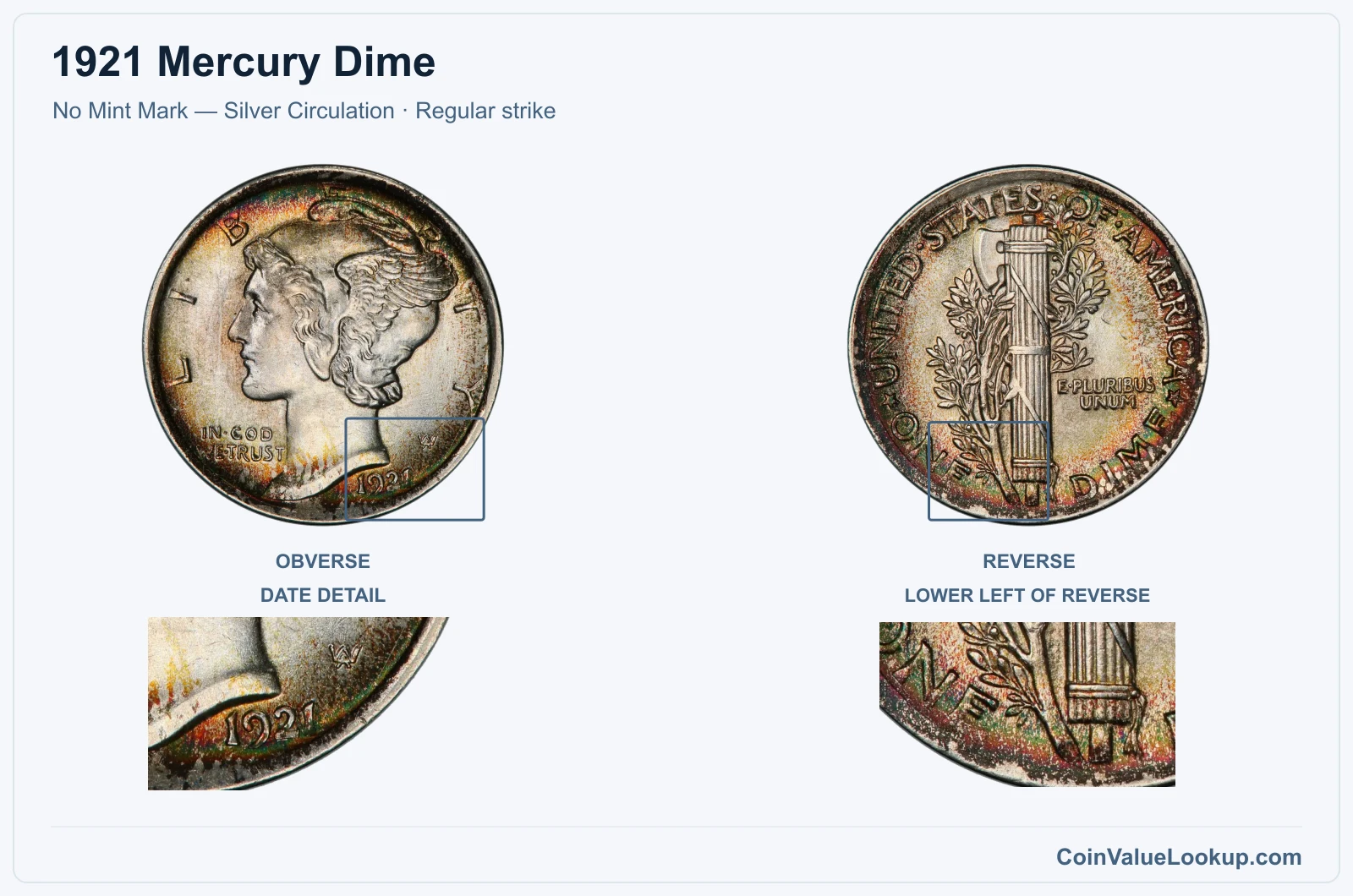
The 1921 Philadelphia Mercury dime has no mintmark — just a clean field on the lower-left reverse where a D or S would sit on other issues. It is struck in 90% silver and 10% copper at 2.5 grams.
This is a key date. USA Coin Book guide estimates place it around $64 in G4 and roughly $4,074 in MS65 for a regular strike without Full Bands designation.
Those are guide estimates, not guaranteed sale prices, and the live silver component can shift the floor.
Full Bands examples trade at their own level, but no FB-specific price is included here because the regular MS65 figure does not cover that designation. If your coin has sharply separated bands on the reverse fasces, it deserves a closer look from a grading service.
Weak peripheral legends or soft bands alone do not confirm circulation wear — Philadelphia strikes from 1921 can simply be soft.
Coin Value Lookup is a good starting point if you want to look up guides for other dates in the Mercury dime series or compare across denominations.
Range Grade
Price Auction Records Appraisal PO PO 1
—
Coin Identifier FR FR 2
—
Coin Identifier AG AG 3
Coin Identifier G G 4
Coin Identifier
G 6
Coin Identifier VG VG 8
Coin Identifier
VG 10
Coin Identifier F F 12
Coin Identifier
F 15
Coin Identifier VF VF 20
Coin Identifier
VF 25
Coin Identifier
VF 30
Coin Identifier
VF 35
Coin Identifier XF XF 40
Coin Identifier
XF 45
Coin Identifier AU AU 50
Coin Identifier
AU 53
Coin Identifier
AU 55
Coin Identifier
AU 58
Coin Identifier MS MS 60
Coin Identifier
MS 61
Coin Identifier
MS 62
Coin Identifier
MS 63
Coin Identifier
MS 64
—
Coin Identifier
MS 65
Coin Identifier
MS 66
—
—
—
MS 67
—
—
—
MS 68
—
—
—
MS 69
—
—
—
MS 70
—
—
—
1921 Mercury Dime — D — Silver Circulation
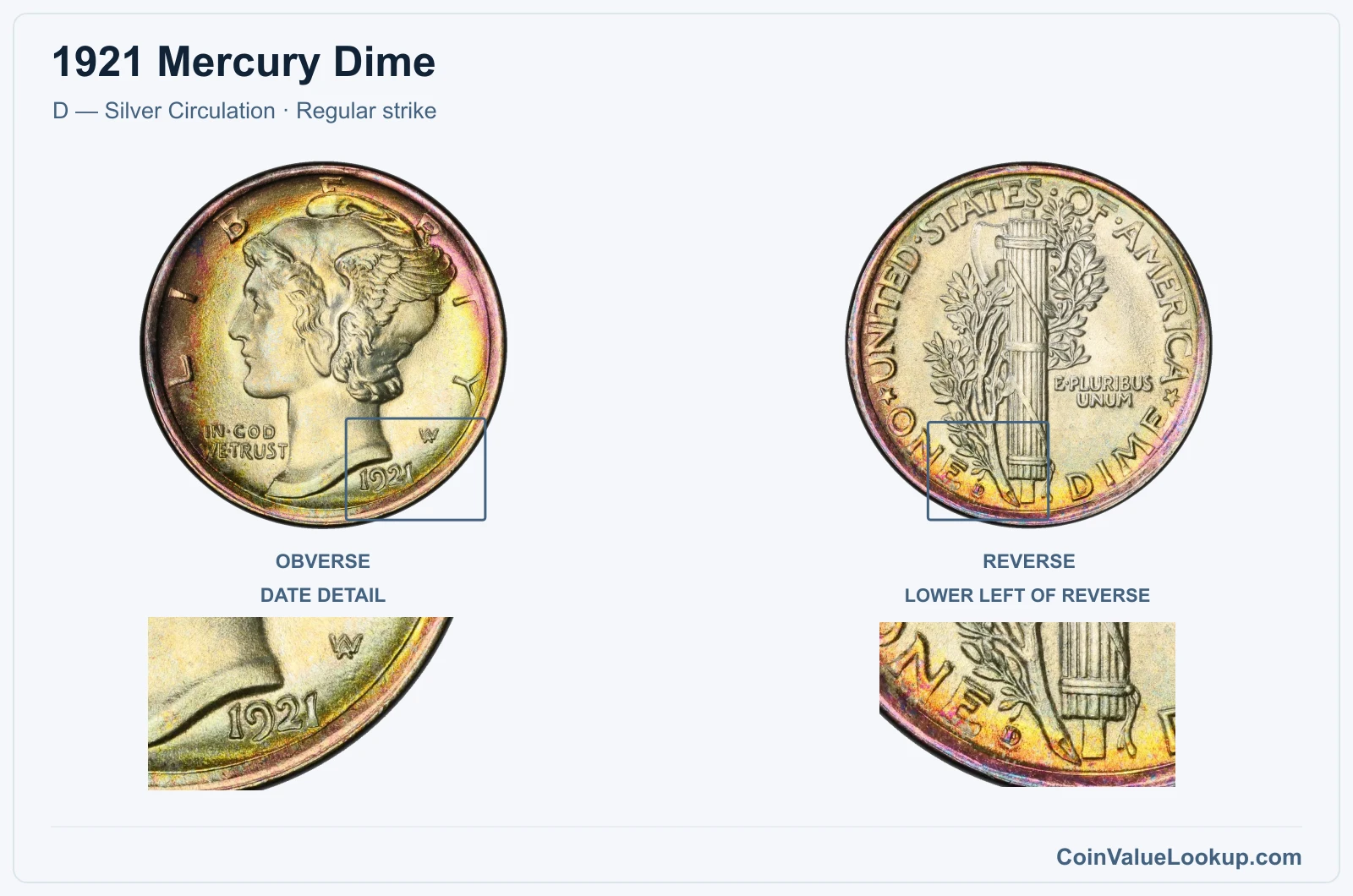
The 1921-D carries a small "D" mintmark on the lower-left reverse beside the word ONE. Same 90% silver composition, same 2.5-gram weight, same reeded edge.
This is the other key date in the pair. USA Coin Book estimates about $84 in G4 and around $4,251 in MS65 for a standard strike.
The Denver issue tends to bring slightly higher guide figures than Philadelphia across these grades, though actual sale prices depend on surfaces, eye appeal, and whether the coin has been cleaned.
As with the Philadelphia issue, Full Bands pricing is separate and not inferred from the regular MS65 estimate here. Denver strikes can be especially soft, so a coin that looks like it has worn bands may just be weakly struck.
Confirming FB status usually requires magnification and, ideally, professional evaluation.
Range Grade
Price Auction Records Appraisal PO PO 1
—
Coin Identifier FR FR 2
Coin Identifier AG AG 3
Coin Identifier G G 4
Coin Identifier
G 6
Coin Identifier VG VG 8
Coin Identifier
VG 10
Coin Identifier F F 12
Coin Identifier
F 15
Coin Identifier VF VF 20
Coin Identifier
VF 25
Coin Identifier
VF 30
Coin Identifier
VF 35
Coin Identifier XF XF 40
Coin Identifier
XF 45
Coin Identifier AU AU 50
Coin Identifier
AU 53
Coin Identifier
AU 55
Coin Identifier
AU 58
Coin Identifier MS MS 60
Coin Identifier
MS 61
Coin Identifier
MS 62
Coin Identifier
MS 63
Coin Identifier
MS 64
Coin Identifier
MS 65
Coin Identifier
MS 66
Coin Identifier
MS 67
Coin Identifier
MS 68
—
—
—
MS 69
—
—
—
MS 70
—
—
—
1921 Mercury Dime Error List
1. 1921 Mercury Dime — Die Crack / Die Chip
Die cracks show up as thin raised lines on the coin's surface, running in straight or gently curving paths. Die chips appear as small raised blobs — little lumps of metal that filled a chip in the die face.
Both result from a damaged die transferring its defect onto every coin it strikes.
On a 1921 dime, look across both obverse and reverse fields for these raised features. A crack that extends from an interior point to the rim is different from an interior chip, and a large rim-connected break is sometimes called a cud.
Each type carries different collector interest.
Do not confuse incuse scratches, surface corrosion, or foreign material stuck to the coin with a die crack. A genuine die crack is raised above the field, not sunk into it.
Value depends on the crack's size, location, and the coin's overall condition — no specific price range is adopted here because these factors vary widely.
2. 1921 Mercury Dime — Off-Center Strike
An off-center strike happens when the planchet is not properly seated between the dies at the moment of striking. The result is a design that is shifted to one side, leaving an unstruck crescent of blank metal on the opposite edge.
The percentage of off-center displacement matters a lot. A 5% shift is subtle; a 50% shift is dramatic.
For collector appeal on a 1921 dime, the date needs to remain fully visible — without it, the coin loses most of its key-date premium.
Do not mistake a clipped planchet, a one-sided die misalignment, or post-mint damage (like a coin that was flattened unevenly) for a true off-center error. The displaced design should be consistent across the entire face.
Condition and degree of displacement both affect value, but no specific price range is provided here.
3. 1921 Mercury Dime — Repunched Mintmark
A repunched mintmark occurs when the mintmark punch was applied more than once in slightly different positions, leaving traces of the earlier placement visible under magnification. On a 1921 dime, this would apply to the Denver issue since Philadelphia coins carry no mintmark.
Inspect the D on the lower-left reverse carefully. You are looking for a faint secondary outline, a notch, or a partial letter remnant near the primary D that does not match the normal letter shape.
Compare your coin's mintmark against a known normal example at the same magnification.
Machine doubling — a flat, shelf-like distortion — can mimic a repunched mintmark to the untrained eye. Die chips or corrosion around the mintmark area can also create confusing shapes.
The value of a confirmed RPM depends on its visibility and the coin's overall grade; no numerical price is adopted here.
4. 1921 Mercury Dime — Clashed Dies
Clashed dies occur when the obverse and reverse dies strike each other without a planchet between them. The impact transfers faint traces of one die's design onto the opposite die, and those ghost impressions then appear on subsequently struck coins.
On a 1921 Mercury dime, look for faint outlines of the fasces on the obverse or traces of Liberty's profile on the reverse, positioned where you would expect the opposite design to align. The transferred features should match the known die orientation.
Do not mistake random scratches, raised lines from die polishing, or a brockage (struck against another coin) for a die clash. Clash marks follow the geometry of the opposing die in a predictable way.
The value of a clashed-die 1921 dime depends on how visible the transferred design is and the coin's condition — no specific price range is provided here.